automatic transmission CHRYSLER VOYAGER 2023 Owner's Manual
[x] Cancel search | Manufacturer: CHRYSLER, Model Year: 2023, Model line: VOYAGER, Model: CHRYSLER VOYAGER 2023Pages: 256, PDF Size: 13.97 MB
Page 154 of 256
152SAFETY
(Continued)
Do not drive your vehicle after the air bags have deployed.
If you are involved in another collision, the air bags will not
be in place to protect you.
NOTE:
Air bag covers may not be obvious in the interior trim,
but they will open during air bag deployment.
After any collision, the vehicle should be taken to an
authorized dealer immediately.
Enhanced Accident Response System
In the event of an impact, if the communication network
remains intact, and the power remains intact, depending
on the nature of the event, the ORC will determine whether
to have the Enhanced Accident Response System perform
the following functions:
Cut off fuel to the engine (if equipped).
Cut off battery power to the electric motor (if equipped).
Flash hazard lights as long as the battery has power.
Turn on the interior lights, which remain on as long as
the battery has power or for 15 minutes from the inter -
vention of the Enhanced Accident Response System.
Unlock the power door locks. Your vehicle may also be designed to perform any of these
other functions in response to the Enhanced Accident
Response System:
Turn off the Fuel Filter Heater, Turn off the HVAC Blower
Motor, Close the HVAC Circulation Door
Cut off battery power to the:
Engine
Electric Motor (if equipped)
Electric power steering
Brake booster
Electric park brake
Automatic transmission gear selector
Horn
Front wiper
NOTE:After an accident, remember to cycle the ignition to the
STOP (OFF/LOCK) position and remove the key from the
ignition switch to avoid draining the battery. Carefully
check the vehicle for fuel leaks in the engine compartment
and on the ground near the engine compartment and fuel
tank before resetting the system and starting the engine.
If there are no fuel leaks or damage to the vehicle elec -
trical devices (e.g. headlights) after an accident, reset the
system by following the procedure described below. If you
have any doubt, contact an authorized dealer.
Enhanced Accident Response System
Reset Procedure
In order to reset the Enhanced Accident Response System
functions after an event, the ignition switch must be changed
from ignition START or ON/RUN to ignition OFF. Carefully check
the vehicle for fuel leaks in the engine compartment and on the
ground near the engine compartment and fuel tank before
resetting the system and starting the engine.
After an accident, if the vehicle will not start after
performing the reset procedure, the vehicle must be
towed to an authorized dealer to be inspected and to
have the Enhanced Accident Response System reset.
Maintaining Your Air Bag System
WARNING!
Deployed air bags and seat belt pretensioners cannot
protect you in another collision. Have the air bags, seat
belt pretensioners, and the seat belt retractor assemblies
replaced by an authorized dealer immediately. Also, have the
Occupant Restraint Controller System serviced as well.
WARNING!
Modifications to any part of the air bag system could
cause it to fail when you need it. You could be injured
if the air bag system is not there to protect you.
Do not modify the components or wiring, including
adding any kind of badges or stickers to the steering
wheel hub trim cover or the upper passenger side of
the instrument panel. Do not modify the front fascia/
bumper, vehicle body structure, or add aftermarket
side steps or running boards.
It is dangerous to try to repair any part of the air bag
system yourself. Be sure to tell anyone who works on
your vehicle that it has an air bag system.
23_RUV_OM_EN_US_t.book Page 152
Page 188 of 256
186IN CASE OF EMERGENCY
NOTE:The positive battery post may be covered with a protective
cap. Lift up on the cap to gain access to the positive
battery post. Do not jump off fuses. Only jump directly off
positive post which has a positive (+) symbol on or around
the post.
See the following steps to prepare for jump starting:
1. Apply the parking brake, shift the automatic transmission into PARK (P) and place the ignition
to OFF.
2. Turn off the heater, radio, and all electrical accessories.
3. Pull upward and remove the protective cap over the positive (+) battery post.
4. If using another vehicle to jump start the battery, park the vehicle within the jumper cables reach, set the
parking brake and make sure the ignition is OFF.
JUMP STARTING PROCEDURE
Connecting The Jumper Cables
1. Connect the positive
(+) end of the jumper cable
to the positive (+)
post of the vehicle with the
discharged battery.
2. Connect the opposite end of the positive (+) jumper
cable to the positive (+) post of the booster battery.
3. Connect the negative (-) end of the jumper cable to
the negative (-) post of the booster battery.
4. Connect the opposite end of the negative (-) jumper
cable to the remote negative (-) post (exposed
metallic/unpainted post of the discharge vehicle)
near the windshield cowl.
5. Start the engine in the vehicle that has the booster battery, let the engine idle a few minutes, and then
start the engine in the vehicle with the discharged
battery.
6. Once the engine is started, follow the disconnecting procedure. Disconnecting The Jumper Cables
1. Disconnect the negative
(-)
end of the jumper cable
from the remote negative post of the vehicle with the
discharged battery.
2. Disconnect the opposite end of the negative (-)
jumper cable from the negative (-) post of the booster
battery.
3. Disconnect the positive (+) end of the jumper cable
from the positive (+) post of the booster battery.
4. Disconnect the opposite end of the positive (+)
jumper cable from the positive (+) post of the vehicle
with the discharged battery and reinstall the
protective cap.
If frequent jump starting is required to start your vehicle
you should have the battery and charging system
inspected at an authorized dealer.
WARNING!
Do not allow vehicles to touch each other as this could
establish a ground connection and personal injury
could result.
WARNING!
Failure to follow this jump starting procedure could
result in personal injury or property damage due to
battery explosion.
CAUTION!
Failure to follow these procedures could result in
damage to the charging system of the booster vehicle
or the discharged vehicle.
WARNING!
Do not connect the jumper cable to the negative (-) post
of the discharged battery. The resulting electrical spark
could cause the battery to explode and could result in
personal injury.
CAUTION!
Accessories plugged into the vehicle power outlets draw
power from the vehicle’s battery, even when not in use
(i.e., cellular devices, etc.). Eventually, if plugged in long
enough without engine operation, the vehicle’s battery
will discharge sufficiently to degrade battery life and/or
prevent the engine from starting.
23_RUV_OM_EN_US_t.book Page 186
Page 206 of 256
204SERVICING AND MAINTENANCE
Under normal operating conditions, the catalytic converter
will not require maintenance. However, it is important to
keep the engine properly tuned to ensure proper catalyst
operation and prevent possible catalyst damage.
NOTE:Intentional tampering with emissions control systems can
result in civil penalties being assessed against you.
In unusual situations involving grossly malfunctioning
engine operation, a scorching odor may suggest severe
and abnormal catalyst overheating. If this occurs, stop the
vehicle, turn off the engine and allow it to cool. Service,
including a tune-up to the manufacturer specifications,
should be obtained immediately.
To minimize the possibility of catalytic converter damage:
Do not interrupt the ignition when the transmission is
in gear and the vehicle is in motion.
Do not try to start the vehicle by pushing or towing the
vehicle.
Do not idle the engine with any ignition components
disconnected or removed, such as when diagnostic
testing, or for prolonged periods during very rough idle
or malfunctioning operating conditions.
COOLING SYSTEM
Engine Coolant Checks
Check the engine coolant (antifreeze) protection every
12 months (before the onset of freezing weather, where
applicable). If the engine coolant is dirty, the system
should be drained, flushed, and refilled with fresh Organic
Additive Technology (OAT) coolant (conforming to
MS.90032) by an authorized dealer. Check the front of the
A/C condenser for any accumulation of bugs, leaves, etc.
If dirty, clean by gently spraying water from a garden hose
vertically down the face of the condenser. Check the engine cooling system hoses for brittle rubber,
cracking, tears, cuts, and tightness of the connection at
the coolant recovery bottle and radiator. Inspect the entire
system for leaks. DO NOT REMOVE THE COOLANT
PRESSURE CAP WHEN THE COOLING SYSTEM IS HOT.
Cooling System — Drain, Flush And Refill
NOTE:
Some vehicles require special tools to add coolant properly.
Failure to fill these systems properly could lead to severe
internal engine damage. If any coolant is needed to be added
to the system please contact an authorized dealer.
If the engine coolant (antifreeze) is dirty or contains visible
sediment, have an authorized dealer clean and flush with
Organic Additive Technology (OAT) coolant (conforming to
MS.90032).
For the proper maintenance intervals
Úpage 193.
Selection Of Coolant
For further information Úpage 238.
NOTE:
Mixing of engine coolant (antifreeze) other than speci-
fied Organic Additive Technology (OAT) engine coolant,
may result in engine damage and may decrease corro -
sion protection. OAT engine coolant is different and
should not be mixed with Hybrid Organic Additive Tech -
nology (HOAT) engine coolant or any “globally compat -
ible” coolant. If a non-OAT engine coolant is introduced
into the cooling system in an emergency, the cooling
system will need to be drained, flushed, and refilled
with fresh OAT coolant (conforming to MS.90032), by
an authorized dealer as soon as possible.
WARNING!
You or others can be badly burned by hot engine
coolant (antifreeze) or steam from your radiator.
If you see or hear steam coming from under the
hood, do not open the hood until the radiator has had
time to cool. Never open a cooling system pressure
cap when the radiator or coolant bottle is hot.
Keep hands, tools, clothing, and jewelry away from
the radiator cooling fan when the hood is raised.
The fan starts automatically and may start at any
time, whether the engine is running or not.
When working near the radiator cooling fan, discon -
nect the fan motor lead or turn the ignition to the OFF
mode. The fan is temperature controlled and can
start at any time the ignition is in the ON mode.
23_RUV_OM_EN_US_t.book Page 204
Page 209 of 256
SERVICING AND MAINTENANCE207
AUTOMATIC TRANSMISSION
Special Additives
The manufacturer strongly recommends against using any
special additives in the transmission. Automatic Transmission
Fluid (ATF) is an engineered product and its performance may
be impaired by supplemental additives. Therefore, do not
add any fluid additives to the transmission. Avoid using
transmission sealers as they may adversely affect seals.
Fluid Level Check
The fluid level is preset at the factory and does not require
adjustment under normal operating conditions. Routine fluid
level checks are not required; therefore the transmission has
no dipstick. An authorized dealer can check your transmission
fluid level using special service tools. If you notice fluid leakage
or transmission malfunction, visit an authorized dealer
immediately to have the transmission fluid level checked.
Operating the vehicle with an improper fluid level can cause
severe transmission damage.
Fluid And Filter Changes
Under normal operating conditions, the fluid installed at
the factory will provide satisfactory lubrication for the life
of the vehicle.
Routine fluid and filter changes are not required.
However, change the fluid and filter if the fluid becomes
contaminated (with water, etc.), or if the transmission is
disassembled for any reason.
Selection Of Lubricant
It is important to use the proper transmission fluid to
ensure optimum transmission performance and life.
Use only the manufacturer specified transmission fluid
Úpage 239. It is important to maintain the transmission
fluid at the correct level using the recommended fluid.
NOTE:No chemical flushes should be used in any transmission;
only the approved lubricant should be used.
Overfilling the brake fluid reservoir can result in
spilling brake fluid on hot engine parts, causing the
brake fluid to catch fire. Brake fluid can also damage
painted and vinyl surfaces, care should be taken to
avoid its contact with these surfaces.
Do not allow petroleum-based fluid to contaminate
the brake fluid. Brake seal components could be
damaged, causing partial or complete brake failure.
This could result in a collision.
CAUTION!
Do not use chemical flushes in your transmission as the
chemicals can damage your transmission components.
Such damage is not covered by the New Vehicle Limited
Warranty.
WARNING!
CAUTION!
If a transmission fluid leak occurs, visit an authorized
dealer immediately. Severe transmission damage may
occur. An authorized dealer has the proper tools to
adjust the fluid level accurately.
CAUTION!
Using a transmission fluid other than manufacturer
recommended fluid may cause deterioration in
transmission shift quality and/or torque converter
shudder
Úpage 239.
8
23_RUV_OM_EN_US_t.book Page 207
Page 241 of 256
TECHNICAL SPECIFICATIONS239
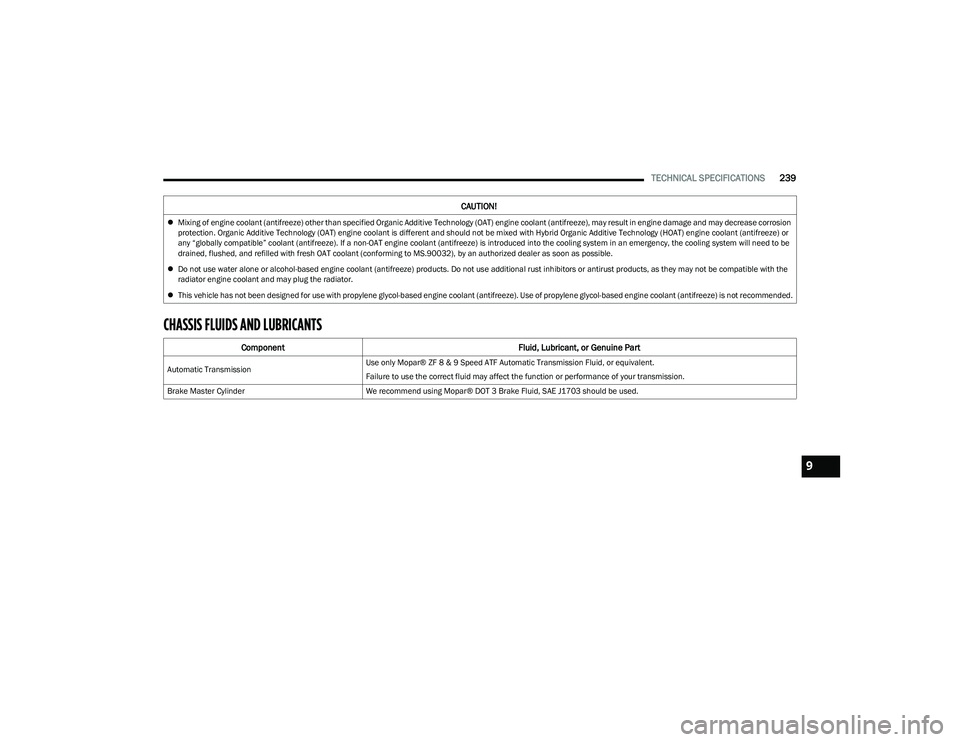
CHASSIS FLUIDS AND LUBRICANTS
CAUTION!
Mixing of engine coolant (antifreeze) other than specified Organic Additive Technology (OAT) engine coolant (antifreeze), may result in engine damage and may decrease corrosion
protection. Organic Additive Technology (OAT) engine coolant is different and should not be mixed with Hybrid Organic Additive Technology (HOAT) engine coolant (antifreeze) or
any “globally compatible” coolant (antifreeze). If a non-OAT engine coolant (antifreeze) is introduced into the cooling system in an emergency, the cooling system will need to be
drained, flushed, and refilled with fresh OAT coolant (conforming to MS.90032), by an authorized dealer as soon as possible.
Do not use water alone or alcohol-based engine coolant (antifreeze) products. Do not use additional rust inhibitors or antirust products, as they may not be compatible with the
radiator engine coolant and may plug the radiator.
This vehicle has not been designed for use with propylene glycol-based engine coolant (antifreeze). Use of propylene glycol-based engine coolant (antifreeze) is not recommended.
Component Fluid, Lubricant, or Genuine Part
Automatic TransmissionUse only Mopar® ZF 8 & 9 Speed ATF Automatic Transmission Fluid, or equivalent.
Failure to use the correct fluid may affect the function or performance of your transmission.
Brake Master Cylinder We recommend using Mopar® DOT 3 Brake Fluid, SAE J1703 should be used.
9
23_RUV_OM_EN_US_t.book Page 239
Page 247 of 256
245
INDEX
AAbout Your Brakes ....................................................... 235
Adding Engine Coolant (Antifreeze) ............................ 205
Additives, Fuel .............................................................. 237
AdjustDown...........................................................................33
Forward ...................................................................... 33
Rearward ....................................................................33
Up................................................................................ 33
Air Bag........................................................................... 144 Air Bag Operation.................................................... 145
Air Bag Warning Light .................................... 143
, 145
Driver Knee Air Bag ................................................ 149
Enhanced Accident Response ...................... 152
, 191
Event Data Recorder (EDR).................................... 191 Front Air Bag ........................................................... 145
If Deployment Occurs ............................................. 151
Knee Impact Bolsters ............................................. 149
Maintaining Your Air Bag System .......................... 152
Maintenance ........................................................... 152
Redundant Air Bag Warning Light ......................... 144
Side Air Bags ........................................................... 149
Transporting Pets.................................................... 167
Air Bag Light ................................................. 67
, 143, 167
Air Cleaner, Engine (Engine Air Cleaner Filter) ........... 198
Air Conditioner Maintenance ...................................... 199
Air Conditioner Refrigerant .......................................... 199
Air Conditioner System ................................................ 199
Air Conditioning Filter ........................................... 49
, 199
Air Conditioning, Operating Tips ..................................... 48 Air Filter......................................................................... 198 Air Pressure
Tires.......................................................................... 224
Alarm Arm The System......................................................... 16
Disarm The System ................................................... 16
Security Alarm............................................................ 70
Alterations/Modifications Vehicle.......................................................................... 7
Antifreeze (Engine Coolant) ............................... 204
, 238
Disposal ...................................................................205
Anti-Lock Brake System (ABS) ..................................... 121
Anti-Lock Warning Light.................................................. 70
Assist, Hill Start ............................................................. 124
Audio Jack ....................................................................... 52
Audio Systems (Radio) ................................................. 104
Auto Up Power Windows ................................................ 55
Automatic Dimming Mirror ............................................. 38 Automatic Headlights ..................................................... 40Automatic Transaxle ....................................................... 81
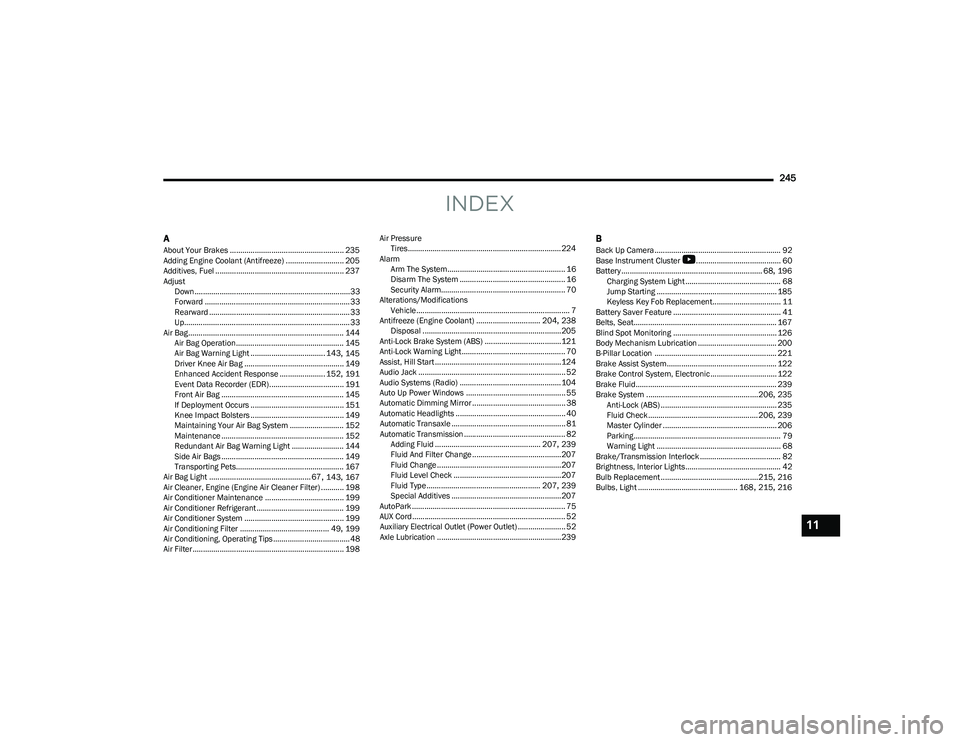
Automatic Transmission ................................................. 82 Adding Fluid ................................................... 207
, 239
Fluid And Filter Change ...........................................207
Fluid Change ............................................................207 Fluid Level Check ....................................................207Fluid Type ....................................................... 207
, 239
Special Additives ..................................................... 207
AutoPark .......................................................................... 75 AUX Cord.......................................................................... 52Auxiliary Electrical Outlet (Power Outlet) ....................... 52
Axle Lubrication ............................................................239
BBack Up Camera............................................................. 92
Base Instrument Cluster
b
......................................... 60
Battery.................................................................... 68, 196
Charging System Light .............................................. 68
Jump Starting .......................................................... 185
Keyless Key Fob Replacement................................. 11
Battery Saver Feature .................................................... 41
Belts, Seat..................................................................... 167
Blind Spot Monitoring .................................................. 126
Body Mechanism Lubrication ...................................... 200
B-Pillar Location ........................................................... 221
Brake Assist System..................................................... 122
Brake Control System, Electronic................................ 122
Brake Fluid.................................................................... 239
Brake System ......................................................206
, 235
Anti-Lock (ABS) ........................................................ 235 Fluid Check ..................................................... 206
, 239
Master Cylinder ....................................................... 206 Parking....................................................................... 79
Warning Light ............................................................ 68
Brake/Transmission Interlock ....................................... 82
Brightness, Interior Lights.............................................. 42
Bulb Replacement ...............................................215
, 216
Bulbs, Light ................................................ 168, 215, 216
11
23_RUV_OM_EN_US_t.book Page 245
Page 252 of 256
250
Remote StartingExit Remote Start Mode ............................................14
Uconnect Customer Programmable Features .........15
Uconnect Settings...................................................... 15
Remote Starting System.................................................14
Replacement Bulbs...................................................... 215
Replacement Tires ....................................................... 226
Reporting Safety Defects............................................. 243
Restraints, Child ........................................................... 153
Restraints, Head ............................................................. 35
Rotation, Tires .............................................................. 230
SSafety Checks Inside Vehicle ...................................... 167
Safety Checks Outside Vehicle ................................... 168
Safety Defects, Reporting............................................ 243
Safety Information, Tire ............................................... 217
Safety Tips .................................................................... 167
Safety, Exhaust Gas ..................................................... 169
Schedule, Maintenance............................................... 192
Screen Setup ...................................................................65
Seat Belt Reminder.........................................................69 Seat Belts ............................................................ 135
, 167
Adjustable Shoulder Belt........................................ 138
Adjustable Upper Shoulder Anchorage ................. 138
Adjustable Upper Shoulder Belt Anchorage.......... 138
Automatic Locking Retractor (ALR)........................ 141
Child Restraints ...................................................... 153
Energy Management Feature ................................ 141
Extender .................................................................. 140
Front Seat....................................................... 135
, 137 Inspection ................................................................ 167
Lap/Shoulder Belt Operation ................................. 137
Lap/Shoulder Belt Untwisting ................................ 137
Lap/Shoulder Belts ................................................. 135
Operating Instructions............................................. 137Pregnant Women..................................................... 140Pretensioners .......................................................... 141
Rear Seat ................................................................. 135
Reminder ................................................................. 135
Seat Belt Extender...................................................140
Seat Belt Pretensioner ............................................141
Untwisting Procedure .............................................. 137
Seat Belts Maintenance ............................................... 233
Seats.................................................................. 23
, 33, 34
Adjustment................................................... 23, 24, 33
Heated........................................................................ 34
Power ......................................................................... 33
Rear Folding............................................................... 23
Reclining .................................................................... 24
Seatback Release .............................................. 23
, 24
Stow ‘n Go (Fold in Floor).......................................... 30
Tilting ................................................................... 23
, 24
Security Alarm ................................................................. 70 Arm The System......................................................... 16
Disarm The System ................................................... 16
Selection Of Coolant (Antifreeze)................................. 238
Sentry Key (Immobilizer) ................................................ 12
Service Assistance........................................................ 240
Service Contract ...........................................................242
Service Manuals ...........................................................243
Shifting Automatic Transmission ........................................... 82
Shoulder Belts .............................................................. 135 Side View Mirror Adjustment ......................................... 38
Signals, Turn .......................................... 39
, 72, 168, 216
Snow Chains (Tire Chains) ........................................... 230
Snow Tires .................................................................... 227
Spare Tire Changing ..................................................... 173
Spare Tire Stowage ...................................................... 180
Spare Tires ................................................. 174
, 228, 229
Specifications Oil ............................................................................. 238
Speed Control Cancel ........................................................................ 87
Resume...................................................................... 87
Starting..................................................................... 14
, 75
Button ........................................................................ 12
Cold Weather............................................................. 77
Engine Fails To Start ................................................. 77
Remote ...................................................................... 14
Starting And Operating................................................... 75
Starting Procedures ....................................................... 75 Steering ........................................................................... 84 Tilt Column................................................................. 22
Wheel, Heated ........................................................... 22
Wheel, Tilt .................................................................. 22
Storage ............................................................................ 49 Stow ‘n Go (Fold In Floor) Seats .................................... 30
Stuck, Freeing............................................................... 189
Sunglasses Storage ....................................................... 49Supplemental Restraint System – Air Bag ................. 144
Sway Control, Trailer .................................................... 125
Symbol Glossary ................................................................7
Synthetic Engine Oil ..................................................... 197
System, Remote Starting ............................................... 14
23_RUV_OM_EN_US_t.book Page 250
Page 253 of 256
251
T
Telescoping Steering Column ........................................22
Tilt Steering Column ....................................................... 22
Time Delay Headlight ....................................................................39
Tire And Loading Information Placard ........................ 221
Tire Markings................................................................ 217
Tire Safety Information ................................................ 217
Tire Service Kit ............................................................. 180
Tire Service Kit — If Equipped
b
.............................. 180
Tire Stowage ................................................................. 180
Tires .................................................. 168
, 224, 228, 231
Aging (Life Of Tires)................................................. 226 Air Pressure ............................................................. 224
Chains...................................................................... 230Changing ................................................................. 173
Compact Spare ....................................................... 228
General Information ...................................... 224
, 228
High Speed .............................................................. 225
Inflation Pressure ................................................... 224
Jacking............................................................ 173
, 175
Life Of Tires ............................................................. 226
Load Capacity................................................. 221
, 222
Pressure Monitoring System (TPMS) ....... 64, 71, 131
Quality Grading ....................................................... 231
Radial ...................................................................... 225 Replacement ........................................................... 226
Rotation ................................................................... 230
Safety.............................................................. 217
, 224
Sizes ........................................................................ 218
Snow Tires ............................................................... 227 Spare Tires ............................................174
, 228, 229 Spinning ...................................................................225
Trailer Towing .......................................................... 100
Tread Wear Indicators ............................................. 226Wheel Nut Torque....................................................235
To Open Hood ................................................................. 56
Tongue Weight/Trailer Weight ....................................... 99 Towing ............................................................................. 94 Disabled Vehicle ...................................................... 190
Guide .......................................................................... 97
Recreational ............................................................101Weight ........................................................................ 97
Towing Behind A Motorhome ....................................... 101
Traction ............................................................... 102
, 103
Traction Control ............................................................125
Trailer Sway Control (TSC) ............................................125
Trailer Towing .................................................................. 94 Hitches ....................................................................... 96
Minimum Requirements ........................................... 99
Tips ...........................................................................101 Trailer And Tongue Weight........................................ 99
Wiring ....................................................................... 100
Trailer Towing Guide ....................................................... 97
Trailer Weight .................................................................. 97
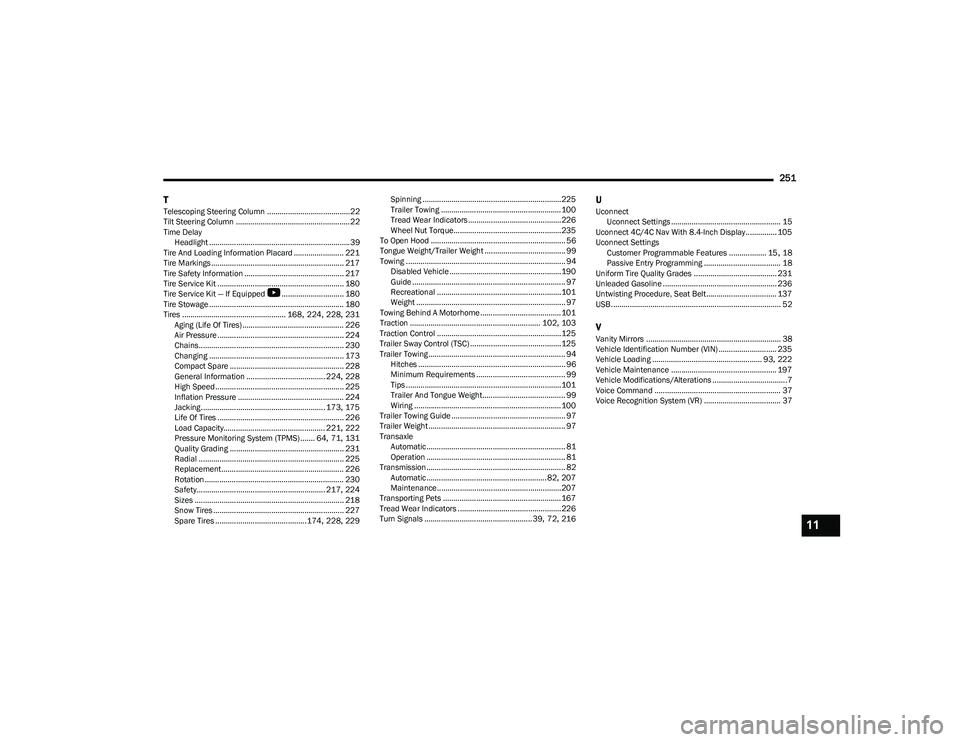
Transaxle Automatic ................................................................... 81
Operation ................................................................... 81
Transmission................................................................... 82 Automatic ..........................................................82
, 207
Maintenance............................................................207
Transporting Pets ......................................................... 167
Tread Wear Indicators ..................................................226
Turn Signals .................................................... 39
, 72, 216
UUconnect Uconnect Settings ..................................................... 15
Uconnect 4C/4C Nav With 8.4-Inch Display............... 105
Uconnect Settings Customer Programmable Features .................. 15
, 18
Passive Entry Programming ..................................... 18
Uniform Tire Quality Grades ........................................ 231
Unleaded Gasoline ....................................................... 236
Untwisting Procedure, Seat Belt.................................. 137
USB.................................................................................. 52
VVanity Mirrors ................................................................. 38
Vehicle Identification Number (VIN) ............................ 235
Vehicle Loading ..................................................... 93
, 222
Vehicle Maintenance ................................................... 197
Vehicle Modifications/Alterations ....................................7
Voice Command ............................................................. 37
Voice Recognition System (VR) ..................................... 37
11
23_RUV_OM_EN_US_t.book Page 251