brake CITROEN 2CV 1975 Owners Manual
[x] Cancel search | Manufacturer: CITROEN, Model Year: 1975, Model line: 2CV, Model: CITROEN 2CV 1975Pages: 86, PDF Size: 2.21 MB
Page 5 of 86
: Keep a little below the speed li\
mits indicated
by the red marks on the speedometer.
At 600 mi (1,000 km): by any Citroën Dealer.
Before sett")
IMPORTANT POINTS
During the first 1,200 mi (2,000 km): Keep a little below the speed li\
mits indicated
by the red marks on the speedometer.
At 600 mi (1,000 km): by any Citroën Dealer.
Before setting out on a long journey, check: The engine oil level; the l\
evel of the
brake fluid and top up if necessary.
Every 3,000 mi (5,000 km): Engine sump - drain and refill
Every 12,000 mi (20,000 km): Gearbox - change the oil
On "2 CV6", pay attention to the red warning lamp, (engine oil pressure\
). If it lights
up while driving, stop immediately.
Always keep in your vehicle: complete set of spare bulbs; set of fuses (\
10 & 15
amps).
Check inflation pressures regularly.
Changing a wheel: Tools and spare
wheel in boot (trunk).
From the very beginning make
yourself acquainted with the
handling operations specified in the
Tyre (tire) changing section.Model
Michelin FrontRearSpare
2 CV4 125-15X 1.4 bar
20 psi 1.8 bar
26 psi 2 bar
29 psi
2 CV6 125-15X 1.4 bar
20 psi 1.8 bar
26 psi 2 bar
29 psi
In order to ensure a longer life for your vehicle, and, for your safety,\
"Citroën" advises you to adhere to these most important points, systematically.
Page 8 of 86
Seats, rear-view mirrors, seat beltsStarting:
Anti-theft, ignition, starter
Gears, clutch, brakes
Signals and visibility:
Lights, signals, windscreen wipers/
washer
Air conditioning:
Ventilation, heating, de-misting Comfort:
Folding canvas hood
Accessories
07516
JULY 1975
AZ-KB AZ-KA 2 CV4 2 CV6
[Contents] [Notices] [Important Points] [Driving] [Maintenance] [Minor Repairs] [Miscellaneous Information]
Page 12 of 86
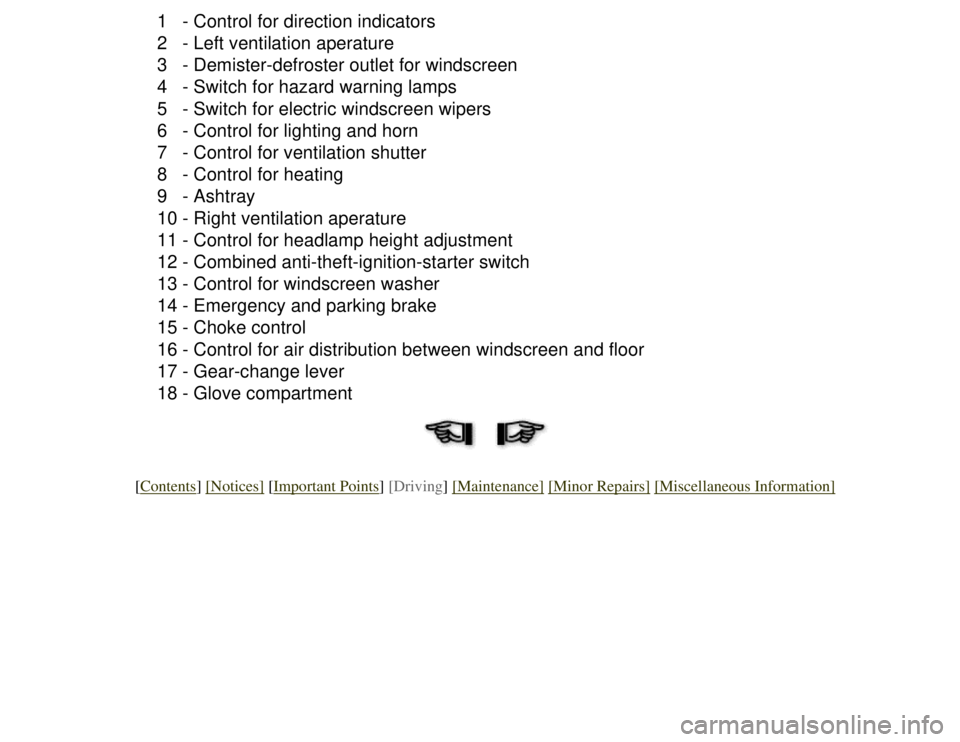
1 - Control for direction indicators
2 - Left ventilation aperature
3 - Demister-defroster outlet for windscreen
4 - Switch for hazard warning lamps
5 - Switch for electric windscreen wipers
6 - Control for lighting and horn
7 - Control for ventilation shutter
8 - Control for heating
9 - Ashtray
10 - Right ventilation aperature
11 - Control for headlamp height adjustment
12 - Combined anti-theft-ignition-starter switch
13 - Control for windscreen washer
14 - Emergency and parking brake
15 - Choke control
16 - Control for air distribution between windscreen and floor
17 - Gear-change lever
18 - Glove compartment
[Contents] [Notices] [Important Points] [Driving] [Maintenance] [Minor Repairs] [Miscellaneous Information]
Page 14 of 86
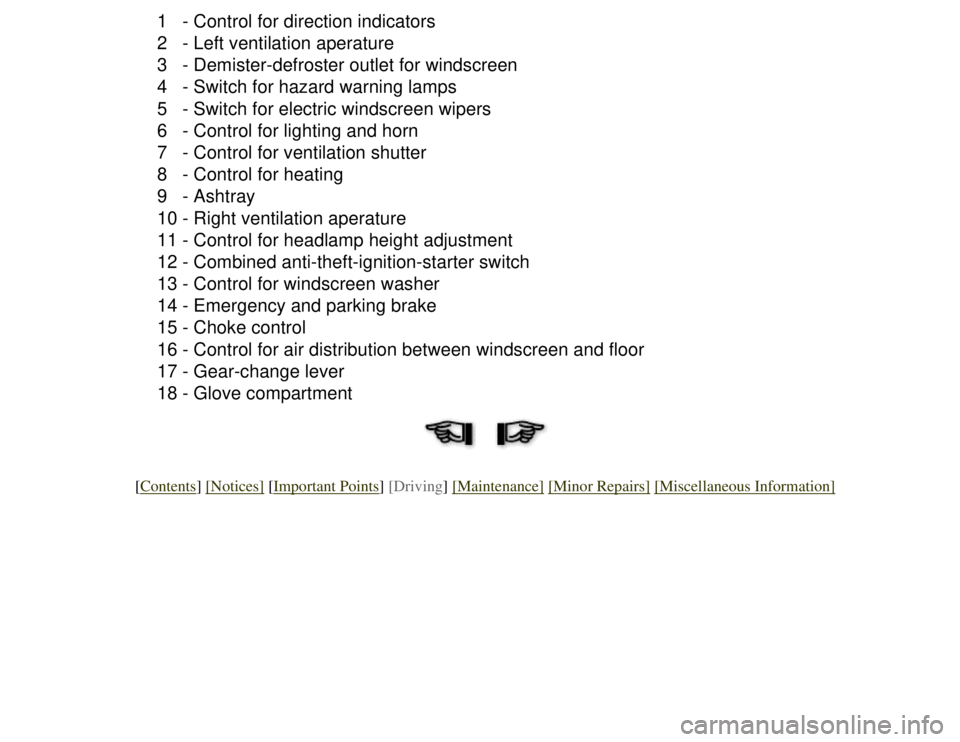
1 - Control for direction indicators
2 - Left ventilation aperature
3 - Demister-defroster outlet for windscreen
4 - Switch for hazard warning lamps
5 - Switch for electric windscreen wipers
6 - Control for lighting and horn
7 - Control for ventilation shutter
8 - Control for heating
9 - Ashtray
10 - Right ventilation aperature
11 - Control for headlamp height adjustment
12 - Combined anti-theft-ignition-starter switch
13 - Control for windscreen washer
14 - Emergency and parking brake
15 - Choke control
16 - Control for air distribution between windscreen and floor
17 - Gear-change lever
18 - Glove compartment
[Contents] [Notices] [Important Points] [Driving] [Maintenance] [Minor Repairs] [Miscellaneous Information]
Page 18 of 86
MAINTENANCE
This section deals with the small
points which are essential to
ensure the good condition of your
car: checking levels, keeping and
eye on the tyres, washing the
bodywork ...
Other maintenance operations,
such as greasing, oil changes,
adjustments - which the Citroën
network will competently carry out
for you, through is special Service
Stations - form the subject of the
"Maintenance Guide", which was
supplied with the vehicle when
originally delivered.
MAINTENANCE2 CV4 - 2 CV6
Levels:
Oil, Brake Fluid - Checks and Topping
Up
Mechanical and Electrical
Bodywork
Page 20 of 86

MAINTENANCE
Levels
Checks and Topping up
1 Engine oil dipstick
The engine oil level, which must lie between the ends of the cut-out
on the dipstick, must be checked from time to time between oil
changes and, in particular, before any long journey.
The check should be carried out with the car as level as possible,
after the engine has been stopped for at least 10 minutes.
To top up, add oil without the level going above the top end of the
dipstick cut-out. The length of the cut-out is equivalent to 7/8 imp.
pints (0,5 litre).
2 Engine oil filler pipe
In Summer, as in Winter, use "TOTAL Altigrade GT Spéciale
Autoroute 20 W 40" or "GTS 20 W 50" oil. If "TOTAL" oils are
not available, use equivalent grades of other reputable makes.
In very cold countries (temperatures often lower than -10C (14F),
use "TOTAL Altigrade GT Spéciale Autoroute 10 W 30" or "GTS
10 W 30" oil, or equivalent grades of other reputable makes.
Never use additives
Do not forget to tightly seal the oil filler cap.
3 Brake fluid reservoir
Fig. 32
Engine Oil Dipstick 1 - Maximum2 - Minimum
3 - Oil level reading
Page 21 of 86
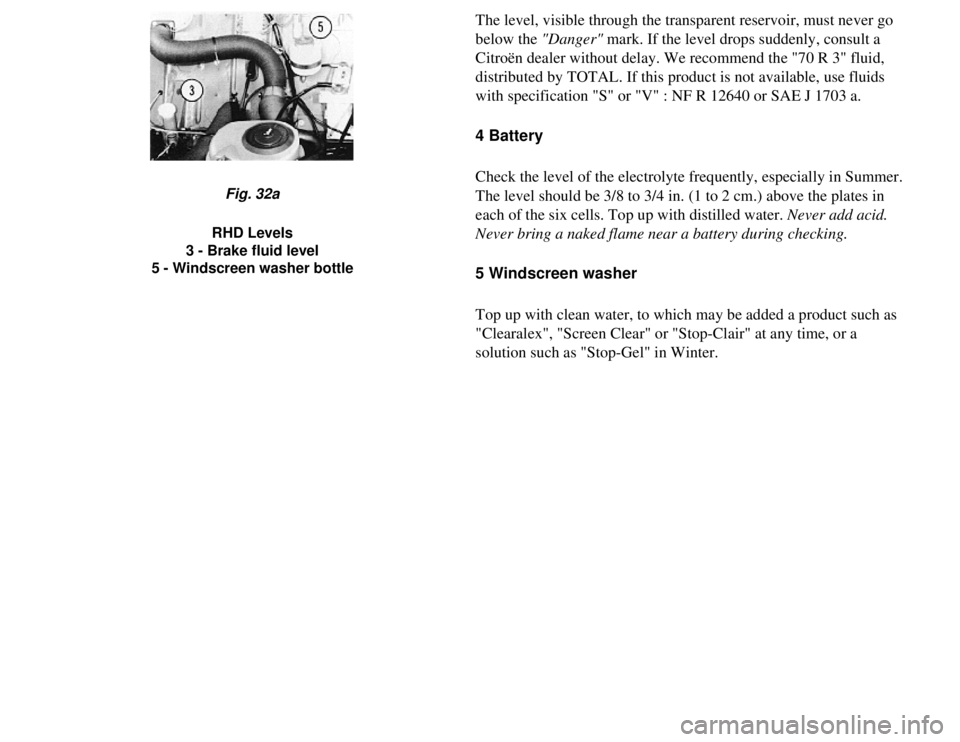
The level, visible through the transparent reservoir, must never go
below the "Danger" mark. If the level drops suddenly, consult a
Citroën dealer without delay. We recommend the "70 R 3" fluid,
distributed by TOTAL. If this product is not available, use fluids
with specification "S" or "V" : NF R 12640 or SAE J 1703 a.
4 Battery
Check the level of the electrolyte frequently, especially in Summer.
The level should be 3/8 to 3/4 in. (1 to 2 cm.) above the plates in
each of the six cells. Top up with distilled water. Never add acid.
Never bring a naked flame near a battery during checking.
5 Windscreen washer
Top up with clean water, to which may be added a product such as
"Clearalex", "Screen Clear" or "Stop-Clair" at any time, or a
solution such as "Stop-Gel" in Winter.
Fig. 32a
RHD Levels
3 - Brake fluid level
5 - Windscreen washer bottle
Page 22 of 86
![CITROEN 2CV 1975 Owners Manual
Fig. 32b
Levels
1 - Engine oil dipstick
2 - Engine oil filler tube
3 - Brake fluid reservoir
4 - Battery
5 - Windscreen washer bottle
[Contents] [Notices] [Important Points] [Driving] [Maintenance] [](/img/9/56684/w960_56684-21.png "CITROEN 2CV 1975 Owners Manual
Fig. 32b
Levels
1 - Engine oil dipstick
2 - Engine oil filler tube
3 - Brake fluid reservoir
4 - Battery
5 - Windscreen washer bottle
[Contents] [Notices] [Important Points] [Driving] [Maintenance] [")
Fig. 32b
Levels
1 - Engine oil dipstick
2 - Engine oil filler tube
3 - Brake fluid reservoir
4 - Battery
5 - Windscreen washer bottle
[Contents] [Notices] [Important Points] [Driving] [Maintenance] [Minor Repairs] [Miscellaneous Information]
Page 27 of 86
When setting off, apply the brakes a few times to dry out any water
on the brake linings.
Cleaning the Windows
The windows may be cleaned with alcohol or with special
commercial products. Silicone based products are not recommended.
Pivot the windscreen wiper blades to the front and clean them with
a little soapy water without putting pressure on the rubber edges.
Metal Decorative Components
Wash in suds or water to which a little detergent such as Teepol has
been added (2.5 to 3.0 cu. in. per gallon or 10 ro 15 ccm per litre), \
preceded and followed by a thorough rinsing with clean water.
The embellishers in particular should be washed very often since, in
time, mud might damage the surface so that repolishing may
become necessary.
AFter drying with a chamois leather, it is recommended that a
product like "ABEL PROTEGE CHROME", or other proprietary
chrome-polishes, be applied as a protection for the polished metal
finish.
Spots of Tar on the Bodywork
These should be removed as soon as possible.
Do not scrape off and do not use petrol or a spot remover for cloth,
but a special tar remover, such as "ABEL", or other proprietary tar
removers.
Polishing the Paintwork
Polishing is not recommended for metallic paintwork, because of
the risk of rings appearing.
On the other hand, for non-metallic paintwork, it is recommended
to carry out polishing at the end of Winter. For this, the body must
be perfectly clean and dry.
Page 33 of 86

MINOR REPAIRS
Replacing a Wheel
TOOL KIT
The spare wheel and jack, the starting handle, and the wooden block
are positioned in the boot (trunk).
REMOVAL (Fig. 37 and 38)
Engage fully the handbrake
Position the wooden block under the wheel directly diagonally
opposite the one which is to be changed. If the road is on a slope,
wedge the wheel on the downward side.
Unlock but do not slacken the three wheel nuts with the wheel brace.
Place the base of the jack well under the car and turned slightly
towards the wheel to be changed, so as to avoid contact with the
bodywork in the final stage of jacking.
Engage lifting arm (1) fully into socket (2) (these sockets are
situated under the front and rear doors).
Turn the operating screw (3) clockwiase by hand until the jack is in
firm contact.
Fig. 37 Fig. 38
37 - Replacing a front wheel 1 - Lifting arm2 - Support3 - Screw
38 - Replacing a rear wheel