oil CITROEN 2CV 1975 Owners Manual
[x] Cancel search | Manufacturer: CITROEN, Model Year: 1975, Model line: 2CV, Model: CITROEN 2CV 1975Pages: 86, PDF Size: 2.21 MB
Page 5 of 86
: Keep a little below the speed li\
mits indicated
by the red marks on the speedometer.
At 600 mi (1,000 km): by any Citroën Dealer.
Before sett")
IMPORTANT POINTS
During the first 1,200 mi (2,000 km): Keep a little below the speed li\
mits indicated
by the red marks on the speedometer.
At 600 mi (1,000 km): by any Citroën Dealer.
Before setting out on a long journey, check: The engine oil level; the l\
evel of the
brake fluid and top up if necessary.
Every 3,000 mi (5,000 km): Engine sump - drain and refill
Every 12,000 mi (20,000 km): Gearbox - change the oil
On "2 CV6", pay attention to the red warning lamp, (engine oil pressure\
). If it lights
up while driving, stop immediately.
Always keep in your vehicle: complete set of spare bulbs; set of fuses (\
10 & 15
amps).
Check inflation pressures regularly.
Changing a wheel: Tools and spare
wheel in boot (trunk).
From the very beginning make
yourself acquainted with the
handling operations specified in the
Tyre (tire) changing section.Model
Michelin FrontRearSpare
2 CV4 125-15X 1.4 bar
20 psi 1.8 bar
26 psi 2 bar
29 psi
2 CV6 125-15X 1.4 bar
20 psi 1.8 bar
26 psi 2 bar
29 psi
In order to ensure a longer life for your vehicle, and, for your safety,\
"Citroën" advises you to adhere to these most important points, systematically.
Page 10 of 86
 an\
d hazard warning device (6),
the illumination of the following dashboard instruments is controlled by\
the exterior lighting")
With the exception of the warning lamps for engine oil pressure (2) an\
d hazard warning device (6),
the illumination of the following dashboard instruments is controlled by\
the exterior lighting switch.
These instruments do not function when the ignition is off, with the exc\
eption of the hazard warning
device (6).
1 - Speedometer: The red marks indicate maximum speed permitted in each gear.
2 - Engine oil pressure warning lamp (2 CV6 only): This lights up when the ignition is switched on
and goes out as soon as the engine is running. If it lights up when driv\
ing, stop the engine
immediately and top up the level of oil if necessary. If the lamp remain\
s alight despite the oil level
being correct, stop again and contact a Citroën dealer.
3 - Fuel gauge: Tank capacity: 4 1/2 Imp. Gal. (20 litres)
4 - Total mileage indicator
5 - Charge indicator: At normal engine running speed, the needle should remain in the white se\
ctor.
If the needle should remain in either of the red sectors, consult a Citr\
oën dealer. It is possible that,
when driving with the headlamps on, the needle may stay in the white cro\
ss-hatched zone - indication
that the battery is insufficiently charged. In normal circumstances, whe\
n driving, the generator should
charge the battery and within two hours the needle should return to the \
white zone. If this does not
occur, consult a Citroën dealer.
6 - Hazard warning lamp: Flashes throughout the operation. If it does not function, check the
direction indicators.
[Contents] [Notices] [Important Points] [Driving] [Maintenance] [Minor Repairs] [Miscellaneous Information]
Page 18 of 86
MAINTENANCE
This section deals with the small
points which are essential to
ensure the good condition of your
car: checking levels, keeping and
eye on the tyres, washing the
bodywork ...
Other maintenance operations,
such as greasing, oil changes,
adjustments - which the Citroën
network will competently carry out
for you, through is special Service
Stations - form the subject of the
"Maintenance Guide", which was
supplied with the vehicle when
originally delivered.
MAINTENANCE2 CV4 - 2 CV6
Levels:
Oil, Brake Fluid - Checks and Topping
Up
Mechanical and Electrical
Bodywork
Page 20 of 86

MAINTENANCE
Levels
Checks and Topping up
1 Engine oil dipstick
The engine oil level, which must lie between the ends of the cut-out
on the dipstick, must be checked from time to time between oil
changes and, in particular, before any long journey.
The check should be carried out with the car as level as possible,
after the engine has been stopped for at least 10 minutes.
To top up, add oil without the level going above the top end of the
dipstick cut-out. The length of the cut-out is equivalent to 7/8 imp.
pints (0,5 litre).
2 Engine oil filler pipe
In Summer, as in Winter, use "TOTAL Altigrade GT Spéciale
Autoroute 20 W 40" or "GTS 20 W 50" oil. If "TOTAL" oils are
not available, use equivalent grades of other reputable makes.
In very cold countries (temperatures often lower than -10C (14F),
use "TOTAL Altigrade GT Spéciale Autoroute 10 W 30" or "GTS
10 W 30" oil, or equivalent grades of other reputable makes.
Never use additives
Do not forget to tightly seal the oil filler cap.
3 Brake fluid reservoir
Fig. 32
Engine Oil Dipstick 1 - Maximum2 - Minimum
3 - Oil level reading
Page 22 of 86
![CITROEN 2CV 1975 Owners Manual
Fig. 32b
Levels
1 - Engine oil dipstick
2 - Engine oil filler tube
3 - Brake fluid reservoir
4 - Battery
5 - Windscreen washer bottle
[Contents] [Notices] [Important Points] [Driving] [Maintenance] [](/img/9/56684/w960_56684-21.png "CITROEN 2CV 1975 Owners Manual
Fig. 32b
Levels
1 - Engine oil dipstick
2 - Engine oil filler tube
3 - Brake fluid reservoir
4 - Battery
5 - Windscreen washer bottle
[Contents] [Notices] [Important Points] [Driving] [Maintenance] [")
Fig. 32b
Levels
1 - Engine oil dipstick
2 - Engine oil filler tube
3 - Brake fluid reservoir
4 - Battery
5 - Windscreen washer bottle
[Contents] [Notices] [Important Points] [Driving] [Maintenance] [Minor Repairs] [Miscellaneous Information]
Page 23 of 86
MAINTENANCE
Maintenance
Mechanical and Electrical
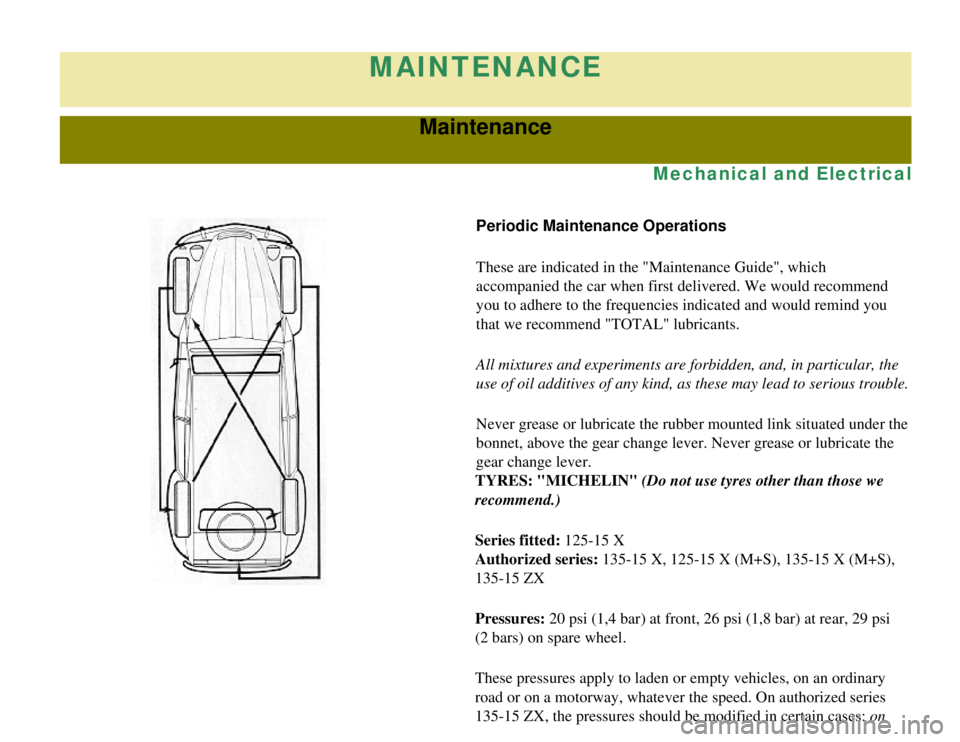
Periodic Maintenance Operations
These are indicated in the "Maintenance Guide", which
accompanied the car when first delivered. We would recommend
you to adhere to the frequencies indicated and would remind you
that we recommend "TOTAL" lubricants.
All mixtures and experiments are forbidden, and, in particular, the
use of oil additives of any kind, as these may lead to serious trouble.
Never grease or lubricate the rubber mounted link situated under the
bonnet, above the gear change lever. Never grease or lubricate the
gear change lever.
TYRES: "MICHELIN" (Do not use tyres other than those we
recommend.)
Series fitted: 125-15 X
Authorized series: 135-15 X, 125-15 X (M+S), 135-15 X (M+S),
135-15 ZX
Pressures: 20 psi (1,4 bar) at front, 26 psi (1,8 bar) at rear, 29 psi
(2 bars) on spare wheel.
These pressures apply to laden or empty vehicles, on an ordinary
road or on a motorway, whatever the speed. On authorized series
135-15 ZX, the pressures should be modified in certain cases: on
Page 25 of 86

sulphated, unscrew them, clean them, and soak the felt insulating
washers in castor oil or in neutral vaseline oil. If the vehicle is not \
in use, recharge the battery every month.
In Winter, a correct charge protects against frost. The battery
charged normally (a density of 1.25 to 1.27) resists to -50C (-58F),\
whilst a discharged battery (density 1.07 to 1.09) may burst at -5C
(23F).
Do not disconnect the leads from the terminals when the engine
is running.
Never recharge the battery without first having disconnecting
the leads from the two terminals.
Air Filter Maintenance (Fig. 35)
Cleaning instructions are to be found on the filter cover (1).
Fig. 35
Air filter
1 - Cover
[Contents] [Notices] [Important Points] [Driving] [Maintenance] [Minor Repairs] [Miscellaneous Information]
Page 29 of 86
MAINTENANCE
Maintenance
Interior
Cleaning the Upholstery
(A sample of cloth can be found stapled under the driver's
seat)
Only use mild non-caustic soaps, toilet type.
According to model:
Cloth upholstery:
This should be brushed or, preferably suction cleaned. If the
upholstery is generally very dirty, use commercial "dry foam", after
carefully removing all traces of dust.
Plastic Trim (and folding canvas hood):
This can be cleaned with a product like "SPIC" or with a little soapy
water, followed by a good rinse and wipe with a dry cloth. We do
not advise the use of products intended to make these parts shine.
Isolated Spots on Upholstery
Spots on cloth or plastic trim upholstery can be cleaned off with
water containing soap or a detergent like Teepol.
If this treatment is unsuccessful, try 90° alcohol (commercial
methylated spirit) or lead-free petrol.
Use pads well wrung-out and rub lightly.
Solvents like acetone or trichlorethylene are not recommended.
Page 41 of 86

RH side and tail lamps
(and rear number plate lamps) Fuel gauge
Direction indicators Windscreen wipers
Alternator field feed
Charging rate indicator
Engine oil pressure warning lamp (on "2 CV 6")
LOWER FUSE BOX (Item B) Green marking (16 A) Blue marking (16 A)
RH dipped beam LH main beam
Red marking (16 A) Yellow marking (16 A)
LH dipped beam RH main beam
REPLACING THE BATTERY (Fig. 46)
Battery reference: 12 V - 125/25 Ah. CEI (or 150/30 Ah. CEI)
Disconnect the battery terminals, always beginning with the
negative one.
Unscrew the two tie-rods of the support frame then disengage the
battery by sliding it towards the front of the vehicle.
Check that the terminals are in the correct position before fitting the \
new battery.
Fig. 46
Battery
1 - Terminals 2 - Tie-rods
Page 46 of 86
DOOR LOCKS FROZEN UP
Maintenance:
At the beginning of the cold season, insert into the door-locks a
small amount of glycerin or anti-freeze, using an oiler or a dropper.
In case of emergency:
Heat the key slightly with a match flame or lighter before inserting
it.
[Contents] [Notices] [Important Points] [Driving] [Maintenance] [Minor Repairs] [Miscellaneous Information]