Sign Citroen BERLINGO 2014 2.G User Guide
[x] Cancel search | Manufacturer: CITROEN, Model Year: 2014, Model line: BERLINGO, Model: Citroen BERLINGO 2014 2.GPages: 268, PDF Size: 13.39 MB
Page 88 of 268
Practical information
86
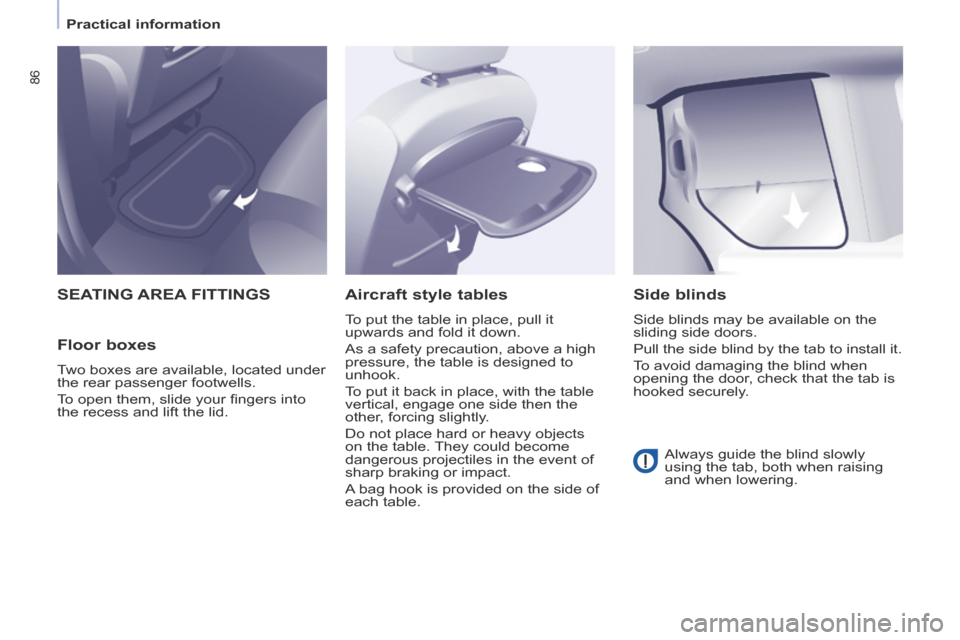
SEATING AREA FITTINGS
Floor boxes
Two boxes are available, located under
the rear passenger footwells.
To open them, slide your fi ngers into
the recess and lift the lid.
Aircraft style tables
To put the table in place, pull it
upwards and fold it down.
As a safety precaution, above a high
pressure, the table is designed to
unhook.
To put it back in place, with the table
vertical, engage one side then the
other, forcing slightly.
Do not place hard or heavy objects
on the table. They could become
dangerous projectiles in the event of
sharp braking or impact.
A bag hook is provided on the side of
each table.
Side blinds
Side blinds may be available on the
sliding side doors.
Pull the side blind by the tab to install it.
To avoid damaging the blind when
opening the door, check that the tab is
hooked securely. Always guide the blind slowly
using the tab, both when raising
and when lowering.
Page 106 of 268

104
Parking sensors
The audible and/or visual rear parking
sensor system consists of four
proximity sensors, installed in the
rear bumper. The sensors detect any
obstacle which enters the fi eld: person,
vehicle, tree, fence, behind the vehicle
during the manoeuvre.
Certain objects detected at the
beginning of the manoeuvre will no
longer be detected at the end of the
manoeuvre due to the blind spots
between and below the sensors.
Examples: stake, roadworks cone or
pavement post.
Engage reverse gear
REAR PARKING SENSORS
Display in the screen
Stop the assistance
Change to neutral.
An audible signal confi rms the
activation of the system by engaging
reverse gear.
The proximity information is indicated
by an audible signal which becomes
more rapid as the vehicle approaches
the obstacle. When the distance
between the rear of the vehicle and
the obstacle is less than approximately
thirty centimetres, the audible signal
becomes continuous.
Page 107 of 268
105
Parking sensors
SAFETY
4
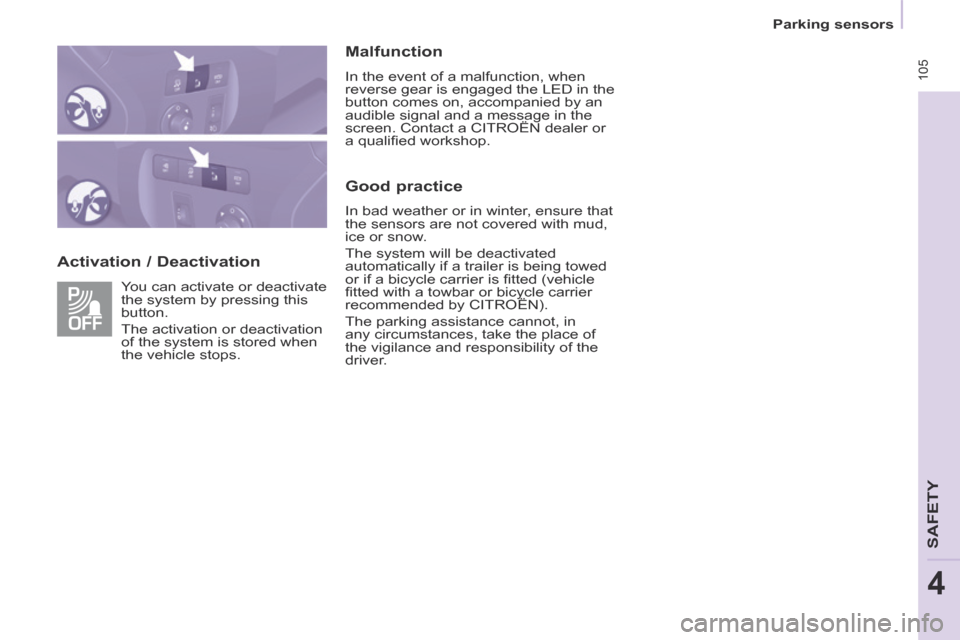
Activation / Deactivation Malfunction
In the event of a malfunction, when
reverse gear is engaged the LED in the
button comes on, accompanied by an
audible signal and a message in the
screen. Contact a CITROËN dealer or
a qualifi ed workshop.
Good practice
In bad weather or in winter, ensure that
the sensors are not covered with mud,
ice or snow.
The system will be deactivated
automatically if a trailer is being towed
or if a bicycle carrier is fi tted (vehicle
fi tted with a towbar or bicycle carrier
recommended by CITROËN).
The parking assistance cannot, in
any circumstances, take the place of
the vigilance and responsibility of the
driver.
You can activate or deactivate
the system by pressing this
button.
The activation or deactivation
of the system is stored when
the vehicle stops.
Page 108 of 268
ABS
ABS
106
Driving safely
ANTI-LOCK BRAKING SYSTEM
(ABS - EBFD)
The ABS and EBFD (electronic brake
force distribution) systems improve the
stability and manoeuvrability of your
vehicle on braking, in particular on
poor or slippery surfaces.
The ABS prevents locking of the
wheels, the EBFD provides control of
the braking pressure wheel by wheel. If this warning lamp comes
on, accompanied by an
audible signal and a message
in the screen, it indicates a
malfunction of the ABS which
could result in a loss of control of the
vehicle on braking.
If this warning lamp comes
on, together with the brake
and STOP warning lamps,
accompanied by an audible
signal and a message in the
screen, it indicates a malfunction of
the electronic brake force distribution
which could result in a loss of control of
the vehicle on braking.
EMERGENCY BRAKING
ASSISTANCE SYSTEM (EBA)
In an emergency, this system enables
the optimum braking pressure to be
reached more quickly, press the pedal
fi rmly without releasing it.
It is triggered by the speed at which the
brake pedal is activated.
This alters the resistance of the brake
pedal under your foot.
To prolong the operation of the
emergency braking assistance system:
keep your foot on the brake pedal.
Good practice
The anti-lock braking system comes
into operation automatically when
there is a risk of wheel lock. It does not
reduce the braking distance.
On very slippery surfaces (ice, oil,
etc...) the ABS may increase the
braking distance. When braking in
an emergency, do not hesitate to
press the brake pedal fi rmly, without
releasing the pressure, even on a
slippery surface, you will then be able
to continue to manoeuvre the vehicle
to avoid an obstacle.
Normal operation of the ABS may be
felt by slight vibration of the brake
pedal.
When changing wheels (tyres
and rims), ensure that these are
recommended by CITROËN. Stop as soon as it is safe to do so.
In both cases, contact a CITROËN
dealer or a qualifi ed workshop.
Page 109 of 268
107
Driving safely
SAFETY
4
ANTI-SLIP REGULATION (ASR)
AND DYNAMIC STABILITY
CONTROL (DSC)
These systems are linked and
complement the ABS.
The ASR system is very useful for
maintaining optimum drive and
avoiding losses of control of the vehicle
on acceleration.
The system optimises drive to prevent
the wheels skidding, by acting on the
brakes of the drive wheels and on the
engine. It also allows the directional
stability of the vehicle to be improved
on acceleration.
Use the DSC to hold your course
without attempting to countersteer.
If there is a variation between the
trajectory followed by the vehicle and
that required by the driver, the DSC
system automatically acts on the
engine and the brake of one or more
wheels, in order to put the vehicle back
on course.
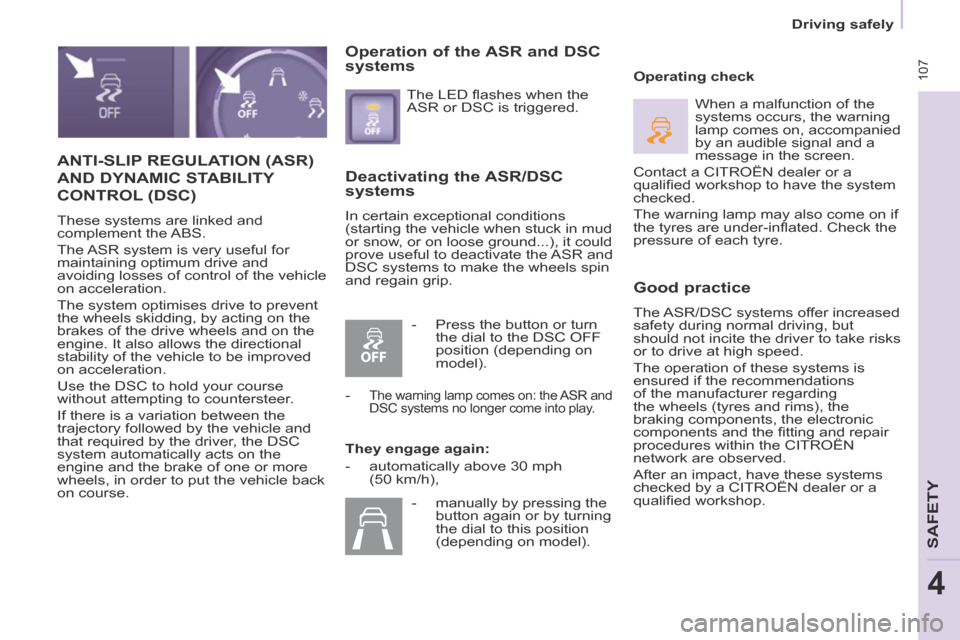
Deactivating the ASR/DSC
systems
In certain exceptional conditions
(starting the vehicle when stuck in mud
or snow, or on loose ground...), it could
prove useful to deactivate the ASR and
DSC systems to make the wheels spin
and regain grip. Operating check
Good practice
The ASR/DSC systems offer increased
safety during normal driving, but
should not incite the driver to take risks
or to drive at high speed.
The operation of these systems is
ensured if the recommendations
of the manufacturer regarding
the wheels (tyres and rims), the
braking components, the electronic
components and the fi tting and repair
procedures within the CITROËN
network are observed.
After an impact, have these systems
checked by a CITROËN dealer or a
qualifi ed workshop.
Operation of the ASR and DSC
systems
The LED fl ashes when the
ASR or DSC is triggered.
They engage again:
- automatically above 30 mph (50 km/h), When a malfunction of the
systems occurs, the warning
lamp comes on, accompanied
by an audible signal and a
message in the screen.
Contact a CITROËN dealer or a
qualifi ed workshop to have the system
checked.
The warning lamp may also come on if
the tyres are under-infl ated. Check the
pressure of each tyre.
- Press the button or turn the dial to the DSC OFF
position (depending on
model).
-
The warning lamp comes on: the ASR and
DSC systems no longer come into play.
- manually by pressing the button again or by turning
the dial to this position
(depending on model).
Page 110 of 268
108
Driving safely
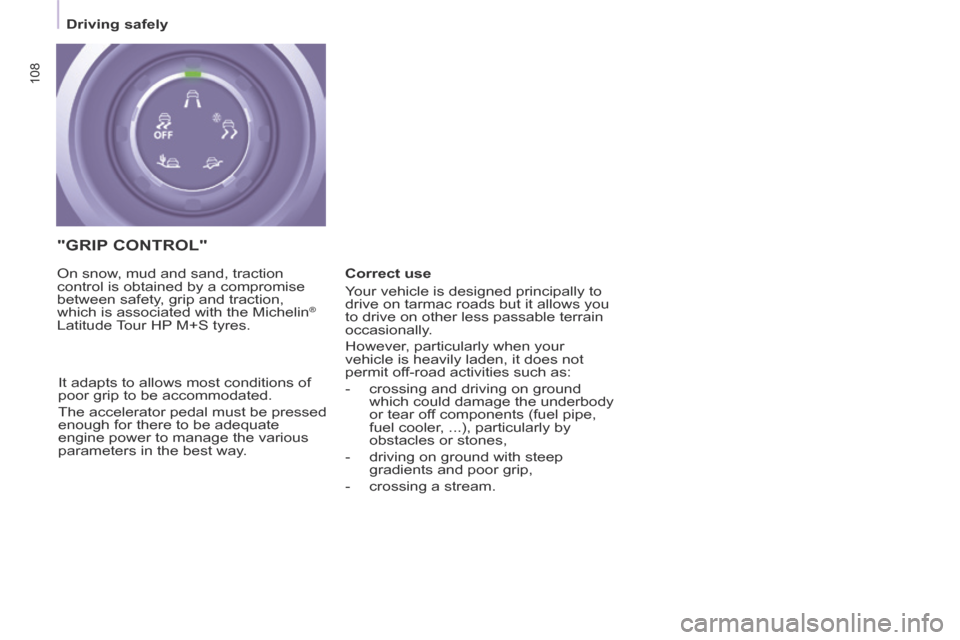
"GRIP CONTROL"
Correct use
Your vehicle is designed principally to
drive on tarmac roads but it allows you
to drive on other less passable terrain
occasionally.
However, particularly when your
vehicle is heavily laden, it does not
permit off-road activities such as:
- crossing and driving on ground which could damage the underbody
or tear off components (fuel pipe,
fuel cooler, ...), particularly by
obstacles or stones,
- driving on ground with steep gradients and poor grip,
- crossing a stream.
On snow, mud and sand, traction
control is obtained by a compromise
between safety, grip and traction,
which is associated with the Michelin
®
Latitude Tour HP M+S tyres.
It adapts to allows most conditions of
poor grip to be accommodated.
The accelerator pedal must be pressed
enough for there to be adequate
engine power to manage the various
parameters in the best way.
Page 113 of 268
Seat belts
111
SAFETY
4
Recommendations for children:
- use a suitable child seat if the passenger is less than 12 years old
or shorter than one metre fi fty,
- never allow a child to travel on your lap, even with the seat belt
fastened.
For more information on child
seats, refer to the "Children on
board" section of chapter 4.
Clean the seat belt straps with
soapy water or a textile cleaning
product, sold by CITROËN
dealers.
In accordance with current safety
regulations, your CITROËN dealer can
guarantee all work or any checks, from
testing to maintenance, on your seat
belt equipment.
Have the seat belts checked regularly
(even after a minor impact) by a
CITROËN dealer or a qualifi ed
workshop: they must not show any
signs of wear, cutting or fraying
and they must not be converted or
modifi ed.
The force limiter reduces the pressure
of the seat belt against the body of the
occupants.
The pretensioning seat belts are active
when the ignition is switched on.
The inertia reels are fi tted with a device
which automatically locks the strap in
the event of a collision or emergency
braking or if the vehicle rolls over.
You can unfasten the seat belt by
pressing the red button on the buckle.
Guide the seat belt after unfastening.
The airbag warning lamp comes on
if the pretensioners are deployed.
Contact a CITROËN dealer or a
qualifi ed workshop.
In order to be effective, a seat belt
must:
- restrain one person only,
- must not be twisted, check by
pulling in front of you with an even
movement,
- be tightened as close to the body as possible.
The upper part of the seat belt should
be positioned in the hollow of the
shoulder.
The lap part should be placed as low
as possible on the pelvis.
Do not invert the seat belt buckles as
they will not fulfi l their role completely.
If the seats are fi tted with armrests, the
lap part of the seat belt should always
pass under the armrest.
Check that the seat belt is fastened
correctly by pulling the strap fi rmly. Front seat belts
The front seats are fi tted with
pretensioners and force limiters.
Rear seat belts
(5 seat version)
The rear seats are fi tted with three-
point inertia reel seat belts.
Page 115 of 268
11 3
Airbags
11 3
SAFETY
4
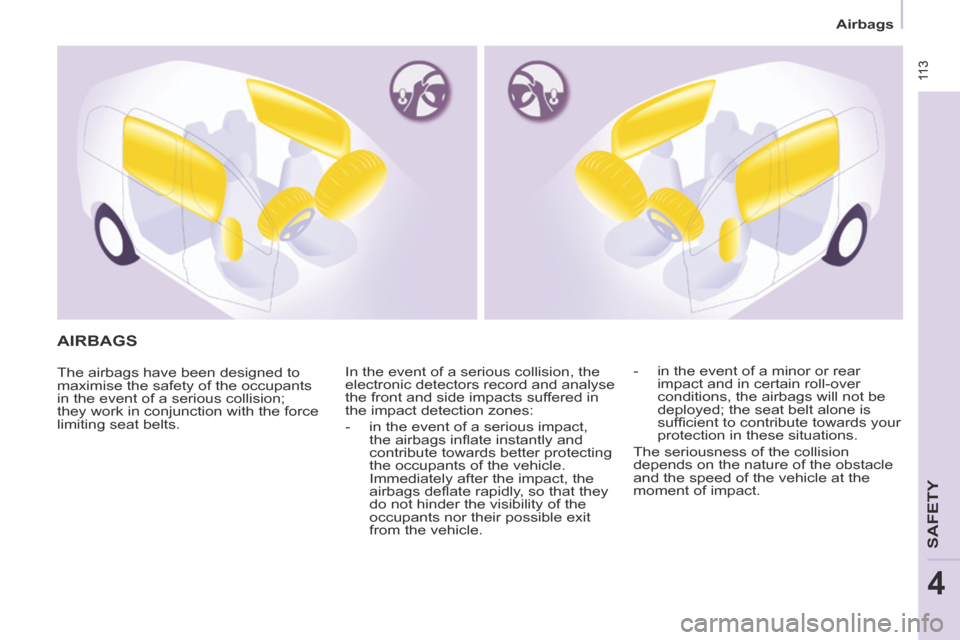
AIRBAGS
The airbags have been designed to
maximise the safety of the occupants
in the event of a serious collision;
they work in conjunction with the force
limiting seat belts. In the event of a serious collision, the
electronic detectors record and analyse
the front and side impacts suffered in
the impact detection zones:
- in the event of a serious impact,
the airbags infl ate instantly and
contribute towards better protecting
the occupants of the vehicle.
Immediately after the impact, the
airbags defl ate rapidly, so that they
do not hinder the visibility of the
occupants nor their possible exit
from the vehicle. - in the event of a minor or rear
impact and in certain roll-over
conditions, the airbags will not be
deployed; the seat belt alone is
suffi cient to contribute towards your
protection in these situations.
The seriousness of the collision
depends on the nature of the obstacle
and the speed of the vehicle at the
moment of impact.
Page 117 of 268
115
Airbags
115
SAFETY
4
Curtain airbags
This is a system which protects the
driver and passengers (with the
exception of the centre seat of row 2)
in the event of a serious side impact in
order to limit the risk of head injuries.
Each curtain airbag is incorporated in
the pillars and the upper part of the
passenger compartment.
Activation
It is triggered at the same time as the
corresponding lateral airbag in the
event of a serious side impact applied
to all or part of the side impact zone B ,
perpendicular to the longitudinal
centreline of the vehicle on a horizontal
plane and directed from the outside
towards the inside of the vehicle.
The curtain airbag infl ates between the
front or rear occupant of the vehicle
and the windows.
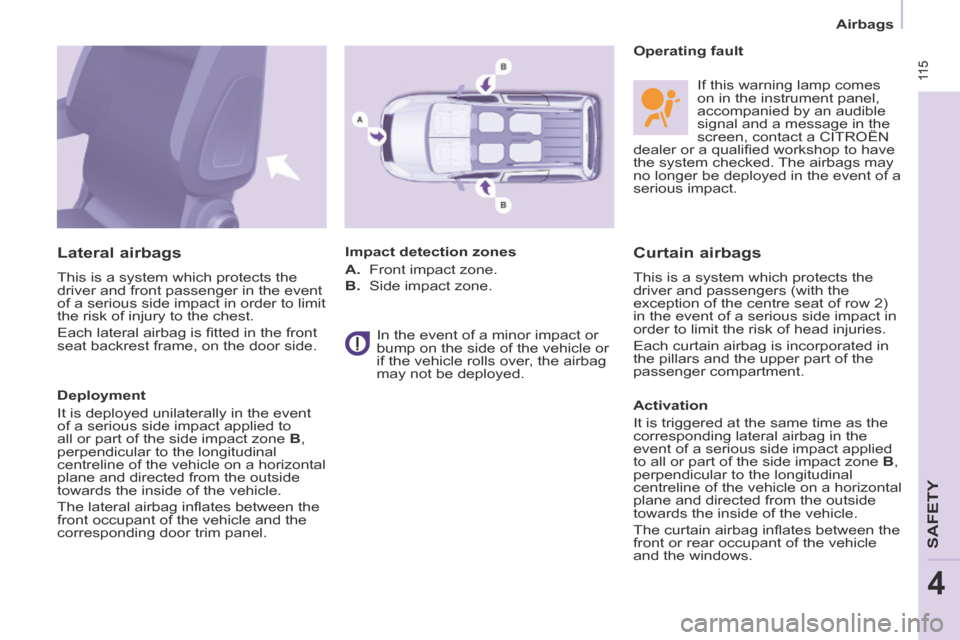
Lateral airbags
This is a system which protects the
driver and front passenger in the event
of a serious side impact in order to limit
the risk of injury to the chest.
Each lateral airbag is fi tted in the front
seat backrest frame, on the door side.
Deployment
It is deployed unilaterally in the event
of a serious side impact applied to
all or part of the side impact zone B ,
perpendicular to the longitudinal
centreline of the vehicle on a horizontal
plane and directed from the outside
towards the inside of the vehicle.
The lateral airbag infl ates between the
front occupant of the vehicle and the
corresponding door trim panel. Impact detection zones
A. Front impact zone.
B. Side impact zone.
Operating fault
If this warning lamp comes
on in the instrument panel,
accompanied by an audible
signal and a message in the
screen, contact a CITROËN
dealer or a qualifi ed workshop to have
the system checked. The airbags may
no longer be deployed in the event of a
serious impact.
In the event of a minor impact or
bump on the side of the vehicle or
if the vehicle rolls over, the airbag
may not be deployed.
Page 118 of 268
11 6
Airbags
11 6
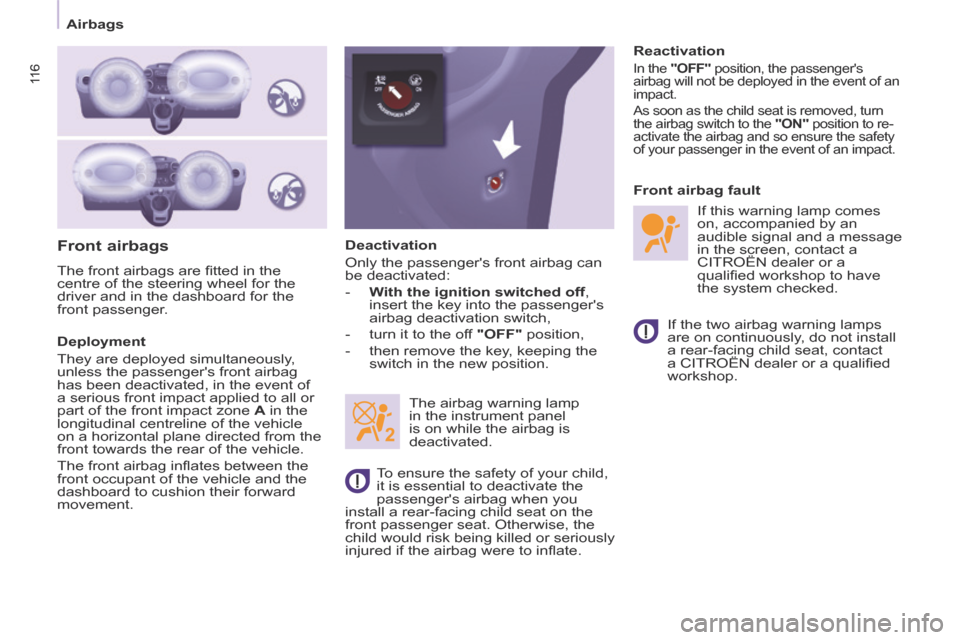
Front airbags
The front airbags are fi tted in the
centre of the steering wheel for the
driver and in the dashboard for the
front passenger.
Deployment
They are deployed simultaneously,
unless the passenger's front airbag
has been deactivated, in the event of
a serious front impact applied to all or
part of the front impact zone A in the
longitudinal centreline of the vehicle
on a horizontal plane directed from the
front towards the rear of the vehicle.
The front airbag infl ates between the
front occupant of the vehicle and the
dashboard to cushion their forward
movement. Deactivation
Only the passenger's front airbag can
be deactivated:
- With the ignition switched off ,
insert the key into the passenger's
airbag deactivation switch,
- turn it to the off "OFF" position,
- then remove the key, keeping the switch in the new position.
The airbag warning lamp
in the instrument panel
is on while the airbag is
deactivated. If the two airbag warning lamps
are on continuously, do not install
a rear-facing child seat, contact
a CITROËN dealer or a qualifi ed
workshop.
Front airbag fault
To ensure the safety of your child,
it is essential to deactivate the
passenger's airbag when you
install a rear-facing child seat on the
front passenger seat. Otherwise, the
child would risk being killed or seriously
injured if the airbag were to infl ate. Reactivation
In the
"OFF" position, the passenger's
airbag will not be deployed in the event of an
impact.
As soon as the child seat is removed, turn
the airbag switch to the "ON" position to re-
activate the airbag and so ensure the safety
of your passenger in the event of an impact.
If this warning lamp comes
on, accompanied by an
audible signal and a message
in the screen, contact a
CITROËN dealer or a
qualifi ed workshop to have
the system checked.