parking brake CITROEN C-ELYSÉE 2017 Owners Manual
[x] Cancel search | Manufacturer: CITROEN, Model Year: 2017, Model line: C-ELYSÉE, Model: CITROEN C-ELYSÉE 2017Pages: 260, PDF Size: 7.11 MB
Page 4 of 260
.
.
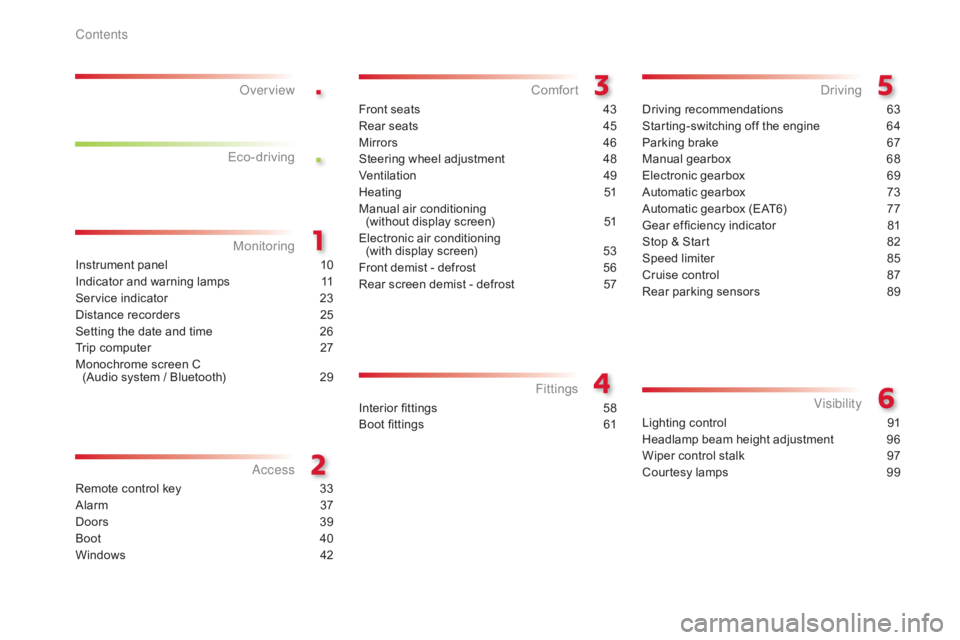
C-elysee_en_Chap00a_sommaire_ed01-2016
Instrument panel 10
Indicator and warning lamps
1
1
Service
indicator
2
3
Distance
recorders
2
5
Setting
the date and time
2
6
Trip
computer
2
7
Monochrome
screen C
(Audio
system / Bluetooth)
2
9
MonitoringOver view
Remote control key 3
3
Alarm
3
7
Doors
39
Boo
t
4
0
Windows
4
2
Access
Front seats 43
Rear seats
4
5
Mirrors
4
6
Steering
wheel adjustment
4
8
Ventilation
4
9
Heating
5
1
Manual
a
ir
c
onditioning
(
without display screen)
5
1
Electronic
air conditioning
(with
display screen)
5
3
Front
demist - defrost
5
6
Rear
screen demist - defrost
5
7
Comfort
Driving recommendations 63
Starting-switching off the engine
6
4
Parking
brake
6
7
Manual
g
earbox
6
8
Electronic
gearbox
6
9
Automatic
gearbox
7
3
Automatic
gearbox (EAT6)
7
7
Gear
ef ficiency indicator
8
1
Stop
& Start
8
2
Speed
limiter
8
5
Cruise
control
87
R
ear parking sensors
8
9
Driving
Lighting control 91
Headlamp beam height adjustment
9
6
Wiper
control stalk
9
7
Courtesy
lamps
9
9
Visibility
Eco-drivingInterior fittings 5
8
Boot fittings
6
1
Fittings
Contents
Page 15 of 260

13
C-elysee_en_Chap01_controle-de-marche_ed01-2016
C-elysee_en_Chap01_controle-de-marche_ed01-2016
Warning / indicator lampStateCause Action / Observations
Diesel engine
pre-heating fixed.
The
key is at position 2 (ignition on) in
t
he ignition switch.Wait
until the warning lamp goes off before starting.
The
period of illumination of the warning lamp is
d
etermined by the ambient conditions (up to about
t
hirty seconds in very low temperatures).
If
the engine does not start, switch the ignition off and
t
hen on, wait until the warning lamp goes off again,
t
hen start the engine.
Parking
brake fixed.
The
parking brake is applied or not
p
roperly
r
eleased.Release
the parking brake to switch off the warning
l
amp, keeping your foot on the brake pedal.
Observe
the safety recommendations.
For
further information on the parking brake, refer to
t
he "Driving" section.
Foot on the
brake pedal fixed.
The
brake pedal must be pressed. With an electronic gearbox, press the brake pedal to
s
tart the engine (lever in position N).
W
ith an automatic gearbox, with the engine running,
p
ress the brake pedal before releasing the parking
b
rake, to unlock the lever and come out of position P.
If
you wish to release the parking brake without
p
ressing the brake pedal, this warning lamp will
r
emain on.
flashing. With
an electronic gearbox, if you
h
old the vehicle on an incline using
t
he accelerator for too long, the
c
lutch overheats.Use
the brake pedal and/or the parking brake.
1
Monitoring
Page 65 of 260

63
C-elysee_en_Chap05_conduite_ed01-2016
Never drive with the parking brake applied - Risk of overheating and
d
amage to the braking system!
Do
not park or run the engine when
s
tationary in areas where inflammable
s
ubstances and materials (dry grass,
d
ead leaves...) might come into contact
w
ith the hot exhaust system - Risk of
f
ire!
Never
leave a vehicle unsupervised
w
ith the engine running. If you have
t
o leave your vehicle with the engine
r
unning, apply the parking brake
a
nd put the gearbox into neutral or
p
osition
N or P,
depending on the type
o
f gearbox.
Driving recommendations
Observe the driving regulations and remain vigilant whatever the traffic conditions.
Pay
close attention to the traffic and keep your
h
ands on the wheel so that you are ready to
r
eact at any time to any eventuality.
On
a long journey, a break every two hours is
s
trongly
re
commended.
In
difficult weather, drive smoothly, anticipate
t
he need to brake and increase the distance
f
rom other vehicles. If
you are obliged to drive through water:
-
c
heck that the depth of water does not
e
xceed 15 cm, taking account of waves
t
hat might be generated by other users,
-
d
eactivate the Stop & Start system,
-
d
rive as slowly as possible without
s
talling. In all cases, do not exceed 6 mph
(
10 km/h),
-
d
o not stop and do not switch off the
e
ngine.
On
leaving the flooded road, as soon as
c
ircumstances allow, make several light brake
a
pplications to dry the brake discs and pads.
If
in doubt on the state of your vehicle, contact
a
CITROËN dealer or a qualified workshop.Important!
Driving on flooded
roads
We strongly advise against driving on flooded r
oads, as this could cause serious damage
t
o the engine or gearbox, as well as to the
e
lectrical systems of your vehicle.
5
Driving
Page 67 of 260

65
C-elysee_en_Chap05_conduite_ed01-2016
In certain cases, you may have to apply more force to the steering (wheels on
f
ull lock, for example).
Starting the engine
F With a petrol engine, operate the starter m
otor by turning the key to position 3
without
pressing the accelerator pedal,
u
ntil the engine starts. Once the engine is
r
unning, release the key. F
W
ith a Diesel engine, turn the key to
p
osition 2
, ignition on, to operate the
eng
ine
p
re-heating
s
ystem.
With the parking brake applied and the gearbox
i
n neutral or position N or P
:
F
d
epress the clutch pedal fully (manual
g
earbox),
or
F
p
ress the brake pedal firmly (electronic or
a
utomatic gearbox),
F
i
nsert the key into the ignition switch; the
s
ystem recognises the code,
F
u
nlock the steering column by
s
imultaneously turning the steering and
t
he key.
Wait until this warning lamp goes off in the i
nstrument panel then operate the starter m
otor by turning the key to position 3
without
pressing the accelerator pedal,
u
ntil the engine starts. Once the engine is
r
unning, release the key.
If the engine does not start straight away, switch off the ignition. Wait a
f
ew moments before operating the
s
tarter motor again. If the engine does
n
ot start after several attempts, do not
k
eep trying: you risk damaging the
s
tarter motor or the engine. Contact
a
CITROËN dealer or a qualified
w
orkshop.
In
wintry conditions, the warning lamp
c
an stay on for a longer period. When
t
he engine is hot, the warning lamp
d
oes not come on. Never leave the engine running in
a
n enclosed area without adequate
v
entilation:
in
ternal
c
ombustion
e
ngines emit toxic exhaust gases,
s
uch as carbon monoxide. Danger of
i
ntoxication and death.
In very severe wintry conditions
(
temperatures below -23°C), to ensure
t
he correct operation and durability of
t
he mechanical components of your
v
ehicle, engine and gearbox, it is n
ecessary to leave the engine running f
or 4 minutes before moving off.
In
temperate conditions, do not leave
t
he engine at idle to warm up but move
o
ff straight away and drive at moderate
s
peed.
5
Driving
Page 68 of 260

66
C-elysee_en_Chap05_conduite_ed01-2016
Never switch off the ignition before the vehicle is at a complete stop. With the
e
ngine off, the braking and steering
a
ssistance systems are also cut off: risk
o
f loss of control of the vehicle.
For
more information, refer to the
"
Practical information" section, under
"
Energy economy mode".
When
you leave the vehicle, keep the
k
ey with you and lock the vehicle.
To
facilitate
unlocking
of
the
steering
c
olumn,
it
is
recommended
that
the
w
heels
be
returned
to
the
straight
ahead
p
osition
before
switching
off
the
engine.
Switching off the engine
F Check that the parking brake is correctly a
pplied, particularly on sloping ground.
F
S
top the vehicle.
F
W
ith the engine running at idle, turn the key
t
o position 1
.
F
R
emove the key from the ignition switch.
F
T
o lock the steering column, turn the
s
teering until it locks.
Energy economy mode
After switching off the engine (position 1- Stop
), f
or a maximum of 30 minutes you can still use
f
unctions such as the audio and telematic
s
ystem, the wipers, dipped beam headlamps,
c
ourtesy lamps, ...
Key left in the "Ignition on"
position
On opening the driver's door, an alert message is displayed, accompanied by an a
udible signal, to remind you that the key is
s
till
i
n
t
he
i
gnition
s
witch
a
t
p
osition
1
(Stop).
If the key has been left in the ignition s
witch at position 2 (Ignition on) ,
the
ignition will be switched off
a
utomatically after one hour.
To
switch the ignition back on, turn the
k
ey to position 1 (Stop),
then back to
p
osition 2 (Ignition on) .
Driving
Page 69 of 260

67
C-elysee_en_Chap05_conduite_ed01-2016
Parking brake
Application
F Pull the parking brake lever up to i
mmobilise your vehicle.
Release
F Pull the parking brake lever up gently, p
ress the release button then lower the
lever
f
ully.
When
parking on a slope, direct your
w
heels against the kerb, apply the
p
arking brake, engage a gear and
s
witch off the ignition.
When the vehicle is being driven, if this warning lamp and the STOP warning lamp come o
n, accompanied by an audible signal and
a message in the screen, indicating that the parking brake is still on or has not been fully released.
5
Driving
Page 72 of 260

70
C-elysee_en_Chap05_conduite_ed01-2016
N appears in the instrument panel.
Y
ou must keep your foot on the brake
p
edal while starting the engine.
The vehicle then moves off on its own
(
refer to the section on the "Creep
function").
F
S
elect automated mode (position A
),
m
anual mode (position M) or reverse
(
position R
).
AUTO
and 1
, 1 or R appear in the
instrument
pan
el.
F
R
elease the parking brake.
F
P
rogressively take your foot off the brake
ped
al.
Moving off
F Select position N
.
F P ress the brake pedal fully.
F
S
tart the engine.
Do
not press the brake and clutch
p
edals simultaneously. This can cause
r
apid clutch wear.The
creep function may be temporarily
u
navailable if the clutch temperature is
t
oo high or the slope too steep.
Do
not leave children unsupervised
i
nside the vehicle when the engine is
r
unning.
F
A
ccelerate away.Creep function
This function allows the vehicle to be
manoeuvred more easily at low speeds (when
p
arking, in traffic jams...).
With
the gear selector in position A, M or R ,
the vehicle moves as soon as you take your
foot off the brake pedal ,
at low speed and
w
ith the engine at idle.
If
the
engine
does
not
start:
-
I
f
N
is
flashing
in
the
instrument
p
anel,
move
the
selector
to
p
osition
A then to position N .
-
I
f
the
message
"Foot
on
the
brake"
i
s
displayed,
press
the
brake
pedal
f
i r m l y.
Driving
Page 74 of 260

72
C-elysee_en_Chap05_conduite_ed01-2016
AUTO and - appear in the instrument pan
el.
F
Sel
ect position N .
F
P
ress
the brake pedal.
F
W
ait
for around 30 seconds until N or a
gear
appears in the instrument panel.
F
M
ove
the gear selector to position A, then
to position N .
F
W
ith
your foot still on the brake pedal, start
t
he
eng
ine.
The
gearbox is operational again.
Reinitialisation
Following disconnection of the battery, it is necessary to reinitialise the gearbox.
F
S
witch on the ignition.
Before
doing
anything
under
the
b
onnet,
ensure
that
the
gear
selector
i
s in neutral (position N )
and
that
the
p
arking
brake
is
applied. In
exceptional circumstances, the
g
earbox may need an automatic
r
einitialisation: starting and gear
c
hanging are no longer possible.
AUTO
and - appear in the
instrument
pan
el.
For
all
parking
situations,
you
must
apply the parking brake
to
immobilise
t
he
vehicle.
When
immobilising
the
vehicle
with
the
e
ngine
running,
you
must
put
the
gear
s
elector into neutral (position N ).
Before
switching
off
the
engine:
-
c
hange
to
position
N to be in neutral,
or
-
l
eave
the
vehicle
in
gear;
in
this
case
the
v
ehicle
cannot
be
moved.
Follow
the procedure described above.
Stopping the vehicle
With the ignition o n, i f t his w arning l
amp comes on and AUTO
flashes,
accompanied by an audible signal and
a
message
in the multifunction screen, this
i
ndicates
a
gearbox fault.
Have
it
checked by a CITROËN dealer or a
q
ualified
w
orkshop.
Operating fault
Driving
Page 75 of 260

73
C-elysee_en_Chap05_conduite_ed01-2016
Four-speed automatic gearbox which offers a choice between the comfort of fully automatic
o
peration, enhanced by sport and snow
p
rogrammes,
o
r
m
anual
g
ear
c
hanging.
Two
driving modes are available:
-
a
utomatic operation with electronic
management
of the gears by the gearbox,
w
ith a sport
programme for a more
d
ynamic style of driving and a snow
programme
to make driving easier when
g
rip is poor.
-
m
anual
operation for sequential changing
o
f the gears by the driver.
Automatic gearbox
1. Gear selector knob.
2. B utton "S" (spor t) .
3.
B
utton "T " (snow).
Gear selection gate Gear selector positions
P.
Park.
- I mmobilisation of the vehicle, parking brake
o
n or off.
-
S
tarting the engine.
R.
R
everse.
-
R
eversing manoeuvres, vehicle stationary,
e
ngine at idle.
N.
Neutral.
-
I
mmobilisation of the vehicle, parking
b
rake on.
-
S
tarting the engine.
D.
A
utomatic
ope
ration.
M + / -.
M
anual operation with sequential
c
hanging of the four gears.
F
P
ush for wards to change up through
t
he gears.
or
F
P
ull backwards to change down through
t
he gears.
Displays in the instrument panel
When you move the selector in the gate to select a position, the corresponding indicator is
d
isplayed in the instrument panel.
P.
Pa
rk
R.
Reverse
N.
N
eutral
D.
D
rive (Automatic driving)
S.
Sp
ort
pro
gramme
T .
S
now
pro
gramme
1 2 3 4.
G
ears engaged during manual
ope
ration
-.
I
nvalid value during manual operation
Foot on brake
F Press the brake pedal when this i
ndicator lamp is displayed in the
i
nstrument panel (e.g.: starting
t
he
eng
ine).
5
Driving
Page 76 of 260

74
C-elysee_en_Chap05_conduite_ed01-2016
F Apply the parking brake.
F Sel ect position P or N .
F
S
tart the engine.
If
this procedure is not followed, there is an
a
udible signal, accompanied by the display of
a
n warning message.
F
W
ith the engine running, press the brake
ped
al.
F
R
elease the parking brake.
F
Sel
ect position R , D or M.
F
G
radually release the brake pedal.
The
vehicle moves off immediately.
Moving off
When the engine is running at idle, with the brakes released, if position R, D or
M
is selected, the vehicle moves even
w
ithout the accelerator being pressed.
When
the engine is running, never
l
eave children in the vehicle without
sup
ervision.
When
carrying out maintenance with
t
he engine running, apply the parking
b
rake and select position P.
If position N
is
selected
inadvertently
w
hile
driving,
allow
the
engine
to
r
eturn
to
idle
then
select
position
D to
accelerate.
Never select position N while the
vehicle
is moving.
Never select positions P or R unless the
vehicle
is completely stationary.
Automatic operation
F Select position D for automatic changing o
f the four gears.
The
gearbox then operates in auto-adaptive
m
ode, without any intervention on the part
o
f the driver. It continuously selects the most
s
uitable gear according to the style of driving,
t
he profile of the road and the load in the
v
ehicle.
For
maximum acceleration without touching
t
he selector, press the accelerator pedal down
f
ully (kick down). The gearbox changes down
a
utomatically or maintains the gear selected
u
ntil the maximum engine speed is reached.
On
braking, the gearbox changes down
a
utomatically to provide efficient engine
b
raking.
If you release the accelerator sharply, the
gearbox
will not change to a higher gear for
s
afety reasons.
If
the
ambient
temperature
is
below
-
23°C,
the
engine
should
be
left
at
idle
f
or
four
minutes,
to
ensure
the
correct
o
peration
and
life
of
the
engine
and
g
earbox.
Driving