battery Citroen C ZERO 2014.5 1.G Owner's Guide
[x] Cancel search | Manufacturer: CITROEN, Model Year: 2014.5, Model line: C ZERO, Model: Citroen C ZERO 2014.5 1.GPages: 176, PDF Size: 5.22 MB
Page 96 of 176

94
F Lift the protective cover on the (+) terminal.F
C
onnect one end of the red cable to
the (+) terminal of your discharged
battery A , then the other end to the
(+) terminal of the battery on the other
vehicle B .
Starting using a battery on
another vehicle
F Connect one end of the green or black
cable to the (-) terminal of the battery on
the other vehicle B .
F
C
onnect the other end the green or black
cable to the earth point C of your vehicle.
Ensure that the electrolyte is not frozen.
Check the electrolyte level and top up
with distilled water if necessary (refer
to the "checking levels" section in this
document).
Check that the battery on the other
vehicle is a 12
V battery.
Practical information
Page 97 of 176

95
Charging the battery using
a battery charger
F Start the other vehicle and wait a few m inutes.
F
T
urn the ignition key on your vehicle, until
the "Ready" lamp comes on.
F
D
isconnect the cables in the reverse order.
F
R
efit the battery protective cover and
tighten the fixing screw.
If the "Ready" lamp does not come on, proceed
as follows:
F
L
eave the cables connected.
F
R
eturn the ignition switch on your vehicle
to the " LOCK" position.
F
P
ut the main battery on charge, following
the procedure for normal charging (see the
"charging the main battery" section).
F
W
hen the charging warning lamp in
the instrument panel comes on fixed,
disconnect the cables.
F
L
eave the battery on charge for at least
one hour.
F
T
urn the ignition key on your vehicle, until
the "Ready" lamp comes on.
If the problem persists, contact a
CITROËN
dealer or a qualified workshop. F
R emove the protective cover from
the battery.
Ensure that the electrolyte is not frozen.
Check the electrolyte level and top up
with distilled water if necessary (refer to
the "checking levels" section). F
S
lacken nut 1 and lift off the retaining bar.
8
Practical information
Page 98 of 176
96
Never charge the battery without
first disconnecting the terminals and
removing it from the vehicle.
Do not disconnect the terminals when
the "Ready" lamp is on, nor when the
vehicle is being charged.
Before disconnecting
You must wait 2 minutes after switching
off the ignition before disconnecting the
battery.Batteries contain harmful substances
such as sulphuric acid and lead. They
must be disposed of in line with legal
requirements and never put out with
household waste.
Take used batteries to an authorised
collection point.
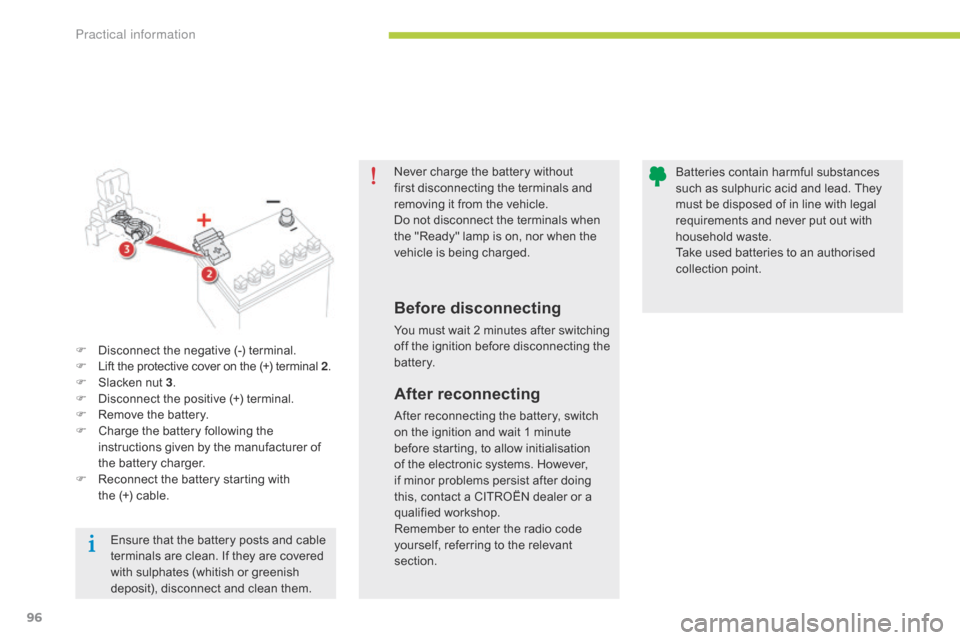
F
D
isconnect the negative (-) terminal.
F
L
ift the protective cover on the (+) terminal 2 .
F
S
lacken nut 3 .
F
D
isconnect the positive (+) terminal.
F
R
emove the battery.
F
C
harge the battery following the
instructions given by the manufacturer of
the battery charger.
F
R
econnect the battery starting with
the (+) cable.
After reconnecting
After reconnecting the battery, switch
on the ignition and wait 1 minute
before starting, to allow initialisation
of the electronic systems. However,
if minor problems persist after doing
this, contact a CITROËN dealer or a
qualified workshop.
Remember to enter the radio code
yourself, referring to the relevant
section.
Ensure that the battery posts and cable
terminals are clean. If they are covered
with sulphates (whitish or greenish
deposit), disconnect and clean them.
Practical information
Page 119 of 176
117
Fuse N°Rating Functions
1 -Not used.
2 30 AInternal fuse.
3 40 AElectric motor.
4 40 ARadiator fan.
5 40 AElectric windows.
6 30 AVacuum pump.
7 15 AMain battery ECU.
8 15 AThird brake lamp.
9 15 AFront foglamps.
10 15 AWater pump.
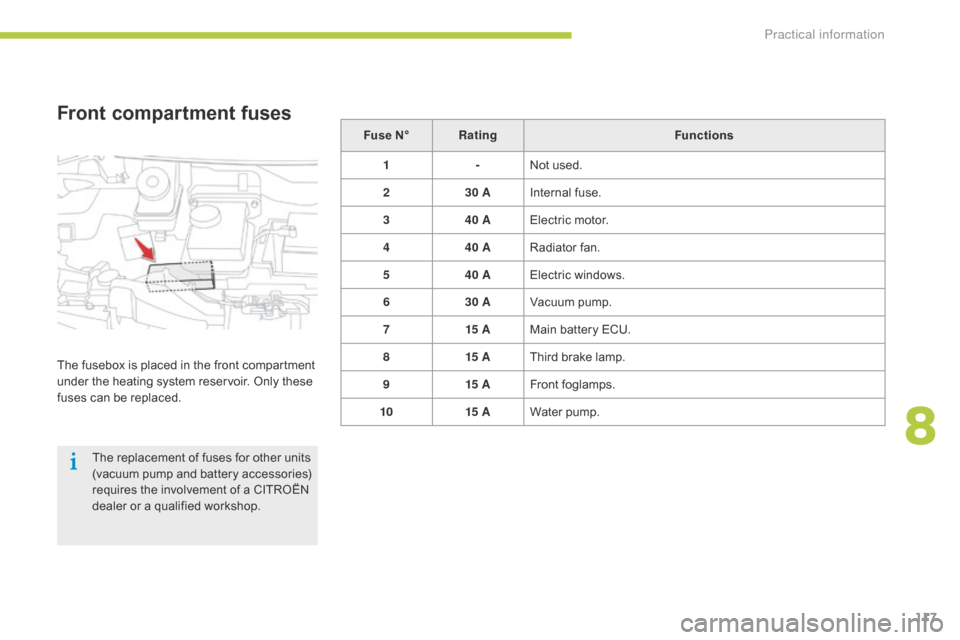
Front compartment fuses
The fusebox is placed in the front compartment
under the heating system reservoir. Only these
fuses can be replaced.
The replacement of fuses for other units
(vacuum pump and battery accessories)
requires the involvement of a CITROËN
dealer or a qualified workshop.
8
Practical information
Page 120 of 176
118
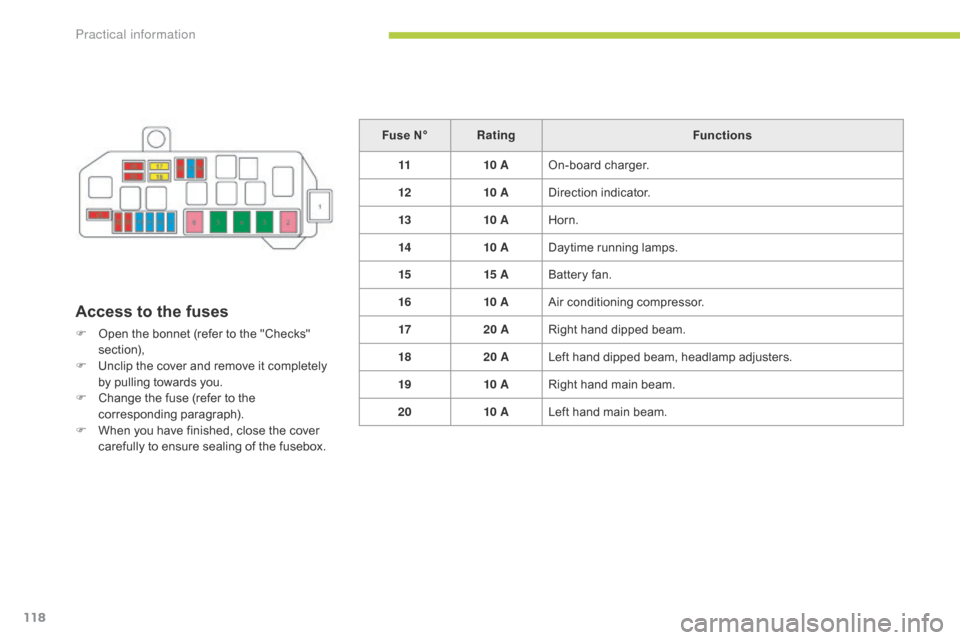
Access to the fuses
F Open the bonnet (refer to the "Checks" section),
F
U
nclip the cover and remove it completely
by pulling towards you.
F
C
hange the fuse (refer to the
corresponding paragraph).
F
W
hen you have finished, close the cover
carefully to ensure sealing of the fusebox. Fuse N°
Rating Functions
11 10 AOn-board charger.
12 10 ADirection indicator.
13 10 AHorn.
14 10 ADaytime running lamps.
15 15 ABattery fan.
16 10 AAir conditioning compressor.
17 20 ARight hand dipped beam.
18 20 ALeft hand dipped beam, headlamp adjusters.
19 10 ARight hand main beam.
20 10 ALeft hand main beam.
Practical information
Page 122 of 176
120
accessories
A wide range of accessories and genuine parts is available from the CITROËN dealer network.
These accessories and parts are all suitable for your vehicle and benefit from CITROËN's
recommendation and warranty.
Conversion kits
You can obtain an "Enterprise" kit to convert a
trade vehicle to a private car and vice-versa.
"Comfort":
black armrest, reading lamp, insulated
modules, rear parking sensors, cigarette
lighter, ashtray with base, head restraint
mounted coat hanger...
"Transport solutions":
boot liner, boot carpet, rear parcel shelf, boot
dividers...
"Security and safety":
alarm, wheel security bolts, child seats,
breathalyzer, warning triangle, high visibility
vest, first aid kit, snow chains, non-slip covers,
pet transport cage, pet safety belt...
Precautions for
washing
To avoid damaging the electrical
components, the use of a high pressure
jet wash is strictly prohibited:
-
i
n the front compartment (under the
bonnet),
-
u
nder the body.
For washing the body, do not use a
pressure greater than 80
bars.
Check - before washing the vehicle -
that the charging flaps and the charging
socket covers (normal and fast charge)
are properly closed.
do n
ot wash the vehicle while the
battery is being recharged.
Practical information
Page 125 of 176
123
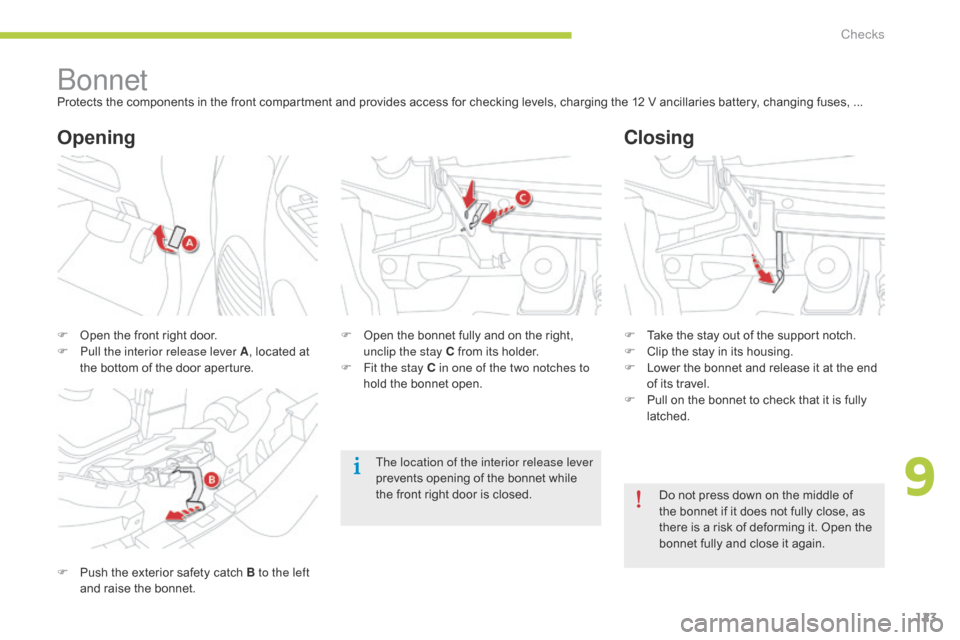
bonnetProtects the components in the front compartment and provides access for checking levels, charging the 12 V ancillaries battery, changing fuses, ...
F
P
ush the exterior safety catch B to the left
and raise the bonnet. F
O
pen the bonnet fully and on the right,
unclip the stay C from its holder.
F
F
it the stay C in one of the two notches to
hold the bonnet open.
F
O
pen the front right door.
F
P
ull the interior release lever A , located at
the bottom of the door aperture.
Opening Closing
F Take the stay out of the support notch.
F
C lip the stay in its housing.
F
L
ower the bonnet and release it at the end
of its travel.
F
P
ull on the bonnet to check that it is fully
latched.
Do not press down on the middle of
the bonnet if it does not fully close, as
there is a risk of deforming it. Open the
bonnet fully and close it again.
The location of the interior release lever
prevents opening of the bonnet while
the front right door is closed.
9
Checks
Page 126 of 176
124
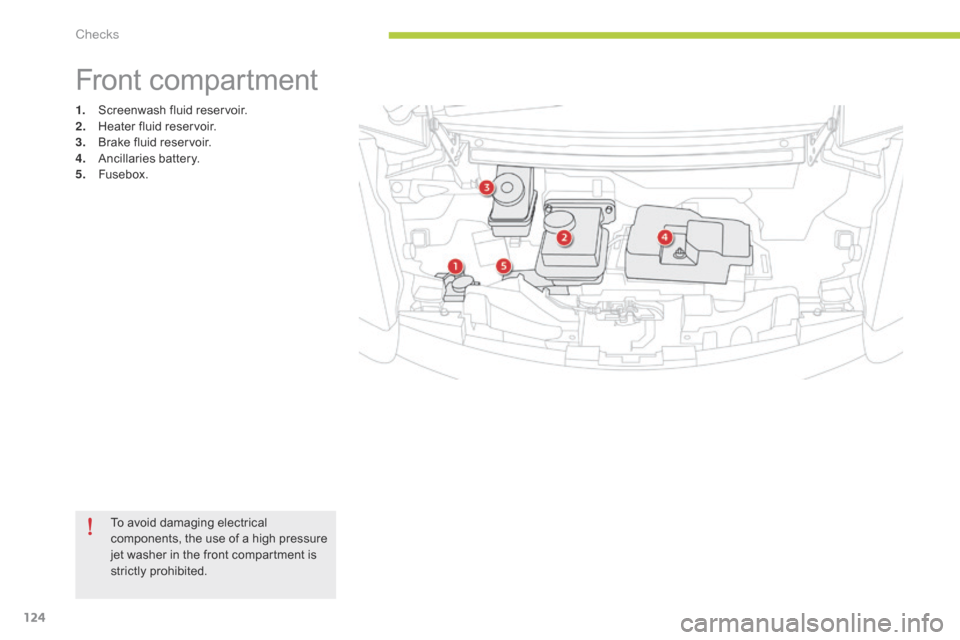
1. Screenwash fluid reservoir.
2. Heater fluid reservoir.
3.
B
rake fluid reservoir.
4.
A
ncillaries battery.
5.
F
usebox.
Front compartment
To avoid damaging electrical
components, the use of a high pressure
jet washer in the front compartment is
strictly prohibited.
Checks
Page 129 of 176
127
The coolant level should be between
the MIN "L" and MA X "F" marks.
Coolant levelAvoid prolonged contact of used fluids
with the skin.
Most of these fluids are harmful to
health and some are very corrosive.
Do not discard used fluids into sewers
or onto the ground.
Take used fluids to a CITROËN dealer
or a qualified workshop (France) or to
an authorised waste disposal site.
Used products
Rear compartment
Changing the coolant
The coolant does not have to be changed.
Coolant specification
The coolant must conform to the
manufacturer's recommendations. As the cooling system is pressurised, wait at
least one hour after switching off the motor
and/or the end of the charge cycle before
carrying out any work.
To avoid any risk of scalding, unscrew the cap
by two turns to allow the pressure to drop.
When the pressure has dropped, remove the
cap and top up the level.
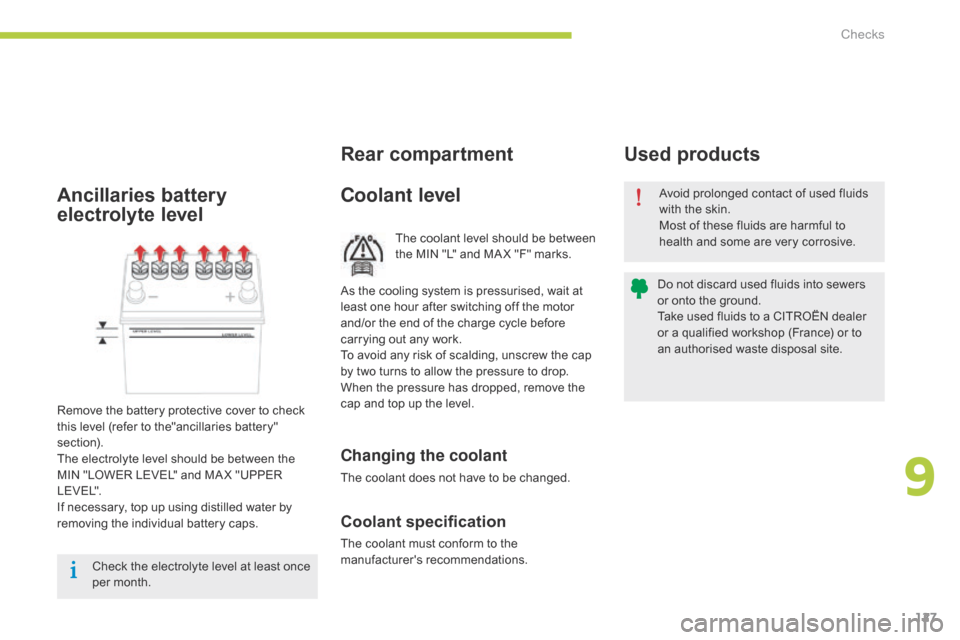
Ancillaries battery
electrolyte level
Remove the battery protective cover to check
this level (refer to the"ancillaries battery"
section).
The electrolyte level should be between the
MIN "LOWER LEVEL" and MA X "UPPER
L E V E L" .
If necessary, top up using distilled water by
removing the individual battery caps.
Check the electrolyte level at least once
per month.
9
Checks
Page 131 of 176
129
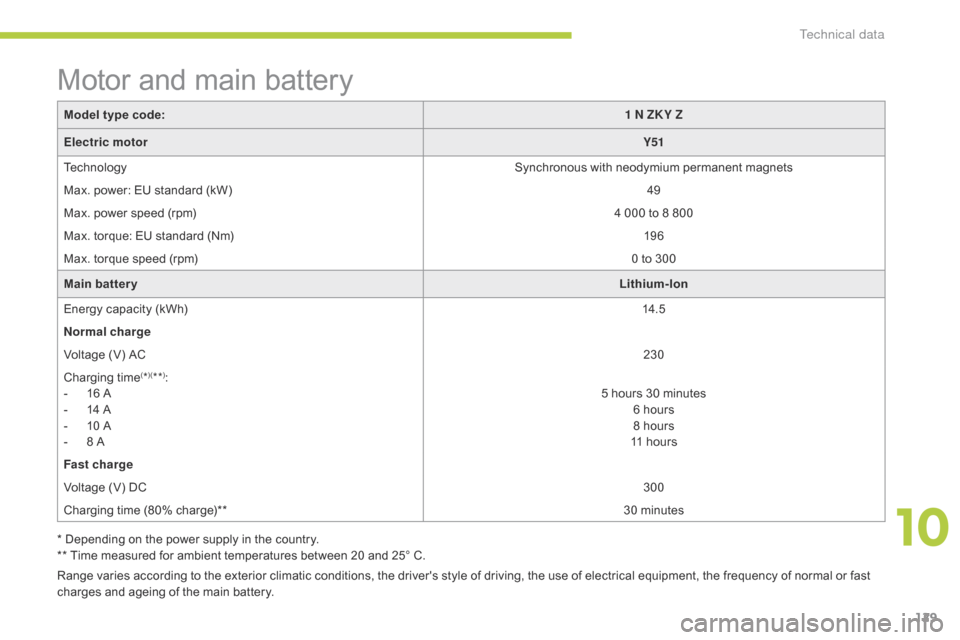
Motor and main battery
Model type code:1 N ZK Y Z
Electric motor Y51
Technology Synchronous with neodymium permanent magnets
Max. power: EU standard (kW) 49
Max. power speed (rpm) 4 000 to 8 800
Max. torque: EU standard (Nm) 19 6
Max. torque speed (rpm) 0 to 300
Main batter y Lithium-Ion
Energy capacity (kWh) 14.5
Normal charge
Voltage (V) AC 230
Charging time
(*)(**):
-
1
6 A
-
1
4 A
-
1
0 A
-
8 A 5 h
ours 30 minutes
6 hours
8 hours
11 hours
Fast charge
Voltage (V) DC 300
Charging time (80% charge)** 30 minutes
Range varies according to the exterior climatic conditions, the driver's style of driving, the use of electrical equipment, the frequency of normal or fast
charges and ageing of the main battery. * Depending on the power supply in the country.
** Time measured for ambient temperatures between 20 and 25° C.
10
Technical data