heating Citroen C ZERO 2015 1.G Owner's Manual
[x] Cancel search | Manufacturer: CITROEN, Model Year: 2015, Model line: C ZERO, Model: Citroen C ZERO 2015 1.GPages: 176, PDF Size: 5.21 MB
Page 10 of 176
8
C-zero_en_Chap00c_Eco-conduite_ed01-2014
For more economical driving, and increased rangePractical advice for everyday use to optimise the range of your vehicle by conserving battery power.
Adopt a smooth driving
style
The electrical consumption of your vehicle
depends greatly on your journey, your driving
style and your speed.
In all cases, adopt a smooth driving style.
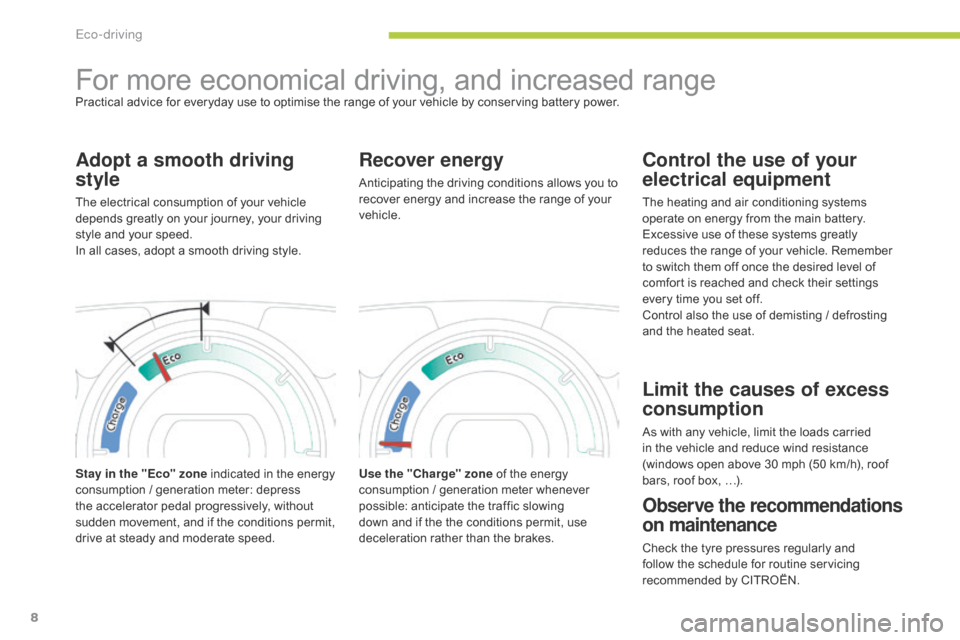
Stay in the "Eco" zone indicated in the energy
consumption
/ g
eneration meter: depress
the accelerator pedal progressively, without
sudden movement, and if the conditions permit,
drive at steady and moderate speed.
Recover energy
Anticipating the driving conditions allows you to
recover energy and increase the range of your
vehicle.
Use the "Charge" zone of the energy
consumption
/ g
eneration meter whenever
possible: anticipate the traffic slowing
down and if the the conditions permit, use
deceleration rather than the brakes.
Control the use of your
electrical equipment
The heating and air conditioning systems
operate on energy from the main battery.
Excessive use of these systems greatly
reduces the range of your vehicle. Remember
to switch them off once the desired level of
comfort is reached and check their settings
every time you set off.
Control also the use of demisting
/ d
efrosting
and the heated seat.
Limit the causes of excess
consumption
As with any vehicle, limit the loads carried
in the vehicle and reduce wind resistance
(windows open above 30 mph (50 km/h), roof
bars, roof box, …).
Observe the recommendations
on maintenance
Check the tyre pressures regularly and
follow the schedule for routine servicing
recommended by CITROËN.
Eco-driving
Page 20 of 176
18
C-zero_en_Chap01_controle-de-marche_ed01-2014
Main battery state of charge indicator
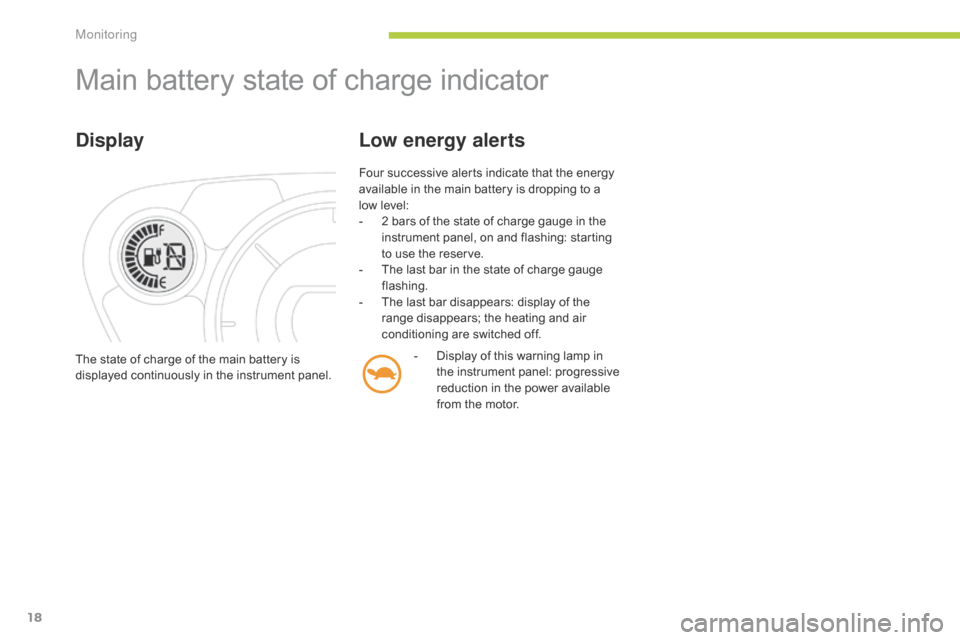
Display
Four successive alerts indicate that the energy
available in the main battery is dropping to a
low level:
-
2 ba
rs of the state of charge gauge in the
instrument panel, on and flashing: starting
to use the reserve.
-
Th
e last bar in the state of charge gauge
flashing.
-
Th
e last bar disappears: display of the
range disappears; the heating and air
conditioning are switched off.
Low energy alerts
- Display of this warning lamp in
t he instrument panel: progressive
reduction in the power available
from the motor.
The state of charge of the main battery is
displayed continuously in the instrument panel.
Monitoring
Page 21 of 176
19
C-zero_en_Chap01_controle-de-marche_ed01-2014
Energy consumption / generation indicator
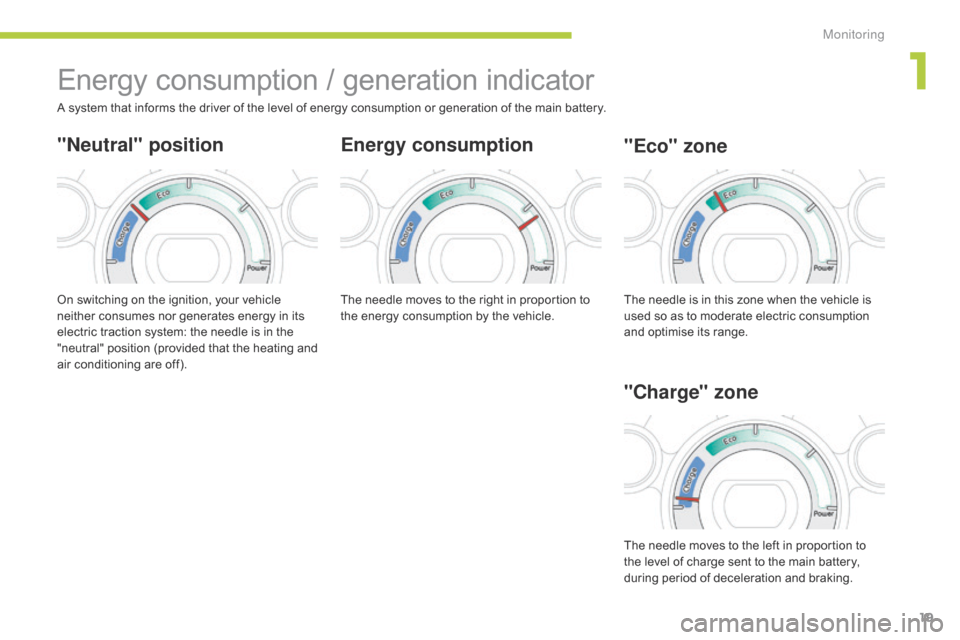
Energy consumption
On switching on the ignition, your vehicle
neither consumes nor generates energy in its
electric traction system: the needle is in the
"neutral" position (provided that the heating and
air conditioning are off).
"Eco" zone
A system that informs the driver of the level of energy consumption or generation of the main battery.
"Neutral" position"Charge" zone
The needle moves to the right in proportion to
the energy consumption by the vehicle.The needle is in this zone when the vehicle is
used so as to moderate electric consumption
and optimise its range.
The needle moves to the left in proportion to
the level of charge sent to the main battery,
during period of deceleration and braking.
1
Monitoring
Page 25 of 176
23
C-zero_en_Chap01_controle-de-marche_ed01-2014
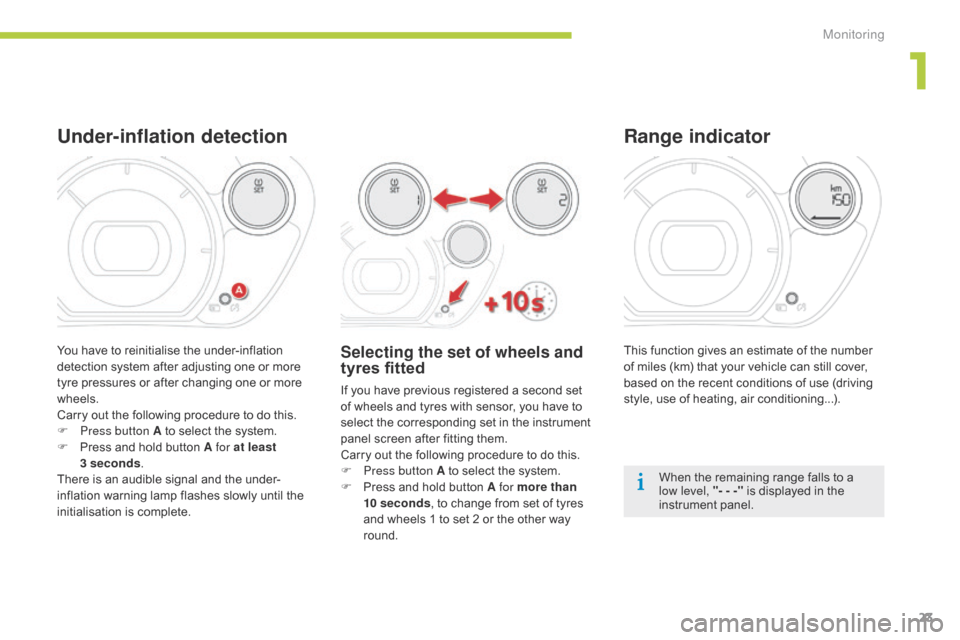
This function gives an estimate of the number
of miles (km) that your vehicle can still cover,
based on the recent conditions of use (driving
style, use of heating, air conditioning...).
Range indicator
When the remaining range falls to a
low level, "- - -" is displayed in the
instrument panel.
Under-inflation detection
Selecting the set of wheels and
tyres fitted
If you have previous registered a second set
of wheels and tyres with sensor, you have to
select the corresponding set in the instrument
panel screen after fitting them.
Carry out the following procedure to do this.
F
Pr
ess button A to select the system.
F
Pr
ess and hold button A for more than
10
s
econds, to change from set of tyres
and wheels 1 to set 2 or the other way
round.
You have to reinitialise the under-inflation
detection system after adjusting one or more
tyre pressures or after changing one or more
wheels.
Carry out the following procedure to do this.
F
Pr
ess button A to select the system.
F
Pr
ess and hold button A for at least
3
s
econds .
There is an audible signal and the under-
inflation warning lamp flashes slowly until the
initialisation is complete.
1
Monitoring
Page 34 of 176

32
C-zero_en_Chap03_confort_ed01-2014
Head restraint height adjustment
F To raise it, pull upwards.
F To l ower it, push it downwards, pressing
the height adjustment button at the same
time.
F
To r
emove it, raise it to the high position,
then remove it pressing the height
adjustment button at the same time.
F
To r
efit it, engage the rods of the head
restraint in the apertures, pressing the
height adjustment button at the same time. Never drive with the removed head
restraints in the vehicle as they could
be thrown around the vehicle on sharp
braking. They must always be in place
and adjusted correctly.
After installing the head restraint, check
that the height adjustment button has
engaged correctly.
The adjustment is correct when the top
of the head restraint is aligned with the
top of the head of the seated person.Press the control switch, located on the
dashboard, to switch on the driver's seat
heating.
The warning lamp in the switch comes on.
The temperature is controlled automatically.
Pressing a second time stops operation.
Heated seat control
Comfort
Page 43 of 176
41
C-zero_en_Chap03_confort_ed01-2014
In order for these systems to be fully effective, follow the operation and maintenance
guidelines below:
F
If t
he interior temperature remains very high after the vehicle has been parked in the
sun for a considerable time, first ventilate the passenger compartment for a few minutes
by opening the windows.
Pl
ace the air flow control at a sufficient level to provide an adequate renewal of air in
the passenger compartment.
F
Co
ndensation created by the air conditioning results in a discharge of water under the
vehicle when stationary, which is per fectly normal.
F
To o
btain an even air distribution, take care not to obstruct the exterior air intake grilles
located at the base of the windscreen, the nozzles, the vents and the air outlets, as well
as the air extractor located in the boot.
F
Us
e in preference the intake of exterior air as prolonged use of the air recirculation may
cause misting of the windows and side windows.
F
Op
erate the air conditioning system for 5 to 10 minutes, once or twice a month to keep it
in good working order.
F
En
sure that the passenger compartment filter is in good condition and have the filter
elements replaced regularly (refer to "Checks").
F
To e
nsure correct operation of the air conditioning system, you are also advised to have
it checked regularly.
F
If t
he system does not produce cold air, do not use it and contact a CITROËN dealer or
a qualified workshop.
Recommendations for ventilation and air conditioning
The heating and air conditioning use
energy from the main battery. Their use
increases electrical consumption and
reduces the range of the vehicle.
Remember to switch off the heating
or air conditioning as soon as it is no
longer needed.
3
Comfort
Page 44 of 176
42
C-zero_en_Chap03_confort_ed01-2014
Air conditioning
The air conditioning can be used as soon as
the "Ready" lamp is on.1. Temperature adjustment
F Turn the dial from blue
(cold) to red (hot) to adjust
the temperature to your
requirements.
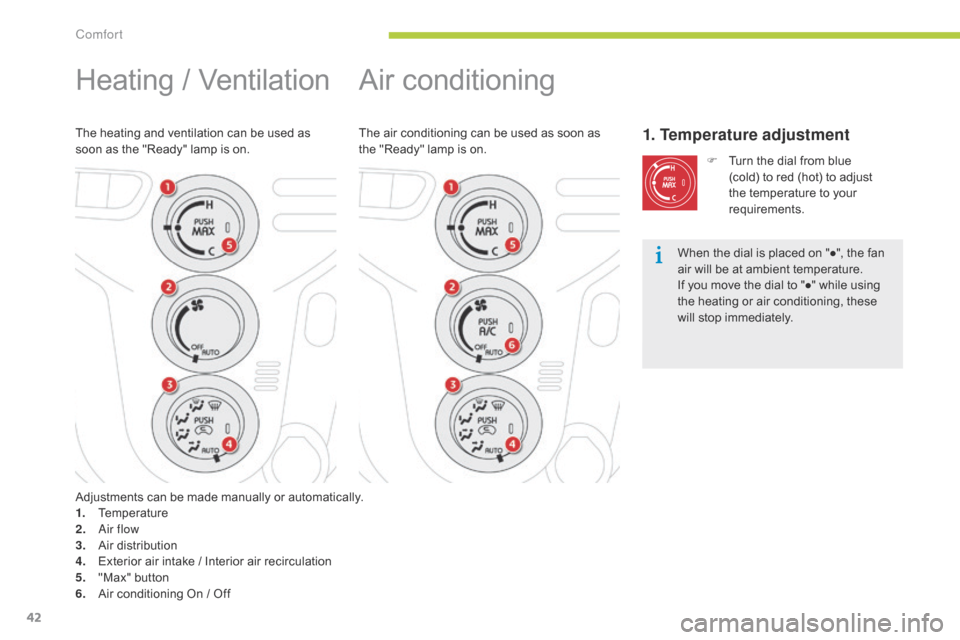
Adjustments can be made manually or automatically.
1.
Te
mperature
2.
air f
low
3.
Air
distribution
4.
Ex
terior air intake
/ I
nterior air recirculation
5.
"M
ax" button
6.
Ai
r conditioning On
/ O
ff When the dial is placed on "●", the fan
air will be at ambient temperature.
If you move the dial to "●" while using
the heating or air conditioning, these
will stop immediately.
Heating / Ventilation
The heating and ventilation can be used as
soon as the "Ready" lamp is on.
Comfort
Page 46 of 176
44
C-zero_en_Chap03_confort_ed01-2014
6. Air conditioning On / Off
Sw itching on
F Press the "A /C " b utton, the associated
indicator lamp comes on.
The air conditioning does not operate when
the air flow adjustment is set to off.
Switching off
F Press the "A /C " b utton again, the
associated indicator lamp goes off.
Switching off may result in some discomfort
(humidity, misting).
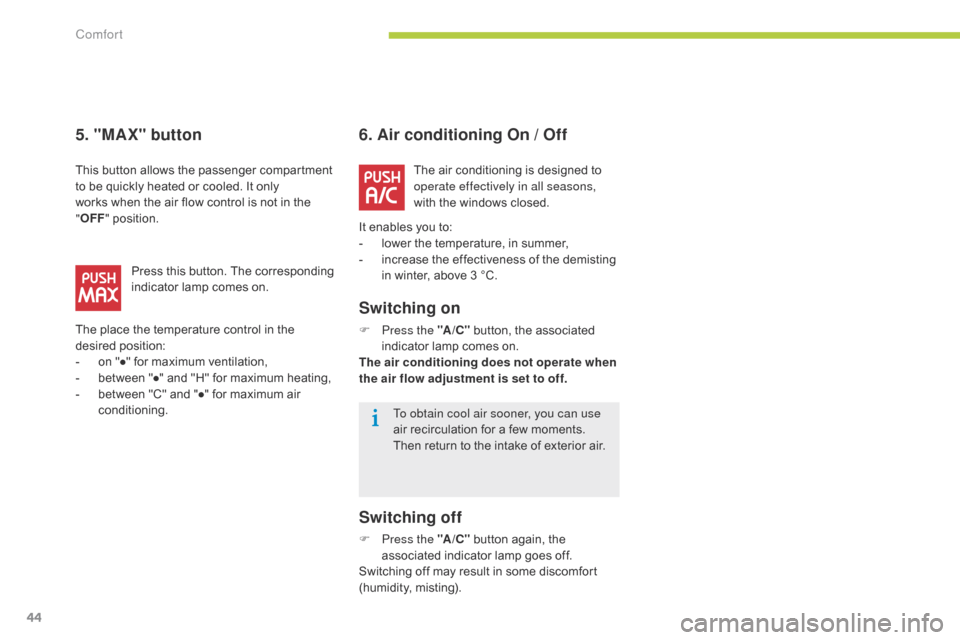
5. "MAX" button
The air conditioning is designed to
operate effectively in all seasons,
with the windows closed.
It enables you to:
-
lo
wer the temperature, in summer,
-
in
crease the effectiveness of the demisting
in winter, above 3 °C.
This button allows the passenger compartment
to be quickly heated or cooled. It only
works when the air flow control is not in the
"
OFF "
p
osition.
Press this button. The corresponding
indicator lamp comes on.
The place the temperature control in the
desired position:
-
on "
●" for maximum ventilation,
-
be
tween "●" and "H" for maximum heating,
-
be
tween "C" and "●" for maximum air
conditioning. To obtain cool air sooner, you can use
air recirculation for a few moments.
Then return to the intake of exterior air.
Comfort
Page 48 of 176
46
C-zero_en_Chap04_conduite_ed01-2014
A few driving recommendations
Observe the driving regulations at all times and
remain vigilant whatever the traffic conditions.
Pay close attention to the traffic and keep your
hands on the wheel so that you are ready to
react at any time to any eventuality.
On a long journey, a break every two hours is
strongly recommended.
In difficult weather, drive smoothly, anticipate
the need to brake and increase the distance
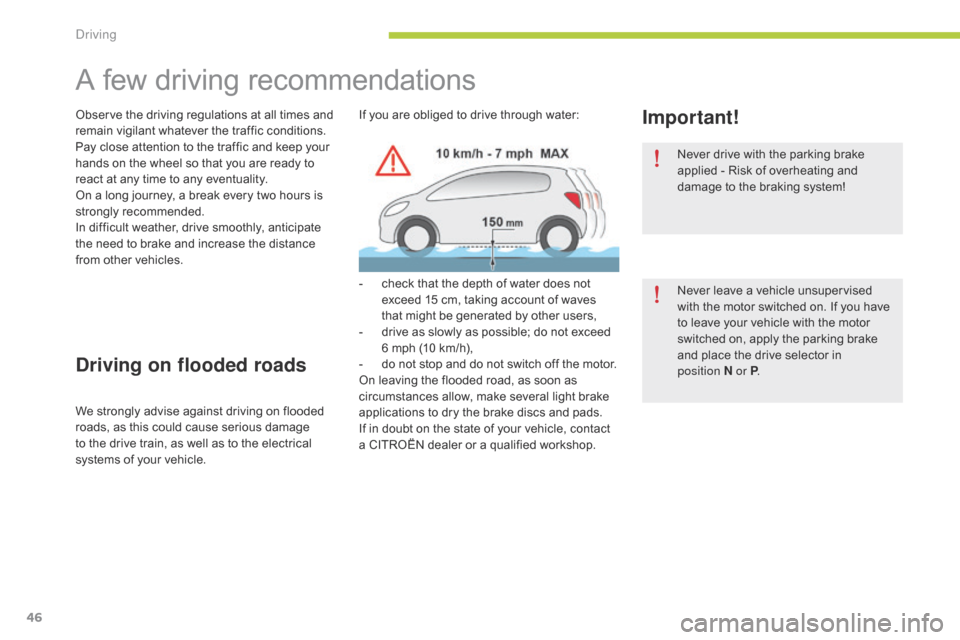
from other vehicles.If you are obliged to drive through water:
-
ch
eck that the depth of water does not
exceed 15 cm, taking account of waves
that might be generated by other users,
-
dr
ive as slowly as possible; do not exceed
6 mph (10 km/h),
-
do n
ot stop and do not switch off the motor.
On leaving the flooded road, as soon as
circumstances allow, make several light brake
applications to dry the brake discs and pads.
If in doubt on the state of your vehicle, contact
a CITROËN dealer or a qualified workshop.Important!
Driving on flooded roads
We strongly advise against driving on flooded
roads, as this could cause serious damage
to the drive train, as well as to the electrical
systems of your vehicle. Never drive with the parking brake
applied - Risk of overheating and
damage to the braking system!
Never leave a vehicle unsupervised
with the motor switched on. If you have
to leave your vehicle with the motor
switched on, apply the parking brake
and place the drive selector in
position N or P
.
Driving
Page 95 of 176

93
C-zero_en_Chap08_info-pratiques_ed01-2014
ancillaries battery
All of the electrical components of your vehicle
(other than the electric motor, the heating and
the air conditioning) are powered by this 12
V
anc
illaries battery.
It is located in the front compartment and is
recharged by the main battery, during phases
of operation ("Ready" lamp on in the instrument
panel) and charging.
If the ancillaries battery is discharged,
it will not be possible to start the
motor and the main battery cannot be
charged. F
Op
en the front bonnet using the interior
release lever, then the exterior safety
catch.
F
Se
cure the bonnet stay.
F
Sl
acken nut 1.
F
Re
move the battery protective cover for
access to the two terminals.Access to the battery
Disconnecting the battery is not
recommended.
However, if the vehicle is not to be
used for a prolonged period of more
than a month, it may be necessary to
disconnect and store it to avoid the
electrolyte freezing.
After prolonged disconnection of the
battery, you must contact a CITROËN
dealer or a qualified workshop to have
the electronic control unit reinitialised.
8
Practical information