adjust Citroen C1 2016 1.G Owner's Guide
[x] Cancel search | Manufacturer: CITROEN, Model Year: 2016, Model line: C1, Model: Citroen C1 2016 1.GPages: 269, PDF Size: 7.63 MB
Page 97 of 269
95
C1_en_Chap04_conduite_ed01-2016
Under-inflation detection
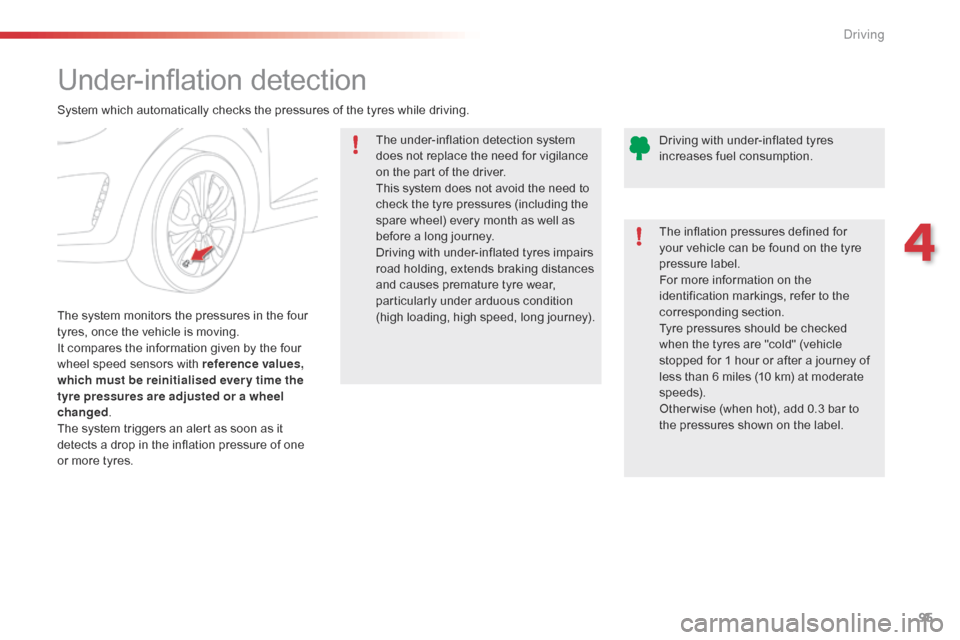
The system monitors the pressures in the four t
yres, once the vehicle is moving.
It
compares the information given by the four
w
heel speed sensors with reference values,
which must be reinitialised ever y time the
tyre pressures are adjusted or a wheel
changed .
The
system triggers an alert as soon as it
d
etects a drop in the inflation pressure of one
o
r more tyres. The
under-inflation detection system
d
oes not replace the need for vigilance
o
n the part of the driver.
This system does not avoid the need to
c
heck the tyre pressures (including the
s
pare wheel) every month as well as
b
efore a long journey.
Driving with under-inflated tyres impairs
r
oad holding, extends braking distances
a
nd causes premature tyre wear, p
articularly under arduous condition (
high loading, high speed, long journey).
System
which automatically checks the pressures of the tyres while driving.
The inflation pressures defined for
y
our vehicle can be found on the tyre
p
ressure label.
For more information on the
i
dentification markings, refer to the c
orresponding s ection.
Tyre pressures should be checked
w
hen the tyres are "cold" (vehicle
s
topped for 1 hour or after a journey of
l
ess than 6 miles (10 km) at moderate
s
peeds).
Other wise
(when hot), add 0.3 bar to
t
he pressures shown on the label.
Driving
with under-inflated tyres
i
ncreases fuel consumption.
4
Driving
Page 98 of 269
96
C1_en_Chap04_conduite_ed01-2016
Under-inflation alert
This is given by fixed illumination of this warning lamp, accompanied by
a
n audible signal.
F
R
educe speed immediately, avoid
e
xcessive steering movements and sudden
b
raking.
F
S
top the vehicle as soon as it is safe to
do so.
The
loss of pressure detected does not
a
lways cause visible bulging of the tyre.
D
o
not satisfy yourself with just a visual
c
heck.
F
I
f
you
have a compressor (such as the one
i
n
the
temporary puncture repair kit) check
t
he
pressures of the four tyres when cold.
I
f
it
is
not possible to carry out this check
s
traight away, drive carefully at reduced
s
peed.
or
F
I
n the event of a puncture, use the
temporary
puncture repair kit or the spare
w
heel (depending on equipment).
The
alert is maintained until the system
i
s
r
einitialised.
Reinitialisation
Before reinitialising the system, ensure t hat the pressures of the four tyres are
correct
for the use of the vehicle and in
l
ine with the recommendations on the
t
yre pressure label.
The
under-inflation alert can only be
r
elied on if the reinitialisation of the
s
ystem has done with the pressures in
t
he four tyres correctly adjusted.
The
under-inflation detection system
d
oes not give a warning if a pressure is
i
ncorrect at the time of reinitialisation.
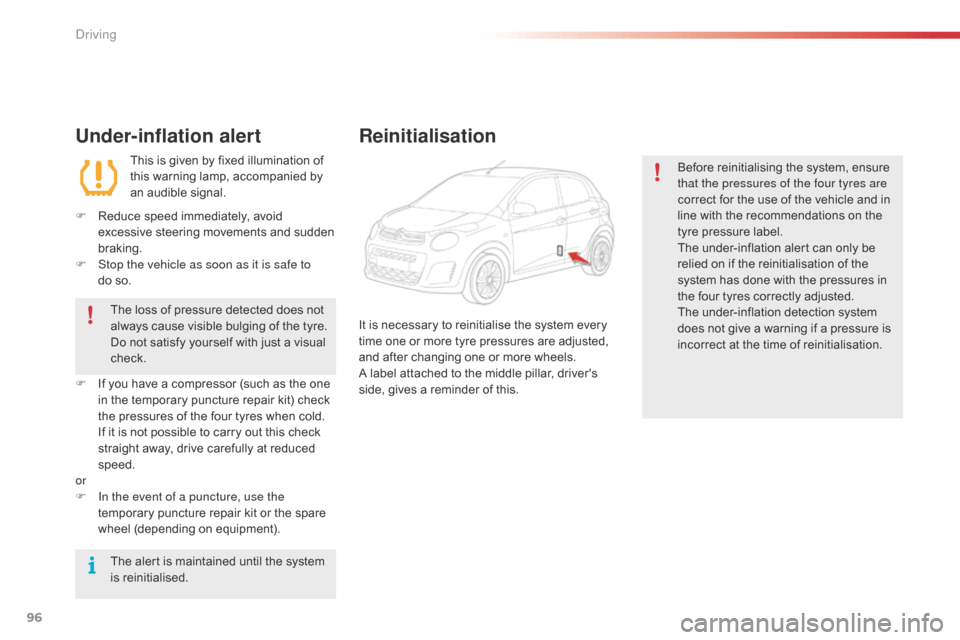
It
is
necessary
to
reinitialise
the
system
every
t
ime
one
or
more
tyre
pressures
are
adjusted,
a
nd
after
changing
one
or
more
wheels.
A
label
attached
to
the
middle
pillar,
driver's
s
ide,
gives
a
reminder
of
this.
Driving
Page 100 of 269
98
C1_en_Chap05_eclairage-visibilite_ed01-2016
Exterior lighting control stalk
Main lighting
The various front and rear lamps of the vehicle are designed to adapt the driver's visibility
p
rogressively according to the ambient light
l
evel and weather:
-
s
idelamps, to be seen,
-
d
ipped beam headlamps to see without
d
azzling
o
ther
d
rivers,
-
m
ain beam headlamps to see clearly when
t
he road is clear.
Additional lighting
Other lamps are provided to meet the requirements of particular driving conditions:
-
a
rear foglamp,
-
d
aytime running lamps to be more visible
d
uring the day. In
some weather conditions (e.g. low
t
emperature or humidity), the presence
o
f misting on the internal sur face of the
g
lass of the headlamps and rear lamps
i
s normal; it disappears after the lamps
h
ave been on for a few minutes.Travelling abroad
If using your vehicle in a country that d
rives on the other side of the road, the
h
eadlamps must be adjusted to avoid
d
azzling on-coming drivers.
Contact
a CITROËN dealer or a
q
ualified
w
orkshop.
Lighting and visibility
Page 105 of 269

103
C1_en_Chap05_eclairage-visibilite_ed01-2016
Headlamp beam
h
eight
ad
justment
To avoid causing a nuisance to other road u
sers, the height of the headlamp beams
s
hould be adjusted according to the load in the
v
ehicle.
0.
D
river only.
0.5.
D
river + front passenger.
1.5 .
4
people.
3.
4
people + maximum authorised load.
3.5.
D
river + maximum authorised load.
The
initial setting is position "0".
Direction indicators
F Left: lower the lighting stalk passing the p
oint of resistance.
F
R
ight: raise the lighting stalk passing the
p
oint of resistance.
Three flashes of the direction
indicators
F Press briefly upwards or downwards, w
ithout going beyond the point of
r
esistance; the direction indicators will
f
lash 3 times.
5
Lighting and visibility
Page 116 of 269
114
C1_en_Chap06_securite_ed01-2016
Operating faults
Sensor fault
The operation of the laser sensor may suffer inter ference from accumulations of dirt or
m
isting of the windscreen or the presence of
a
n object causing an obstruction (e.g.: bonnet
ope
n). In
this case you are warned by the
d
isplay of this flashing warning lamp
i
n the instrument panel.
Use
the windscreen demisting and regularly
c
lean the area of the windscreen in front of the
sen
sor.Do
not stick or other wise fix any object
o
n the windscreen in front of the sensor.
System fault
In the event of a malfunction of the system, you are warned by the
d
isplay of this flashing warning lamp
i
n the instrument panel.
Have
the
system checked by a CITROËN
d
ealer
or
a qualified workshop.
In
the event of an impact to the
w
indscreen at the sensor, deactivate
t
he
system and contact a CITROËN
d
ealer or a qualified workshop to have
y
our windscreen replaced.
Never
try to remove, adjust or test the
sen
sor.
Only
a CITROËN dealer or a qualified
w
orkshop is able to work on the system.
Safety
Page 119 of 269
117
C1_en_Chap06_securite_ed01-2016
The driver must ensure that passengers use the seat belts correctly and that they are all
f
astened before setting off.
Wherever
you are seated in the vehicle,
a
lways fasten your seat belt, even for short
journeys.
Do
not interchange the seat belt buckles as
t
hey will not fulfil their role fully.
The
seat belts are fitted with an inertia reel
p
ermitting automatic adjustment of the
l
ength of the strap to your size. The seat belt
i
s stowed automatically when not in use.
Before
and after use, ensure that the seat
b
elt is reeled in correctly.
The
lower part of the strap must be
p
ositioned as low as possible on the pelvis.
The
upper part must be positioned in the
h
ollow of the shoulder.
The
inertia reels are fitted with an automatic
l
ocking device which comes into operation in
t
he event of a collision, emergency braking
o
r if the vehicle rolls over. You can release
t
he device by pulling the strap firmly and
t
hen releasing it so that it reels in slightly.Recommendations for children
Use a suitable child seat if the passenger is less than 12 years old or shorter than one
a
nd a half metres.
Never
use the same seat belt to secure more
t
han one person.
Never
allow a child to travel on your lap.
For
more information on child seats, refer to
t
he corresponding section.
In
order
to
be
effective,
a
seat
belt
must:
-
b
e
tightened
as
close
to
the
body
as
p
ossible,
-
b
e
pulled
in
front
of
you
with
a
smooth
m
ovement,
checking
that
it
does
not
t
wist,
-
b
e
used
to
restrain
only
one
person,
-
n
ot
bear
any
trace
of
cuts
or
fraying,
-
n
ot
be
converted
or
modified
to
avoid
a
ffecting
it
s
p
erformance.
In the event of an impact
Depending on the nature and
seriousness of the impact , the
pretensioning
device may be deployed
b
efore and independently of the airbags.
D
eployment of the pretensioners is
a
ccompanied by a slight discharge of
h
armless smoke and a noise, due to the
a
ctivation of the pyrotechnic cartridge
i
ncorporated in the system.
In
all cases, the airbag warning lamp
c
omes on.
Following
an impact, have the seat belts
s
ystem checked, and if necessary replaced,
b
y a CITROËN dealer or a qualified
w
orkshop.
In
accordance
with
current
safety
r
egulations,
for
all
repairs
on
your
vehicle's
s
eat
belts,
go
to
a
qualified
workshop
with
t
he
skills
and
equipment
needed,
which
a
C
ITROËN
dealer
is
able
to
provide.
Have
your
seat
belts
checked
regularly
by
a
CITROËN
dealer
or
a
qualified
workshop,
p
articularly
if
the
straps
show
signs
of
d
amage.
Clean the seat belt straps with soapy
water
or
a
textile
cleaning
product,
sold
by
C
ITROËN
dealers.
After
folding
or
moving
a
seat
or
rear
bench
s
eat,
ensure
that
the
seat
belt
is
positioned
a
nd
reeled
in
correctly.
Advice
6
Safety
Page 124 of 269
122
C1_en_Chap06_securite_ed01-2016
Sit in a normal upright position.
W ear a correctly adjusted seat belt.
Do
not leave anything between the
o
ccupants and the airbags (a child, pet,
o
bject...), nor fix or attach anything close to
t
he inflation trajectory of the airbags; this
c
ould cause injuries during their deployment.
Never
modify the original definition of your
v
ehicle, particularly in the area directly
a
round the airbags.
After
an accident or if the vehicle has been
s
tolen or broken into, have the airbag
s
ystems checked.
All
work on the airbag system must be
c
arried out by a CITROËN dealer or a
q
ualified
w
orkshop.
Even
if all of the precautions mentioned
a
re observed, a risk of injury or of minor
b
urns to the head, chest or arms when an
a
irbag is deployed cannot be ruled out. The
b
ag inflates almost instantly (within a few
m
illiseconds) then deflates within the same
t
ime discharging the hot gas via openings
p
rovided for this purpose.Front airbags
Do not drive holding the steering wheel by its spokes or resting your hands on the centre
p
art of the wheel.
Passengers
must not place their feet on the
das
hboard.
Do
not smoke as deployment of the airbags
c
an cause burns or the risk of injury from a
c
igarette or pipe.
Never
remove
or
pierce
the
steering
wheel
or
h
it it violently.
Do
not fit or attach anything to the steering
w
heel or dashboard, this could cause
i
njuries with deployment of the airbags.
Advice
Lateral airbags
Use only approved covers on the seats, compatible with the deployment the lateral
a
irbags. For information on the range of seat
c
overs suitable for your vehicle, you can
contact
a CITROËN dealer.
For
more information on accessories, refer
t
o the corresponding section.
Do
not fix or attach anything to the seat
b
acks (clothing...). This could cause injury
t
o the chest or arms if the lateral airbag is
d
eployed.
Do
not sit with the upper part of the body any
n
earer to the door than necessary.
Curtain airbags
Do not fix or attach anything to the roof. This could cause injury to the head if the curtain
a
irbag is deployed.
If
fitted on your vehicle, do not remove the
g
rab handles installed on the roof, they play
a
part in securing the curtain airbags.
For the airbags to be fully effective, observe the safety recommendations below:
Safety
Page 127 of 269
125
C1_en_Chap06_securite_ed01-2016
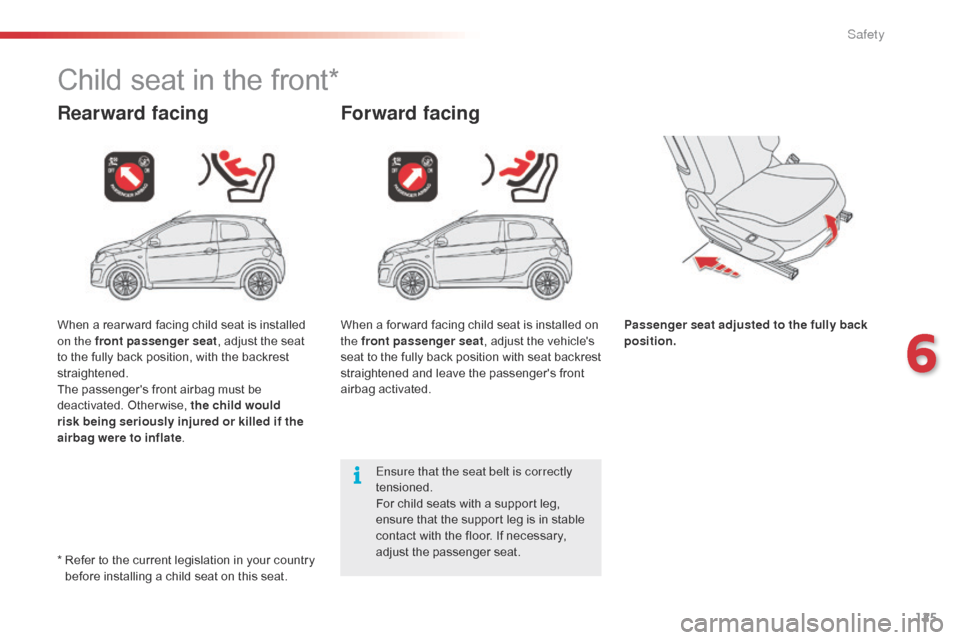
Child seat in the front*
Rearward facingForward facing
Passenger seat adjusted to the fully back
position.
Ensure that the seat belt is correctly
tensioned.
For
child
seats
with
a
support
leg,
e
nsure
that
the
support
leg
is
in
stable
c
ontact
with
the
floor.
If
necessary,
a
djust
t
he
p
assenger
sea
t.
When
a
rear ward
facing
child
seat
is
installed
o
n the front passenger seat ,
adjust
the
seat
t
o
the
fully
back
position,
with
the
backrest
s
traightened.
The
passenger's
front
airbag
must
be
d
eactivated.
O
therwise,
t
he child would
risk being seriously injured or killed if the
airbag were to inflate . When
a
for ward
facing
child
seat
is
installed
on
t
he front passenger seat ,
adjust
the
vehicle's
s
eat
t
o
t
he
f
ully
b
ack
p
osition
w
ith
s
eat
b
ackrest
s
traightened
and
leave
the
passenger's
front
a
irbag
activated.
*
R
efer
to
the
current
legislation
in
your
country
b
efore
installing
a
child
seat
on
this
seat.
6
Safety
Page 132 of 269
130
C1_en_Chap06_securite_ed01-2016
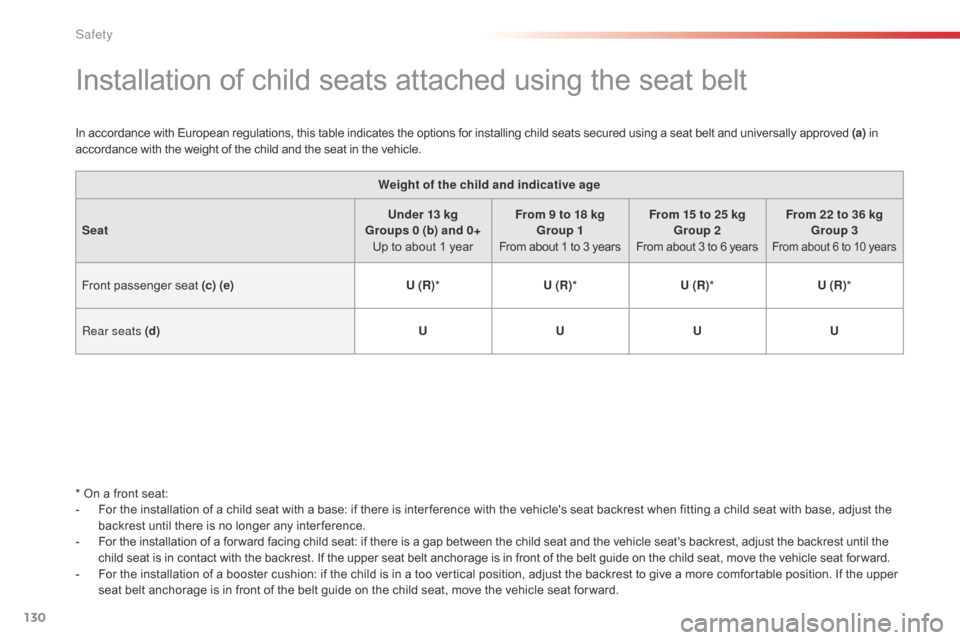
Installation of child seats attached using the seat belt
In accordance with European regulations, this table indicates the options for installing child seats secured using a seat belt and universally approved (a) in
accordance with the weight of the child and the seat in the vehicle.
Weight of the child and indicative age
Seat Under 13 kg
Groups 0 (b) and 0+ Up
to about 1 yearFrom 9 to 18 kg
Group 1
From
about 1 to 3 yearsFrom 15 to 25 kg
Group 2
From
about 3 to 6 yearsFrom 22 to 36 kg
Group 3
From about 6 t o 1 0 ye ars
Front passenger sea t ( c) (e) U (R)* U (R)* U (R)* U (R)*
Rear seats (d) UUUU
*
On a front seat:
-
F
or the installation of a child seat with a base: if there is inter ference with the vehicle's seat backrest when fitting a child seat with base, adjust the
b
ackrest until there is no longer any inter ference.
-
F
or the installation of a for ward facing child seat: if there is a gap between the child seat and the vehicle seat's backrest, adjust the backrest until the
c
hild seat is in contact with the backrest. If the upper seat belt anchorage is in front of the belt guide on the child seat, move the vehicle seat for ward.
-
F
or the installation of a booster cushion: if the child is in a too vertical position, adjust the backrest to give a more comfortable position. If the upper
s
eat belt anchorage is in front of the belt guide on the child seat, move the vehicle seat for ward.
Safety
Page 135 of 269
133
C1_en_Chap06_securite_ed01-2016
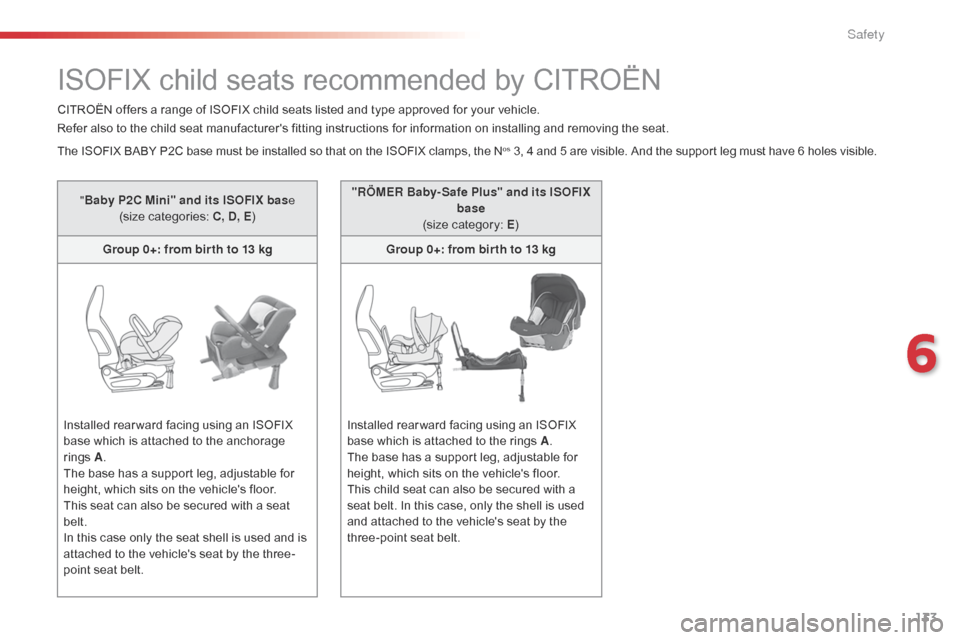
"Baby P2C Mini" and its ISOFIX bas e
(size c ategories: C , D, E)
Group 0+: from bir th to 13 kg
Installed
rear ward facing using an ISOFIX
b
ase which is attached to the anchorage
r
ings
A .
T
he base has a support leg, adjustable for
h
eight, which sits on the vehicle's floor.
This
seat can also be secured with a seat
bel
t.
In
this case only the seat shell is used and is
a
ttached to the vehicle's seat by the three-
point
seat belt.
ISOFIX child seats recommended by CITROËN
CITROËN offers a range of ISOFIX child seats listed and type approved for your vehicle.
R efer also to the child seat manufacturer's fitting instructions for information on installing and removing the seat.
The
ISOFIX BABY P2C base must be installed so that on the ISOFIX clamps, the N
os 3, 4 and 5 are visible. And the support leg must have 6 holes visible.
"
RÖMER Baby- Safe Plus" and its ISOFIX base
(size
category:
E )
Group 0+: from bir th to 13 kg
Installed
rear ward
facing
using an ISOFIX
b
ase
which
is
attached
to
the
rings A.
The
base
has
a
support
leg,
adjustable for
h
eight,
which
sits
on
the
vehicle's floor.
This
child
seat
can
also
be
secured with a
s
eat
belt.
In
this
case,
only
the shell is used
a
nd
attached
to
the
vehicle's
seat by the
t
hree-point
seat
belt.
6
Safety