eco CITROEN C1 2017 Owners Manual
[x] Cancel search | Manufacturer: CITROEN, Model Year: 2017, Model line: C1, Model: CITROEN C1 2017Pages: 269, PDF Size: 7.63 MB
Page 4 of 269
.
.
C1_en_Chap00a_sommaire_ed01-2016
Instrument panels 11
Display screens
1
3
Indicator
and warning lamps
1
5
Indicators
2
6
Trip
computer
2
7
Setting
the time
2
9
InstrumentsOver view
Keys 31
K eyless Entry and Starting system
3
4
Doors
3
8
Boot
3
9
Front
electric windows
4
1
Rear
quarter windows
4
1
Electric
fa
bric
ro
of
4
2
Access
Front seats 46
Rear seats
4
8
Mirrors
5
0
Steering
wheel adjustment
5
1
Ventilation
5
2
Heating
5
4
Manual
a
ir
c
onditioning
5
5
Automatic
air conditioning
5
7
Front
demist - defrost
6
0
Rear
screen demist - defrost
6
1
Courtesy
lamp
6
2
Boot
lamp
6
2
Interior
fittings
6
3
Rear
parcel shelf
6
7
Boot
fittings
6
8
Ease of use a nd c omfort
Driving recommendations 7 0
Starting - switching off the engine
with
the key
7
1
Starting
- switching off the engine with
t
he Keyless Entry and Starting system
7
2
Manual
par
king
b
rake
7
6
5 -speed
manual gearbox
7
6
ETG
electronic gearbox
7
7
Gear
shift indicator
8
1
Hill
start assist
8
2
Stop
& Start
8
3
Speed
limiter
8
6
Reversing
camera
9
2
Lane
departure warning system
9
3
Under-inflation
d
etection
9
5
Driving
Eco-driving
Contents
Page 5 of 269
.
C1_en_Chap00a_sommaire_ed01-2016
Exterior lighting control stalk 98
Automatic illumination of headlamps
1
01
Direction
indicators
1
03
Headlamp
beam height adjustment
1
03
Wiper
control stalk
1
04
Lighting and v isibility
Horn 10 6
Hazard warning lamps
1
06
ESC
system
1
07
Active
City Brake
1
10
Seat
belts
1
15
Airbags
1
18
Child
seats
1
23
Deactivating the passenger's front airbag 126
ISOFIX
child
seats
1
32
Child
lock
1
37
Safety
In
t
he
e
vent
o
f
a
b
reakdown
Fuel tank 138
Snow chains
1
40
Electrical
energy economy mode
1
41
Accessories
1
42
Changing
a wiper blade
1
44
Fitting
roof bars
1
44
Bonnet
14
6
Petrol
engines
1
47
Checking
levels
1
48
C h e c ks
1
51
Practical information Technical da ta
7-inch touch screen tablet 185
Audio system
2
35
Audio and telematics
Alphabetical
in
dex
Temporary puncture repair kit 1 53
Spare wheel
1
58
Changing
a bulb
1
63
Changing
a fuse
1
68
12
V battery
1
77
Towing
the vehicle
1
80Engines
1
81
Weights
1
82
Dimensions
1
83
Identification
ma
rkings
1
84
Contents
Page 10 of 269
8
C1_en_Chap00b_vue-ensemble_ed01-2016
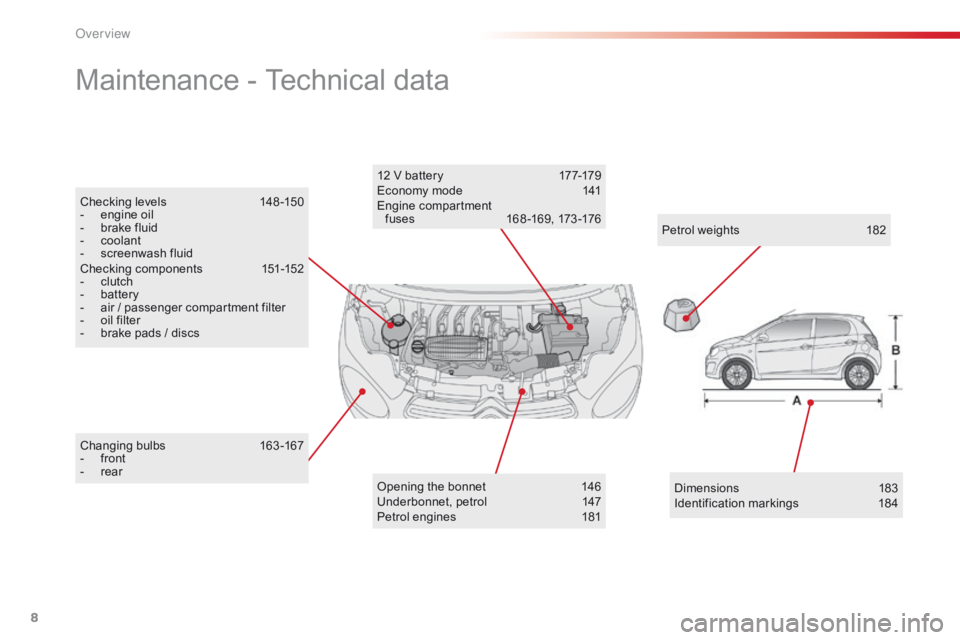
Changing bulbs 1 63-167
- f ront
-
r
ear
Maintenance - Technical data
Opening the bonnet 1 46
Underbonnet, petrol 1 47
Petrol
engines
1
81
12
V battery
1
77-179
Economy mode
1
41
Engine
c
ompartment
f
uses
1
68 -169, 173 -176
Petrol weights
1
82
Checking
levels
1
48 -150
-
e
ngine
oil
-
b
rake
fluid
-
c
oolant
-
s
creenwash
fluid
Checking
components
1
51-152
-
c
lutch
-
b
attery
-
a
ir
/
passenger
compartment
filter
-
o
il
filter
-
b
rake
pads
/
discs
Dimensions 1 83
Identification
ma
rkings
1
84
Over view
Page 11 of 269
9
C1_en_Chap00c_eco-conduite_ed01-2016
Optimise the use of your gearbox
With a manual gearbox, move off gently and change up without waiting. During acceleration change up early.
With
an ETG electronic gearbox, give preference to automatic (Easy)
m
ode and avoid pressing the accelerator pedal heavily or suddenly.
Control the use of your electrical
equipment
Before moving off, if the passenger compartment is too warm, ventilate it by opening the windows and air vents before using the air conditioning.
Above
30 mph (50 km/h), close the windows and leave the air vents
ope
n.
Remember
to make use of equipment that can help keep the
t
emperature in the passenger compartment down (sunroof and window
b
linds...).
Switch
off the air conditioning, unless it has automatic regulation, as
s
oon as the desired temperature is attained.
Switch
off the demisting and defrosting controls, if not automatic.
Switch
off the heated seat as soon as possible.
Switch
off the headlamps and front foglamps when the level of light
d
oes not require their use.
Avoid
running the engine before moving off, particularly in winter; your
v
ehicle will warm up much faster while driving.
As
a passenger, if you avoid connecting your multimedia devices
(
film, music, video game...), you will contribute towards limiting the
c
onsumption of electrical energy, and so of fuel.
Disconnect
your portable devices before leaving the vehicle.
Eco-driving
Eco-driving is a range of everyday practices that allow the motorist to optimise their fuel consumption and CO2 emissions.
The
gear
shift
indicator
invites
you
to
engage
the
most
suitable
gear:
a
s
soon
as
the
indication
is
displayed
in
the
instrument
panel,
follow
it
s
traight
away.
For
vehicles
fitted
with
an
ETG
electronic
gearbox,
this
indicator
a
ppears
only
in
manual
mode.
Drive smoothly
Maintain a safe distance between vehicles, use engine braking rather t han the brake pedal, and press the accelerator progressively. These
p
ractices contribute towards a reduction in fuel consumption and CO
2
emissions
and
also
helps
reduce
the
background
traffic
noise.
.
Eco-driving
Page 12 of 269
10
C1_en_Chap00c_eco-conduite_ed01-2016
Limit the causes of excess consumption
Spread loads throughout the vehicle; place the heaviest items in the bottom of the boot, as close as possible to the rear seats.
Limit
the loads carried in the vehicle and reduce wind resistance
(roof
bars, roof rack...). Use a roof box in preference.
Remove
roof bars and roof racks after use.
At
the end of winter, remove snow tyres and refit your summer tyres.
Observe the recommendations on
maintenance
Check the tyre pressures regularly, when cold, referring to the label in the door aperture, driver's side.
Carry
out this check in particular:
-
b
efore a long journey,
-
a
t each change of season,
-
a
fter a long period out of use.
Don't
forget the spare wheel and the tyres on any trailer or caravan.
Have
your vehicle serviced regularly (engine oil, oil filter, air filter,
p
assenger compartment filter...) and observe the schedule of
o
perations recommended in the maintenance and warranty guide.
When
refuelling, do not continue after the third cut-off of the nozzle to
a
void any over flow.
At
the wheel of your new vehicle, it is only after the first 1 800 miles
(
3 000 kilometres) that you will see the fuel consumption settle down to
a
consistent average.
Eco-driving
Page 15 of 269

13
C1_en_Chap01_instrument- de-bord_ed01-2016
Central display screen
The information displayed varies according to your vehicle's engine and type of gearbox.
Central display screen
with the VTi 68 engine and
manual gearboxCentral display screen
with the VTi 68 and ETG
electronic gearboxCentral display screen with
the PureTech 82 engine and
manual gearbox
1. Ambient t
emperature. I
t flashes if there is a risk of ice.
2.
V
ehicle information with:
-
T
otal and trip distance recorders.
-
T
rip computer information.
-
S
peed limiter information.
3.
F
uel gauge. 1. G
ear selector position and gear engaged.
2. V ehicle information with:
-
T
otal and trip distance recorders.
-
T
rip computer information.
-
S
peed limiter information.
-
A
mbient
t
emperature.
I
t flashes if there is a risk of ice.
3.
F
uel gauge.1. S
peed limiter information.
2. V ehicle information with:
-
T
otal and trip distance recorders.
-
T
rip computer information.
-
A
mbient
t
emperature.
I
t flashes if there is a risk of ice.
3.
F
uel gauge.
For
more information, refer to the
s
ection corresponding to the function
a
nd its associated display.
1
Instruments
Page 17 of 269
15
C1_en_Chap01_instrument- de-bord_ed01-2016
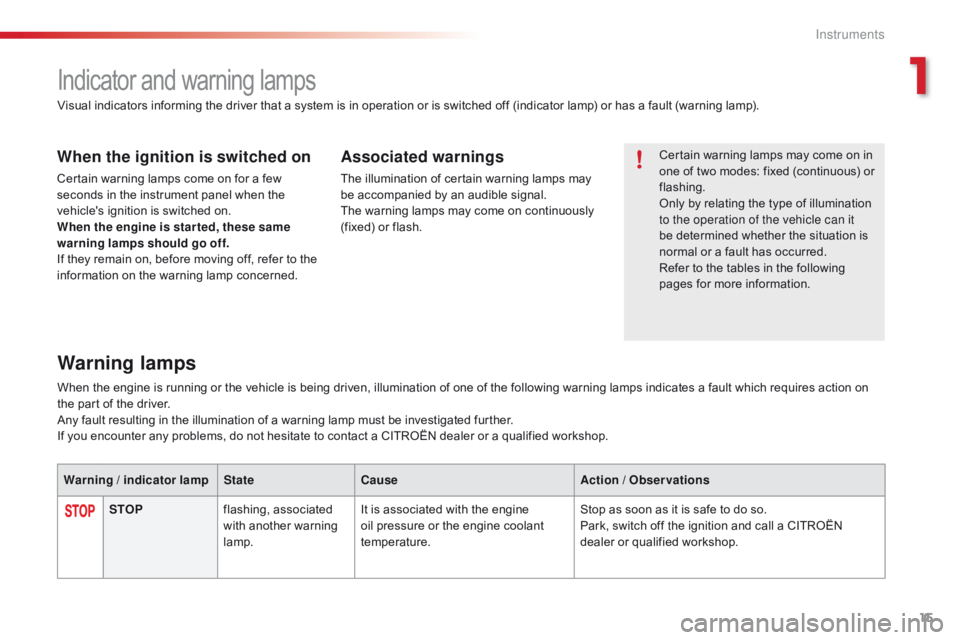
Indicator and warning lamps
Certain warning lamps may come on in one of two modes: fixed (continuous) or
f
lashing.
Only
by relating the type of illumination
t
o the operation of the vehicle can it
be
determined whether the situation is
n
ormal or a fault has occurred.
Refer
to the tables in the following
p
ages
f
or
m
ore
i
nformation.
Visual
indicators
informing
the
driver
that
a
system
is
in
operation
or
is
switched
off
(indicator
lamp)
or
has
a
fault (warning lamp).When the ignition is switched on
Certain warning lamps come on for a few s
econds in the instrument panel when the
v
ehicle's ignition is switched on.
When the engine is star ted, these same
warning lamps should go off.
If
they remain on, before moving off, refer to the
i
nformation on the warning lamp concerned.
Associated warnings
The illumination of certain warning lamps may be accompanied by an audible signal.
The
warning lamps may come on continuously
(
fixed) or flash.
Warning lamps
STOP flashing, associated w
ith another warning
lam
p.It
is associated with the engine o
il pressure or the engine coolant
t
emperature.Stop
as soon as it is safe to do so.
Park, switch off the
ignition and call a CITROËN
d
ealer or qualified workshop.
When
the engine is running or the vehicle is being driven, illumination of one of the following warning lamps indicates a fault which requires action on
t
he
part
of the driver.
Any
fault
resulting in the illumination of a warning lamp must be investigated further.
If
you
encounter any problems, do not hesitate to contact a CITROËN dealer or a qualified workshop.
Warning
/ indicator lamp
State Cause Action
/ Observations
1
Instruments
Page 18 of 269
16
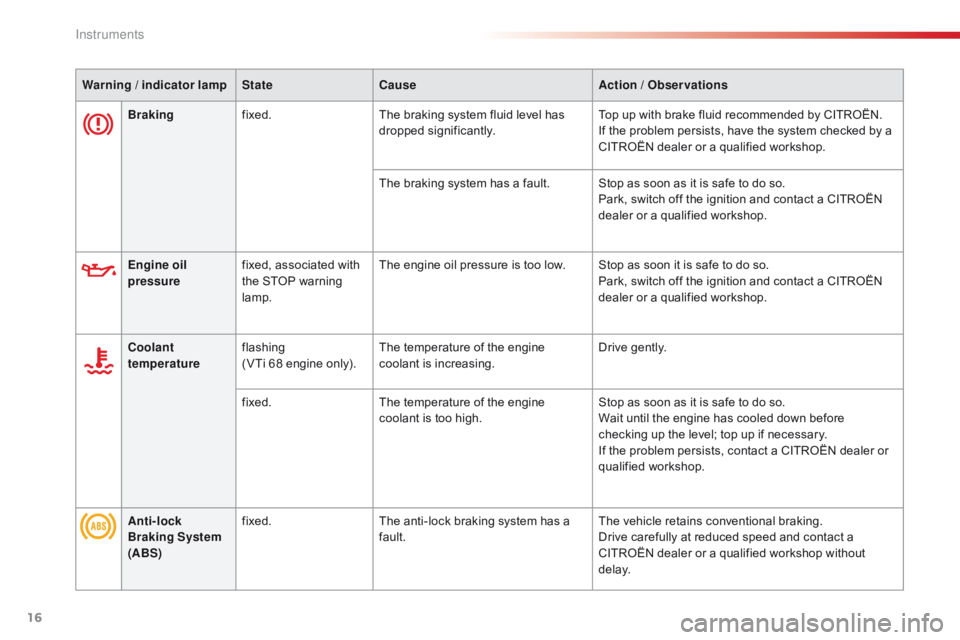
Brakingfixed. The braking system fluid level has d
ropped s ignificantly.Top
up with brake fluid recommended by CITROËN.
If the problem persists, have the system checked by a
C
ITROËN dealer or a qualified workshop.
The
braking system has a fault. Stop as soon as it is safe to do so.
Park,
switch off the ignition and contact a CITROËN
d
ealer or a qualified workshop.
Warning
/ indicator lamp
State Cause Action
/ Observations
Engine oil
pressure fixed,
associated with
t
he STOP warning
lam
p.The
engine oil pressure is too low. Stop as soon it is safe to do so.
Park,
switch off the ignition and contact a CITROËN
d
ealer or a qualified workshop.
Coolant
temperature flashing
(
VTi 68 engine only).The
temperature of the engine
c
oolant
i
s
inc
reasing.Drive
gently.
fixed. The
temperature of the engine
c
oolant is too high.Stop
as soon as it is safe to do so.
Wait
until the engine has cooled down before
c
hecking up the level; top up if necessary.
If
the problem persists, contact a CITROËN dealer or
q
ualified
w
orkshop.
Anti-lock
Braking System
(ABS) fixed.
The
anti-lock braking system has a
f
ault.The
vehicle retains conventional braking.
Drive
carefully at reduced speed and contact a
C
ITROËN dealer or a qualified workshop without
d
e l ay.
Instruments
Page 24 of 269
22
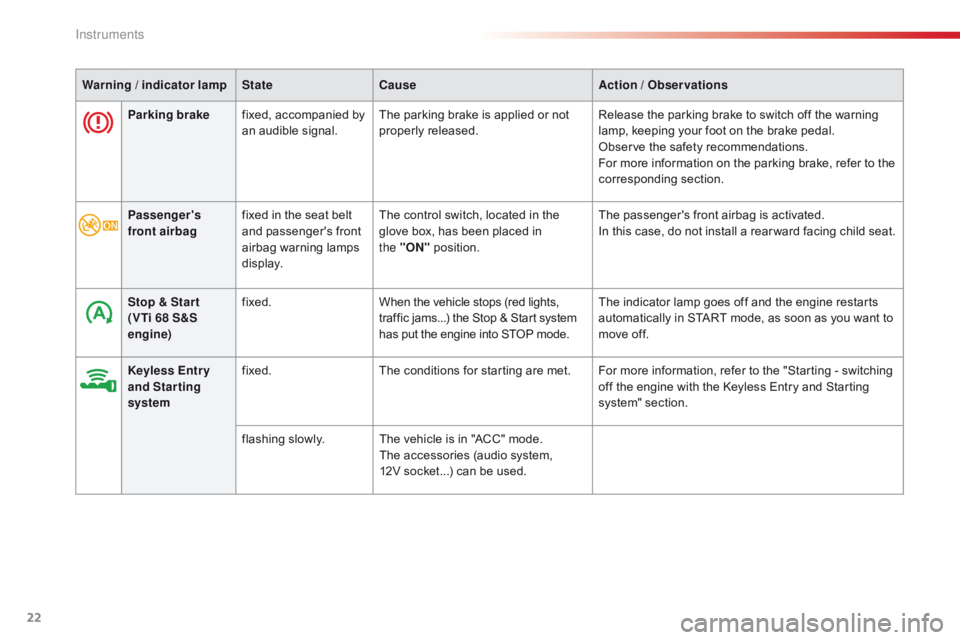
Parking brakefixed, accompanied by a
n audible signal.The
parking brake is applied or not p
roperly r eleased.Release
the parking brake to switch off the warning l
amp, keeping your foot on the brake pedal.
Observe
the safety recommendations.
For
more information on the parking brake, refer to the
c
orresponding
s
ection.
Warning
/ indicator lamp
State Cause Action
/ Observations
Passenger's
front airbag fixed
in the seat belt
a
nd passenger's front
a
irbag
w
arning
lam
ps
d
isplay. The
control switch, located in the
g
love box, has been placed in
t
he "ON"
p
osition.The
passenger's front airbag is activated.
In
this case, do not install a rear ward facing child seat.
Stop & Star t
(VTi 68 S&S
engine) fixed.
When
the vehicle stops (red lights,
t
raffic jams...) the Stop & Start system
h
as put the engine into STOP mode.The
indicator lamp goes off and the engine restarts
a
utomatically in START mode, as soon as you want to
m
ove off.
Keyless Entr y
and Starting
system fixed.
The
conditions for starting are met. For more information, refer to the "Starting - switching
o
ff the engine with the Keyless Entry and Starting
s
ystem" section.
flashing
s
lowly.The
vehicle is in "ACC" mode.
The
accessories (audio system,
1
2V socket...) can be used.
Instruments
Page 26 of 269

24
Passenger's
front airbagfixed,
in the seat belt a
nd front passenger's
a
irbag
w
arning
lam
ps
d
isplay. The
control switch, located in the g
love box, is set to the OFF p osition.The
passenger's front airbag is deactivated.
You can install a rear ward facing child seat on the
f
ront seat unless there is a fault with the airbags
(
Airbag warning lamp on).
Traction control
(TRC) fixed.
A
brief press has been made on the
b
utton.
The
traction control (TRC) system is
d
eactivated.Press
the button to activate the system.
The
TRC system is activated automatically when the
v
ehicle is started.
If
deactivated, the system is reactivated automatically
f
rom around 30 mph (50 km/h).
For
more information, refer to the corresponding
s
ection.
Dynamic
stability control
(DSC) fixed.
Vehicle stationary, the button
has
been pressed for more than
3 s
econds.
The
traction control (TRC) and
d
ynamic stability control (DSC)
s
ystems are deactivated.Press
this button to activate the systems.
The
DSC system is activated automatically when the
v
ehicle is started.
For
more information, refer to the corresponding
s
ection.
Warning
/ indicator lamp
State Cause Action
/ Observations
Deactivation indicator lamps
If one of the following indicator lamps comes on, this confirms that the corresponding system has been switched off intentionally.
T his is may be accompanied by an audible signal.
Instruments