ignition Citroen C3 2015 2.G Workshop Manual
[x] Cancel search | Manufacturer: CITROEN, Model Year: 2015, Model line: C3, Model: Citroen C3 2015 2.GPages: 401, PDF Size: 13.04 MB
Page 162 of 401
160
For vehicles without a multifunction screen, the range indicator
appears in the instrument panel screen.
In the event of a fault with the the SCR emissions control systema system that prevents engine starting
i s activated automatically from
650
miles (1 100 km) after confirmation
of a fault with the SCR emissions
control system. Have the system
checked by a CITR
oËn
dealer or a
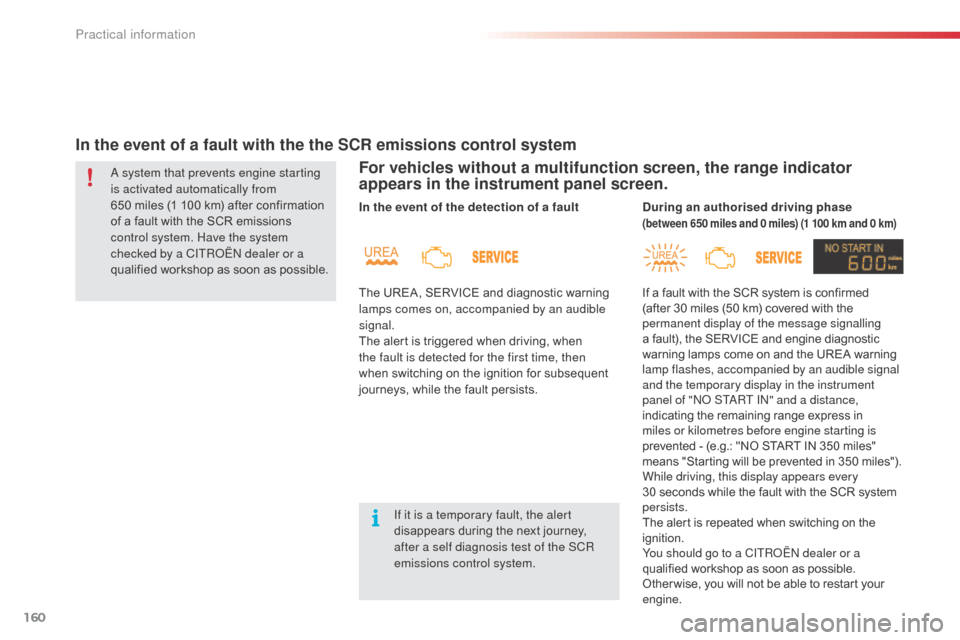
qualified workshop as soon as possible. In the event of the detection of a fault
If it is a temporary fault, the alert
disappears during the next journey,
after a self diagnosis test of the SCR
emissions control system.
The UREA, SERVICE and diagnostic warning
lamps comes on, accompanied by an audible
signal.
The alert is triggered when driving, when
the fault is detected for the first time, then
when switching on the ignition for subsequent
journeys, while the fault persists.
If a fault with the SCR system is confirmed
(after 30 miles (50 km) covered with the
permanent display of the message signalling
a fault), the SERVICE and engine diagnostic
warning lamps come on and the UREA warning
lamp flashes, accompanied by an audible signal
and the temporary display in the instrument
panel of "
n
o ST
aR
T I
n" a
nd a distance,
indicating the remaining range express in
miles or kilometres before engine starting is
prevented
- (e.g.: "NO START IN 350 miles"
means "Starting will be prevented in 350 miles").
While driving, this display appears every
30
seconds while the fault with the SCR system
persists.
The alert is repeated when switching on the
ignition.
You should go to a CITR
oËn
dealer or a
qualified workshop as soon as possible.
Other wise, you will not be able to restart your
engine. During an authorised driving phase
(between 650 miles and 0 miles) (1 100 km and 0 km)
Practical information
Page 163 of 401
161
You have exceeded the authorised
driving limit: the starting prevention
system inhibits engine starting.
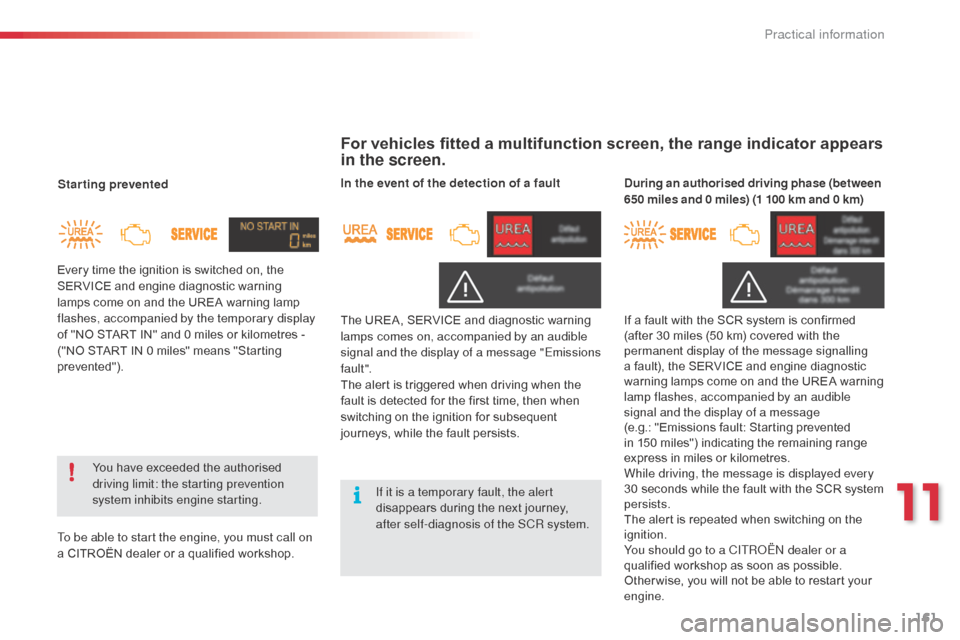
Every time the ignition is switched on, the
SERVICE and engine diagnostic warning
lamps come on and the UREA warning lamp
flashes, accompanied by the temporary display
of "NO START IN" and 0 miles or kilometres
-
("NO START IN 0 miles" means "Starting
prevented"). Starting prevented
To be able to start the engine, you must call on
a CITROËN dealer or a qualified workshop.
For vehicles fitted a multifunction screen, the range indicator appears
in the screen.
If it is a temporary fault, the alert
disappears during the next journey,
after self-diagnosis of the SCR system.
The UREA, SERVICE and diagnostic warning
lamps comes on, accompanied by an audible
signal and the display of a message "Emissions
fault".
The alert is triggered when driving when the
fault is detected for the first time, then when
switching on the ignition for subsequent
journeys, while the fault persists. In the event of the detection of a fault
If a fault with the SCR system is confirmed
(after 30 miles (50 km) covered with the
permanent display of the message signalling
a fault), the SERVICE and engine diagnostic
warning lamps come on and the UREA warning
lamp flashes, accompanied by an audible
signal and the display of a message
(e.g.: "Emissions fault: Starting prevented
in 150 miles") indicating the remaining range
express in miles or kilometres.
While driving, the message is displayed every
30 seconds while the fault with the SCR system
persists.
The alert is repeated when switching on the
ignition.
You should go to a CITR
oËn
dealer or a
qualified workshop as soon as possible.
Other wise, you will not be able to restart your
engine. During an authorised driving phase (between
650 miles and 0 miles) (1 100 km and 0 km)
11
Practical information
Page 164 of 401
162
You have exceeded the authorised
driving limit: the starting prevention
system inhibits engine starting.
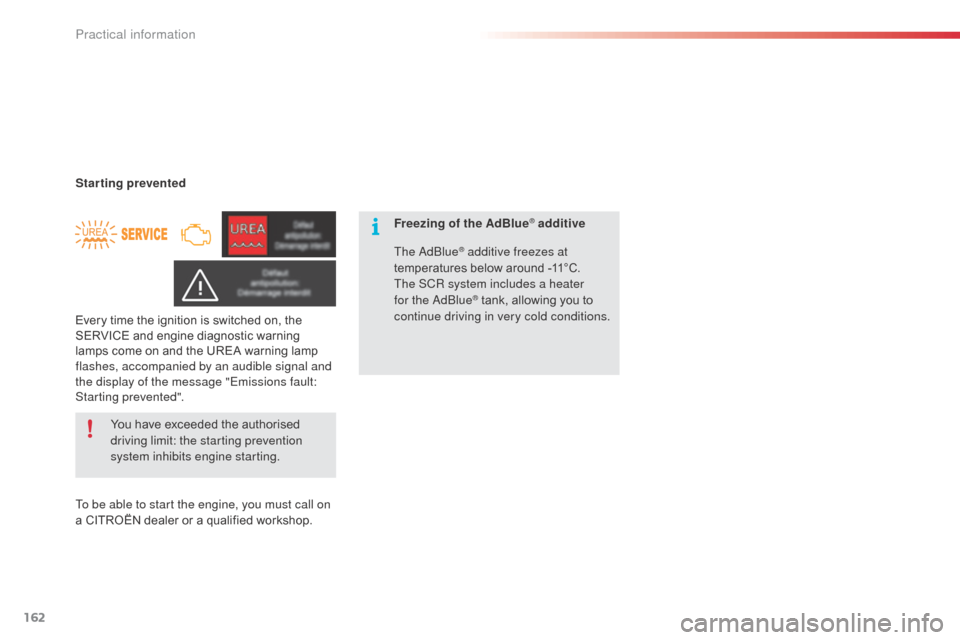
Every time the ignition is switched on, the
SERVICE and engine diagnostic warning
lamps come on and the UREA warning lamp
flashes, accompanied by an audible signal and
the display of the message "Emissions fault:
Starting prevented". Starting prevented
To be able to start the engine, you must call on
a CITROËN dealer or a qualified workshop. Freezing of the AdBlue
® additive
The
a
d
blu
e
® additive freezes at
temperatures below around -11°C.
The SCR system includes a heater
for the
a
dbl
ue
® tank, allowing you to
continue driving in very cold conditions.
Practical information
Page 167 of 401
165
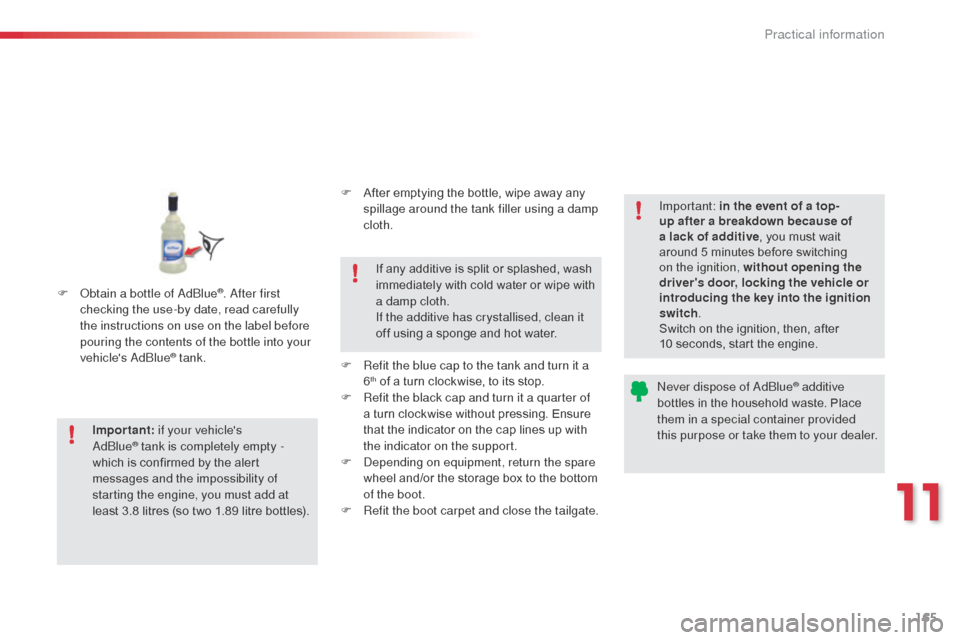
F obtain a bottle of adbl ue®. after first
checking the use-by date, read carefully
the instructions on use on the label before
pouring the contents of the bottle into your
vehicle's
a
d
blu
e
® tank.
Important : if your vehicle's
a
d
blu
e
® tank is completely empty -
w
hich is confirmed by the alert
messages and the impossibility of
starting the engine, you must add at
least 3.8 litres (so two 1.89 litre bottles). If any additive is split or splashed, wash
immediately with cold water or wipe with
a damp cloth.
If the additive has crystallised, clean it
off using a sponge and hot water.
Important: in the event of a top-
up after a breakdown because of
a lack of additive
, you must wait
around 5 minutes before switching
on the ignition, without opening the
driver's door, locking the vehicle or
introducing the key into the ignition
switch .
Switch on the ignition, then, after
10 seconds, start the engine.
ne
ver dispose of a
dbl
ue
® additive
bottles in the household waste. Place
them in a special container provided
this purpose or take them to your dealer.
F
A
fter emptying the bottle, wipe away any
spillage around the tank filler using a damp
cloth.
F
R
efit the blue cap to the tank and turn it a
6th of a turn clockwise, to its stop.
F
R
efit the black cap and turn it a quarter of
a turn clockwise without pressing. Ensure
that the indicator on the cap lines up with
the indicator on the support.
F
d
e
pending on equipment, return the spare
wheel and/or the storage box to the bottom
of the boot.
F
R
efit the boot carpet and close the tailgate.
11
Practical information
Page 169 of 401
167
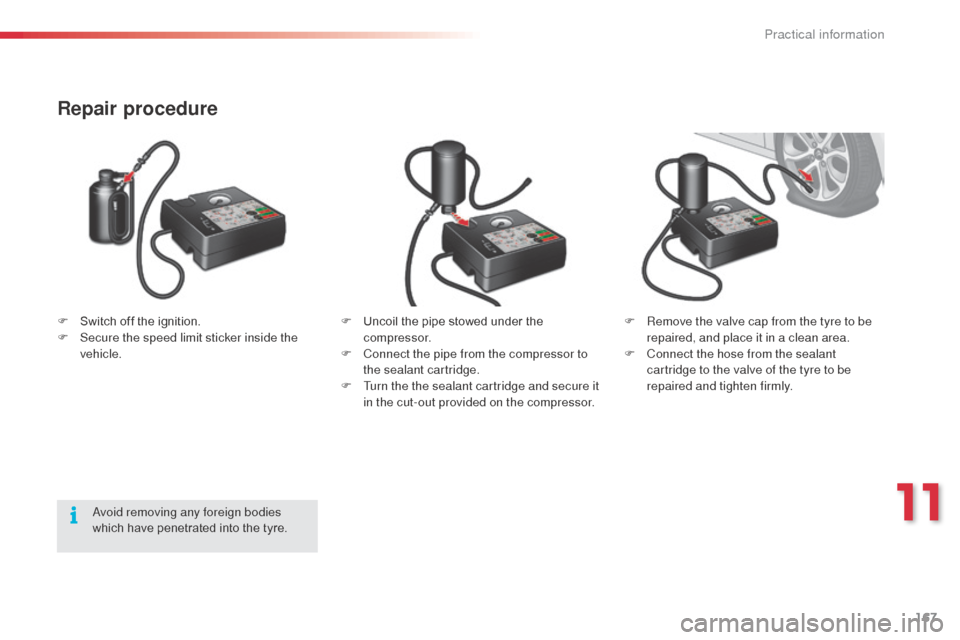
Repair procedure
F Uncoil the pipe stowed under the compressor.
F
C
onnect the pipe from the compressor to
the sealant cartridge.
F
T
urn the the sealant cartridge and secure it
in the cut-out provided on the compressor.
av
oid removing any foreign bodies
which have penetrated into the tyre.
F
S
witch off the ignition.
F
S
ecure the speed limit sticker inside the
vehicle. F
R emove the valve cap from the tyre to be
repaired, and place it in a clean area.
F
C
onnect the hose from the sealant
cartridge to the valve of the tyre to be
repaired and tighten firmly.
11
Practical information
Page 170 of 401
168
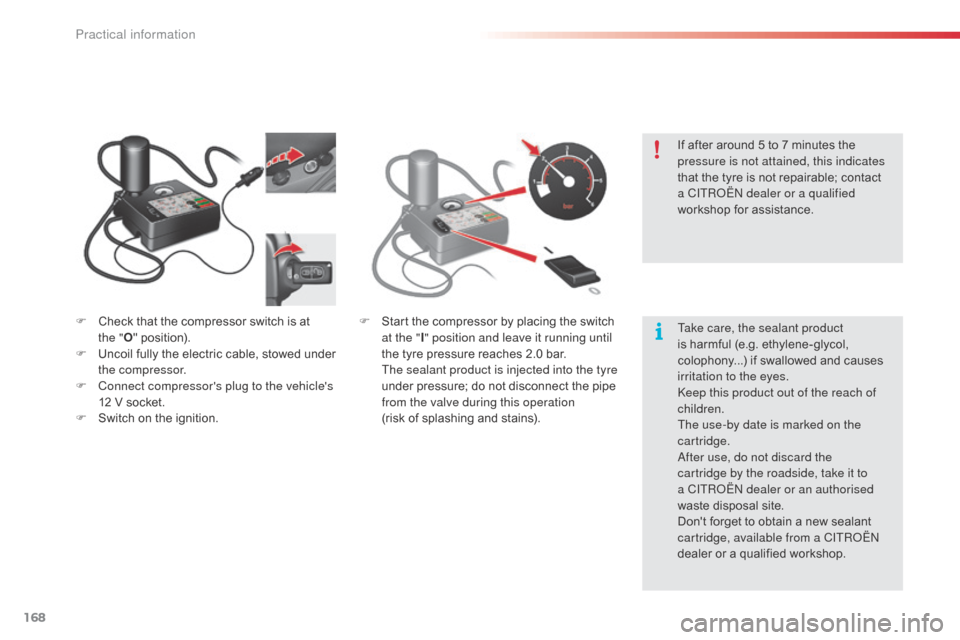
F Check that the compressor switch is at the " O" position).
F
U
ncoil fully the electric cable, stowed under
the compressor.
F
C
onnect compressor's plug to the vehicle's
12 V socket.
F
S
witch on the ignition. F
S tart the compressor by placing the switch
at the " I" position and leave it running until
the tyre pressure reaches 2.0 bar.
T
he sealant product is injected into the tyre
under pressure; do not disconnect the pipe
from the valve during this operation
(risk of splashing and stains). If after around 5 to 7 minutes the
pressure is not attained, this indicates
that the tyre is not repairable; contact
a CITR
oËn
dealer or a qualified
workshop for assistance.
Take care, the sealant product
is harmful (e.g. ethylene-glycol,
colophony...) if swallowed and causes
irritation to the eyes.
ke
ep this product out of the reach of
children.
The use-by date is marked on the
cartridge.
af
ter use, do not discard the
cartridge by the roadside, take it to
a CITR
oËn
dealer or an authorised
waste disposal site.
Don't forget to obtain a new sealant
cartridge, available from a CITR
oËn
dealer or a qualified workshop.
Practical information
Page 171 of 401

169
F Place the switch in the "O" position.
F R emove the kit.
F
D
rive immediately for approximately
three miles (five kilometres), at reduced
speed (between 15 and 35 mph (20 and
60
km/h)), to plug the puncture.
F
S
top to check the repair and the tyre
pressure using the kit.
Checking / adjusting tyre pressures
You can also use the compressor, without
injecting sealant, to check and if necessary
adjust the tyre pressures.
F
R
emove the valve cap from the tyre and
place it in a clean area.
F
U
ncoil the pipe stowed under the
compressor.
F
S
crew the pipe onto the valve and tighten
f i r m l y. F
C heck that the compressor switch is at
the " O" position.
F
U
ncoil fully the electric cable, stowed under
the compressor.
F
C
onnect the compressor's plug to the
vehicle's 12 V socket.
F
S
witch on the ignition.
11
Practical information
Page 176 of 401

174
Removing a wheel
List of operations
F Remove the bolt cover from each of the bolts using the tool 3 (with alloy wheels
only).
F
F
it the security bolt socket 4 on the
wheelbrace 1 to slacken the security bolt
(if your vehicle has them).
F
S
lacken the other bolts using the
wheelbrace 1 o n l y.
Parking the vehicle
Immobilise the vehicle where it does not
block traffic: the ground must be level,
stable and not slippery.
Apply the parking brake, switch off the
ignition and engage first gear* to lock
the wheels.
If necessary, place a chock under the
wheel diagonally opposite the wheel to
be changed.
You must ensure that the occupants get
out of the vehicle and wait where they
are safe.
ne
ver go underneath a vehicle raised
using a jack; use an axle stand.
*
position R for an electronic gearbox;
position
P for an automatic gearbox.
Practical information
Page 189 of 401
187
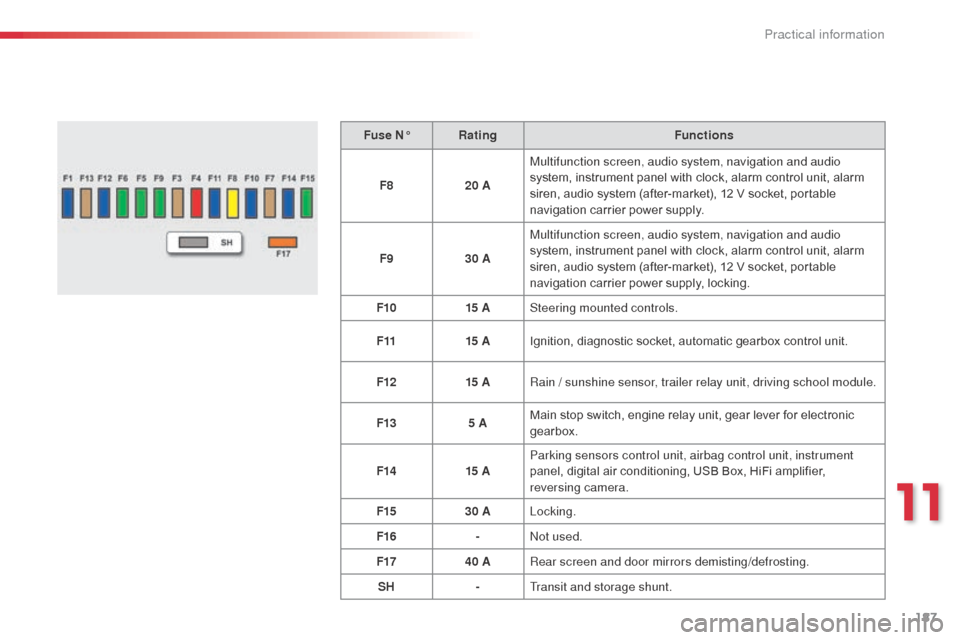
Fuse N°Rating Functions
F8 20 AMultifunction screen, audio system, navigation and audio
system, instrument panel with clock, alarm control unit, alarm
siren, audio system (after-market), 12 V socket, portable
navigation carrier power supply.
F9 30 AMultifunction screen, audio system, navigation and audio
system, instrument panel with clock, alarm control unit, alarm
siren, audio system (after-market), 12 V socket, portable
navigation carrier power supply, locking.
F10 15 ASteering mounted controls.
F11 15 AIgnition, diagnostic socket, automatic gearbox control unit.
F12 15 ARain / sunshine sensor, trailer relay unit, driving school module.
F13 5 AMain stop switch, engine relay unit, gear lever for electronic
gearbox.
F14 15 AParking sensors control unit, airbag control unit, instrument
panel, digital air conditioning, USB Box, HiFi amplifier,
reversing camera.
F15 30 ALocking.
F16 -
no
t used.
F17 40 ARear screen and door mirrors demisting/defrosting.
SH -Transit and storage shunt.
11
Practical information
Page 191 of 401
189
Fuse table
Fuse N°Rating Functions
F1 20 AEngine control unit supply, cooling fan unit control relay,
multifunction engine control main relay, injection pump (Diesel).
F2 15 AHorn.
F3 10 AFront / rear wash-wipe.
F4 20 A
da
ytime running lamps, LE
d d
aytime running lamps.
F5 15 ADiesel heater (Diesel), particle filter additive pump (Diesel), air
flow sensor (Diesel), fuel pump (1.1i and 1.4i), blow-by heater
and electrovalves (VTi).
F6 10 AABS/ESP control unit, secondary brake lamp switch.
F7 10 AElectric power steering, automatic gearbox.
F8 25 AStarter motor control.
F9 10 ASwitching and protection unit (Diesel).
F10 30 AFuel heater (Diesel), blow-by heater (1.1i, 1.4i and Diesel),
fuel pump (VTi), injectors and ignition coils (petrol), electronic
thermostat and canister purge electrovalve (1.1i and 1.4i).
F11 40 AHeater blower.
11
Practical information