child seat CITROEN C3 AIRCROSS 2021 Handbook (in English)
[x] Cancel search | Manufacturer: CITROEN, Model Year: 2021, Model line: C3 AIRCROSS, Model: CITROEN C3 AIRCROSS 2021Pages: 244, PDF Size: 6.29 MB
Page 80 of 244
78
Safety
Deactivating/Reactivating the front
passenger airbag
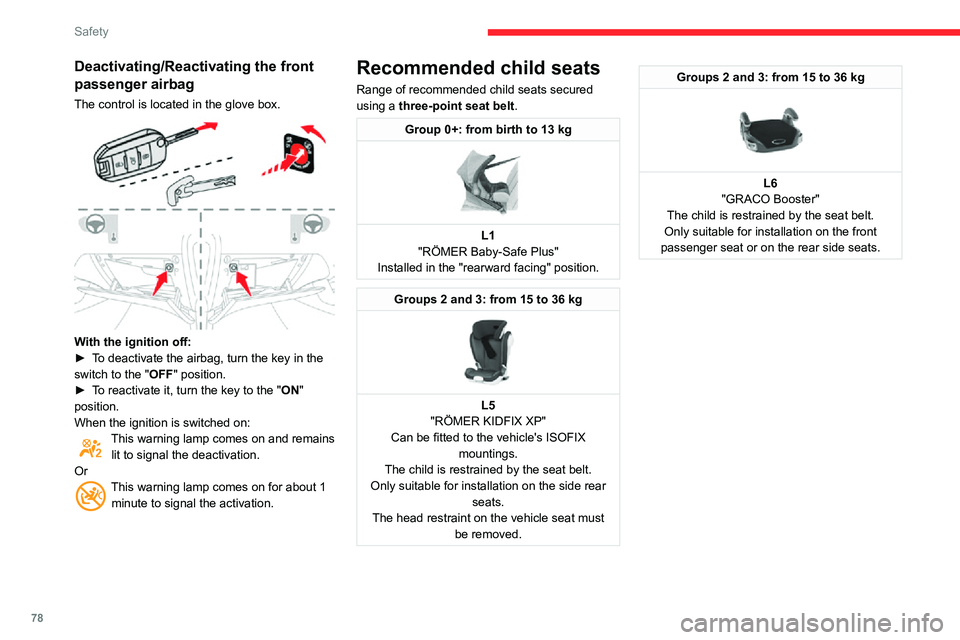
The control is located in the glove box.
With the ignition off:► To deactivate the airbag, turn the key in the switch to the "OFF" position. ► To reactivate it, turn the key to the "ON"
position.
When the ignition is switched on:
This warning lamp comes on and remains lit to signal the deactivation.
Or
This warning lamp comes on for about 1 minute to signal the activation.
Recommended child seats
Range of recommended child seats secured
using a three-point seat belt.
Group 0+: from birth to 13 kg
L1
"RÖMER Baby-Safe Plus"
Installed in the "rearward facing" position.
Groups 2 and 3: from 15 to 36 kg
L5
"RÖMER KIDFIX XP"
Can be fitted to the vehicle's ISOFIX mountings.
The child is restrained by the seat belt.
Only suitable for installation on the side rear seats.
The head restraint on the vehicle seat must be removed.
Groups 2 and 3: from 15 to 36 kg
L6
"GRACO Booster"
The child is restrained by the seat belt.
Only suitable for installation on the front
passenger seat or on the rear side seats.
Locations for child seats secured using the seat belt
In accordance with European regulations, this table indicates the options for installing child seats secured using the seat belt and universally approved (a)
in relation to the weight of the child and the seat position in the vehicle.
Weight of the child
/ indicative age
SeatUnder 13 kg(groups 0 (b) and
0+)
Up to about 1 year
oldFrom 9 to 18 kg(group 1)
From about 1 to 3
years oldFrom 15 to 25 kg(group 2)
From about 3 to 6
years oldFrom 22 to 36 kg(group 3)
From about 6 to
10 years old
Row 1 (c) Passenger seat with
passenger airbag
deactivated "OFF"
U UX X
Passenger seat with
passenger airbag
activated "ON" X
XU U
Row 2 (d) (e) Rear side seats
U UU U
Rear central seat
X XX X
U
: seat position suitable for installing a child seat secured using the seat belt and universally approved for "rearward facing" and/or "forward facing" use.X: seat position not suitable for installing a child seat for the weight group indicated.
(a): Universal child seat: child seat which can be installed in any vehicle using the seat belt.
(b)
: Group 0: from birth to 10 kg. Carrycots and "car" infant carriers cannot be installed on the front passenger seat.(c): refer to the legislation in force in your country before installing your child in this seat position.
(d): to install a "rearward facing" or "forward facing" child seat at the rear , move the front seat forward, then straighten the backrest to allow enough room
for the child seat and the child's legs.
(e):: to install a "rearward facing" or "forward facing" child seat at the rear , slide the rear seat as far backwards as possible, with the backrest straightened.
Page 81 of 244
79
Safety
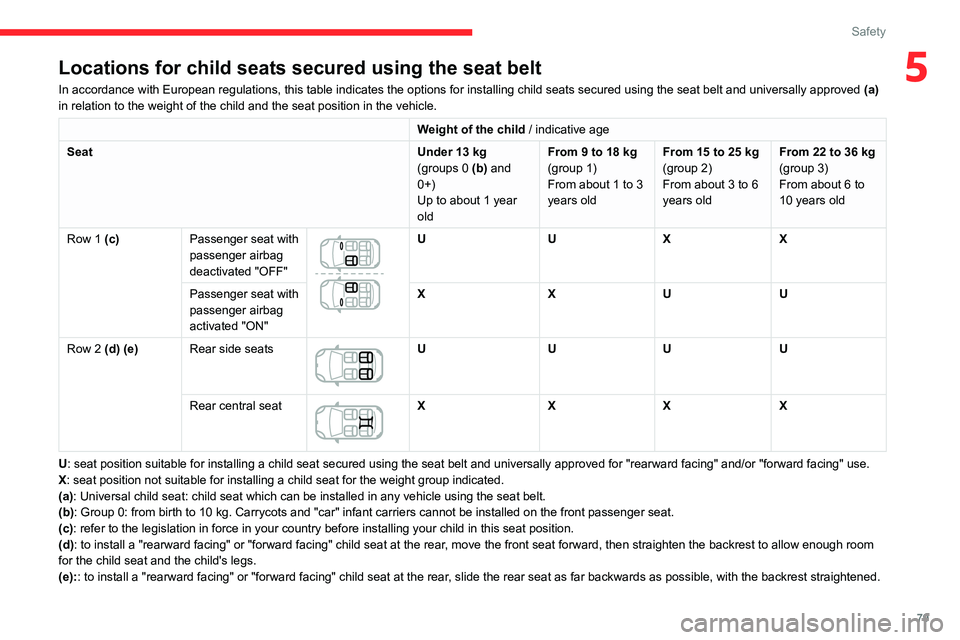
5Locations for child seats secured using the seat belt
In accordance with European regulations, this table indicates the options for installing child seats secured using the seat belt and universally approved (a)
in relation to the weight of the child and the seat position in the vehicle.
Weight of the child / indicative age
SeatUnder 13 kg(groups 0 (b) and
0+)
Up to about 1 year
oldFrom 9 to 18 kg(group 1)
From about 1 to 3
years oldFrom 15 to 25 kg(group 2)
From about 3 to 6
years oldFrom 22 to 36 kg(group 3)
From about 6 to
10 years old
Row 1 (c) Passenger seat with
passenger airbag
deactivated "OFF"
U UX X
Passenger seat with
passenger airbag
activated "ON" X
XU U
Row 2 (d) (e) Rear side seats
U UU U
Rear central seat
X XX X
U
: seat position suitable for installing a child seat secured using the seat belt and universally approved for "rearward facing" and/or "forward facing" use.X: seat position not suitable for installing a child seat for the weight group indicated.
(a): Universal child seat: child seat which can be installed in any vehicle using the seat belt.
(b)
: Group 0: from birth to 10 kg. Carrycots and "car" infant carriers cannot be installed on the front passenger seat.(c): refer to the legislation in force in your country before installing your child in this seat position.
(d): to install a "rearward facing" or "forward facing" child seat at the rear , move the front seat forward, then straighten the backrest to allow enough room
for the child seat and the child's legs.
(e):: to install a "rearward facing" or "forward facing" child seat at the rear , slide the rear seat as far backwards as possible, with the backrest straightened.
Page 82 of 244
80
Safety
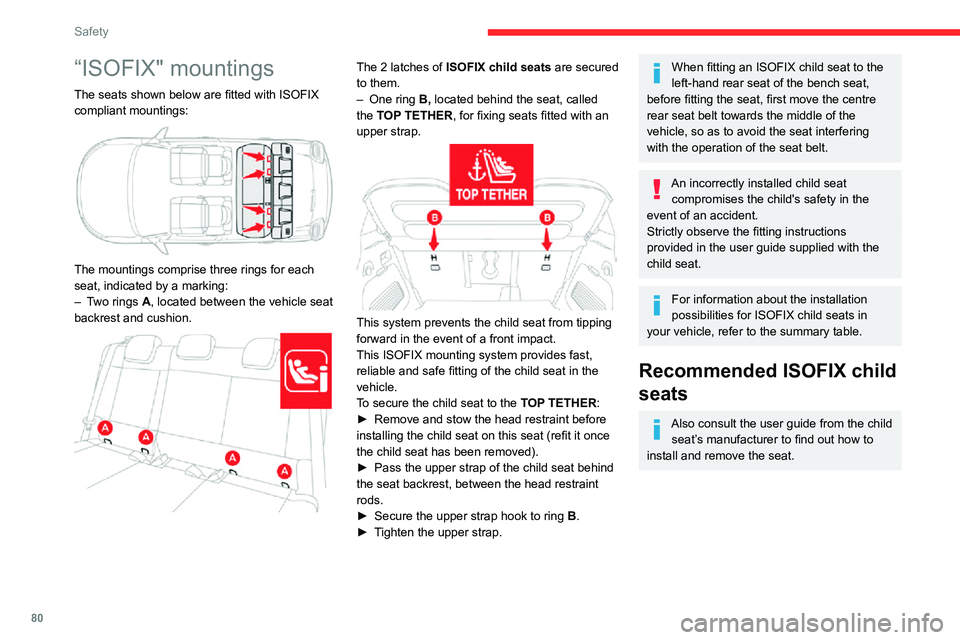
“ISOFIX" mountings
The seats shown below are fitted with ISOFIX
compliant mountings:
The mountings comprise three rings for each
seat, indicated by a marking:
– Two rings A, located between the vehicle seat
backrest and cushion.
The 2 latches of ISOFIX child seats are secured
to them.
– One ring B, located behind the seat, called
the TOP TETHER, for fixing seats fitted with an
upper strap.
This system prevents the child seat from tipping
forward in the event of a front impact.
This ISOFIX mounting system provides fast,
reliable and safe fitting of the child seat in the
vehicle.
To secure the child seat to the TOP TETHER:
► Remove and stow the head restraint before
installing the child seat on this seat (refit it once
the child seat has been removed).
► Pass the upper strap of the child seat behind the seat backrest, between the head restraint
rods.
► Secure the upper strap hook to ring B.► Tighten the upper strap.
When fitting an ISOFIX child seat to the
left-hand rear seat of the bench seat,
before fitting the seat, first move the centre
rear seat belt towards the middle of the
vehicle, so as to avoid the seat interfering
with the operation of the seat belt.
An incorrectly installed child seat compromises the child's safety in the
event of an accident.
Strictly observe the fitting instructions
provided in the user guide supplied with the
child seat.
For information about the installation
possibilities for ISOFIX child seats in
your vehicle, refer to the summary table.
Recommended ISOFIX child
seats
Also consult the user guide from the child seat’s manufacturer to find out how to
install and remove the seat.
Summary table of locations for ISOFIX child seats
In accordance with European regulations, this table shows the options for installing ISOFIX child seats on vehicle seats fitted with ISOFIX mountings.
In the case of universal and semi-universal ISOFIX child seats, the ISOFIX size category , determined by a letter from A to G, is indicated on the child seat
next to the ISOFIX logo.
Weight of the child
/ indicative age
Under 10 kg(group 0)Up to about 6 months old
Under 10 kg(group 0)Under 13 kg (group 0+)Up to about 1 year old
From 9 to 18 kg(group 1)
From about 1 to 3 years old
Type of ISOFIX child seat CarrycotRearward facing Rearward
facing Forward facing
Page 83 of 244

81
Safety
5"RÖMER Baby-Safe Plus and its ISOFIX base"
(size category: E)
Group 0+: from birth to 13 kg
Installed "rearward facing" using an ISOFIX base which is attached to rings A.
The base has a support leg, height-
adjustable, which rests on the vehicle's floor. This child seat can also be secured with a
seat belt. In this case, only the shell is used and attached to the vehicle seat using the three-point seat belt.
"RÖMER Duo Plus ISOFIX "
(size category: B1)
Group 1: from 9 to 18 kg
"RÖMER Duo Plus ISOFIX "
(size category: B1)
Group 1: from 9 to 18 kg
Suitable for forward-facing installation only.
Attached to rings A and ring B, referred to as
TOP TETHER, using an upper strap.
Three seat body angles: sitting, reclining, lying down.
This child seat can also be used in seat positions not equipped with ISOFIX
mountings. In this case, it must be secured to the vehicle's seat by the three-point seat belt. Adjust the front seat of the vehicle so that the child's feet do not touch the backrest.
Summary table of locations for ISOFIX child seats
In accordance with European regulations, this table shows the options for installing ISOFIX child seats on vehicle seats fitted with ISOFIX mountings.
In the case of universal and semi-universal ISOFIX child seats, the ISOFIX size category , determined by a letter from A to G, is indicated on the child seat
next to the ISOFIX logo.
Weight of the child / indicative age
Under 10 kg(group 0)Up to about 6 months old
Under 10 kg(group 0)Under 13 kg (group 0+)Up to about 1 year old
From 9 to 18 kg(group 1)
From about 1 to 3 years old
Type of ISOFIX child seat CarrycotRearward facing Rearward
facing Forward facing
Page 84 of 244

82
Safety
Weight of the child / indicative age
Under 10 kg(group 0)Up to about 6 months old
Under 10 kg(group 0)Under 13 kg (group 0+)Up to about 1 year old
From 9 to 18 kg(group 1)
From about 1 to 3 years old
ISOFIX size category FG CD EC DABB1
Seat
Row 1 (a) Passenger seat
Front
passenger airbag
deactivated "OFF " Not ISOFIX
Front
passenger airbag
activated "ON" Not ISOFIX
Row 2 (b)
Rear side seats
X IL ILIUF / IL
Rear central seat
Not ISOFIX
(a): refer to the legislation in force in your country before installing a child in this seat position.
(b): to install a “rearward facing” or “forward facing” child seat at the rear , slide the rear seat as far backwards as possible, with the backrest straightened.
IUF: seat position suitable for installing an Isofix Universal seat, "Forward facing", secured using the upper strap.
IL: seat position suitable for installing an Isofix Semi-Universal seat, either:– "rearward facing" fitted with an upper strap or a support leg.– “forward facing”, fitted with a support leg.– a carrycot fitted with an upper strap or a support leg.For securing the upper strap using the ISOFIX mountings, refer to the corresponding section.
X: seat position not suitable for installing an ISOFIX seat or carrycot for the weight group indicated.
i-Size child seats
i-Size child seats have two latches that engage on the two rings A.
These i-Size child seats also have:
– either an upper strap that is attached to ring B.– or a support leg that rests on the vehicle floor, compatible with the approved i-Size seat position.Their role is to prevent the child seat from tipping forward in the event of a collision.
For more information on the ISOFIX mountings, refer to the corresponding section.
In accordance with the new European regulations, this table indicates the options for installing i-Size child seats on seats in the vehicle fitted with ISOFIX
mountings approved for i-Size.
Seat i-Size restraint system
Row 1 (a) Passenger seat with passenger
airbag deactivated "OFF"
Not i-Size
Passenger seat with passenger
airbag activated "ON" Not i-Size
Row 2 (b)
Rear side seats
i-U
Rear central seat
Not i-Size
i-U: suitable for i-Size restraint systems in the "Universal" category , "forward facing" and "rearward facing".
Page 85 of 244

83
Safety
5IL: seat position suitable for installing an Isofix Semi-Universal seat, either:– "rearward facing" fitted with an upper strap or a support leg.– “forward facing”, fitted with a support leg.– a carrycot fitted with an upper strap or a support leg.For securing the upper strap using the ISOFIX mountings, refer to the corresponding section.
X: seat position not suitable for installing an ISOFIX seat or carrycot for the weight group indicated.
i-Size child seats
i-Size child seats have two latches that engage on the two rings A.
These i-Size child seats also have:
– either an upper strap that is attached to ring B.– or a support leg that rests on the vehicle floor , compatible with the approved i-Size seat position.Their role is to prevent the child seat from tipping forward in the event of a collision.
For more information on the ISOFIX mountings, refer to the corresponding section.
In accordance with the new European regulations, this table indicates the options for installing i-Size child seats on seats in the vehicle fitted with ISOFIX
mountings approved for i-Size.
Seat i-Size restraint system
Row 1 (a) Passenger seat with passenger
airbag deactivated "OFF"
Not i-Size
Passenger seat with passenger
airbag activated "ON" Not i-Size
Row 2 (b)
Rear side seats
i-U
Rear central seat
Not i-Size
i-U: suitable for i-Size restraint systems in the "Universal" category , "forward facing" and "rearward facing".
Page 86 of 244

84
Safety
(a): refer to the current legislation in the country in which you are driving before placing a child in this seat position.
(B): to install a “rearward facing” or “forward facing” child seat at the rear, slide the rear seat as far backwards as possible, with the backrest straightened.
Manual child lock
Mechanical system to prevent opening of a rear
door using its interior control.
The control, red in colour, is located on the edge
of each rear door.
It is identified by a mark on the bodywork.
Locking
► Using the ignition key or the integral key,
depending on version, turn the red control as far
as it will go:
• to the right on the left-hand rear door ,• to the left on the right-hand rear door.
Unlocking
► Using the ignition key or the integral key , depending on version, turn the red control as far
as it will go:
• to the left on the left-hand rear door ,• to the right on the right-hand rear door .
Do not confuse the child lock control,
which is red, with the back-up locking
control, which is black.
Electric child lock
Remote control system to prevent opening of the
rear doors using their interior controls.
Activation/Deactivation
► With the ignition on, press this button to activate/deactivate the child lock.
A message is displayed, confirming activation/
deactivation of the child lock.
When the indicator lamp is on, the child lock is
activated.
Any other status of the indicator lamp indicates a malfunction of the electric
child lock.
Have it checked by a CITROËN dealer or a
qualified workshop.
With the child lock activated, it is still
possible to open the doors from outside.
This system is independent and in no circumstances does it take the place of
the central locking control.
Check the status of the child lock each time
you switch on the ignition.
Always keep the electronic key with you when
leaving the vehicle, even for a short time.
In the event of a serious impact, the electric
child lock is switched off automatically to
permit the exit of the rear passengers.
Any other state of the indicator lamp indicates a fault with the electric child
lock.
Have it checked by a CITROËN dealer or a
qualified workshop.
This system is independent and in no circumstances does it take the place of
the central locking control.
Check the status of the child locks each time
you switch on the ignition.
Always remove the key from the ignition when
leaving the vehicle, even for a short time.
Page 216 of 244
214
Alphabetical index
180° rear vision 118
A
ABS 67Accessories 64Active Safety Brake 108–109, 111AdBlue® 14, 135
AdBlue® tank 136Additive, Diesel 133–134Adjusting headlamps 59Adjusting head restraints 36Adjusting seat 37Adjusting the air distribution 44Adjusting the air flow 44–45Adjusting the date 17, 22, 187, 210Adjusting the height and reach of the steering wheel 41Adjusting the seat angle 37Adjusting the seat belt height 71Adjusting the temperature 44Adjusting the time 17, 22, 187, 210Advice on care and maintenance 137Advice on driving 6, 86Airbags 73, 75, 77Airbags, curtain 74–75Airbags, front 74–75, 78Airbags, lateral 74–75Air conditioning 43–44Air conditioning, automatic 44Air conditioning, manual 43–44
Air intake 44Air vents 42Alarm 30–32Anti-lock braking system (ABS) 67Antitheft / Immobiliser 26Apple CarPlay connection 183, 199Armrest, front 49Armrest, rear 50Assistance call 65
Assistance, emergency braking 67, 110Audible warning 65Audio streaming (Bluetooth) 170, 182, 204
B
Battery 128, 152–155Battery, 12 V 133–134, 154Battery, charging 154Battery, remote control 26–27Blind 32–33Blind spot sensors 113Blinds, side 50BlueHDi 14, 133, 139Bluetooth (hands-free) 170–171, 184–185, 205–206Bluetooth (telephone) 184–185, 205–207Bodywork 138Bonnet 130Boot 29, 54Brake discs 134Brake lamps 148
Brakes 134Braking assistance system 67Braking, automatic emergency 108–111Brightness 186Bulbs 147Bulbs (changing) 146–148
C
Cable, audio 204Cable, Jack 204Capacity, fuel tank 123–124Cap, fuel filler 123–124Care of the bodywork 138CD 169, 182, 204CD, MP3 169, 182, 204Central locking 25, 30Changing a bulb 146–149Changing a fuse 150–152Changing a wheel 139, 143Changing a wiper blade 61–62Changing the remote control battery 27Charger, induction 48Charger, wireless 48Checking the engine oil level 14Checking the levels 131–133Checking tyre pressures (using the kit) 140, 142Checks 131, 133–134Checks, routine 133–134Child lock 84–85
Page 217 of 244
215
Alphabetical index
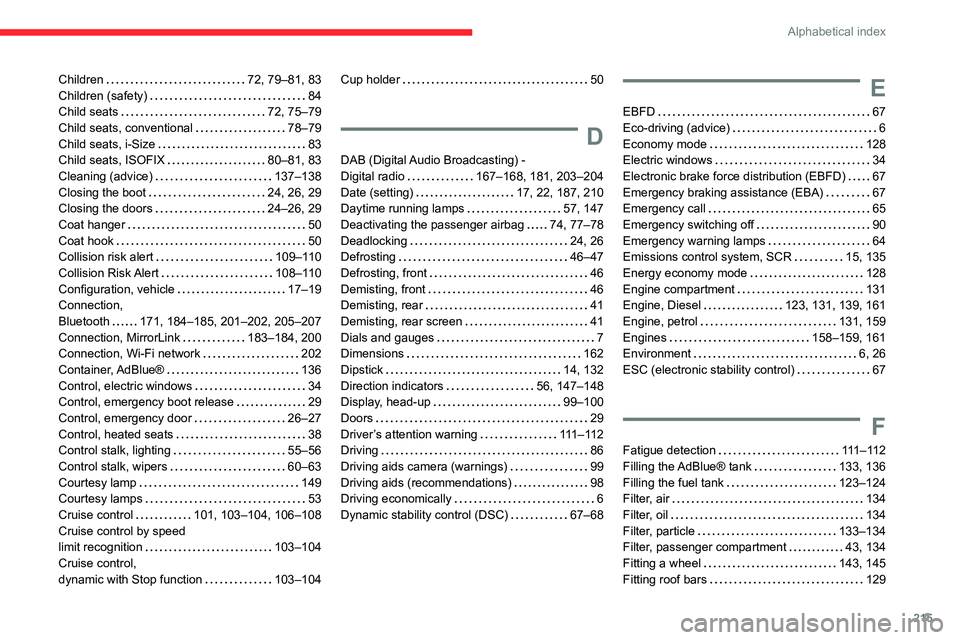
Children 72, 79–81, 83Children (safety) 84Child seats 72, 75–79Child seats, conventional 78–79Child seats, i-Size 83Child seats, ISOFIX 80–81, 83Cleaning (advice) 137–138Closing the boot 24, 26, 29Closing the doors 24–26, 29
Coat hanger 50Coat hook 50Collision risk alert 109–110Collision Risk Alert 108–110Configuration, vehicle 17–19Connection, Bluetooth 171, 184–185, 201–202, 205–207Connection, MirrorLink 183–184, 200Connection, Wi-Fi network 202Container, AdBlue® 136Control, electric windows 34Control, emergency boot release 29Control, emergency door 26–27Control, heated seats 38Control stalk, lighting 55–56Control stalk, wipers 60–63Courtesy lamp 149Courtesy lamps 53Cruise control 101, 103–104, 106–108Cruise control by speed limit recognition 103–104Cruise control, dynamic with Stop function 103–104
Cup holder 50
D
DAB (Digital Audio Broadcasting) - Digital radio 167–168, 181, 203–204Date (setting) 17, 22, 187, 210Daytime running lamps 57, 147
Deactivating the passenger airbag 74, 77–78Deadlocking 24, 26Defrosting 46–47Defrosting, front 46Demisting, front 46Demisting, rear 41Demisting, rear screen 41Dials and gauges 7Dimensions 162Dipstick 14, 132Direction indicators 56, 147–148Display, head-up 99–100Doors 29Driver’s attention warning 111 – 11 2Driving 86Driving aids camera (warnings) 99Driving aids (recommendations) 98Driving economically 6Dynamic stability control (DSC) 67–68
E
EBFD 67Eco-driving (advice) 6Economy mode 128Electric windows 34Electronic brake force distribution (EBFD) 67Emergency braking assistance (EBA) 67Emergency call 65
Emergency switching off 90Emergency warning lamps 64Emissions control system, SCR 15, 135Energy economy mode 128Engine compartment 131Engine, Diesel 123, 131, 139, 161Engine, petrol 131, 159Engines 158–159, 161Environment 6, 26ESC (electronic stability control) 67
F
Fatigue detection 111 – 11 2Filling the AdBlue® tank 133, 136Filling the fuel tank 123–124Filter, air 134Filter, oil 134Filter, particle 133–134Filter, passenger compartment 43, 134Fitting a wheel 143, 145Fitting roof bars 129
Page 219 of 244
217
Alphabetical index
L
Labels, identification 162Lamp, boot 54, 149Lamps, parking 56Lamps, rear 148Lane Departure Warning System (LDWS) 112–113LEDs - Light-emitting diodes 57, 147
Level, AdBlue® 133Level, brake fluid 132Level, Diesel additive 133–134Level, engine coolant 13, 133Level, engine oil 14, 132Levels and checks 131–133Level, screenwash fluid 61, 133Light-emitting diodes - LEDs 57, 147Lighting, cornering 60Lighting, directional 59Lighting, exterior 55Lighting, guide-me home 57Lighting, interior 53Lighting, mood 53Lighting, welcome 58Load reduction mode 128Locating your vehicle 24Locking 24, 26Locking from the inside 30Locking the doors 30Low fuel level 123–124
M
Maintenance (advice) 137Maintenance, routine 99, 133Manoeuvring aids (recommendations) 98Map reading lamps 53Markings, identification 162Mat 50, 99Memorising a speed 101
Menu 183Menu, main 165Menus (audio) 178–179, 192–193Messages 207Messages, quick 208Mirror, rear view 42Mirrors, door 41–42, 113Misfuel prevention 124Mountings, ISOFIX 80MP3 CD 169
N
Net, storage 50
O
Obstacle detection 114Oil change 132Oil consumption 132OIl, engine 132
On-board tools 53, 139–140Opening the bonnet 130Opening the boot 24–25, 29Opening the doors 24–25, 29
P
Pads, brake 134
Paint 138, 162Paint colour code 162Parcel shelf, rear 51Park Assist 118Parking brake 91, 134Parking sensors, audible and visual 114Parking sensors, front 11 5Parking sensors, rear 11 5Plates, identification 162Player, Apple® 170, 182, 205Player, MP3 CD 169, 204Player, USB 168, 181, 204Port, USB 49, 168, 181, 204Pressures, tyres 135, 143, 163Pre-tensioning seat belts 72Priming pump 139Priming the fuel system 139Profiles 186, 209Protecting children 74–81, 83Puncture 140–141, 143