warning Citroen C4 2014.5 2.G Owner's Guide
[x] Cancel search | Manufacturer: CITROEN, Model Year: 2014.5, Model line: C4, Model: Citroen C4 2014.5 2.GPages: 494, PDF Size: 21.47 MB
Page 136 of 494
134
Passenger airbag OFF
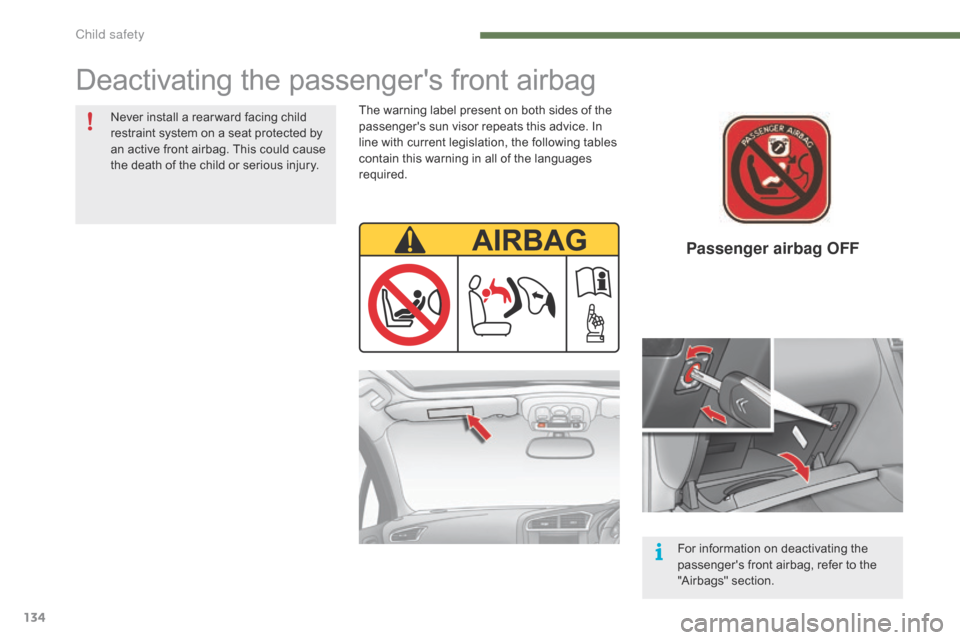
Deactivating the passenger's front airbag
The warning label present on both sides of the passenger's sun visor repeats this advice. In
l
ine with current legislation, the following tables
c
ontain this warning in all of the languages
r
equired.
For
information on deactivating the
p
assenger's front airbag, refer to the
"
Airbags" section.
Never
install
a
rear ward
facing
child
r
estraint
system
on
a
seat
protected
by
a
n
active
front
airbag.
This
could
cause
t
he
death
of
the
child
or
serious
injury.
Child safety
Page 149 of 494
147
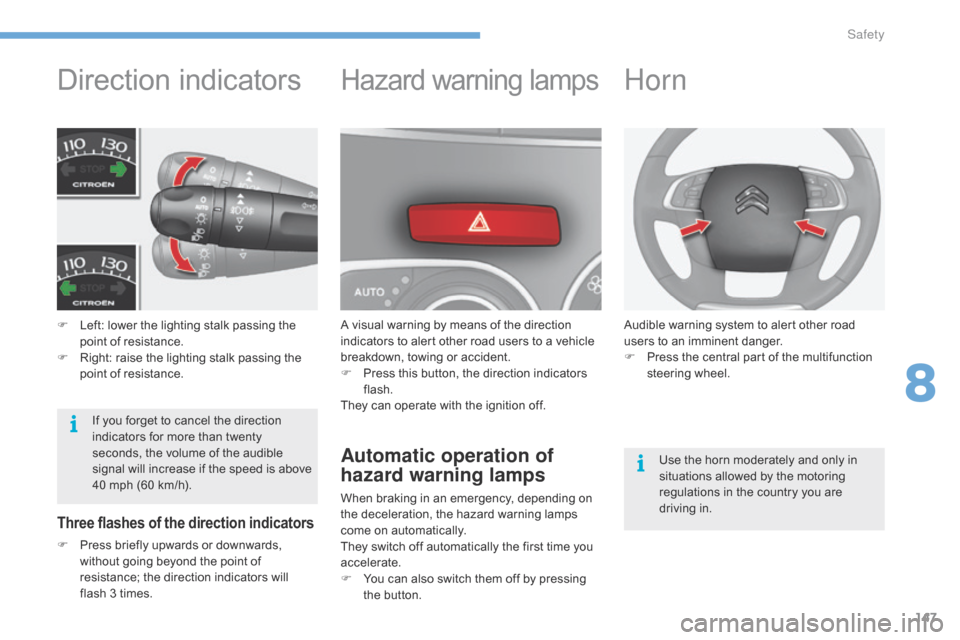
Direction indicators
F Left: lower the lighting stalk passing the p
oint of resistance.
F
R
ight: raise the lighting stalk passing the
p
oint of resistance.
Hazard warning lam ps
A visual warning by means of the direction i
ndicators to alert other road users to a vehicle
b
reakdown, towing or accident.
F
P
ress this button, the direction indicators
f
lash.
They
can operate with the ignition off.
Automatic operation of
hazard warning lamps
When braking in an emergency, depending on the deceleration, the hazard warning lamps
c
ome on automatically.
They
switch off automatically the first time you
a
ccelerate.
F
Y
ou can also switch them off by pressing
t
he button.
Horn
Three flashes of the direction indicators
F Press briefly upwards or downwards, w
ithout going beyond the point of
r
esistance; the direction indicators will
f
lash 3 times. Audible
warning system to alert other road
u
sers to an imminent danger.
F
P
ress the central part of the multifunction
s
teering
w
heel.
Use the horn moderately and only in
s
ituations allowed by the motoring
r
egulations in the country you are
d
riving in.
If you forget to cancel the direction
i
ndicators for more than twenty
s
econds, the volume of the audible
s
ignal will increase if the speed is above
4
0 mph (60 km/h).
8
Safety
Page 150 of 494
148
Group of supplementary systems which help you to obtain optimum braking in complete
s
afety in emergency situations:
-
a
nti-lock braking system (ABS),
-
e
lectronic brake force distribution (EBFD),
-
e
mergency braking assistance (EBA).
Anti-lock braking system
and electronic brake force
distribution
Linked systems which improve the stability and manoeuvrability of your vehicle when braking, in p
articular on poor or slippery sur faces.
Activation
The anti-lock braking system comes into operation automatically when there is a risk of
w
heel lock.
Normal
operation of the ABS may make itself
f
elt by slight vibration of the brake pedal.
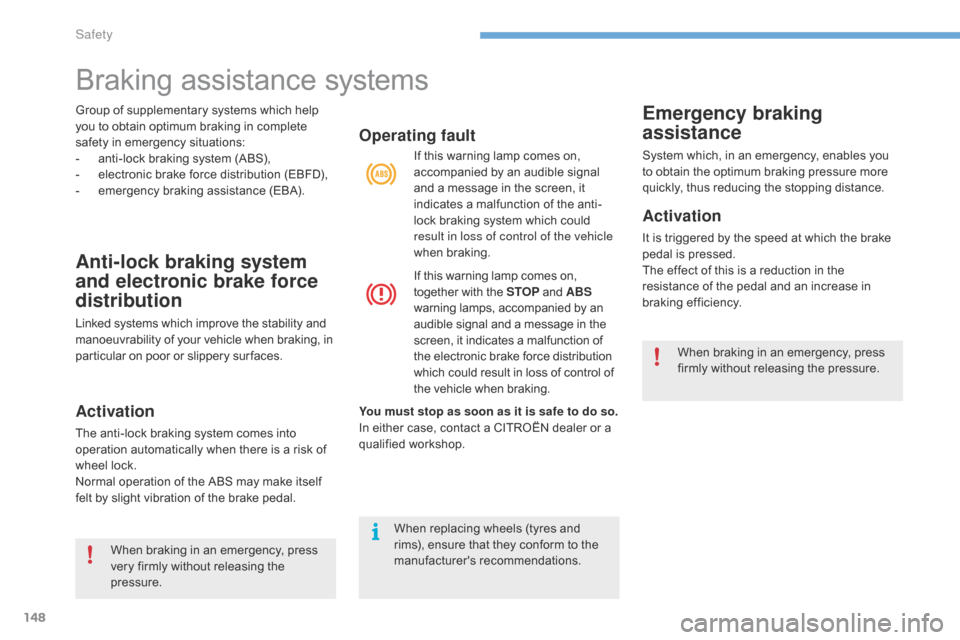
Operating fault
If this warning lamp comes on, accompanied by an audible signal
a
nd a message in the screen, it
i
ndicates a malfunction of the anti-
lock
braking system which could
r
esult in loss of control of the vehicle
when
b
raking.
If
this warning lamp comes on,
t
ogether with the STOP
and ABS
warning
lamps, accompanied by an
a
udible signal and a message in the
s
creen, it indicates a malfunction of
t
he electronic brake force distribution
w
hich could result in loss of control of
t
he vehicle when braking.
Emergency braking
assistance
System which, in an emergency, enables you to obtain the optimum braking pressure more
q
uickly, thus reducing the stopping distance.
Activation
It is triggered by the speed at which the brake pedal is pressed.
The
effect of this is a reduction in the
r
esistance of the pedal and an increase in
b
raking
e
fficiency.
You must stop as soon as it is safe to do so.
In
either
case,
contact
a
CITROËN
dealer
or
a
q
ualified
w
orkshop.
When
braking
in
an
emergency,
press
v
ery
firmly
without
releasing
the
p
ressure. When
braking in an emergency, press
f
irmly without releasing the pressure.
When
replacing
wheels
(tyres
and
r
ims),
ensure
that
they
conform
to
the
ma
nufacturer's
r
ecommendations.
Braking assistance systems
Safety
Page 154 of 494
152
Seat belt not fastened / unfastened
warning lamp in the instrument
panel
When the ignition is switched on, this warning lamp comes on in the instrument p
anel if the driver and/or the front
p
assenger has not fastened their seat belt.
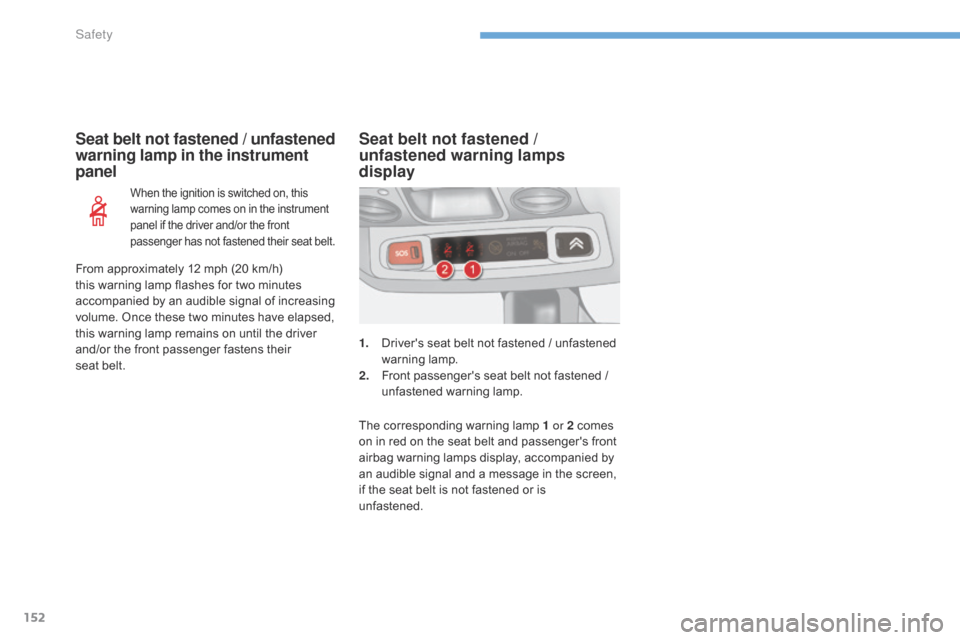
1. Driver's seat belt not fastened / unfastened w
arning lam p.
2.
F
ront passenger's seat belt not fastened /
u
nfastened warning lamp.
Seat belt not fastened /
unfastened warning lamps
display
The corresponding warning lamp 1 or 2 comes on in red on the seat belt and passenger's front
a
irbag warning lamps display, accompanied by
a
n audible signal and a message in the screen,
i
f the seat belt is not fastened or is
unfastened.
From
approximately
12
mph
(20 km/h)
t
his
warning
lamp
flashes
for
two
minutes
a
ccompanied
by
an
audible
signal
of
increasing
v
olume.
Once
these
two
minutes
have
elapsed,
t
his
warning
lamp
remains
on
until
the
driver
a
nd/or
the
front
passenger
fastens
their
seat
belt.
Safety
Page 155 of 494
153
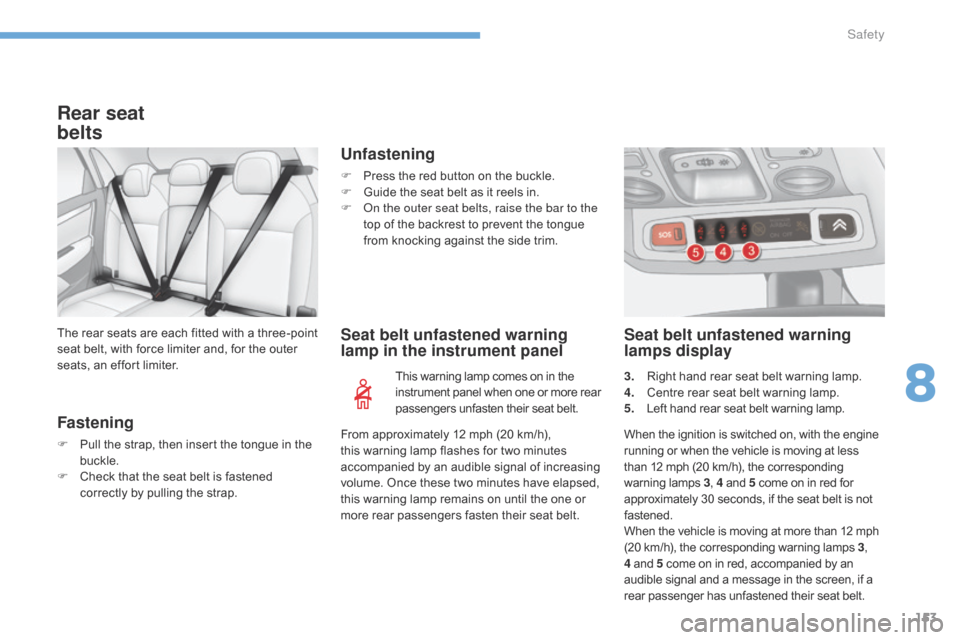
Rear seat
belts
Fastening
F Pull the strap, then insert the tongue in the buc
kle.
F
C
heck that the seat belt is fastened
c
orrectly by pulling the strap.
Unfastening
F Press the red button on the buckle.
F G uide the seat belt as it reels in.
F
o
n t
he outer seat belts, raise the bar to the
top
of the backrest to prevent the tongue
f
rom knocking against the side trim.
This
warning lamp comes on in the
i
nstrument
panel
when
one
or
more
rear
p
assengers
u
nfasten
t
heir
sea
t
b
elt.
Seat belt unfastened warning
lamp in the instrument panelSeat belt unfastened warning
lamps display
3. Right
hand rear seat belt warning lamp.
4. C entre rear seat belt warning lamp.
5.
L
eft hand rear seat belt warning lamp.
From
approximately
12 mph
(20 km/h),
t
his
warning
lamp
flashes
for
two
minutes
a
ccompanied
by
an
audible
signal
of
increasing
v
olume.
Once
these
two
minutes
have
elapsed,
t
his
warning
lamp
remains
on
until
the
one
or
m
ore
rear
passengers
fasten
their
seat
belt.
The
rear
seats
are
each
fitted
with
a
three-point
s
eat
belt,
with
force
limiter
and,
for
the
outer
s
eats,
an
effort
limiter.
When the ignition is switched on, with the engine
r
unning or when the vehicle is moving at less
t
han 12 mph (20 km/h), the corresponding
w
arning
lam
ps
3, 4
and 5
come on in red for
a
pproximately 30 seconds, if the seat belt is not
f
astened.
When
the vehicle is moving at more than 12 mph
(
20 km/h), the corresponding warning lamps 3,
4
and 5
come on in red, accompanied by an
a
udible signal and a message in the screen, if a
r
ear passenger has unfastened their seat belt.
8
Safety
Page 156 of 494
154
The driver must ensure that passengers use the seat belts correctly and that they are all
r
estrained securely before setting off.
Wherever
you are seated in the vehicle,
a
lways fasten your seat belt, even for short
journeys.
Do
not interchange the seat belt buckles as
t
hey will not fulfil their role fully.
The
seat belts are fitted with an inertia reel
p
ermitting automatic adjustment of the length
o
f the strap to your size. The seat belt is
s
towed automatically when not in use.
Before
and after use, ensure that the seat belt
i
s reeled in correctly.
The
lower part of the strap must be positioned
a
s low as possible on the pelvis.
The
upper part must be positioned in the
h
ollow of the shoulder.
The
inertia reels are fitted with an automatic
l
ocking device which comes into operation in
t
he event of a collision, emergency braking
o
r if the vehicle rolls over. You can release
t
he device by pulling the strap firmly and then
r
eleasing it so that it reels in slightly.In
order to be effective, a seat belt must:
- b e tightened as close to the body as
p
ossible,
-
b
e pulled in front of you with a smooth
m
ovement, checking that it does not
t
wist,
-
b
e used to restrain only one person,
-
n
ot bear any trace of cuts or fraying,
-
n
ot be converted or modified to avoid
a
ffecting
it
s
p
erformance.
In
accordance with current safety
r
egulations, for all repairs on your vehicle's
s
eat belts, go to a qualified workshop with
t
he skills and equipment needed, which a
C
ITROËN dealer is able to provide.
Have
your seat belts checked regularly by
a
CITROËN dealer or a qualified workshop,
p
articularly if the straps show signs of
d
amage.
Clean the seat belt straps with soapy
water
or a textile cleaning product, sold by
C
ITROËN dealers.
After
folding or moving a seat or rear bench
s
eat, ensure that the seat belt is positioned
a
nd reeled in correctly.Recommendations for children
Use a suitable child seat if the passenger is less than 12 years old or shorter than one
a
nd a half metres.
Never
use the same seat belt to secure more
t
han one person.
Never
allow a child to travel on your lap.
For
more information, refer to the "Child
sea
ts"
se
ction.
In the event of an impact
Depending on the nature and seriousness
of the impact ,
the pretensioning device may
b
e deployed before and independently of the
a
irbags. Deployment of the pretensioners
i
s accompanied by a slight discharge of
h
armless smoke and a noise, due to the
a
ctivation of the pyrotechnic cartridge
i
ncorporated in the system.
In
all cases, the airbag warning lamp
comes
on.
Following
an impact, have the seat belts
s
ystem checked, and if necessary replaced,
b
y a CITROËN dealer or a qualified
w
orkshop.
Safety
Page 158 of 494
156
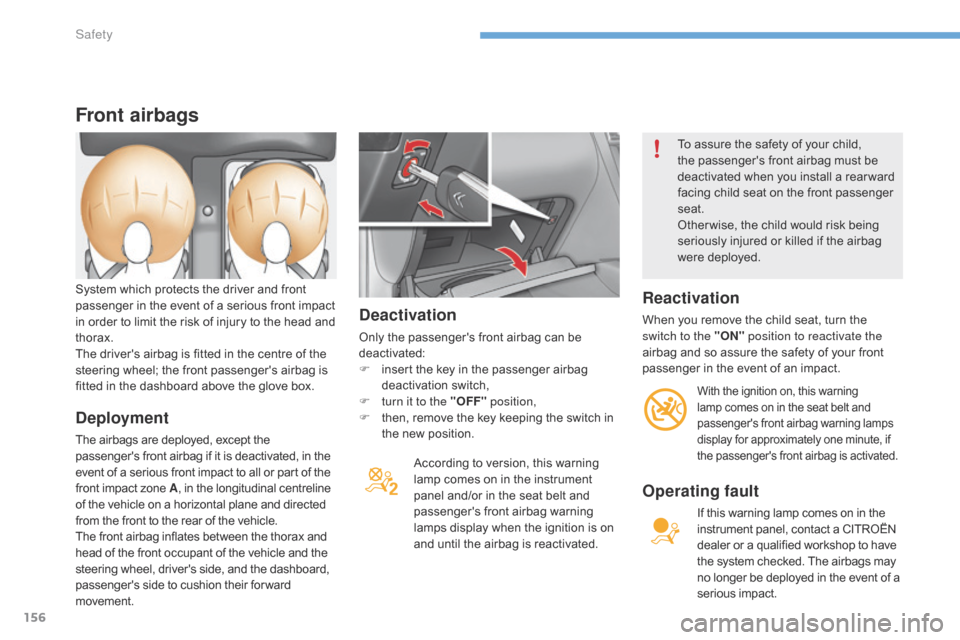
Deactivation
Only the passenger's front airbag can be deactivated:
F
i
nsert the key in the passenger airbag
d
eactivation
s
witch,
F
t
urn it to the "OFF" position,
F
t
hen, remove the key keeping the switch in
t
he new position.
According
to version, this warning
l
amp comes on in the instrument
p
anel and/or in the seat belt and
p
assenger's front airbag warning
l
amps display when the ignition is on
a
nd until the airbag is reactivated.
Front airbags
Deployment
The airbags are deployed, except the passenger's front airbag if it is deactivated, in the e
vent of a serious front impact to all or part of the
f
ront impact zone A,
in the longitudinal centreline
o
f the vehicle on a horizontal plane and directed
f
rom the front to the rear of the vehicle.
The
front airbag inflates between the thorax and
h
ead of the front occupant of the vehicle and the
s
teering wheel, driver's side, and the dashboard,
p
assenger's side to cushion their for ward
m
ovement. To
assure the safety of your child,
t
he passenger's front airbag must be
d
eactivated when you install a rear ward
f
acing child seat on the front passenger
sea
t.
Other wise, the child would risk being
s
eriously injured or killed if the airbag
w
ere deployed.
System which protects the driver and front
p
assenger in the event of a serious front impact
i
n order to limit the risk of injury to the head and
t
horax.
The driver's airbag is fitted in the centre of the
s
teering wheel; the front passenger's airbag is
f
itted in the dashboard above the glove box.
Reactivation
When you remove the child seat, turn the s
witch to the "ON" position to reactivate the
airbag
and so assure the safety of your front
p
assenger in the event of an impact.
With the ignition on, this warning lamp comes on in the seat belt and p
assenger's front airbag warning lamps
d
isplay for approximately one minute, if
t
he passenger's front airbag is activated.
Operating fault
If this warning lamp comes on in the instrument panel, contact a CITROËN d
ealer or a qualified workshop to have
t
he system checked. The airbags may
n
o longer be deployed in the event of a
s
erious
im
pact.
Safety
Page 163 of 494
161
Starting the engine
F With a petrol engine, operate the starter m
otor by turning the key to position 3
without
pressing the accelerator pedal,
u
ntil the engine starts. Once the engine is
r
unning, release the key. F
W
ith a Diesel engine, turn the key to
p
osition 2
, ignition on, to operate the
eng
ine
p
re-heating
s
ystem.
Wait until this warning lamp goes off
i
n the instrument panel then operate
t
he starter motor by turning the key
t
o position 3 without pressing the
a
ccelerator pedal, until the engine
s
tarts. Once the engine is running,
r
elease the key.
If the engine does not start straight
a
way, switch off the ignition. Wait a
f
ew moments before operating the
s
tarter motor again. If the engine does
n
ot start after several attempts, do not
k
eep trying: you risk damaging the
s
tarter motor or the engine. Contact
a
CITROËN dealer or a qualified
w
orkshop.Never
leave the engine running in
a
n enclosed area without adequate
v
entilation:
in
ternal
c
ombustion
e
ngines emit toxic exhaust gases,
s
uch as carbon monoxide. Danger of
i
ntoxication and death.
In very severe wintry conditions
(
temperatures below -23°C), to ensure
t
he correct operation and durability of
t
he mechanical components of your
v
ehicle, engine and gearbox, it is n
ecessary to leave the engine running f
or 4 minutes before moving off.
In
certain cases, you may have to apply
m
ore force to the steering (wheels on
f
ull lock, for example).
In wintry conditions, the warning lamp
c
an stay on for a longer period. When
t
he engine is hot, the warning lamp
d
oes not come on.In temperate conditions, do not leave
t
he engine at idle to warm up but move
o
ff straight away and drive at moderate
s
peed.
With the parking brake applied and the gearbox
i
n neutral or position N or P
:
F
d
epress the clutch pedal fully (manual
g
earbox),
or
F
p
ress the brake pedal firmly (electronic or
a
utomatic gearbox),
F
i
nsert the key into the ignition switch; the
s
ystem recognises the code,
F
u
nlock the steering column by
s
imultaneously turning the steering and the
k
ey.
9
Driving
Page 165 of 494
163
Starting-switching off the engine with the
" Keyless Entry and Starting" system
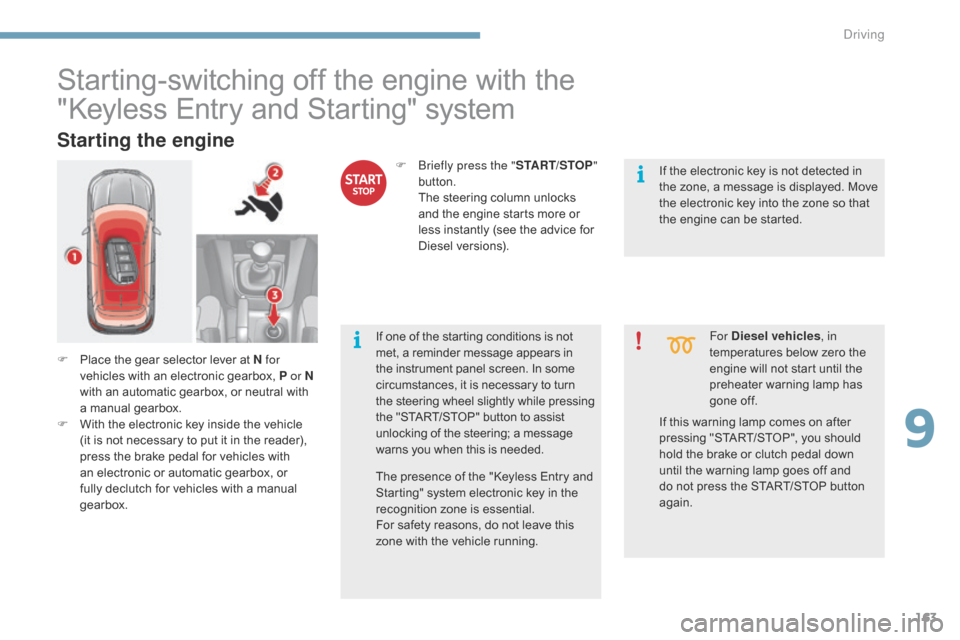
Starting the engine
F Place the gear selector lever at N for
vehicles with an electronic gearbox, P or N
with
an automatic gearbox, or neutral with
a m
anual
g
earbox.
F
W
ith the electronic key inside the vehicle
(
it is not necessary to put it in the reader),
p
ress the brake pedal for vehicles with
a
n electronic or automatic gearbox, or
f
ully declutch for vehicles with a manual
g
earbox. F
b
r
iefly press the "
START/STOP"
button.
T
he steering column unlocks
a
nd the engine starts more or
l
ess instantly (see the advice for
D
iesel
v
ersions).
If this warning lamp comes on after
p
ressing "START/STOP", you should
h
old the brake or clutch pedal down
u
ntil the warning lamp goes off and
d
o not press the START/STOP button
ag
ain.
If
one of the starting conditions is not
m
et, a reminder message appears in t
he instrument panel screen. In some c
ircumstances, it is necessary to turn
t
he steering wheel slightly while pressing
t
he "START/STOP" button to assist
u
nlocking of the steering; a message
w
arns you when this is needed.If
the electronic key is not detected in
t
he zone, a message is displayed. Move
t
he electronic key into the zone so that
t
he engine can be started.
The presence of the "Keyless Entry and
S
tarting" system electronic key in the
r
ecognition zone is essential.
For
safety reasons, do not leave this
z
one with the vehicle running.For Diesel vehicles
, in
temperatures below zero the e
ngine will not start until the
p
reheater warning lamp has
g
one off.
9
driving
Page 169 of 494
167
Electric parking brake
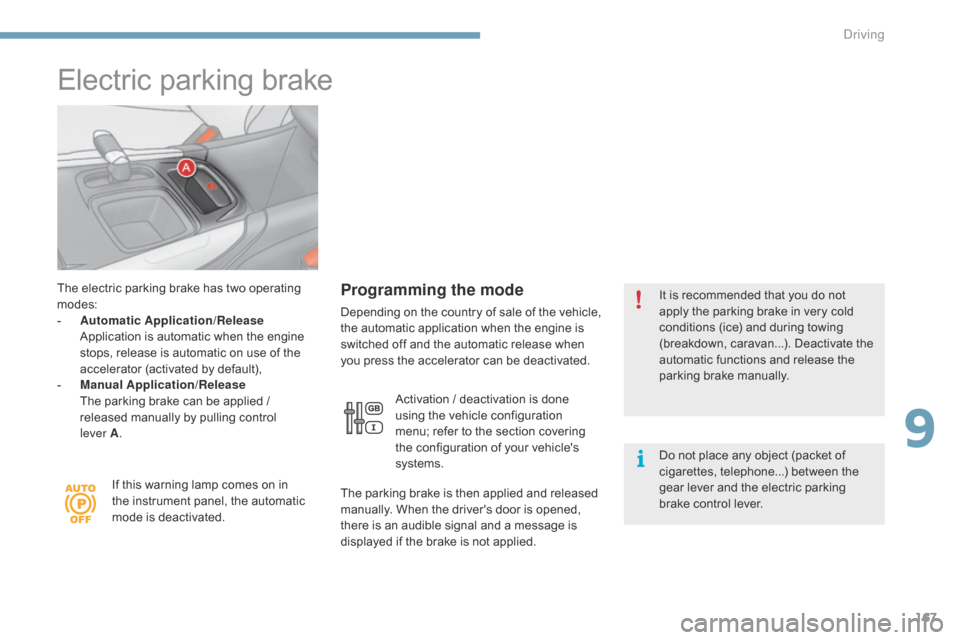
The electric parking brake has two operating modes:
-
A
utomatic Application/Release
A
pplication is automatic when the engine
s
tops, release is automatic on use of the
a
ccelerator (activated by default),
-
M
anual Application/Release
T
he parking brake can be applied /
r
eleased manually by pulling control
l
ever
A.
If
this warning lamp comes on in
t
he instrument panel, the automatic
m
ode is deactivated.Programming the mode
Depending on t he c ountry o f s ale o f t he v ehicle, t
he automatic application when the engine is
s
witched off and the automatic release when
y
ou press the accelerator can be deactivated.
Activation
/ deactivation is done
u
sing the vehicle configuration
m
enu; refer to the section covering
t
he configuration of your vehicle's
s
ystems.
The
parking brake is then applied and released
m
anually. When the driver's door is opened,
t
here is an audible signal and a message is
d
isplayed if the brake is not applied. It
is recommended that you do not a
pply the parking brake in very cold c
onditions (ice) and during towing
(
breakdown, caravan...). Deactivate the
a
utomatic functions and release the
par
king
b
rake
m
anually.
Do
not place any object (packet of
c
igarettes, telephone...) between the
g
ear lever and the electric parking
b
rake control lever.
9
Driving