warning Citroen C4 2014.5 2.G Repair Manual
[x] Cancel search | Manufacturer: CITROEN, Model Year: 2014.5, Model line: C4, Model: Citroen C4 2014.5 2.GPages: 494, PDF Size: 21.47 MB
Page 217 of 494
215
Checks
Particle filter (Diesel)
- fixed illumination of the particle f
ilter warning lamp, accompanied
b
y an audible signal and a
m
essage that there is a risk of
b
lockage of the particle filter.
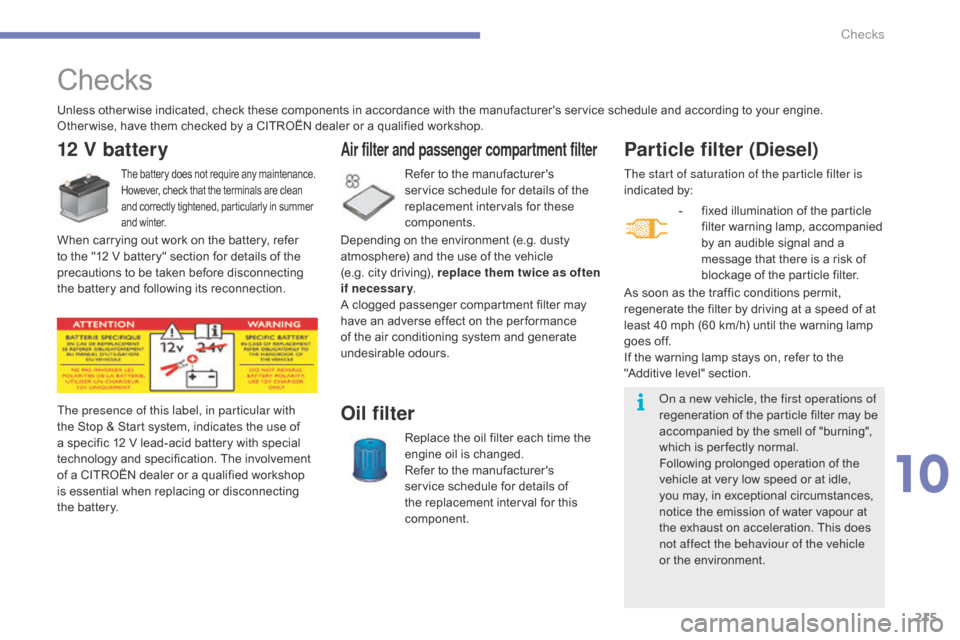
The presence of this label, in particular with
the
Stop
&
Start
system,
indicates
the
use
of
a
specific
12
V
lead-acid
battery
with
special
t
echnology
and
specification.
The
involvement
o
f
a
CITROËN
dealer
or
a
qualified
workshop
i
s
essential
when
replacing
or
disconnecting
t
he
battery. As
soon
as the traffic conditions permit,
r
egenerate the filter by driving at a speed of at
l
east
40
mph (60 km/h) until the warning lamp
g
oes
off.
If
the
warning lamp stays on, refer to the
"
Additive
level" section.
Unless
other wise
indicated,
check
these
components
in
accordance
with
the
manufacturer's
service
schedule
and according to your engine.
Other wise,
have
them
checked
by
a
CITROËN
dealer
or
a
qualified
workshop.
Air filter and passenger compartment filter
Refer to the manufacturer's s
ervice schedule for details of the
r
eplacement intervals for these
c
omponents.
Oil filter
Replace the oil filter each time the e ngine oil is changed.
Refer
to the manufacturer's
s
ervice schedule for details of
t
he replacement interval for this
c
omponent.
12 V battery
The battery does not require any maintenance.
H owever, check that the terminals are clean a
nd correctly tightened, particularly in summer
a
nd winter.
When carrying out work on the battery, refer to the "12 V battery" section for details of the
p
recautions to be taken before disconnecting
t
he battery and following its reconnection.Depending
on the environment (e.g. dusty a
tmosphere) and the use of the vehicle
(e.g.
city driving), replace them twice as often
if necessary .
A
clogged passenger compartment filter may
h
ave an adverse effect on the per formance
o
f the air conditioning system and generate
u
ndesirable
o
dours.The start of saturation of the particle filter is
indicated
by:
on a n
ew vehicle, the first operations of
regeneration
of the particle filter may be
a
ccompanied by the smell of "burning",
w
hich is per fectly normal.
Following
prolonged operation of the
v
ehicle at very low speed or at idle,
y
ou may, in exceptional circumstances,
n
otice the emission of water vapour at
t
he exhaust on acceleration. This does
n
ot affect the behaviour of the vehicle
or
the environment.
10
Checks
Page 220 of 494
218
Range indicators
When switching on the ignition, an indicator gives an estimate of the distance that can
b
e travelled with your vehicle before engine
s
tarting is automatically prevented, once the
v
ehicle starts using the reserve of AdBlue
® or
after
a
fault
is
detected
with
the
SCR
system.
In
the
event
of
simultaneous
system
fault
and
l
ow
AdBlue
® level, the shortest range is the one d
isplayed.
In the event of the risk of non-starting related to a lack of AdBlue®
Range greater than 1 500 miles (2 400 km)
W hen the ignition is switched on, no
i
nformation on range is displayed automatically
i
n the instrument panel.
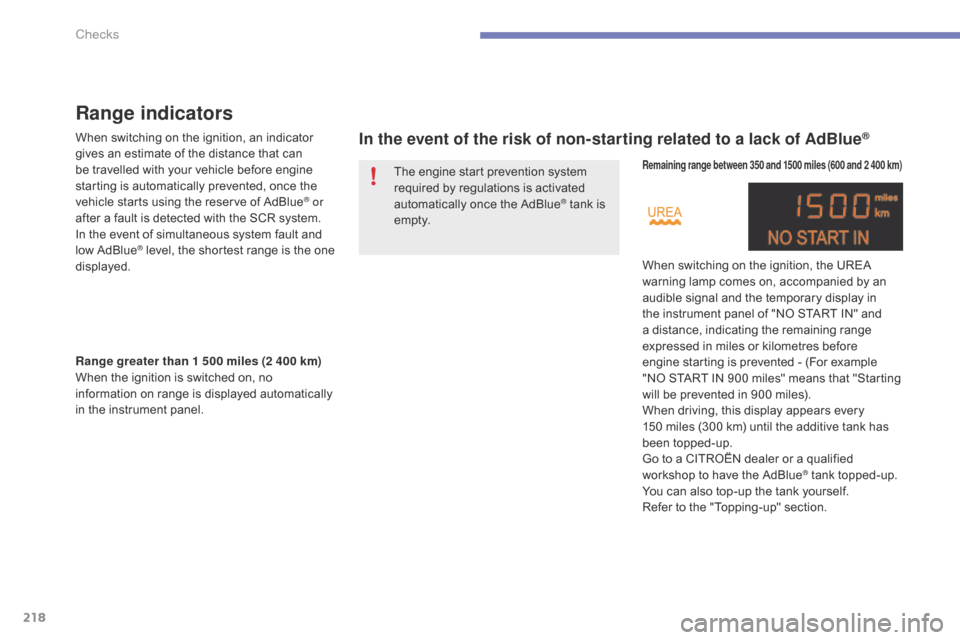
Remaining range between 350 and 1500 miles (600 and 2 400 km)
When switching on the ignition, the UREA warning lamp comes on, accompanied by an
a
udible signal and the temporary display in
t
he instrument panel of "NO START IN" and
a
distance, indicating the remaining range
e
xpressed in miles or kilometres before
e
ngine starting is prevented - (For example
"
NO START IN 900 miles" means that "Starting
w
ill be prevented in 900 miles).
When
driving, this display appears every
1
50 miles (300 km) until the additive tank has
be
en
t
opped-up.
Go
to a CITROËN dealer or a qualified
w
orkshop to have the AdBlue
® tank topped-up.
Y
ou
can
also
top-up
the
tank
yourself.
Refer
to
the
"Topping-up"
section.
The
engine
start
prevention
system
r
equired
by
regulations
is
activated
a
utomatically
once
the
AdBlue
® tank is e
m pt y.
Checks
Page 221 of 494
219
Breakdown related to a lack of AdBlue® additive
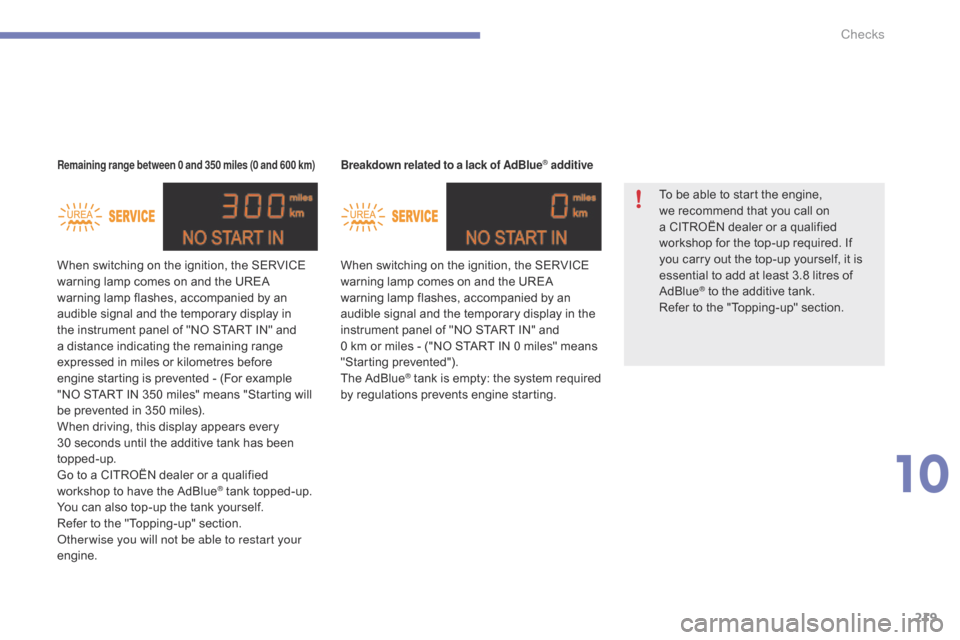
When switching on the ignition, the SERVICE warning lamp comes on and the UREA
w
arning lamp flashes, accompanied by an
a
udible signal and the temporary display in the
i
nstrument panel of "NO START IN" and
0
km or miles - ("NO START IN 0 miles" means
"
Starting
p
revented").
The
Ad
Blue
® tank is empty: t he s ystem r equired b
y
regulations prevents engine starting.
Remaining range between 0 and 350 miles (0 and 600 km)
When switching on the ignition, the SERVICE warning lamp comes on and the UREA
w
arning lamp flashes, accompanied by an
a
udible signal and the temporary display in
t
he instrument panel of "NO START IN" and
a
distance indicating the remaining range
e
xpressed in miles or kilometres before
e
ngine starting is prevented - (For example
"
NO START IN 350 miles" means "Starting will
b
e prevented in 350 miles).
When
driving, this display appears every
3
0 seconds until the additive tank has been
t
opped-up.
Go
to a CITROËN dealer or a qualified
w
orkshop to have the AdBlue
® tank topped-up.
Y
ou
can
also
top-up
the
tank
yourself.
Refer
to
the
"Topping-up"
section.
ot
her wise you will not be able to restart your
engine. To
be able to start the engine,
w
e recommend that you call on
a
CITROËN dealer or a qualified
w
orkshop for the top-up required. If
y
ou carry out the top-up yourself, it is
e
ssential to add at least 3.8 litres of
Ad
Blue
® to the additive tank.
R
efer
to
the "Topping-up" section.
10
Checks
Page 222 of 494
220
In the event of a fault with the the SCR emissions control system
In the event of the detection
of a fault
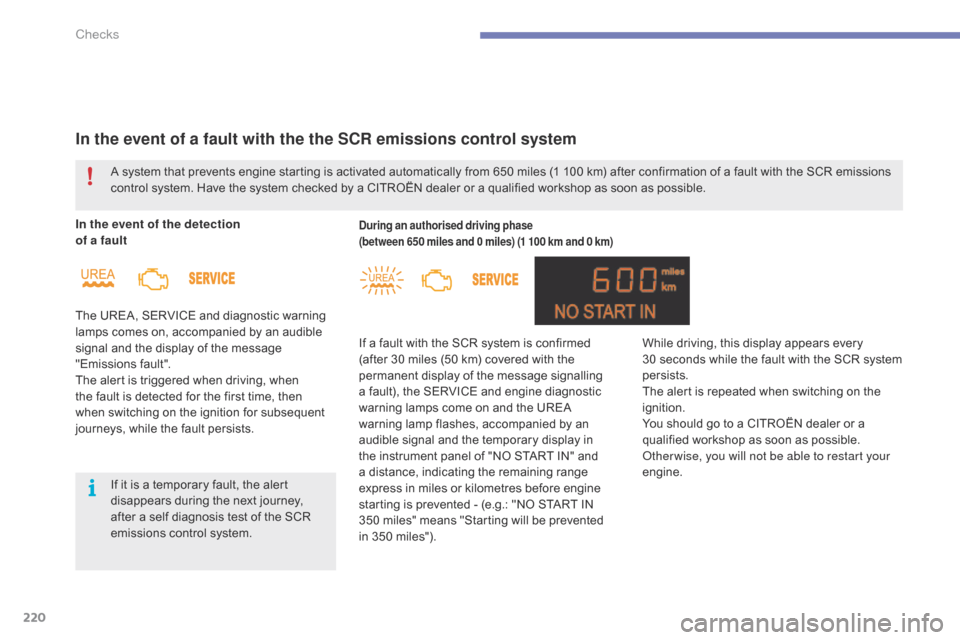
The UREA, SERVICE and diagnostic warning
l
amps comes on, accompanied by an audible
s
ignal and the display of the message
"
Emissions
f
ault".
The
alert is triggered when driving, when
t
he fault is detected for the first time, then
w
hen switching on the ignition for subsequent
j
ourneys, while the fault persists.During an authorised driving phase
(between 650 miles and 0 miles) (1 100 km and 0 km)
If a fault with the SCR system is confirmed ( after 30 miles (50 km) covered with the
p
ermanent display of the message signalling
a
fault), the SERVICE and engine diagnostic
w
arning lamps come on and the UREA
w
arning lamp flashes, accompanied by an
a
udible signal and the temporary display in
t
he instrument panel of "NO START IN" and
a
distance, indicating the remaining range
e
xpress in miles or kilometres before engine
s
tarting is prevented - (e.g.: "NO START IN
350
miles" means "Starting will be prevented
in
350 miles").
A
system
that
prevents
engine
starting
is
activated automatically from 650 miles (1 100 km) after confirmation of a fault with the SCR emissions
c
ontrol
system.
Have
the
system
checked
by
a CITROËN dealer or a qualified workshop as soon as possible.
If
it
is
a
temporary
fault,
the
alert
d
isappears
during
the
next
journey,
a
fter
a
self
diagnosis
test
of
the
SCR
e
missions
control
system. While
driving, this display appears every
30 seconds while the fault with the SCR system
p
ersists.
The
alert is repeated when switching on the
ig
nition.
You
should go to a CITROËN dealer or a
q
ualified workshop as soon as possible.
ot
her wise, you will not be able to restart your
engine.
Checks
Page 223 of 494
221
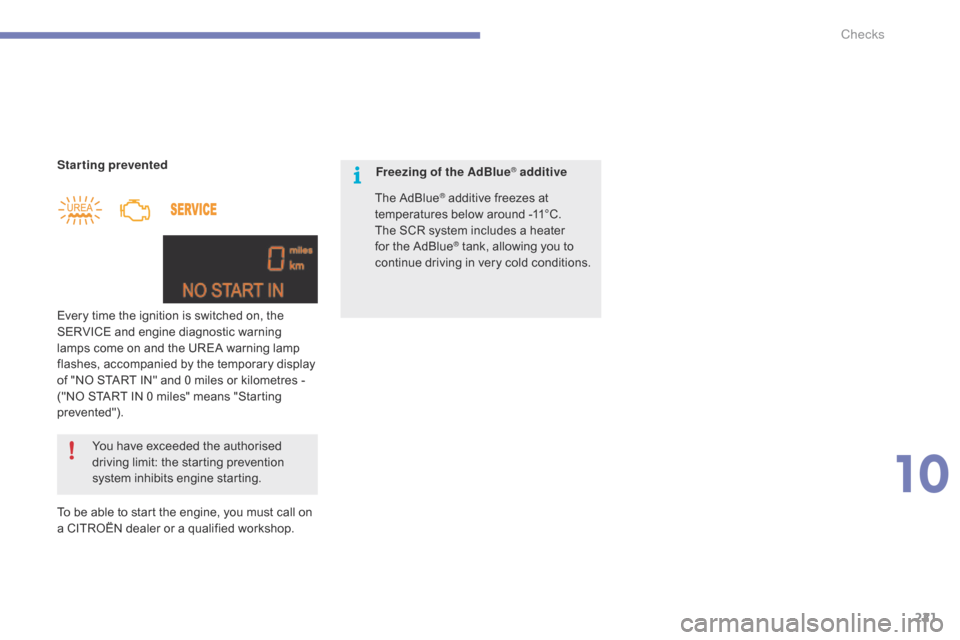
Starting prevented
Every time the ignition is switched on, the
S
ERVICE and engine diagnostic warning
l
amps come on and the UREA warning lamp
f
lashes, accompanied by the temporary display
o
f "NO START IN" and 0 miles or kilometres -
(
"NO START IN 0 miles" means "Starting
p
revented").
To
be able to start the engine, you must call on
a
CITROËN dealer or a qualified workshop.
You
have exceeded the authorised
d
riving limit: the starting prevention
s
ystem inhibits engine starting.Freezing of the AdBlue® additive
The
AdBlue
® additive freezes at t
emperatures below around -11°C.
The
SCR
system includes a heater
f
or
the
AdBlue
® tank, allowing you to c
ontinue
driving in very cold conditions.
10
Checks
Page 224 of 494
222
Topping-up the AdBlue® additive
Precautions in use
Use only AdBlue® additive that meets the I
SO 22241
standard.
The
supply
in
a
non-drip bottle simplifies
t
oping-up.
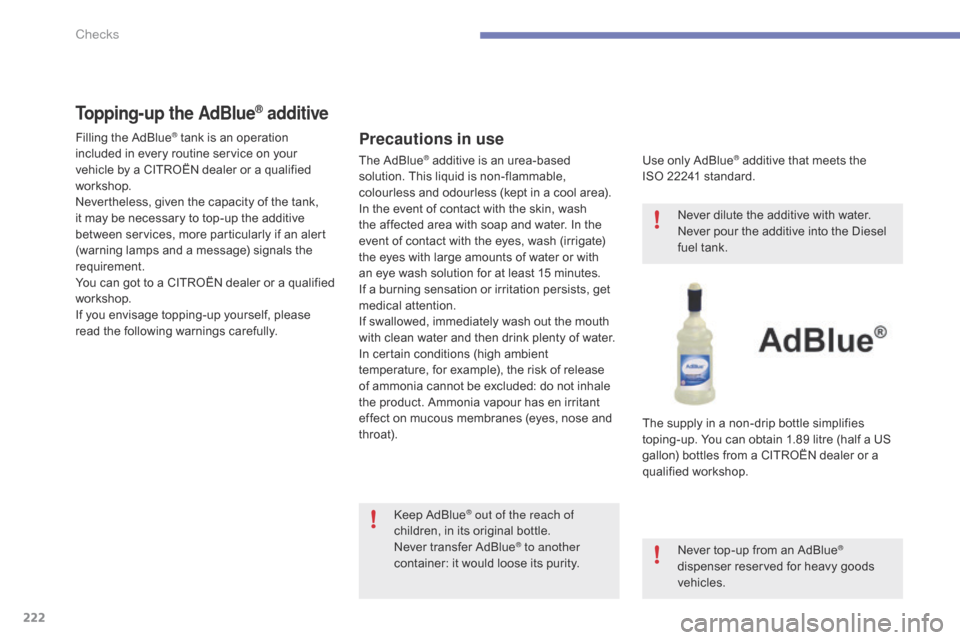
You
can obtain 1.89 litre (half a US
g
allon)
bottles
from a CITROËN dealer or a
q
ualified
w
orkshop.
Keep
AdBlue
® out of the reach of
children,
in
its
original bottle.
Never
transfer AdBlue
® to another
container:
it
would
loose its purity. Never
dilute the additive with water.
Never pour the additive into the Diesel
f
uel tank.
Never top-up from an AdBlue®
dispenser
reserved
for
heavy
goods
v
ehicles.
Filling
the
AdBlue
® tank is an operation i
ncluded
in
every
routine service on your
v
ehicle
by
a
CITROËN dealer or a qualified
w
orkshop.
Nevertheless,
given the capacity of the tank,
i
t
may
be
necessary to top-up the additive
b
etween
services,
more particularly if an alert
(
warning
lamps
and a message) signals the
r
equirement.
You
can
got
to
a
CITROËN dealer or a qualified
w
orkshop.
If
you
envisage
topping-up yourself, please
r
ead
the
following
warnings carefully. The
AdBlue
® additive is an urea-based s
olution.
This liquid is non-flammable,
c
olourless
and odourless (kept in a cool area).
In
the
event
of contact with the skin, wash
t
he
affected
area with soap and water. In the
e
vent
of
contact with the eyes, wash (irrigate)
t
he
eyes
with large amounts of water or with
a
n
eye
wash
solution for at least 15 minutes.
I
f
a
burning
sensation or irritation persists, get
m
edical
attention.
If
swallowed, immediately wash out the mouth
w
ith
clean
water and then drink plenty of water.
In
certain
conditions (high ambient
t
emperature,
for example), the risk of release
o
f
ammonia
cannot be excluded: do not inhale
t
he
product.
Ammonia vapour has en irritant
e
ffect
on
mucous membranes (eyes, nose and
t
hroat).
Checks
Page 235 of 494
233
Removing a wheel
* position R for an electronic gearbox; P for an
automatic gearbox.
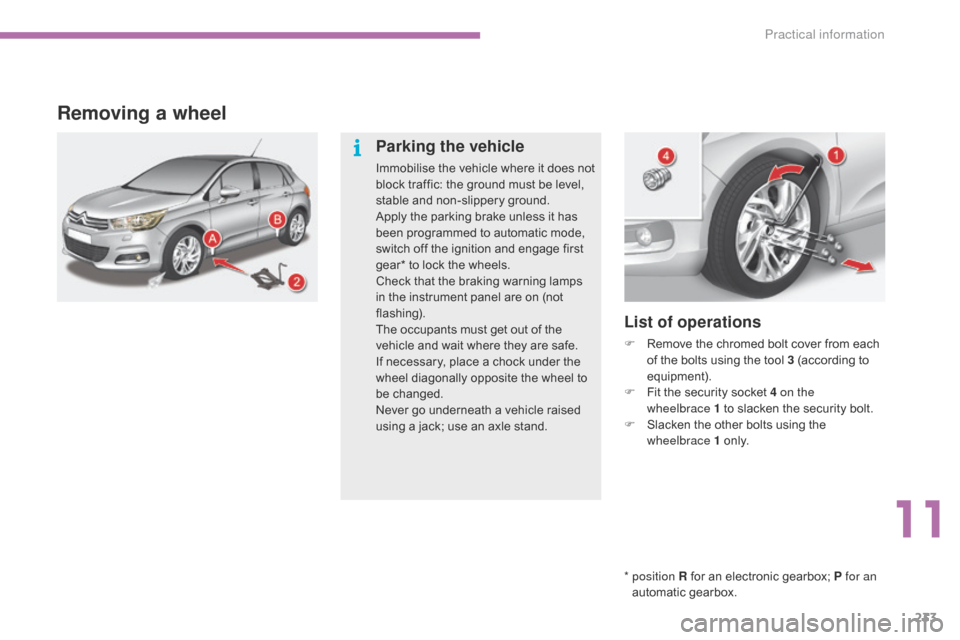
List of operations
F Remove the chromed bolt cover from each o
f the bolts using the tool 3 (according to
e
quipment).
F
F
it the security socket 4 on the
wheelbrace
1 to slacken the security bolt.
F
S
lacken the other bolts using the
w
heelbrace 1
o
n l y.
Parking the vehicle
Immobilise the vehicle where it does not block traffic: the ground must be level,
s
table and non-slippery ground.
Apply
the parking brake unless it has
b
een programmed to automatic mode,
s
witch off the ignition and engage first
g
ear* to lock the wheels.
Check
that the braking warning lamps
i
n the instrument panel are on (not
f
lashing).
The
occupants must get out of the
v
ehicle and wait where they are safe.
If
necessary, place a chock under the
w
heel diagonally opposite the wheel to
be c
hanged.
Never
go underneath a vehicle raised
u
sing a jack; use an axle stand.
11
Practical information
Page 257 of 494
255
Charging the battery using
a battery charger
F Disconnect the battery from the vehicle.
F F ollow the instructions for use provided by
t
he manufacturer of the charger.
F
C
onnect the battery starting with the
n
egative terminal (-).
F
C
heck that the terminals and connectors
a
re clean. If they are covered
w
ith
s
ulphate
(
whitish or greenish deposit), remove them
a
nd clean them.
Reinitialisation after
reconnection
after any reconnection of the battery, switch on
the ignition and wait at least one minute before
s
tarting, to allow time for the initialisation of the
e
lectronic systems.
By
referring to the corresponding sections, you
s
hould set or initialise the following systems
y
ourself:
-
o
ne-touch electric windows,
-
t
ime and date,
-
a
udio and navigation system settings.
Check
that no alert message or warning lamp
c
omes on after switching on the ignition.
However,
if minor problems persist after
c
arrying out these operations, contact a
C
ITROËN dealer or a qualified workshop.
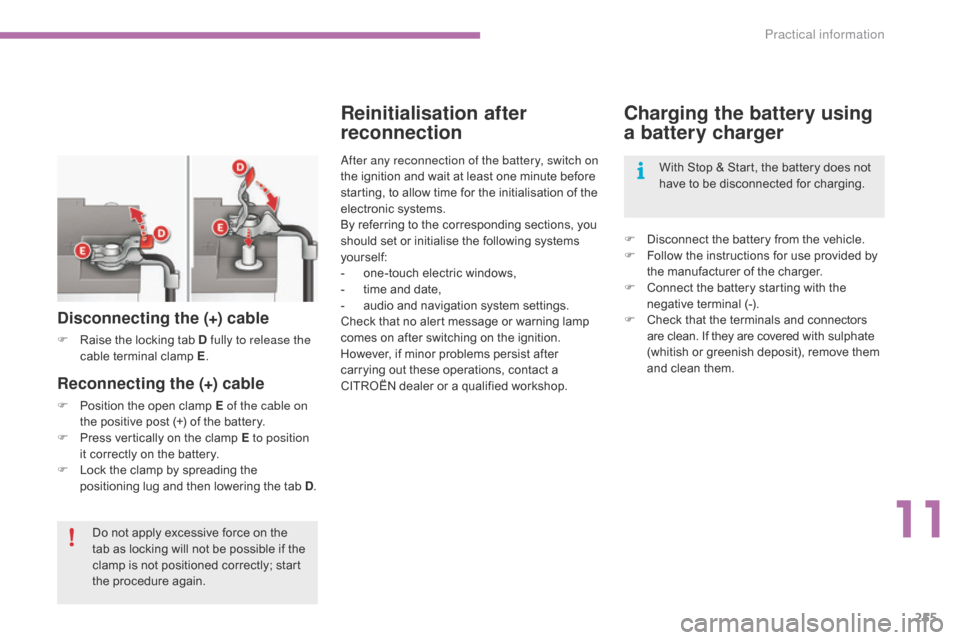
Reconnecting the (+) cable
F Position the open clamp E of the cable on
the positive post (+) of the battery.
F
P
ress vertically on the clamp E to position
it
correctly on the battery.
F
L
ock the clamp by spreading the
p
ositioning lug and then lowering the tab D.
Disconnecting the (+) cable
F Raise the locking tab D fully to release the
cable t erminal c lamp E.
D
o not apply excessive force on the
t
ab as locking will not be possible if the
c
lamp is not positioned correctly; start
t
he procedure again. With
Stop & Start, the battery does not
h
ave to be disconnected for charging.
11
Practical information
Page 262 of 494
260
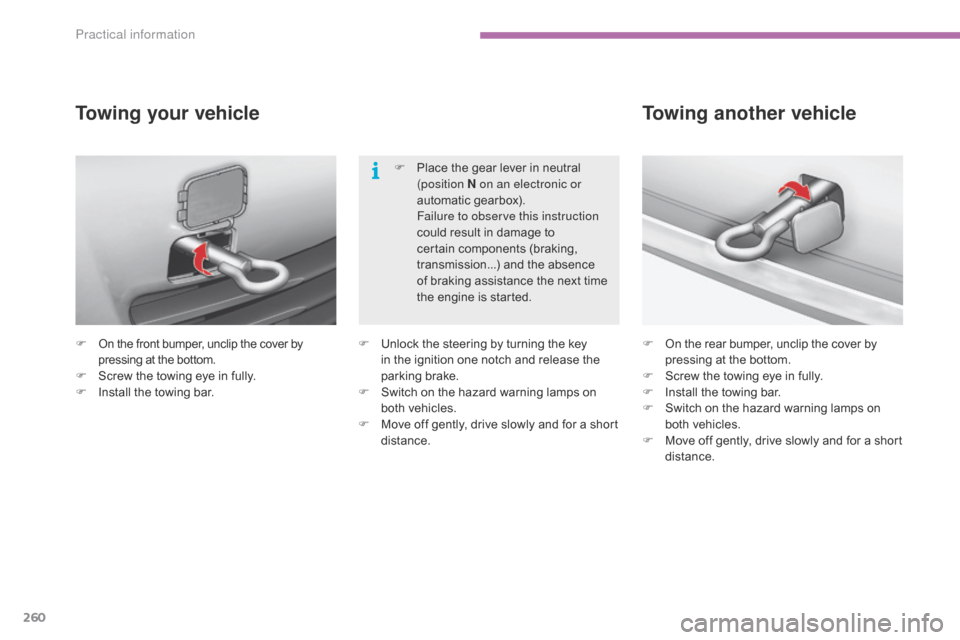
F On the front bumper, unclip the cover by p
ressing at the bottom.
F
S
crew the towing eye in fully.
F
I
nstall the towing bar.
Towing your vehicle
F On the rear bumper, unclip the cover b y p
ressing at the bottom.
F
S
crew the towing eye in fully.
F
I
nstall the towing bar.
F
S
witch on the hazard warning lamps on
b
oth vehicles.
F
M
ove off gently, drive slowly and for a short
di
stance.
Towing another vehicle
F Unlock the steering by turning the key i
n the ignition one notch and release the
par
king
b
rake.
F
S
witch on the hazard warning lamps on
b
oth vehicles.
F
M
ove off gently, drive slowly and for a short
di
stance.F
P
lace the gear lever in neutral
(
position N on an electronic or
automatic gearbox).
F
ailure to observe this instruction
could result in damage to
c
ertain components (braking,
t
ransmission...) and the absence
o
f braking assistance the next time
t
he engine is started.
Practical information
Page 264 of 494
262
F If the warning lamp and the S
TOP warning lamp come on,
s
top the vehicle and switch off
t
he engine as soon as possible.
Braking
Towing a trailer increases the braking distance.
T o avoid overheating of the brakes on a long
m
ountain type of descent, the use of engine
b
raking is recommended.
Ty r e s
F Check the tyre pressures of the
towing vehicle and of the trailer, observing
t
he
re
commended
p
ressures.
Lighting
F Check the electrical lighting and signalling o
n the trailer.
The
rear parking sensors will be
d
eactivated automatically if a genuine
C
ITROËN towbar is used.
Cooling
Towing a trailer on a slope increases the temperature of the coolant.
As
the fan is electrically controlled, its cooling
c
apacity is not dependent on the engine speed.
F
T
o lower the engine speed, reduce your
s
peed.
The
maximum towed load on a long incline
d
epends on the gradient and the ambient
t
emperature.
In
all cases, keep a check on the
c
oolant
t
emperature.
Practical information