check engine Citroen C4 2015 2.G User Guide
[x] Cancel search | Manufacturer: CITROEN, Model Year: 2015, Model line: C4, Model: Citroen C4 2015 2.GPages: 494, PDF Size: 20.49 MB
Page 132 of 494
130
C4-2_en_Chap06_visibilite_ed01-2015
C4-2_en_Chap06_visibilite_ed01-2015
Operating fault
If an automatic rain sensitive wiper malfunction occurs, the wipers will operate in intermittent
m
ode.
Contact
a CITROËN dealer or a qualified
w
orkshop.
Windscreen and headlamp
wash
Low screenwash / headlamp
wash fluid level
On vehicle fitted with headlamp washers, the low level of this fluid is indicated by gauge in
t
he reservoir filler neck under the bonnet.
Checking
and topping up this fluid can should
b
e done with the engine off.
The
level of this fluid should be checked
r
egularly,
par
ticularly
d
uring
w
inter.
Refer
to "Checks - Screenwash / headlamp
w
ash level" section for the procedure on
checking
the level.
F
P
ull
the
windscreen
wiper
stalk
towards
y
ou.
The
windscreen
wash
then
the
w
indscreen
wipers
operate
for
a
fixed
p
eriod.
The
headlamp
washers
only
operate
when
the
dipped or main beam headlamps are on, with
the vehicle moving .
Do
not
cover
the
rain
sensor,
linked
with
t
he sunshine sensor and located in the
centre of the windscreen behind the rear
view
mirror.
Switch
off
the
automatic
rain
sensitive
w
ipers
when
using
an
automatic
car
wash.
In winter, it is advisable to wait until the
windscreen
is
completely
clear
of
ice
b
efore
activating
the
automatic
rain
sen
sitive
w
ipers. To
reduce
the
consumption
of
the
fluid
b
y
the
headlamp
washers,
they
operate
o
nly with every seventh use of the
screenwash
or
every
25
miles
(40
km)
d
uring
a
given
journey.
Visibility
Page 178 of 494
176
C4-2_en_Chap09_conduite_ed01-2015
C4-2_en_Chap09_conduite_ed01-2015
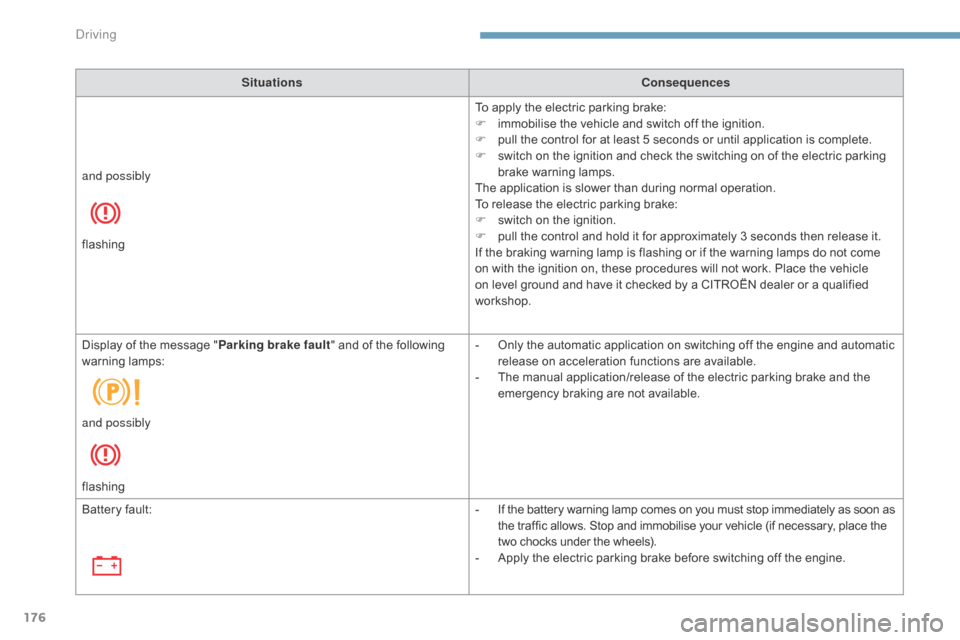
SituationsConsequences
To apply the electric parking brake:
F
i
mmobilise the vehicle and switch off the ignition.
F
p
ull the control for at least 5 seconds or until application is complete.
F
s
witch on the ignition and check the switching on of the electric parking
b
rake warning lamps.
The
application is slower than during normal operation.
To
release the electric parking brake:
F
s
witch on the ignition.
F
p
ull the control and hold it for approximately 3 seconds then release it.
If
the braking warning lamp is flashing or if the warning lamps do not come
o
n with the ignition on, these procedures will not work. Place the vehicle
o
n level ground and have it checked by a CITROËN dealer or a qualified
w
orkshop.
and possibly
flashing
Display
of
the
message
" Parking brake fault "
and of the following
w
arning
lam
ps: -
O
nly the automatic application on switching off the engine and automatic
r
elease on acceleration functions are available.
-
T
he manual application/release of the electric parking brake and the
e
mergency braking are not available.
and possibly
flashing
Battery
fault: -
I
f the battery warning lamp comes on you must stop immediately as soon as
t
he traffic allows. Stop and immobilise your vehicle (if necessary, place the
t
wo chocks under the wheels).
-
A
pply the electric parking brake before switching off the engine.
Driving
Page 184 of 494
182
C4-2_en_Chap09_conduite_ed01-2015
C4-2_en_Chap09_conduite_ed01-2015
At low high speed, if reverse gear is requested, the N indicator flashes and the gearbox goes
i
nto neutral automatically. To engage reverse,
p
ut the gear lever in position N, then position R .
Reverse
To engage reverse gear R, the vehicle must be i
mmobilised with your foot on the brake pedal.
F
Sel
ect position R .
Operating fault
Stopping the vehicle
When immobilising the vehicle, with t
he engine running, you must place the
g
ear lever in neutral N.
Before
carrying out any work in the
e
ngine compartment, ensure that the
g
ear lever is in neutral N and that the
parking
brake is applied.
Whatever
the circumstances, you must
m
anually apply the parking brake when
p
arking, unless the parking brake is
p
rogrammed in automatic mode.
Before
switching off the engine, you can:
-
m
ove to position N to engage neutral,
or
-
l
eave the gear engaged; in this case, it will
n
ot be possible to move the vehicle.
In both cases, you must apply the parking
brake
to immobilise the vehicle.
With the ignition on, the flashing of AUTO
,
accompanied by an audible signal and a
m
essage in the screen, indicates a malfunction
o
f the gearbox.
Have it checked by a CITROËN dealer or a
q
ualified
w
orkshop.
driving
Page 196 of 494
194
C4-2_en_Chap09_conduite_ed01-2015
C4-2_en_Chap09_conduite_ed01-2015
Maintenance
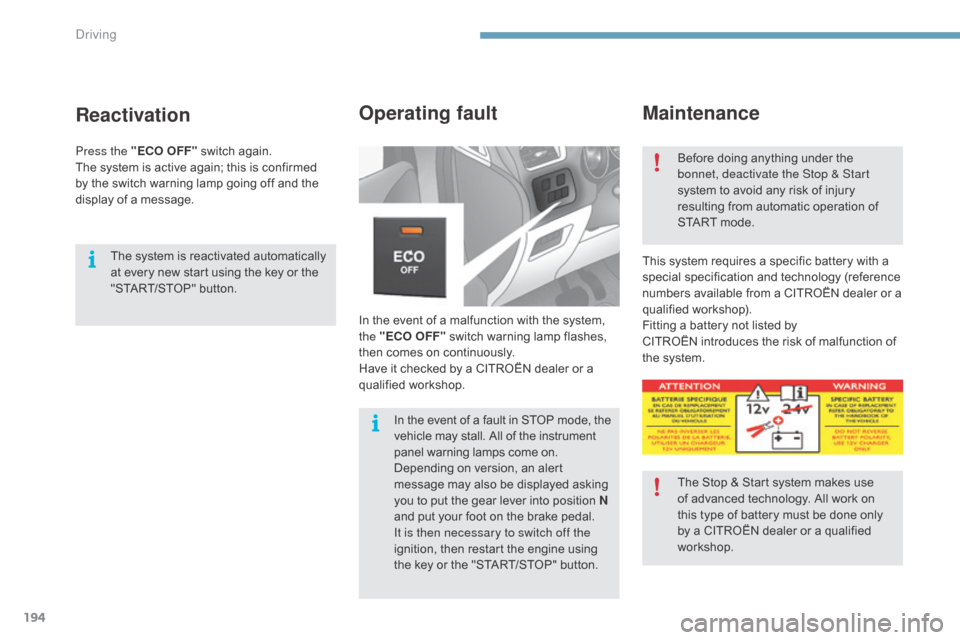
In the event of a malfunction with the system, the "ECO OFF" switch warning lamp flashes,
t
hen comes on continuously.
Ha
ve it checked by a CITROËN dealer or a
q
ualified
w
orkshop.
Operating fault
This system requires a specific battery with a special specification and technology (reference
n
umbers available from a CITROËN dealer or a
q
ualified
w
orkshop).
Fitting
a battery not listed by
C
ITROËN introduces the risk of malfunction of
t
he system.Before
doing anything under the
b
onnet, deactivate the Stop & Start
system to avoid any risk of injury
r
esulting from automatic operation of
S
TART mode.
The Stop & Start system makes use
o
f advanced technology. All work on
t
his type of battery must be done only
b
y a CITROËN dealer or a qualified
w
orkshop.
In
the
event
of
a
fault
in
STOP
mode,
the
v
ehicle
may
stall.
All
of
the
instrument
p
anel
warning
lamps
come
on.
Depending
on
version,
an
alert
m
essage
may
also
be
displayed
asking
y
ou
to
put
the
gear
lever
into
position
N
and
put
your
foot
on
the
brake
pedal.
It is then necessary to switch off the
ignition,
then
restart
the
engine
using
t
he
key
or
the
"START/STOP"
button.
Reactivation
The system is reactivated automatically a t every new start using the key or the
"
START/STOP" button.
Press the "ECO OFF"
switch again.
The
system is active again; this is confirmed
b
y
the
switch warning lamp going off and the
d
isplay of a message.
Driving
Page 198 of 494
196
C4-2_en_Chap09_conduite_ed01-2015
C4-2_en_Chap09_conduite_ed01-2015
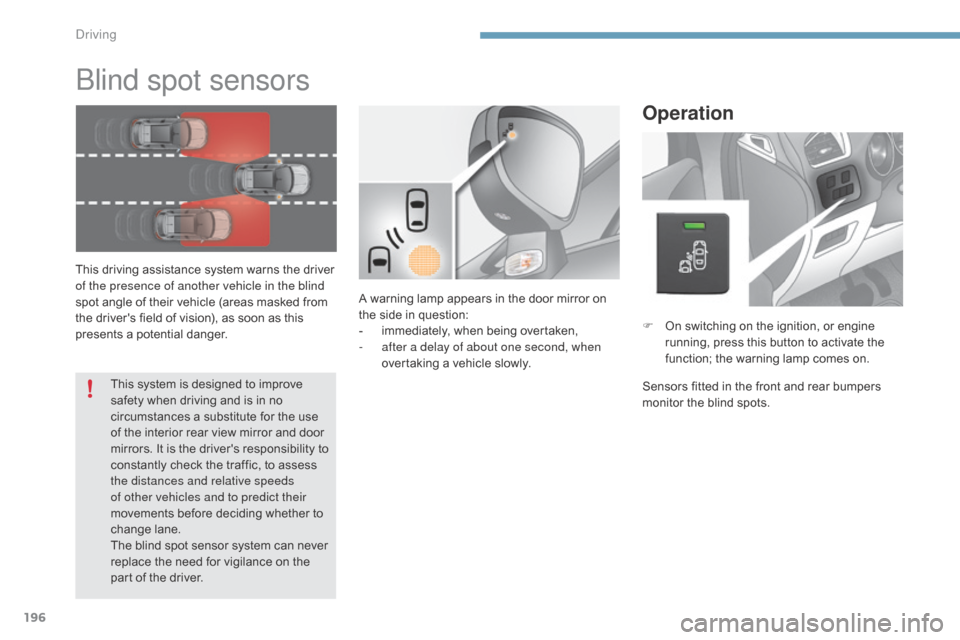
blind spot sensors
This driving assistance system warns the driver of the presence of another vehicle in the blind
spot
angle of their vehicle (areas masked from
t
he driver's field of vision), as soon as this
p
resents a potential danger.
Operation
F On switching on the ignition, or engine r
unning, press this button to activate the
f
unction; the warning lamp comes on.
Sensors
fitted in the front and rear bumpers
m
onitor the blind spots.
A
warning
lamp
appears
in
the
door
mirror
on
t
he
side
in
question:
-
i
mmediately,
when
being
overtaken,
-
a
fter a delay of about one second, when
overtaking
a
vehicle
slowly.
This
system
is
designed
to
improve
s
afety
when
driving
and
is
in
no
c
ircumstances
a
substitute
for
the
use
o
f
the
interior
rear
view
mirror
and
door
m
irrors.
It
is
the
driver's
responsibility
to
c
onstantly
check
the
traffic,
to
assess
t
he distances and relative speeds
of other vehicles and to predict their
movements
before
deciding
whether
to
c
hange
lan
e.
The
blind
spot
sensor
system
can
never
r
eplace
the
need
for
vigilance
on
the
p
art
of
the
driver.
driving
Page 209 of 494
207
C4-2_en_Chap10_verification_ed01-2015
C4-2_en_Chap10_verification_ed01-2015
ToTaL & CITRoËn
Partners in performance and
protecting the environment
Innovation in the search for
performance
For over 40 year, the ToTaL Research and
Development departments have developed for
C
ITROËN, lubricants to match the latest technical
i
nnovations on CITR
oËn
vehicles, both for
competition
and for everyday motoring.
For you, this is an assurance that you will obtain of the
best
per formance for your engine.
Optimum protection for
your engine
By having your CITROËN vehicle serviced with ToTaL l ubricants, you are
contributing
towards improving the life and
p
er formances of your engine, while also
pro
tecting
t
he
e
nvironment.
prefers
10
Checks
Page 211 of 494
209
C4-2_en_Chap10_verification_ed01-2015
C4-2_en_Chap10_verification_ed01-2015
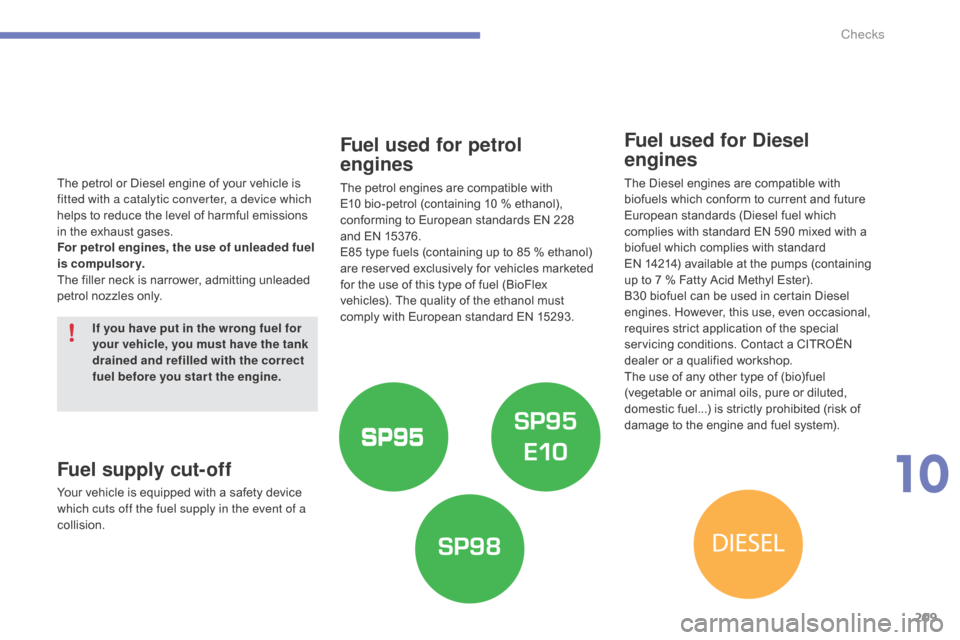
Fuel used for petrol
engines
The petrol engines are compatible with E
10 bio-petrol (containing 10 % ethanol),
c
onforming to European standards EN 228
and
EN 15376.
E85
type fuels (containing up to 85 % ethanol)
a
re reserved exclusively for vehicles marketed
f
or the use of this type of fuel (BioFlex
v
ehicles). The quality of the ethanol must
c
omply with European standard EN 15293.
Fuel used for Diesel
engines
The Diesel engines are compatible with biofuels which conform to current and future
E
uropean standards (Diesel fuel which
c
omplies with standard EN 590 mixed with a
b
iofuel which complies with standard
EN
14214) available at the pumps (containing
u
p to 7 % Fatty Acid Methyl Ester).
B30
biofuel can be used in certain Diesel
e
ngines. However, this use, even occasional,
r
equires strict application of the special
s
ervicing conditions. Contact a CITROËN
d
ealer or a qualified workshop.
The
use of any other type of (bio)fuel
(
vegetable or animal oils, pure or diluted,
d
omestic fuel...) is strictly prohibited (risk of
d
amage to the engine and fuel system).
The
petrol
or
Diesel
engine
of
your
vehicle
is
f
itted with a catalytic converter, a device which
helps
to
reduce
the
level
of
harmful
emissions
i
n
the
exhaust
gases.
For petrol engines, the use of unleaded fuel
is compulsory.
The
filler
neck
is
narrower,
admitting
unleaded
p
etrol
nozzles
only.
Fuel supply cut-off
Your vehicle is equipped with a safety device w hich cuts off the fuel supply in the event of a
collision. If you have put in the wrong fuel for
your vehicle, you must have the tank
drained and refilled with the correct
fuel before you star t the engine.
10
Checks
Page 212 of 494
210
C4-2_en_Chap10_verification_ed01-2015
C4-2_en_Chap10_verification_ed01-2015
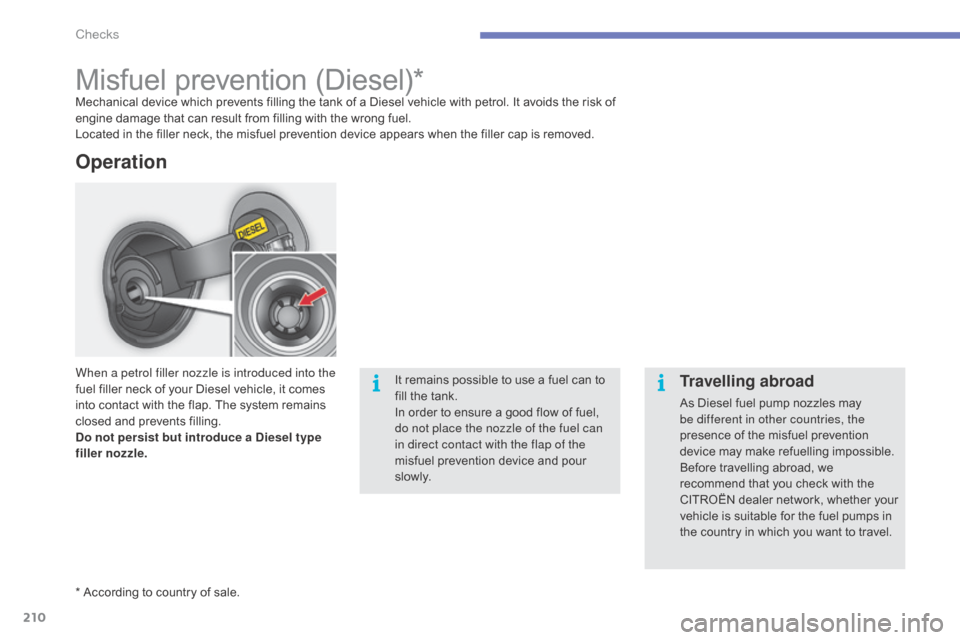
Misfuel prevention (Diesel)*Mechanical device which prevents filling the tank of a Diesel vehicle with petrol. It avoids the risk of engine damage that can result from filling with the wrong fuel.
Located
in the filler neck, the misfuel prevention device appears when the filler cap is removed.
When a petrol filler nozzle is introduced into the
fuel
filler neck of your Diesel vehicle, it comes
i
nto contact with the flap. The system remains
c
losed and prevents filling.
Do not persist but introduce a Diesel type
filler nozzle.
*
According to country of sale. It
remains possible to use a fuel can to
f
ill the tank.
In
order to ensure a good flow of fuel,
d
o not place the nozzle of the fuel can
in direct contact with the flap of the
misfuel
prevention device and pour
s
l ow l y.
Travelling abroad
As Diesel fuel pump nozzles may be different in other countries, the
presence
of the misfuel prevention
d
evice may make refuelling impossible.
Before
travelling abroad, we
r
ecommend that you check with the
C
ITROËN dealer network, whether your
v
ehicle is suitable for the fuel pumps in
t
he country in which you want to travel.
Operation
Checks
Page 213 of 494
211
C4-2_en_Chap10_verification_ed01-2015
C4-2_en_Chap10_verification_ed01-2015
Running out of fuel (Diesel)
1.6 HDi engine2.0 HDi engineOn vehicles fitted with HDi engines, the fuel s
ystem must be primed if you run out of fuel;
r
efer to the corresponding engine compartment
v
iew.
If
the tank on your vehicle is fitted with a
m
isfuel prevention device, refer to the "Misfuel
p
revention
(
Diesel)"
s
ection.
BlueHDi 100, 115 and
120
engines
If the engine does not start first time, d
on't keep trying but start the procedure
a
gain from the beginning. F
F
ill the fuel tank with at least five litres of
d
iesel.
F
O
pen the bonnet.
F
I
f necessary, unclip the styling cover for
a
ccess to the priming pump.
F
S
queeze and release the priming pump
r
epeatedly until resistance is felt (there m
ay be resistance at the first press).
F O perate the starter until the engine starts
(
if the engine does not start at the first
a
ttempt, wait around 15 seconds before
t
rying
ag
ain).
F
I
f the engine does not start after a few
a
ttempts, operate the priming pump again
t
hen start the engine.
F
R
efit the styling cover and clip it in place.
F
C
lose the bonnet.F
F
ill the fuel tank with at least five litres of
D
iesel.
F
O
pen the bonnet.
F
I
f necessary, unclip the style cover for
access to the priming pump.
F
S
lacken the bleed screw.
F
S
queeze and release the priming pump r
epeatedly until fuel appears in the
transparent p ipe.
F
T
ighten the bleed screw.
F
O
perate the starter until the engine starts
(
if the engine fails to start at the first
a
ttempt, wait around 15 seconds before
t
rying
ag
ain).
F
I
f the engine fails to start after a few
a
ttempts, operate the priming pump again,
t
hen the starter.
F
P
ut the style cover back in position and
c
lip it in place, ensuring that it has clipped
c
o r r e c t l y.
F
C
lose the bonnet.
F
F
ill the fuel tank with at least five litres of
D
iesel.
F
S
witch on the ignition (without starting the
e
ngine).
F
W
ait around 6 seconds and switch off the
ig
nition.
F
R
epeat the operation 10 times.
F
O
perate the starter to run the engine.
10
Checks
Page 214 of 494
212
C4-2_en_Chap10_verification_ed01-2015
C4-2_en_Chap10_verification_ed01-2015
bonnet
F Push the exterior safety catch B to the left
and raise the bonnet.
Opening
F Open the front left door.
F P ull the interior bonnet release lever A,
located
at the bottom of the door aperture.
F
U
nclip the stay C from its housing on the
b
ack of the bonnet.
F
F
ix the stay in the notch to hold the bonnet
ope
n.
Closing
F Take the stay out of the support notch.
F C lip the stay in its housing on the back of
t
he bonnet.
F
L
ower the bonnet and release it at the end
of
its travel.
F
P
ull on the bonnet to check that it is
s
ecured
c
orrectly.
The cooling fan may star t after switching
off the engine: take care with ar ticles and
clothing that might be caught by the fan
blades.
Before
doing
anything
under
the
b
onnet, switch off the Stop & Start
system
to
avoid
any
risk
of
injury
r
esulting
from
an
automatic
c
hange
t
o
S
TART
mode.
Do not open the bonnet in high winds.
When the engine is hot, handle the
e
xterior safety catch and the bonnet
s
tay with care (risk of burns).
be
cause of the presence of electrical
equipment under the bonnet, it is
r
ecommended that exposure to water
(
rain,
w
ashing, ...) be limited.
The location of the interior bonnet
release
lever
prevents
opening
of
t
he bonnet while the front left door is
closed.
Checks