ECU Citroen C4 2015 2.G Owner's Guide
[x] Cancel search | Manufacturer: CITROEN, Model Year: 2015, Model line: C4, Model: Citroen C4 2015 2.GPages: 494, PDF Size: 20.49 MB
Page 162 of 494
160
C4-2_en_Chap08_securite_ed01-2015
C4-2_en_Chap08_securite_ed01-2015
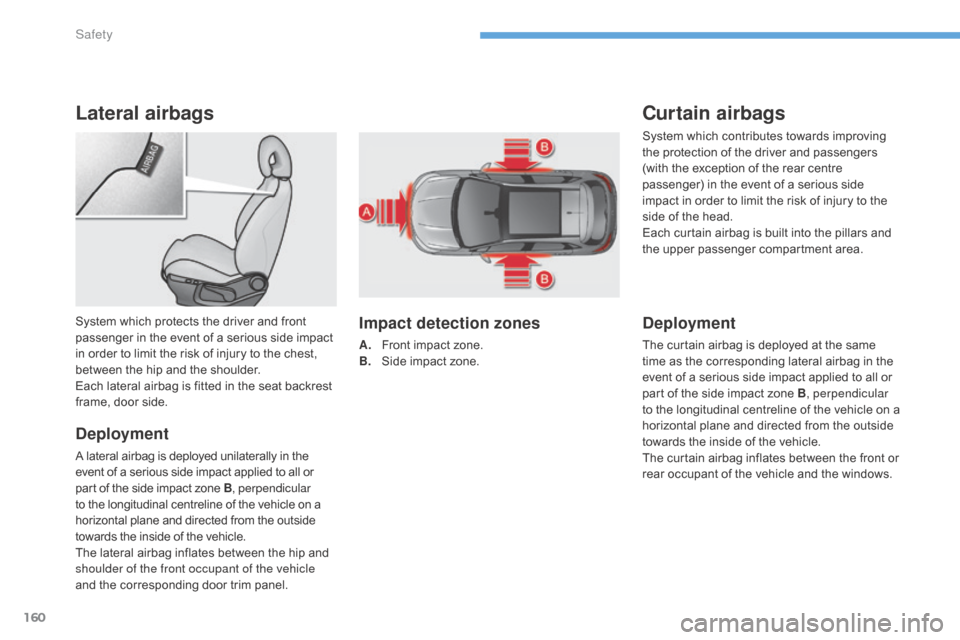
Lateral airbags
Deployment
A lateral airbag is deployed unilaterally in the event of a serious side impact applied to all or p
art of the side impact zone B, perpendicular
to
the longitudinal centreline of the vehicle on a
h
orizontal plane and directed from the outside
t
owards the inside of the vehicle.
The
lateral airbag inflates between the hip and
s
houlder of the front occupant of the vehicle
and
the corresponding door trim panel.
Impact detection zones
A. Front impact zone.
B. S ide impact zone.
Curtain airbags
System which contributes towards improving the protection of the driver and passengers
(
with the exception of the rear centre
p
assenger) in the event of a serious side
i
mpact in order to limit the risk of injury to the
s
ide of the head.
Each
curtain airbag is built into the pillars and
t
he upper passenger compartment area.
Deployment
The curtain airbag is deployed at the same time as the corresponding lateral airbag in the
e
vent of a serious side impact applied to all or
p
art of the side impact zone B, perpendicular
to
the longitudinal centreline of the vehicle on a
h
orizontal plane and directed from the outside
t
owards the inside of the vehicle.
The
curtain airbag inflates between the front or
r
ear occupant of the vehicle and the windows.
System
which
protects
the
driver
and
front
p
assenger
in
the
event
of
a
serious
side
impact
i
n
order
to
limit
the
risk
of
injury
to
the
chest,
b
etween
the
hip
and
the
shoulder.
Each
lateral
airbag
is
fitted
in
the
seat
backrest
f
rame,
door
side.
Safety
Page 163 of 494
161
C4-2_en_Chap08_securite_ed01-2015
C4-2_en_Chap08_securite_ed01-2015
For the airbags to be fully effective, observe the following safety rules:Front airbags
Do not drive holding the steering wheel by its spokes or resting your hands on the centre
p
art of the wheel.
Passengers
must not place their feet on the
das
hboard.
Do
not smoke as deployment of the airbags
c
an cause burns or the risk of injury from a
c
igarette or pipe.
Never
remove or pierce the steering wheel or
h
it it violently.
Do
not fit or attach anything to the steering
w
heel
o
r
d
ashboard,
t
his
c
ould
c
ause
i
njuries
w
ith deployment of the airbags.
Lateral airbags
Use only approved covers on the seats, compatible with the deployment the lateral
a
irbags. For information on the range of seat
c
overs suitable for your vehicle, you can
contact
a CITROËN dealer.
Refer
to the "Accessories" section.
Do
not fix or attach anything to the seat
b
acks (clothing...). This could cause injury
t
o the chest or arms if the lateral airbag is
d
eployed.
do n
ot sit with the upper part of the body any
nearer
to the door than necessary.
Curtain airbags
Do not fix or attach anything to the roof. This could cause injury to the head if the curtain
a
irbag is deployed.
If
fitted on your vehicle, do not remove the
g
rab handles installed on the roof, they play
a
part in securing the curtain airbags.
Sit
in
a
normal
upright
position.
Wear
a
correctly
adjusted
seat
belt.
Do
not
leave
anything
between
the
o
ccupants
and
the
airbags
(a
child,
pet,
o
bject...).
This
could
hamper
the
operation
of
t
he
airbags
or
injure
the
occupants.
af
ter an accident or if the vehicle has been
stolen
or
broken
into,
have
the
airbag
s
ystems
checked.
All
work
on
the
airbag
system
must
be
c
arried out by a CITR
oËn
dealer or a
qualified
w
orkshop.
Even
if
all
of
the
precautions
mentioned
a
re
observed,
a
risk
of
injury
or
of
minor
b
urns
to
the
head,
chest
or
arms
when
an
a
irbag
is
deployed
cannot
be
ruled
out.
The
b
ag
inflates
almost
instantly
(within
a
few
m
illiseconds)
then
deflates
within
the
same
t
ime
discharging
the
hot
gas
via
openings
p
rovided
for
this
purpose.
8
Safety
Page 214 of 494
212
C4-2_en_Chap10_verification_ed01-2015
C4-2_en_Chap10_verification_ed01-2015
bonnet
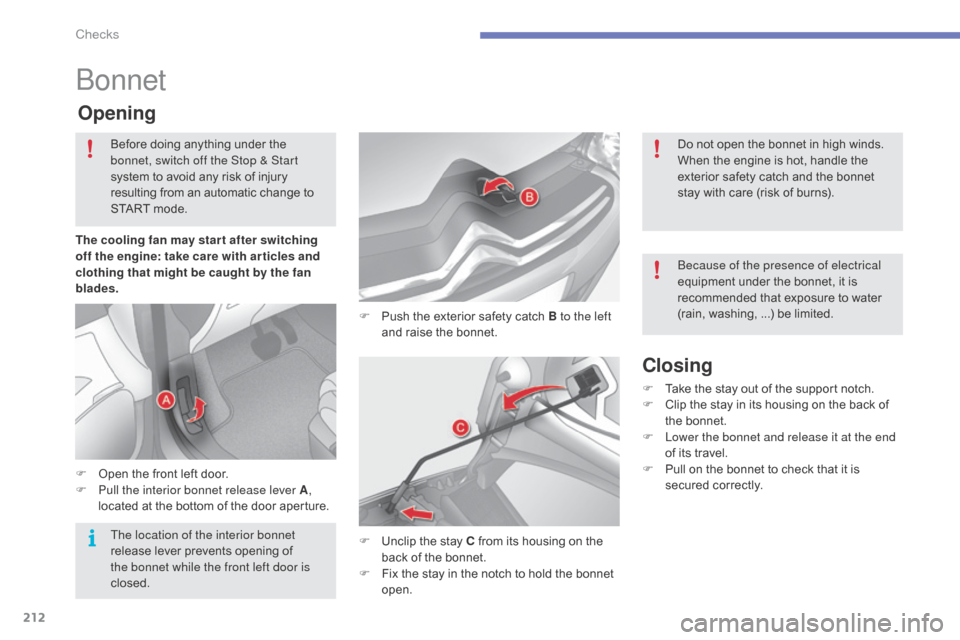
F Push the exterior safety catch B to the left
and raise the bonnet.
Opening
F Open the front left door.
F P ull the interior bonnet release lever A,
located
at the bottom of the door aperture.
F
U
nclip the stay C from its housing on the
b
ack of the bonnet.
F
F
ix the stay in the notch to hold the bonnet
ope
n.
Closing
F Take the stay out of the support notch.
F C lip the stay in its housing on the back of
t
he bonnet.
F
L
ower the bonnet and release it at the end
of
its travel.
F
P
ull on the bonnet to check that it is
s
ecured
c
orrectly.
The cooling fan may star t after switching
off the engine: take care with ar ticles and
clothing that might be caught by the fan
blades.
Before
doing
anything
under
the
b
onnet, switch off the Stop & Start
system
to
avoid
any
risk
of
injury
r
esulting
from
an
automatic
c
hange
t
o
S
TART
mode.
Do not open the bonnet in high winds.
When the engine is hot, handle the
e
xterior safety catch and the bonnet
s
tay with care (risk of burns).
be
cause of the presence of electrical
equipment under the bonnet, it is
r
ecommended that exposure to water
(
rain,
w
ashing, ...) be limited.
The location of the interior bonnet
release
lever
prevents
opening
of
t
he bonnet while the front left door is
closed.
Checks
Page 219 of 494
217
C4-2_en_Chap10_verification_ed01-2015
C4-2_en_Chap10_verification_ed01-2015
Screenwash / headlamp
wash fluid level
Specification of the fluid
To ensure optimum cleaning and to avoid freezing, the fluid should never be topped up or r
eplaced by plain water.
In wintry conditions, the use of a fluid
with
an ethyl alcohol or methanol base is
re
commended.
To
check
the
level
or
top
up
the
f
luid
on
vehicle
fitted
with
headlamp
w
ashers,
immobilise
the
vehicle
and
s
witch
of
the
engine.
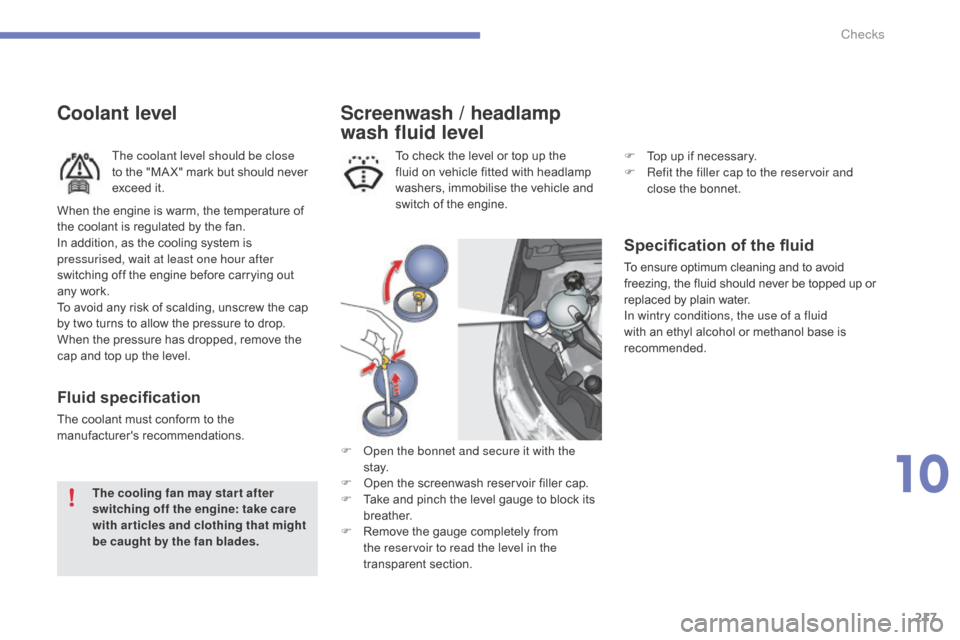
F
o
p
en the bonnet and secure it with the
st ay.
F
O
pen
the
screenwash
reservoir
filler
cap.
F
T
ake
and
pinch
the
level
gauge
to
block
its
b
reather.
F
R
emove
the
gauge
completely
from
t
he reservoir to read the level in the
transparent
s
ection.
Coolant level
The coolant level should be close
to the "MA X" mark but should never
e
xceed it.
Fluid specification
The coolant must conform to the manufacturer's r ecommendations.
The cooling fan may star t after
switching off the engine: take care
with articles and clothing that might
be caught by the fan blades.
When
the engine is warm, the temperature of
t
he coolant is regulated by the fan.
In addition, as the cooling system is
p
ressurised, wait at least one hour after
switching off the engine before carrying out
any work.
To avoid any risk of scalding, unscrew the cap
b
y two turns to allow the pressure to drop.
W
hen the pressure has dropped, remove the
c
ap and top up the level. F
T
op up if necessary.
F
R
efit the filler cap to the reservoir and
close the bonnet.
10
Checks
Page 229 of 494
227
C4-2_en_Chap10_verification_ed01-2015
C4-2_en_Chap10_verification_ed01-2015
Recommendations on storage Procedure
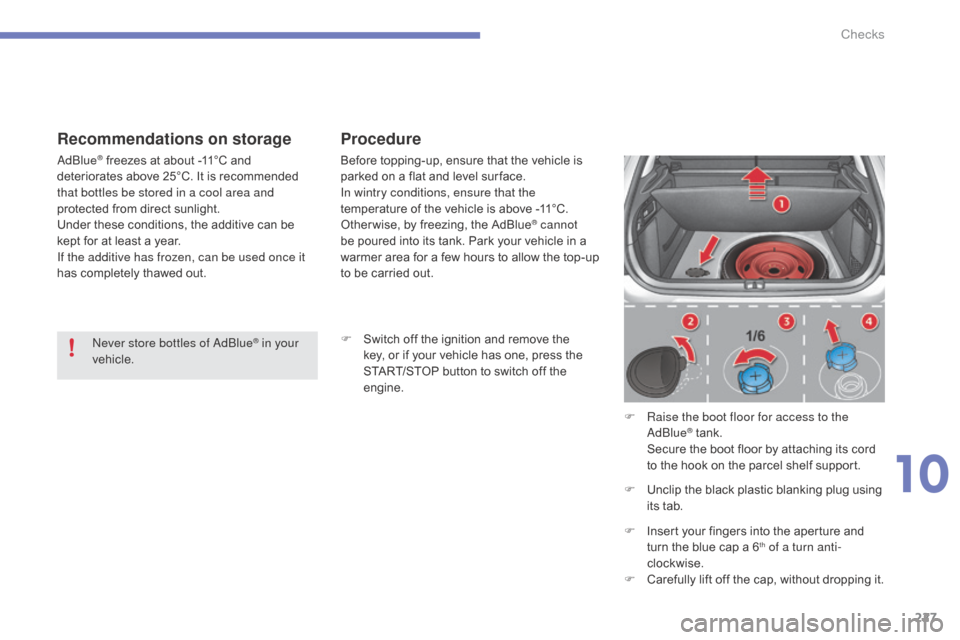
F Switch off the ignition and remove the k
ey, or if your vehicle has one, press the
S
TART/STOP button to switch off the
e
ngine. F
R
aise the boot floor for access to the
a
d
blu
e
® tank. S
ecure
the boot floor by attaching its cord
t
o
the
hook on the parcel shelf support.
F
U
nclip
the black plastic blanking plug using
i
ts
tab.
F
I
nsert
your fingers into the aperture and
t
urn
the
blue cap a 6
th of a turn anti-
clockwise.
F
C
arefully
lift
off
the
cap, without dropping it.
ne
ver store bottles of
a
dbl
ue
® in your
vehicle. Before
topping-up, ensure that the vehicle is
p
arked on a flat and level sur face.
In wintry conditions, ensure that the
temperature of the vehicle is above -11°C.
O
ther wise, by freezing, the AdBlue
® cannot
be
poured
into
its
tank.
Park
your
vehicle in a
w
armer
area
for
a
few
hours
to
allow the top-up
t
o
be
carried
out.
a
d
blu
e
® freezes at about -11°C and d
eteriorates above 25°C. It is recommended
t
hat bottles be stored in a cool area and
protected
from direct sunlight.
Under
these conditions, the additive can be
k
ept
for
at least a year.
If the additive has frozen, can be used once it
has
completely thawed out.
10
Checks
Page 236 of 494
234
C4-2_en_Chap11_info-pratique_ed01-2015
C4-2_en_Chap11_info-pratique_ed01-2015
Changing a wheel
Access to the tools
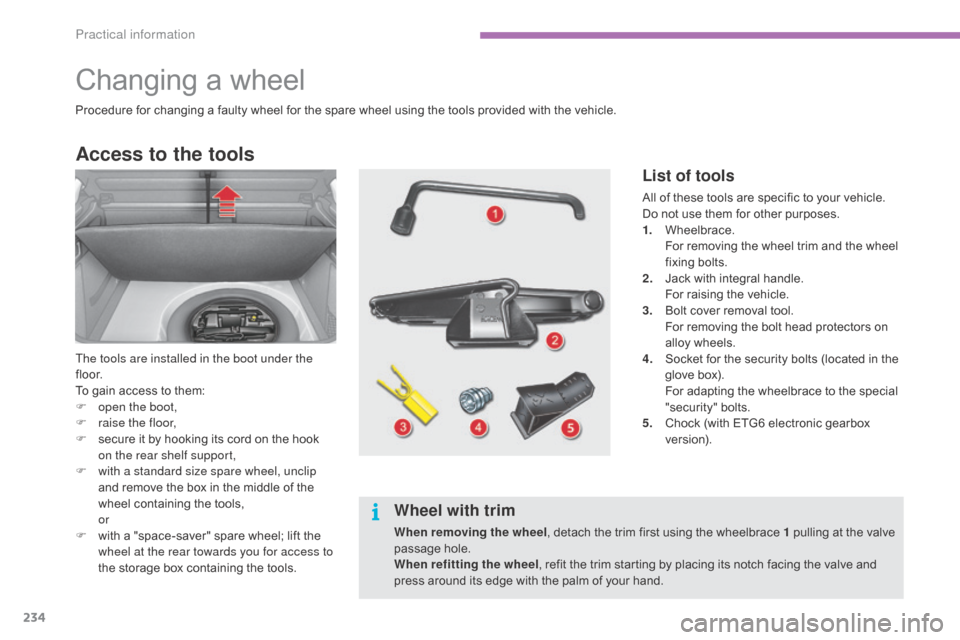
The tools are installed in the boot under the
f l o o r.
To gain access to them:
F
o
pen the boot,
F
r
aise the floor,
F
s
ecure it by hooking its cord on the hook
o
n the rear shelf support,
F
w
ith a standard size spare wheel, unclip
and
remove the box in the middle of the
w
heel containing the tools,
or
F
w
ith a "space-saver" spare wheel; lift the
w
heel at the rear towards you for access to
the
storage box containing the tools.
List of tools
All of these tools are specific to your vehicle. Do not use them for other purposes.
1.
W
heelbrace.
F
or removing the wheel trim and the wheel
f
ixing
bol
ts.
2.
J
ack with integral handle.
F
or raising the vehicle.
3.
B
olt cover removal tool.
F
or removing the bolt head protectors on
a
lloy wheels.
4.
S
ocket for the security bolts (located in the
g
love box).
F
or adapting the wheelbrace to the special
"s
ecurity"
b
olts.
5.
C
hock (with ETG6 electronic gearbox
v
e r s i o n).
Wheel with trim
When removing the wheel , detach the trim first using the wheelbrace 1 pulling at the valve p
assage hole.
When refitting the wheel ,
refit the trim starting by placing its notch facing the valve and
p
ress around its edge with the palm of your hand.
Procedure
for
changing
a
faulty
wheel
for
the
spare
wheel
using the tools provided with the vehicle.
Practical information
Page 239 of 494
237
C4-2_en_Chap11_info-pratique_ed01-2015
C4-2_en_Chap11_info-pratique_ed01-2015
Removing a wheel
* position R for an electronic gearbox; P for an
automatic gearbox.
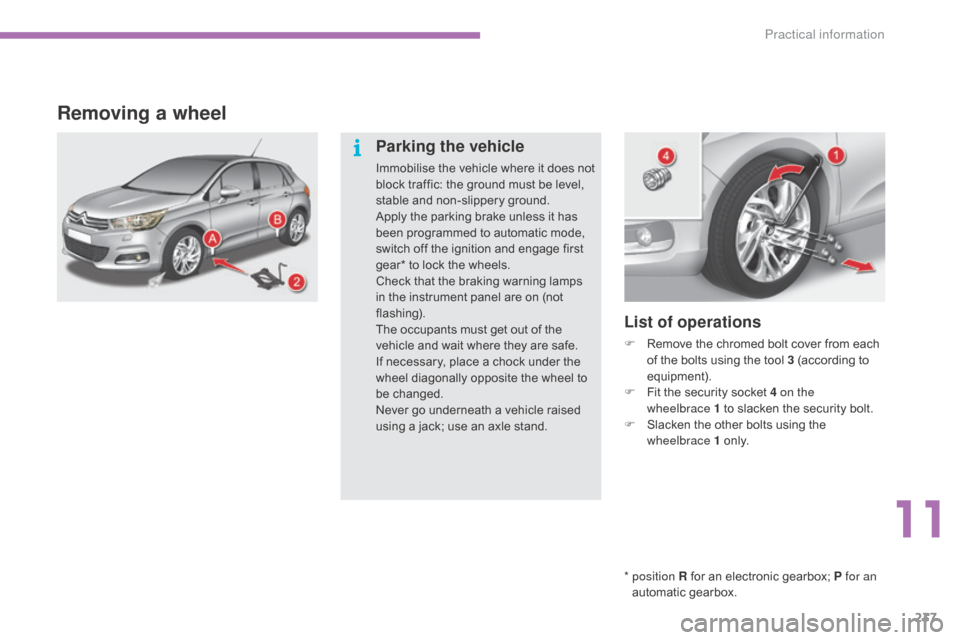
List of operations
F Remove the chromed bolt cover from each o
f the bolts using the tool 3 (according to
e
quipment).
F
F
it the security socket 4 on the
wheelbrace
1 to slacken the security bolt.
F
S
lacken the other bolts using the
w
heelbrace 1
o
n l y.
Parking the vehicle
Immobilise the vehicle where it does not block traffic: the ground must be level,
s
table and non-slippery ground.
Apply
the parking brake unless it has
b
een programmed to automatic mode,
s
witch off the ignition and engage first
g
ear* to lock the wheels.
Check
that the braking warning lamps
i
n the instrument panel are on (not
f
lashing).
The
occupants must get out of the
v
ehicle and wait where they are safe.
If
necessary, place a chock under the
w
heel diagonally opposite the wheel to
be c
hanged.
Never
go underneath a vehicle raised
u
sing a jack; use an axle stand.
11
Practical information
Page 241 of 494
239
C4-2_en_Chap11_info-pratique_ed01-2015
C4-2_en_Chap11_info-pratique_ed01-2015
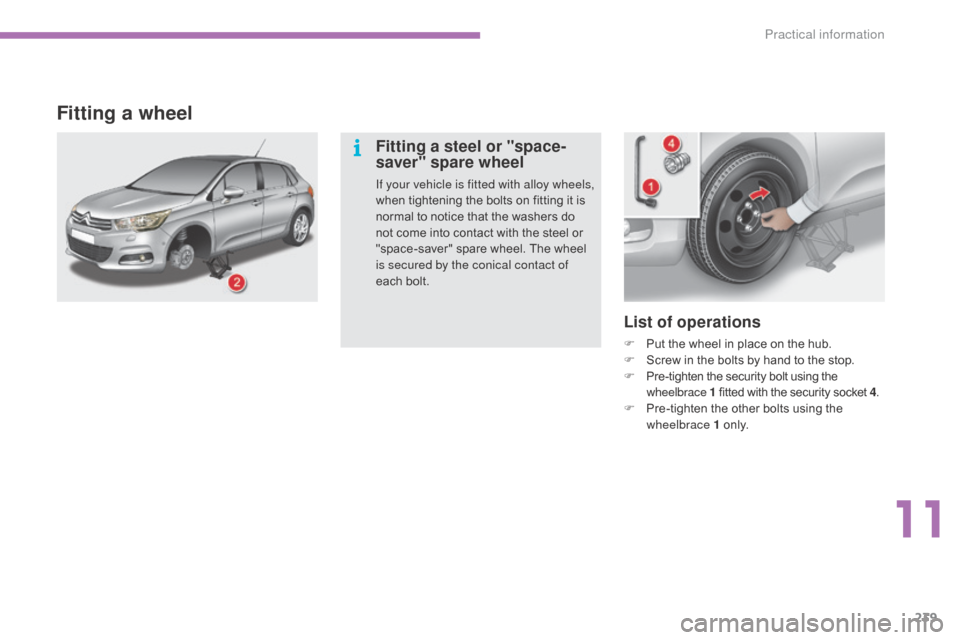
List of operations
F Put the wheel in place on the hub.
F S crew in the bolts by hand to the stop.
F
P
re-tighten the security bolt using the
w
heelbrace 1
fitted with the security socket 4.
F
P
re-tighten the other bolts using the
w
heelbrace 1
o
n l y.
Fitting a wheel
Fitting a steel or "space-
saver" spare wheel
If your vehicle is fitted with alloy wheels,
when tightening the bolts on fitting it is
n
ormal to notice that the washers do
n
ot come into contact with the steel or
"
space-saver" spare wheel. The wheel
i
s secured by the conical contact of
each
bolt.
11
Practical information
Page 242 of 494
240
C4-2_en_Chap11_info-pratique_ed01-2015
C4-2_en_Chap11_info-pratique_ed01-2015
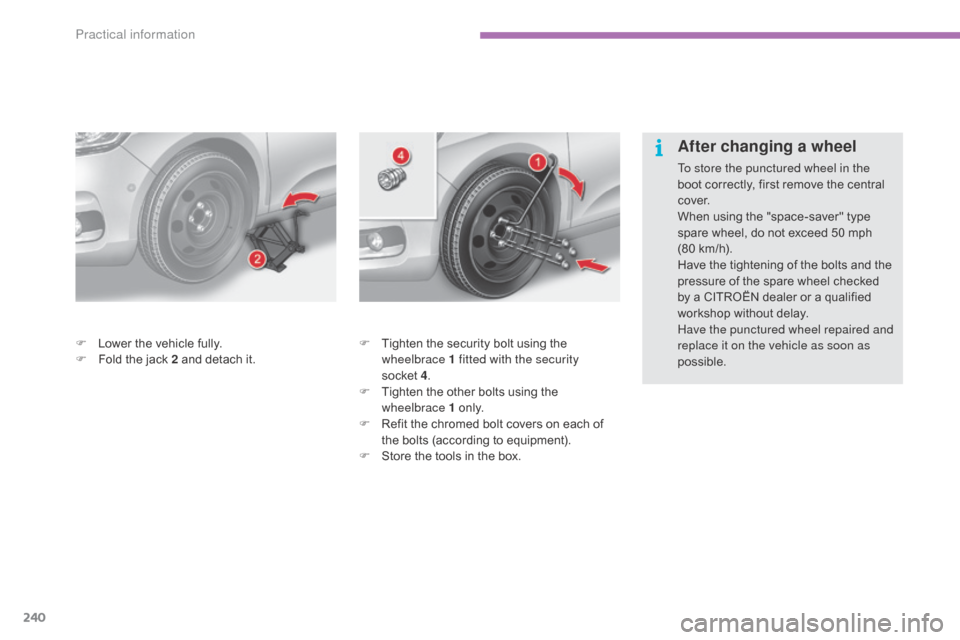
F Tighten the security bolt using the w
heelbrace 1 fitted with the security
socket 4.
F
T
ighten the other bolts using the
w
heelbrace 1
o
n l y.
F
R
efit the chromed bolt covers on each of
t
he bolts (according to equipment).
F
S
tore the tools in the box.
F
L
ower
the
vehicle
fully.
F
F
old
the
jack
2
and
detach
it.
After changing a wheel
To store the punctured wheel in the
boot
correctly, first remove the central
c
ove r.
When
using the "space-saver" type
s
pare wheel, do not exceed 50 mph
(
80 km/h).
Have
the tightening of the bolts and the
p
ressure of the spare wheel checked
b
y a CITROËN dealer or a qualified
w
orkshop without delay.
Have the punctured wheel repaired and
replace it on the vehicle as soon as
possible.
Practical information
Page 254 of 494
252
C4-2_en_Chap11_info-pratique_ed01-2015
C4-2_en_Chap11_info-pratique_ed01-2015
Changing a fuse
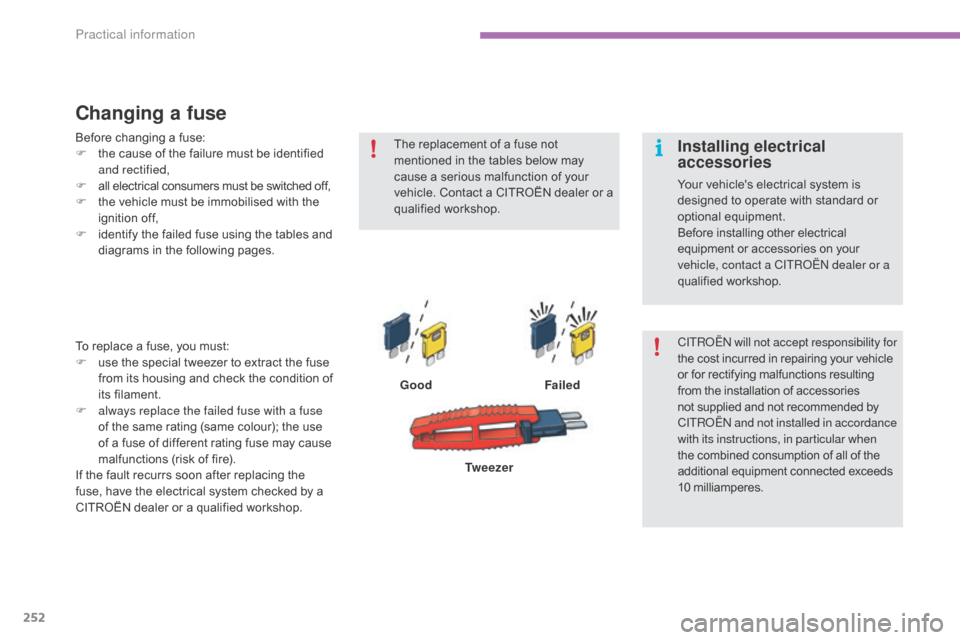
GoodFailed
To
replace
a
fuse,
you
must:
F
u
se
the
special
tweezer
to
extract
the
fuse
f
rom
its
housing
and
check
the
condition
of
it
s f
ilament.
F
a
lways replace the failed fuse with a fuse
of
the
same
rating
(same
colour);
the
use
o
f
a
fuse
of
different
rating
fuse
may
cause
m
alfunctions
(risk
of
fire).
If
the
fault
recurrs
soon
after
replacing
the
f
use,
have
the
electrical
system
checked
by
a
C
ITROËN
dealer
or
a
qualified
workshop. Tw e e z e r
The
replacement of a fuse not
m
entioned in the tables below may
c
ause a serious malfunction of your
v
ehicle. Contact a CITROËN dealer or a
q
ualified
w
orkshop.
CITR
oËn
will not accept responsibility for
the cost incurred in repairing your vehicle
o
r for rectifying malfunctions resulting f
rom the installation of accessories n
ot supplied and not recommended by
C
ITR
oËn an
d not installed in accordance
with its instructions, in particular when
the
combined consumption of all of the
a
dditional equipment connected exceeds
1
0
mil
liamperes.
Installing electrical
accessories
Your vehicle's electrical system is designed to operate with standard or
o
ptional
e
quipment.
Before
installing other electrical
e
quipment or accessories on your
v
ehicle, contact a CITR
oËn
dealer or a
qualified
w
orkshop.
Before
changing
a
fuse:
F
t
he
cause
of
the
failure
must
be
identified
a
nd rectified,
F
a
ll
electrical
consumers
must
be
switched
off,
F
t
he
vehicle
must
be
immobilised
with
the
ig
nition
o
ff,
F
i
dentify
the
failed
fuse
using
the
tables
and
d
iagrams
in
the
following
pages.
Practical information