ECU Citroen C4 2015 2.G User Guide
[x] Cancel search | Manufacturer: CITROEN, Model Year: 2015, Model line: C4, Model: Citroen C4 2015 2.GPages: 494, PDF Size: 20.49 MB
Page 142 of 494
140
C4-2_en_Chap07_securite-enfants_ed01-2015
C4-2_en_Chap07_securite-enfants_ed01-2015
Child seat at the rear
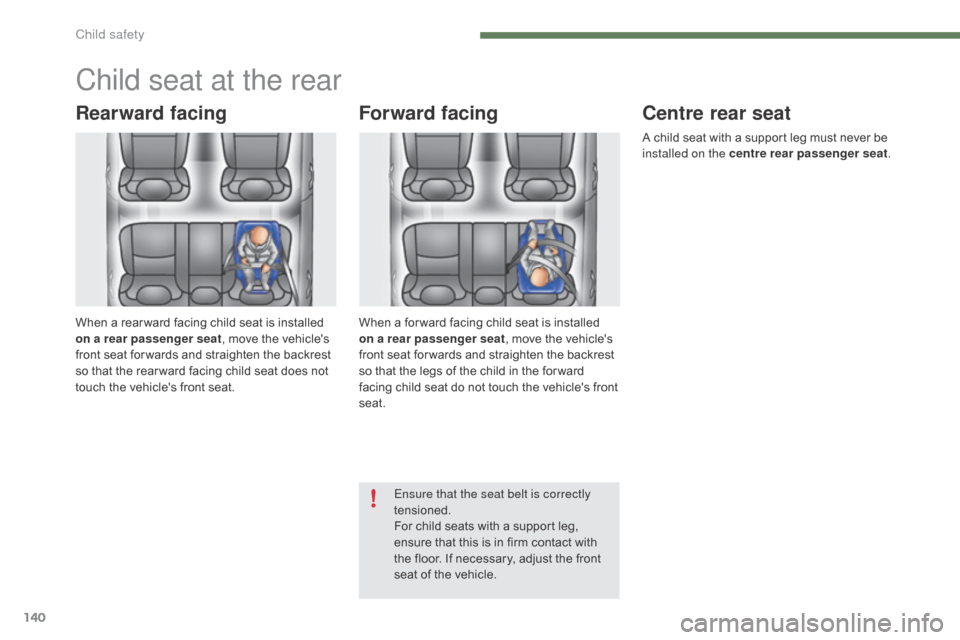
Rearward facing
When a rear ward facing child seat is installed on a rear passenger seat ,
move the vehicle's
f
ront seat for wards and straighten the backrest
s
o that the rear ward facing child seat does not
t
ouch the vehicle's front seat.
Forward facing
When a for ward facing child seat is installed on a rear passenger seat ,
move the vehicle's
f
ront seat for wards and straighten the backrest
s
o that the legs of the child in the for ward
f
acing child seat do not touch the vehicle's front
sea
t.
Centre rear seat
A child seat with a support leg must never be installed on the centre rear passenger seat .
Ensure that the seat belt is correctly
tensioned.
For
child
seats
with
a
support
leg,
e
nsure
that
this
is
in
firm
contact
with
t
he
floor.
If
necessary,
adjust
the
front
s
eat
of
the
vehicle.
Child safety
Page 143 of 494
141
C4-2_en_Chap07_securite-enfants_ed01-2015
C4-2_en_Chap07_securite-enfants_ed01-2015
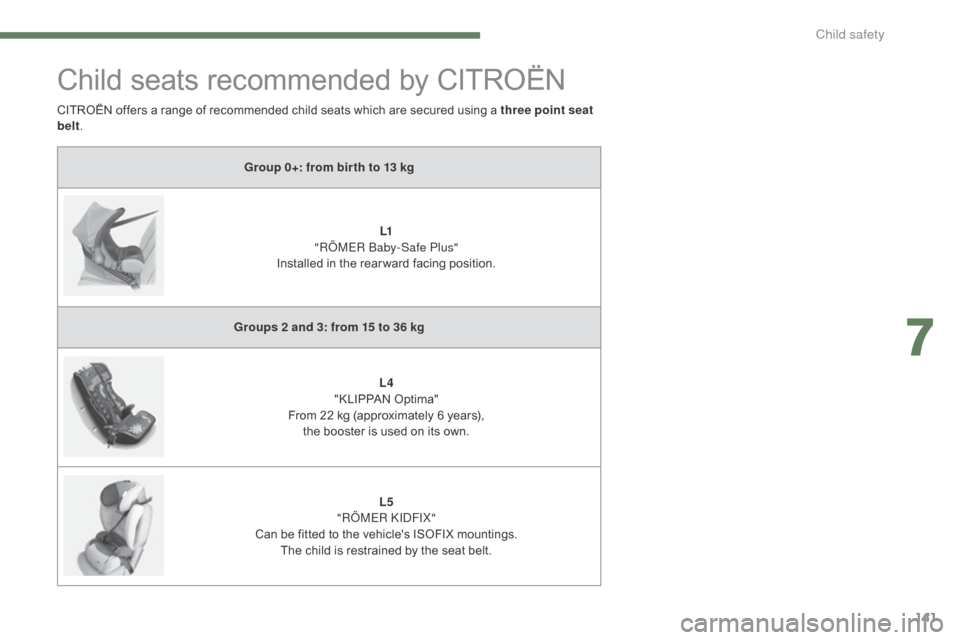
Child seats recommended by CITROËN
Group 0+: from bir th to 13 kgL1
"RÖMER
b
a
by-Safe Plus"
Installed
in the rear ward facing position.
Groups 2 and 3: from 15 to 36 kg L4
"KLIPPAN
Optima"
From
22 kg (approximately 6 years),
the
booster is used on its own.
L5
"RÖMER
k I d FIX"
Can
be fitted to the vehicle's ISOFIX mountings.
The
child is restrained by the seat belt.
CITROËN
offers
a
range
of
recommended child seats which are secured using a three point seat
belt .
7
Child safety
Page 144 of 494
142
C4-2_en_Chap07_securite-enfants_ed01-2015
C4-2_en_Chap07_securite-enfants_ed01-2015
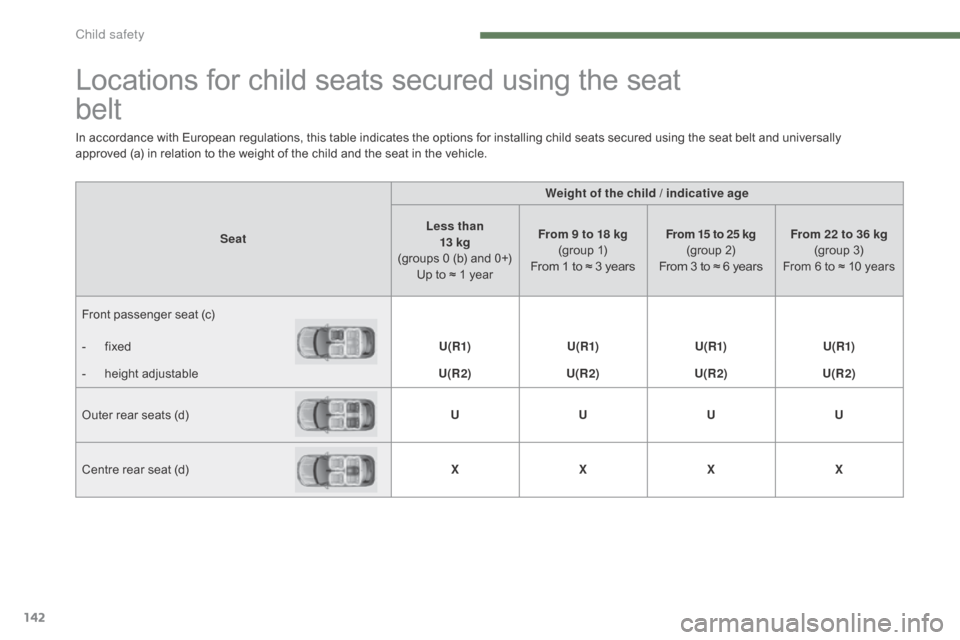
Locations for child seats secured using the seat
bel t
Seat Weight of the child / indicative age
Less than 13 kg
(groups
0 (b) and 0+)
Up
to ≈ 1 yearFrom 9 to 18 kg
(group 1)
From 1 to ≈ 3 years
From 15 to 25 kg
(group 2)
From 3 to ≈ 6 years
From 22 to 36 kg (group 3)
From
6 to ≈ 10 years
Front
passenger
seat
(c)
-
f
ixed U(R1)U(R1)U(R1)U(R1)
-
h
eight
adjustable U(R2)U(R2)U(R2)U(R2)
Outer
rear
seats
(d) UUUU
Centre
rear
seat
(d) XXXX
In
accordance
with
European
regulations,
this
table
indicates
the
options
for
installing
child
seats
secured
using
the
seat
belt
and
universally
a
pproved (a)
in
relation
to
the
weight
of
the
child
and
the
seat
in
the
vehicle.
Child safety
Page 145 of 494
143
C4-2_en_Chap07_securite-enfants_ed01-2015
C4-2_en_Chap07_securite-enfants_ed01-2015
(a) Universal child seat: child seat which can be i
nstalled in all vehicles using the seat belt.
(b)
G
roup 0: from birth to 10 kg. Infant car seats
a
nd "car cots" cannot be installed on the
front
p
assenger
sea
t.
(c)
C
onsult the legislation in force in your
c
ountry before installing your child on this
sea
t.
(d)
T
o install a child seat at the rear, rear ward
o
r for ward facing, move the front seat
f
or ward, then straighten the backrest to
a
llow enough room for the child seat and the
c
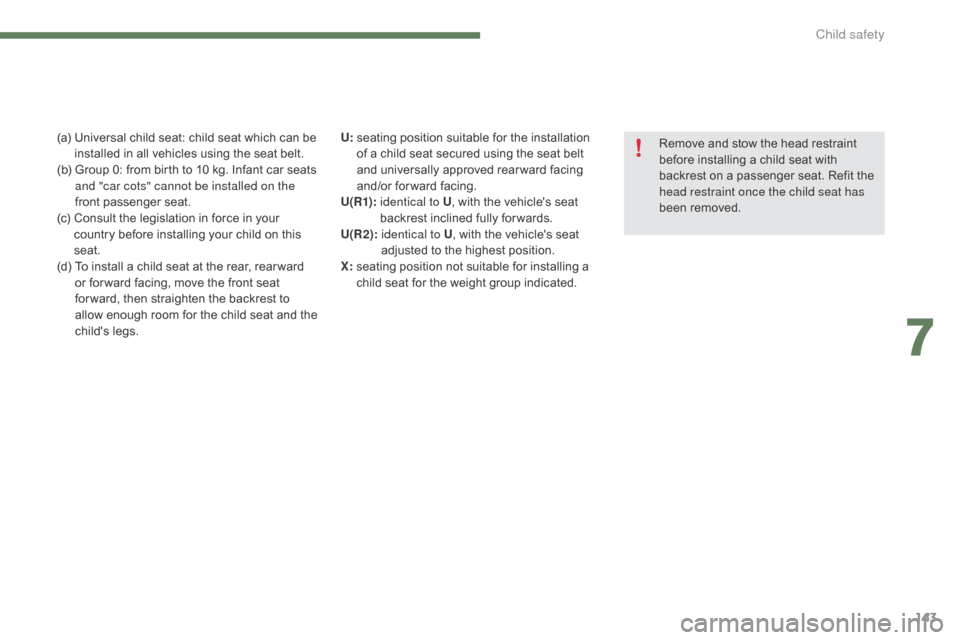
hild's legs. U:
s eating position suitable for the installation o
f a child seat secured using the seat belt
a
nd universally approved rear ward facing
a
nd/or for ward facing.
U(R1) :
i
dentical to U,
with the vehicle's seat
b
ackrest inclined fully for wards.
U(R2) :
i
dentical to U,
with the vehicle's seat
a
djusted to the highest position.
X:
s
eating position not suitable for installing a
c
hild seat for the weight group indicated.Remove
and stow the head restraint
b
efore installing a child seat with
b
ackrest on a passenger seat. Refit the
h
ead restraint once the child seat has
been
removed.
7
Child safety
Page 146 of 494
144
C4-2_en_Chap07_securite-enfants_ed01-2015
C4-2_en_Chap07_securite-enfants_ed01-2015
"ISOFIX" mountings
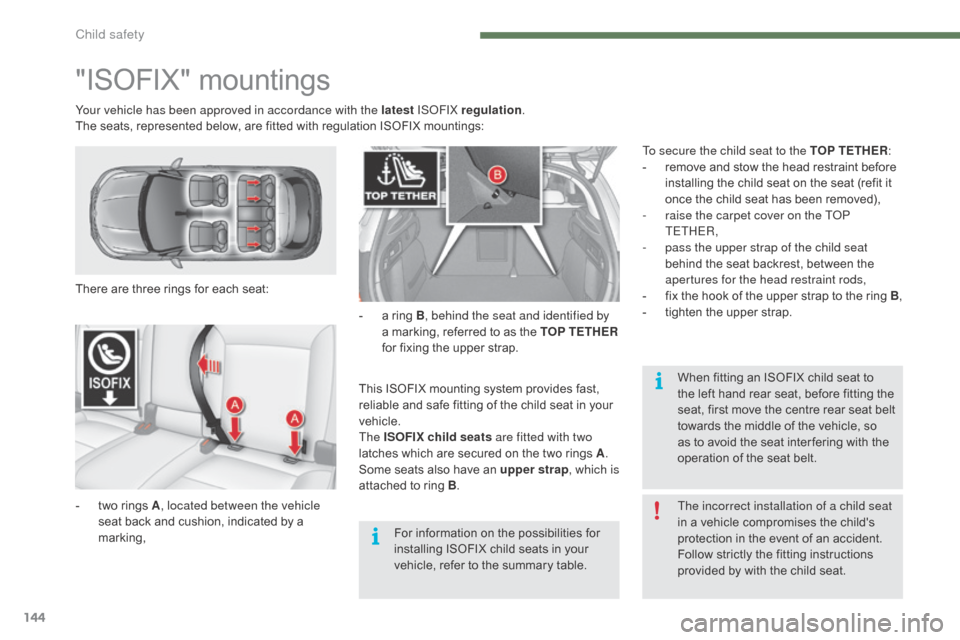
There are three rings for each seat:
-
t
wo rings A, located between the vehicle
seat
back and cushion, indicated by a
m
arking, This
ISOFIX mounting system provides fast,
r
eliable and safe fitting of the child seat in your
v
ehicle.
The ISOFIX child seats are fitted with two
latches
which are secured on the two rings A.
Some
seats also have an upper strap, which is
attached
to ring B.
Your vehicle has been approved in accordance with the latest
IS
oFI
X regulation
.
The seats, represented below, are fitted with regulation ISOFIX mountings:
To secure the child seat to the TOP TETHER :
-
r
emove and stow the head restraint before
i
nstalling the child seat on the seat (refit it
o
nce the child seat has been removed),
-
r
aise the carpet cover on the T
oP
T
ETHER,
-
p
ass the upper strap of the child seat
behind the seat backrest, between the a
pertures for the head restraint rods,
- f ix the hook of the upper strap to the ring B,
-
t
ighten the upper strap.
-
a
ring B, behind the seat and identified by
a
marking, referred to as the TOP TETHER
for
fixing the upper strap.
The incorrect installation of a child seat
in
a vehicle compromises the child's
p
rotection in the event of an accident.
Follow
strictly the fitting instructions
p
rovided by with the child seat.
When
fitting an ISOFIX child seat to
t
he left hand rear seat, before fitting the
s
eat, first move the centre rear seat belt
t
owards the middle of the vehicle, so
a
s to avoid the seat inter fering with the
o
peration of the seat belt.
For
information on the possibilities for
i
nstalling ISOFIX child seats in your
v
ehicle, refer to the summary table.
Child safety
Page 147 of 494
145
C4-2_en_Chap07_securite-enfants_ed01-2015
C4-2_en_Chap07_securite-enfants_ed01-2015
ISOFIX child seats recommended by CITROËN
CITROËN offers a range of ISOFIX child seats listed and type approved for your vehicle.
R efer also to the child seat manufacturer's fitting instructions for information on installing and removing the seat.
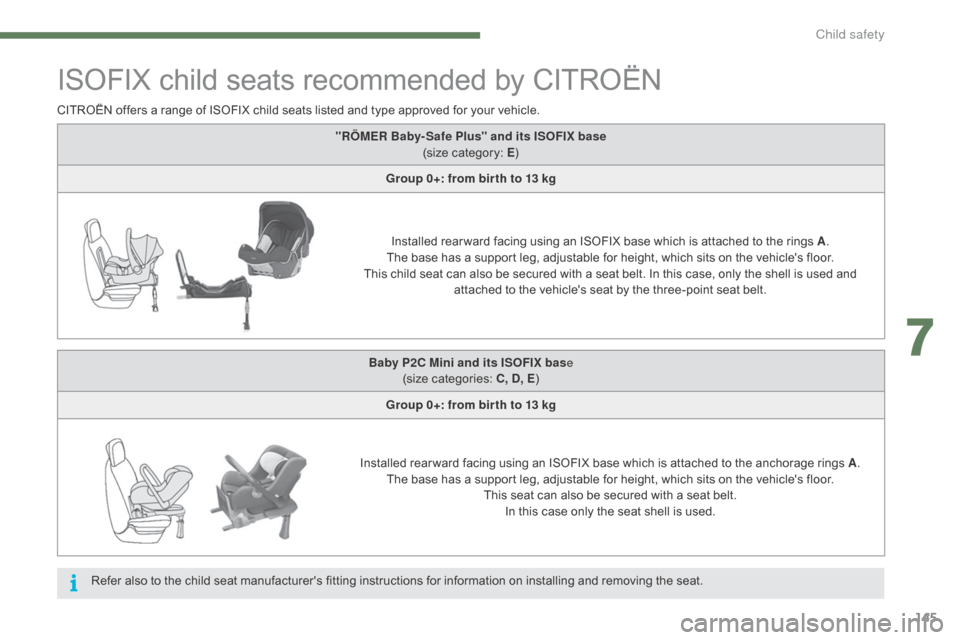
"RÖMER Baby- Safe Plus" and its ISOFIX base
(size
category: E)
Group 0+: from bir th to 13 kg
Installed
rear ward facing using an ISOFIX base which is attached to the rings A.
The
base has a support leg, adjustable for height, which sits on the vehicle's floor.
This
child seat can also be secured with a seat belt. In this case, only the shell is used and
a
ttached to the vehicle's seat by the three-point seat belt.
Baby P2C Mini and its ISOFIX bas e
(size
c
ategories:
C
, D, E)
Group 0+: from bir th to 13 kg
Installed
rear ward facing using an ISOFIX base which is attached to the anchorage rings A.
The
base has a support leg, adjustable for height, which sits on the vehicle's floor.
This
seat can also be secured with a seat belt.
In
this case only the seat shell is used.
7
Child safety
Page 148 of 494
146
C4-2_en_Chap07_securite-enfants_ed01-2015
C4-2_en_Chap07_securite-enfants_ed01-2015
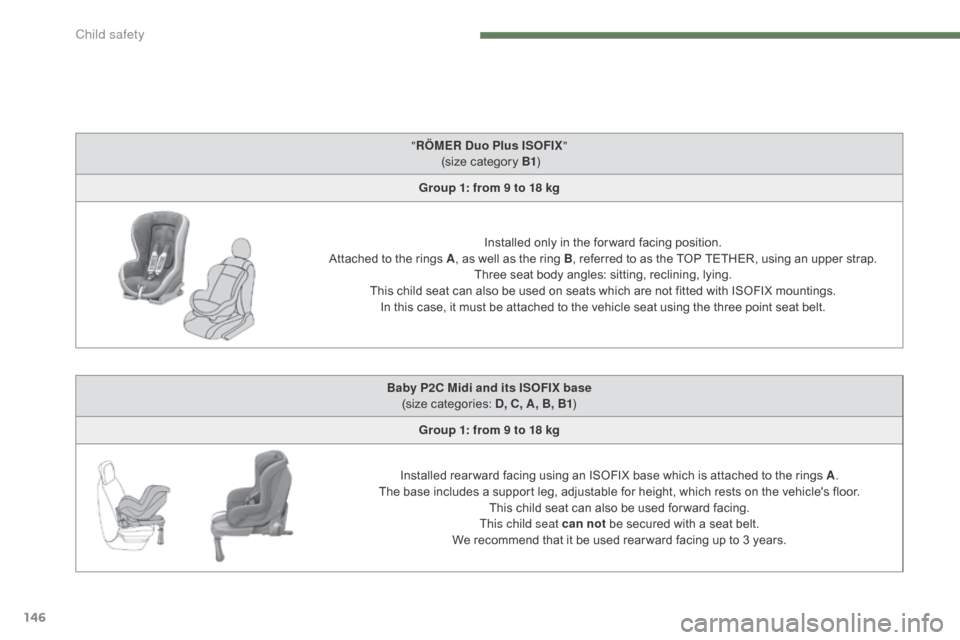
"RÖMER Duo Plus ISOFIX "
(size category B1)
Group 1: from 9 to 18 kg
Installed
only in the for ward facing position.
Attached
to
the rings A,
as well as the ring B,
referred to as the TOP TETHER, using an upper strap.
Three
seat body angles: sitting, reclining, lying.
This
child seat can also be used on seats which are not fitted with ISOFIX mountings.
In
this case, it must be attached to the vehicle seat using the three point seat belt.
Baby P2C Midi and its ISOFIX base (size
c
ategories:
D
, C, A, B, B1)
Group 1: from 9 to 18 kg
Installed
rear ward facing using an ISOFIX base which is attached to the rings A.
The
base includes a support leg, adjustable for height, which rests on the vehicle's floor.
This
child seat can also be used for ward facing.
This child seat can not
be secured with a seat belt.
We
recommend that it be used rear ward facing up to 3 years.
Child safety
Page 149 of 494
147
C4-2_en_Chap07_securite-enfants_ed01-2015
C4-2_en_Chap07_securite-enfants_ed01-2015
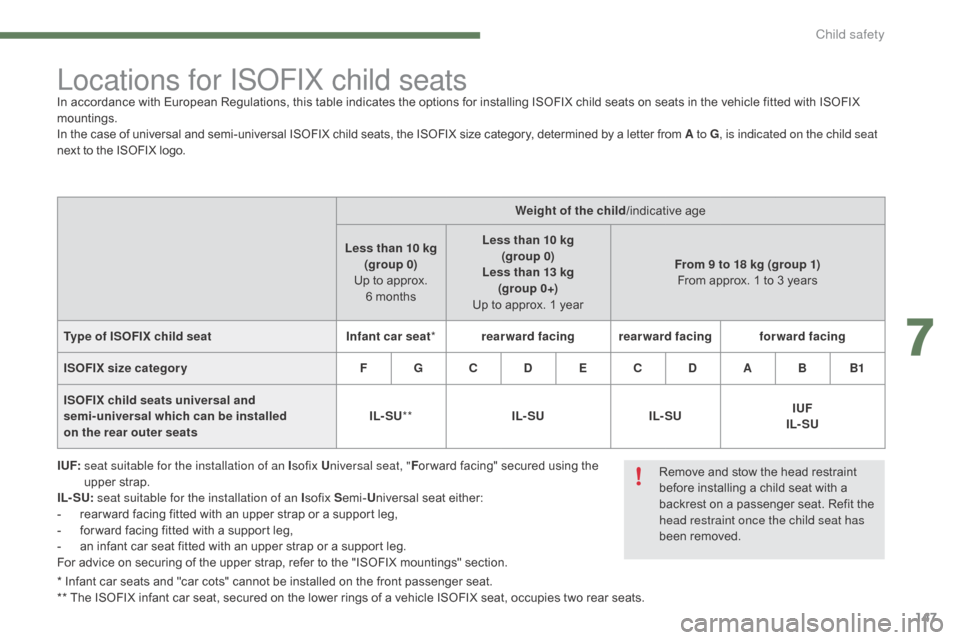
* Infant car seats and "car cots" cannot be installed on the front passenger seat.
* * The ISOFIX infant car seat, secured on the lower rings of a vehicle ISOFIX seat, occupies two rear seats.
Locations for ISoFIX child seatsIn accordance with European Regulations, this table indicates the options for installing ISOFIX child seats on seats in the vehicle fitted with ISOFIX m
ountings.
In
the case of universal and semi-universal ISOFIX child seats, the ISOFIX size category, determined by a letter from A to G , is indicated on the child seat
next
to the ISOFIX logo.
I UF:
s
eat suitable for the installation of an I sofix
Universal seat, " For ward
facing" secured using the
u
pper strap.
IL- SU: seat suitable for the installation of an I sofix
Semi- Universal
sea
t
ei
ther:
-
r
ear ward facing fitted with an upper strap or a support leg,
-
f
or ward facing fitted with a support leg,
-
a
n infant car seat fitted with an upper strap or a support leg.
For
advice on securing of the upper strap, refer to the "ISOFIX mountings" section.Weight of the child
/indicative
age
Less than 10
kg
(group 0)
Up
to approx.
6
monthsLess than 10 kg
(group 0)
Less than 13 kg (group 0+)
Up
to approx. 1 yearFrom 9 to 18 kg (group 1)
From
approx. 1 to 3 years
Type of ISOFIX child seat Infant car seat*rearward facing rearward facing forward facing
ISOFIX size categor y F G C D E C D A B B1
ISOFIX child seats universal and
semi-universal which can be installed
on the rear outer seats IL- SU
** IL- SU IL- SU IUF
IL- SU
Remove
and stow the head restraint
b
efore installing a child seat with a
b
ackrest on a passenger seat. Refit the
h
ead restraint once the child seat has
been
removed.
7
Child safety
Page 150 of 494
148
C4-2_en_Chap07_securite-enfants_ed01-2015
C4-2_en_Chap07_securite-enfants_ed01-2015
For optimum installation of the for ward facing child seat, ensure that the back of the child
s
eat is as close as possible to the backrest of
t
he vehicle's seat, in contact if possible.
You
mst remove the head restraint before
i
nstalling a child seat with backrest to a
p
assenger
sea
t.
Ensure that the head restraint is stored or
attached
securely to prevent it from being
t
hrown around the vehicle in the event of
sharp
braking. Refit the head restraint when
t
he child seat is removed.
advice on child seats
Installing a booster
seat
Children at the frontThe incorrect installation of a child seat in a
vehicle compromises the child's protection in
t
he event of an accident.
Ensure that there is no seat belt or seat belt
buckle
under the child seat, as this could
de
stabilise
i
t.
Remember
to fasten the seat belts or the
c
hild seat harnesses keeping the slack
r
elative to the child's body to a minimum,
e
ven for short journeys.
When
installing a child seat using the seat
b
elt, ensure that the seat belt is tightened
c
orrectly on the child seat and that it secures
the
child seat firmly on the seat of your
v
ehicle. If your passenger seat is adjustable,
m
ove it for wards if necessary. The
legislation on carrying children on the
f
ront passenger seat is specific to each
c
ountry. Refer to the legislation in force in
y
our country.
Deactivate
the passenger airbag when a
r
ear ward facing child seat is installed on the
f
ront seat.
Other wise,
the child would risk being
s
eriously injured or killed if the airbag were
t
o inflate.The
chest part of the seat belt must be
p
ositioned on the child's shoulder without
t
ouching the neck.
Ensure that the lap part of the seat belt
passes
correctly over the child's thighs.
CITROËN
recommends the use of a booster
s
eat which has a back, fitted with a seat belt
g
uide at shoulder level.
As
a safety precaution, do not leave:
-
a c
hild or children alone and
unsupervised in a vehicle,
-
a
child or an animal in a vehicle which
i
s exposed to the sun, with the windows
c
losed,
-
t
he keys within reach of children inside
t
he vehicle.
At
rear seating positions, always leave
s
ufficient space between the front seat and:
-
a
rear ward facing child seat,
-
t
he child's feet for a child seat fitted
fo
rward
f
acing.
To
do this, move the front seat for wards
a
nd, if necessary, move its backrest into the
u
pright
p
osition. To
prevent accidental opening of the doors
a
nd rear windows, use the child lock.
Take
care not to open the rear windows by
m
ore than one third.
To
protect young children from the rays of the
s
un, fit side blinds on the rear windows.
Child safety
Page 151 of 494
149
C4-2_en_Chap07_securite-enfants_ed01-2015
C4-2_en_Chap07_securite-enfants_ed01-2015
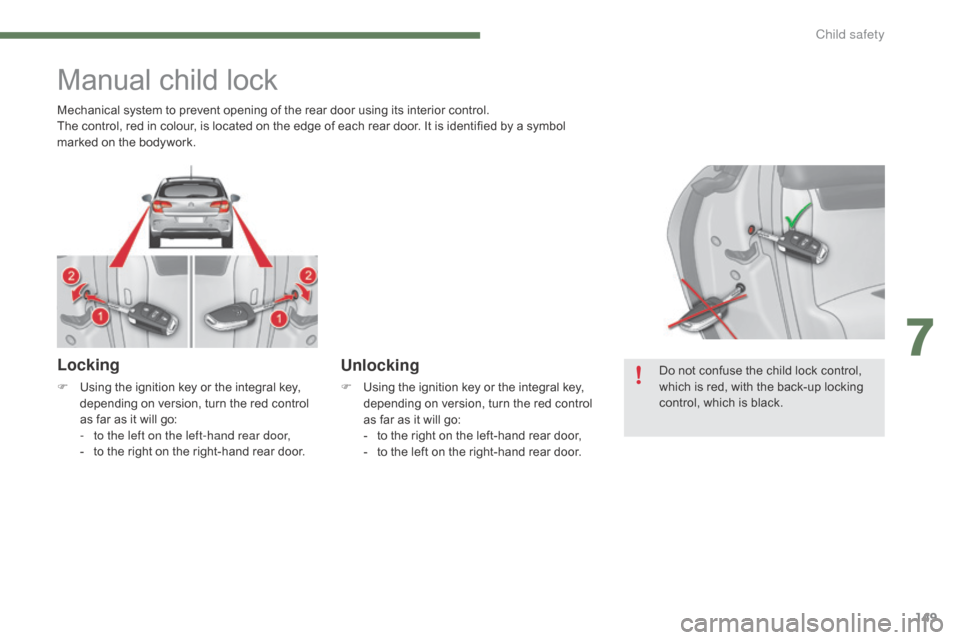
Manual child lock
Locking
F Using the ignition key or the integral key, d
epending on version, turn the red control
a
s far as it will go:
-
t
o the left on the left-hand rear door,
-
t
o the right on the right-hand rear door.
Unlocking
F Using the ignition key or the integral key, d
epending on version, turn the red control
a
s far as it will go:
-
t
o the right on the left-hand rear door,
-
t
o the left on the right-hand rear door.Do
not confuse the child lock control, w
hich is red, with the back-up locking c
ontrol, which is black.
Mechanical
system
to
prevent
opening
of
the
rear
door using its interior control.
The
control,
red
in
colour,
is
located
on
the
edge
of
each rear door. It is identified by a symbol
m
arked
on
the
bodywork.
7
Child safety