tyres Citroen C4 2015 2.G Owner's Manual
[x] Cancel search | Manufacturer: CITROEN, Model Year: 2015, Model line: C4, Model: Citroen C4 2015 2.GPages: 494, PDF Size: 20.49 MB
Page 13 of 494
11
C4-2_en_Chap00c_eco-conduite_ed01-2015
C4-2_en_Chap00c_eco-conduite_ed01-2015
Limit the causes of excess consumption
Spread loads throughout the vehicle; place the heaviest items in the bottom of the boot, as close as possible to the rear seats.
Limit
the loads carried in the vehicle and reduce wind resistance (roof
b
ars, roof rack, bicycle carrier, trailer...). Use a roof box in preference.
Remove
roof bars and roof racks after use.
At
the end of winter, remove snow tyres and refit your summer tyres.
Observe the recommendations on maintenance
Check the tyre pressures regularly, when cold, referring to the label in the door aperture, driver's side.
Carry
out this check in particular:
-
b
efore a long journey,
-
a
t each change of season,
-
a
fter a long period out of use.
Don't
forget the spare wheel and the tyres on any trailer or caravan.
Have
your vehicle serviced regularly (engine oil, oil filter, air filter,
p
assenger compartment filter...) and observe the schedule of
o
perations recommended in the manufacturer's service schedule.
With
a BlueHDi Diesel engine, if the SCR system is faulty your vehicle
b
ecomes polluting; go to a CITROËN dealer or a qualified workshop
w
ithout delay to have the emissions of nitrous oxides brought back to
t
he legal level.
When
refuelling, do not continue after the third cut-off of the nozzle to
a
void any over flow.
At
the wheel of your new vehicle, it is only after the first 1 800 miles
(
3 000 kilometres) that you will see the fuel consumption settle down to
a
consistent average.
.
Eco-driving
Page 23 of 494
21
C4-2_en_Chap01_controle-de-marche_ed01-2015
C4-2_en_Chap01_controle-de-marche_ed01-2015
Warning/indicator lampis on Cause Action/Observations
Foot on the
clutch** fixed.
In
the STOP mode of Stop & Start,
c
hanging to START mode is refused
b
ecause the clutch pedal is not fully
down. You
must declutch fully to allow the change to engine
S
TART mode.
**
Only on the type 1 instrument panel.
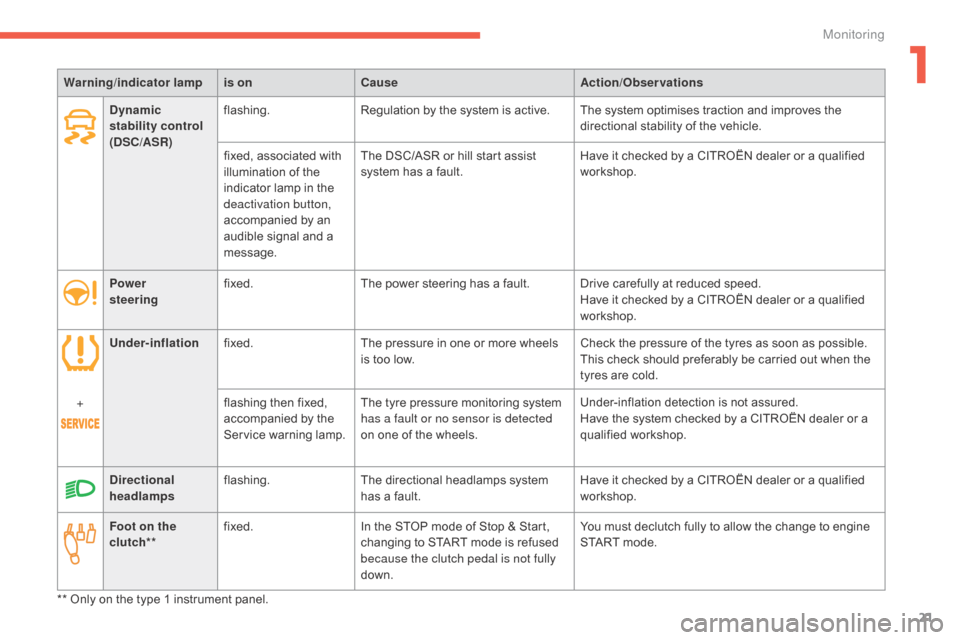
Dynamic
stability control
(DSC/ASR)
flashing.
Regulation
by the system is active. The system optimises traction and improves the
d
irectional stability of the vehicle.
fixed,
associated with
i
llumination of the
i
ndicator lamp in the
d
eactivation button,
accompanied
by an
a
udible signal and a
m
essage.The
DSC/ASR or hill start assist
s
ystem has a fault.Have
it checked by a CITROËN dealer or a qualified
w
orkshop.
Power
steering fixed.
The
power steering has a fault. Drive carefully at reduced speed.
Have
it checked by a CITROËN dealer or a qualified
w
orkshop.
Under-inflation fixed. The
pressure in one or more wheels
i
s too low.Check
the pressure of the tyres as soon as possible.
This
check should preferably be carried out when the
t
yres are cold.
+ flashing
then fixed,
a
ccompanied by the
S
ervice warning lamp.The
tyre pressure monitoring system
h
as a fault or no sensor is detected
on
one of the wheels.Under-inflation
detection is not assured.
Have
the system checked by a CITROËN dealer or a
q
ualified
w
orkshop.
Directional
headlamps flashing.
The
directional headlamps system
h
as a fault.Have
it checked by a CITROËN dealer or a qualified
w
orkshop.
1
Monitoring
Page 153 of 494
151
C4-2_en_Chap08_securite_ed01-2015
C4-2_en_Chap08_securite_ed01-2015
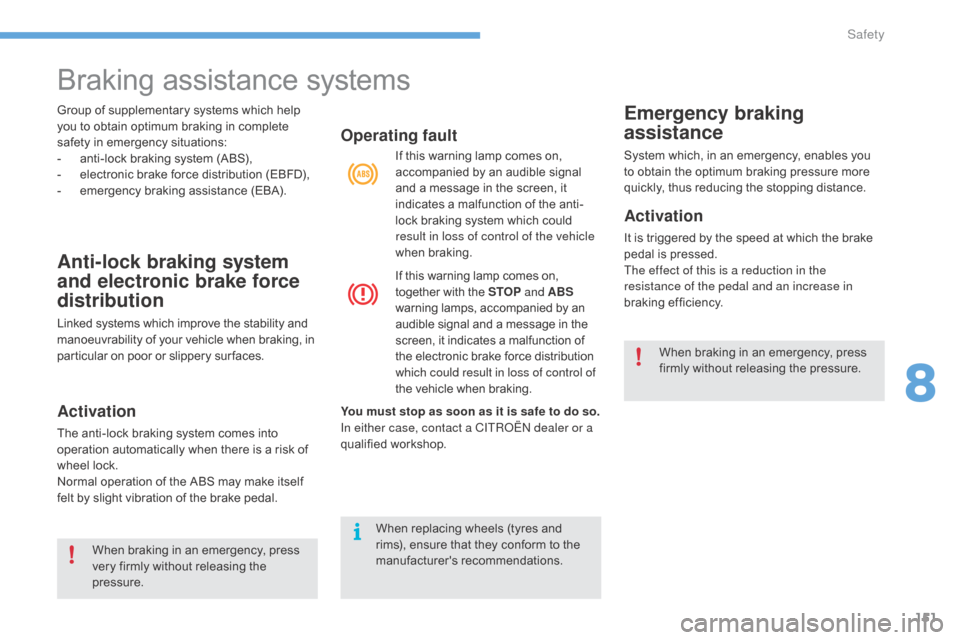
Group of supplementary systems which help you to obtain optimum braking in complete
s
afety in emergency situations:
-
a
nti-lock braking system (ABS),
-
e
lectronic brake force distribution (EBFD),
-
e
mergency braking assistance (EBA).
Anti-lock braking system
and electronic brake force
distribution
Linked systems which improve the stability and manoeuvrability of your vehicle when braking, in p
articular on poor or slippery sur faces.
Activation
The anti-lock braking system comes into operation automatically when there is a risk of
w
heel lock.
Normal
operation of the ABS may make itself
f
elt by slight vibration of the brake pedal.
Operating fault
If this warning lamp comes on, accompanied by an audible signal
a
nd a message in the screen, it
i
ndicates a malfunction of the anti-
lock
braking system which could
r
esult in loss of control of the vehicle
when
b
raking.
If
this warning lamp comes on,
t
ogether with the STOP and ABS
warning
lamps, accompanied by an
a
udible signal and a message in the
s
creen, it indicates a malfunction of
t
he electronic brake force distribution
w
hich could result in loss of control of
the
vehicle when braking.
Emergency braking
assistance
System which, in an emergency, enables you to obtain the optimum braking pressure more
q
uickly, thus reducing the stopping distance.
Activation
It is triggered by the speed at which the brake pedal is pressed.
The effect of this is a reduction in the
resistance of the pedal and an increase in
braking
e
fficiency.
You must stop as soon as it is safe to do so.
In either case, contact a CITR
oËn
dealer or a
qualified
w
orkshop.
When
braking
in
an
emergency,
press
v
ery
firmly
without
releasing
the
p
ressure. When
braking in an emergency, press
f
irmly without releasing the pressure.
When
replacing
wheels
(tyres
and
r
ims),
ensure
that
they
conform
to
the
ma
nufacturer's
r
ecommendations.
Braking assistance systems
8
Safety
Page 154 of 494
152
C4-2_en_Chap08_securite_ed01-2015
C4-2_en_Chap08_securite_ed01-2015
Trajectory control systems
Anti-slip regulation (ASR)
and dynamic stability
control (DSC)
The anti-slip regulation (also known as traction control) optimises traction to prevent skidding
o
f the wheels, by acting on the brakes of the
d
riving wheels and on the engine.
The electronic stability control acts on the
brake
of one or more wheels and on the engine
t
o keep the vehicle on the trajectory required
b
y the driver, within the limits of the laws of
p
hysics.
Activation
These systems are activated automatically each time the vehicle is started.
They
come into operation in the event of a grip
o
r
t
rajectory
pro
blem.
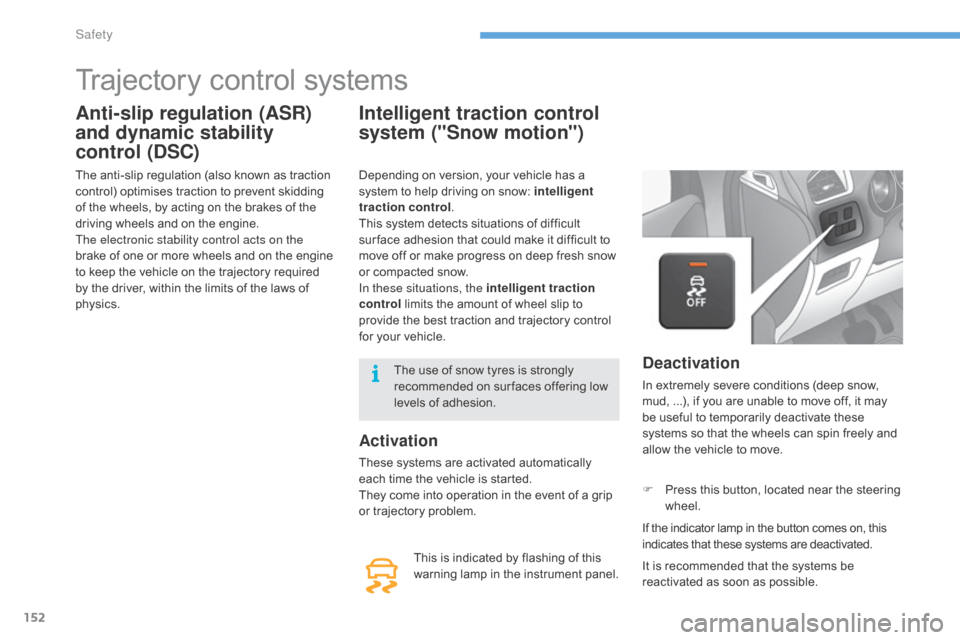
This
is indicated by flashing of this
w
arning lamp in the instrument panel.
Intelligent traction control
system ("Snow motion")
Deactivation
In extremely severe conditions (deep snow, mud, ...), if you are unable to move off, it may
b
e useful to temporarily deactivate these
s
ystems so that the wheels can spin freely and
a
llow the vehicle to move.
F
P
ress this button, located near the steering
w
heel.
If
the indicator lamp in the button comes on, this
i
ndicates that these systems are deactivated.
Depending
on
version,
your
vehicle
has
a
s
ystem
to
help
driving
on
snow:
intelligent
traction control .
This
system
detects
situations
of
difficult
s
ur face
adhesion
that
could
make
it
difficult
to
m
ove
off
or
make
progress
on
deep
fresh
snow
o
r
compacted
snow.
In these situations, the intelligent traction
control
limits
the
amount
of
wheel
slip
to
p
rovide
the
best
traction
and
trajectory
control
f
or
your
vehicle.
It is recommended that the systems be
r
eactivated as soon as possible.
The
use
of
snow
tyres
is
strongly
r
ecommended
on
sur faces
offering
low
l
evels
of
adhesion.
Safety
Page 155 of 494

153
C4-2_en_Chap08_securite_ed01-2015
C4-2_en_Chap08_securite_ed01-2015
Reactivation
These systems are reactivated automatically each time the ignition is switched back on or
f
rom 30 mph (50 km/h).
F
P
ress this button again to reactivate them
m
anually.
The
illumination of the indicator
l
amps in the instrument panel and
i
n this button, accompanied by an
a
udible signal and a message in the
s
creen, indicates a fault with these
systems.
Operating fault
Emergency o r
a ssistance call
This system allows you to make an emergency o
r assistance call to the emergency services or
t
o the dedicated CITROËN service.
For
more information on the use of this
f
unction, refer to the "Audio and telematics"
s
ection.
The
trajectory
control
systems
offer
i
ncreased
safety
in
normal
driving,
but
t
his
should
not
encourage
the
driver
to
t
ake
extra
risks
or
drive
at
high
speed.
The
correct
functioning
of
these
s
ystems
is
assured
provided
that
m
anufacturer's
recommendations
are
ob
served
on
:
-
w
heels
(tyres
and
rims),
-
b
raking
components,
-
el
ectronic
c
omponents,
-
a
ssembly
and
repair
procedures.
After
an
impact,
have
these
systems
c
hecked
by
a
CITROËN
dealer
or
a
q
ualified
w
orkshop.
Have
it
checked
by
a
CITROËN
dealer
or
a
q
ualified
w
orkshop.
8
Safety
Page 192 of 494
190
C4-2_en_Chap09_conduite_ed01-2015
C4-2_en_Chap09_conduite_ed01-2015
Tyre under-inflation detection
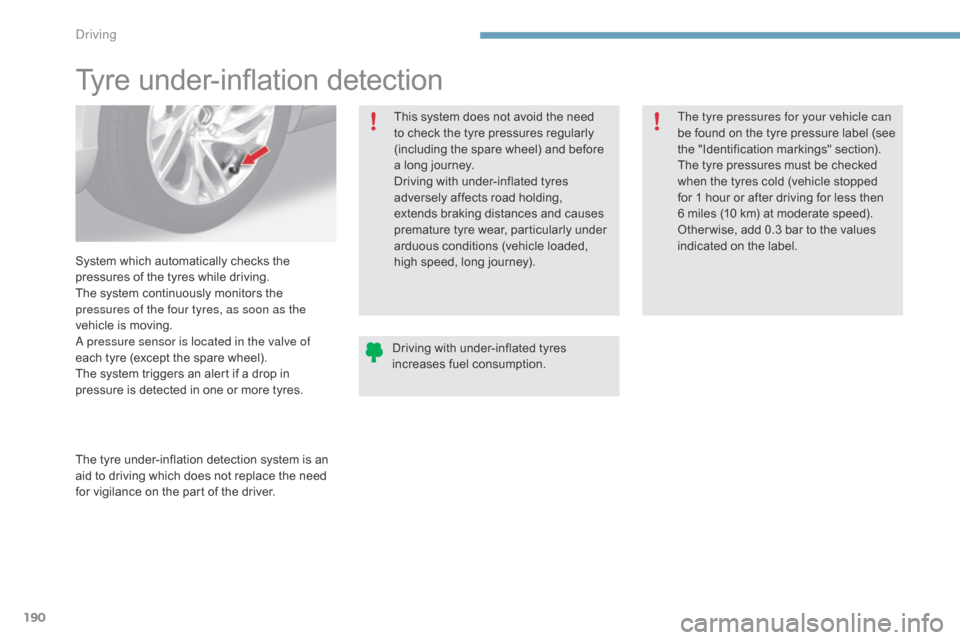
System which automatically checks the p
ressures of the tyres while driving.
The
system continuously monitors the
p
ressures of the four tyres, as soon as the
vehicle
is moving.
a
pressure sensor is located in the valve of
each
tyre (except the spare wheel).
The
system triggers an alert if a drop in
p
ressure is detected in one or more tyres.
The
tyre under-inflation detection system is an
a
id to driving which does not replace the need
f
or vigilance on the part of the driver.This
system does not avoid the need
t
o check the tyre pressures regularly
(
including the spare wheel) and before
a
long journey.
Driving with under-inflated tyres
a
dversely affects road holding,
e
xtends braking distances and causes
p
remature tyre wear, particularly under a
rduous conditions (vehicle loaded, h
igh speed, long journey).The tyre pressures for your vehicle can
be
found on the tyre pressure label (see
t
he "Identification markings" section).
The tyre pressures must be checked
w
hen the tyres cold (vehicle stopped
f
or 1 hour or after driving for less then
6
miles (10 km) at moderate speed).
O
ther wise, add 0.3 bar to the values i
ndicated on the label.
Driving with under-inflated tyres
i
ncreases fuel consumption.
driving
Page 193 of 494
191
C4-2_en_Chap09_conduite_ed01-2015
C4-2_en_Chap09_conduite_ed01-2015
The flashing and then fixed illumination of the under-inflation w
arning lamp accompanied by the
i
llumination of the service warning
l
amp indicates a fault with the system.
Operating fault
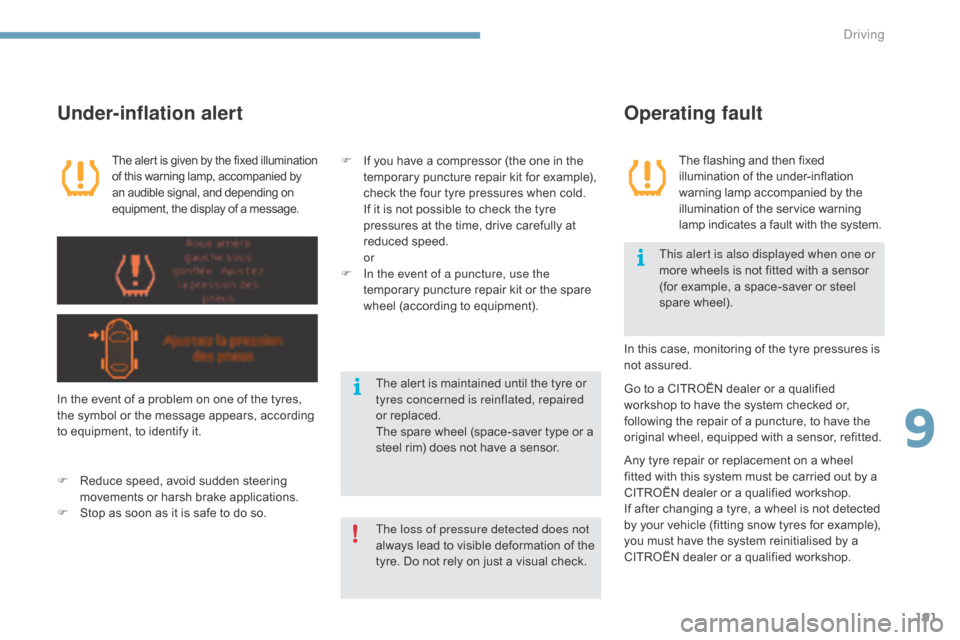
The aler t is given by the fixed illumination o
f this warning lamp, accompanied by a
n audible signal, and depending on
e
quipment, the display of a message.
Under-inflation alert
In the event of a problem on one of the tyres, the symbol or the message appears, according
t
o equipment, to identify it.
F
R
educe speed, avoid sudden steering
m
ovements or harsh brake applications.
F
S
top as soon as it is safe to do so. In
this case, monitoring of the tyre pressures is
n
ot assured.
F
I
f you have a compressor (the one in the
t
emporary puncture repair kit for example),
c
heck the four tyre pressures when cold.
I
f it is not possible to check the tyre
p
ressures at the time, drive carefully at
r
educed
s
peed.
or
F
I
n the event of a puncture, use the
temporary puncture repair kit or the spare
w
heel (according to equipment).
Go to a CITROËN dealer or a qualified w
orkshop to have the system checked or,
f
ollowing the repair of a puncture, to have the
o
riginal wheel, equipped with a sensor, refitted.
Any
tyre repair or replacement on a wheel
f
itted with this system must be carried out by a
C
ITROËN dealer or a qualified workshop.
If
after changing a tyre, a wheel is not detected
b
y your vehicle (fitting snow tyres for example),
y
ou must have the system reinitialised by a
C
ITROËN dealer or a qualified workshop.
The loss of pressure detected does not
always
lead to visible deformation of the
t
yre. Do not rely on just a visual check.This alert is also displayed when one or
more
wheels is not fitted with a sensor
(
for example, a space-saver or steel
spar
e
w
heel).
The alert is maintained until the tyre or t
yres concerned is reinflated, repaired
or
replaced.
The
spare wheel (space-saver type or a
s
teel rim) does not have a sensor.
9
Driving
Page 231 of 494
229
C4-2_en_Chap11_info-pratique_ed01-2015
C4-2_en_Chap11_info-pratique_ed01-2015
Temporary puncture r epair k it
Access to the kit
This kit is installed i n t he s torage b ox, u nder t he b
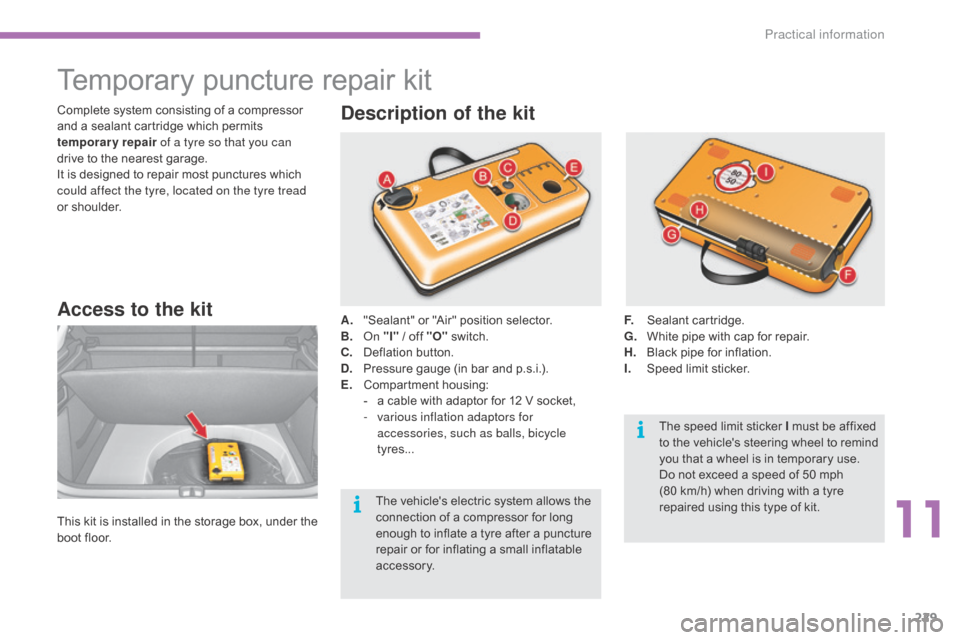
oot floor. A.
"
Sealant" or "Air" position selector.
B.
on "
I"
/ off "O"
s
witch.
C.
D
eflation button.
D.
P
ressure gauge (in bar and p.s.i.).
E.
C
ompartment
h
ousing:
-
a
cable with adaptor for 12 V socket,
-
v
arious inflation adaptors for
accessories, such as balls, bicycle
tyres...
Description of the kit
F. Sealant c artridge.
G. W hite pipe with cap for repair.
H.
B
lack pipe for inflation.
I.
S
peed limit sticker.
Complete
system
consisting
of
a
compressor
a
nd
a
sealant
cartridge
which
permits
t
emporary repair
of a tyre so that you can
drive
to
the
nearest
garage.
It
is
designed
to
repair
most
punctures
which
c
ould affect the tyre, located on the tyre tread
or
shoulder.
The
vehicle's
electric
system
allows
the
c
onnection
of
a
compressor
for
long
e
nough
to
inflate
a
tyre
after
a
puncture
r
epair
or
for
inflating
a
small
inflatable
a
ccessory. The
speed limit sticker I must be affixed
t
o the vehicle's steering wheel to remind
y
ou that a wheel is in temporary use.
Do
not exceed a speed of 50 mph
(
80 km/h) when driving with a tyre
r
epaired using this type of kit.
11
Practical information
Page 235 of 494
233
C4-2_en_Chap11_info-pratique_ed01-2015
C4-2_en_Chap11_info-pratique_ed01-2015
Removing the cartridge
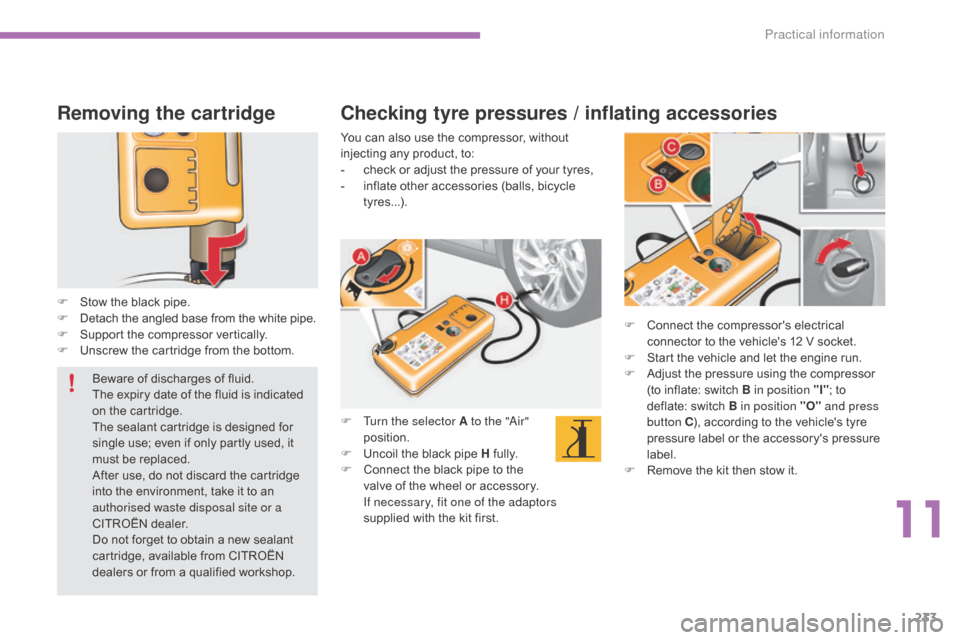
F Stow the black pipe.
F D etach the angled base from the white pipe.
F
S
upport the compressor vertically.
F
U
nscrew the cartridge from the bottom. F
C
onnect the compressor's electrical
c
onnector to the vehicle's 12 V socket.
F
S
tart the vehicle and let the engine run.
F
A
djust the pressure using the compressor
(
to inflate: switch B in position "I";
to
d
eflate: switch B in position "O" and press
button C ),
according to the vehicle's tyre
p
ressure label or the accessory's pressure
lab
el.
F
R
emove the kit then stow it.
Checking tyre pressures / inflating accessories
You can also use the compressor, without injecting any product, to:
-
c
heck or adjust the pressure of your tyres,
-
i
nflate other accessories (balls, bicycle
t
yres...).
F
T
urn the selector A to the "
ai
r"
position.
F
U
ncoil the black pipe H
f
ully.
F
C
onnect the black pipe to the
v
alve of the wheel or accessory.
I
f necessary, fit one of the adaptors
supplied
with the kit first.
Beware
of
discharges
of
fluid.
The
expiry
date
of
the
fluid
is
indicated
o
n
the
cartridge.
The
sealant
cartridge
is
designed
for
s
ingle
use;
even
if
only
partly
used,
it
m
ust
be
replaced.
After
use,
do
not
discard
the
cartridge
i
nto
the
environment,
take
it
to
an
a
uthorised waste disposal site or a
CITROËN
dealer.
Do
not
forget
to
obtain
a
new
sealant
c
artridge,
available
from
CITROËN
d
ealers
or
from
a
qualified
workshop.
11
Practical information
Page 243 of 494
241
C4-2_en_Chap11_info-pratique_ed01-2015
C4-2_en_Chap11_info-pratique_ed01-2015
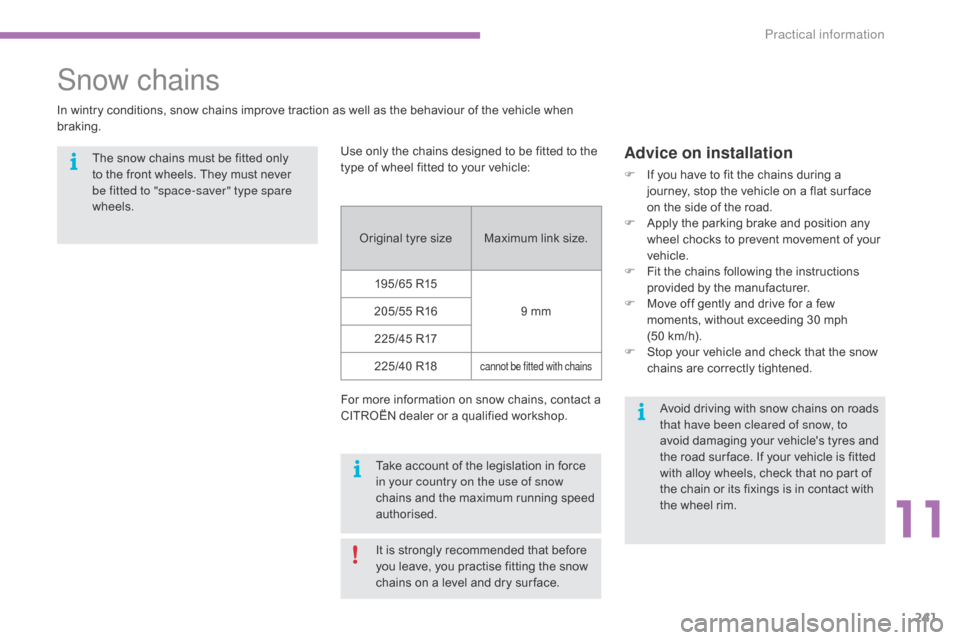
Snow chains
In wintry conditions, snow chains improve traction as well as the behaviour of the vehicle when braking.
Advice on installation
F If you have to fit the chains during a j
ourney, stop the vehicle on a flat sur face
o
n the side of the road.
F
A
pply the parking brake and position any
w
heel chocks to prevent movement of your
v
ehicle.
F
F
it the chains following the instructions
p
rovided by the manufacturer.
F
M
ove off gently and drive for a few
m
oments, without exceeding 30 mph
(
50 km/h).
F
S
top your vehicle and check that the snow
c
hains are correctly tightened.
Use
only
the
chains
designed
to
be
fitted
to
the
t
ype
of
wheel
fitted
to
your
vehicle:
Original
tyre
size Maximum
link
size.
195/65
R15 9
mm
205/55
R16
225/45
R17
225/40
R18
cannot be fitted with chains
For more information on snow chains, contact a C ITROËN dealer or a qualified workshop.
It
is strongly recommended that before
y
ou leave, you practise fitting the snow
c
hains on a level and dry sur face.
The
snow
chains
must
be
fitted
only
t
o
the
front
wheels.
They
must
never
b
e fitted to "space-saver" type spare
wheels.
Take account of the legislation in force
i
n your country on the use of snow
chains
and the maximum running speed
a
uthorised. Avoid
driving with snow chains on roads
t
hat have been cleared of snow, to
avoid
damaging your vehicle's tyres and
t
he road sur face. If your vehicle is fitted
w
ith alloy wheels, check that no part of
t
he chain or its fixings is in contact with
t
he wheel rim.
11
Practical information