USB Citroen C4 2016 2.G User Guide
[x] Cancel search | Manufacturer: CITROEN, Model Year: 2016, Model line: C4, Model: Citroen C4 2016 2.GPages: 396, PDF Size: 10.22 MB
Page 331 of 396
329
C4-2_en_Chap10b_SMEGplus_ed02-2015
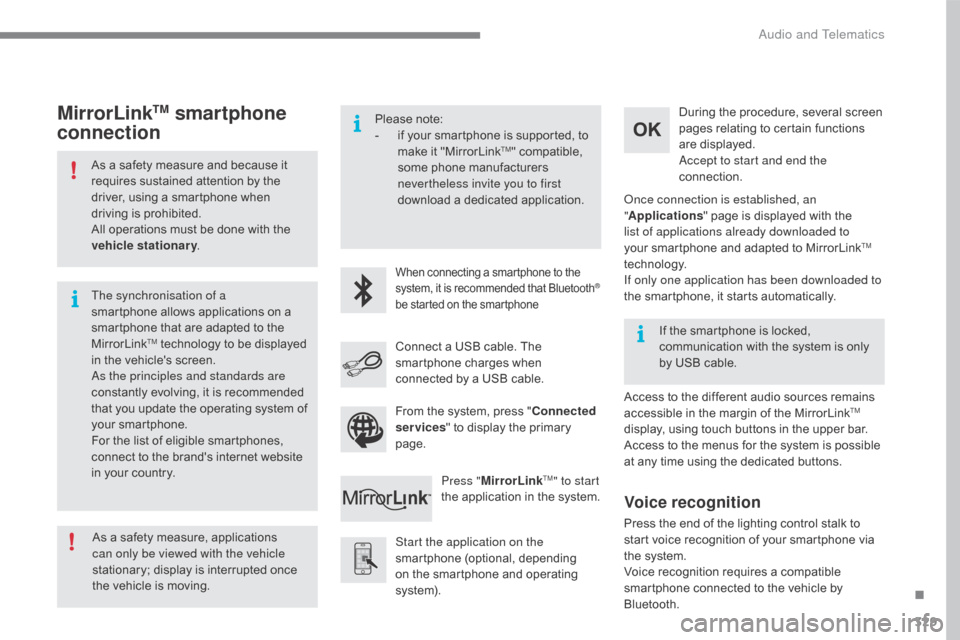
As a safety measure and because it requires sustained attention by the
d
river, using a smartphone when
d
riving is prohibited.
All
operations must be done with the
v
ehicle stationary .
The synchronisation of a
smartphone
allows applications on a
s
martphone that are adapted to the
M
irrorLink
TM technology to be displayed i
n
the
vehicle's screen.
As the principles and standards are
constantly
evolving, it is recommended
t
hat
you
update the operating system of
y
our
smartphone.
For
the
list
of eligible smartphones,
c
onnect
to
the brand's internet website
i
n
your
country. Please
note:
-
i
f your smartphone is supported, to
m
ake it "MirrorLink
TM" compatible, s
ome
phone
manufacturers
n
evertheless invite you to first
download
a
dedicated application.
When connecting a smartphone to the system, it is recommended that Bluetooth®
be
started
on
the
smartphone
Start the application on the
smartphone (optional, depending
o
n the smartphone and operating
s
yste m). During
the procedure, several screen
p
ages relating to certain functions
a
re displayed.
Accept to start and end the
connection.
Connect a USB cable. The
s
martphone charges when
c
onnected by a USB cable.
Press " MirrorLink
TM" to start
the
application
in
the system. Once connection is established, an
"
Applications " page is displayed with the
l
ist of applications already downloaded to
your smartphone and adapted to MirrorLink
TM
technology.
If only one application has been downloaded to
the
smartphone,
it
starts
automatically.
MirrorLinkTM smartphone
connection
Access to the different audio sources remains a
ccessible in the margin of the MirrorLinkTM
display,
using
touch
buttons
in
the
upper
bar.
Access
to
the
menus
for
the
system
is
possible
a
t
any
time
using
the
dedicated
buttons.
If
the
smartphone
is
locked,
c
ommunication
with
the
system
is
only
b
y
USB
cable.
From
the
system,
press
"
Connected
services "
to
display
the
primary
pag
e.
As
a
safety
measure,
applications
c
an only be viewed with the vehicle
stationary;
display
is
interrupted
once
t
he
vehicle
is
moving.
Voice recognition
Press the end of the lighting control stalk to s tart voice recognition of your smartphone via
t
he system.
Voice
recognition requires a compatible
s
martphone connected to the vehicle by
Bl
uetooth.
.
Audio and Telematics
Page 335 of 396
333
C4-2_en_Chap10b_SMEGplus_ed02-2015
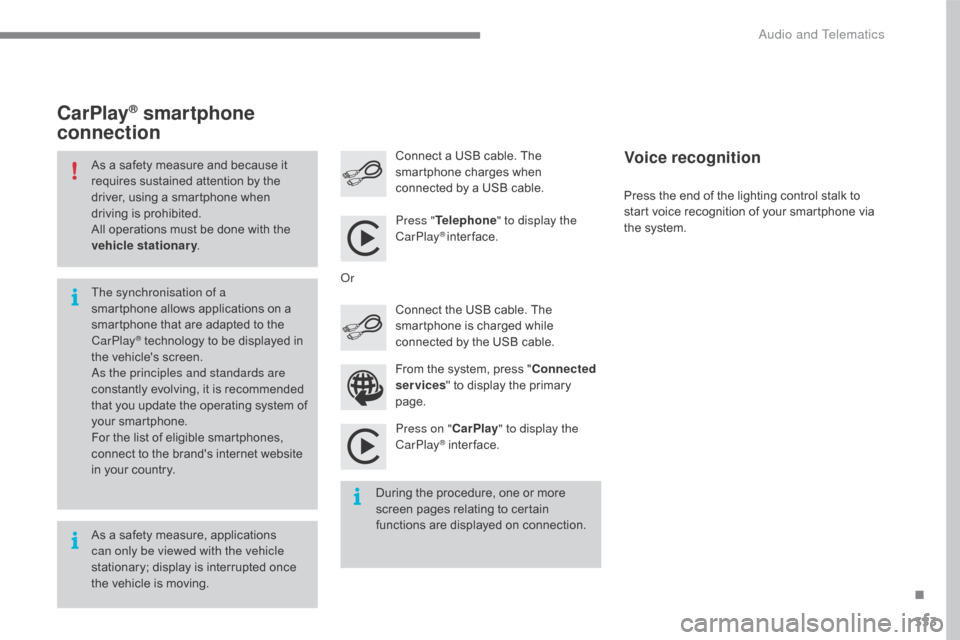
As a safety measure and because it requires sustained attention by the
d
river, using a smartphone when
d
riving is prohibited.
All
operations must be done with the
v
ehicle stationary .
As
a safety measure, applications
c
an only be viewed with the vehicle
stationary;
display is interrupted once
t
he vehicle is moving.
The synchronisation of a
smartphone
allows applications on a
s
martphone that are adapted to the
C
arPlay
® technology to be displayed in t
he
vehicle's screen.
As the principles and standards are
constantly
evolving, it is recommended
t
hat
you
update the operating system of
y
our
smartphone.
For
the
list of eligible smartphones,
c
onnect
to the brand's internet website
i
n
your
country. Press "
Telephone " to display the
CarPlay
® inter face.
Press on " CarPlay" to display the
CarPlay
® inter face.
C
onnect
a USB cable. The
s
martphone charges when
c
onnected by a USB cable.
Press the end of the lighting control stalk to
s
tart voice recognition of your smartphone via
t
he system.
CarPlay® smartphone
connection
During the procedure, one or more s
creen pages relating to certain
f
unctions are displayed on connection.
From
the system, press "
Connected
services " to display the primary
pag
e.
Connect the USB cable. The
s
martphone is charged while
c
onnected by the USB cable.
Or
Voice recognition
.
Audio and Telematics
Page 349 of 396
347
C4-2_en_Chap10b_SMEGplus_ed02-2015
Media
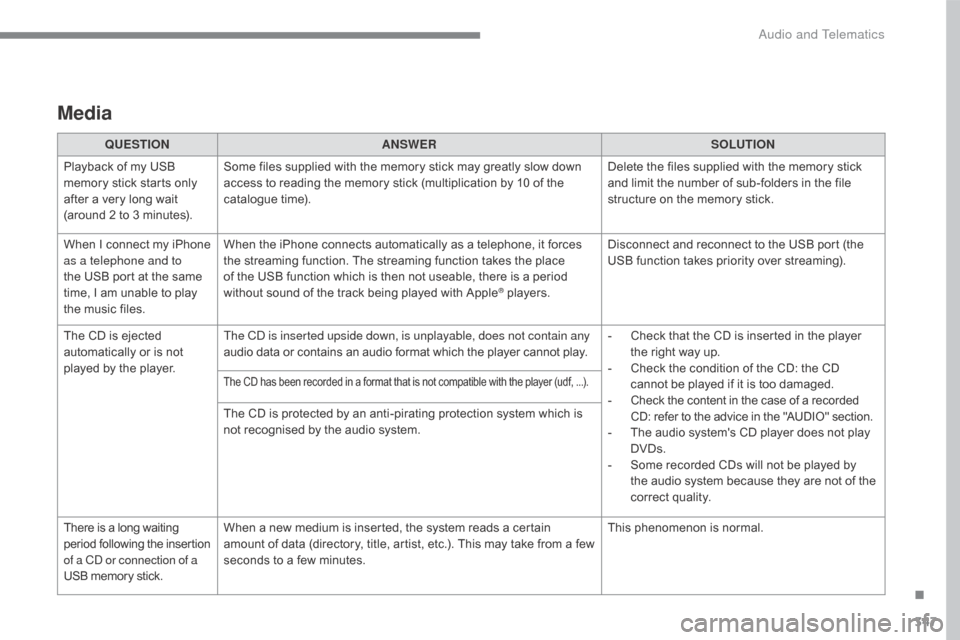
QUESTIONANSWER SOLUTION
Playback of my USB
m
emory stick starts only
a
fter
a
very long wait
(
around 2 to 3 minutes). Some
files supplied with the memory stick may greatly slow down
a
ccess to reading the memory stick (multiplication by 10 of the
c
atalogue time). Delete
the files supplied with the memory stick
a
nd limit the number of sub-folders in the file
s
tructure on the memory stick.
When
I
c
onnect
m
y
i
Phone
a
s a telephone and to
the
USB port at the same
t
ime,
I
am unable to play
t
he
music files. When
the iPhone connects automatically as a telephone, it forces
t
he streaming function. The streaming function takes the place
o
f the USB function which is then not useable, there is a period
w
ithout sound of the track being played with Apple
® players.D isconnect and reconnect to the USB port (the
U
SB function takes priority over streaming).
The
CD
is
ejected
a
utomatically
or
is
not
p
layed
by
the
player. The CD is inserted upside down, is unplayable, does not contain any
audio
data
or
contains
an
audio
format
which
the
player cannot play.-
C
heck that the CD is inserted in the player
t
he right way up.
-
C
heck the condition of the CD: the CD
c
annot be played if it is too damaged.
-
C
heck the content in the case of a recorded
C
D: refer to the advice in the "AUDIO" section.
-
T
he audio system's CD player does not play
DV
Ds.
-
S
ome recorded CDs will not be played by
t
he audio system because they are not of the
c
orrect
q
uality.
The CD has been recorded in a format that is not compatible with the player (udf, ...).
The CD is protected by an anti-pirating protection system which is not recognised by the audio system.
There
is
a
long
waiting
p
eriod
f
ollowing
t
he
i
nsertion
o
f a CD or connection of a
USB
memory
stick. When
a new medium is inserted, the system reads a certain
a
mount of data (directory, title, artist, etc.). This may take from a few
s
econds to a few minutes. This
phenomenon is normal.
.
Audio and Telematics
Page 356 of 396
354
C4-2_en_Chap10c_RD5_ed02-2015
First steps
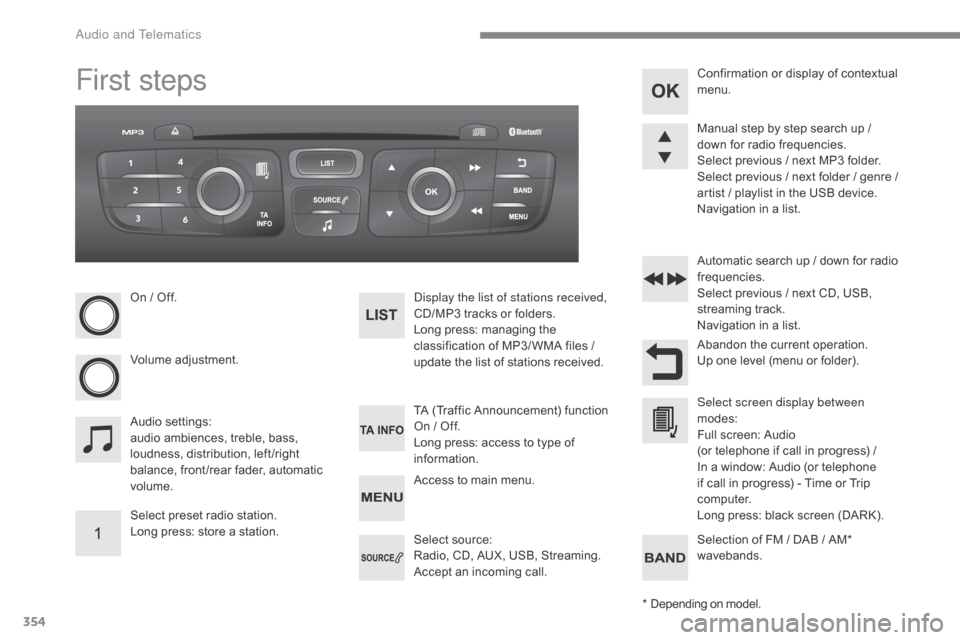
On / Off.
V olume
adj
ustment.
Select
preset radio station.
Long
press: store a station. Display the list of stations received,
CD/MP3
tracks or folders.
Long
press: managing the
c
lassification of MP3/ WMA files /
u
pdate the list of stations received.
Audio
se
ttings:
audio
ambiences, treble, bass,
l
oudness, distribution, left /right
b
alance, front /rear fader, automatic
vo
lume. TA
(Traffic Announcement) function
O
n / Off.
Long
press: access to type of
i
nformation.Automatic
search up / down for radio
f
requencies.
Select previous / next CD, USB, s
treaming t rack.
Navigation
in a list.
Access
to main menu.Abandon
the current operation.
Up
one level (menu or folder).
Confirmation
or display of contextual
m
enu.
Manual step by step search up /
d
own for radio frequencies.
Select previous / next MP3 folder.
Select previous / next folder / genre /
a
rtist / playlist in the USB device.
Navigation in a list.
Select
s
ource:
Radio,
CD, AUX, USB, Streaming.
Accept
an incoming call.Select screen display between
modes:
Full
screen: Audio
(or
telephone if call in progress) /
In
a window: Audio (or telephone
i
f call in progress) - Time or Trip
c
omputer.
Long
press: black screen (DARK).
*
D
epending on model.
Selection
of FM / DAB / AM*
w
avebands.
Audio and Telematics
Page 360 of 396
358
C4-2_en_Chap10c_RD5_ed02-2015
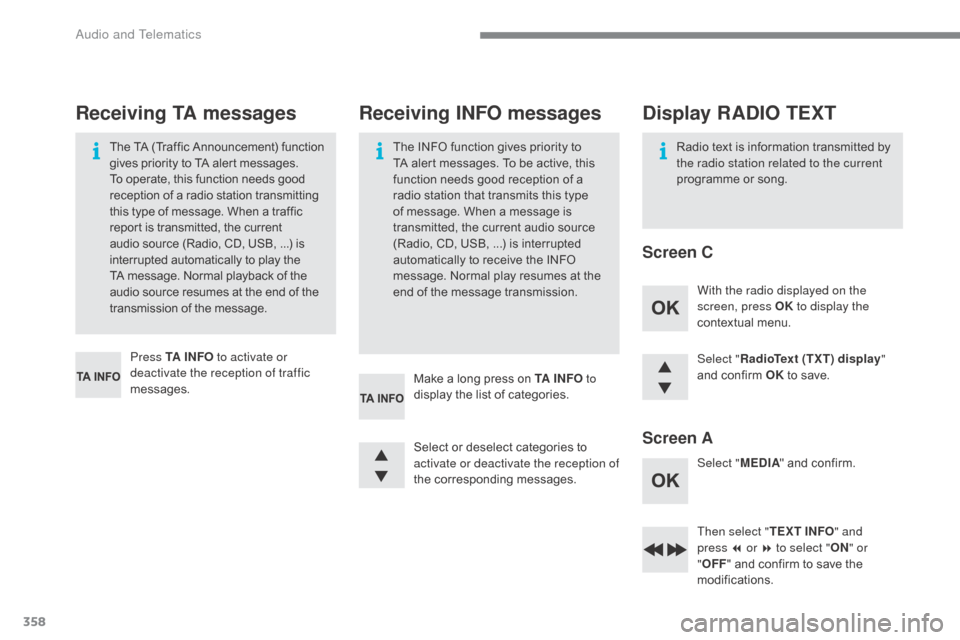
Select "RadioText (TXT) display "
and confirm OK to save.
Then select " TEXT INFO" and
press
7 or 8 to select " ON" or
" OFF "
and confirm to save the
m
odifications.
Select
or
deselect
categories
to
a
ctivate or deactivate the reception of
the
c
orresponding
m
essages.
Press TA I N FO
to activate or
deactivate the reception of traffic
messages. With the radio displayed on the
screen, press OK
to display the
contextual menu.
Select " MEDIA"
and confirm.
Make
a
long
press
on
TA I N FO to
display
the
list
of
categories.
The
TA
(Traffic
Announcement)
function
g
ives
priority
to
TA
alert
messages.
T
o
operate,
this
function
needs
good
r
eception
of
a
radio
station
transmitting
t
his
type
of
message.
When
a
traffic
r
eport
is
transmitted,
the
current
a
udio
source
(Radio,
CD,
USB,
...)
is
i
nterrupted
automatically
to
play
the
T
A
message.
Normal
playback
of
the
a
udio
source
resumes
at
the
end
of
the
t
ransmission
of
the
message.
Receiving TA messages Receiving INFO messages
The INFO function gives priority to T
A alert messages. To be active, this
f
unction needs good reception of a
r
adio station that transmits this type
o
f message. When a message is
t
ransmitted, the current audio source
(
Radio, CD, USB, ...) is interrupted
a
utomatically to receive the INFO
m
essage. Normal play resumes at the
e
nd of the message transmission. Radio
text is information transmitted by t
he radio station related to the current
programme
or song.
Display RADIO TEXT
Screen C
Screen A
Audio and Telematics
Page 363 of 396
361
C4-2_en_Chap10c_RD5_ed02-2015
Press and hold one of the buttons for
fast for ward or backward.
Press one of the buttons to select a
track
on the CD.
Press LIST to display the list of
tracks on the CD.
To play a disc which has already
been inserted, press the SOURCE
or SRC
button several times in
s
uccession and select "
CD".
Audio CD
Playing a CD
Insert 12 cm diameter circular compact discs o
n l y.
Some
anti-pirating systems, on original discs
o
r CDs copied using a personal recorder, may
c
ause faults which are no reflection on the
quality
of the original player.
Without
pressing the EJECT button, insert a
CD
in the player, play begins automatically.
CD, USB
Information and advice
The audio system will only play files with extension ".mp3" or ".wma" and a compression
r
ate that is constant or variable between
32
Kbps and 320 Kbps.
It
is advisable to restrict file names to
2
0 characters without using special characters
(
e.g. " ? ; ù) to avoid any playing or displaying
pro
blems.
The
playlists accepted are types .m3u and .pls.
The
number of files is limited to 5 000 in
5
00 directories on a maximum of 8 levels.
On
a single disc, the CD player can
r
ead up to 255 MP3 files spread
ov
er 8 directory levels. However, it
i
s recommended that this be kept to
2 l
evels so as to limit the time taken to
a
ccess and play the CD.
During
play, the folder structure is not
o
bserved. In order to be able to play a recorded CDR or
CDRW,
when recording it is preferable to select
s
tandards ISO 9660 level 1.2 or Joliet.
If
the disc is recorded in another format, it may
n
ot be played correctly.
It
is recommended that the same recording
s
tandard is always used for an individual disc,
with
as low a speed as possible (4x maximum)
f
or optimum sound quality.
In
the particular case of a multi-session CD, the
J
oliet standard is recommended.
Use
only USB memory sticks formatted FAT32
(
File Allocation Table).
Do
not connect a hard disk or USB
d
evice other than audio players to the
USB
port. This may cause damage to
y
our
i
nstallation.
Media
.
Audio and Telematics
Page 364 of 396
362
C4-2_en_Chap10c_RD5_ed02-2015
Up a level in the menu.
S
elect
a
line
in
the
list.
Press one of the buttons to select the
next
or
previous
track.
Press and hold one of the buttons for
fast
for wards
or
backwards. Skip
a track.
Select
a track or a folder.
Press LIST
to
display
the
menu
of
f
olders
in
the
compilation.
To
play
a
disc
or
memory
stick
which
h
as already been inserted, press
SOURCE or SRC
several
times
in
s
uccession and select "
CD" or " USB ".
Press one of the buttons to select the
next
or
previous
folder
in
the
order
c
hosen.
CD, USB
Playing a compilation
Insert an MP3 compilation in the CD p layer or connect a memory stick to the
U
SB port, directly or via an extension
l
ead.
The
system creates playlists (temporary
m
emory) the creation time for which can take
f
rom
a few seconds to several minutes.
The
playlists are updated every time the
i
gnition is switched off or a USB memory stick
i
s
c
onnected.
Play
starts automatically after a period which
d
epends on the capacity of the USB memory
st
ick.
At
a
first connection, the order suggested is
b
y
folder. When connecting again, the order
p
reviously chosen is retained.
Audio and Telematics
Page 365 of 396
363
C4-2_en_Chap10c_RD5_ed02-2015
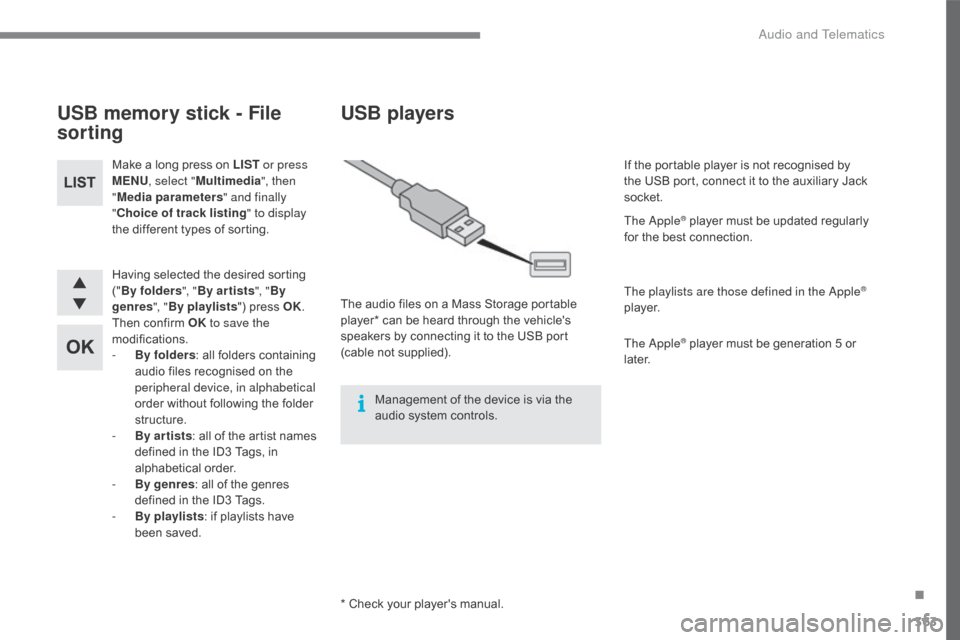
Having selected the desired sorting ("B
y folders ", "By ar tists ", "By
genres ", "By playlists ")
press OK.
Then
confirm OK to save the
modifications.
-
B
y folders :
all folders containing
a
udio files recognised on the
p
eripheral device, in alphabetical
order
without following the folder
s
tructure.
-
B
y ar tists :
all of the artist names
d
efined in the ID3 Tags, in
al
phabetical
o
rder.
-
B
y genres :
all of the genres
d
efined in the ID3 Tags.
-
By
playlists :
if playlists have
b
een saved.
Make
a long press on LIST
or press
MENU , select " Multimedia ", then
" Media parameters " and finally
" Choice of track listing " to display
the different types of sorting.
USB memory stick - File
sorting
* Check your player's manual.
USB players
The audio files on a Mass Storage portable p
layer* can be heard through the vehicle's
s
peakers by connecting it to the USB port
(
cable
no
t
s
upplied).
Management
of the device is via the
a
udio system controls. If
the portable player is not recognised by
t
he USB port, connect it to the auxiliary Jack
s
ocket.
The Apple
® player must be updated regularly f
or
the
best
connection.
The playlists are those defined in the Apple
®
p l aye r.
The Apple
® player must be generation 5 or l
ater.
.
Audio and Telematics
Page 366 of 396
364
C4-2_en_Chap10c_RD5_ed02-2015
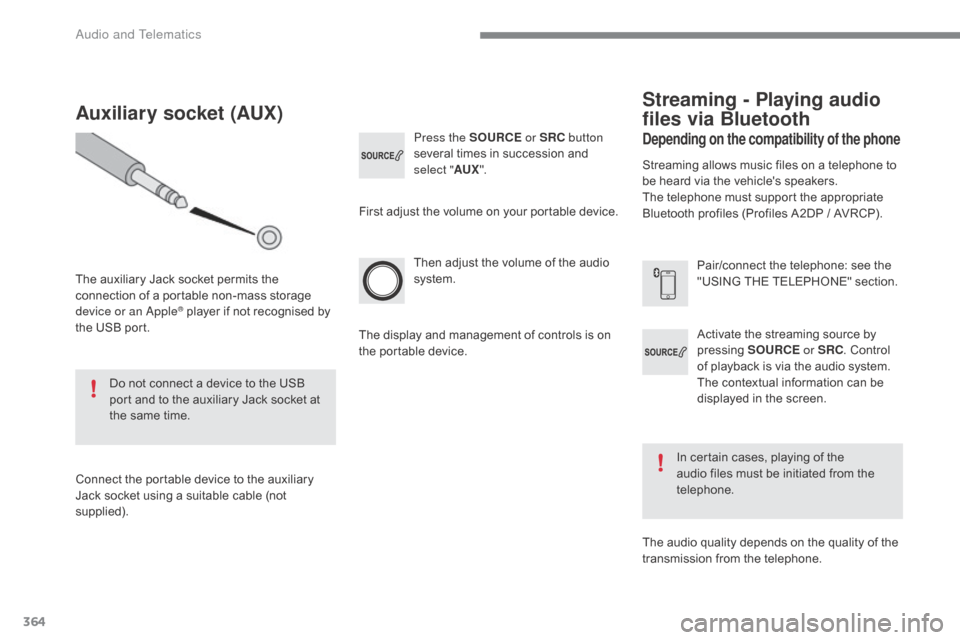
Activate the streaming source by pressing S OURCE or SRC.
Control
o
f playback is via the audio system.
T
he contextual information can be
d
isplayed in the screen.
Then
adjust
the
volume
of
the
audio
s
ystem.
Pair/connect the telephone: see the
"
USING THE TELEPHONE" section.
Press the SOURCE
or SRC button
several
times
in
succession
and
s
elect "
AUX".
Auxiliary socket (AUX)
The auxiliary Jack socket permits the c
onnection of a portable non-mass storage
d
evice or an Apple
® player if not recognised by t
he
USB
port.
Do
not
connect a device to the USB
p
ort
and
to
the auxiliary Jack socket at
t
he
same
time.
Connect
the
portable device to the auxiliary
J
ack
socket
using
a
suitable cable (not
sup
plied). First
adjust the volume on your portable device.
The display and management of controls is on
t
he portable device.
Depending on the compatibility of the phone
Streaming - Playing audio
files via Bluetooth
Streaming allows music files on a telephone to be heard via the vehicle's speakers.
The
telephone must support the appropriate
B
luetooth profiles (Profiles A2DP / AVRCP).
In
certain cases, playing of the
a
udio files must be initiated from the
t
elephone.
The
audio quality depends on the quality of the
t
ransmission from the telephone.
Audio and Telematics
Page 382 of 396
380
C4-2_en_Chap10c_RD5_ed02-2015
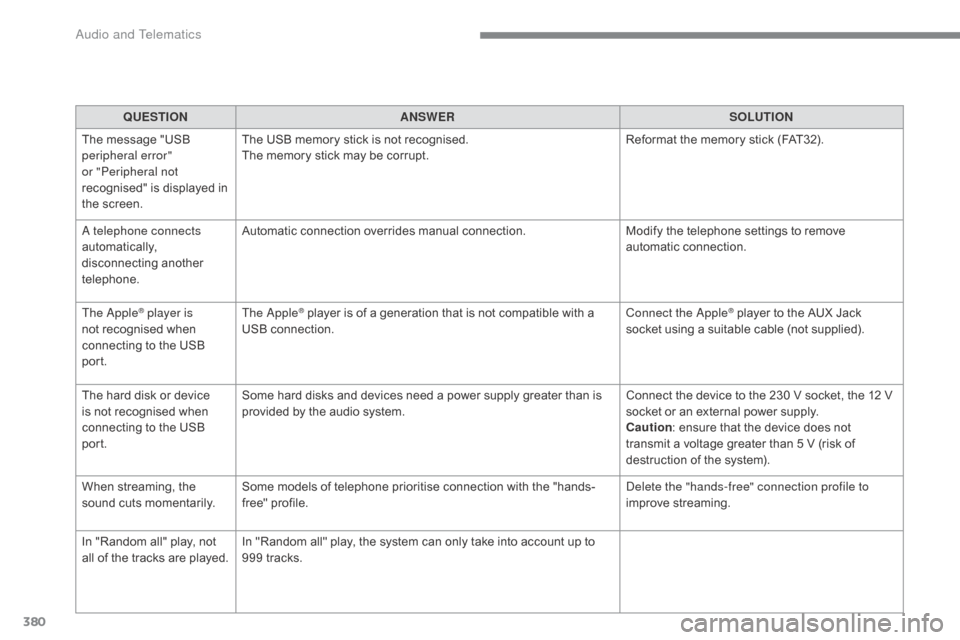
QUESTIONANSWER SOLUTION
The
message "USB
p
eripheral error"
or "Peripheral not
recognised"
is displayed in
t
he
screen. The
USB memory stick is not recognised.
The
memory stick may be corrupt.Reformat
the memory stick (FAT32).
A telephone connects
automatically,
d
isconnecting
a
nother
t
elephone. Automatic
connection overrides manual connection.Modify
the telephone settings to remove
a
utomatic
c
onnection.
The Apple
® player is
not
recognised when
c
onnecting
to the USB
po
rt. The Apple® player is of a generation that is not compatible with a U
SB c
onnection. Connect the Apple® player to the AUX Jack s
ocket
using
a
suitable cable (not supplied).
The
hard
disk
or
device
i
s
not
recognised
when
c
onnecting
to
the
USB
po
rt. Some
hard
disks
and
devices
need
a
power
supply
greater
than
is
p
rovided
by
the
audio
system. Connect
the
device
to the 230 V socket, the 12 V
s
ocket
or
an
external power supply.
Caution :
ensure
that the device does not
t
ransmit
a
voltage
greater than 5 V (risk of
d
estruction
of
the
system).
When
streaming,
the
s
ound
cuts
momentarily. Some
models
of
telephone
prioritise
connection
with
the
"hands-
free"
pro
file. Delete the "hands-free" connection profile to
improve
streaming.
In
"Random
all"
play,
not
a
ll
of
the
tracks
are
played. In
"Random
all"
play,
the
system
can
only
take
into
account
up
to
9
99
tracks.
Audio and Telematics