service Citroen C4 2016 2.G Owner's Guide
[x] Cancel search | Manufacturer: CITROEN, Model Year: 2016, Model line: C4, Model: Citroen C4 2016 2.GPages: 396, PDF Size: 10.22 MB
Page 195 of 396
193
C4-2_en_Chap06_conduite_ed02-2015
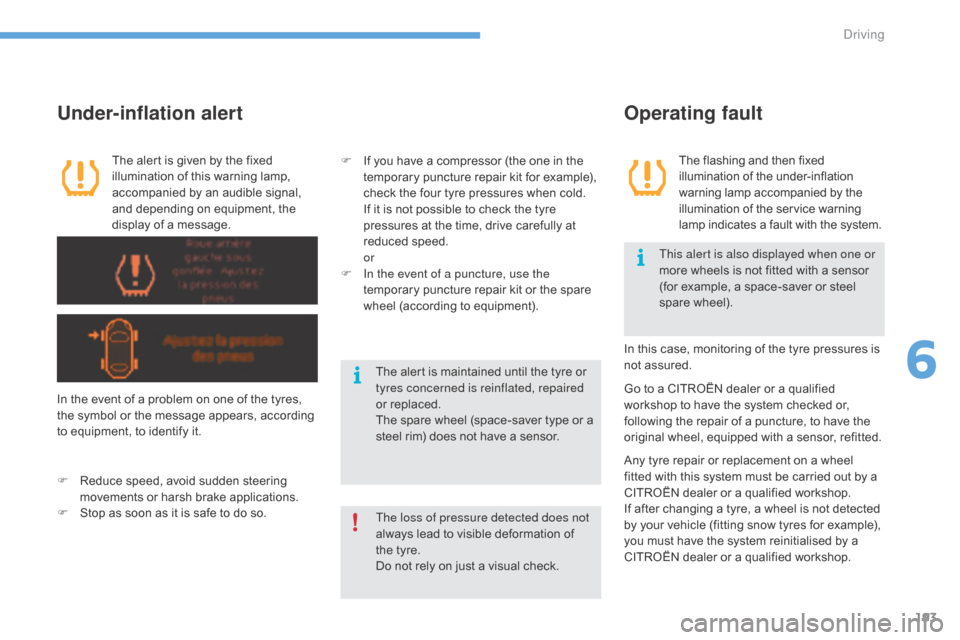
The flashing and then fixed illumination of the under-inflation w
arning lamp accompanied by the
i
llumination of the service warning
l
amp indicates a fault with the system.
Operating fault
The alert is given by the fixed illumination of this warning lamp,
a
ccompanied by an audible signal,
a
nd depending on equipment, the
d
isplay of a message.
Under-inflation alert
In the event of a problem on one of the tyres, the symbol or the message appears, according
t
o equipment, to identify it.
F
R
educe speed, avoid sudden steering
m
ovements or harsh brake applications.
F
S
top as soon as it is safe to do so. In
this case, monitoring of the tyre pressures is
n
ot assured.
F
I
f you have a compressor (the one in the
t
emporary puncture repair kit for example),
c
heck the four tyre pressures when cold.
I
f it is not possible to check the tyre
p
ressures at the time, drive carefully at
r
educed
s
peed.
or
F
I
n the event of a puncture, use the
temporary puncture repair kit or the spare
w
heel (according to equipment).
Go to a CITROËN dealer or a qualified w
orkshop to have the system checked or,
f
ollowing the repair of a puncture, to have the
o
riginal wheel, equipped with a sensor, refitted.
Any
tyre repair or replacement on a wheel
f
itted with this system must be carried out by a
C
ITROËN dealer or a qualified workshop.
If
after changing a tyre, a wheel is not detected
b
y your vehicle (fitting snow tyres for example),
y
ou must have the system reinitialised by a
C
ITROËN dealer or a qualified workshop.
The loss of pressure detected does not
always
lead to visible deformation of
t
he tyre.
Do
not rely on just a visual check.This alert is also displayed when one or
more
wheels is not fitted with a sensor
(
for example, a space-saver or steel
spar
e
w
heel).
The alert is maintained until the tyre or t
yres concerned is reinflated, repaired
or replaced.
The
spare wheel (space-saver type or a
s
teel rim) does not have a sensor.
6
Driving
Page 210 of 396
208
C4-2_en_Chap07_infos-pratiques_ed02-2015
TOTAL & CITROËN
Partners in performance and
protecting the environment
Innovation in the search for
performance
For over 40 year, the TOTAL Research and
Development departments h ave d eveloped l
ubricants for CITROËN, to match the latest
t
echnical innovations on CITROËN vehicles, both for
competition
and for everyday motoring.
For you, this is an assurance that you will obtain the
best
per formance from your engine.
Optimum protection for
your engine
By having your CITROËN vehicle serviced with TOTAL lubricants, you are
contributing
towards improving the life
a
nd per formance of your engine, while
a
lso protecting the environment.
Practical information
Page 228 of 396
226
C4-2_en_Chap07_infos-pratiques_ed02-2015
Checking levels
The check is carried out either when the ignition is switched on using the
o
il level indicator in the instrument
p
anel for vehicles so equipped, or
u
sing the dipstick.
Engine oil level
Checking using
the dipstick
Check all of these levels regularly, in line with the manufacturer's service schedule. Top them up if necessary, unless other wise indicated.
I f a level drops significantly, have the corresponding system checked by a CITROËN dealer or a qualified workshop.
It
is normal to top up the oil level between
t
wo services (or oil changes). CITROËN
r
ecommends that you check the level, and top
u
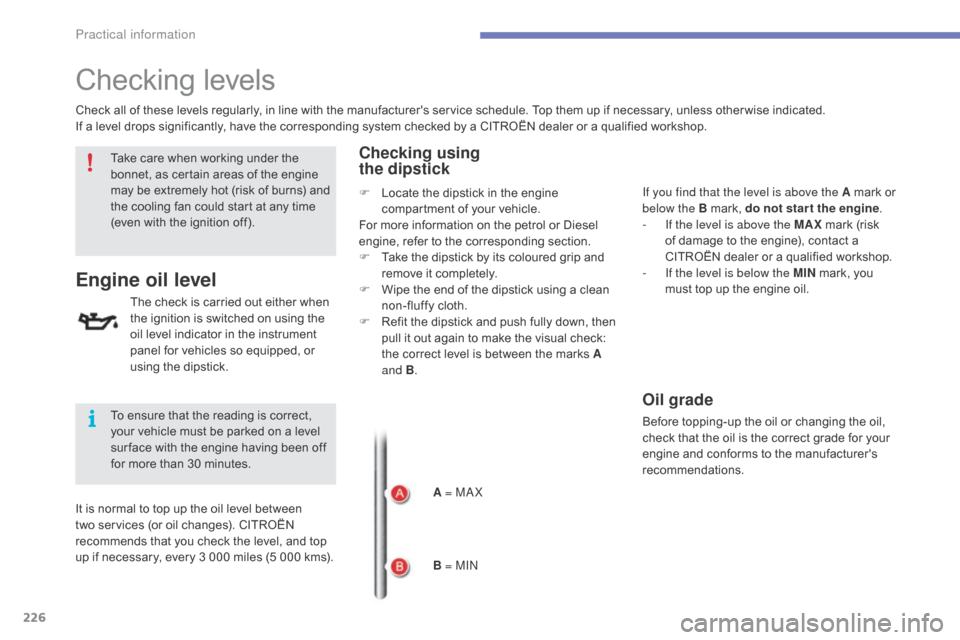
p if necessary, every 3 000 miles (5 000 kms).A = MA X
B = MIN If you find that the level is above the A
mark or
belo
w the B mark, do not star t the engine.
-
I
f the level is above the MAX
mark (risk
o
f damage to the engine), contact a
C
ITROËN dealer or a qualified workshop.
-
I
f the level is below the MIN
mark, you
m
ust top up the engine oil.
Oil grade
Before topping-up the oil or changing the oil, check that the oil is the correct grade for your
e
ngine and conforms to the manufacturer's
r
ecommendations.
Take
care
when
working
under
the
b
onnet,
as
certain
areas
of
the
engine
m
ay
be
extremely
hot
(risk
of
burns)
and
t
he
cooling
fan
could
start
at
any
time
(
even
with
the
ignition
off).
To
ensure
that
the
reading
is
correct,
y
our
vehicle
must
be
parked
on
a
level
s
ur face
with
the
engine
having
been
off
f
or
more
than
30
minutes. F
L
ocate
the
dipstick
in
the
engine
c
ompartment
of
your
vehicle.
For
more
information
on
the
petrol
or
Diesel
e
ngine,
refer
to
the
corresponding
section.
F
T
ake
the
dipstick
by
its
coloured
grip
and
r
emove
it
completely.
F
W
ipe
the
end
of
the
dipstick
using
a
clean
n
on-fluffy
cloth.
F
R
efit
the
dipstick
and
push
fully
down,
then
p
ull
it
out
again
to
make
the
visual
check:
t
he
correct
level
is
between
the
marks
A
and B .
Practical information
Page 229 of 396
227
C4-2_en_Chap07_infos-pratiques_ed02-2015
Topping-up the engine oil level
F Locate the oil filler cap in the engine c
ompartment of your vehicle.
For
more information on the petrol or Diesel
e
ngine, refer to the corresponding section.
F
U
nscrew the oil filler cap to reveal the filler
a
perture.
F
A
dd oil in small quantities, avoiding any
s
pills on engine components (risk of fire).
F
W
ait a few minutes before checking the
l
evel again using the dipstick.
F
A
dd more oil if necessary.
F
A
fter checking the level, carefully refit the
o
il filler cap and the dipstick in its tube.
After
topping-up the oil, the check when
s
witching on the ignition with the oil level
i
ndicator in the instrument panel is not valid
d
uring the 30 minutes after topping up.
Engine oil change
Refer to the manufacturer's service schedule for details of the interval for this operation.
In
order to maintain the reliability of the engine
a
nd emission control system, never use
a
dditives in the engine oil.
Brake fluid level
Changing the fluid
Refer to the manufacturer's service schedule for details of the interval for this operation.
Fluid specification
The brake fluid must conform to the manufacturer's r ecommendations.
The
brake fluid level should be close
t
o the "MA X" mark. If it is not, check
t
he brake pad wear.
Power steering
fluid level
The power steering fluid level should b
e close to the "MA X" mark. With
t
he engine cold, unscrew the cap to
c
heck the level.
7
Practical information
Page 232 of 396
230
C4-2_en_Chap07_infos-pratiques_ed02-2015
Checks
Particle filter (Diesel)
- fixed illumination of the particle f
ilter warning lamp, accompanied
b
y an audible signal and a
m
essage that there is a risk of
b
lockage of the particle filter.
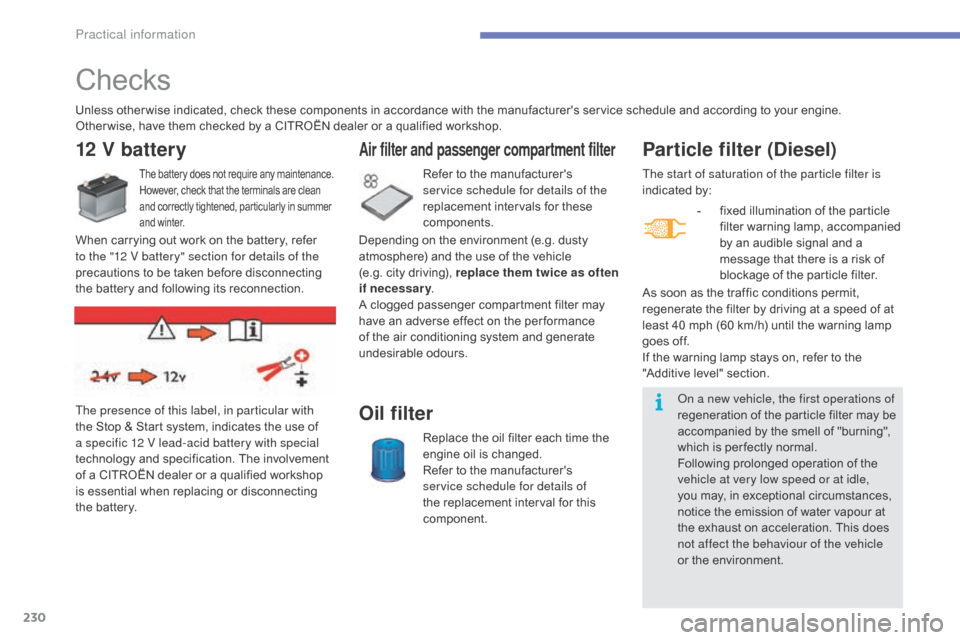
The presence of this label, in particular with
the
Stop
&
Start
system,
indicates
the
use
of
a s
pecific 12 V lead-acid battery with special
technology
and
specification.
The
involvement
o
f
a
CITROËN
dealer
or
a
qualified
workshop
i
s
essential
when
replacing
or
disconnecting
t
he
battery. As
soon
as the traffic conditions permit,
r
egenerate the filter by driving at a speed of at
l
east
40
mph (60 km/h) until the warning lamp
g
oes
off.
If
the
warning lamp stays on, refer to the
"
Additive
level" section.
Unless
other wise
indicated,
check
these
components
in
accordance
with
the
manufacturer's
service
schedule
and according to your engine.
Other wise,
have
them
checked
by
a
CITROËN
dealer
or
a
qualified
workshop.
Air filter and passenger compartment filter
Refer to the manufacturer's s
ervice schedule for details of the
replacement
intervals for these
c
omponents.
Oil filter
Replace the oil filter each time the e ngine oil is changed.
Refer
to the manufacturer's
s
ervice schedule for details of
the
replacement interval for this
c
omponent.
12 V battery
The battery does not require any maintenance.
H owever, check that the terminals are clean a
nd correctly tightened, particularly in summer
a
nd winter.
When carrying out work on the battery, refer to the "12 V battery" section for details of the
precautions
to be taken before disconnecting
t
he battery and following its reconnection.Depending
on the environment (e.g. dusty a
tmosphere) and the use of the vehicle
(e.g.
city driving), replace them twice as often
if necessary .
A
clogged passenger compartment filter may
h
ave an adverse effect on the per formance
o
f the air conditioning system and generate
u
ndesirable
o
dours.The start of saturation of the particle filter is
indicated
by:
On a new vehicle, the first operations of
regeneration of the particle filter may be
a
ccompanied by the smell of "burning",
w
hich is per fectly normal.
Following
prolonged operation of the
v
ehicle at very low speed or at idle,
you
may, in exceptional circumstances,
n
otice the emission of water vapour at
t
he exhaust on acceleration. This does
n
ot affect the behaviour of the vehicle
or
the environment.
Practical information
Page 233 of 396
231
C4-2_en_Chap07_infos-pratiques_ed02-2015
Automatic gearbox
The gearbox does not require any maintenance (no oil change).
Refer
to the manufacturer's
s
ervice schedule for details of
the
level checking interval for this
c
omponent.
Electric parking brake
This system does not require any routine servicing. However, in
t
he event of a problem, have the
s
ystem checked by a CITROËN
d
ealer or a qualified workshop.
Manual parking brake
If a loss of effectiveness of this
system i s n oticed, t he p arking b rake
m
ust be checked, even between
t
wo services.
Brake pads
Brake wear depends on the style of driving, particularly in the case
o
f vehicles used in town, over short
distances.
It may be necessary to
Brake disc wear
For information on checking brake disc wear, contact a CITROËN
dealer
or a qualified workshop.
For
more information on the electric parking
b
rake, refer to the corresponding section.
Manual gearbox
The gearbox does not require any maintenance (no oil change).
Refer
to the manufacturer's service
s
chedule for the checking interval
f
or this component.
Only
use products recommended by
C
ITROËN or products of equivalent
q
uality
an
d
sp
ecification.
In
order to optimise the operation of
u
nits as important as those in the
b
raking system, CITROËN selects and
o
ffers very specific products.
After
washing the vehicle, dampness,
o
r in wintry conditions, ice can form
o
n the brake discs and pads: braking
e
fficiency may be reduced. Make light
b
rake applications to dry and defrost
t
he brakes.
have
the
condition of the brakes checked, even
b
etween
v
ehicle
s
ervices.
Unless
there is a leak in the circuit, a drop in
t
he
brake
fluid level indicates that the brake
p
ads
are
worn. Checking
this system must be done by a
C
ITROËN dealer or a qualified workshop.
7
Practical information
Page 234 of 396
232
C4-2_en_Chap07_infos-pratiques_ed02-2015
AdBlue® additive and SCR system
f
or
BlueHDi Diesel engines
To assure respect for the environment and c
onformity with the new Euro 6 emissions
s
tandard, without adversely affecting the
p
er formance or fuel consumption of Diesel
e
ngines, CITROËN has taken the decision to
e
quip its vehicles with an effective system that
a
ssociates SCR (Selective Catalytic Reduction)
w
ith a particle filter (FAP) for the treatment of
e
xhaust gases.
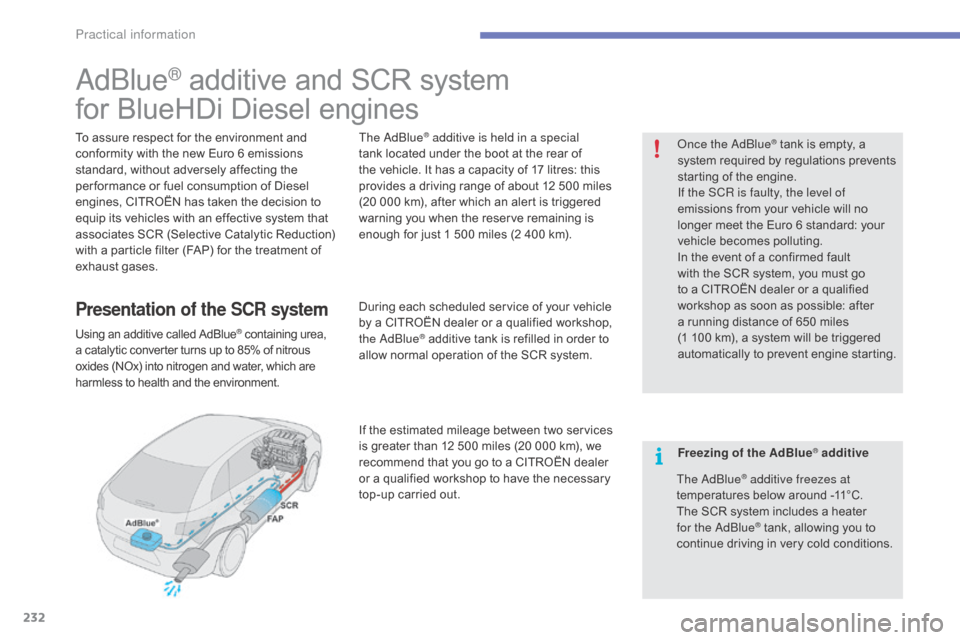
Presentation of the SCR system
Using an additive called AdBlue® containing urea, a
catalytic
converter
turns
up
to
85% of nitrous o
xides
(NOx)
into
nitrogen
and
water, which are
h
armless
to
health
and
the
environment.
The AdBlue® additive is held in a special
tank
located
under the boot at the rear of
t
he
vehicle.
It has a capacity of 17 litres: this
p
rovides
a
driving range of about 12 500 miles
(
20
000
km),
after which an alert is triggered
w
arning
you
when the reserve remaining is
e
nough
for
just 1 500 miles (2 400 km).
During
each
scheduled service of your vehicle
b
y
a
CITROËN dealer or a qualified workshop,
t
he AdBlue
® additive tank is refilled in order to a
llow
normal operation of the SCR system.
If
the
estimated mileage between two services
i
s
greater
than 12 500 miles (20 000 km), we
r
ecommend
that you go to a CITROËN dealer
o
r
a
qualified workshop to have the necessary
t
op-up
carried out. Once the AdBlue
® tank is empty, a s
ystem
required
by regulations prevents
s
tarting
of
the
engine.
If the SCR is faulty, the level of
emissions
from
your vehicle will no
l
onger
meet
the
Euro 6 standard: your
v
ehicle
becomes
polluting.
In
the
event
of
a
confirmed fault
w
ith
the
SCR
system, you must go
t
o
a
CITROËN
dealer or a qualified
w
orkshop
as
soon as possible: after
a
running
distance of 650 miles
(
1 100
km),
a
system will be triggered
a
utomatically
to
prevent engine starting.
Freezing of the AdBlue
® additive
The AdBlue
® additive freezes at
temperatures below around -11°C.
The
SCR
system includes a heater
f
or the AdBlue
® tank, allowing you to c
ontinue
driving in very cold conditions.
Practical information
Page 235 of 396
233
C4-2_en_Chap07_infos-pratiques_ed02-2015
Topping-up the AdBlue® additive
Precautions in use
Use only AdBlue® additive that meets t
he ISO 22241
standard.
The
supply
in
a
non-drip bottle simplifies
t
oping-up.
You
can obtain 1.89 litre (half a
U
S gallon)
bottles from a CITROËN dealer or a
q
ualified
w
orkshop.
Keep AdBlue
® out of the reach of
children,
in
its
original bottle.
Never transfer AdBlue
® to another
container:
it
would
lose
its purity. Never
dilute the additive with water.
Never pour the additive into the Diesel
fuel tank.
Never top-up from an AdBlue®
dispenser
reserved
for
heavy
goods
v
ehicles.
Filling
the
AdBlue
® tank is an operation i
ncluded in every routine service on your
vehicle
by
a
CITROËN dealer or a qualified
w
orkshop.
Nevertheless,
given the capacity of the tank,
i
t
may
be
necessary to top-up the additive
b
etween
services,
more particularly if an alert
(
warning
lamps
and a message) signals the
r
equirement.
You
can
got
to
a
CITROËN dealer or a qualified
w
orkshop.
If
you
envisage
topping-up yourself, please
r
ead
the
following
warnings carefully. The AdBlue
® additive is an urea-based
solution.
This liquid is non-flammable,
c
olourless
and odourless (kept in a cool area).
In
the
event
of contact with the skin, wash
t
he
affected
area with soap and water. In the
e
vent
of
contact with the eyes, wash (irrigate)
t
he
eyes
with large amounts of water or with
a
n
eye
wash
solution for at least 15 minutes.
I
f
a
burning
sensation or irritation persists, get
m
edical
attention.
If
swallowed, immediately wash out the mouth
w
ith
clean
water and then drink plenty of water.
In
certain
conditions (high ambient
t
emperature,
for example), the risk of release
o
f
ammonia
cannot be excluded: do not inhale
t
he
product.
Ammonia vapour has en irritant
e
ffect
on
mucous membranes (eyes, nose and
t
hroat).
7
Practical information
Page 271 of 396
269
C4-2_en_Chap08_en-cas-de-panne_ed02-2015
Towing the vehicle
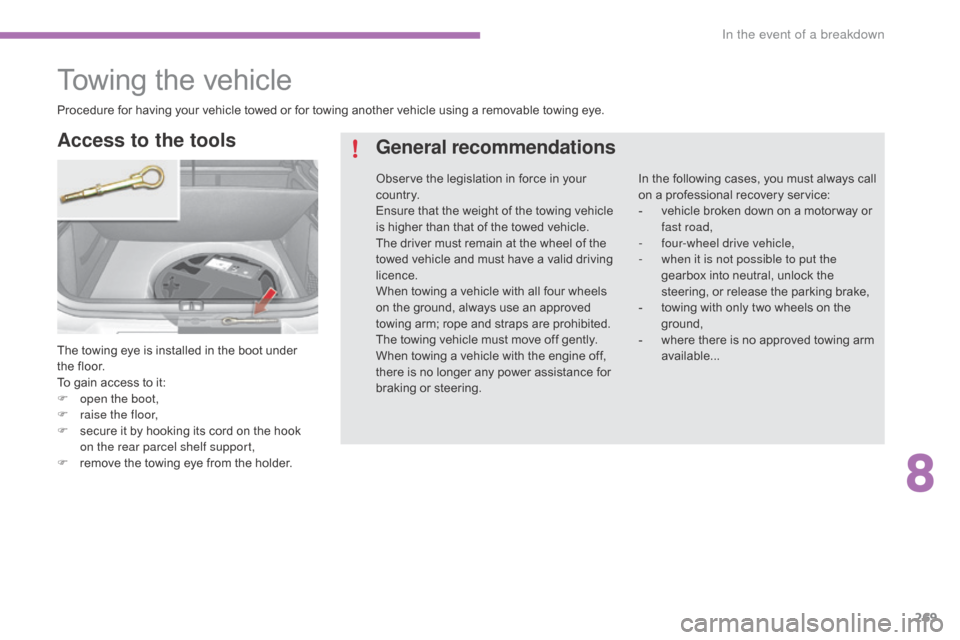
The towing eye is installed in the boot under the floor.
To
gain access to it:
F
o
pen the boot,
F
r
aise the floor,
F
s
ecure it by hooking its cord on the hook
o
n the rear parcel shelf support,
F
r
emove the towing eye from the holder.
Access to the tools General recommendations
In the following cases, you must always call o
n a professional recovery service:
-
v
ehicle broken down on a motor way or
f
ast road,
-
f
our-wheel drive vehicle,
-
w
hen it is not possible to put the
gearbox
into neutral, unlock the
s
teering, or release the parking brake,
-
t
owing with only two wheels on the
g
round,
-
w
here there is no approved towing arm
a
vailable...
Procedure
for
having
your
vehicle
towed
or
for
towing
another
vehicle
using
a
removable
towing
eye.
Observe
the
legislation
in
force
in
your
c
o unt r y.
Ensure
that
the
weight
of
the
towing
vehicle
i
s
higher
than
that
of
the
towed
vehicle.
The
driver
must
remain
at
the
wheel
of
the
t
owed
vehicle
and
must
have
a
valid
driving
l
icence.
When
towing
a
vehicle
with
all
four
wheels
o
n
the
ground,
always
use
an
approved
t
owing
arm;
rope
and
straps
are
prohibited.
The
towing
vehicle
must
move
off
gently.
When
towing
a
vehicle
with
the
engine
off,
t
here
is
no
longer
any
power
assistance
for
b
raking
or
steering.
8
In the event of a breakdown
Page 282 of 396
280
C4-2_en_Chap10a_BTA_ed02-2015
Emergency or assistance call
Localised Emergency Call
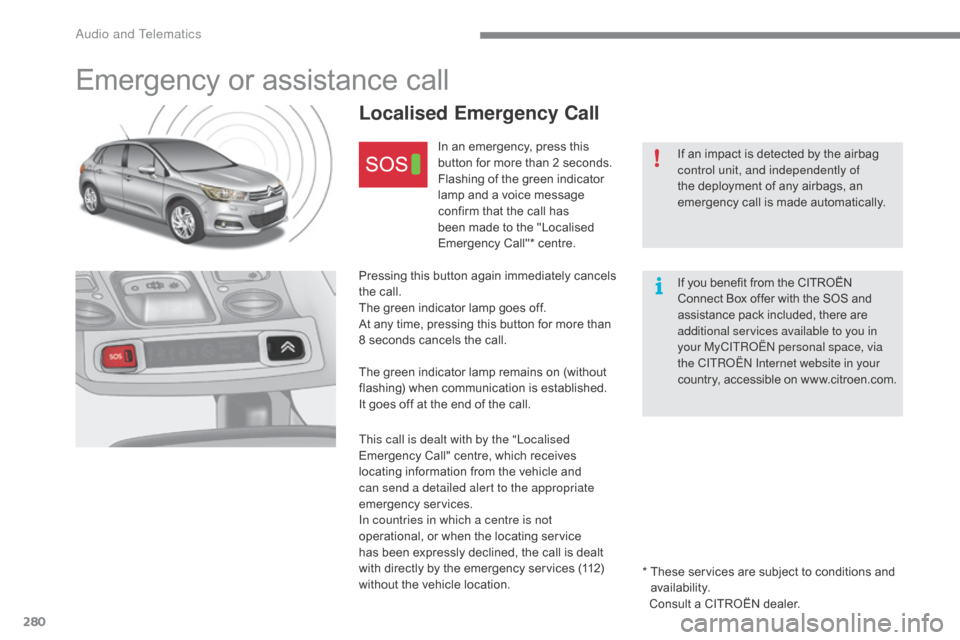
In an emergency, press this button for more than 2 seconds.
Flashing
of the green indicator
l
amp and a voice message
c
onfirm that the call has
b
een made to the "Localised
E
mergency Call"* centre.
Pressing
this
button again immediately cancels
t
he
call.
The
green
indicator lamp goes off.
At
any
time,
pressing this button for more than
8
seconds
cancels the call.
The
green
indicator lamp remains on (without
f
lashing)
when communication is established.
It
goes
off
at
the end of the call.
This call is dealt with by the "Localised
Emergency
Call" centre, which receives
l
ocating
information from the vehicle and
c
an send a detailed alert to the appropriate
emergency
ser
vices.
In countries in which a centre is not
operational,
or when the locating service
h
as
been
expressly declined, the call is dealt
w
ith
directly
by the emergency services (112)
w
ithout
the
vehicle location. If
an impact is detected by the airbag
c
ontrol unit, and independently of
the
deployment of any airbags, an
e
mergency call is made automatically.
If
you benefit from the CITROËN
C
onnect Box offer with the SOS and
a
ssistance pack included, there are
a
dditional services available to you in
your MyCITROËN personal space, via
the CITROËN Internet website in your
countr y,
accessible
on
w w w.citroen.com.
*
T
hese services are subject to conditions and
a
vailability.
Consult a CITROËN dealer.
Audio and Telematics