service Citroen C4 2016 2.G User Guide
[x] Cancel search | Manufacturer: CITROEN, Model Year: 2016, Model line: C4, Model: Citroen C4 2016 2.GPages: 396, PDF Size: 10.22 MB
Page 33 of 396
31
C4-2_en_Chap01_instruments-de-bord_ed02-2015
Service overdue
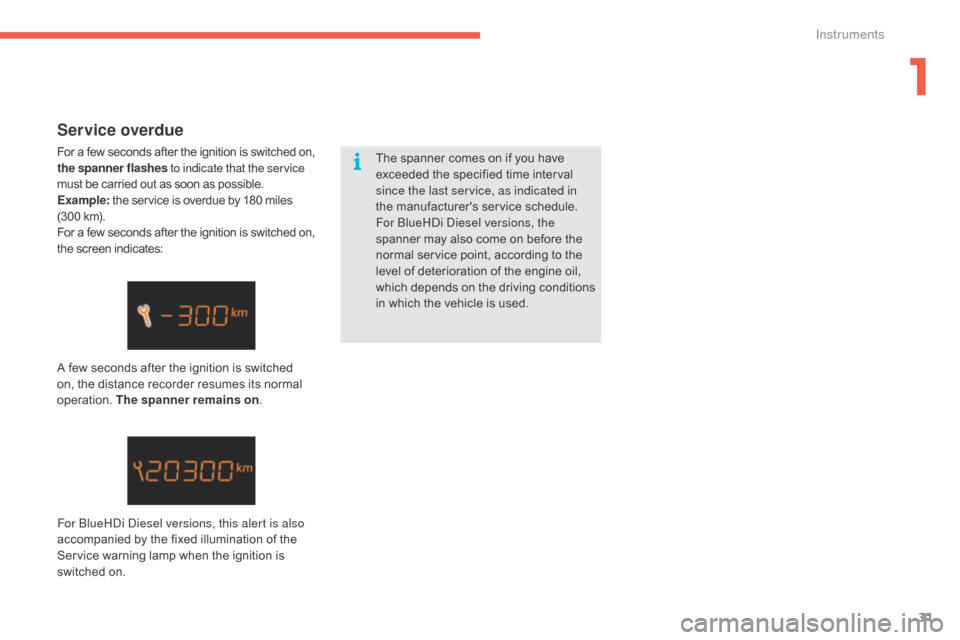
For a few seconds after the ignition is switched on, the spanner flashes to indicate that the service
must
be carried out as soon as possible.
Example:
the service is overdue by 180 miles
(
300 km).
For
a few seconds after the ignition is switched on,
t
he screen indicates:
A
few seconds after the ignition is switched
o
n, the distance recorder resumes its normal
ope
ration.
T
he spanner remains on .
For BlueHDi Diesel versions, this alert is also
accompanied
by the fixed illumination of the
S
ervice warning lamp when the ignition is
s
witched on. The
spanner comes on if you have
e
xceeded the specified time interval
s
ince the last service, as indicated in
the
ma
nufacturer's
ser
vice
s
chedule.
For BlueHDi Diesel versions, the
spanner
may also come on before the
n
ormal service point, according to the
l
evel of deterioration of the engine oil,
w
hich
d
epends
o
n
t
he
d
riving
c
onditions
i
n which the vehicle is used.
1
Instruments
Page 34 of 396
32
C4-2_en_Chap01_instruments-de-bord_ed02-2015
Service indicator zero reset
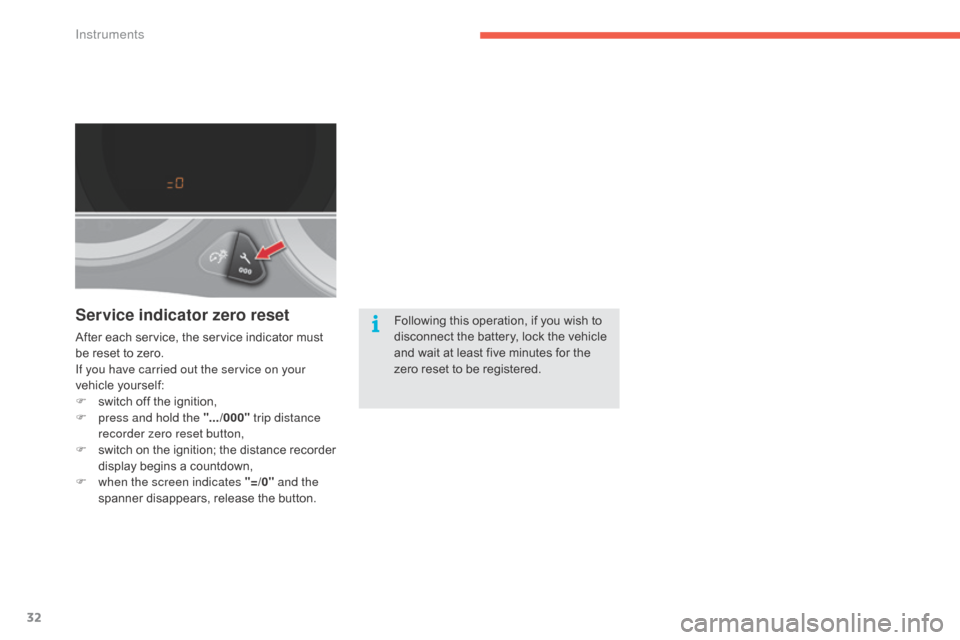
After each service, the service indicator must be reset to zero.
If you have carried out the service on your
vehicle
y
ourself:
F
s
witch off the ignition,
F
p
ress and hold the ".../000" trip distance
recorder zero reset button,
F
s
witch
o
n
t
he
i
gnition;
t
he
d
istance
r
ecorder
d
isplay begins a countdown,
F
w
hen the screen indicates "=/0" and the
spanner
disappears, release the button.Following
this operation, if you wish to d
isconnect the battery, lock the vehicle a
nd wait at least five minutes for the
z
ero reset to be registered.
Instruments
Page 36 of 396
34
C4-2_en_Chap01_instruments-de-bord_ed02-2015
Breakdown related to a lack of AdBlue® additive
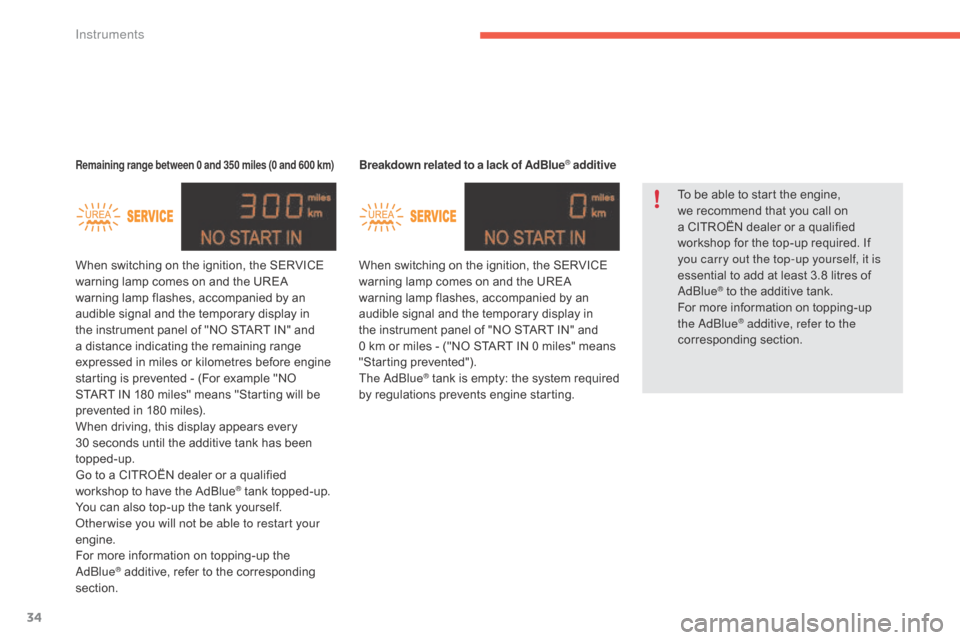
When switching on the ignition, the SERVICE w
arning lamp comes on and the UREA
w
arning lamp flashes, accompanied by an
a
udible signal and the temporary display in
t
he instrument panel of "NO START IN" and
0 k
m or miles - ("NO START IN 0 miles" means
"
Starting
p
revented").
The AdBlue
® tank is empty: t he s ystem r equired b
y
regulations prevents engine starting.
Remaining range between 0 and 350 miles (0 and 600 km)
When switching on the ignition, the SERVICE warning lamp comes on and the UREA
w
arning lamp flashes, accompanied by an
a
udible signal and the temporary display in
t
he instrument panel of "NO START IN" and
a
distance indicating the remaining range
e
xpressed in miles or kilometres before engine
s
tarting is prevented - (For example "NO
S
TART IN 180 miles" means "Starting will be
p
revented in 180 miles).
When
driving, this display appears every
3
0 seconds until the additive tank has been
t
opped-up.
Go
to a CITROËN dealer or a qualified
w
orkshop to have the AdBlue
® tank topped-up.
Y
ou
can
also
top-up
the
tank
yourself.
Other wise you will not be able to restart your
engine.
For
more
information
on
topping-up the
Ad
Blue
® additive, refer to the corresponding s
ection. To
be able to start the engine,
w
e recommend that you call on
a
CITROËN dealer or a qualified
w
orkshop for the top-up required. If
y
ou carry out the top-up yourself, it is
essential to add at least 3.8 litres of
Ad
Blue
® to the additive tank.
F
or
more information on topping-up
t
he AdBlue
® additive, refer to the
corresponding s ection.
Instruments
Page 37 of 396
35
C4-2_en_Chap01_instruments-de-bord_ed02-2015
In the event of a fault with the the SCR emissions control system
In the event of the detection of a fault
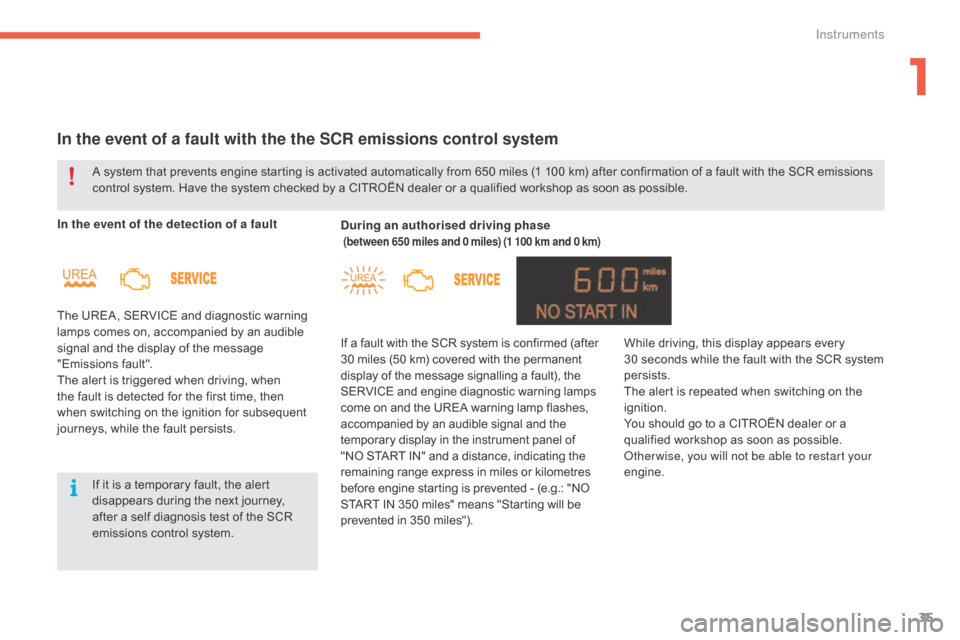
The UREA, SERVICE and diagnostic warning
l
amps comes on, accompanied by an audible
s
ignal and the display of the message
"
Emissions
f
ault".
The
alert is triggered when driving, when
t
he fault is detected for the first time, then
w
hen switching on the ignition for subsequent
j
ourneys, while the fault persists. During an authorised driving phase
(between 650 miles and 0 miles) (1 100 km and 0 km)
If a fault with the SCR system is confirmed (after 3
0 miles (50 km) covered with the permanent d
isplay of the message signalling a fault), the
S
ERVICE and engine diagnostic warning lamps
c
ome on and the UREA warning lamp flashes,
a
ccompanied by an audible signal and the
t
emporary display in the instrument panel of
"
NO START IN" and a distance, indicating the
r
emaining range express in miles or kilometres
b
efore engine starting is prevented - (e.g.: "NO
S
TART IN 350 miles" means "Starting will be
p
revented in 350 miles").
A
system
that
prevents
engine
starting
is
activated automatically from 650 miles (1 100 km) after confirmation of a fault with the SCR emissions
c
ontrol
system.
Have
the
system
checked
by
a CITROËN dealer or a qualified workshop as soon as possible.
If
it
is
a
temporary
fault,
the
alert
d
isappears
during
the
next
journey,
a
fter
a
self
diagnosis
test
of
the
SCR
e
missions
control
system. While
driving, this display appears every 3
0 seconds while the fault with the SCR system
p
ersists.
The
alert is repeated when switching on the
ig
nition.
You
should go to a CITROËN dealer or a
q
ualified workshop as soon as possible.
Other wise, you will not be able to restart your
engine.
1
Instruments
Page 49 of 396
47
C4-2_en_Chap01_instruments-de-bord_ed02-2015
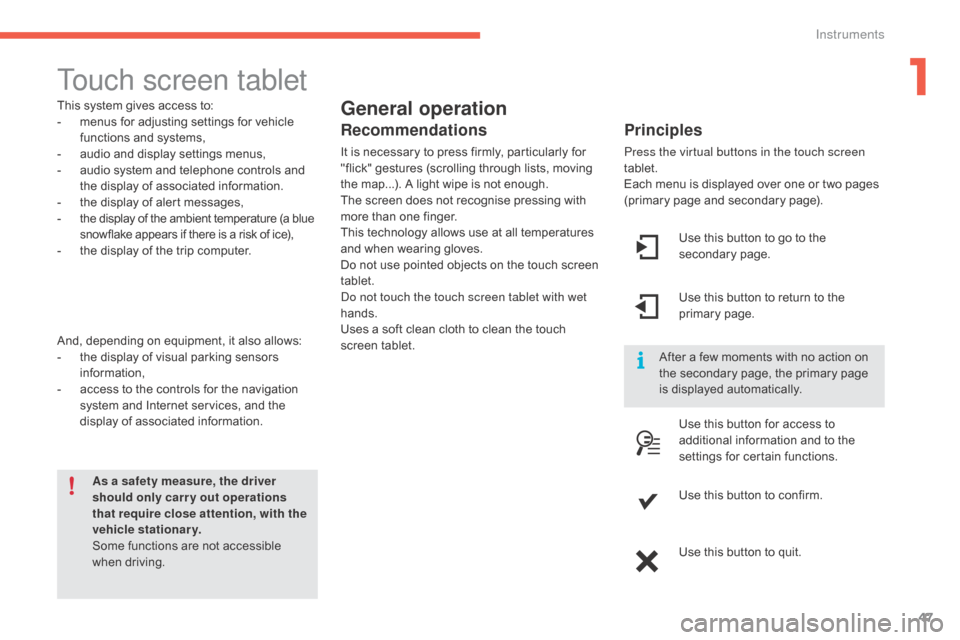
Touch screen tablet
General operation
Principles
Press the virtual buttons in the touch screen
tablet.
Each menu is displayed over one or two pages
(
primary page and secondary page).
As a safety measure, the driver
should only carr y out operations
that require close attention, with the
vehicle stationary.
Some
functions
are
not
accessible
w
hen
d
riving.
This
system
gives
access
to:
-
m
enus
for
adjusting
settings
for
vehicle
f
unctions
and
systems,
-
a
udio
and
display
settings
menus,
-
a
udio
system
and
telephone
controls
and
t
he
display
of
associated
information.
-
t
he
display
of
alert
messages,
-
t
he
display
of
the
ambient
temperature
(a
blue
s
nowflake
appears
if
there
is
a
risk
of
ice),
-
t
he
display
of
the
trip
computer.
And,
depending
on
equipment,
it
also
allows:
-
t
he
display
of
visual
parking
sensors
i
nformation,
-
a
ccess
to
the
controls
for
the
navigation
s
ystem
and
Internet
services,
and
the
d
isplay
of
associated
information.
Recommendations
It is necessary to press firmly, particularly for " flick" gestures (scrolling through lists, moving
t
he map...). A light wipe is not enough.
The
screen does not recognise pressing with
m
ore than one finger.
This
technology allows use at all temperatures
a
nd when wearing gloves.
Do
not use pointed objects on the touch screen
t
ablet.
Do not touch the touch screen tablet with wet
hands.
Uses
a soft clean cloth to clean the touch
s
creen
t
ablet. Use
this button to go to the
s
econdary
pag
e.
After
a few moments with no action on
t
he secondary page, the primary page
i
s displayed automatically.
Use
this button to return to the
p
rimary
pag
e.
Use
this button for access to
a
dditional information and to the
s
ettings for certain functions.
Use
this button to confirm.
Use
this button to quit.
1
Instruments
Page 50 of 396
48
C4-2_en_Chap01_instruments-de-bord_ed02-2015
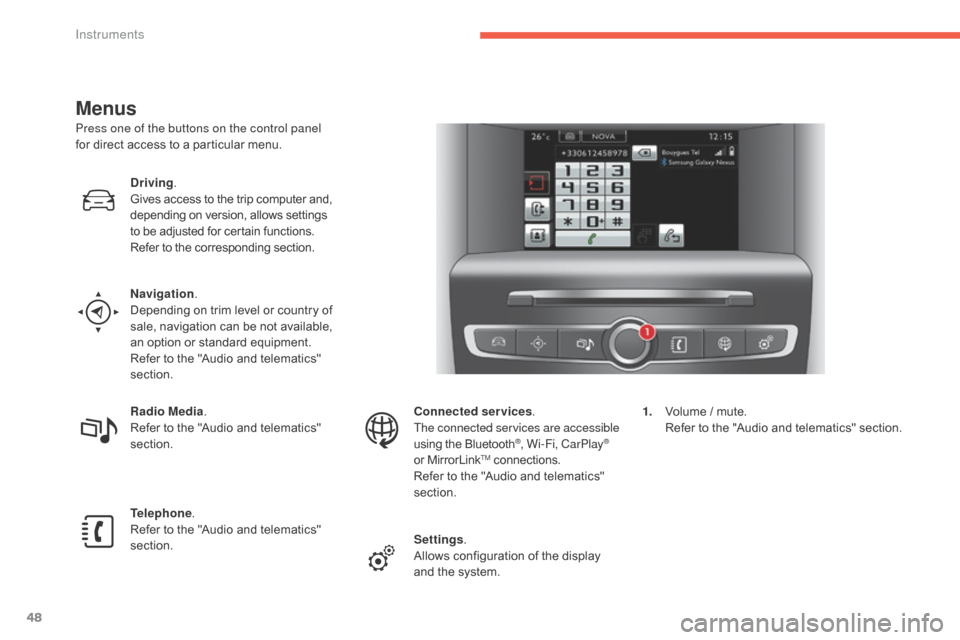
Menus
Press one of the buttons on the control panel
for direct access to a particular menu.
Driving .
Gives
access to the trip computer and,
d
epending on version, allows settings
t
o be adjusted for certain functions.
Refer
to the corresponding section.
Navigation .
Depending
on trim level or country of
s
ale, navigation can be not available,
a
n option or standard equipment.
Refer
to the "Audio and telematics"
s
ection.
Radio Media .
Refer
to the "Audio and telematics"
s
ection.
Telephone .
Refer
to the "Audio and telematics"
s
ection. Connected services
.
The connected services are accessible
using
the Bluetooth
®, Wi-Fi, CarPlay®
or
MirrorLinkTM connections.
Refer
to
the
"Audio and telematics"
s
ection.
Settings .
Allows
configuration of the display
a
nd
the
system. 1.
V
olume / mute.
R
efer to the "Audio and telematics" section.
Instruments
Page 70 of 396
68
C4-2_en_Chap02_ouvertures_ed02-2015
Remote control
The high frequency remote control is a sensitive system; do not operate it while it is in your pocket as there is a possibility that it may unlock the vehicle, without you being aware of it.
Do
not repeatedly press the buttons of your remote control out of range and out of sight of your vehicle. You run the risk of stopping it from
w
orking and the remote control would have to be reinitialised.
The
remote control does not operate when the key is in the ignition, even when the ignition is switched off.
Locking the vehicle
Driving with the doors locked may make access to the passenger compartment by the emergency services more difficult in an emergency.
A s a safety precaution (with children on board), remove the key from the ignition or take the electronic key when you leave the vehicle, even for
a
short time.
Electrical interference
The Keyless Entry and Starting electronic key may not operate if close to certain electronic devices: telephone, laptop computer, strong magnetic fields, ...
Anti-theft protection
Do not make any modifications to the electronic engine immobiliser system; this could cause malfunctions.
D on't forget to turn the steering to engage the steering lock.
Lost keys, remote control, electronic key
Visit a CITROËN dealer with the vehicle's registration certificate, your personal identification documents and if possible, the label bearing the key code.
The
CITROËN dealer will be able to retrieve the key code and the transponder code required to order a new key
Do
not throw the remote control batteries away, they contain metals which are harmful to the environment.
Take
them to an approved collection point.
When purchasing a second-hand vehicle
Have the key codes memorised by a CITROËN dealer, to ensure that the keys in your possession are the only ones which can start the vehicle.
Access
Page 73 of 396

71
C4-2_en_Chap02_ouvertures_ed02-2015
* Depending on the country of sale.
Alarm*
- exterior perimeter
The system checks for opening of the vehicle.
T he alarm is triggered if anyone tries to open a
d
oor, the boot, the bonnet...
- interior volumetric
The system checks for any variation in the volume in the passenger compartment.
The
alarm is triggered if anyone breaks a
w
indow, enters the passenger compartment or
m
oves inside the vehicle.
- tilt
The system checks for any change in the attitude of the vehicle.
The
alarm is triggered if the vehicle is lifted,
m
oved or knocked.
Self-protection function
The system checks for the putting out of service of its components.
The
alarm is triggered if the battery, the central
c
ontrol or the siren wiring are put out of service
o
r damaged. For
all work on the alarm system, c
ontact a CITROËN dealer or a
qualified w orkshop.
System
which
protects
and
provides
a
deterrent
against theft and break-ins. It provides the
f
ollowing
types
of
monitoring:
2
Access
Page 141 of 396
139
C4-2_en_Chap05_securite_ed02-2015
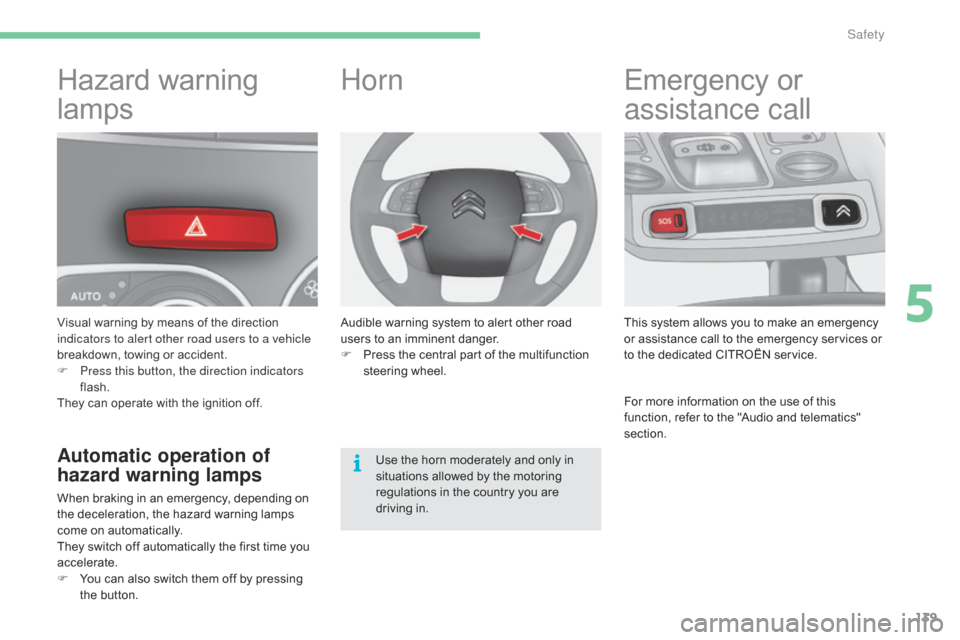
Hazard warning
lam
ps
Visual warning by means of the direction i
ndicators to alert other road users to a vehicle
breakdown,
towing or accident.
F
P
ress this button, the direction indicators
flash.
They
can operate with the ignition off.
Automatic operation of
hazard warning lamps
When braking in an emergency, depending on the deceleration, the hazard warning lamps
c
ome on automatically.
They
switch off automatically the first time you
a
ccelerate.
F
Y
ou can also switch them off by pressing
t
he button.
Horn
Audible warning system to alert other road users to an imminent danger.
F
P
ress the central part of the multifunction
s
teering
w
heel.
Use
the horn moderately and only in
s
ituations allowed by the motoring
r
egulations in the country you are
d
riving in.
Emergency or
a
ssistance call
This system allows you to make an emergency o
r assistance call to the emergency services or
t
o the dedicated CITROËN service.
For
more information on the use of this
f
unction, refer to the "Audio and telematics"
s
ection.
5
Safety
Page 180 of 396
178
C4-2_en_Chap06_conduite_ed02-2015
Particular situations
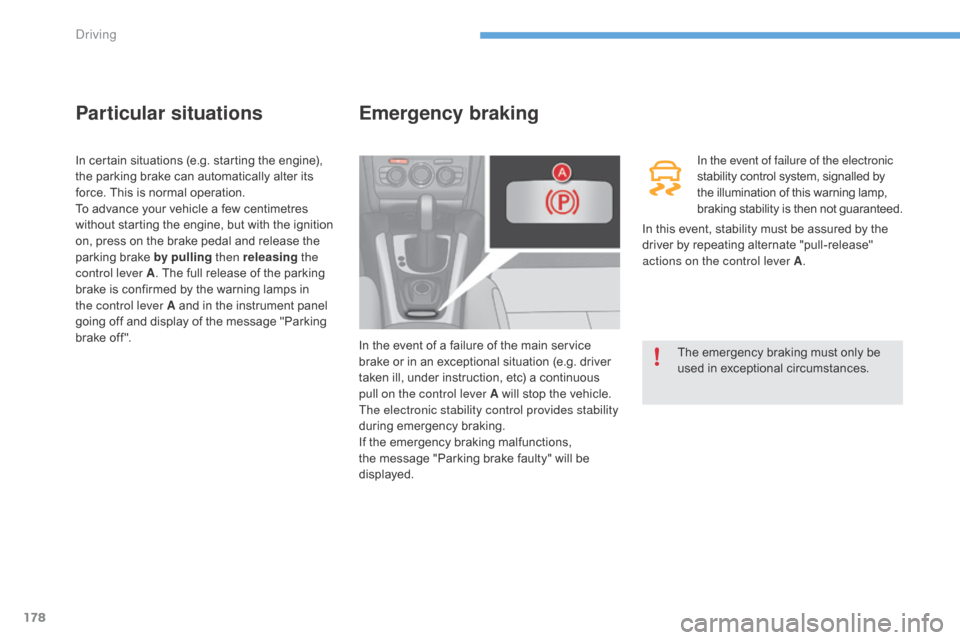
In certain situations (e.g. starting the engine), the parking brake can automatically alter its
f
orce. This is normal operation.
To
advance your vehicle a few centimetres
w
ithout starting the engine, but with the ignition
o
n, press on the brake pedal and release the
p
arking brake by pulling then releasing the
control lever A .
The full release of the parking
b
rake is confirmed by the warning lamps in
t
he control lever A and in the instrument panel
g
oing off and display of the message "Parking
b
rake off ".
Emergency braking
In the event of failure of the electronic
stability control system, signalled by t
he illumination of this warning lamp,
b
raking stability is then not guaranteed.
In
the
event
of
a
failure
of
the
main
service
b
rake
or
in
an
exceptional
situation
(e.g.
driver
t
aken
ill,
under
instruction,
etc)
a
continuous
p
ull on the control lever A
will
stop
the
vehicle.
The electronic stability control provides stability
during
em
ergency
b
raking.
If
the
emergency
braking
malfunctions,
t
he
message
"Parking
brake
faulty"
will
be
d
isplayed. The
emergency braking must only be
us
ed
in e
xceptional
c
ircumstances.
In
this
event, stability must be assured by the
d
river
by
repeating alternate "pull-release"
a
ctions on the control lever A .
Driving