lock Citroen C4 2016 2.G Service Manual
[x] Cancel search | Manufacturer: CITROEN, Model Year: 2016, Model line: C4, Model: Citroen C4 2016 2.GPages: 396, PDF Size: 10.22 MB
Page 113 of 396
111
C4-2_en_Chap03_ergonomie-et-confort_ed02-2015
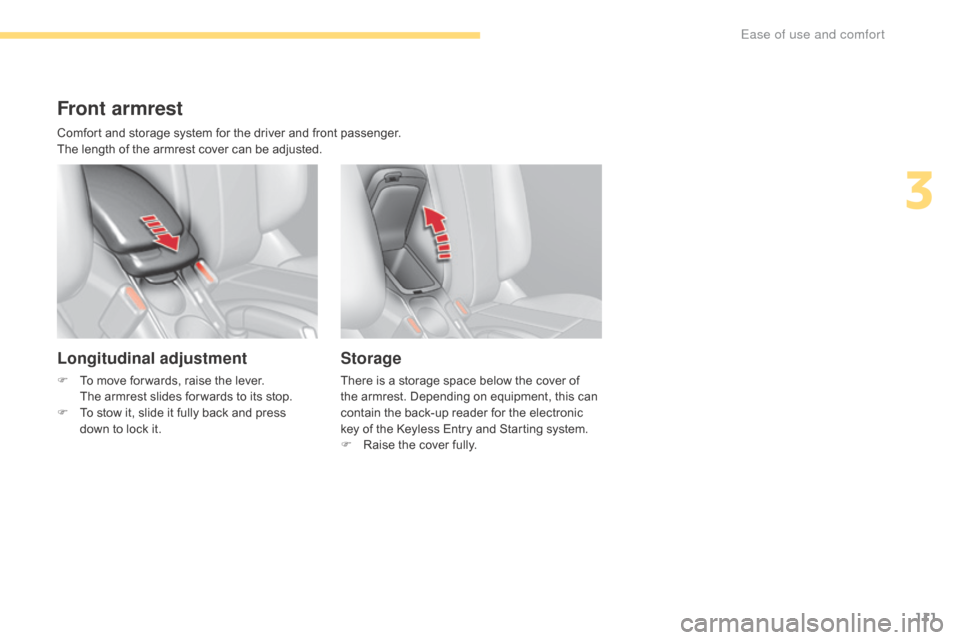
Front armrest
Longitudinal adjustment
F To move for wards, raise the lever.
The armrest slides for wards to its stop.
F
T
o stow it, slide it fully back and press
d
own to lock it.
Storage
There is a storage space below the cover of the armrest. Depending on equipment, this can
c
ontain the back-up reader for the electronic
k
ey of the Keyless Entry and Starting system.
F
R
aise the cover fully.
Comfort
and
storage
system
for
the
driver
and
front
passenger.
The
length
of
the
armrest
cover
can
be
adjusted.
3
Ease of use and comfort
Page 132 of 396
130
C4-2_en_Chap04_eclairage-et-visibilite_ed02-2015
Switching off
The welcome lighting switches off automatically after a programmed time, when the ignition is
s
witched on or on locking the vehicle.
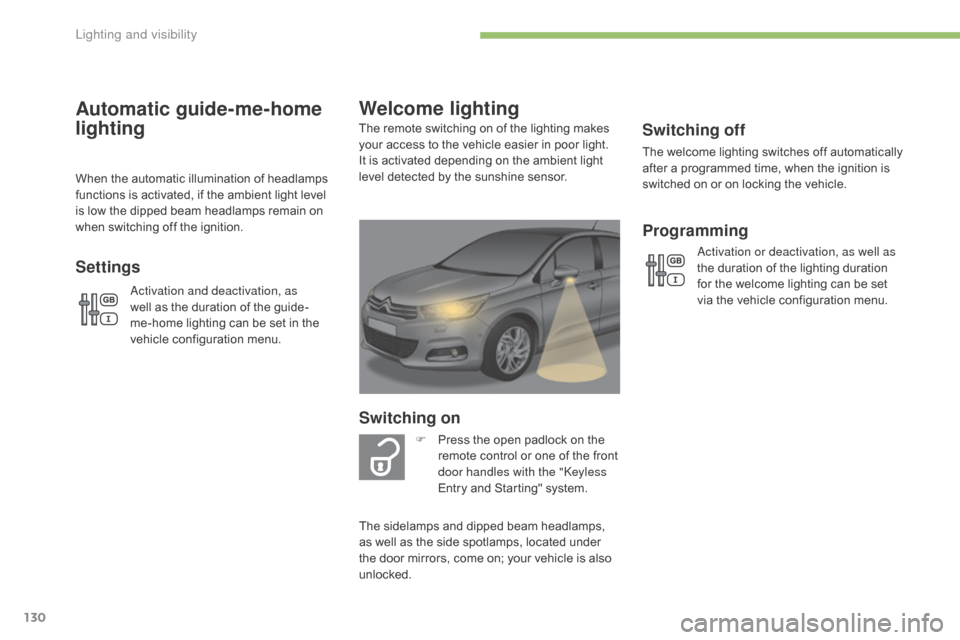
Welcome lighting
Switching on
F Press the open padlock on the r
emote control or one of the front
d
oor handles with the "Keyless
Entry
and Starting" system.
The
remote switching on of the lighting makes
y
our
access to the vehicle easier in poor light.
I
t
is
activated depending on the ambient light
l
evel
detected by the sunshine sensor.
The
sidelamps and dipped beam headlamps,
a
s
well
as
the side spotlamps, located under
t
he
door
mirrors, come on; your vehicle is also
u
nlocked.
Programming
Activation or deactivation, as well as
the duration of the lighting duration
f
or the welcome lighting can be set
v
ia the vehicle configuration menu.
Automatic guide-me-home
lighting
When the automatic illumination of headlamps functions is activated, if the ambient light level
i
s low the dipped beam headlamps remain on
w
hen switching off the ignition.
Settings
Activation and deactivation, as
well as the duration of the guide-
me-home
lighting can be set in the
v
ehicle configuration menu.
Lighting and visibility
Page 142 of 396
140
C4-2_en_Chap05_securite_ed02-2015
Group of supplementary systems which help you to obtain optimum braking in complete
s
afety in emergency situations:
-
a
nti-lock braking system (ABS),
-
e
lectronic brake force distribution (EBFD),
-
e
mergency braking assistance (EBA).
Anti-lock braking system
and electronic brake force
distribution
Linked systems which improve the stability and manoeuvrability of your vehicle when braking, in p
articular on poor or slippery sur faces.
Activation
The anti-lock braking system comes into operation automatically when there is a risk of
w
heel lock.
Normal
operation of the ABS may make itself
f
elt by slight vibration of the brake pedal.
Operating fault
If this warning lamp comes on, accompanied by an audible signal
a
nd a message in the screen, it
i
ndicates a malfunction of the anti-
lock
braking system which could
r
esult in loss of control of the vehicle
when
b
raking.
If
this warning lamp comes on,
t
ogether with the STOP and ABS
warning
lamps, accompanied by an
a
udible signal and a message in the
s
creen, it indicates a malfunction of
t
he electronic brake force distribution
w
hich could result in loss of control of
the
vehicle when braking.
Emergency braking
assistance
System which, in an emergency, enables you to obtain the optimum braking pressure more
q
uickly, thus reducing the stopping distance.
Activation
It is triggered by the speed at which the brake pedal is pressed.
The effect of this is a reduction in the
resistance of the pedal and an increase in
braking
e
fficiency.
You must stop as soon as it is safe to do so.
In either case, contact a CITROËN dealer or a
qualified
w
orkshop.
When
braking
in
an
emergency,
press
v
ery
firmly
without
releasing
the
p
ressure. When
braking in an emergency, press
f
irmly without releasing the pressure.
When
replacing
wheels
(tyres
and
r
ims),
ensure
that
they
conform
to
the
ma
nufacturer's
r
ecommendations.
Braking assistance systems
Safety
Page 166 of 396
164
C4-2_en_Chap05_securite_ed02-2015
For optimum installation o f t he fo rward f acing c
hild seat, ensure that the back of the child
s
eat is as close as possible to the backrest
o
f the vehicle's seat, in contact if possible.
You
mst remove the head restraint before
i
nstalling a child seat with backrest to a
p
assenger
sea
t.
Ensure that the head restraint is stored or
attached
securely to prevent it from being
t
hrown around the vehicle in the event of
sharp
braking. Refit the head restraint when
t
he child seat is removed.
Advice
Installing a booster seat
Children at the frontThe incorrect installation of a child seat in a
vehicle compromises the child's protection in
t
he event of an accident.
Ensure that there is no seat belt or seat belt
buckle
under the child seat, as this could
de
stabilise
i
t.
Remember
to fasten the seat belts or the
c
hild seat harnesses keeping the slack
r
elative to the child's body to a minimum,
e
ven for short journeys.
When
installing a child seat using the seat
b
elt, ensure that the seat belt is tightened
c
orrectly on the child seat and that it secures
the
child seat firmly on the seat of your
v
ehicle. If your passenger seat is adjustable,
m
ove it for wards if necessary. The
legislation on carrying children on the
f
ront passenger seat is specific to each
c
ountry. Refer to the legislation in force in
y
our country.
Deactivate
the passenger's front airbag
w
hen a rear ward facing child seat is installed
o
n the front passenger seat.
Otherwise,
t
he
c
hild
r
isks
b
eing
ser
iously
i
njured or killed if the airbag is deployed.The
chest part of the seat belt must be
p
ositioned on the child's shoulder without
t
ouching the neck.
Ensure that the lap part of the seat belt
passes
correctly over the child's thighs.
CITROËN
recommends the use of a booster
s
eat which has a back, fitted with a seat belt
g
uide at shoulder level.
At
rear seating positions, always leave
s
ufficient space between the front seat and:
-
a
rear ward facing child seat,
-
t
he child's feet for a child seat fitted
fo
rward
f
acing.
To
do this, move the front seat for wards
a
nd, if necessary, move its backrest into the
u
pright
p
osition. As
a safety precaution, do not leave:
-
a c
hild or children alone and
unsupervised in a vehicle,
-
a
child or an animal in a vehicle which
i
s exposed to the sun, with the windows
c
losed,
-
t
he keys within reach of children inside
t
he vehicle.
To
prevent accidental opening of the doors
a
nd rear windows, use the child lock.
Take
care not to open the rear windows by
m
ore than one third.
To
protect young children from the rays of
t
he sun, fit side blinds on the rear windows.
Safety
Page 167 of 396
165
C4-2_en_Chap05_securite_ed02-2015
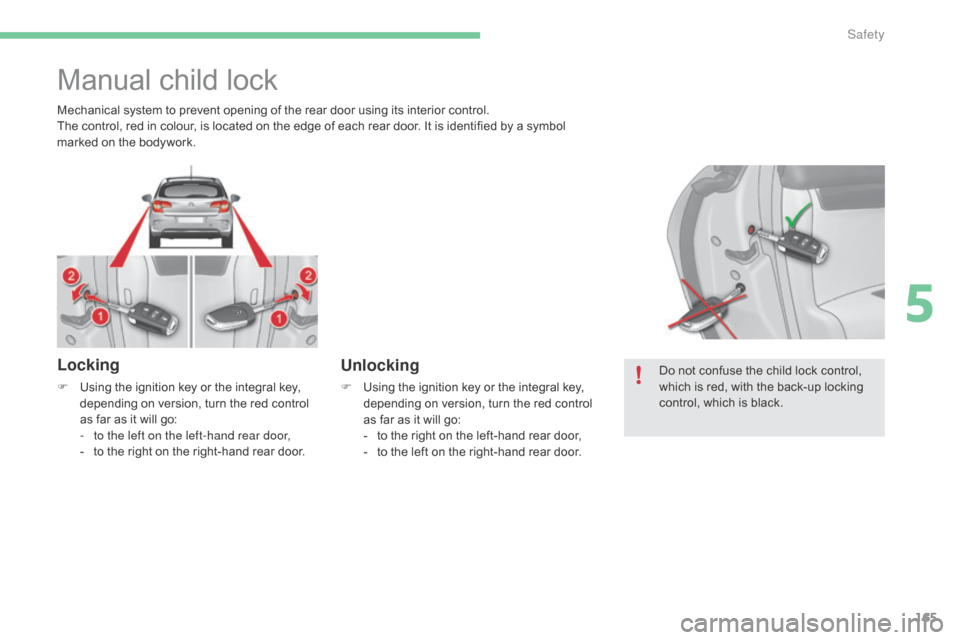
Manual child lock
Locking
F Using the ignition key or the integral key, d
epending on version, turn the red control
a
s far as it will go:
-
t
o the left on the left-hand rear door,
-
t
o the right on the right-hand rear door.
Unlocking
F Using the ignition key or the integral key, d
epending on version, turn the red control
a
s far as it will go:
-
t
o the right on the left-hand rear door,
-
t
o the left on the right-hand rear door.Do
not confuse the child lock control, w
hich is red, with the back-up locking c
ontrol, which is black.
Mechanical
system
to
prevent
opening
of
the
rear
door using its interior control.
The
control,
red
in
colour,
is
located
on
the
edge
of
each rear door. It is identified by a symbol
m
arked
on
the
bodywork.
5
Safety
Page 170 of 396
168
C4-2_en_Chap06_conduite_ed02-2015
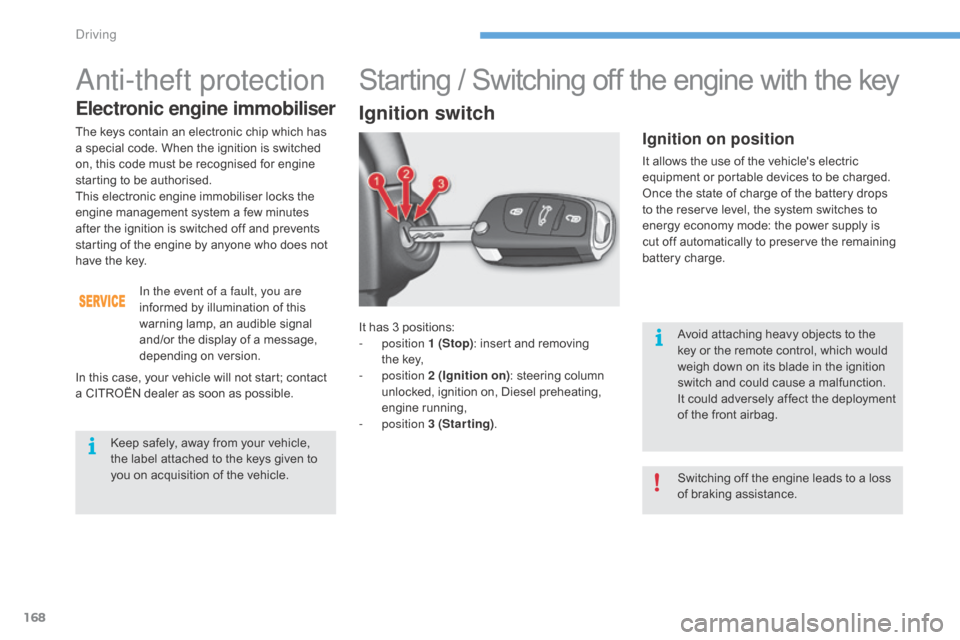
It has 3 positions:
- position 1 (Stop):
insert and removing
t
he key,
-
position 2 (Ignition on) :
steering column
u
nlocked, ignition on, Diesel preheating,
e
ngine
r
unning,
-
position 3 (Starting) .
Ignition on position
It allows the use of the vehicle's electric e
quipment or portable devices to be charged.
Once
the state of charge of the battery drops
t
o the reserve level, the system switches to
e
nergy economy mode: the power supply is
c
ut off automatically to preserve the remaining
b
attery charge.
Starting / Switching off the engine with the key
Ignition switch
Avoid attaching heavy objects to the key or the remote control, which would
w
eigh down on its blade in the ignition
s
witch and could cause a malfunction.
It
could adversely affect the deployment
o
f the front airbag.
Switching
off the engine leads to a loss
o
f braking assistance.
Anti-theft protection
Electronic engine immobiliser
Keep safely, away from your vehicle, the label attached to the keys given to
y
ou on acquisition of the vehicle.
The
keys contain an electronic chip which has
a
special code. When the ignition is switched
o
n,
this code must be recognised for engine
s
tarting to be authorised.
This
electronic engine immobiliser locks the
e
ngine management system a few minutes
a
fter
the ignition is switched off and prevents
s
tarting of the engine by anyone who does not
h
ave
the key.
In the event of a fault, you are
informed by illumination of this
w
arning lamp, an audible signal
a
nd/or the display of a message,
d
epending
o
n
v
ersion.
In
this
case, your vehicle will not start; contact
a
CITROËN dealer as soon as possible.
Driving
Page 171 of 396
169
C4-2_en_Chap06_conduite_ed02-2015
Starting the engine
F With a petrol engine, operate the starter m
otor by turning the key to position 3
without
pressing the accelerator pedal,
u
ntil the engine starts. Once the engine is
r
unning, release the key. F
W
ith a Diesel engine, turn the key to
p
osition 2
, ignition on, to operate the
eng
ine
p
re-heating
s
ystem.
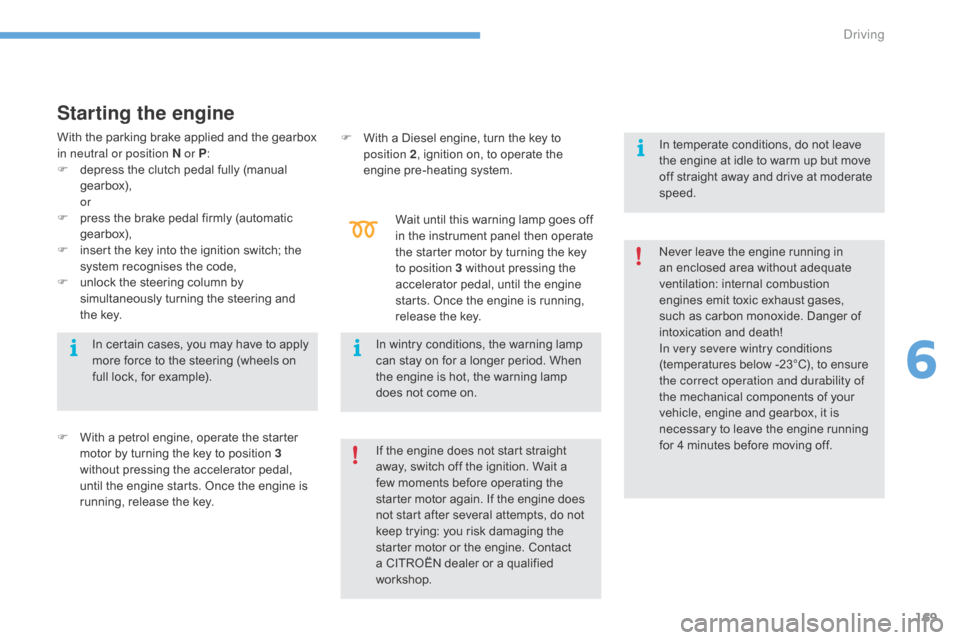
Wait until this warning lamp goes off
i
n the instrument panel then operate
t
he starter motor by turning the key
t
o position 3 without pressing the
a
ccelerator pedal, until the engine
s
tarts. Once the engine is running,
r
elease the key.
If the engine does not start straight
a
way, switch off the ignition. Wait a
f
ew moments before operating the
s
tarter motor again. If the engine does
n
ot start after several attempts, do not
k
eep trying: you risk damaging the
s
tarter motor or the engine. Contact
a
CITROËN dealer or a qualified
w
orkshop.Never
leave the engine running in
a
n enclosed area without adequate
v
entilation:
in
ternal
c
ombustion
e
ngines emit toxic exhaust gases,
s
uch as carbon monoxide. Danger of
i
ntoxication and death!
In very severe wintry conditions
(temperatures below -23°C), to ensure
t
he correct operation and durability of
the mechanical components of your
v
ehicle, engine and gearbox, it is n
ecessary to leave the engine running f
or 4 minutes before moving off.
In
certain cases, you may have to apply
m
ore force to the steering (wheels on
f
ull lock, for example).
In wintry conditions, the warning lamp
c
an stay on for a longer period. When
t
he engine is hot, the warning lamp
d
oes not come on.In temperate conditions, do not leave
t
he engine at idle to warm up but move
o
ff straight away and drive at moderate
s
peed.
With the parking brake applied and the gearbox
i
n neutral or position N or P
:
F
d
epress the clutch pedal fully (manual
g
earbox),
or
F
p
ress the brake pedal firmly (automatic
g
earbox),
F
i
nsert the key into the ignition switch; the
s
ystem recognises the code,
F
u
nlock the steering column by
s
imultaneously turning the steering and
t
he key.
6
Driving
Page 172 of 396
170
C4-2_en_Chap06_conduite_ed02-2015
Switching off the engine
Energy economy mode
After switching off the engine (position 1- Stop), f
or a maximum of 30 minutes you can still use
f
unctions such as the audio and telematic
s
ystem, the wipers, dipped beam headlamps,
c
ourtesy lamps, ...
F
C
heck
that
the
parking
brake
is
correctly
a
pplied,
particularly
on
sloping
ground.
Never
switch
off
the
ignition
before
the
v
ehicle
is
at
a
complete
stop.
With
the
e
ngine
off,
the
braking
and
steering
a
ssistance
systems
are
also
cut
off:
risk
o
f
loss
of
control
of
the
vehicle.
To
facilitate
unlocking
of
the
steering
c
olumn,
it
is
recommended
that
the
w
heels
be
returned
to
the
straight
ahead
p
osition
before
switching
off
the
engine.
When
you
leave
the
vehicle,
keep
the
k
ey
with
you
and
lock
the
vehicle. For
more information on the
e
nergy economy mode, refer to the
c
orresponding
s
ection.Key left in the "Ignition on" position
If the key has been left in the ignition switch at position 2 (Ignition on) ,
the
ignition will be switched off
a
utomatically after one hour.
To
switch the ignition back on, turn the
k
ey to position 1 (Stop),
then back to
p
osition 2 (Ignition on) .
F
S
top
the
vehicle.
F
W
ith
the
engine
running
at
idle,
turn
the
key
t
o position 1 .
F
R
emove
the
key
from
the
ignition
switch.
F
T
o
lock
the
steering
column,
turn
the
s
teering
until
it
locks.
Driving
Page 173 of 396
171
C4-2_en_Chap06_conduite_ed02-2015
Starting / Switching off the engine with Keyless Entry and
S
tarting
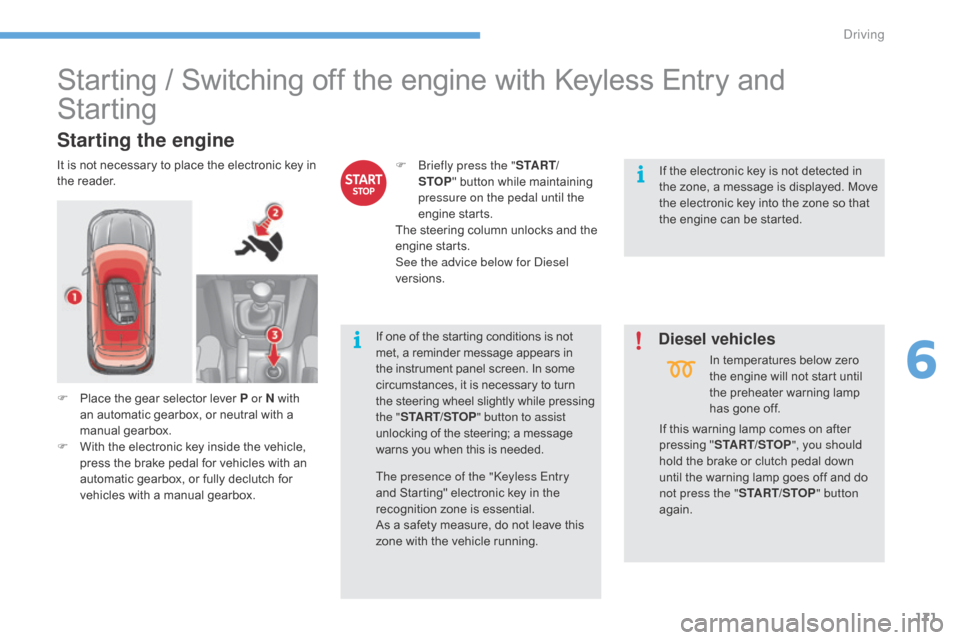
Starting the engine
It is not necessary to place the electronic key in t
he r eader. F
B riefly press the "S TA R T/
STOP "
button while maintaining
p
ressure on the pedal until the
engine
s
tarts.
The
steering column unlocks and the
e
ngine
s
tarts.
See the advice below for Diesel
versions.
If
this warning lamp comes on after
p
ressing "START/STOP ", you should
hold
the brake or clutch pedal down
u
ntil the warning lamp goes off and do
n
ot press the "START/STOP " button
again.
If
one of the starting conditions is not
m
et, a reminder message appears in
t
he instrument panel screen. In some
c
ircumstances, it is necessary to turn
t
he steering wheel slightly while pressing
t
he "START/STOP " button to assist
unlocking
of the steering; a message
w
arns you when this is needed.If
the electronic key is not detected in
t
he zone, a message is displayed. Move
t
he electronic key into the zone so that
t
he engine can be started.
The presence of the "Keyless Entry
and
Starting" electronic key in the
r
ecognition zone is essential.
As
a safety measure, do not leave this
z
one with the vehicle running.In
temperatures below zero
t
he engine will not start until
t
he preheater warning lamp
h
as gone off.
F
P
lace the gear selector lever P or N with
an
automatic gearbox, or neutral with a
m
anual
g
earbox.
F
W
ith the electronic key inside the vehicle,
p
ress the brake pedal for vehicles with an
a
utomatic gearbox, or fully declutch for
v
ehicles with a manual gearbox.
Diesel vehicles
6
Driving
Page 174 of 396
172
C4-2_en_Chap06_conduite_ed02-2015
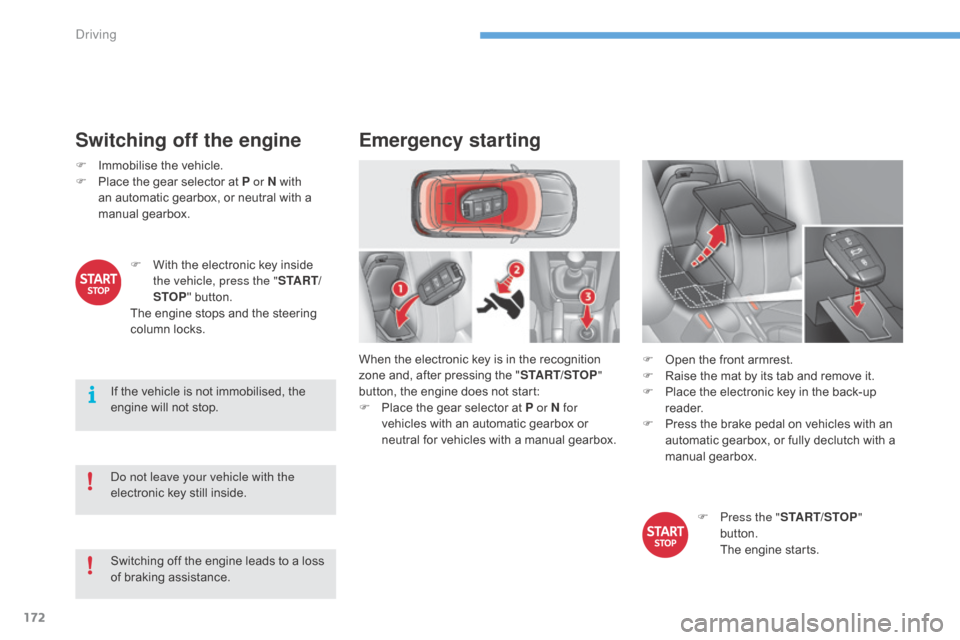
Switching off the engine
F Immobilise the vehicle.
F P lace the gear selector at P or N with
an
automatic gearbox, or neutral with a
m
anual
g
earbox.
Do not leave your vehicle with the
electronic
key still inside.
Switching
off the engine leads to a loss
o
f braking assistance.
If
the vehicle is not immobilised, the
e
ngine will not stop.
F
W
ith the electronic key inside
t
he vehicle, press the " S TA R T/
STOP "
button.
The
engine stops and the steering
c
olumn locks.
Emergency starting
When the electronic key is in the recognition zone and, after pressing the "START/STOP "
button,
the engine does not start:
F
P
lace the gear selector at P or N for
vehicles
with an automatic gearbox or
n
eutral for vehicles with a manual gearbox.F
O pen the front armrest.
F
R
aise the mat by its tab and remove it.
F
P
lace the electronic key in the back-up
re
ader.
F
P
ress the brake pedal on vehicles with an
a
utomatic gearbox, or fully declutch with a
m
anual
g
earbox.
F
P
ress the "START/STOP "
button.
T
he engine starts.
Driving