ECU CITROEN C4 CACTUS 2017 User Guide
[x] Cancel search | Manufacturer: CITROEN, Model Year: 2017, Model line: C4 CACTUS, Model: CITROEN C4 CACTUS 2017Pages: 256, PDF Size: 7.62 MB
Page 90 of 256
88
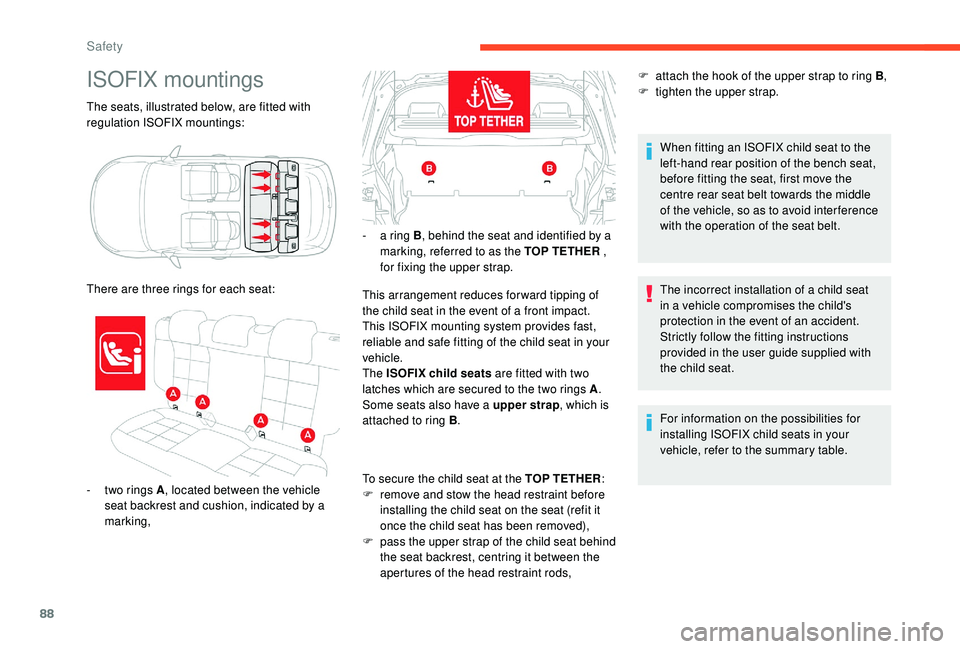
The seats, illustrated below, are fitted with
regulation ISOFIX mountings:
ISOFIX mountings
- two rings A, located between the vehicle
seat backrest and cushion, indicated by a
marking,
There are three rings for each seat:
-
a r
ing B
, behind the seat and identified by a
marking, referred to as the TOP TETHER ,
for fixing the upper strap.
This arrangement reduces forward tipping of
the child seat in the event of a front impact.
This ISOFIX mounting system provides fast,
reliable and safe fitting of the child seat in your
vehicle.
The ISOFIX child seats are fitted with two
latches which are secured to the two rings A .
Some seats also have a upper strap , which is
attached to ring B .
To secure the child seat at the TOP TETHER :
F r emove and stow the head restraint before
installing the child seat on the seat (refit it
once the child seat has been removed),
F
p
ass the upper strap of the child seat behind
the seat backrest, centring it between the
apertures of the head restraint rods, When fitting an ISOFIX child seat to the
left-hand rear position of the bench seat,
before fitting the seat, first move the
centre rear seat belt towards the middle
of the vehicle, so as to avoid inter ference
with the operation of the seat belt.
The incorrect installation of a child seat
in a vehicle compromises the child's
protection in the event of an accident.
Strictly follow the fitting instructions
provided in the user guide supplied with
the child seat.
For information on the possibilities for
installing ISOFIX child seats in your
vehicle, refer to the summary table.
F
a
ttach the hook of the upper strap to ring B
,
F
t
ighten the upper strap.
Safety
Page 91 of 256
89
Recommended ISOFIX
child seats
Also consult the installation notes from the
child seat's manufacturer to find out how
to install and remove the seat.
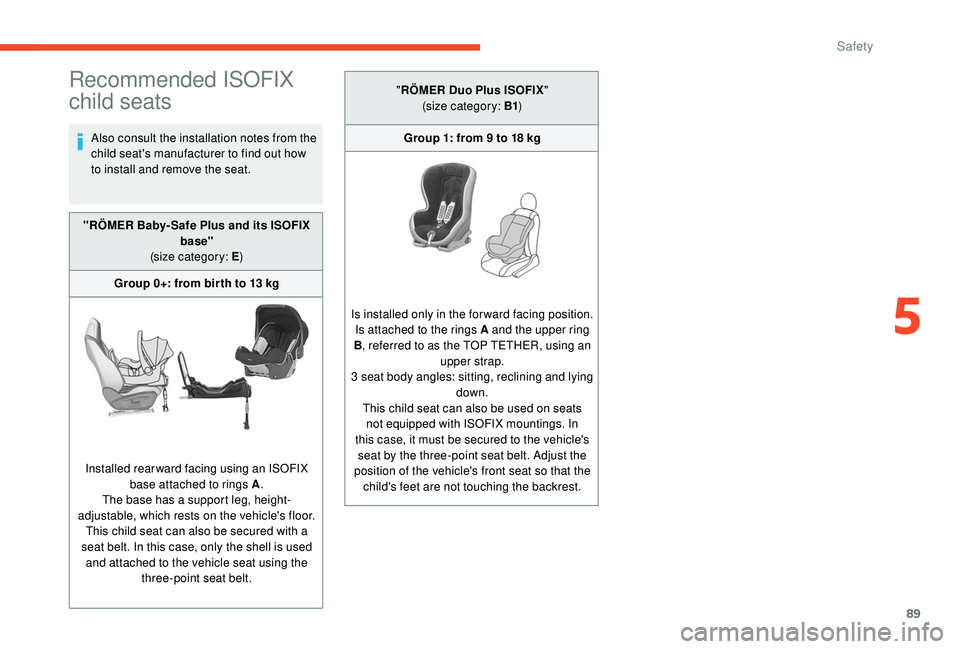
"RÖMER Baby- Safe Plus and its ISOFIX base"
(size category: E )
Group 0+: from bir th to 13 kg
Installed rearward facing using an ISOFIX base attached to rings A .
The base has a support leg, height-
adjustable, which rests on the vehicle's floor. This child seat can also be secured with a
seat belt. In this case, only the shell is used and attached to the vehicle seat using the three-point seat belt. "
RÖMER Duo Plus ISOFIX "
(size category: B1 )
Group 1: from 9 to 18 kg
Is installed only in the forward facing position. Is attached to the rings A and the upper ring
B , referred to as the TOP TETHER, using an
upper strap.
3 seat body angles: sitting, reclining and lying down.
This child seat can also be used on seats not equipped with ISOFIX mountings. In
this case, it must be secured to the vehicle's seat by the three-point seat belt. Adjust the
position of the vehicle's front seat so that the child's feet are not touching the backrest.
5
Safety
Page 92 of 256
90
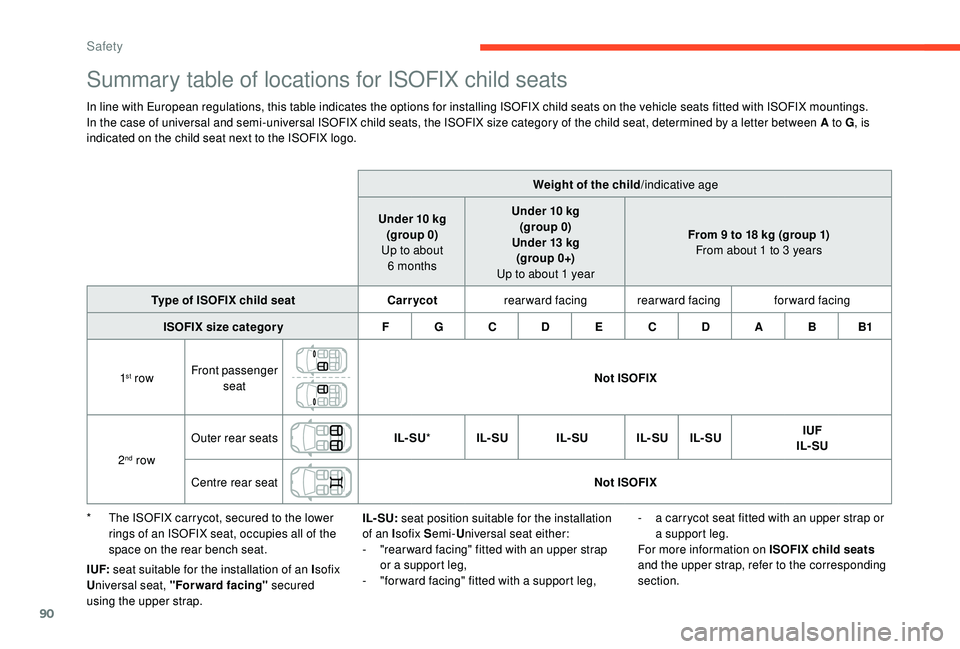
Summary table of locations for ISOFIX child seats
In line with European regulations, this table indicates the options for installing ISOFIX child seats on the vehicle seats fitted with ISOFIX mountings.
In the case of universal and semi-universal ISOFIX child seats, the ISOFIX size category of the child seat, determined by a letter between A to G, is
indicated on the child seat next to the ISOFIX logo.
Weight of the child/indicative age
Under 10 kg (group 0)
Up to about 6 months Under 10 kg
(group 0)
Under 13 kg (group 0+)
Up to about 1 year From 9 to 18 kg (group 1)
From about 1 to 3 years
Type of ISOFIX child seat Carr ycotrearward facing rearward facing forward facing
ISOFIX size categor y F G C D E C D A B B1
1
st row Front passenger
seat Not ISOFIX
2
nd row Outer rear seats
IL- SU* IL- SU IL- SU IL- SU IL- SU IUF
IL- SU
Centre rear seat Not ISOFIX
IL- SU: seat position suitable for the installation
of an I sofix S emi-Universal seat either:
-
"
rear ward facing" fitted with an upper strap
or a support leg,
-
"
for ward facing" fitted with a support leg,
*
T
he ISOFIX carrycot, secured to the lower
rings of an ISOFIX seat, occupies all of the
space on the rear bench seat. -
a c
arrycot seat fitted with an upper strap or
a support leg.
For more information on ISOFIX child seats
and the upper strap, refer to the corresponding
section.
I UF:
seat suitable for the installation of an I sofix
U niversal seat, "Forward facing" secured
using the upper strap.
Safety
Page 94 of 256
92
Advice
The incorrect installation of a child seat in a
vehicle compromises the child's protection in
the event of an accident.
Ensure that there is no seat belt or seat belt
buckle under the child seat, as this could
destabilise it.
Remember to fasten the seat belts or the
child seat harnesses keeping the slack
relative to the child's body to a minimum,
even for short journeys.
When installing a child seat using the seat
belt, ensure that the seat belt is tightened
correctly on the child seat and that it secures
the child seat firmly on the seat of your
vehicle. If your passenger seat is adjustable,
move it for wards if necessary.
At rear seating positions, always leave
sufficient space between the front seat and:
-
a "
rear ward facing" child seat,
-
t
he child's feet for a child seat fitted
"forward facing".
To do this, move the front seat for wards
and, if necessary, move its backrest into the
upright position.
For optimal installation of the "forward facing"
child seat, verify that its backrest is as close
as possible to the backrest of the vehicle
seat, if possible in contact with it. The head restraint must be removed
before installing a child seat with a
backrest on a passenger seat.
Ensure that the head restraint is stored or
attached securely to prevent it from being
thrown around the vehicle in the event of
sharp braking. Refit the head restraint when
the child seat is removed.
As a safety precaution, do not leave:
-
a c hild or children alone and unattended in
a vehicle,
-
a c
hild or an animal in a vehicle which
is exposed to the sun, with the windows
closed,
-
t
he keys within reach of children inside the
vehicle.
To prevent accidental opening of the doors
and rear windows, use the child lock.
Take care not to open the rear windows by
more than one third.
To protect young children from the rays of the
sun, fit side blinds on the rear windows.
Children in front
The legislation on carrying children on the
front passenger seat is specific to each
country. Refer to the legislation in force in
your country.
Deactivate the front passenger airbag when a
"rear ward facing" child seat is installed on the
front passenger seat.
Other wise, there is a risk of serious or fatal
injury to the child if the airbag is deployed.
Installing a booster seat
The chest part of the seat belt must be
positioned on the child's shoulder without
touching the neck.
Ensure that the lap part of the seat belt
passes correctly over the child's thighs.
We recommend using a booster seat with
a backrest equipped with a belt guide at
shoulder level.
Safety
Page 144 of 256
142
After refitting a front wiper blade
F Switch on the ignition.
F O perate the wiper stalk again to park the
wiper blades.
Replacement of wiper arms should be
carried out only by a CITROËN dealer or
in a qualified workshop.
Roof bars
For safety reasons and to avoid damaging
the roof, it is essential to use the
transverse bars approved for your vehicle.
Obser ve the fitting instructions and the
conditions of use in the guide supplied
with the roof bars.
Version without longitudinal
bars
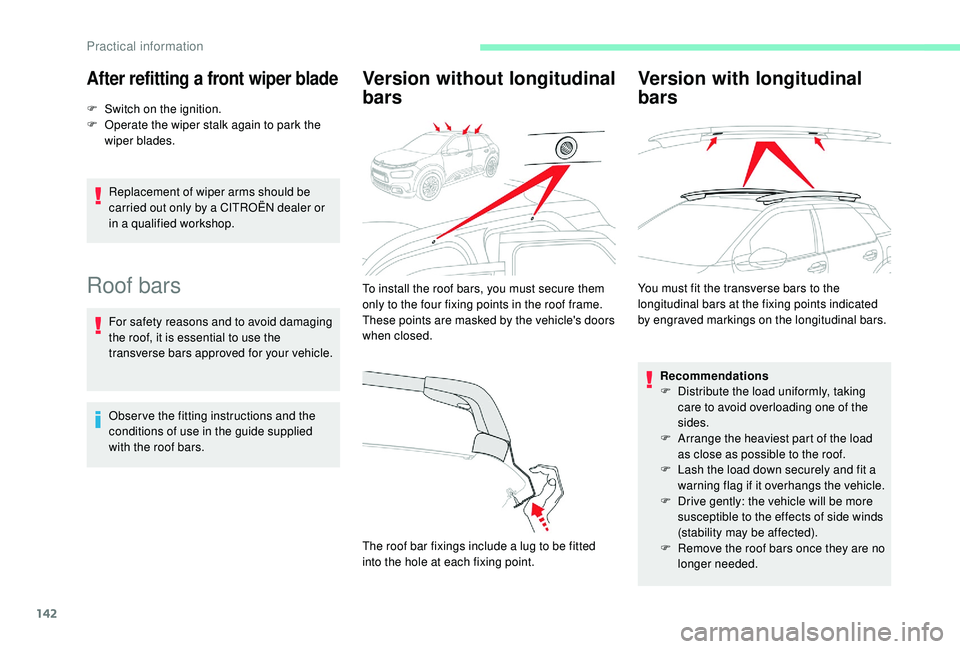
To install the roof bars, you must secure them
only to the four fixing points in the roof frame.
These points are masked by the vehicle's doors
when closed.
The roof bar fixings include a lug to be fitted
into the hole at each fixing point.
Version with longitudinal
bars
You must fit the transverse bars to the
longitudinal bars at the fixing points indicated
by engraved markings on the longitudinal bars.
Recommendations
F
D
istribute the load uniformly, taking
care to avoid overloading one of the
sides.
F
A
rrange the heaviest part of the load
as close as possible to the roof.
F
L
ash the load down securely and fit a
warning flag if it overhangs the vehicle.
F
D
rive gently: the vehicle will be more
susceptible to the effects of side winds
(stability may be affected).
F
R
emove the roof bars once they are no
longer needed.
Practical information
Page 156 of 256
154
Under-inflation detection
After repair of the tyre, the warning
lamp will remain on until the system is
reinitialised.
For more information on Tyre under-
inflation detection, refer to the
corresponding section.
Access to the kit
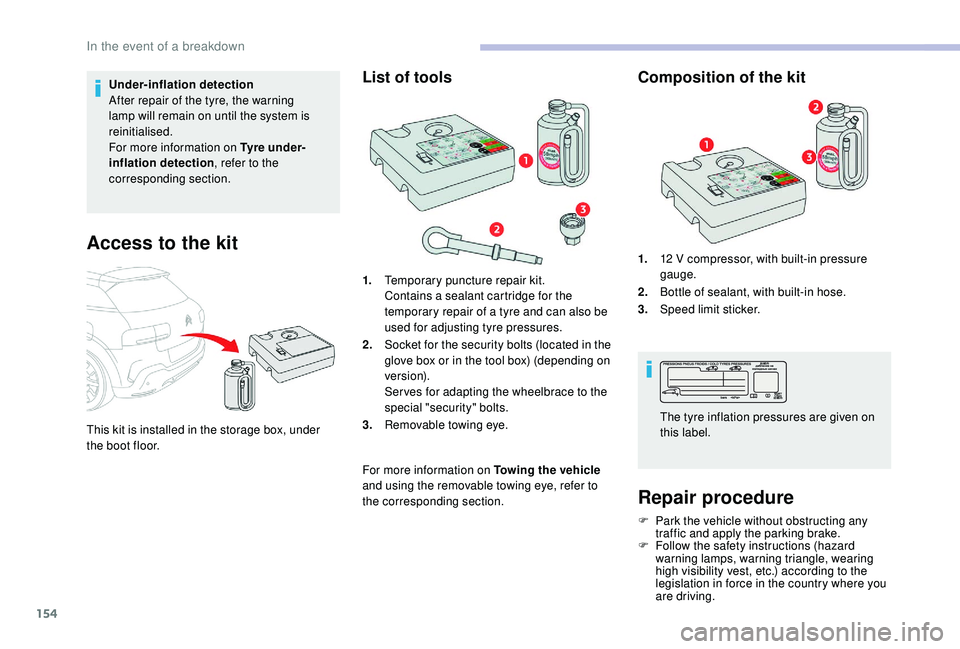
This kit is installed in the storage box, under
the boot floor.
List of tools
1. Temporary puncture repair kit.
Contains a sealant cartridge for the
temporary repair of a tyre and can also be
used for adjusting tyre pressures.
2. Socket for the security bolts (located in the
glove box or in the tool box) (depending on
ve r s i o n).
Ser ves for adapting the wheelbrace to the
special "security" bolts.
3. Removable towing eye.
For more information on Towing the vehicle
and using the removable towing eye, refer to
the corresponding section.
Composition of the kit
1. 12 V compressor, with built-in pressure
gauge.
2. Bottle of sealant, with built-in hose.
3. Speed limit sticker.
Repair procedure
F Park the vehicle without obstructing any
traffic and apply the parking brake.
F
F
ollow the safety instructions (hazard
warning lamps, warning triangle, wearing
high visibility vest, etc.) according to the
legislation in force in the country where you
are driving. The tyre inflation pressures are given on
this label.
In the event of a breakdown
Page 157 of 256
155
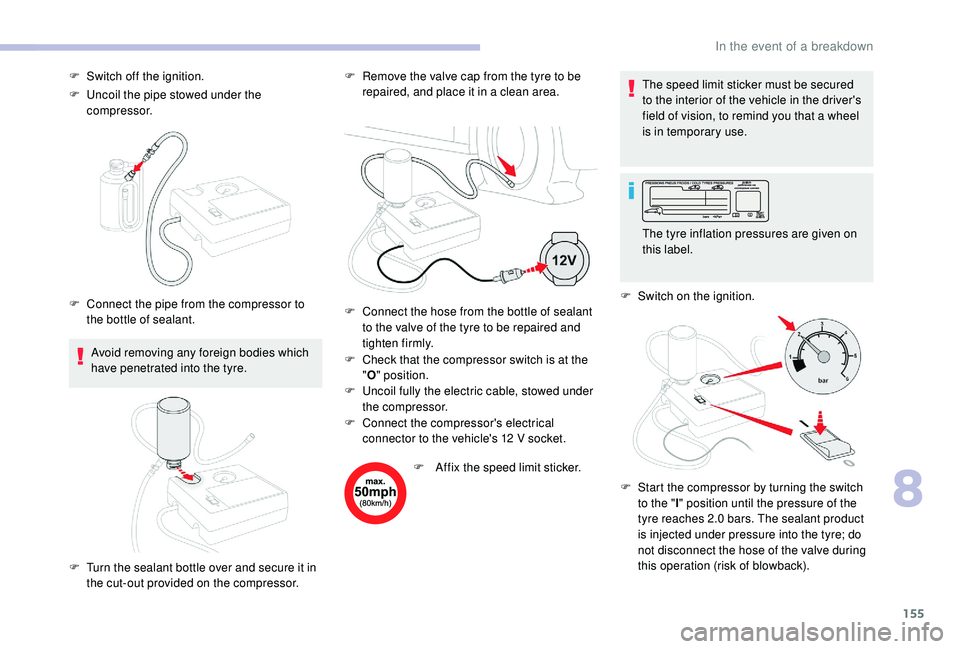
F Uncoil the pipe stowed under the compressor.
Avoid removing any foreign bodies which
have penetrated into the tyre. F
R
emove the valve cap from the tyre to be
repaired, and place it in a clean area.
F
C
heck that the compressor switch is at the
" O " position.
F
U
ncoil fully the electric cable, stowed under
the compressor.
F
A
ffix the speed limit sticker.The speed limit sticker must be secured
to the interior of the vehicle in the driver's
field of vision, to remind you that a wheel
is in temporary use.
F
S
witch on the ignition.
F
S
witch off the ignition.
F
C
onnect the pipe from the compressor to
the bottle of sealant.
F
T
urn the sealant bottle over and secure it in
the cut-out provided on the compressor. F
C
onnect the hose from the bottle of sealant
to the valve of the tyre to be repaired and
tighten firmly.
F
C
onnect the compressor's electrical
connector to the vehicle's 12 V socket. The tyre inflation pressures are given on
this label.
F
S
tart the compressor by turning the switch
to the " l" position until the pressure of the
tyre reaches 2.0 bars. The sealant product
is injected under pressure into the tyre; do
not disconnect the hose of the valve during
this operation (risk of blowback).
8
In the event of a breakdown
Page 160 of 256
158
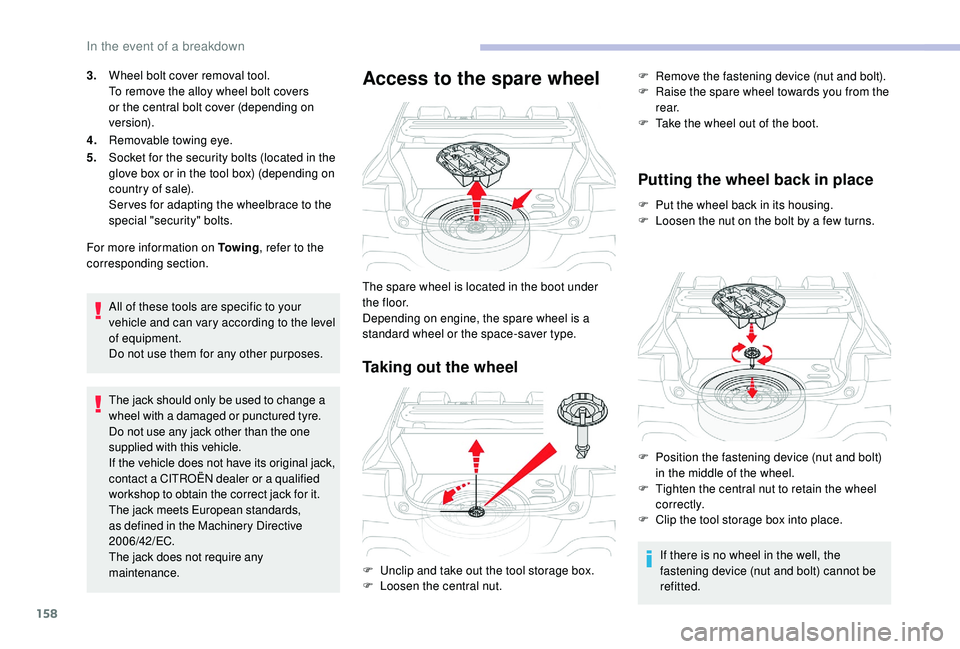
3.Wheel bolt cover removal tool.
To remove the alloy wheel bolt covers
or the central bolt cover (depending on
ve r s i o n).
4. Removable towing eye.
5. Socket for the security bolts (located in the
glove box or in the tool box) (depending on
country of sale).
Ser ves for adapting the wheelbrace to the
special "security" bolts.
For more information on To w i n g , refer to the
corresponding section.
All of these tools are specific to your
vehicle and can vary according to the level
of equipment.
Do not use them for any other purposes.
The jack should only be used to change a
wheel with a damaged or punctured tyre.
Do not use any jack other than the one
supplied with this vehicle.
If the vehicle does not have its original jack,
contact a CITROËN dealer or a qualified
workshop to obtain the correct jack for it.
The jack meets European standards,
as defined in the Machinery Directive
2006/42/EC.
The jack does not require any
maintenance.Access to the spare wheel
Taking out the wheel Putting the wheel back in place
F Put the wheel back in its housing.
F
L oosen the nut on the bolt by a few turns.
If there is no wheel in the well, the
fastening device (nut and bolt) cannot be
refitted.
The spare wheel is located in the boot under
t h e f l o o r.
Depending on engine, the spare wheel is a
standard wheel or the space-saver type.
F
U
nclip and take out the tool storage box.
F
L
oosen the central nut. F
R
emove the fastening device (nut and bolt).
F
R
aise the spare wheel towards you from the
r e a r.
F
T
ake the wheel out of the boot.
F
P
osition the fastening device (nut and bolt)
in the middle of the wheel.
F
T
ighten the central nut to retain the wheel
c o r r e c t l y.
F
C
lip the tool storage box into place.
In the event of a breakdown
Page 161 of 256
159
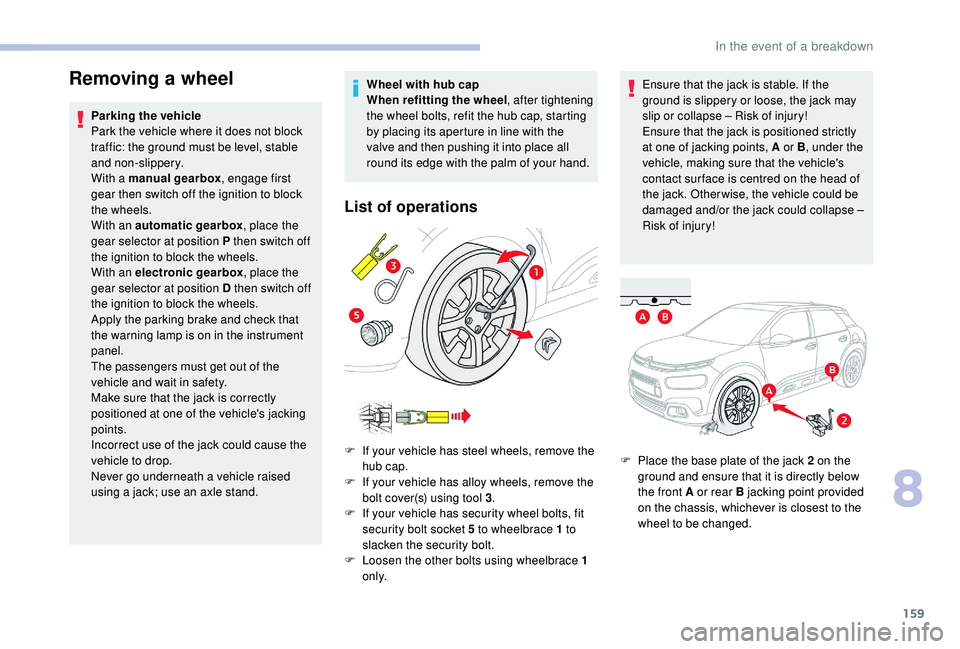
Removing a wheel
Parking the vehicle
Park the vehicle where it does not block
traffic: the ground must be level, stable
and non-slippery.
With a manual gearbox, engage first
gear then switch off the ignition to block
the wheels.
With an automatic gearbox , place the
gear selector at position P then switch off
the ignition to block the wheels.
With an electronic gearbox , place the
gear selector at position D then switch off
the ignition to block the wheels.
Apply the parking brake and check that
the warning lamp is on in the instrument
panel.
The passengers must get out of the
vehicle and wait in safety.
Make sure that the jack is correctly
positioned at one of the vehicle's jacking
points.
Incorrect use of the jack could cause the
vehicle to drop.
Never go underneath a vehicle raised
using a jack; use an axle stand. Wheel with hub cap
When refitting the wheel
, after tightening
the wheel bolts, refit the hub cap, starting
by placing its aperture in line with the
valve and then pushing it into place all
round its edge with the palm of your hand.
List of operations
F If your vehicle has steel wheels, remove the hub cap.
F
I
f your vehicle has alloy wheels, remove the
bolt cover(s) using tool 3 .
F
I
f your vehicle has security wheel bolts, fit
security bolt socket 5 to wheelbrace 1 to
slacken the security bolt.
F
L
oosen the other bolts using wheelbrace 1
o n l y. Ensure that the jack is stable. If the
ground is slippery or loose, the jack may
slip or collapse – Risk of injury!
Ensure that the jack is positioned strictly
at one of jacking points, A or B
, under the
vehicle, making sure that the vehicle's
contact sur face is centred on the head of
the jack. Otherwise, the vehicle could be
damaged and/or the jack could collapse –
Risk of injury!
F P lace the base plate of the jack 2 on the
ground and ensure that it is directly below
the front A or rear B jacking point provided
on the chassis, whichever is closest to the
wheel to be changed.
8
In the event of a breakdown
Page 162 of 256
160
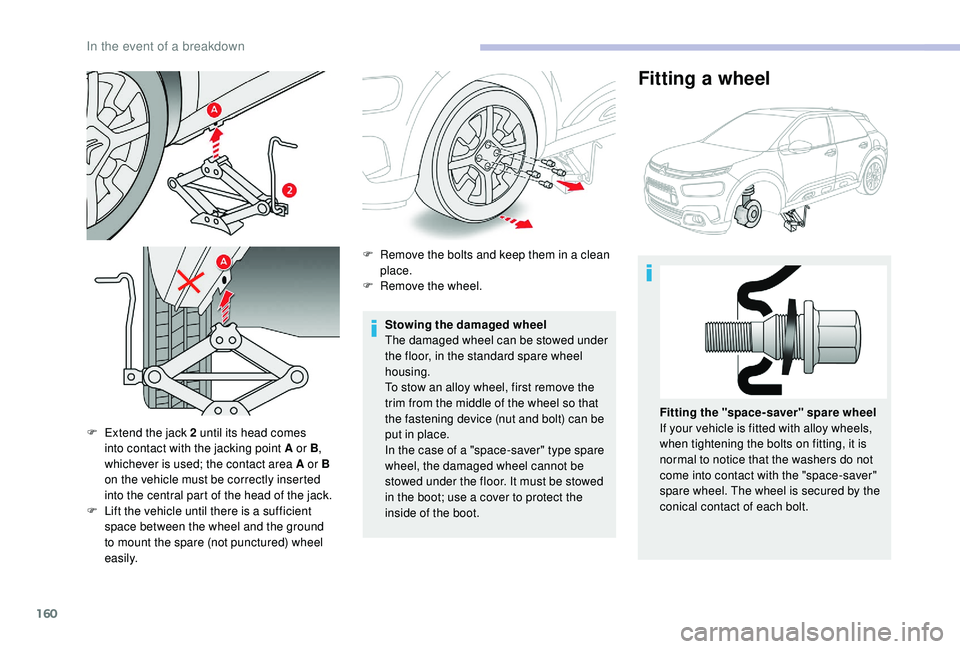
F Extend the jack 2 until its head comes into contact with the jacking point A or B ,
whichever is used; the contact area A or B
on the vehicle must be correctly inserted
into the central part of the head of the jack.
F
L
ift the vehicle until there is a sufficient
space between the wheel and the ground
to mount the spare (not punctured) wheel
easily. Stowing the damaged wheel
The damaged wheel can be stowed under
the floor, in the standard spare wheel
housing.
To stow an alloy wheel, first remove the
trim from the middle of the wheel so that
the fastening device (nut and bolt) can be
put in place.
In the case of a "space-saver" type spare
wheel, the damaged wheel cannot be
stowed under the floor. It must be stowed
in the boot; use a cover to protect the
inside of the boot.
Fitting a wheel
F Remove the bolts and keep them in a clean
place.
F
R
emove the wheel.
Fitting the "space-saver" spare wheel
If your vehicle is fitted with alloy wheels,
when tightening the bolts on fitting, it is
normal to notice that the washers do not
come into contact with the "space-saver"
spare wheel. The wheel is secured by the
conical contact of each bolt.
In the event of a breakdown