service CITROEN C4 DAG 2013 User Guide
[x] Cancel search | Manufacturer: CITROEN, Model Year: 2013, Model line: C4 DAG, Model: CITROEN C4 DAG 2013Pages: 340, PDF Size: 28.95 MB
Page 47 of 340
1
MONITORING
45
Service overdue
For a few seconds after the ignition is
switched on, the spanner fl ashes
to
indicate that the service must be car-
ried out as soon as possible.
Example:
the service is overdue by
180 miles (300 km).
For a few seconds after the ignition is
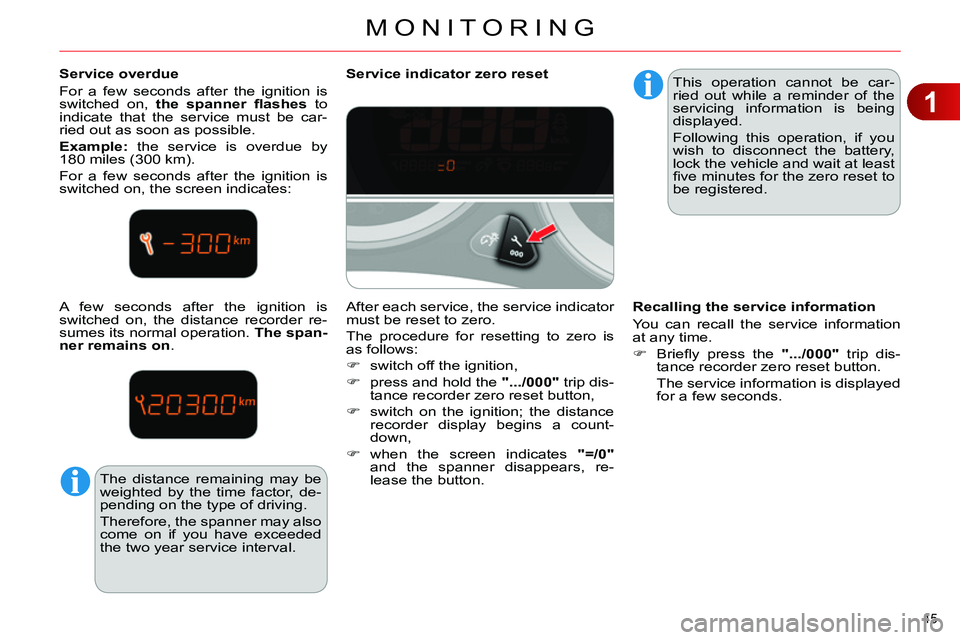
switched on, the screen indicates:
A few seconds after the ignition is
switched on, the distance recorder re-
sumes its normal operation. The span-
ner remains on
.
The distance remaining may be
weighted by the time factor, de-
pending on the type of driving.
Therefore, the spanner may also
come on if you have exceeded
the two year service interval.
Service indicator zero reset
This operation cannot be car-
ried out while a reminder of the
servicing information is being
displayed.
Following this operation, if you
wish to disconnect the battery,
lock the vehicle and wait at least
fi ve minutes for the zero reset to
be registered.
Recalling the service information
You can recall the service information
at any time.
Briefl y press the ".../000"
trip dis-
tance recorder zero reset button.
The service information is displayed
for a few seconds.
After each service, the service indicator
must be reset to zero.
The procedure for resetting to zero is
as follows:
switch off the ignition,
press and hold the ".../000"
trip dis-
tance recorder zero reset button,
switch on the ignition; the distance
recorder display begins a count-
down,
when the screen indicates "=/0"
and the spanner disappears, re-
lease the button.
Page 87 of 340
4
ACCESS
85
Lost keys
Go to a CITROËN dealer with the vehicle's registration document, your
personal identifi cation documents and if possible the key code label.
The CITROËN dealer will be able to look up the key code and the transponder
code required to order a new key.
Do not throw the remote con-
trol batteries away, they contain
metals which are harmful to the
environment.
Take them to an approved col-
lection point.
Remote control
The high frequency remote control is a sensitive system; do not operate
it while it is in your pocket as there is a possibility that it may unlock the
vehicle, without you being aware of it.
Do not repeatedly press the buttons of your remote control out of range and
out of sight of your vehicle. You run the risk of stopping it from working and
the remote control would have to be reinitialised.
No remote control can operate when the key is in the ignition switch, even
when the ignition is switched off, except for reinitialisation.
Locking the vehicle
Driving with the doors locked may make access to the passenger compart-
ment by the emergency services more diffi cult in an emergency.
As a safety precaution, never leave children alone in the vehicle, except for
a very short period.
In all cases, it is essential to remove the key from the ignition switch when
leaving the vehicle.
Anti-theft protection
Do not make any modifi cations to the electronic engine immobiliser system;
this could cause malfunctions.
When purchasing a second-hand vehicle
Have the pairing of all of the keys in your possession checked by a
CITROËN dealer, to ensure that only your keys can be used to open and
start the vehicle.
Page 90 of 340
4
ACCESS
88
*
According to country.
ALARM *
System which protects and provides a
deterrent against theft and break-ins. It
provides the following types of monitoring.
- exterior perimeter
The system checks for opening of the
vehicle.
The alarm is triggered if anyone tries to
open a door, the boot, the bonnet...
- interior volumetric
The system checks for any variation in the
volume in the passenger compartment.
The alarm is triggered if anyone breaks a
window, enters the passenger compart-
ment or moves inside the vehicle.
- tilt
The system checks for any change in
the attitude of the vehicle.
The alarm is triggered if the vehicle is
lifted, moved or knocked.
Self-protection function
The system checks for the putting out
of service of its components.
The alarm is triggered if the battery, the
central control or the siren wiring are
put out of service or damaged.
For all work on the alarm sys-
tem, contact a CITROËN dealer
or a qualifi ed workshop.
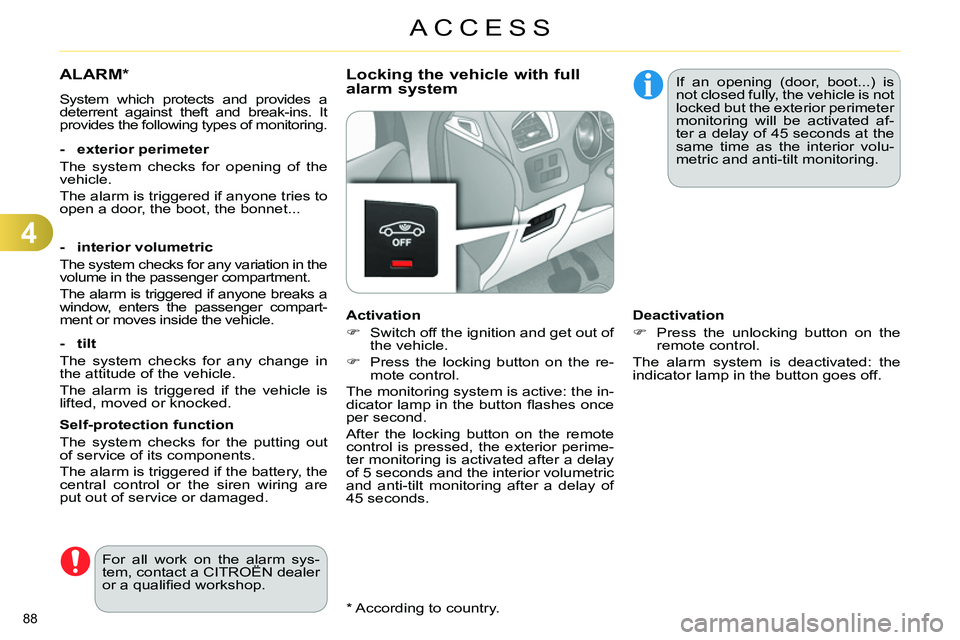
Locking the vehicle with full
alarm system
Activation
Switch off the ignition and get out of
the vehicle.
Press the locking button on the re-
mote control.
The monitoring system is active: the in-
dicator lamp in the button fl ashes once
per second.
After the locking button on the remote
control is pressed, the exterior perime-
ter monitoring is activated after a delay
of 5 seconds and the interior volumetric
and anti-tilt monitoring after a delay of
45 seconds. If an opening (door, boot...) is
not closed fully, the vehicle is not
locked but the exterior perimeter
monitoring will be activated af-
ter a delay of 45 seconds at the
same time as the interior volu-
metric and anti-tilt monitoring.
Deactivation
Press the unlocking button on the
remote control.
The alarm system is deactivated: the
indicator lamp in the button goes off.
Page 144 of 340
8
SAFETY
142
The trajectory control systems
offer increased safety in normal
driving, but this should not en-
courage the driver to take extra
risks or drive at high speed.
The correct functioning of these
systems is assured provided
that manufacturer's recommen-
dations are observed on:
- wheels (tyres and rims),
- braking components,
- electronic components,
- assembly and repair proce-
dures.
After an impact, have these sys-
tems checked by a CITROËN
dealer or a qualifi ed workshop.
Reactivation
These systems are reactivated au-
tomatically each time the ignition is
switched back on or from 30 mph
(50 km/h).
Press the "ESP OFF"
button again
to reactivate them manually.
If this warning lamp in the instru-
ment panel and the " ESP OFF
"
indicator lamp in the button come
on, accompanied by an audible
signal and a message in the screen, this
indicates a fault with these systems.
Have it checked by a CITROËN dealer
or a qualifi ed workshop.
Operating fault
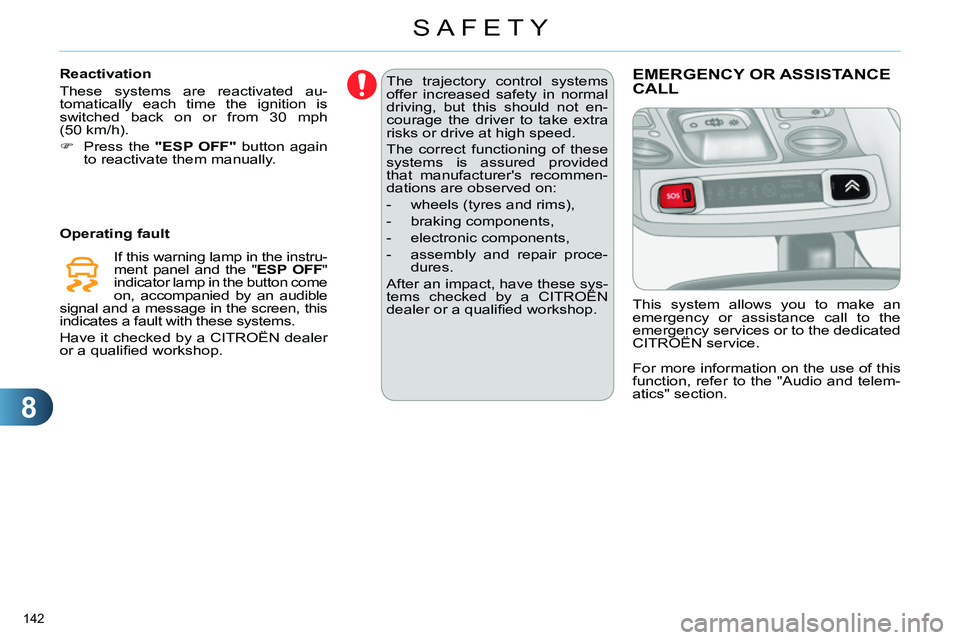
EMERGENCY OR ASSISTANCE
CALL
This system allows you to make an
emergency or assistance call to the
emergency services or to the dedicated
CITROËN service.
For more information on the use of this
function, refer to the "Audio and telem-
atics" section.
Page 169 of 340
9
DRIVING
167
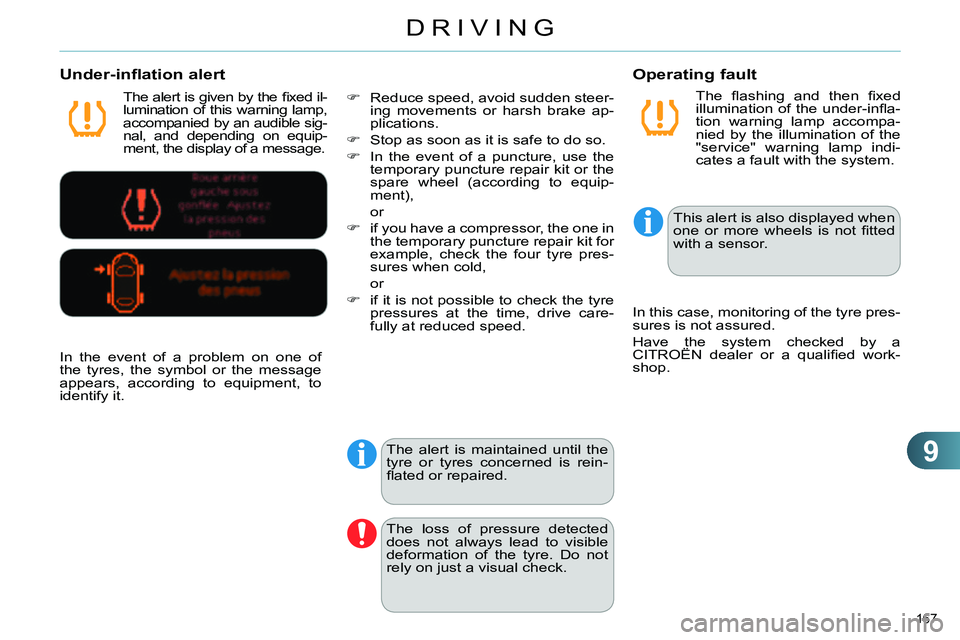
The fl ashing and then fi xed
illumination of the under-infl a-
tion warning lamp accompa-
nied by the illumination of the
"service" warning lamp indi-
cates a fault with the system.
Operating fault
The alert is given by the fi xed il-
lumination of this warning lamp,
accompanied by an audible sig-
nal, and depending on equip-
ment, the display of a message.
Under-inflation alert
The alert is maintained until the
tyre or tyres concerned is rein-
fl ated or repaired.
The loss of pressure detected
does not always lead to visible
deformation of the tyre. Do not
rely on just a visual check.
This alert is also displayed when
one or more wheels is not fi tted
with a sensor.
In the event of a problem on one of
the tyres, the symbol or the message
appears, according to equipment, to
identify it.
Reduce speed, avoid sudden steer-
ing movements or harsh brake ap-
plications.
Stop as soon as it is safe to do so.
In the event of a puncture, use the
temporary puncture repair kit or the
spare wheel (according to equip-
ment),
or
if you have a compressor, the one in
the temporary puncture repair kit for
example, check the four tyre pres-
sures when cold,
or
if it is not possible to check the tyre
pressures at the time, drive care-
fully at reduced speed. In this case, monitoring of the tyre pres-
sures is not assured.
Have the system checked by a
CITROËN dealer or a qualifi ed work-
shop.
Page 173 of 340
9
DRIVING
171
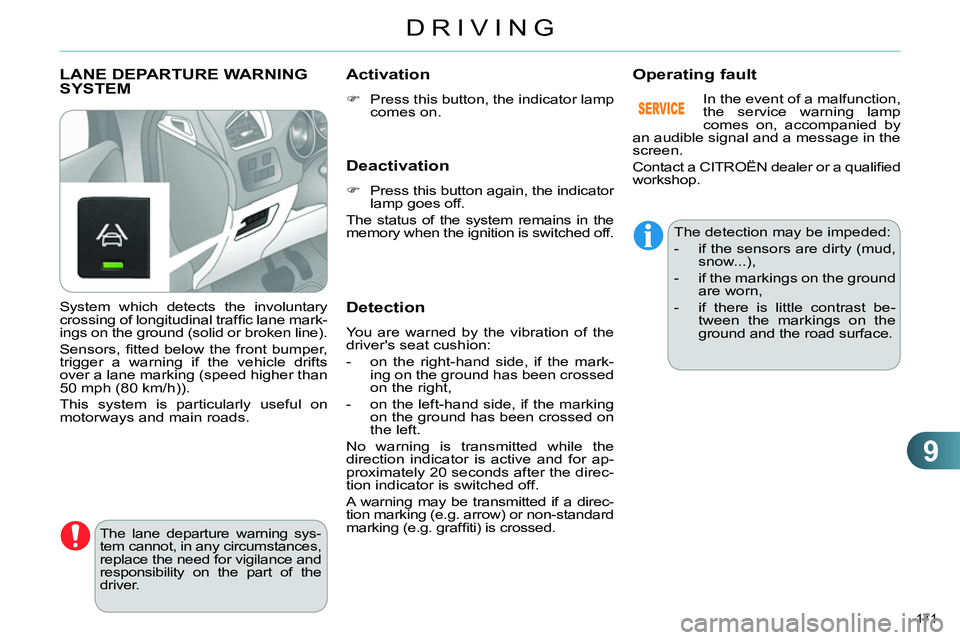
LANE DEPARTURE WARNING
SYSTEM
The lane departure warning sys-
tem cannot, in any circumstances,
replace the need for vigilance and
responsibility on the part of the
driver.
Activation
Press this button, the indicator lamp
comes on.
Deactivation
Press this button again, the indicator
lamp goes off.
The status of the system remains in the
memory when the ignition is switched off.
Detection
You are warned by the vibration of the
driver's seat cushion:
- on the right-hand side, if the mark-
ing on the ground has been crossed
on the right,
- on the left-hand side, if the marking
on the ground has been crossed on
the left.
No warning is transmitted while the
direction indicator is active and for ap-
proximately 20 seconds after the direc-
tion indicator is switched off.
A warning may be transmitted if a direc-
tion marking (e.g. arrow) or non-standard
marking (e.g. graffi ti) is crossed.
Operating fault
The detection may be impeded:
- if the sensors are dirty (mud,
snow...),
- if the markings on the ground
are worn,
- if there is little contrast be-
tween the markings on the
ground and the road surface.
System which detects the involuntary
crossing of longitudinal traffi c lane mark-
ings on the ground (solid or broken line).
Sensors, fi tted below the front bumper,
trigger a warning if the vehicle drifts
over a lane marking (speed higher than
50 mph (80 km/h)).
This system is particularly useful on
motorways and main roads. In the event of a malfunction,
the service warning lamp
comes on, accompanied by
an audible signal and a message in the
screen.
Contact a CITROËN dealer or a qualifi ed
workshop.
Page 186 of 340
10
CHECKS
184
TOTAL & CITROËN
Partners in performance and
protecting the environment
Innovation in the search for
performance
For over 40 year, the TOTAL Research and
Development departments have developed
for CITROËN, lubricants to match the
latest technical innovations on CITROËN
vehicles, both for competition and for
everyday motoring.
For you, this is an assurance that you will
obtain of the best performance for your
engine.
Optimum protection for your
engine
By having your CITROËN vehicle
serviced with TOTAL lubricants,
you are contributing towards im-
proving the life and performances
of your engine, while also protect-
ing the environment.
prefers
Page 191 of 340
10
CHECKS
189
CHECKING LEVELS
Take care when working under
the bonnet, as certain areas of
the engine may be extremely hot
(risk of burns) and the cooling
fan could start at any time (even
with the ignition off).
The check is carried out either
when the ignition is switched
on using the oil level indicator
in the instrument panel, or us-
ing the dipstick.
It will only be correct if the vehicle is on
level ground and the engine has been
off for more than 30 minutes.
It is normal to top up the oil level be-
tween two services (or oil changes).
CITROËN recommends that you check
the level, and top up if necessary, every
3 000 miles (5 000 kms).
After topping up the oil, the check when
switching on the ignition with the oil
level indicator in the instrument panel
is not valid during the 30 minutes after
topping up.
Oil level
Engine oil change
Refer to the maintenance and warranty
guide for details of the interval for this
operation.
In order to maintain the reliability of the
engine and emission control system,
the use of additives in the engine oil is
prohibited.
Brake fluid level
Changing the fl uid
Refer to the maintenance and warranty
guide for details of the interval for this
operation.
Fluid specifi cation
The brake fl uid must conform to the
manufacturer's recommendations.
Power steering fluid level
The power steering fl uid level
should be close to the "MAX"
mark. With the engine cold, un-
screw the cap to check the level.
Coolant level
The coolant level should be
close to the "MAX" mark but
should never exceed it.
When the engine is warm, the
temperature of the coolant is regulated
by the fan.
In addition, as the cooling system is
pressurised, wait at least one hour after
switching off the engine before carrying
out any work.
To avoid any risk of scalding, unscrew
the cap by two turns to allow the pres-
sure to drop. When the pressure has
dropped, remove the cap and top up
the level.
Fluid specifi cation
The coolant must conform to the manu-
facturer's recommendations.
Check all of these levels regularly, in
line with the maintenance and warranty
guide. Top them up if necessary, unless
otherwise indicated.
If a level drops signifi cantly, have the
corresponding system checked by a
CITROËN dealer or a qualifi ed work-
shop.
Oil specifi cation
The oil must be the correct grade for
your engine and conform to the manu-
facturer's recommendations.
The cooling fan may start after
switching off the engine: take
care with articles and clothing
that might become caught by the
fan blades.
The brake fl uid level should be
close to the "MAX" mark. If it is
not, check the brake pad wear.
Page 194 of 340
10
CHECKS
192
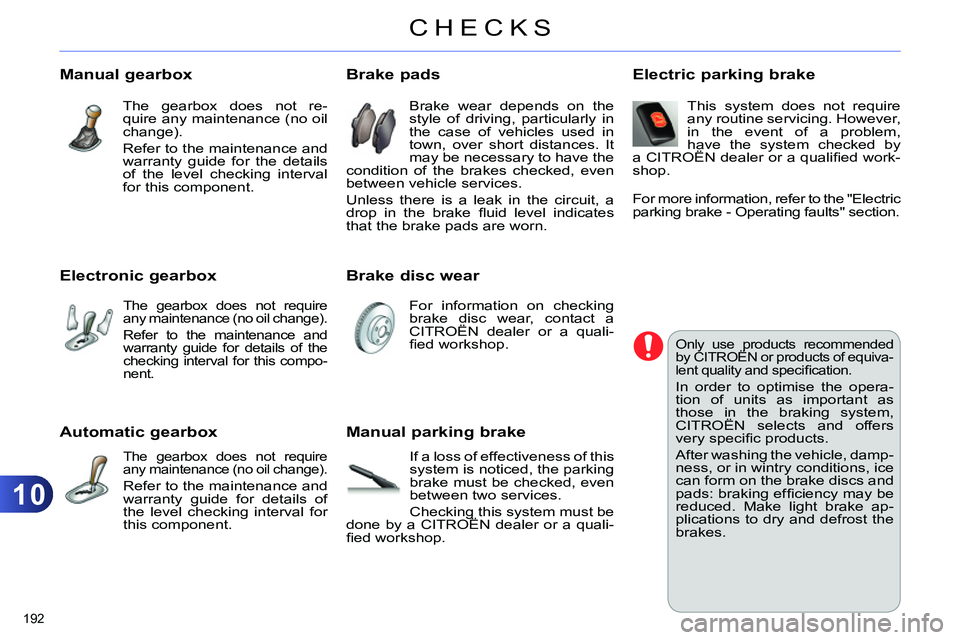
Automatic gearbox
The gearbox does not require
any maintenance (no oil change).
Refer to the maintenance and
warranty guide for details of
the level checking interval for
this component.
Electric parking brake
This system does not require
any routine servicing. However,
in the event of a problem,
have the system checked by
a CITROËN dealer or a qualifi ed work-
shop.
Manual parking brake
Only use products recommended
by CITROËN or products of equiva-
lent quality and specifi cation.
In order to optimise the opera-
tion of units as important as
those in the braking system,
CITROËN selects and offers
very specifi c products.
After washing the vehicle, damp-
ness, or in wintry conditions, ice
can form on the brake discs and
pads: braking effi ciency may be
reduced. Make light brake ap-
plications to dry and defrost the
brakes.
If a loss of effectiveness of this
system is noticed, the parking
brake must be checked, even
between two services.
Checking this system must be
done by a CITROËN dealer or a quali-
fi ed workshop.
Brake pads
Brake wear depends on the
style of driving, particularly in
the case of vehicles used in
town, over short distances. It
may be necessary to have the
condition of the brakes checked, even
between vehicle services.
Unless there is a leak in the circuit, a
drop in the brake fl uid level indicates
that the brake pads are worn.
Brake disc wear
For information on checking
brake disc wear, contact a
CITROËN dealer or a quali-
fi ed workshop.
For more information, refer to the "Electric
parking brake - Operating faults" section.
Manual gearbox
The gearbox does not re-
quire any maintenance (no oil
change).
Refer to the maintenance and
warranty guide for the details
of the level checking interval
for this component.
Electronic gearbox
The gearbox does not require
any maintenance (no oil change).
Refer to the maintenance and
warranty guide for details of the
checking interval for this compo-
nent.
Page 220 of 340
11
PRACTICAL INFORMATION
218
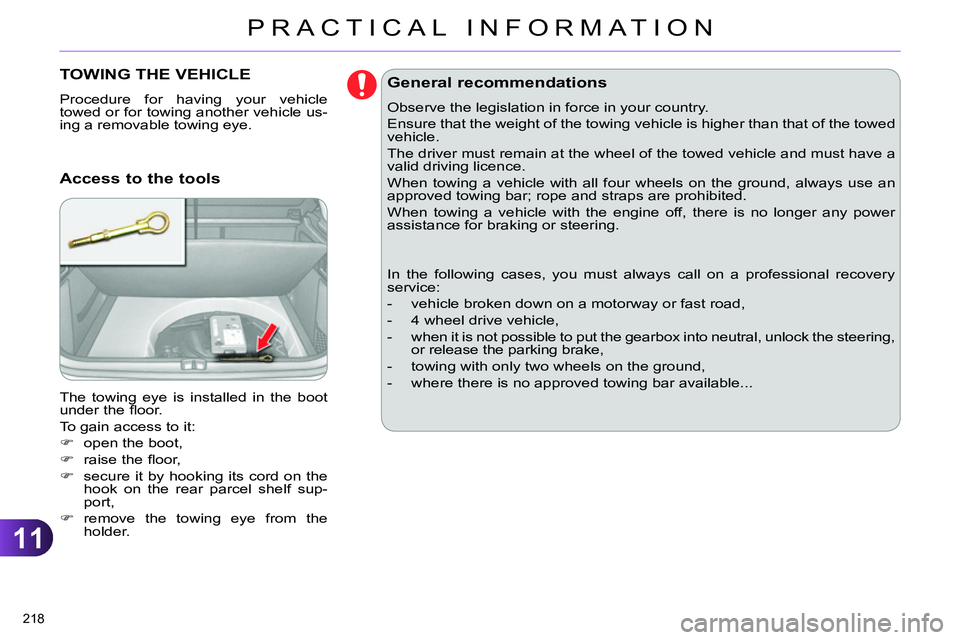
TOWING THE VEHICLE
Procedure for having your vehicle
towed or for towing another vehicle us-
ing a removable towing eye.
The towing eye is installed in the boot
under the fl oor.
To gain access to it:
open the boot,
raise the fl oor,
secure it by hooking its cord on the
hook on the rear parcel shelf sup-
port,
remove the towing eye from the
holder.
Access to the tools
General recommendations
Observe the legislation in force in your country.
Ensure that the weight of the towing vehicle is higher than that of the towed
vehicle.
The driver must remain at the wheel of the towed vehicle and must have a
valid driving licence.
When towing a vehicle with all four wheels on the ground, always use an
approved towing bar; rope and straps are prohibited.
When towing a vehicle with the engine off, there is no longer any power
assistance for braking or steering.
In the following cases, you must always call on a professional recovery
service:
- vehicle broken down on a motorway or fast road,
- 4 wheel drive vehicle,
- when it is not possible to put the gearbox into neutral, unlock the steering,
or release the parking brake,
- towing with only two wheels on the ground,
- where there is no approved towing bar available...