roof Citroen C4 PICASSO 2016 2.G Owner's Manual
[x] Cancel search | Manufacturer: CITROEN, Model Year: 2016, Model line: C4 PICASSO, Model: Citroen C4 PICASSO 2016 2.GPages: 527, PDF Size: 13.72 MB
Page 5 of 527
C4-Picasso-II_en_Chap00a_sommaire_ed01-2016
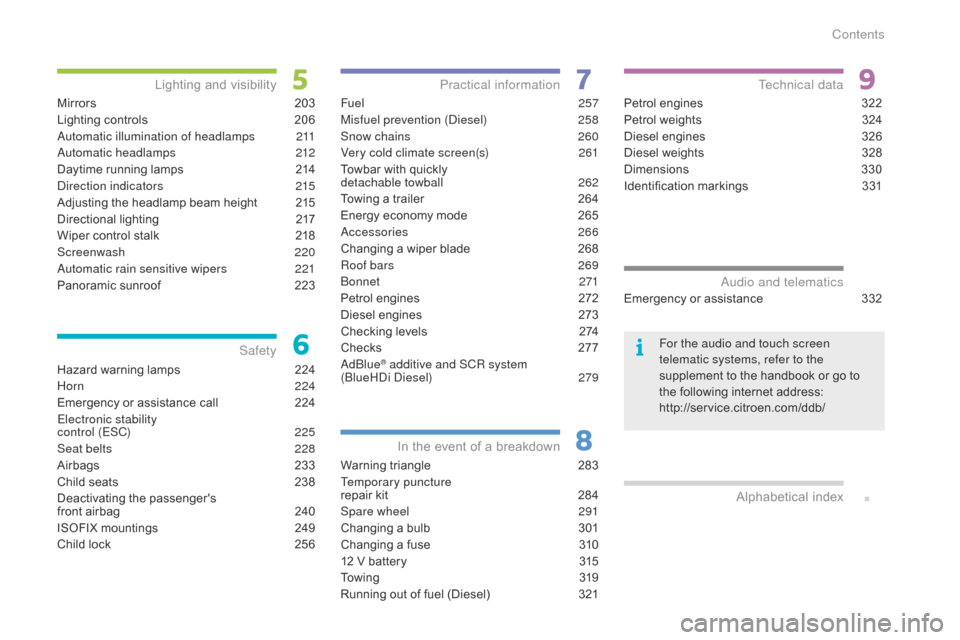
Hazard warning lamps 224
Horn
2
24
Emergency
or assistance call
2
24
Electronic stability
control (ESC)
2
25
Seat belts
2
28
Airbags
2
33
Child
seats
2
38
Deactivating
t
he
p
assenger's
f
ront airbag
2
40
ISOFIX
mountings
2
49
Child
lock
2
56
Safety
Fuel 257
Misfuel prevention (Diesel)
2
58
Snow chains
2
60
Very cold climate screen(s)
2
61
Towbar
with quickly
detachable towball
2
62
Towing
a trailer
2
64
Energy
economy mode
2
65
Accessories
266
Changing
a wiper blade
2
68
Roof bars
2
69
B o nnet
271
Petrol
engines
2
72
Diesel
engines
2
73
Checking
levels
2
74
Checks
2
77
AdBlue
® additive and SCR system
(BlueHDi Diesel) 2 79
Practical information
Warning triangle 2 83
Temporary puncture
repair
kit
2
84
Spare wheel
2
91
Changing
a bulb
3
01
Changing
a fuse
3
10
12
V battery
3
15
To w i n g
3
19
Running
out of fuel (Diesel)
3
21
In the event o f a b reakdown
Petrol engines 3 22
Petrol weights
3
24
Diesel
engines
3
26
Diesel
weights
3
28
Dimensions
3
30
Identification
ma
rkings
3
31
Technical data
Emergency or assistance 332Audio and telematics
Mirrors 203
Lighting controls
2
06
Automatic illumination of headlamps
2
11
Automatic headlamps
2
12
Daytime
running lamps
2
14
Direction indicators
2
15
Adjusting
the headlamp beam height
2
15
Directional
l
ighting
2
17
Wiper
control stalk
2
18
Screenwash
220
Automatic rain sensitive wipers
2
21
Panoramic
sunroof
2
23
Lighting and v isibility
Alphabetical
in
dex
For the audio and touch screen
telematic systems, refer to the
supplement to the handbook or go to
t
he following internet address:
http://service.citroen.com/ddb/
Contents
Page 6 of 527
4
C4-Picasso-II_en_Chap00b_vue-ensemble_ed01-2016
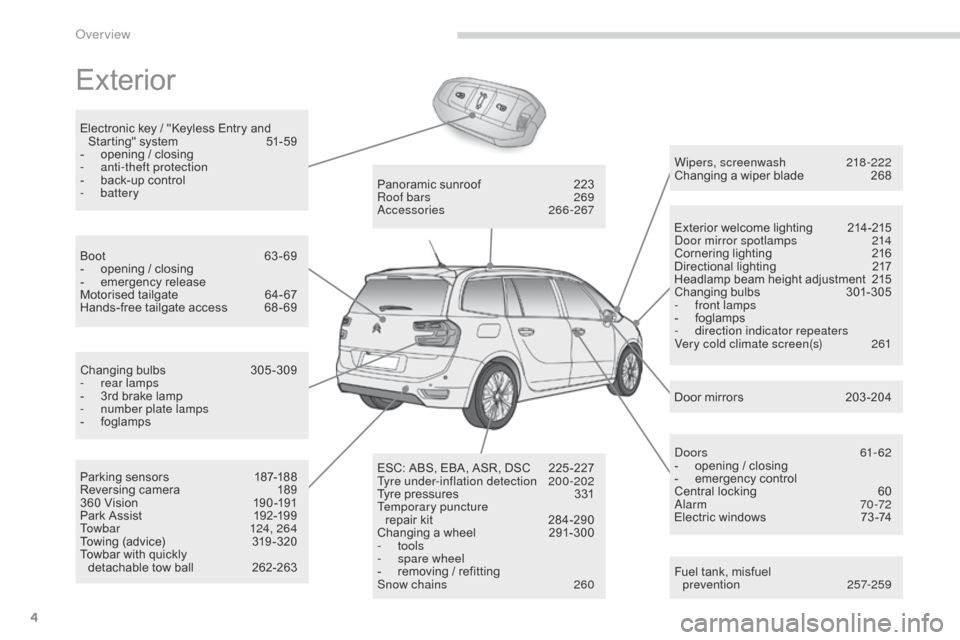
Exterior
Fuel tank, misfuel
p revention 257-259
Wipers, screenwash
2
18 -222
Changing a wiper blade
2
68
Exterior welcome lighting
2
14-215
Door mirror spotlamps
2
14
Cornering lighting
2
16
Directional
l
ighting
2
17
Headlamp beam height adjustment
2
15
Changing
bu
lbs
3
01-305
-
f
ront lamps
-
fo
glamps
-
d
irection indicator repeaters
Very cold climate screen(s)
2
61
Door mirrors
2
03 -204
Panoramic
sunroof
2
23
Roof bars
2
69
Accessories
266-267
ESC:
ABS,
EBA,
ASR,
DSC
2
25 -227
Tyre under-inflation detection
20
0-202
Tyre
pressures
3
31
Temporary puncture repair
kit
2
84-290
Changing
a
wheel
2
91-300
-
tools
- spar
e wheel
-
r
emoving
/
refitting
Snow chains
2
60
Changing
bu
lbs
3
05-309
-
r
ear lamps
-
3
rd
brake
lamp
-
n
umber plate lamps
-
fo
glamps
Parking
sensors
1
87-188
Reversing
camera
1
89
360
Vision
1
90 -191
Park
Assist
1
92-199
Towbar
1
24, 264
Towing
(advice)
3
19 -320
Towbar
with
quickly
detachable
tow
ball
2
62-263
Boot
6
3-69
-
o
pening
/
closing
-
em
ergency
r
elease
Motorised
tailgate
6
4- 67
Hands-free
tailgate
access
6
8 - 69
Electronic
key
/
"Keyless
Entry
and
S
tarting"
system
5
1-59
-
o
pening
/
closing
-
a
nti-theft protection
-
b
ack-up
control
-
battery
Doors
61
- 62
-
o
pening / closing
-
em
ergency
c
ontrol
Central locking
6
0
Alarm
7
0-72
Electric windows
7
3 -74
Over view
Page 8 of 527
6
C4-Picasso-II_en_Chap00b_vue-ensemble_ed01-2016
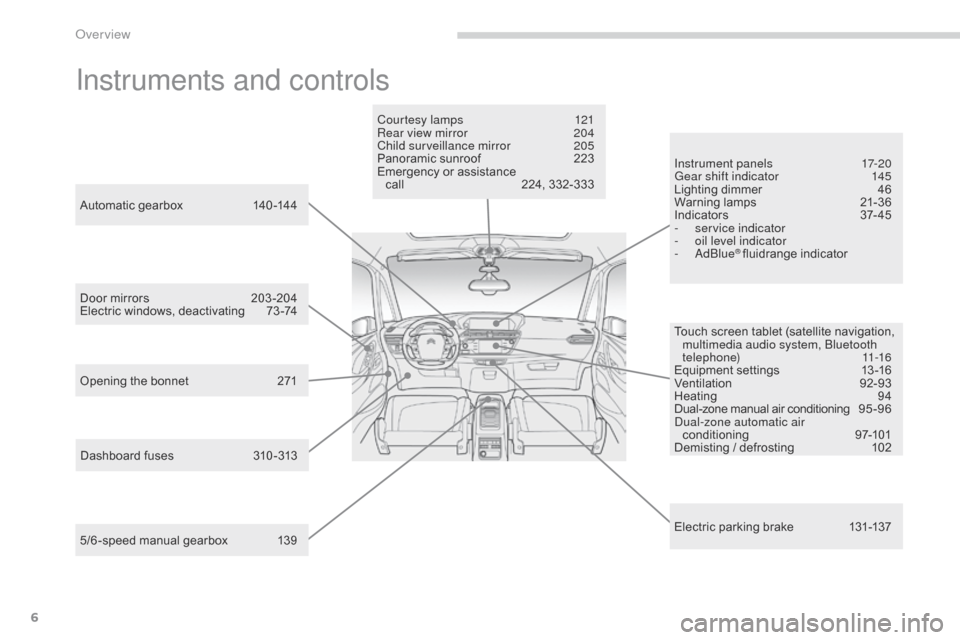
Instruments and controls
Touch screen tablet (satellite navigation, multimedia audio system, Bluetooth
telephone)
11-16
Equipment
se
ttings
1
3-16
Ventilation
9
2-93
Heating
9
4
Dual-zone
m
anual
a
ir
c
onditioning
9
5 - 9 6
Dual-zone automatic air conditioning
9
7-101
Demisting
/ defrosting
1
02
Door
mirrors
2
03 -204
Electric
windows,
deactivating
7
3 -74
5/6 -speed
manual
gearbox
1
39
Automatic
gearbox
1
40 -144
Opening
the
bonnet
2
71 Courtesy lamps
1
21
Rear view mirror
2
04
Child surveillance mirror
2
05
Panoramic
sunroof
2
23
Emergency
or
assistance
c
all
2
24,
332-333
Instrument panels
1
7-20
Gear shift indicator
1
45
Lighting dimmer
4
6
Warning
lam
ps
2
1-36
I n di c ato r s
3
7- 4 5
-
ser
vice indicator
-
o
il level indicator
-
AdBlue
® fluidrange indicator
E
lectric
parking brake
1
31-137
Dashboard
fuses
3
10 -313
Over view
Page 11 of 527
9
C4-Picasso-II_en_Chap00c_eco-conduite_ed01-2016
Optimise the use of your gearbox
With a manual gearbox, move off gently and change up without waiting. During acceleration change up early.
With
an automatic gearbox, give preference to automatic mode and
a
void pressing the accelerator pedal heavily or suddenly.
Control the use of your electrical
equipment
Before moving off, if the passenger compartment is too warm, ventilate it by opening the windows and air vents before using the air
c
onditioning.
Above
30 mph (50 km/h), close the windows and leave the air vents
ope
n.
Remember
to make use of equipment that can help keep the temperature
i
n the passenger compartment down (sunroof and window blinds...).
Switch
off the air conditioning, unless it has automatic regulation, as
s
oon as the desired temperature is attained.
Switch
off the demisting and defrosting controls, if not automatic.
Switch
off the heated seat as soon as possible.
Switch
off the headlamps and front foglamps when the ambient light
l
evel does not require their use.
Avoid
running the engine before moving off, particularly in winter; your
v
ehicle will warm up much faster while driving.
As
a passenger, if you avoid connecting your multimedia devices
(
film, music, video game...), you will contribute towards limiting the
c
onsumption of electrical energy, and so of fuel.
Disconnect
your portable devices before leaving the vehicle.
Eco-driving
Eco-driving is a range of everyday practices that allow the motorist to optimise their fuel consumption and CO2 emissions.
Drive smoothly
Maintain a safe distance between vehicles, use engine braking rather than the brake pedal, and press the accelerator progressively. These
p
ractices contribute towards a reduction in fuel consumption and CO
2
emissions
and
also
helps
reduce
the
background
traffic
noise.
If
your
vehicle
has
cruise
control,
make
use
of
the
system
at
speeds
a
bove
25
mph
(40
km/h)
when
the
traffic
is
flowing
well.
The
gear
shift
indicator
invites
you
engage
the
most
suitable
gear:
as
s
oon as the indication is displayed in the instrument panel, follow it
straight
away.
For
vehicles
fitted
with
an
automatic
gearbox,
this
indicator
appears
o
nly
in
manual
mode.
.
Eco-driving
Page 12 of 527
10
C4-Picasso-II_en_Chap00c_eco-conduite_ed01-2016
Limit the causes of excess consumption
Spread loads throughout the vehicle; place the heaviest items in the bottom of the boot, as close as possible to the rear seats.
Limit the loads carried in the vehicle and reduce wind resistance (roof
bars,
roof rack, bicycle carrier, trailer...). Use a roof box in preference.
Remove
roof bars and roof racks after use.
At
the end of winter, remove snow tyres and refit your summer tyres.
Observe the recommendations
on maintenance
Check the tyre pressures regularly, when cold, referring to the label in the door aperture, driver's side.
Carry
out this check in particular:
-
b
efore a long journey,
-
a
t each change of season,
-
a
fter a long period out of use.
Don't
forget the spare wheel and the tyres on any trailer or caravan.
Have
your vehicle serviced regularly (engine oil, oil filter, air filter,
p
assenger compartment filter...) and observe the schedule of
o
perations recommended in the manufacturer's service schedule.
With
a BlueHDi Diesel engine, if the SCR system is faulty your vehicle
b
ecomes polluting; go to a CITROËN dealer or a qualified workshop
w
ithout delay to have the emissions of nitrous oxides brought back to
t
he legal level.
When
refuelling, do not continue after the third cut-off of the nozzle to
a
void any over flow.
At the wheel of your new vehicle, it is only after the first 1 800 miles
(3 000
kilometres) that you will see the fuel consumption settle down to
a
consistent average.
Eco-driving
Page 201 of 527
199
C4-Picasso-II_en_Chap04_conduite_ed01-2016
The system is deactivated by pressing the control.
The
system is deactivated automatically:
-
o
n switching off the ignition,
-
i
f the engine stalls,
-
i
f no manoeuvre is started within 5 minutes
of selection of the type of manoeuvre,
-
a
fter a prolonged stop of the vehicle during
a
manoeuvre,
-
i
f the road wheel anti-slip regulation (ASR)
i
s
t
riggered,
-
i
f the speed of the vehicle exceeds the
s
tated limit,
-
w
hen the driver interrupts movement of the
steering
w
heel,
-
a
fter 4 manoeuvre cycles,
-
o
n opening the driver's door,
-
i
f one of the front wheels encounters an
obstacle.
The
operation indicator lamp goes off in the
i
nstrument panel and a message is displayed
a
ccompanied by an audible signal.
The
driver should then take back control of the
v
ehicle's
s
teering.
Deactivation
The system is switched off automatically:
- w hen towing a trailer, connected
e
lectrically,
-
i
f the driver's door is opened,
-
i
f the speed of the vehicle is above 42 mph
(70
km/h).
To
switch the system of for a prolonged period,
c
ontact a CITROËN dealer or a qualified
workshop.
Operating faults
In the event of a fault with the power
steering, this warning lamp flashes in
t
he instrument panel, accompanied
by
a message.
Contact a CITROËN dealer or a qualified
workshop.
Switching off
If the lateral distance between your
vehicle and the space is too great, the s
ystem may not be able to measure the
space.
Anything
projecting beyond the envelope
o
f the vehicle (a ladder on the roof, for
example)
is not taken into account by the
P
ark Assist system during a manoeuvre.
In bad weather or in winter, ensure that
the sensors are not covered by road
dirt,
ice or snow.
In the event of a fault, have the system
checked
by a CITROËN dealer or a
q
ualified
w
orkshop.
If
the
system
is
deactivated
during
a
ma
noeuvre, the drive should reactivate
it
to
repeat
the
measurement. In
the
event
of
a
fault,
this
warning
l
amp flashes for a few seconds,
accompanied
by
an
audible
signal.
If
the
fault
occurs
during
the
use
o
f
the
system,
the
warning
lamp
g
oes off. High pressure jet washing
When
washing your vehicle, keep the
l
ance at least 30 cm away from the
sen
sors.
4
Driving
Page 225 of 527
223
C4-Picasso-II_en_Chap05_eclairage-visibilite_ed01-2016
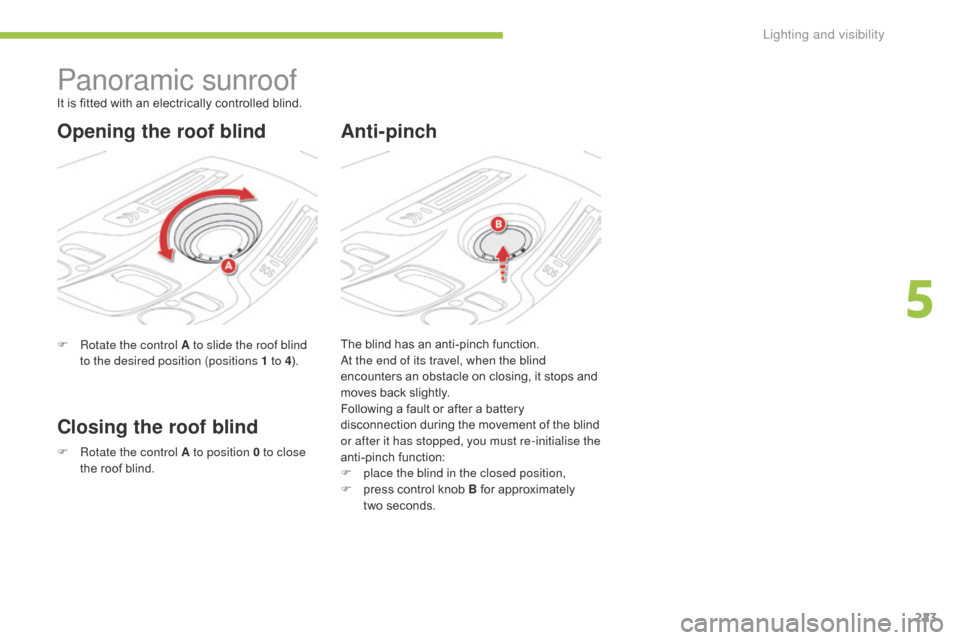
Panoramic sunroof
F Rotate the control A to slide the roof blind to the desired position (positions 1 to 4 ).
Closing the roof blindAnti-pinch
It is fitted with an electrically controlled blind.
Opening the roof blind
F Rotate the control A to position 0 to close
the roof blind. The
blind has an anti-pinch function.
At the end of its travel, when the blind
encounters an obstacle on closing, it stops and
m
oves back slightly.
Following a fault or after a battery
d
isconnection during the movement of the blind o
r after it has stopped, you must re-initialise the
anti-pinch f unction:
F
p
lace the blind in the closed position,
F
p
ress control knob B for approximately
t
wo seconds.
5
Lighting and visibility
Page 232 of 527
230
C4-Picasso-II_en_Chap06_securite_ed01-2016
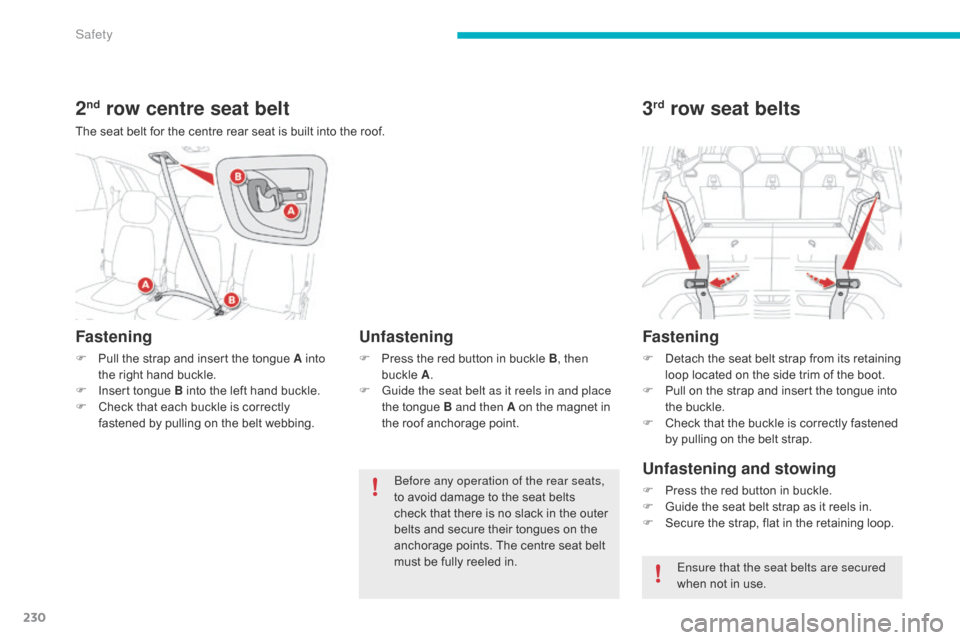
2nd row centre seat belt
The seat belt for the centre rear seat is built into the roof.
Fastening
F Pull the strap and insert the tongue A into
the right hand buckle.
F
I
nsert tongue B into the left hand buckle.
F
C
heck that each buckle is correctly
f
astened by pulling on the belt webbing.
Unfastening
F Press the red button in buckle B, then
buckle A .
F
G
uide the seat belt as it reels in and place
the
tongue B and then A on the magnet in
t
he roof anchorage point.
Before any operation of the rear seats,
to
avoid damage to the seat belts
c
heck that there is no slack in the outer
b
elts and secure their tongues on the
a
nchorage points. The centre seat belt
m
ust be fully reeled in.
3rd row seat belts
Fastening
F Detach the seat belt strap from its retaining l
oop located on the side trim of the boot.
F
P
ull on the strap and insert the tongue into
t
he buckle.
F
C
heck that the buckle is correctly fastened
b
y pulling on the belt strap.
Unfastening and stowing
F Press the red button in buckle.
F G uide the seat belt strap as it reels in.
F
S
ecure the strap, flat in the retaining loop.
Ensure that the seat belts are secured
when
not in use.
Safety
Page 239 of 527
237
C4-Picasso-II_en_Chap06_securite_ed01-2016
Sit in a normal upright position.
W ear a correctly adjusted seat belt.
Do
not leave anything between the
o
ccupants and the airbags (a child, pet,
o
bject...), nor fix or attach anything close to
t
he inflation trajectory of the airbags; this
c
ould cause injuries during their deployment.
Never
modify the original definition of your
v
ehicle, particularly in the area directly
around
the airbags.
After an accident or if the vehicle has been
stolen
or broken into, have the airbag
s
ystems checked.
All
work on the airbag system must be
c
arried out by a CITROËN dealer or a
qualified
w
orkshop.
Even if all of the precautions mentioned
are
observed, a risk of injury or of minor
b
urns to the head, chest or arms when an
airbag
is deployed cannot be ruled out. The
b
ag inflates almost instantly (within a few
m
illiseconds) then deflates within the same
time
discharging the hot gas via openings
p
rovided for this purpose.Front airbags
Do not drive holding the steering wheel by its spokes or resting your hands on the centre
p
art of the wheel.
Passengers
must not place their feet on the
das
hboard.
Do
not smoke as deployment of the airbags
c
an cause burns or the risk of injury from a
c
igarette or pipe.
Never
remove
or
pierce
the
steering
wheel
or
h
it it violently.
Do
not fit or attach anything to the steering
w
heel or dashboard, this could cause
injuries
with deployment of the airbags.
Advice
Lateral airbags
Use only approved covers on the seats,
compatible with the deployment the lateral
airbags. For information on the range of seat
c
overs suitable for your vehicle, you can
contact
a CITROËN dealer.
For more information on Accessories , refer
to
the corresponding section.
Do
not fix or attach anything to the seat
b
acks (clothing...). This could cause injury
t
o the chest or arms if the lateral airbag is
d
eployed.
Do not sit with the upper part of the body any
nearer
to the door than necessary.
Curtain airbags
Do not fix or attach anything to the roof. This could cause injury to the head if the curtain
a
irbag is deployed.
If fitted on your vehicle, do not remove the
grab
handles installed on the roof, they play
a
part in securing the curtain airbags.
For the airbags to be fully effective, observe the safety recommendations below:
6
Safety
Page 268 of 527
266
C4-Picasso-II_en_Chap07_info-pratiques_ed01-2016
Accessories
A wide range of accessories and genuine parts is available from the CITROËN dealer network.
T hese accessories and parts are all suitable for your vehicle and benefit from CITROËN's recommendation and warranty.
"Comfort"
Door deflectors, sun blind, insulated module,
coat hanger fixed to head restraint, mobile
r
eading lamp, mirror for caravan, front and rear
par
king
s
ensors,
p
rogrammable
a
dditional
h
eating, smoker's kit, solar film for rear door
w
indows, portable scented air freshener...
"Transport systems"
Boot carpet, boot liner, boot net, boot
spacers, transverse roof bars, ski carrier, roof
b
oxes, towbars, towbar wiring harnesses,
b
icycle carriers for towbar and roof bars,
towbars
with fixed and detachable towball,
s
eparation net, sliding carrier, boot organiser
(
Grand C4 Picasso)...
If
a towbar and wiring harness are fitted
o
utside the CITROËN dealer network, the
i
nstallation must be done strictly in line with the
manufacturer's
r
ecommendations.
If your vehicle has a detachable towball, it is
recommended that the ball be removed when
not
towing.
"Styling"
Gear lever knobs, aluminium foot rest, alloy wheels, door sill finishers, interior mirror
shells...
"Security and safety"
Anti-intrusion alarm, vehicle tracking system, c hild seats and booster cushions, breathalyser,
first
aid kit, fire extinguisher, warning triangle,
h
igh visibility vest, wheel security bolts, snow
c
hains, non-slip covers, winter tyres, foglamp
k
it, security film for front door windows, dog
g
uard, pet seat belt...
"Protection"
Mats*, seat covers compatible with lateral
airbags, mud flaps, door protective mouldings,
b
umper protection strips, vehicle cover, boot
sill protector, door sill protectors, seat and boot
protective
covers for pets...
The
rear bodywork has been designed to avoid
s
p r ay.
*
T
o avoid any risk of jamming the pedals:
-
e
nsure that mats are correctly positioned
and secured,
-
n
ever fit one mat on top of another.
Practical information