light CITROEN C5 2018 Owner's Manual
[x] Cancel search | Manufacturer: CITROEN, Model Year: 2018, Model line: C5, Model: CITROEN C5 2018Pages: 348, PDF Size: 10.72 MB
Page 80 of 348
78
C5_en_Chap03_ergonomie-et-confort_ed01-2016
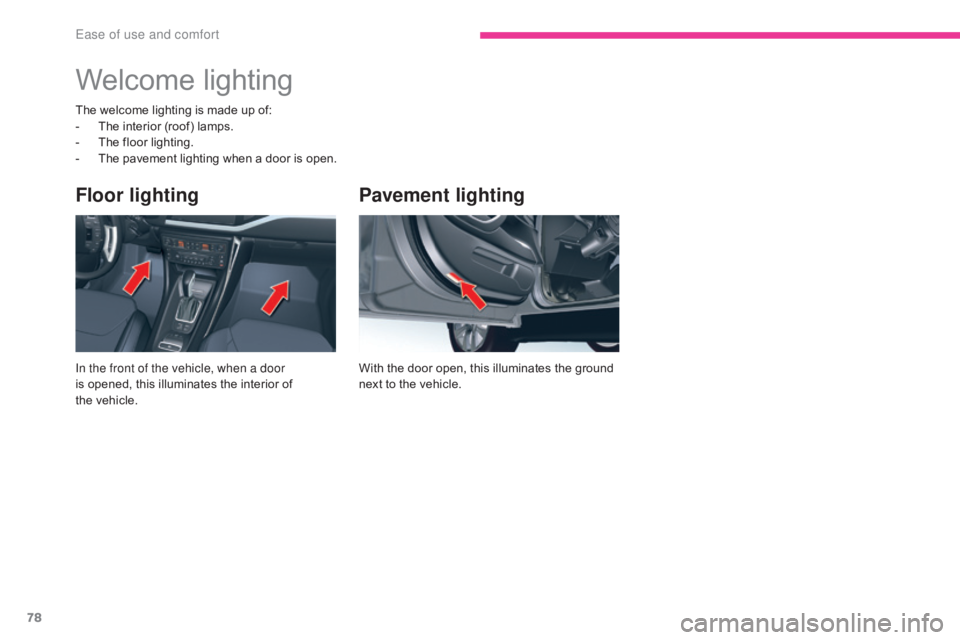
Pavement lighting
With the door open, this illuminates the ground
next to the vehicle.
Floor lighting
In the front of the vehicle, when a door
is opened, this illuminates the interior of
the vehicle.
The welcome lighting is made up of:
-
T
he interior (roof) lamps.
-
T
he floor lighting.
-
T
he pavement lighting when a door is open.
Welcome lighting
Ease of use and comfort
Page 89 of 348
87
C5_en_Chap03_ergonomie-et-confort_ed01-2016
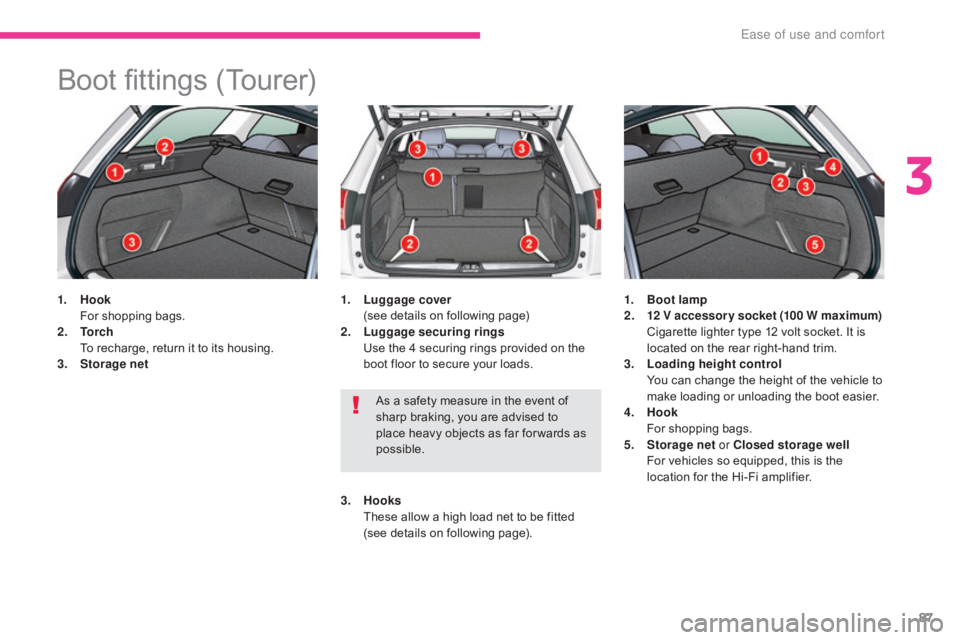
Boot fittings (Tourer)
1. Hook
F or shopping bags.
2.
T
o r c h
T
o recharge, return it to its housing.
3.
Sto
rage net 1. Lu
ggage
cover (
see details on following page)
2.
Lu
ggage securing rings
U
se the 4 securing rings provided on the
boot floor to secure your loads. 1. B
oot lamp
2. 1 2 V accessor y socket (100 W maximum)
C
igarette lighter type 12 volt socket. It is
located on the rear right-hand trim.
3.
L
oading height control
Y
ou can change the height of the vehicle to
make loading or unloading the boot easier.
4.
Hoo
k
F
or shopping bags.
5.
Sto
rage net or Closed storage well
F
or vehicles so equipped, this is the
location for the Hi-Fi amplifier.
As a safety measure in the event of
sharp braking, you are advised to
place heavy objects as far for wards as
possible.
3.
Hoo
ks
T
hese allow a high load net to be fitted
(see details on following page).
3
Ease of use and comfort
Page 93 of 348
91
C5_en_Chap04_conduite_ed01-2016
Observe the driving regulations and remain
vigilant whatever the traffic conditions.
Pay close attention to the traffic and keep your
hands on the wheel so that you are ready to
react at any time to any eventuality.
On a long journey, a break every two hours is
strongly recommended.
In difficult weather, drive smoothly, anticipate
the need to brake and increase the distance
from other vehicles.
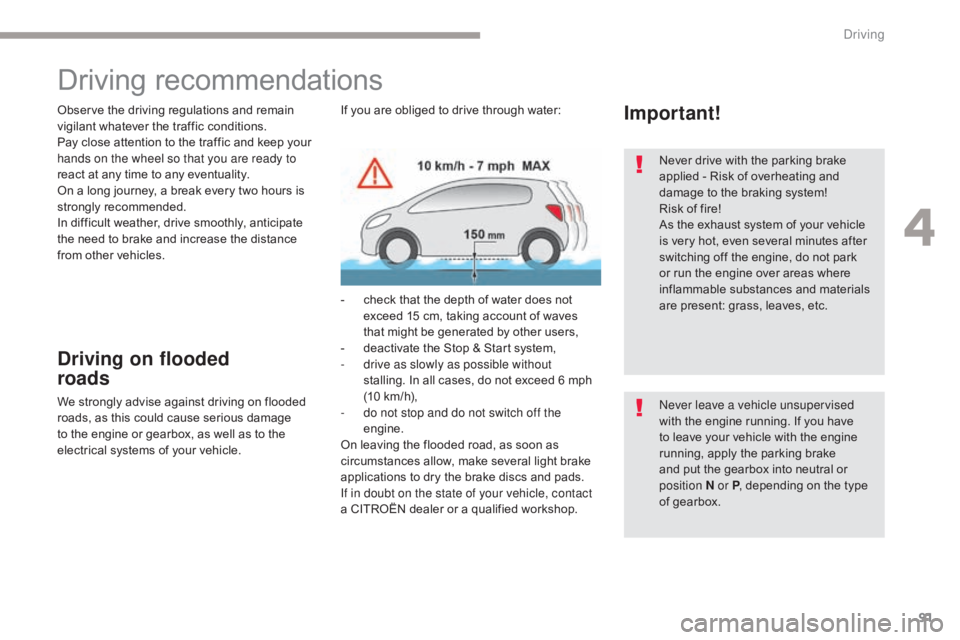
Driving on flooded
roads
We strongly advise against driving on flooded
roads, as this could cause serious damage
to the engine or gearbox, as well as to the
electrical systems of your vehicle.
Driving recommendations
Important!
Never drive with the parking brake
applied - Risk of overheating and
damage to the braking system!
Risk of fire!
As the exhaust system of your vehicle
is very hot, even several minutes after
switching off the engine, do not park
or run the engine over areas where
inflammable substances and materials
are present: grass, leaves, etc.
Never leave a vehicle unsupervised
with the engine running. If you have
to leave your vehicle with the engine
running, apply the parking brake
and put the gearbox into neutral or
position
N or P, depending on the type
of gearbox.
If you are obliged to drive through water:
-
c
heck that the depth of water does not
exceed 15 cm, taking account of waves
that might be generated by other users,
-
d
eactivate the Stop & Start system,
-
d
rive as slowly as possible without
stalling. In all cases, do not exceed 6 mph
(10
km/h),
-
d
o not stop and do not switch off the
engine.
On leaving the flooded road, as soon as
circumstances allow, make several light brake
applications to dry the brake discs and pads.
If in doubt on the state of your vehicle, contact
a CITROËN dealer or a qualified workshop.
4
Driving
Page 112 of 348
110
C5_en_Chap04_conduite_ed01-2016
Stop & Start
Operation
- with a manual gearbox, at speeds below
12 mph (20 km/h) with BlueHDi Diesel
versions, when you put the gear selector
into neutral and release the clutch pedal,
-
w
ith an automatic gearbox, vehicle
stationary, when you press the brake pedal
or place the gear selector in position N .
Going into engine STOP
mode
The "ECO" warning lamp comes on
in the instrument panel and the engine
goes into standby automatically:
If your vehicle is fitted with the
system, a time counter calculates
the sum of the periods in STOP
mode during a journey. It resets
itself to zero every time the
ignition is switched on with the
key.
The Stop & Start system puts the engine
temporarily into standby - STOP mode - during
stops in the traffic (red lights, traffic jams...).
The engine restarts automatically - START
mode - as soon as you want to move off.
The restart takes place instantly, quickly and
silently.
Per fect for urban use, the Stop & Start system
reduces fuel consumption and exhaust
emissions as well as the noise level when
stationary.
Never refuel with the engine in STOP
mode; you must switch off the ignition
with the key.
For your comfort, when parking, STOP
is not available for a few seconds after
coming out of reverse.
The Stop & Start system does not affect
the functionality of the vehicle, such as
braking, power steering...
Driving
Page 124 of 348
122
C5_en_Chap04_conduite_ed01-2016
Exceeding the programmed
speed
While cruise control is in operation, it is always
possible to go above the programmed speed
simply by pressing the accelerator pedal (for
example to overtake another vehicle).
The speed displayed in zone A flashes.
You only have to release the accelerator pedal
to return to the programmed speed.
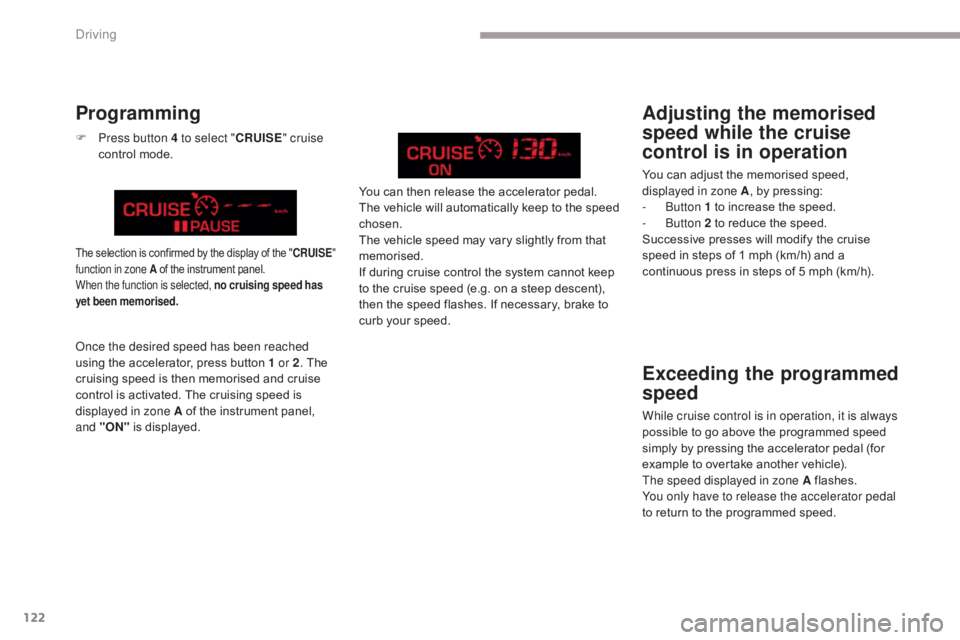
Programming
The selection is confirmed by the display of the "CRU ISE"
function in zone A of the instrument panel.
When the function is selected, no cruising speed has
yet been memorised.
Once the desired speed has been reached
using the accelerator, press button 1 or 2 . The
cruising speed is then memorised and cruise
control is activated. The cruising speed is
displayed in zone A of the instrument panel,
and "ON" is displayed.
Adjusting the memorised
speed while the cruise
control is in operation
You can adjust the memorised speed,
displayed in zone A , by pressing:
-
Button 1 to increase the speed.
-
Button 2 to reduce the speed.
Successive presses will modify the cruise
speed in steps of 1 mph (km/h) and a
continuous press in steps of 5 mph (km/h).
You can then release the accelerator pedal.
The vehicle will automatically keep to the speed
chosen.
The vehicle speed may vary slightly from that
memorised.
If during cruise control the system cannot keep
to the cruise speed (e.g. on a steep descent),
then the speed flashes. If necessary, brake to
curb your speed.
F
P
ress button 4 to select "
CRUISE" cruise
control mode.
Driving
Page 134 of 348
132
C5_en_Chap05_eclairage-et-visibilite_ed01-2016
Exterior lighting controls
Main lighting
The various front and rear lamps of the
vehicle are designed to adapt the driver's
visibility progressively in relation to the climatic
conditions:
-
s
idelamps, to be seen,
-
d
ipped beam headlamps to see without
dazzling other drivers,
-
m
ain beam headlamps to see clearly when
the road is clear.
Additional lighting
Other lamps are fitted to meet the requirements
of particular driving conditions:
-
r
ear foglamps, to be seen from a distance,
-
f
ront foglamps for even better for ward
vision,
-
d
irectional headlamps for improved
visibility when cornering,
-
d
aytime running lamps to be seen during
the day.
Settings
You can configure some functions:
- d aytime running lamps,
-
a
utomatic illumination of headlamps,
-
d
irectional lighting,
-
g
uide-me-home lighting.
In some weather conditions (e.g. low
temperature or humidity), the presence
of misting on the internal sur face of the
glass of the headlamps and rear lamps
is normal; it disappears after the lamps
have been on for a few minutes.
Control stalk for the selection and control of the various front and rear lamps providing the vehicle's lighting.
Lighting and visibility
Page 135 of 348
133
C5_en_Chap05_eclairage-et-visibilite_ed01-2016
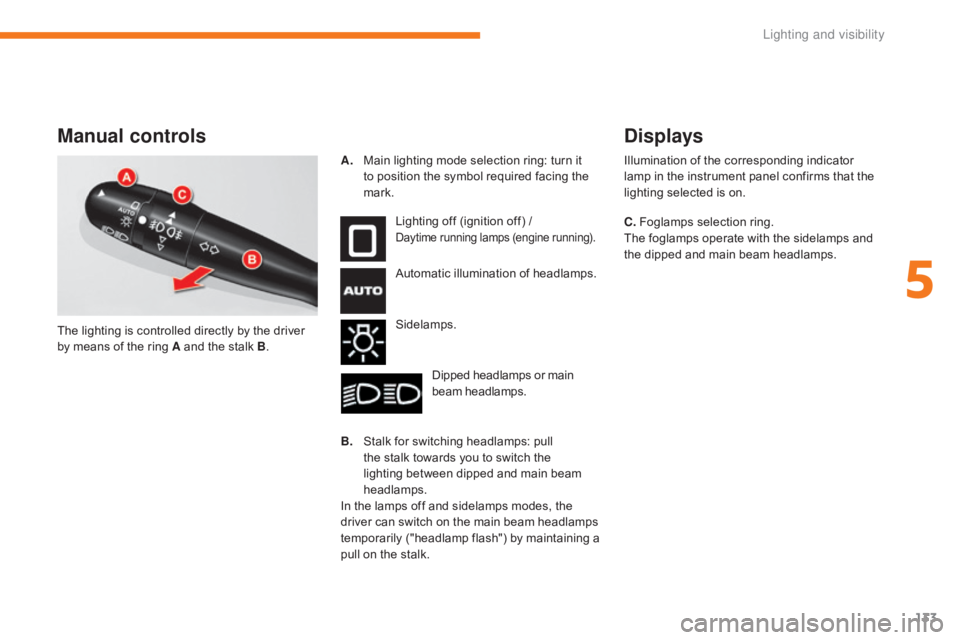
Manual controls
Lighting off (ignition off) /
Daytime running lamps (engine running).
Automatic illumination of headlamps.
Sidelamps.Dipped headlamps or main
beam headlamps.
B.
S
talk for switching headlamps: pull
the stalk towards you to switch the
lighting between dipped and main beam
headlamps.
In the lamps off and sidelamps modes, the
driver can switch on the main beam headlamps
temporarily ("headlamp flash") by maintaining a
pull on the stalk.
Displays
The lighting is controlled directly by the driver
by means of the ring A and the stalk B .A.
M
ain lighting mode selection ring: turn it
to position the symbol required facing the
mark.
C. Foglamps selection ring.
The foglamps operate with the sidelamps and
the dipped and main beam headlamps. Illumination of the corresponding indicator
lamp in the instrument panel confirms that the
lighting selected is on.
5
Lighting and visibility
Page 136 of 348
134
C5_en_Chap05_eclairage-et-visibilite_ed01-2016
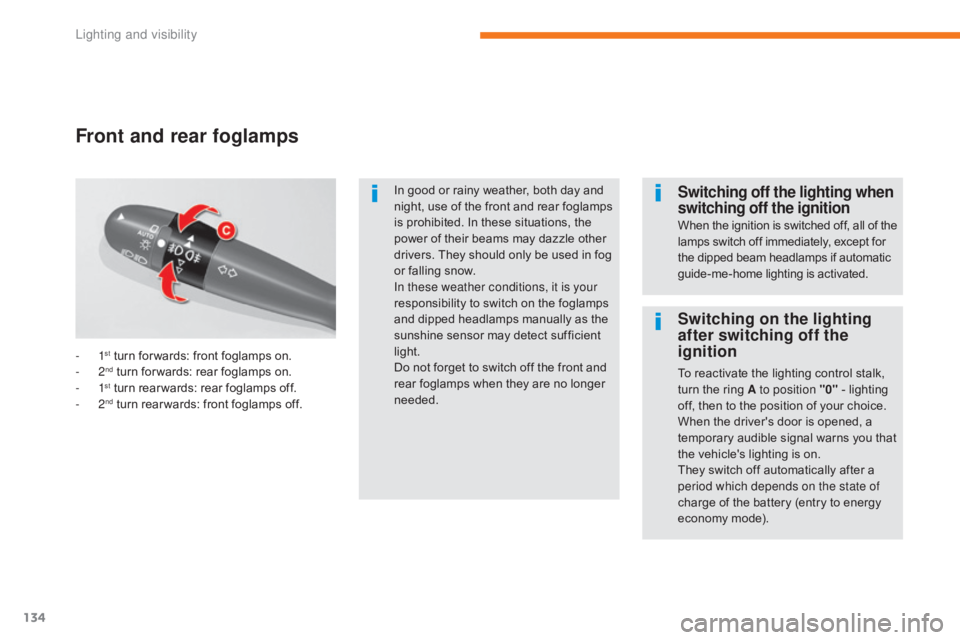
- 1st turn for wards: front foglamps on.
-
2nd turn for wards: rear foglamps on.
-
1st turn rear wards: rear foglamps off.
-
2nd turn rear wards: front foglamps off.
Front and rear foglamps
In good or rainy weather, both day and
night, use of the front and rear foglamps
is prohibited. In these situations, the
power of their beams may dazzle other
drivers. They should only be used in fog
or falling snow.
In these weather conditions, it is your
responsibility to switch on the foglamps
and dipped headlamps manually as the
sunshine sensor may detect sufficient
light.
Do not forget to switch off the front and
rear foglamps when they are no longer
needed.Switching off the lighting when
switching off the ignition
When the ignition is switched off, all of the
lamps switch off immediately, except for
the dipped beam headlamps if automatic
guide-me-home lighting is activated.
Switching on the lighting
after switching off the
ignition
To reactivate the lighting control stalk,
turn the ring A to position "0" - lighting
off, then to the position of your choice.
When the driver's door is opened, a
temporary audible signal warns you that
the vehicle's lighting is on.
They switch off automatically after a
period which depends on the state of
charge of the battery (entry to energy
economy mode).
Lighting and visibility
Page 137 of 348
135
C5_en_Chap05_eclairage-et-visibilite_ed01-2016
Daytime running lampsManual guide-me-home
lighting
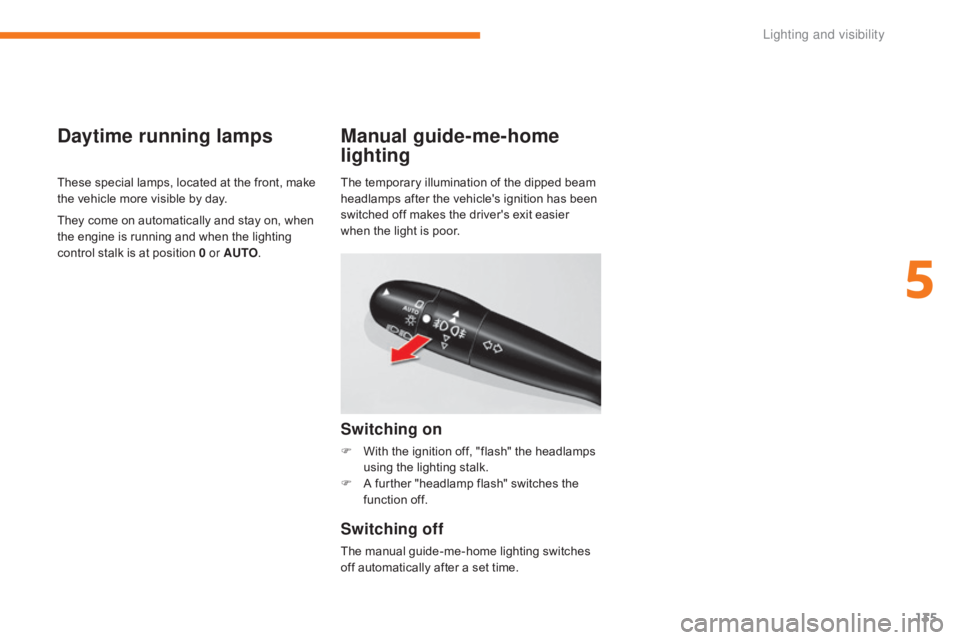
Switching on
F With the ignition off, "flash" the headlamps
using the lighting stalk.
F
A f
urther "headlamp flash" switches the
function off.
Switching off
The manual guide-me-home lighting switches
off automatically after a set time.
These special lamps, located at the front, make
the vehicle more visible by day.
The temporary illumination of the dipped beam
headlamps after the vehicle's ignition has been
switched off makes the driver's exit easier
when the light is poor.
They come on automatically and stay on, when
the engine is running and when the lighting
control stalk is at position 0 or AUTO
.
5
Lighting and visibility
Page 138 of 348
136
C5_en_Chap05_eclairage-et-visibilite_ed01-2016
Linked with the automatic Guide-
me-home lighting
The link with the automatic illumination of
headlamps provides the guide-me-home
lighting with the following additional options:
-
s
election of the duration of lighting for 15,
30 or 60 seconds in the vehicle parameters
menu,
-
a
utomatic activation of the guide-me-home
lighting when automatic illumination of
headlamps is in operation.
Operating fault
In the event of a fault with the sunshine sensor,
the lighting comes on and a message appears
in the instrument panel screen, accompanied
by an audible signal.
Contact a CITROËN dealer or a qualified
workshop.
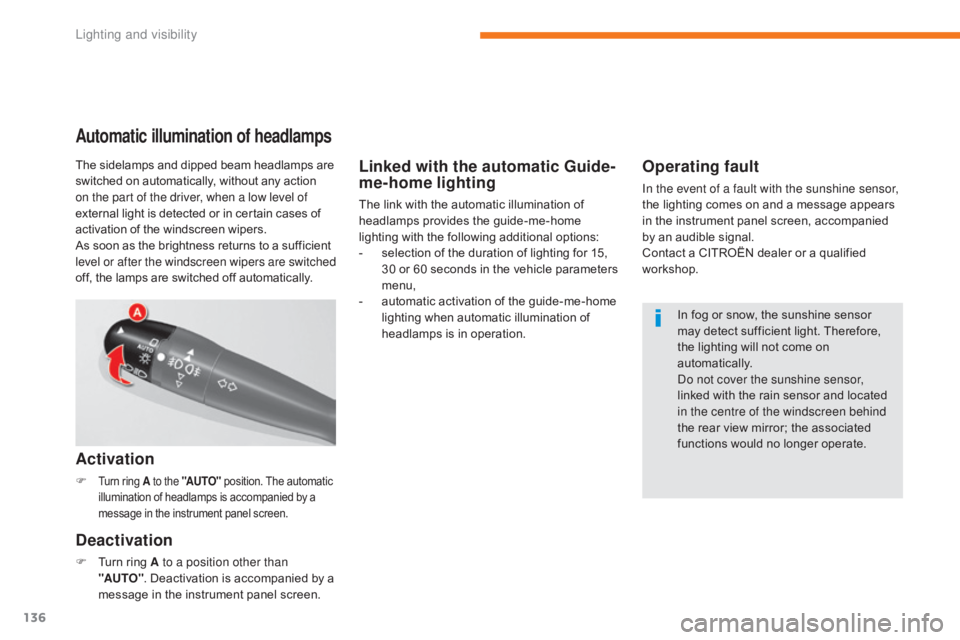
Automatic illumination of headlamps
Activation
F Turn ring A to the "AUTO" position. The automatic
illumination of headlamps is accompanied by a
message in the instrument panel screen.
Deactivation
F Turn ring A to a position other than "AUTO" . Deactivation is accompanied by a
message in the instrument panel screen.
The sidelamps and dipped beam headlamps are
switched on automatically, without any action
on the part of the driver, when a low level of
external light is detected or in certain cases of
activation of the windscreen wipers.
As soon as the brightness returns to a sufficient
level or after the windscreen wipers are switched
off, the lamps are switched off automatically.
In fog or snow, the sunshine sensor
may detect sufficient light. Therefore,
the lighting will not come on
automatically.
Do not cover the sunshine sensor,
linked with the rain sensor and located
in the centre of the windscreen behind
the rear view mirror; the associated
functions would no longer operate.
Lighting and visibility