Front CITROEN CX 1988 User Guide
[x] Cancel search | Manufacturer: CITROEN, Model Year: 1988, Model line: CX, Model: CITROEN CX 1988Pages: 648, PDF Size: 95.8 MB
Page 307 of 648
FRONT AXLE
TOOLS TO BE USED
631 O-T.
3312-T.
or 6323-T.
Hub locking tool
Lower arm ball-joint extractor, with bosses
Lower arm ball-joint extractor, with or without bosses
Torque wrench (40 mdaN) Sleeve 35
mm A/F
REMOVING AND REFITTING A SWIVEL
+I+ 8531-8532
Page 308 of 648
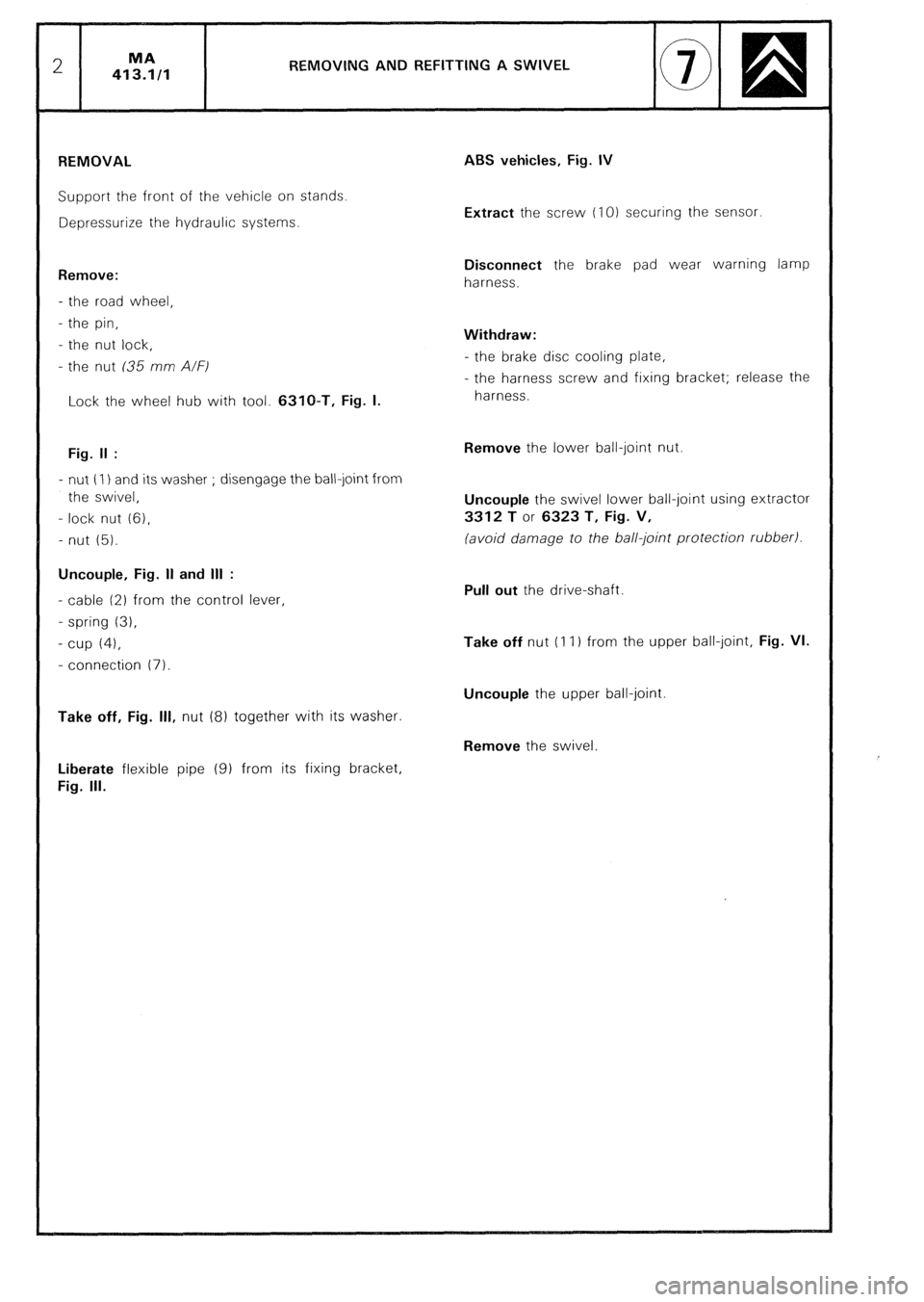
REMOVlNG AND REFlTTlNG A SWIVEL
REMOVAL
Support the front of the vehicle on stands.
Depressurize the hydraulic systems.
Remove:
- the road wheel,
- the pin,
- the nut lock,
- the nut (35 mm A/F)
Lock the wheel hub with tool. 6316-T, Fig. I.
Fig. II :
- nut (1) and its washer ; disengage the bail-joint from
the swivel,
- lock nut (6),
- nut (5).
Uncouple, Fig. II and Ill :
- cable (2) from the control lever,
- spring (31,
- cup (41,
- connection (7).
Take off, Fig. Ill, nut (8) together with its washer.
Liberate flexible pipe (9) from its fixing bracket,
Fig. Ill. ABS vehicles, Fig. IV
Extract the screw (I 0) securing the sensor.
Disconnect the brake pad wear warning lamp
harness.
Withdraw:
- the brake disc cooling plate,
- the harness screw and fixing bracket; release the
harness.
Remove the lower ball-joint nut.
Uncouple the swivel lower ball-joint using extractor
3312 T or 6323 T, Fig. V,
(avoid damage to the ball-joint protection rubber).
Pull out the drive-shaft.
Take off nut (I I) from the upper ball-joint, Fig. VI.
Uncouple the upper ball-joint.
Remove the swivel.
Page 311 of 648

REMOVING AND REFITTING A SWIVEL
REFITTING Replace, Fig. IV:
Wipe the ball-joint fixings and location, do not use - flexible pipe (I I) into its fixing bracket,
solvent. - washer (I 0).
Recouple the upper ball-joint with the swivel. Tighten nut (9) to 2.2 mdaN.
Refit, Fig. I: Recouple:
- washer (I),
- Fig. IV, connection (I 2) provided with a new sea/.
- nut (2).
- Fig. V, the steering ball-joint.
Tighten to 7 mdaN (New NYLSTOP nut).
Refit:
Introduce the drive-shaft end into the wheel hub - washer (I 31,
(lubricate the hub seal lips). - nut (14) (New NYLSTOP one).
Couple up the lower ball-joint. Tighten to 6 mdaN.
Tighten to 6 mdaN the new NYLSTOP nut. Reconnect:
-cup (171,
Reconnect the brake pad wear warning lamp harness. - spring (I 61,
-cable (15).
Refit, Fig. II and Ill:
Adjust the handbrake (as indicated in @ 454.011).
- electrical harness fixing bracket (4).
- earth lead (5).
- screw (3). Put the drive-shaft nut into place.
- metal panel (6). (Faces and threads lubricated).
Lock the hub, utilizing tool 6310-T Fig. VI.
ABS vehicles, Fig. Ill:
Tighten to 37.5 mdaN.
Reinstall sensor (7) (spread MOB/L TEMP No. 1
grease over the outside of the sensor.
Bleed the front brakes (see @ 453.0/l/.
Tighten screw (8) to 1 mdaN.
Fit the wheel.
Lower the vehicle to the ground.
8531-8532
Page 312 of 648
TOOLS TO BE USED
3312-T.
or 6323-T.
6310-T.
Lower arm ball-joint extractor, with bosses
Lower arm ball-joint extractor, with or without bosses
Hub locking tool
Torque wrench tool (40 mdaN)
Socket, 35 mm A/F
REMOVING AND REFITTING A FRONT \ij
8531-8532
Page 313 of 648
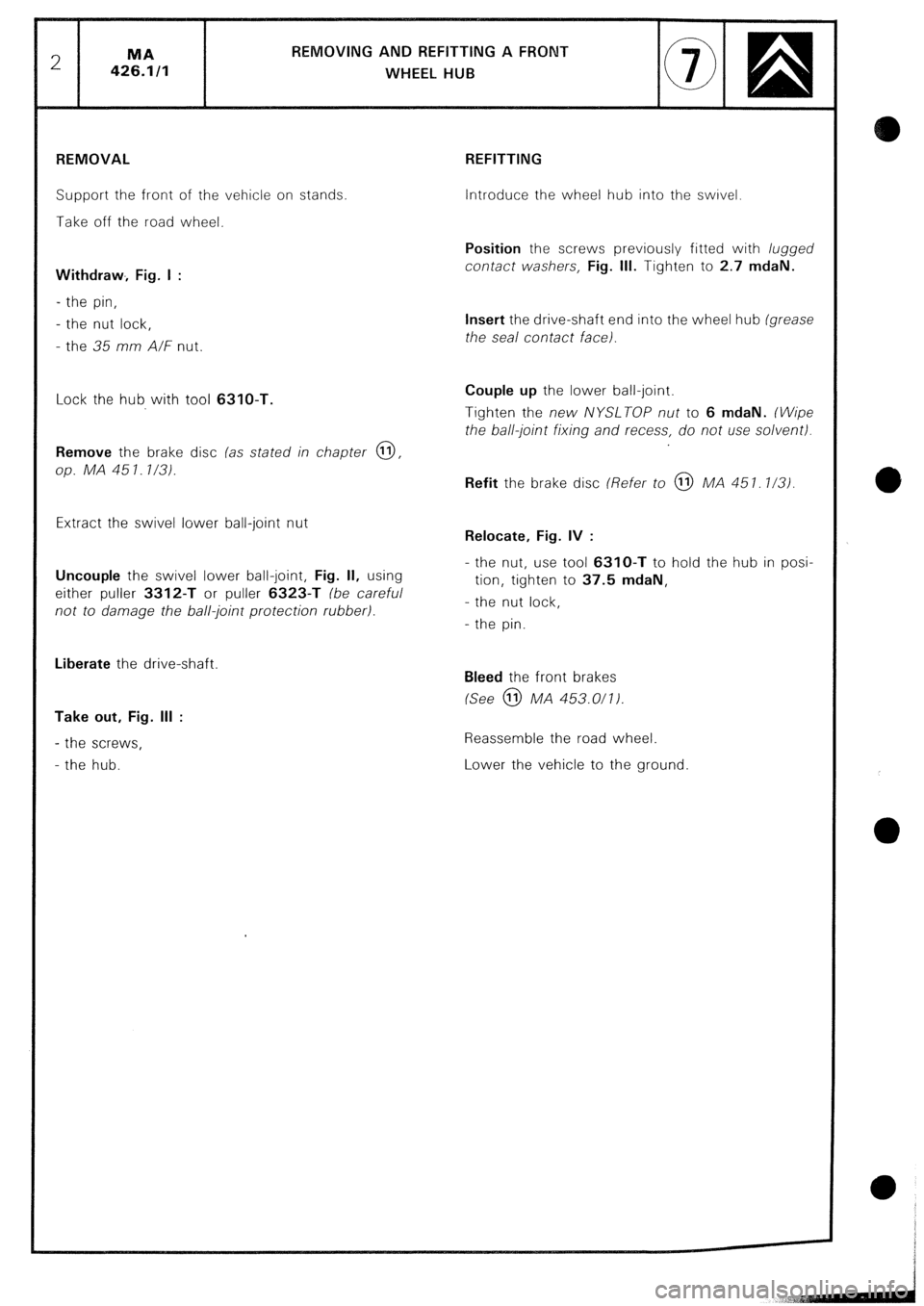
REMOVING AND REFlTTlNG A FRONT
WHEEL HUB
REMOVAL
Support the front of the vehicle on stands
Take off the road wheel.
Withdraw, Fig. I
- the pin,
- the nut lock,
- the 35 mm A/F nut.
Lock the hub with tool 6310-T.
Remove the brake disc fas stated in chapter 0, op.
MA 45 1. l/3/.
Extract the swivel lower ball-joint nut
Uncouple the swivel lower ball-joint, Fig. II, using
either puller 3312-T or puller 6323-T (be careful
not to damage the ball-joint protection rubber).
Liberate the drive-shaft.
Take out, Fig. Ill :
- the screws,
- the hub. REFITTING
Introduce the wheel hub into the swivel.
Position the screws previously fitted with lugged
contact washers, Fig. Ill. Tighten to 2.7 mdaN.
Insert the drive-shaft end into the wheel hub (grease
the seal contact face).
Couple up the lower ball-joint.
Tighten the new NYSLTOP nut to 6 mdaN. (Wipe
the ball-joint fixing and recess, do not use solvent).
Refit the brake disc (Refer to @ MA 451. l/31.
Relocate, Fig. IV :
- the nut, use tool 6310-T to hold the hub in posi-
tion, tighten to 37.5 mdaN,
- the nut lock,
- the pin.
Bleed the front brakes
(See @ MA 453.0/l).
Reassemble the road wheel.
Lower the vehicle to the ground.
Page 319 of 648
REPAIR OF THE HYDRAULIC SYSTEM
FITTING PRECAUTIONS
5. PRECAUTIONS TO BE TAKEN BEFORE WORKING ON THE HYDRAULIC SYSTEM:
a) Carrefully clean the aera of work, the unions and the unit to be removed
- Disconnect the lead from the negative terminal of the battery.
- Only use petrol or lead-free petrol cleaning.
b) Release the pressure in the circuits:
- Place the vehicle in the K/OW~~ position.
- Slacken the pressure regulator release screw (by one turn to one turn and a half, do not remove the screw:
the sealing ball (21, see Fig. I and II page 5, could get lost,
- Wait until the front of the car has reached the low position. 6. PRECAUTIONS TO BE TAKEN DURING REMOVAL.
a) Blank off the metal pipes with plugs, and rubber tubes with round pins of the correct diameter
b) Blank off the openings of components with plugs of the correct diameter.
NOTE: Plugs and pins must be carefully cleaned before insertion 7. CHECK OR TEST OF HYDRAULIC UNITS:
- use 4034-T test bench equipped and designed for use with LHM fluid.
- This bench is painted green and its accessories are marked in green.
- Never use the bench with another fluid or for testing components operating with another fluid (units of a c(D))
car using LHS 2 for instance).
NOTE: The uLe Bozec)) pump used on test benches for checking DIESEL injectors can be resorted to for testing,
components operating with LHM mineral fluid provided that the bench is cleaned first. 8. PRECAUTIONS TO BE TAKEN DURING REFITTING.
a 1 Cleaning:
- steel pipes must be blown through with compressed air,
- rubber tubes and seals must be washed in petrol or lead-free petrol and then dried with compressed air,
- hydraulic units must also be cleaned with petrol or lead-free petrol and blown through with compressed air.
NOTE: Renew all joints and seals during refitting
b) Lubrication.
- Follow the indications as stated in the operations in the Manual.
- Joints and internal parts must be lightly oiled before fitting (use mineral fluid LHM only).
- If parts in contact with hydraulic units have to be greased, use a mineral grease only (as employed for cardan
shafts or bearings). +#+
8531-8532
Page 323 of 648
SPECIFICATION AND PARTICULAR FEATURES OF
THE SOURCE AND RESERVE OF PRESSURE
Reservoir:
The reservoir is located in the left hand rear section of the engine compartment. Its breather, situated on the filler
cap, is connected to a filter-capsule placed in the LH wheelarch.
Level indicator: Fig. I
A: maximum mark
B: minimum mark.
Key to reservoir diagram: Fig. I and II
1 - Overflow return from front and rear suspension cylinders.
2 - Overflow return from security valve and front rear height correctors
3 - Reservoir breather with filter in wheelarch.
4 - Hydraulic control block return pipe (ABS).
5 - Operational and overflow return pipes from compensator-brake control valve.
6 - Operational return pipe from pressure regulator and front and rear height correctors.
7 - Suction line for HP pump.
8 - Baffle deflector.
9 - Filter for overflow and operational return pipes.
10 - Fluid level indicator float.
11 - Filter on HP pump suction line.
Page 327 of 648
SPECIFICATION AND PARTICULAR FEATURES OF
THE SOURCE AND RESERVE OF PRESSURE
Security valve: Fig. I
Calibration pressures for slide valve return spring:
- Pressure for isolation (no supply to suspension at A and D) :
- Pressure for supply to suspension (delivery at A and D) : 110 bars min.
130 bars min.
Key to diagram:
A : Feed to front height corrector.
B : Feed to steering rack and control unit.
C : H.P. inlet
D : Feed to rear height corrector.
E : Leakage return.
(1) : Adjusting shims for the calibration of slide valve return spring.
Shim thickness
(2) : Slide valve.
(3) : Fault detector (mechanically operated through shifting of slide-valve (2) 1.
Brake accumulator: Fig. II
-Capacity: . . . . . . . .._.._..~..._~._............_..........._.....
- Calibration pressure: 0.9 mm
0.4 litres
2
62 f 32 bars
F : HP inlet.
G : Centrifugal regulator, security valve
H: Brake control valve.
Page 359 of 648
REMOVING AND REFITTING
THE DRIVE SHAFT ASSEMBLIES
Support the front of the vehicle on stands 6602-T.
Release the pressure in the hydraulic system.
Set the height control to the “low” position.
Remove: Fig. I:
- the road wheel,
- the pin and nut lock,
- the nut (35 mm A/F). Retain the wheel hub using
tool 6310-T, Fig. I.
Fig. II,
- suspension cylinder swivel ball maintaining pin (I 1,
- anti-roll bar link-rod nut (2).
Uncouple spherical ball (3) from the anti-roll bar link-
rod by means of puller 6320-T, Fig. Ill: (Screw up
the tool nut to the ball-joint stem and fit the tool “U”
part and spindle).
Disconnect the brake pad wear warning lamp electri-
cal harness.
Take off the brake disc cooling plate securing screws. Extract the nut of the swivel lower ball pin.
Uncouple the swivel lower ball pin with extractor
3312-T or 6323-T (Avoid damaging the ball joint
protection rubber).
Removing the LH drive-shaft assembly:
Push the LH drive shaft (5) aside with a chisel (6),
bearing against the heads of the gearbox flange
screws, Fig. V.
Important : If a few hammer strokes are not enough
to push aside drive shaft (51, the circlip is probably
blocked inside the sun gear. In that case, undo
clamp (4) and remove the transmission without its
drive-shaft, (retrieve the rollerl.
Turn the steering through full lock to the left.
Leave the swivel hanging.
Liberate the LH transmission from the hub and remove
it.
Removing the RH drive-shaft assembly:
Slacken the drive-shaft bearing support nuts (71,
Fig. VI.
Swing through a half turn tie rods (81, so as to release
the bearing outer track.
Withdraw drive shaft (9) from the sun gear. (Remove
the shaft, the o’ring seal, bush, and dust seal).
Turn the steering to full right lock; leave the swivel
hanging.
Disengage the RH transmission from the wheel hub
and remove it.
Page 379 of 648
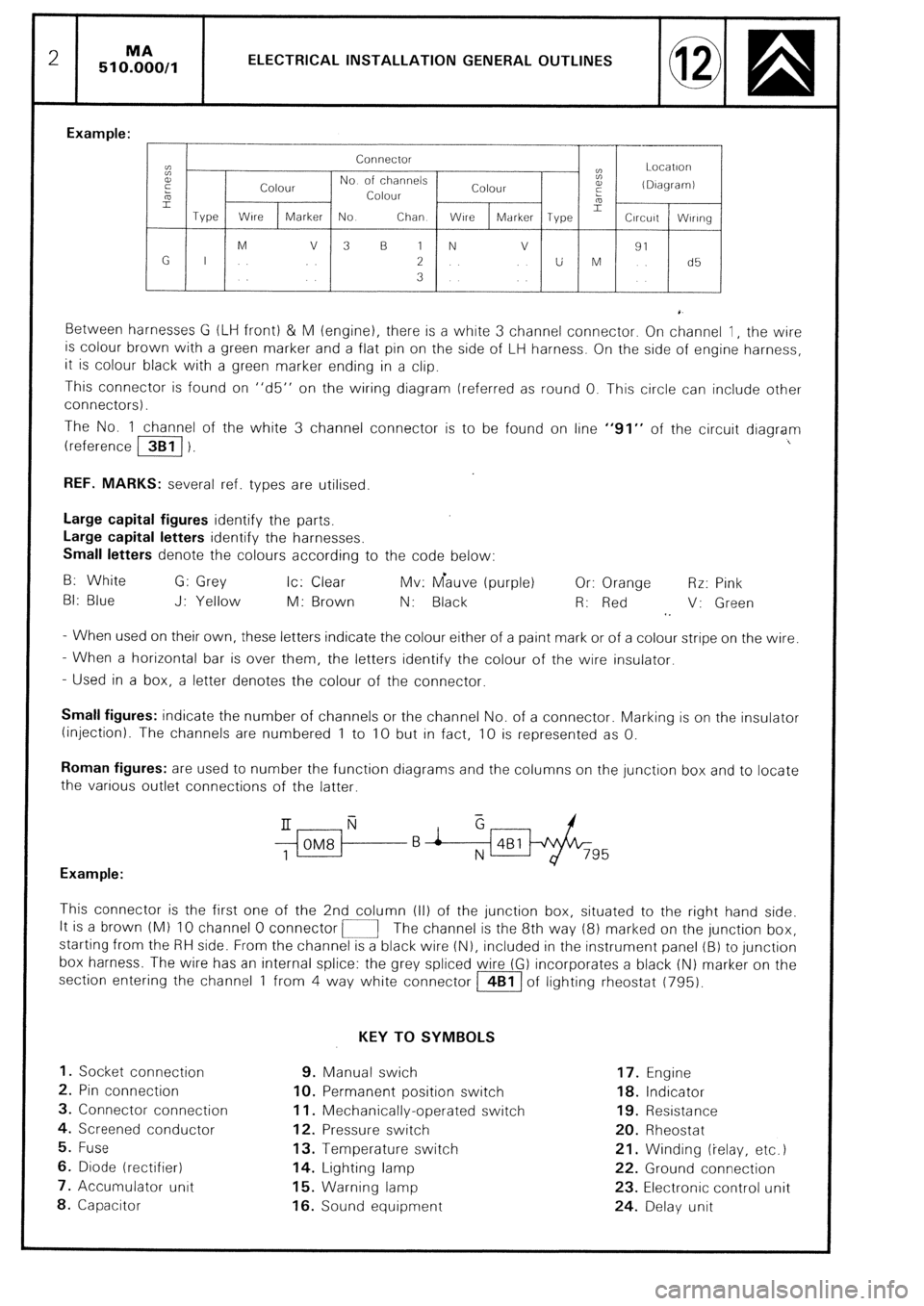
2 51 O%O,l ELECTRICAL INSTALLATION GENERAL OUTLINES
Example:
Connector
cc
t: Locatlori
E
Colour No of channels
Colour a,
(DIagramI
5 Colour :
L
Type Wire 2
Marker No Chan WlrC Marker Type Circuit Wlrlng
M V 3 B 1 N v
91
G I 2 U M d5
3
Between harnesses G (LIH front) & M (engine), there is a white 3 channel connector. On channel 1, the wire
is colour brown with a green marker and a flat pin on the side of LH harness. On the side of engine harness,
it is colour black with a green marker ending in a clip.
This connector is found on “d5” on the wiring diagram (referred as round 0. This circle can include other
connectors).
The No. 1 channel of the white 3 channel connector is to be found on line “91” of the circuit diagram
(reference /3B1/ 1. I
REF. MARKS: several ref. types are utilised.
Large capital figures identify the parts,
Large capital letters identify the harnesses.
Small letters denote the colours according to the code below:
B: White G: Grey Ic: Clear Mv: Gauve (purple) Or: Orange Rr: Pink
BI: Blue J: Yellow M: Brown N: Black R: Red V: Green
1.
- When used on their own, these letters indicate the colour either of a paint mark or of a colour stripe on the wire.
- When a horizontal bar is over them, the letters identify the colour of the wire insulator.
- Used in a box, a letter denotes the colour of the connector.
Small figures: indicate the number of channels or the channel No. of a connector. Marking IS on the insulator
(injection). The channels are numbered 1 to 10 but in fact, 10 is represented as 0.
Roman figures: are used to number the function diagrams and the columns on the junction box and to locate
the various outlet connections of the latter.
$ii-f--B i &Bl/+&-
795
Example:
This connector is the first one of the 2nd column (II) of the junction box, situated to the right hand side.
It is a brown (Ml IO channel 0 connector i-1 The channel is the 8th way (8) marked on the junction box,
starting from the RH side. From the channel is a black wire (N), included in the instrument panel (B) to junction
box harness. The wire has an internal splice: the grey spliced wire (G) incorporates a black (N) marker on the
section entering the channel 1 from 4 way white connector m of lighting rheostat (795).
KEY TO SYMBOLS
1. Socket connection 9. Manual swich 17. Engine
2. Pin connection IO. Permanent position switch 18. Indicator
3. Connector connection 11. Mechanically-operated switch 19. Resistance
4. Screened conductor 12. Pressure switch 20. Rheostat
5. Fuse 13. Temperature switch 21. Winding (ielay, etc.)
6. Diode (rectifier) 14. Lighting lamp 22. Ground connection
7. Accumulator unit 15. Warning lamp 23. Electronic control unit
8. Capacitor 16. Sound equipment 24. Delay unit