warning light Citroen DS3 2015 1.G User Guide
[x] Cancel search | Manufacturer: CITROEN, Model Year: 2015, Model line: DS3, Model: Citroen DS3 2015 1.GPages: 415, PDF Size: 11.95 MB
Page 134 of 415
DS3_en_Chap05_visibilite_ed01-2015
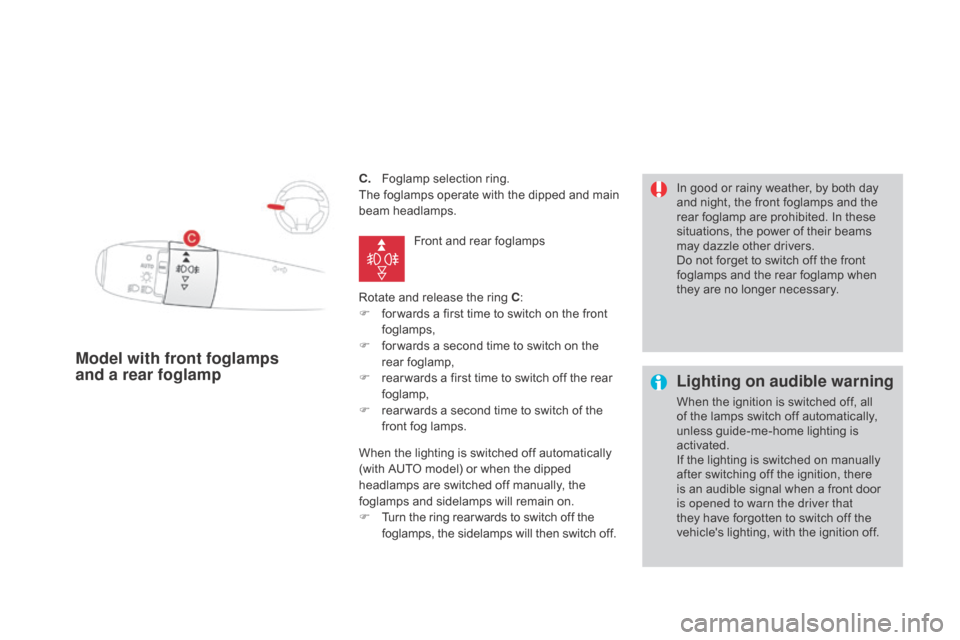
C. Foglamp selection ring.
The foglamps operate with the dipped and main
b
eam
h
eadlamps.
Rotate
and release the ring C:
F
f
or wards a first time to switch on the front
fo
glamps,
F
f
or wards a second time to switch on the
r
ear
fo
glamp,
F
r
ear wards a first time to switch off the rear
fo
glamp,
F
r
ear wards a second time to switch of the
f
ront fog lamps.
Model with front foglamps
and a rear foglamp Lighting on audible warning
When the ignition is switched off, all o
f the lamps switch off automatically,
u
nless guide-me-home lighting is
a
ctivated.
If
the lighting is switched on manually
a
fter switching off the ignition, there
i
s an audible signal when a front door
i
s opened to warn the driver that
they
have forgotten to switch off the
v
ehicle's lighting, with the ignition off.
In
good or rainy weather, by both day
a
nd night, the front foglamps and the
r
ear foglamp are prohibited. In these
s
ituations, the power of their beams
m
ay dazzle other drivers.
Do not forget to switch off the front
f
oglamps and the rear foglamp when
t
hey are no longer necessary.
Front
and
rear
foglamps
When
the
lighting
is
switched
off
automatically
(
with
AUTO
model)
or
when
the
dipped
h
eadlamps
are
switched
off
manually,
the
f
oglamps
and
sidelamps
will
remain
on.
F
T
urn
the
ring
rear wards
to
switch
off
the
f
oglamps,
the
sidelamps
will
then
switch
off.
Page 135 of 415
133
DS3_en_Chap05_visibilite_ed01-2015
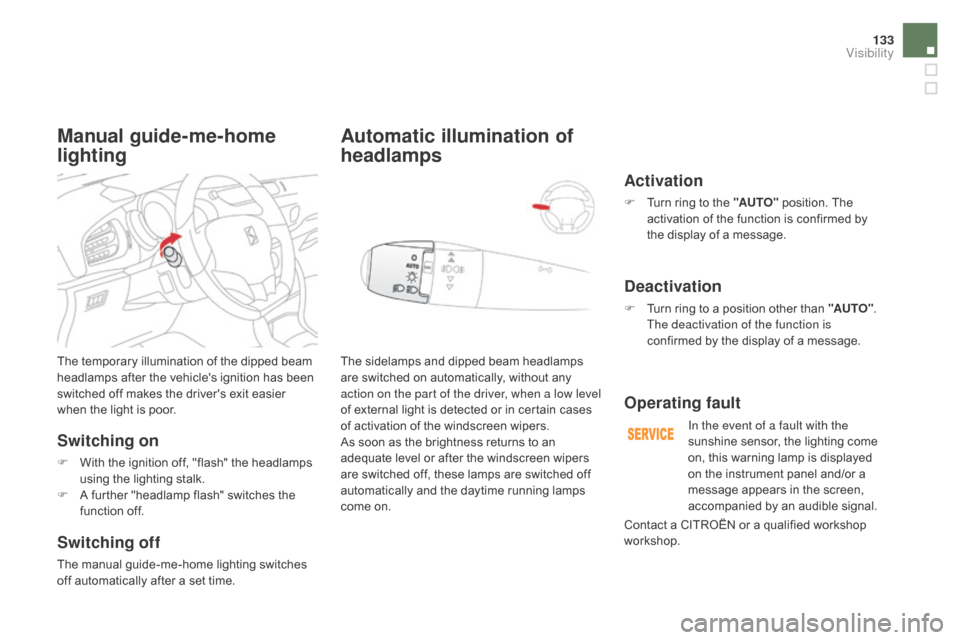
The temporary illumination of the dipped beam headlamps after the vehicle's ignition has been
s
witched off makes the driver's exit easier
w
hen the light is poor.
Switching on
F With the ignition off, "flash" the headlamps u
sing the lighting stalk.
F
A
further "headlamp flash" switches the
f
unction off.
Switching off
The manual guide-me-home lighting switches off automatically after a set time.
Manual guide-me-home
lighting
The sidelamps and dipped beam headlamps are switched on automatically, without any
a
ction on the part of the driver, when a low level
of
external light is detected or in certain cases
o
f activation of the windscreen wipers.
As
soon as the brightness returns to an
a
dequate level or after the windscreen wipers
a
re switched off, these lamps are switched off
a
utomatically and the daytime running lamps
c
ome on.
Automatic illumination of
headlamps
Activation
F Turn ring to the "AUTO" position. The a
ctivation of the function is confirmed by
t
he display of a message.
deactivation
F Turn ring to a position other than "AUTO". T
he deactivation of the function is
confirmed
by the display of a message.
Operating fault
In the event of a fault with the
sunshine sensor, the lighting come
o
n, this warning lamp is displayed
o
n the instrument panel and/or a
m
essage appears in the screen,
a
ccompanied by an audible signal.
Contact
a
CITROËN or a qualified workshop
w
orkshop.
Visibility
Page 146 of 415
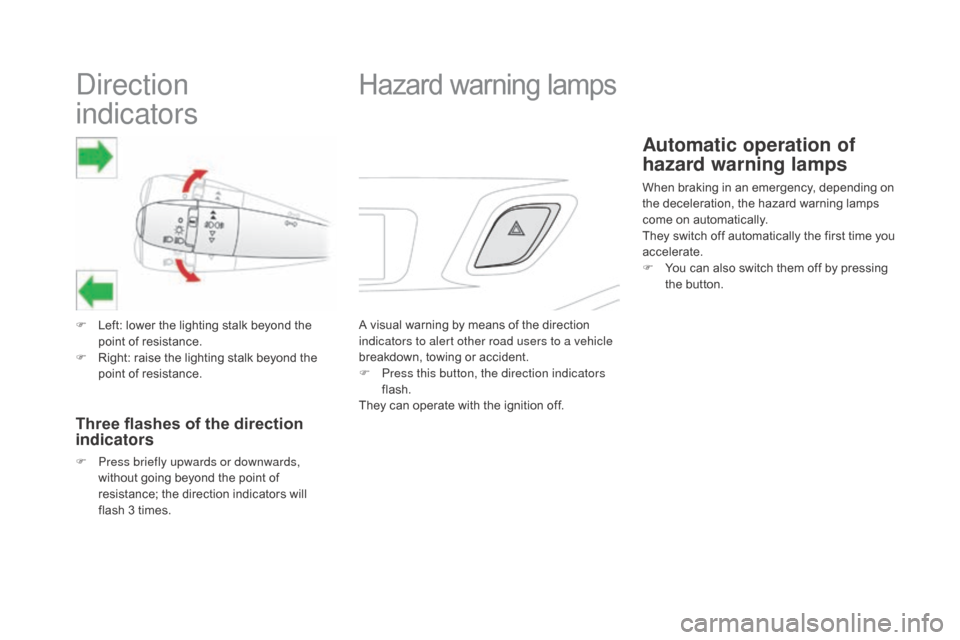
Direction
indicators
F Left: lower the lighting stalk beyond the p
oint of resistance.
F
R
ight: raise the lighting stalk beyond the
p
oint of resistance.
Three flashes of the direction
indicators
F Press briefly upwards or downwards, without going beyond the point of
r
esistance; the direction indicators will
f
lash 3 times.
Hazard warning lam ps
A visual warning by means of the direction i
ndicators to alert other road users to a vehicle
breakdown,
towing or accident.
F
P
ress this button, the direction indicators
flash.
They
can operate with the ignition off.
Automatic operation of
hazard warning lamps
When braking in an emergency, depending on the deceleration, the hazard warning lamps
c
ome on automatically.
They
switch off automatically the first time you
a
ccelerate.
F
Y
ou can also switch them off by pressing
t
he button.
Page 152 of 415
Braking assistance systems
Group of supplementary systems which help you to obtain optimum braking in complete
s
afety in emergency situations:
-
a
nti-lock braking system (ABS),
-
e
lectronic brake force distribution (EBFD),
-
e
mergency braking assistance (EBA).Anti-lock braking system
and electronic brake force
distribution
Linked systems which improve the stability and manoeuvrability of your vehicle when braking,
i
n particular on poor or slippery sur faces.
Activation
The anti-lock braking system comes into operation automatically when there is a risk of
w
heel lock.
Normal
operation of the ABS may make itself
f
elt by slight vibration of the brake pedal.
When
braking in an emergency, press
v
ery firmly without releasing the
p
ressure.
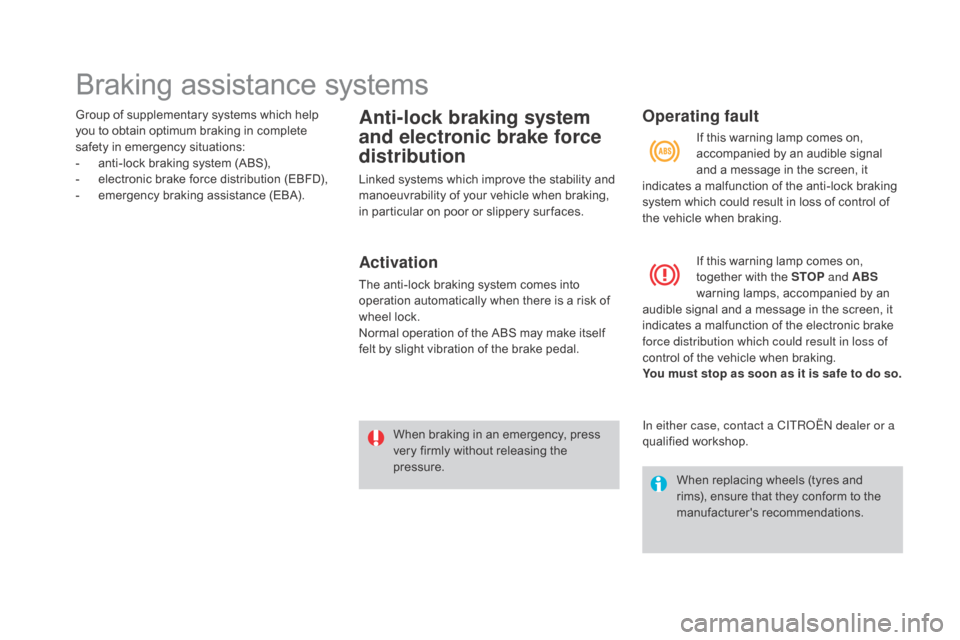
Operating fault
If this warning lamp comes on, together with the STOP and ABS
warning
lamps, accompanied by an
a
udible
signal and a message in the screen, it
i
ndicates
a malfunction of the electronic brake
f
orce distribution which could result in loss of
control
of
the vehicle when braking.
You must stop as soon as it is safe to do so.
When
replacing wheels (tyres and
r
ims), ensure that they conform to the
ma
nufacturer's
r
ecommendations.
If
this warning lamp comes on,
a
ccompanied by an audible signal
a
nd a message in the screen, it
i
ndicates
a malfunction of the anti-lock braking
s
ystem
which could result in loss of control of
t
he
vehicle when braking.
In either case, contact a CITROËN dealer or a
qualified
w
orkshop.
Page 161 of 415
159
DS3_en_Chap06_securite_ed01-2015
The driver must ensure that passengers use the seat belts correctly and that they are all
restrained
securely before setting off.
Wherever you are seated in the vehicle,
always fasten your seat belt, even for short
journeys.
Do
not interchange the seat belt buckles as
t
hey will not fulfil their role fully.
The seat belts are fitted with an inertia reel
permitting
automatic adjustment of the length
o
f the strap to your size. The seat belt is
s
towed automatically when not in use.
Before and after use, ensure that the seat
belt
is reeled in correctly.
The
lower part of the strap must be
p
ositioned as low as possible on the pelvis.
The
upper part must be positioned in the
h
ollow of the shoulder.
The
inertia reels are fitted with an automatic
l
ocking device which comes into operation in
t
he event of a collision, emergency braking
o
r if the vehicle rolls over. You can release
t
he device by pulling the strap firmly and then
r
eleasing it so that it reels in slightly.In
order to be effective, a seat belt must:
- b e tightened as close to the body as
p
ossible,
-
b
e pulled in front of you with a smooth
m
ovement, checking that it does not
t
wist,
-
b
e used to restrain only one person,
-
n
ot bear any trace of cuts or fraying,
-
n
ot be converted or modified to avoid
a
ffecting
it
s
p
erformance.
In
a
ccordance
w
ith
c
urrent
s
afety
r
egulations,
f
or all repairs on your vehicle's seat belts, go
t
o a qualified workshop with the skills and
e
quipment needed, which a CITROËN dealer
i
s able to provide.
Have
your seat belts checked regularly by
a
CITROËN dealer or a qualified workshop,
p
articularly if the straps show signs of
d
amage.
Clean the seat belt straps with soapy water or
a
textile cleaning product, sold by CITROËN
d
ealers.
After
folding or moving a seat or rear bench
s
eat, ensure that the seat belt is positioned
and
reeled in correctly.Recommendations
for children
Use a suitable child seat if the passenger is less than 12 years old or shorter than one
and
a half metres.
Never
use the same seat belt to secure
m
ore than one person.
Never
allow a child to travel on your lap.
For
more information, refer to the "Child
sea
ts"
se
ction.
In the event of an impact
depending on the nature and
seriousness of the impact , the
pretensioning
device may be deployed
b
efore and independently of the airbags.
D
eployment of the pretensioners is
a
ccompanied by a slight discharge of
h
armless smoke and a noise, due to the
a
ctivation of the pyrotechnic cartridge
i
ncorporated in the system.
In
all cases, the airbag warning lamp
c
omes on.
Following
an impact, have the seat belts
s
ystem
c
hecked,
a
nd
i
f
n
ecessary
r
eplaced,
b
y a CITROËN dealer or a qualified
w
orkshop.
Safety
Page 233 of 415
231
DS3_en_Chap08_info-pratiques_ed01-2015
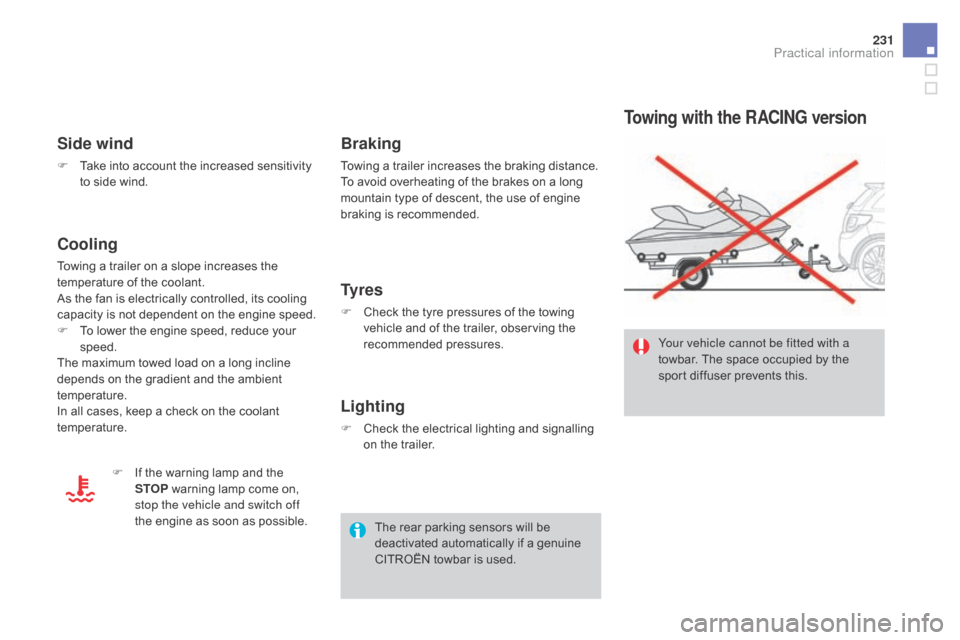
Towing with the RACIng version
Your vehicle cannot be fitted with a
towbar.
The space occupied by the
s
port diffuser prevents this.
Side wind
F Take into account the increased sensitivity t
o side wind.
Cooling
Towing a trailer on a slope increases the temperature of the coolant.
As
the fan is electrically controlled, its cooling
c
apacity is not dependent on the engine speed.
F
T
o lower the engine speed, reduce your
s
peed.
The
maximum towed load on a long incline
d
epends on the gradient and the ambient
t
emperature.
In
all cases, keep a check on the coolant
t
emperature. F
I
f the warning lamp and the
S
TOP
warning lamp come on,
s
top the vehicle and switch off
the
engine as soon as possible.
Braking
Towing a trailer increases the braking distance.
T o avoid overheating of the brakes on a long
m
ountain type of descent, the use of engine
b
raking is recommended.
Ty r e s
F Check the tyre pressures of the towing v
ehicle and of the trailer, observing the
re
commended
p
ressures.
Lighting
F Check the electrical lighting and signalling o
n the trailer.
The
rear parking sensors will be
d
eactivated automatically if a genuine
C
ITROËN towbar is used.
Practical information
Page 255 of 415
253
DS3_en_Chap10_caracteristiques_ed01-2015
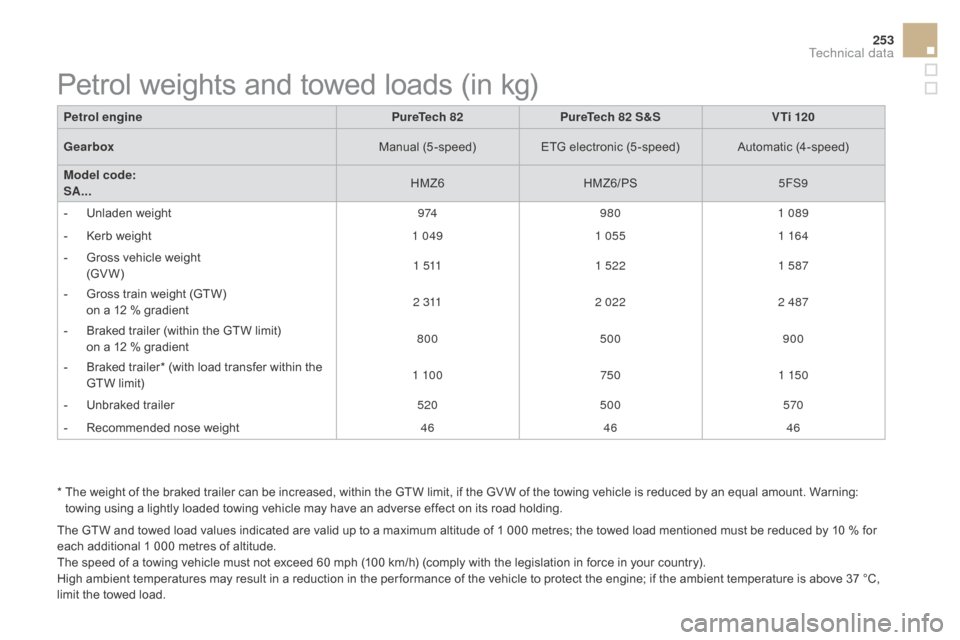
* The weight of the braked trailer can be increased, within the GTW limit, if the GV W of the towing vehicle is reduced by an equal amount. Warning: t
owing using a lightly loaded towing vehicle may have an adverse effect on its road holding.
The
GTW and towed load values indicated are valid up to a maximum altitude of 1 000 metres; the towed load mentioned must be reduced by 10 % for
e
ach additional 1 000 metres of altitude.
The
speed of a towing vehicle must not exceed 60 mph (100 km/h) (comply with the legislation in force in your country).
High
ambient temperatures may result in a reduction in the per formance of the vehicle to protect the engine; if the ambient temperature is above 37 °C,
l
imit the towed load.
Petrol engine
PureTech 82PureTech 82 S&S V Ti 120
ge
arbox
Manual
(
5-speed)
ETG
el
ectronic
(
5-speed) Automatic
(
4-speed)
Model code:
SA... HMZ6
HMZ6/PS 5FS9
-
U
nladen weight
9 749801 089
-
K
erb weight
1 0491 055 1 16 4
-
G
ross vehicle weight
(GV W) 1 511
1 522 1 587
-
G
ross train weight (GTW)
o
n a 12 % gradient
2 311
2 022 2 487
-
B
raked trailer (within the GTW limit)
o
n a 12 % gradient
800
500900
-
B
raked trailer* (with load transfer within the
G
TW limit)
1 10 0
7501 150
-
U
nbraked trailer
520500 570
-
R
ecommended nose weight
464646
Petrol weights and towed loads (in kg)
Technical data
Page 256 of 415
DS3_en_Chap10_caracteristiques_ed01-2015
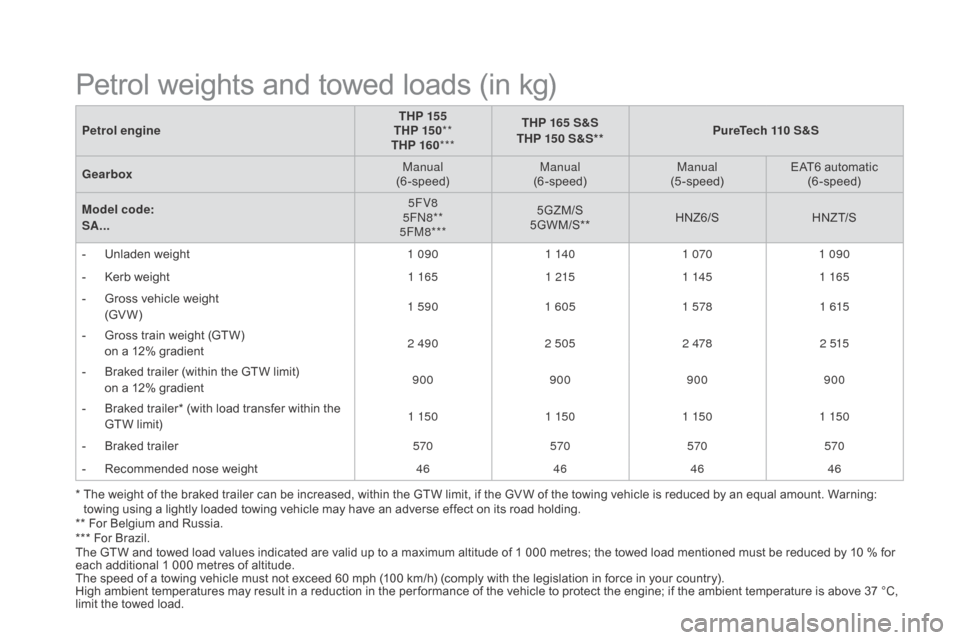
Petrol engineTHP 155
THP 15 0 **
THP 160 *** THP 165 S&S
THP 150 S&S** PureTech 110 S&S
ge
arbox Manual
(6-speed) Manual
(6-speed) Manual
(5-speed) EAT6
automatic
(
6-speed)
Model code:
SA... 5FV8
5FN8**
5FM8*** 5GZM/S
5GWM/S** HNZ6/S
H NZ T/S
-
U
nladen weight 1 0901 1401 0701 090
-
K
erb weight 1 1651 2151 145 1 165
-
G
ross vehicle weight
(GV W) 1 590
1 605 1 5781 615
-
G
ross train weight (GTW)
o
n a 12% gradient 2 490
2 505 2 4782 515
-
B
raked trailer (within the GTW limit)
o
n a 12% gradient 900
900900900
-
B
raked trailer* (with load transfer within the
G
TW limit) 1 150
1 1501 1501 150
-
B
raked trailer 570570570570
-
R
ecommended nose weight 46464646
The
GTW and towed load values indicated are valid up to a maximum altitude of 1 000 metres; the towed load mentioned must be reduced by 10 % for
e
ach additional 1 000 metres of altitude.
The
speed of a towing vehicle must not exceed 60 mph (100 km/h) (comply with the legislation in force in your country).
High
ambient temperatures may result in a reduction in the per formance of the vehicle to protect the engine; if the ambient temperature is above 37 °C,
l
imit the towed load.
*
T
he weight of the braked trailer can be increased, within the GTW limit, if the GV W of the towing vehicle is reduced by an equal amount. Warning:
t
owing using a lightly loaded towing vehicle may have an adverse effect on its road holding.
**
For Belgium and Russia.
***
For Brazil.
Petrol weights and towed loads (in kg)
Page 259 of 415
257
DS3_en_Chap10_caracteristiques_ed01-2015
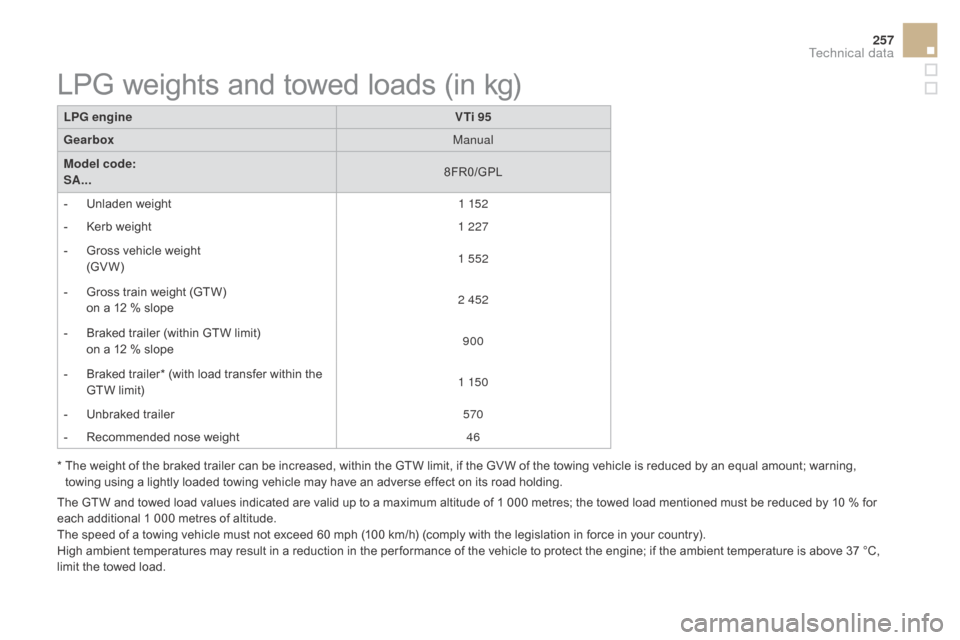
LPg engineVTi 95
ge
arbox Manual
Model code:
SA... 8FR0/GPL
-
U
nladen weight 1 152
-
K
erb weight 1 227
-
G
ross vehicle weight
(GV W) 1 552
-
G
ross train weight (GTW)
o
n a 12 % slope 2 452
-
B
raked trailer (within GTW limit)
o
n a 12 % slope 900
-
B
raked trailer* (with load transfer within the
G
TW limit) 1 150
-
U
nbraked trailer 570
-
R
ecommended nose weight 46
The
GTW and towed load values indicated are valid up to a maximum altitude of 1 000 metres; the towed load mentioned must be reduced by 10 % for
e
ach additional 1 000 metres of altitude.
The
speed of a towing vehicle must not exceed 60 mph (100 km/h) (comply with the legislation in force in your country).
High
ambient temperatures may result in a reduction in the per formance of the vehicle to protect the engine; if the ambient temperature is above 37 °C,
l
imit the towed load.
*
T
he weight of the braked trailer can be increased, within the GTW limit, if the GV W of the towing vehicle is reduced by an equal amount; warning,
t
owing using a lightly loaded towing vehicle may have an adverse effect on its road holding.
LPG weights and towed loads (in kg)
Technical data
Page 261 of 415
259
DS3_en_Chap10_caracteristiques_ed01-2015
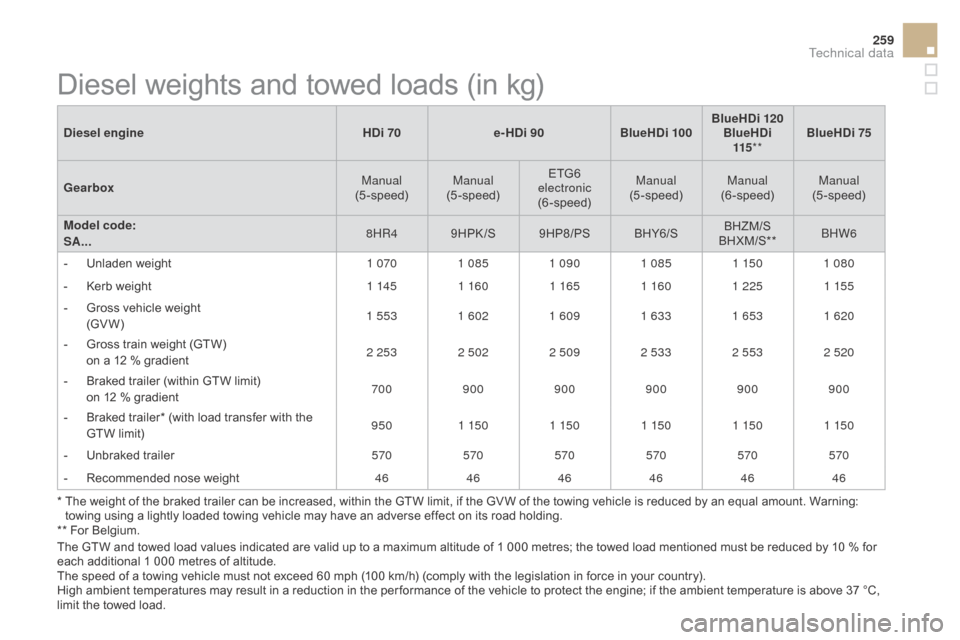
diesel engineH d i 70e-H d i 90BlueH d i 100BlueH d i 120
BlueH d i
115 ** BlueH
d i 75
ge
arbox Manual
(5-speed) Manual
(5-speed) ETG6
e
lectronic
(6-speed) Manual
(5-speed) Manual
(6-speed) Manual
(5-speed)
Model code:
SA... 8HR4
9HPK /S 9HP8/PS BHY6/SBHZM/S
BHXM/S** BHW6
-
U
nladen weight 1 0701 085 1 090 1 085 1 1501 080
-
K
erb weight 1 1451 160 1 1651 1601 225 1 155
-
G
ross vehicle weight
(GV W) 1 553
1 6021 609 1 6331 653 1 620
-
G
ross train weight (GTW)
o
n a 12 % gradient 2 253
2 5022 509 2 5332 553 2 520
-
B
raked trailer (within GTW limit)
o
n 12 % gradient 700
900 900900900900
-
B
raked trailer* (with load transfer with the
G
TW limit) 950
1 150 1 1501 1501 1501 150
-
U
nbraked trailer 570570570570570570
-
R
ecommended nose weight 464646464646
The
GTW and towed load values indicated are valid up to a maximum altitude of 1 000 metres; the towed load mentioned must be reduced by 10 % for
e
ach additional 1 000 metres of altitude.
The
speed of a towing vehicle must not exceed 60 mph (100 km/h) (comply with the legislation in force in your country).
High
ambient temperatures may result in a reduction in the per formance of the vehicle to protect the engine; if the ambient temperature is above 37 °C,
l
imit the towed load.
Diesel weights and towed loads (in kg)
* The weight of the braked trailer can be increased, within the GTW limit, if the GV W of the towing vehicle is reduced by an equal amount. Warning: t
owing using a lightly loaded towing vehicle may have an adverse effect on its road holding.
**
For Belgium.
Technical data