ECU CITROEN DS4 2010 User Guide
[x] Cancel search | Manufacturer: CITROEN, Model Year: 2010, Model line: DS4, Model: CITROEN DS4 2010Pages: 421, PDF Size: 8.05 MB
Page 176 of 421

174
U: seating position suitable for the installation
of a child seat secured using the seat belt
and universally approved rear ward facing
and/or for ward facing.
U(R1) :
i
dentical to U , with the vehicle's seat
backrest inclined fully for wards.
U(R2) :
i
dentical to U , with the vehicle's seat
adjusted to the highest position.
X :
s
eating position not suitable for installing a
child seat for the weight group indicated. Remove and stow the head restraint
before installing a child seat with
backrest on a passenger seat. Refit the
head restraint once the child seat has
been removed.
(a)
U niversal child seat: child seat which can be
installed in all vehicles using the seat belt.
(b)
G
roup 0: from birth to 10 kg. Infant car seats
and "car cots" cannot be installed on the
front passenger seat.
(c)
C
onsult the legislation in force in your
country before installing your child on this
seat.
(d)
T
o install a child seat at the rear, rear ward
or for ward facing, move the front seat
for ward, then straighten the backrest to
allow enough room for the child seat and the
child's legs.
05
Safety
Page 177 of 421

175
Your vehicle has been approved in accordance
with the latest ISOFIX regulation .
The seats, represented below, are fitted with
regulation ISOFIX mountings:
"ISOFIX" mountings
There are three rings for each seat: -
a r
ing B
, located behind the seat and
identified by a marking, referred to as the
Top Tether for fixing the upper strap.
This ISOFIX mounting system provides fast,
reliable and safe fitting of the child seat in your
vehicle.
The ISOFIX child seats are fitted with two
latches which are secured on the two rings A .
Some seats also have an upper strap , known
as the Top Tether, which is attached to ring B .The incorrect installation of a child seat
in a vehicle compromises the child's
protection in the event of an accident.
Strictly follow the fitting instructions provided in
the user guide supplied with the child seat.
For information on the possibilities for installing
ISOFIX child seats in your vehicle, refer to the
summary table. When fitting an ISOFIX child seat to the
left-hand rear seat of the benchseat,
before fitting the seat, first move the
centre rear seat belt towards the middle
of the vehicle, so as to avoid the seat
inter fering with the operation of the
seat belt.
-
p
ass the upper strap of the child seat
behind the seat backrest, centring it
between the apertures for the head
restraint rods,
-
f
ix the hook of the upper strap to the ring B,
-
t
ighten the upper strap.
To secure the child seat to the TOP TETHER :
-
r
emove and stow the head restraint before
installing the child seat on the seat (refit it
once the child seat has been removed),
-
t
wo rings A , located between the seat
backrest and cushion, indicated by a
marking,
05
Safety
Page 178 of 421

176
ISOFIX child seats recommended by CITROËN
Refer also to the child seat
manufacturer's fitting instructions for
information on installing and removing
the seat.
CITROËN offers a range of ISOFIX child seats listed and type approved for your vehicle.
"RÖMER Baby- Safe Plus" and its ISOFIX base
(size category: E )
Group 0+: from bir th to 13 kg
Installed rear ward facing using an ISOFIX
base which is attached to the rings A .
The base has a support leg, adjustable for
height, which sits on the vehicle's floor.
This child seat can also be secured with a
seat belt. In this case, only the shell is used
and attached to the vehicle's seat by the
three-point seat belt. Baby P2C Mini and its ISOFIX bas
e
(size categories: C, D, E)
Group 0+: from bir th to 13 kg
Installed rear ward facing using an ISOFIX
base which is attached to the rings A .
The base has a support leg, adjustable for
height, which sits on the vehicle's floor.
This seat can also be secured with a seat
belt.
In this case only the seat shell is used
and
is
attached to the vehicle's seat by the
three-point seat belt.
05
Safety
Page 179 of 421
177
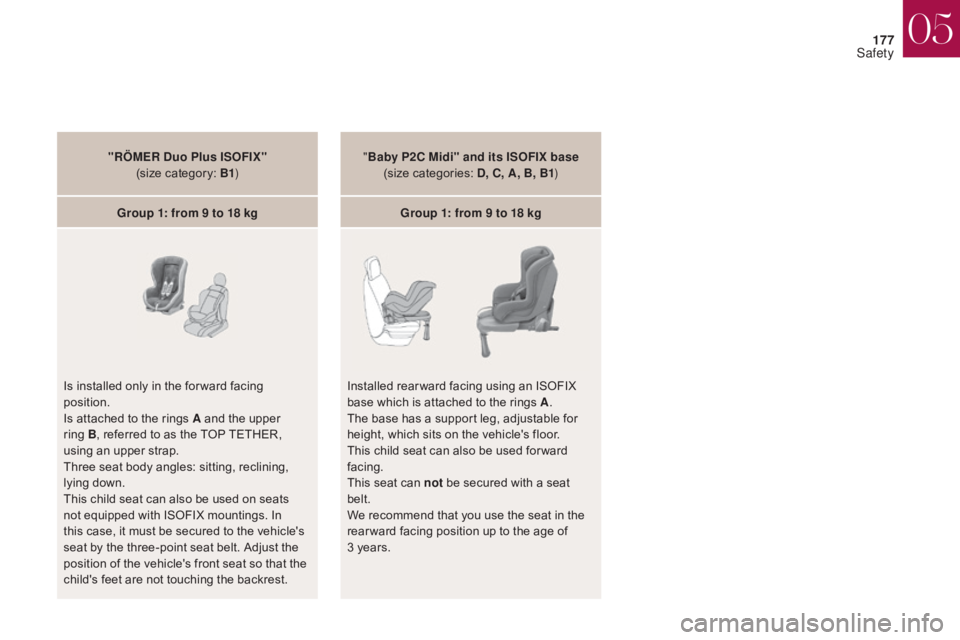
"RÖMER Duo Plus ISOFIX" (size category: B1 )
Group 1: from 9 to 18 kg
Is installed only in the for ward facing
position.
Is attached to the rings A and the upper
ring
B , referred to as the TOP TETHER,
using an upper strap.
Three seat body angles: sitting, reclining,
lying down.
This child seat can also be used on seats
not equipped with ISOFIX mountings. In
this case, it must be secured to the vehicle's
seat by the three-point seat belt. Adjust the
position of the vehicle's front seat so that the
child's feet are not touching the backrest. "
Baby P2C Midi" and its ISOFIX base
(size c ategories: D, C, A, B, B1 )
Group 1: from 9 to 18 kg
Installed rear ward facing using an ISOFIX
base which is attached to the rings A .
The base has a support leg, adjustable for
height, which sits on the vehicle's floor.
This child seat can also be used for ward
facing.
This seat can not be secured with a seat
belt.
We recommend that you use the seat in the
rear ward facing position up to the age of
3
years.
05
Safety
Page 180 of 421

178
Locations for ISOFIX child seatsIn accordance with European Regulations, this table indicates the options for installing ISOFIX child seats on seats in the vehicle fitted with ISOFIX
mountings.
In the case of universal and semi-universal ISOFIX child seats, the ISOFIX size category, determined by a letter from A to G, is indicated on the child
seat next to the ISOFIX logo.
I UF: seat suitable for the installation of an I sofix Universal seat, " For ward facing" secured using the
upper strap.
IL- SU: seat suitable for the installation of an I sofix Semi-Universal seat either:
-
r
ear ward facing fitted with an upper strap or a support leg,
-
f
or ward facing fitted with a support leg,
-
a
n infant car seat fitted with an upper strap or a support leg.
For advice on securing of the upper strap, refer to the "ISOFIX mountings" section.
* Infant car seats and "car cots" cannot be installed on the front passenger seat.
** The ISOFIX infant car seat, secured on the lower rings of a vehicle ISOFIX seat, occupies two rear seats. Weight of the child
/indicative age
Less than 10 kg (group 0)
Up to approx. 6
monthsLess than 10 kg
(group 0)
Less than 13 kg (group 0+)
Up to approx. 1 year From 9 to 18 kg (group 1)
From approx. 1 to 3 years
Type of ISOFIX child seat Infant car seat*rearward facing rearward facing forward facing
ISOFIX size categor y F G C D E C D A B B1
ISOFIX child seats universal and semi-
universal which can be installed on the rear
outer seats IL- SU
** IL- SU IL- SU IUF
IL- SU
Remove and stow the head restraint
before installing a child seat with a
backrest on a passenger seat. Refit the
head restraint once the child seat has
been removed.
05
Safety
Page 181 of 421

179
Advice
The incorrect installation of a child seat in a
vehicle compromises the child's protection
in the event of an accident.
Ensure that there is no seat belt or seat belt
buckle under the child seat, as this could
destabilise it.
Remember to fasten the seat belts or the
child seat harnesses keeping the slack
relative to the child's body to a minimum,
even for short journeys.
When installing a child seat using the seat
belt, ensure that the seat belt is tightened
correctly on the child seat and that it
secures the child seat firmly on the seat
of your vehicle. If your passenger seat is
adjustable, move it for wards if necessary.For optimum installation of the for ward
facing child seat, ensure that the back of
the child seat is as close as possible to the
backrest of the vehicle's seat, in contact if
possible.
You must remove the head restraint before
installing a child seat with backrest to a
passenger seat.
Ensure that the head restraint is stored or
attached securely to prevent it from being
thrown around the vehicle in the event of
sharp braking. Refit the head restraint when
the child seat is removed.
As a safety precaution, do not leave:
-
a c
hild or children alone and
unsupervised in a vehicle,
-
a c
hild or an animal in a vehicle which
is exposed to the sun, with the windows
closed,
-
t
he keys within reach of children inside
the vehicle.
To prevent accidental opening of the doors
and rear windows, use the child lock.
Take care not to open the rear windows by
more than one third.
To protect young children from the rays of
the sun, fit side blinds on the rear windows.
At rear seating positions, always leave
sufficient space between the front seat and:
-
a r
ear ward facing child seat,
-
t
he child's feet for a child seat fitted
forward facing.
To do this, move the front seat for wards
and, if necessary, move its backrest into the
upright position.
Children at the front
The legislation on carrying children on the
front passenger seat is specific to each
country. Refer to the legislation in force in
your country.
Deactivate the passenger's front airbag
when a rear ward facing child seat is
installed on the front passenger seat.
Otherwise, the child risks being seriously
injured or killed if the airbag is deployed.
Installing a booster seat
The chest part of the seat belt must be
positioned on the child's shoulder without
touching the neck.
Ensure that the lap part of the seat belt
passes correctly over the child's thighs.
CITROËN recommends the use of a
booster seat which has a back, fitted with a
seat belt guide at shoulder level.
05
Safety
Page 235 of 421

233
Towbar with quickly detachable towball
For more information on the Technical
data and in particular the maximum
trailer weight and the recommended
nose weight, refer to the corresponding
section.
For more information on the Driving
advice , in particular when towing
a trailer, refer to the corresponding
section.
Observe the legislation in force in the
country in which you are driving.
Presentation
1.
Carrier
2. P rotective blanking plug.
3.
S
ecurity ring.
4.
F
olding trailer harness socket.
5.
D
etachable towball.
6.
L
ocking / unlocking wheel.
7.
S
ecurity key lock.
8.
L
ocking wheel protector.
9.
Ba
ll protector.
10.
St
orage bag. The locking wheel is not in contact with the
towball (gap of about 5 mm).
The green mark is visible.
The lock for the locking wheel is facing
rearward.
The locking wheel is in contact with the towball.
Then green mark is hidden.
The lock for the locking wheel is facing for ward.
This towbar allows the towball to be fitted and
removed quickly and easily without the use
of tools. Installed behind the rear bumper, the
towbar is invisible after removing the towball
and folding the trailer harness socket carrier.
A. Locked position
B. Unlocked position
07
Practical information
Page 236 of 421
234
Before each use
Check that the towball is correctly fitted by verifying the following points:
- t he towball is correctly locked in place (position A ),
-
t
he security key lock is on and the key removed; the locking wheel can no longer be
operated,
-
t
he towball must no longer move at all in its carrier; try to shake it by hand.
During use
Never unlock the device when a trailer or load carrier is fitted to the towball.
Never exceed the maximum authorised weight for the vehicle plus trailer (Gross Train
Weight - GTW).
Before driving, check the adjustment of the headlamp beam height.
For more information on Adjusting the headlamps , refer to the corresponding section.
After use
For journeys made without a trailer or load carrier, the trailer harness socket must be folded
away, the towball removed and
the blanking plug inserted in the carrier. This measure
applies particularly if the towball could hinder visibility of the number plate or lighting.
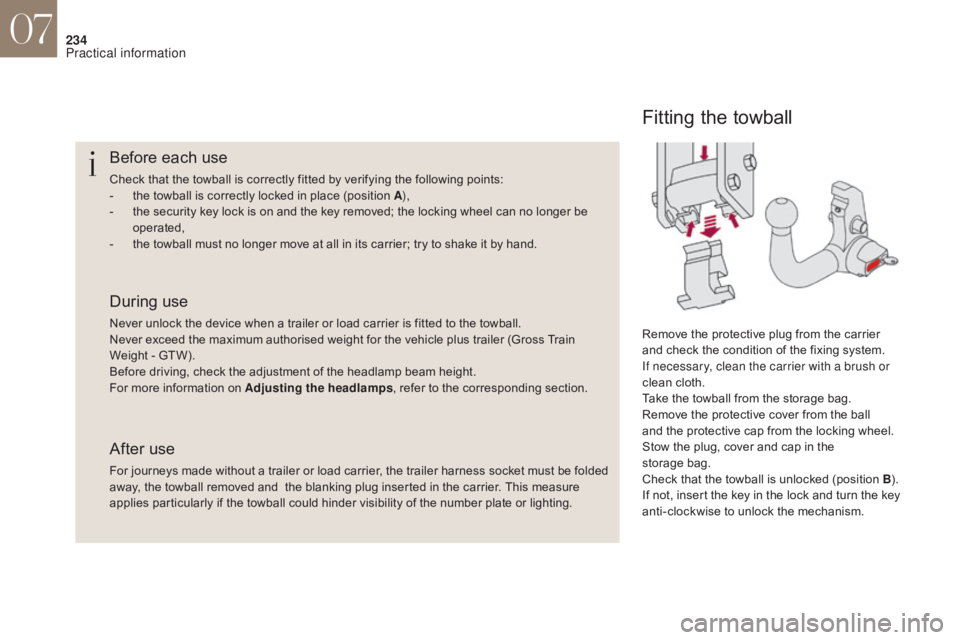
Fitting the towball
Remove the protective plug from the carrier
and check the condition of the fixing system.
If necessary, clean the carrier with a brush or
clean cloth.
Take the towball from the storage bag.
Remove the protective cover from the ball
and
the protective cap from the locking wheel.
Stow the plug, cover and cap in the
storage
bag.
Check that the towball is unlocked (position B ).
If not, insert the key in the lock and turn the key
anti-clockwise to unlock the mechanism.
07
Practical information
Page 238 of 421
236
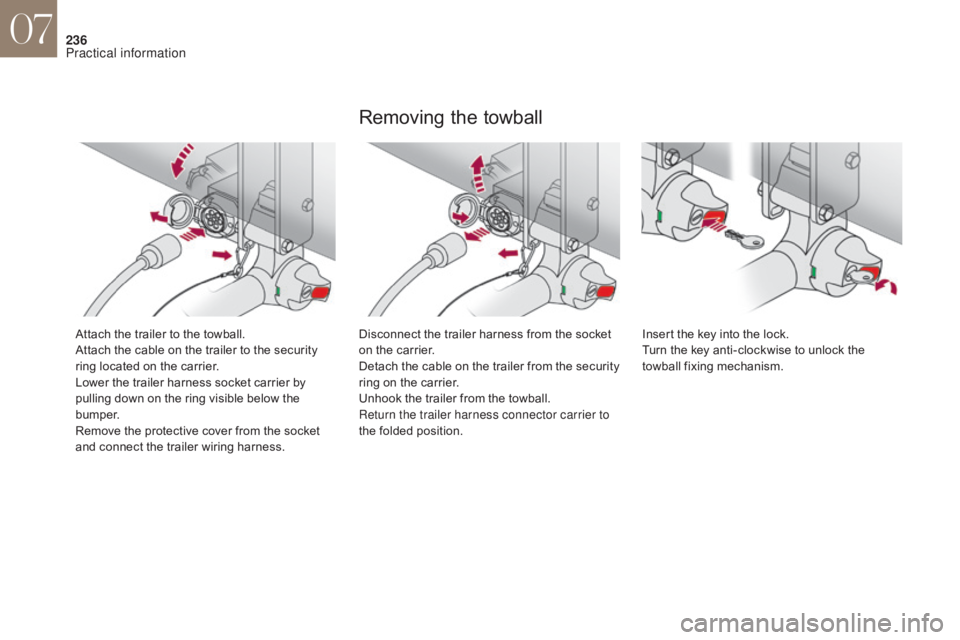
Attach the trailer to the towball.
Attach the cable on the trailer to the security
ring located on the carrier.
Lower the trailer harness socket carrier by
pulling down on the ring visible below the
b u m p e r.
Remove the protective cover from the socket
and connect the trailer wiring harness.
Removing the towball
Disconnect the trailer harness from the socket
on the carrier.
Detach the cable on the trailer from the security
ring on the carrier.
Unhook the trailer from the towball.
Return the trailer harness connector carrier to
the folded position.Insert the key into the lock.
Turn the key anti-clockwise to unlock the
towball fixing mechanism.
07
Practical information
Page 244 of 421

242
Bonnet
Opening
F Pull the interior bonnet release lever A,
located at the bottom of the door aperture. F
P
ush the exterior safety catch B to the left
and raise the bonnet.
F
U
nclip the stay C from its housing on the
back of the bonnet.
F
F
ix the stay in the notch to hold the bonnet
open.
The location of the interior bonnet
release lever prevents opening of
the bonnet while the front left door is
closed. Do not open the bonnet in high winds.
When the engine is hot, handle the
exterior safety catch and the bonnet
stay with care (risk of burns).
Before doing anything under the
bonnet, deactivate the Stop & Start
system to avoid any risk of injury
resulting from an automatic change to
START mode.
Closing
F Take the stay out of the support notch.
F
C lip the stay in its housing on the back of
the bonnet.
F
L
ower the bonnet and release it at the end
of its travel.
F
P
ull on the bonnet to check that it is
secured correctly.
The cooling fan may star t after switching
off the engine: take care with ar ticles and
clothing that might be caught by the fan
blades.
Because of the presence of electrical
equipment under the bonnet, it is
recommended that exposure to water
(rain, washing,
...) be limited.
F
O
pen the front left door.
07
Practical information