fuel CITROEN DS4 2010 Owner's Manual
[x] Cancel search | Manufacturer: CITROEN, Model Year: 2010, Model line: DS4, Model: CITROEN DS4 2010Pages: 421, PDF Size: 8.05 MB
Page 206 of 421

204
Tyre under-inflation detection
System which automatically checks the
pressures of the tyres while driving.
The system continuously monitors the
pressures of the four tyres, as soon as the
vehicle is moving.Driving with under-inflated tyres
increases fuel consumption.The tyre pressures for your vehicle can
be found on the tyre pressure label.
The tyre pressures must be checked
when the tyres are cold (vehicle
stopped for 1 hour or after driving for
less then 6 miles (10 km) at moderate
speed). Other wise, add 0.3 bar to the
values indicated on the label.
For more information on Identification
markings
, including the tyre pressure
label, refer to the corresponding
section.
This system does not avoid the need
to check the tyre pressures regularly
(including the spare wheel) and before
a long journey.
Driving with under-inflated tyres
adversely affects road holding,
extends braking distances and causes
premature tyre wear, particularly under
arduous conditions (vehicle loaded,
high speed, long journey).
The tyre under-inflation detection system is an
aid to driving which does not replace the need
for vigilance on the part of the driver. Pressure sensors are located in the valve of
each tyre (except the spare wheel).
The system triggers an alert if a drop in
pressure is detected in one or more tyres.
06
Driving
Page 208 of 421

206
Stop & Start
Operation
Going into engine STOP mode
STOP mode does not affect the
functionality of the vehicle, such as
braking, power steering, for example.
Never refuel with the engine in
STOP mode; you must switch off the
ignition with the key or the "START/
STOP" button.
With a manual gearbox, at a
speed below 12 mph (20 km/h),
If your vehicle is fitted with the
system, a time counter calculates
the sum of the periods in STOP STOP mode is not invoked when:
-
t
he vehicle is on a steep slope (up or
d ow n),
-
t
he driver's door is open,
-
t
he driver's seat belt is not fastened,
-
t
he vehicle has not exceeded 6 mph
(10 km/h) since the last engine start (using
the key or the "START/STOP" button),
-
t
he electric parking brake is applied or
being applied,
-
t
he engine is needed to maintain a
comfortable temperature in the passenger
compartment,
-
d
emisting is active,
-
s
ome special conditions (battery charge,
engine temperature, braking assistance,
ambient temperature...) where the engine is
needed to assure control of a system.
Special cases: STOP mode
unavailable
In this case, the "ECO" warning lamp
flashes for a few seconds, then goes
of f.
This operation is perfectly normal.
With an automatic gearbox,
when
the vehicle is stationary, this warning mode during a journey. It resets itself to zero
every time the ignition is switched on with the
key or the "START/STOP" button.
The Stop & Start
system puts the engine temporarily into standby - STOP mode - during stops in
the traffic (red lights, traffic jams, or other...). The engine restarts automatically - START mode - as
soon as you want to move off. The restart takes place instantly, quickly and silently.
Per fect for urban use, the Stop & Start system reduces fuel consumption and exhaust emissions as
well as the noise level when stationary.
or when the vehicle is stationary with the
PureTech
130 petrol and BlueHDi Diesel 115
and 120
versions, this warning lamp comes on
in the instrument panel and the engine switches
to standby automatically when you place the
gear lever in neutral and release the clutch
pedal.
lamp comes on in the instrument panel and the
engine switches to standby automatically when
you press the brake pedal or place the gear
selector at position N .
06
Driving
Page 228 of 421

226
A DYNAMIC PARTNERSHIP,
DIRECTED TOWARDS THE FUTURE.
For more than 45 years, TOTAL and DS have
shared common values: excellence, creativity and
technological innovation.
It is in this same spirit that TOTAL has developed a
range of TOTAL QUARTZ lubricants adapted to DS
engines,
making them even more fuel efficient and protective of
the environment.
Choose TOTAL QUARTZ lubricants
for servicing your vehicle,
this is your assurance of optimum
durability and per formance from your
engine.
07
Practical information
Page 229 of 421

227
FuelCapacity of the tank: approximately 60 litres.
Low fuel level
When the low fuel level in the
tank is reached, this warning lamp
comes on in the instrument panel,
accompanied by an audible warning
and the display of an alert message.
When it first comes on, around
6
litres of fuel remain in the tank.
Refuelling
F Press this button until the automatic opening of the fuel flap is heard.
T
his button remains active for a few
minutes after switching off the ignition. If
necessary, switch the ignition on again to
reactivate it.
F
T
ake care to select the pump that delivers
the correct fuel for your vehicle.
If your vehicle is fitted with Stop &
Start, never refuel with the engine in
STOP mode; you must switch off the
ignition using the key, or the START/
STOP button if your vehicle has
Keyless Entry and Starting.
Additions of fuel must be of at least 5 litres to
be registered by the fuel gauge.
Opening the filler cap may result in an inrush of
air. This vacuum is entirely normal and results
from the sealing of the fuel system.
Until sufficient fuel has been added, every time
the ignition is switched on, this warning lamp
appears, accompanied by an audible signal
and an alert message. When driving, this
audible signal and alert message are repeated
with increasing frequency, as the level drops
towards 0.
You must refuel as soon as possible to avoid
running out.
For more information on Running out of fuel
(Diesel) , refer to the corresponding section.
07
Practical information
Page 230 of 421

228
If you have put in the wrong fuel for
your vehicle, you must have the tank
drained and refilled with the correct
fuel before you star t the engine.
Fuel supply cut-off
Your vehicle is equipped with a safety device
which cuts off the fuel supply in the event of a
collision.
F
I
ntroduce the nozzle so as to push in the
metal non-return flap .
F
M
ake sure that the nozzle is pushed in as
far as possible before starting to refuel (risk
of blowback).
F
M
aintain this position while refuelling.
F
P
ush the fuel flap to close it. If you are filling your tank to the top, do not
persist after the third cut- off; this could
cause your vehicle to malfunction.
The petrol or Diesel engine of your vehicle is
fitted with a catalytic converter, a device which
helps to reduce the level of harmful emissions
in the exhaust gases.
For petrol engines, the use of unleaded fuel
is compulsory.
The filler neck is narrower, admitting unleaded
petrol nozzles only.
07
Practical information
Page 231 of 421
229
Travelling abroad
As Diesel fuel pump nozzles may
be different in other countries, the
presence of the misfuel prevention
device may make refuelling impossible.
Not all Diesel vehicles are fitted with
misfuel protection, so before travelling
abroad, we recommend that you check
with the CITROËN dealer network,
whether your vehicle is suitable for the
fuel pumps in the country in which you
intend to travel.
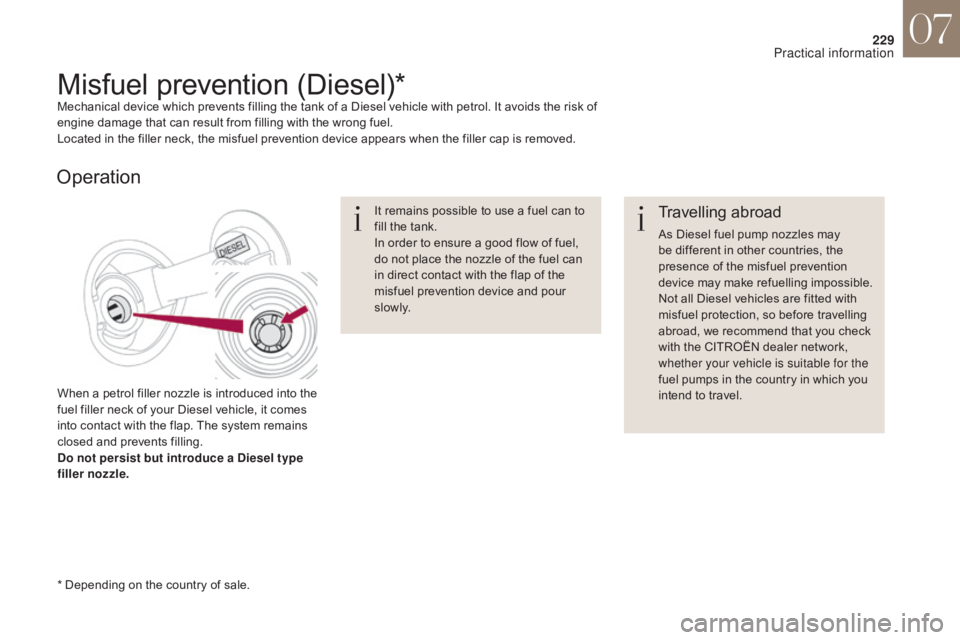
Misfuel prevention (Diesel)*Mechanical device which prevents filling the tank of a Diesel vehicle with petrol. It avoids the risk of
engine damage that can result from filling with the wrong fuel.
Located in the filler neck, the misfuel prevention device appears when the filler cap is removed.
When a petrol filler nozzle is introduced into the
fuel filler neck of your Diesel vehicle, it comes
into contact with the flap. The system remains
closed and prevents filling.
Do not persist but introduce a Diesel type
filler nozzle.
Operation
It remains possible to use a fuel can to
fill the tank.
In order to ensure a good flow of fuel,
do not place the nozzle of the fuel can
in direct contact with the flap of the
misfuel prevention device and pour
s l ow l y.
* Depending on the country of sale.
07
Practical information
Page 232 of 421
230
Fuel used for petrol
engines
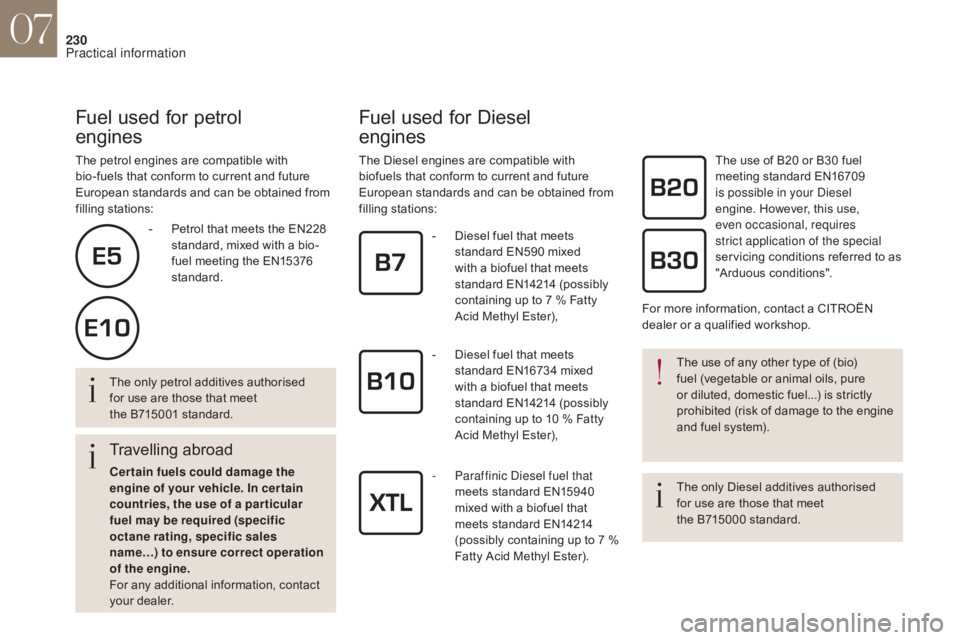
The petrol engines are compatible with
bio-fuels that conform to current and future
European standards and can be obtained from
filling stations:
Fuel used for Diesel
engines
The Diesel engines are compatible with
biofuels that conform to current and future
European standards and can be obtained from
filling stations:
The only Diesel additives authorised
for
use are those that meet
the
B715000 standard.
The use of any other type of (bio)
fuel (vegetable or animal oils, pure
or diluted, domestic fuel...) is strictly
prohibited (risk of damage to the engine
and fuel system).
The only petrol additives authorised
for
use are those that meet
the
B715001 standard.
Travelling abroad
Cer tain fuels could damage the
engine of your vehicle. In cer tain
countries, the use of a par ticular
fuel may be required (specific
octane rating, specific sales
name…) to ensure correct operation
of the engine.
For any additional information, contact
your dealer. -
Pe
trol that meets the EN228
standard, mixed with a bio-
fuel meeting the EN15376
standard. -
D
iesel fuel that meets
standard EN590 mixed
with a biofuel that meets
standard EN14214 (possibly
containing up to 7 % Fatty
Acid Methyl Ester),
-
D
iesel fuel that meets
standard EN16734 mixed
with a biofuel that meets
standard EN14214 (possibly
containing up to 10 % Fatty
Acid Methyl Ester),
- P araffinic Diesel fuel that
meets standard EN15940
mixed with a biofuel that
meets standard EN14214
(possibly containing up to 7 %
Fatty Acid Methyl Ester). The use of B20 or B30 fuel
meeting standard EN16709
is possible in your Diesel
engine. However, this use,
even occasional, requires
strict application of the special
servicing conditions referred to as
"Arduous conditions".
For more information, contact a CITROËN
dealer or a qualified workshop.
07
Practical information
Page 246 of 421

244
Diesel engines
1. Power steering fluid reservoir.
2. Screenwash and headlamp wash fluid
reservoir.
3.
C
oolant header tank.
4.
B
rake fluid reservoir.
5.
B
attery / Fuses.
6.
F
usebox.
7.
R
emote earth point (-).
8.
A
ir filter.
9.
E
ngine oil dipstick.
10.
E
ngine oil filler cap.
11.
P
riming pump*.The Diesel fuel system operates under
high pressure:
-
N
ever carry out any work on this
system yourself.
-
H
Di engines make use of advanced
technology.
All maintenance and repairs require
specially trained staff, which only a
CITROËN dealer can provide.
* According to engine.
07
Practical information
Page 255 of 421
253
Once the AdBlue® tank is empty,
a s
ystem required by regulations
prevents starting of the engine.
If the SCR
system is faulty, the level
of emissions from your vehicle will no
longer meet the Euro 6 standard: your
vehicle becomes polluting.
In the event of a confirmed fault
with the SCR system, you must go
to a CITROËN dealer or a qualified
workshop as soon as possible: after
a running distance of 650 miles
(1
100 km), a system will be triggered
automatically to prevent engine
starting.
In either case, a range indicator gives
you the distance you can travel before
the vehicle is immobilised.
AdBlue® and SCR system
for BlueHDi Diesel engines
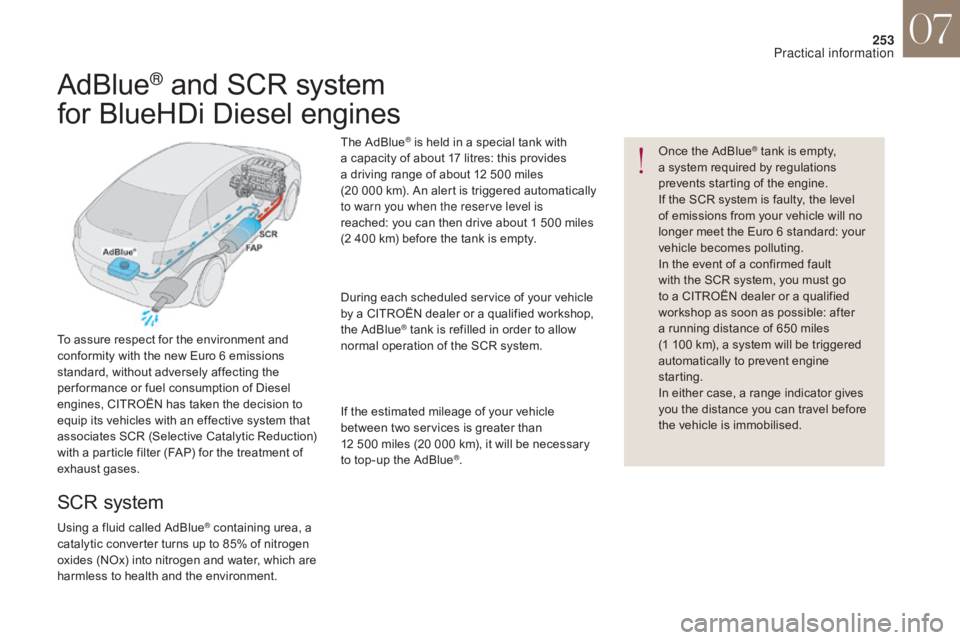
To assure respect for the environment and
conformity with the new Euro 6 emissions
standard, without adversely affecting the
per formance or fuel consumption of Diesel
engines, CITROËN has taken the decision to
equip its vehicles with an effective system that
associates SCR (Selective Catalytic Reduction)
with a particle filter (FAP) for the treatment of
exhaust gases.
SCR system
Using a fluid called AdBlue® containing urea, a
catalytic converter turns up to 85% of nitrogen
oxides (NOx) into nitrogen and water, which are
harmless to health and the environment. The AdBlue
® is held in a special tank with
a capacity of about 17 litres: this provides
a driving range of about 12 500 miles
(20
000
km). An alert is triggered automatically
to warn you when the reserve level is
reached: you can then drive about 1 500 miles
(2
400
km) before the tank is empty.
During each scheduled service of your vehicle
by a CITROËN dealer or a qualified workshop,
the AdBlue
® tank is refilled in order to allow
normal operation of the SCR system.
If the estimated mileage of your vehicle
between two services is greater than
12
500
miles (20 000 km), it will be necessary
to top-up the AdBlue
®.
07
Practical information
Page 256 of 421

254
Topping-up the AdBlue®
Precautions in use
Keep AdBlue® out of the reach of
children, in its original container or
bottle.
Never transfer AdBlue
® to another
container: it would lose its purity. Never dilute AdBlue
® with water.
Never pour AdBlue® into the Diesel fuel
tank.
Never top up from an AdBlue
®
dispenser reserved for heavy goods
vehicles.
AdBlue
® is a urea-based solution. This liquid is
non-flammable, colourless and odourless (kept
in a cool area).
In the event of contact with the skin, wash
the affected area with soap and running
water. In the event of contact with the eyes,
wash (irrigate) the eyes with large amounts of
water or with an eye wash solution for at least
15
minutes. If a burning sensation or irritation
persists, get medical attention.
If swallowed, immediately wash out the mouth
with clean water and then drink plenty of water.
In certain conditions (high exterior temperature,
for example), the risk of release of ammonia
cannot be excluded: do not inhale the fluid.
Ammonia vapour has an irritant effect on
mucous membranes (eyes, nose and throat).
Filling the AdBlue
® tank is an operation
included in every routine service on your
vehicle by a CITROËN dealer or a qualified
workshop.
Nevertheless, given the capacity of the tank, it
may be necessary to top-up the fluid between
services, more particularly if an alert (warning
lamps and a message) signals the requirement.
You can go to a CITROËN dealer or a qualified
workshop.
If you envisage topping-up yourself, please
read the following warnings carefully. Use only AdBlue
® fluid that meets the
ISO
22241 standard.
The supply in a non-drip container or bottle
simplifies topping up. You can obtain 1.89
litre
(half a US gallon) bottles or 5 or 10 litre
containers from a CITROËN
dealer or a
qualified workshop.
Freezing of the AdBlue
®
AdBlue® freezes at temperatures below
around -11°C.
The SCR system includes a heater
for the AdBlue
® tank, allowing you
to continue driving in all weather
conditions.
07
Practical information