light CITROEN DS4 2010 Workshop Manual
[x] Cancel search | Manufacturer: CITROEN, Model Year: 2010, Model line: DS4, Model: CITROEN DS4 2010Pages: 421, PDF Size: 8.05 MB
Page 186 of 421
184
Driving recommendations
Observe the driving regulations and remain vigilant whatever the traffic conditions.
Pay close attention to the traffic and keep your hands on the wheel so that you are ready to react at
any time to any eventuality.
As a safety precaution, the driver must only carry out actions requiring sustained attention when
the vehicle is stationary.
On a long journey, a break every two hours is strongly recommended.
In difficult weather, drive smoothly, anticipate the need to brake and increase the distance from
other vehicles.Never drive with the parking brake
applied - Risk of overheating and
damage to the braking system!
Risk of fire!
As the exhaust system of your vehicle
is very hot, even several minutes
after switching off the engine, do not
park or leave the engine running over
areas where inflammable substances
and materials are present: grass,
leaves,
etc.
Never leave a vehicle unsupervised
with the engine running. If you have
to leave your vehicle with the engine
running, apply the parking brake
and put the gearbox into neutral or
position
N or P, depending on the type
of gearbox.
Driving on flooded roads
We strongly advise against driving on flooded
roads, as this could cause serious damage
to the engine or gearbox, as well as to the
electrical systems of your vehicle.
Important!
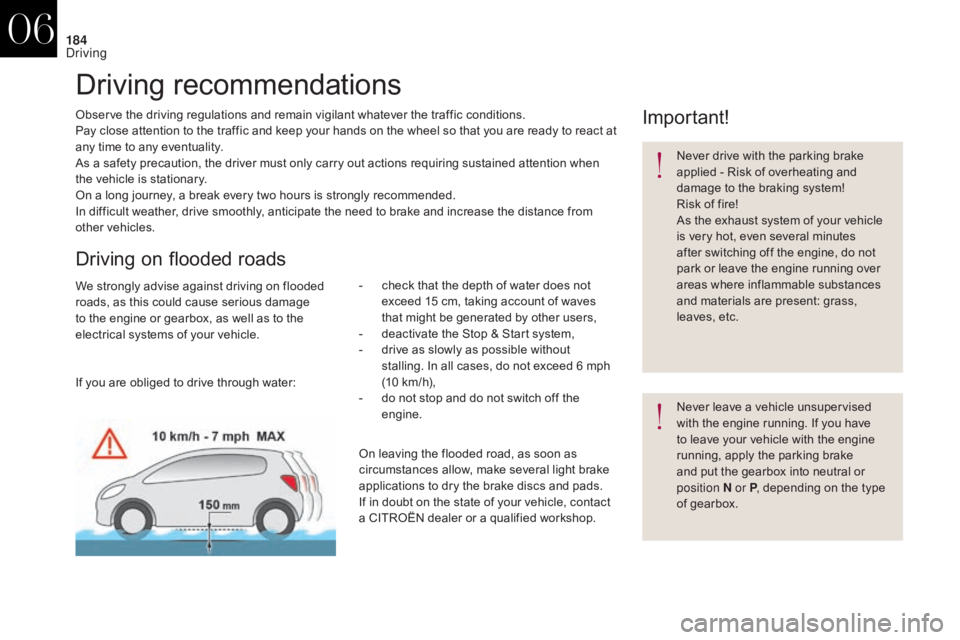
- check that the depth of water does not exceed 15 cm, taking account of waves
that might be generated by other users,
-
d
eactivate the Stop & Start system,
-
d
rive as slowly as possible without
stalling. In all cases, do not exceed 6 mph
(10
km/h),
-
d
o not stop and do not switch off the
engine.
If you are obliged to drive through water:
On leaving the flooded road, as soon as
circumstances allow, make several light brake
applications to dry the brake discs and pads.
If in doubt on the state of your vehicle, contact
a CITROËN dealer or a qualified workshop.
06
Driving
Page 187 of 421
185
When towing
Distribution of loads
F Distribute the load in the trailer so that the heaviest items are as close as possible to
the axle and the nose weight approaches
the maximum permitted without exceeding
it.
Air density decreases with altitude, thus
reducing engine per formance. Above
1
000 metres, the maximum towed load must
be reduced by 10
% for every 1 000 metres of
altitude.
Side wind
F Take into account the increased sensitivity to side wind.
Cooling
Towing a trailer on a slope increases the
temperature of the coolant.
As the fan is electrically controlled, its cooling
capacity is not dependent on the engine speed.
F
T
o lower the engine speed, reduce your
speed.
The maximum towed load on a long incline
depends on the gradient and the exterior
temperature.
In all cases, keep a check on the coolant
temperature.
F
I
f the warning lamp and the STOP
warning lamp come on, stop the
vehicle and switch off the engine
as soon as possible.
Braking
Towing a trailer increases the braking distance.
To avoid overheating of the brakes, the use of
engine braking is recommended.
Ty r e s
F Check the tyre pressures of the towing vehicle and of the trailer, observing the
recommended pressures.
Lighting
F Check the electrical lighting and signalling on the trailer and the headlamp beam
height of your vehicle.
For more information on Adjusting the
headlamp beam height , refer to the
corresponding section.
For more information on Weights
, refer
to the corresponding section.
The rear parking sensors will be
deactivated automatically to avoid the
audible signal if a genuine CITROËN
towbar is used.
If the exterior temperature is high, it
is recommended that the engine be
allowed to idle for 1 to 2 minutes after
the vehicle comes to a stop, to facilitate
its cooling.
06
Driving
Page 191 of 421

189
Starting / Switching off the engine with Keyless Entry and
S tarting
Starting the engine
F With a manual gearbox, place the gear
lever in neutral and declutch fully.
F
W
ith an automatic gearbox, place the gear
selector at P or N and press the brake
pedal. F
B
riefly press the "
S TA R T/
STOP " button while maintaining
pressure on the pedal until the
engine starts. If the electronic key is not detected
in the zone, a message is displayed.
Move the electronic key into the zone
so that the engine can be started.
If one of the starting conditions is not
met, a reminder message appears in
the instrument panel screen. In some
circumstances, it is necessary to
turn the steering wheel slightly while
pressing the " START/STOP " button
to assist unlocking of the steering;
a message warns you when this is
needed.
The presence of the "Keyless Entry
and Starting" electronic key in the
recognition zone is essential.
As a safety measure, do not leave this
zone with the vehicle running.
Diesel vehicles
In temperatures below zero
the engine will not start until
the preheater warning lamp
has gone off.
If this warning lamp comes on after
pressing " START/STOP ", you should
hold the brake or clutch pedal down
until the warning lamp goes off and do
not press the " START/STOP" button
again.
The steering column unlocks and the engine
starts.
See the advice for Diesel versions.
F
P
lace the electronic key inside the vehicle:
there is no need to place it in the reader.
06
Driving
Page 208 of 421

206
Stop & Start
Operation
Going into engine STOP mode
STOP mode does not affect the
functionality of the vehicle, such as
braking, power steering, for example.
Never refuel with the engine in
STOP mode; you must switch off the
ignition with the key or the "START/
STOP" button.
With a manual gearbox, at a
speed below 12 mph (20 km/h),
If your vehicle is fitted with the
system, a time counter calculates
the sum of the periods in STOP STOP mode is not invoked when:
-
t
he vehicle is on a steep slope (up or
d ow n),
-
t
he driver's door is open,
-
t
he driver's seat belt is not fastened,
-
t
he vehicle has not exceeded 6 mph
(10 km/h) since the last engine start (using
the key or the "START/STOP" button),
-
t
he electric parking brake is applied or
being applied,
-
t
he engine is needed to maintain a
comfortable temperature in the passenger
compartment,
-
d
emisting is active,
-
s
ome special conditions (battery charge,
engine temperature, braking assistance,
ambient temperature...) where the engine is
needed to assure control of a system.
Special cases: STOP mode
unavailable
In this case, the "ECO" warning lamp
flashes for a few seconds, then goes
of f.
This operation is perfectly normal.
With an automatic gearbox,
when
the vehicle is stationary, this warning mode during a journey. It resets itself to zero
every time the ignition is switched on with the
key or the "START/STOP" button.
The Stop & Start
system puts the engine temporarily into standby - STOP mode - during stops in
the traffic (red lights, traffic jams, or other...). The engine restarts automatically - START mode - as
soon as you want to move off. The restart takes place instantly, quickly and silently.
Per fect for urban use, the Stop & Start system reduces fuel consumption and exhaust emissions as
well as the noise level when stationary.
or when the vehicle is stationary with the
PureTech
130 petrol and BlueHDi Diesel 115
and 120
versions, this warning lamp comes on
in the instrument panel and the engine switches
to standby automatically when you place the
gear lever in neutral and release the clutch
pedal.
lamp comes on in the instrument panel and the
engine switches to standby automatically when
you press the brake pedal or place the gear
selector at position N .
06
Driving
Page 213 of 421

2 11
No alert will be given in the following situations:
- i n the presence of immobile objects
(parked vehicles, barriers, street lamps,
road signs...),
-
w
ith vehicles moving in the opposite
direction,
-
d
riving on a sinuous road or a sharp
c o r n e r,
The alert is given by a warning lamp which
comes on in the door mirror on the side in
question as soon as a vehicle - car, lorry,
cycle
- is detected.
For this, the following conditions must be met:
-
a
ll the vehicles must be moving in the
same direction,
-
t
he speed of your vehicle is between 7 and
75 mph (12 and 140 km/h),
-
w
hen you overtake a vehicle with a speed
difference of less than 6 mph (10 km/h),
-
w
hen a vehicle overtakes you with a speed
difference of less than 15 mph (25 km/h),
-
t
he traffic must be flowing normally,
-
i
n the case of an overtaking manoeuvre,
if this is prolonged and the vehicle being
overtaken remains in the blind spot,
-
y
ou are driving on a straight or slightly
curved road,
-
y
our vehicle is not pulling a trailer,
a
c
aravan... -
w hen overtaking (or being overtaken by) a
very long vehicle (lorry, coach...) which is
at the same time detected at the rear in the
blind spot angle and present in the driver's
for ward field of vision,
-
i
n very heavy traffic: vehicles detected in
front and behind are confused with a lorry
or a stationary object,
-
w
hen overtaking quickly.
06
Driving
Page 236 of 421
234
Before each use
Check that the towball is correctly fitted by verifying the following points:
- t he towball is correctly locked in place (position A ),
-
t
he security key lock is on and the key removed; the locking wheel can no longer be
operated,
-
t
he towball must no longer move at all in its carrier; try to shake it by hand.
During use
Never unlock the device when a trailer or load carrier is fitted to the towball.
Never exceed the maximum authorised weight for the vehicle plus trailer (Gross Train
Weight - GTW).
Before driving, check the adjustment of the headlamp beam height.
For more information on Adjusting the headlamps , refer to the corresponding section.
After use
For journeys made without a trailer or load carrier, the trailer harness socket must be folded
away, the towball removed and
the blanking plug inserted in the carrier. This measure
applies particularly if the towball could hinder visibility of the number plate or lighting.
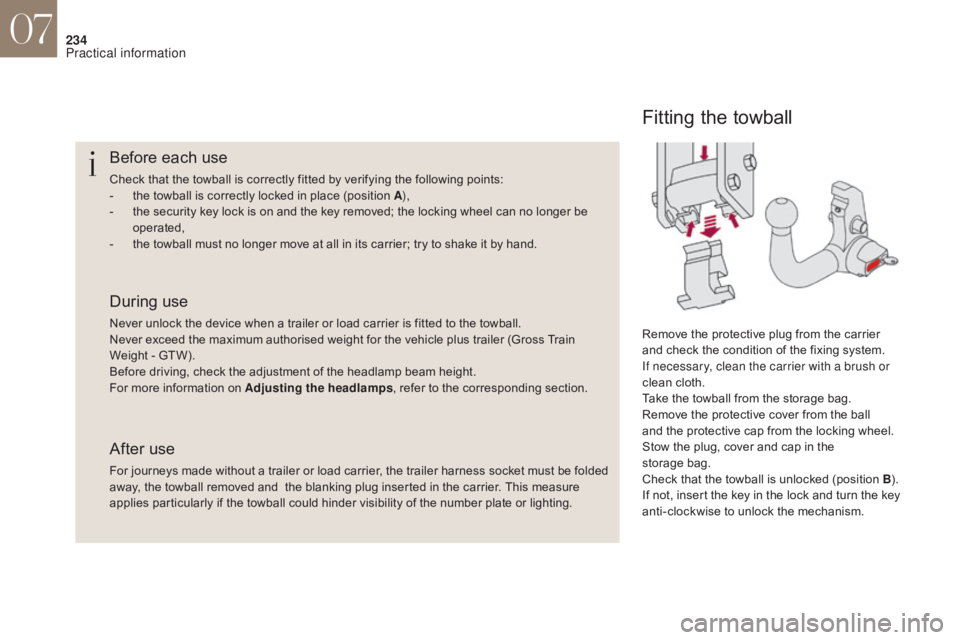
Fitting the towball
Remove the protective plug from the carrier
and check the condition of the fixing system.
If necessary, clean the carrier with a brush or
clean cloth.
Take the towball from the storage bag.
Remove the protective cover from the ball
and
the protective cap from the locking wheel.
Stow the plug, cover and cap in the
storage
bag.
Check that the towball is unlocked (position B ).
If not, insert the key in the lock and turn the key
anti-clockwise to unlock the mechanism.
07
Practical information
Page 254 of 421

252
Electric parking brake
This system does not require any
routine servicing. However, in the
event of a problem, have the system
checked by a CITROËN dealer or a
qualified workshop.Only use products recommended by
CITROËN or products of equivalent
quality and specification.
In order to optimise the operation of
units as important as those in the
braking system, CITROËN selects and
offers very specific products.
After washing the vehicle, dampness,
or in wintry conditions, ice can form
on the brake discs and pads: braking
efficiency may be reduced. Make light
brake applications to dry and defrost
the brakes.
Parking brake
If excessive travel or a loss of
effectiveness of this system is
noticed, the parking brake must be
checked, even between two services.
For more information on the Electric parking
brake , refer to the corresponding section.
Checking this system must be done by a
CITROËN dealer or a qualified workshop.
07
Practical information
Page 257 of 421

255
Never store bottles of AdBlue® in your
vehicle.
Recommendations on storage
AdBlue® freezes at about -11°C and
deteriorates above 25°C. It is recommended
that bottles be stored in a cool area and
protected from direct sunlight .
Under these conditions, the fluid can be kept
for at least a year .
If the additive has frozen, it can be used once it
has completely thawed out. Before starting the top-up procedure, ensure
that the vehicle is parked on a flat and level
sur face.
Procedure
F Switch off the ignition and remove the
key, or if your vehicle has one, press the
START/STOP button to switch off the
engine.
F
R
aise the boot floor for access to the
AdBlue
® tank. S
ecure the boot floor by attaching its cord
to the hook on the parcel shelf support.
F
U
nclip the black plastic blanking plug using
its tab.
F
I
nsert your fingers into the aperture and
turn the blue cap a 6
th of a turn anti-
clockwise.
F
C
arefully lift off the cap, without dropping it.
Do not dispose of AdBlue
® bottles or
containers in the household waste.
Place them in a container provided
for this purpose or take them to your
dealer.
07
Practical information
Page 281 of 421

279
Changing a bulb
The headlamps have polycarbonate
lenses with a protective coating:
F
d
o not clean them using a dr y
or abrasive cloth, nor with a
detergent or solvent product,
F
u
se a sponge and soapy water or a
pH neutral product,
F
w
hen using a high pressure
washer on persistent marks, do not
keep the lance directed towards
the lamps or their edges for too
long, so as not to damage their
protective coating and seals. Changing a bulb should only be done
after the headlamp has been switched
off for several minutes (risk of serious
burns).
F
D
o not touch the bulb directly with
your fingers, use a lint-free cloth.
It is imperative to use only anti-
ultraviolet (UV) type bulbs to avoid
damaging the headlamp.
Always replace a failed bulb with a
new bulb with the same type and
specification.Light-emitting diodes (LED)
For the replacement of this type of
lamp, go to a CITROËN dealer or a
qualified workshop.
LED (light-emitting diode) replacement
kits are available from CITROËN
dealers.
Risk of electrocution
Xenon bulbs (D1S) must be replaced
by a CITROËN dealer or a qualified
workshop.
08
In the event of a breakdown
Page 282 of 421

280
Bulbs with lugs, type H1, H7... take care
to position them correctly to ensure the
best lighting.
1.
D
aytime running lamps / sidelamps
(LEDs).
2.
D
irectional main beam / dipped beam
headlamps (D1S).
3.
D
irection indicators (LEDs).
4.
D
irectional foglamps
(LEDs). 1.
D
irection indicators (H21 clear).
2.
D
ipped beam headlamps (H7).
3.
M
ain beam headlamps (H1).
4.
D
aytime running lamps / sidelamps
(P21/5W XL).
5.
D
irectional front foglamps (H11).
Front lamps
1. Direction indicators (LEDs).
2. D
aytime running lamps / sidelamps
(LEDs).
3.
D
ipped beam headlamps (H7).
4.
M
ain beam headlamps (H7).
5.
D
irectional front foglamps (H11).Bulbs with lugs, type H1, H7... take care
to position them correctly to ensure the
best lighting.
*
LED: light emitting diodes.
Model with directional xenon and
full-LED headlamps Model with halogen headlamps
(t y p e 1)Model with halogen headlamp and
LED light signature (type 2)*
08
In the event of a breakdown