air Citroen DS4 2014 1.G Service Manual
[x] Cancel search | Manufacturer: CITROEN, Model Year: 2014, Model line: DS4, Model: Citroen DS4 2014 1.GPages: 444, PDF Size: 12.68 MB
Page 213 of 444

2 11
Under-inflation alert
The loss of pressure detected does
not always lead to visible deformation
of the tyre. Do not rely on just a visual
check.This alert is also displayed when one or
more wheels is not fitted with a sensor
(for example, a space-saver or steel
spare wheel).
The alert is maintained until the tyre or
tyres concerned is reinflated, repaired
or replaced.
The spare wheel (space-saver type or
a steel rim) does not have a sensor.
The alert is given by the fixed illumination
of this warning lamp, accompanied by
an audible signal, and depending on
equipment, the display of a message.
In the event of a problem on one of the tyres,
the symbol or the message appears, according
to equipment, to identify it.
F
R
educe speed, avoid sudden steering
movements or harsh brake applications.
F
S
top as soon as it is safe to do so.
Operating fault
The flashing and then fixed
illumination of the under-inflation
warning lamp accompanied by the
illumination of the service warning
lamp indicates a fault with the system.
Go to a CITROËN dealer or a qualified
workshop
to have the system checked or,
following the repair of a puncture, to have the
original wheel, equipped with a sensor, refitted.
F
I
f you have a compressor (the one in the
temporary puncture repair kit for example),
check the four tyre pressures when cold.
I
f it is not possible to check the tyre
pressures at the time, drive carefully at
reduced speed.
or
F
I
n the event of a puncture, use the
temporary puncture repair kit or the spare
wheel (according to equipment).
Any tyre repair or replacement on a wheel
fitted with this system must be carried out by a
CITROËN dealer or a qualified workshop.
If after changing a tyre, a wheel is not detected
by your vehicle (fitting snow tyres for example),
you must have the system reinitialised by a
CITROËN dealer or a qualified workshop. In this case, monitoring of the tyre pressures is
not assured.
driving
Page 235 of 444

233
Fuel tankCapacity of the tank: approximately 60 litres.
Low fuel level
When the low fuel level in the
tank is reached, this warning lamp
comes on in the instrument panel,
accompanied by an audible warning
Refuelling
F Press control A until the automatic opening of the fuel flap is heard.
T
his control remains active for a few
minutes after switching off the ignition. If
necessary, switch the ignition on again to
reactivate it.
F
T
ake care to select the pump that delivers
the correct fuel for your vehicle.
With Stop & Start, never refuel with the
system in STOP mode; you must switch
off the ignition with the key, or the
START/STOP button if your vehicle has
Keyless Entry and Starting.
Additions of fuel must be of at least 5 litres to
be registered by the fuel gauge.
Opening the filler cap may result in an inrush of
air. This vacuum is entirely normal and results
from the sealing of the fuel system.
and the display of an alert message. When it
first comes on, around 6 litres of fuel remain
in the tank.
Until sufficient fuel has been added, every
time the ignition is switched on, this warning
lamp appears, accompanied by an audible
signal and an alert message. When driving,
this audible signal and the display of this
alert message are repeated with increasing
frequency, as the level drops towards 0
.
You must refuel as soon as possible to avoid
running out.
If you run out of fuel (Diesel), refer to the
corresponding section.
Checks
Page 247 of 444
245
Checks
Air filter and passenger compartment filter
Oil filter
Unless other wise indicated, check these components in accordance with the manufacturer's service schedule and according to your engine.
Other wise, have them checked by a CITROËN dealer or a qualified workshop.Refer to the manufacturer's
service schedule for details of the
replacement intervals for these
components.
Replace the oil filter each time the
engine oil is changed.
Refer to the manufacturer's
service schedule for details of
the replacement interval for this
component.
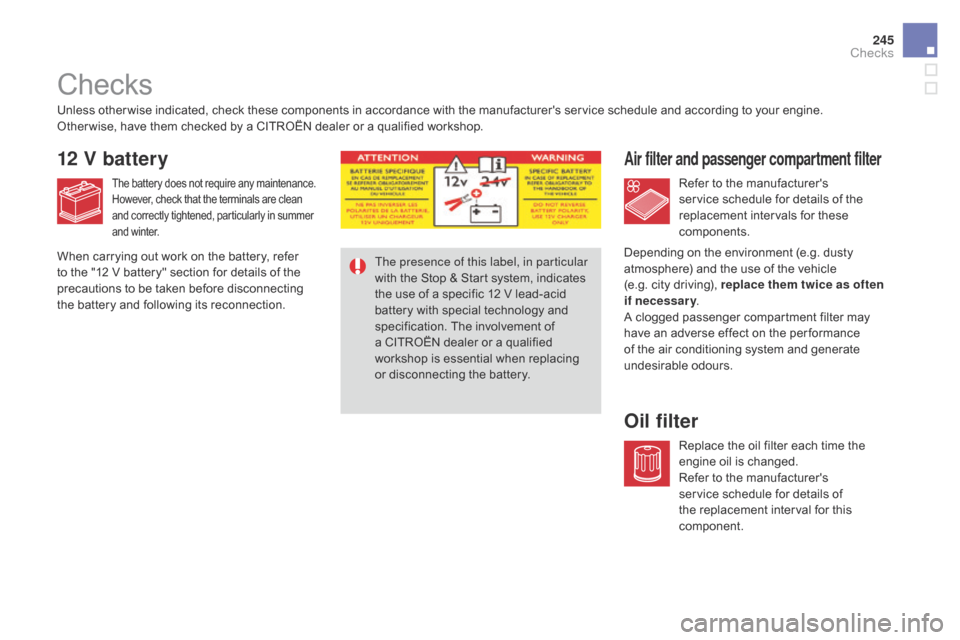
The presence of this label, in particular
with the Stop & Start system, indicates
the use of a specific 12 V lead-acid
battery with special technology and
specification. The involvement of
a CITROËN dealer or a qualified
workshop is essential when replacing
or disconnecting the battery.
12 V battery
When carrying out work on the battery, refer
to the "12 V battery" section for details of the
precautions to be taken before disconnecting
the battery and following its reconnection.
The battery does not require any maintenance.
However, check that the terminals are clean
and correctly tightened, particularly in summer
and winter.
Depending on the environment (e.g. dusty
atmosphere) and the use of the vehicle
(e.g. city driving), replace them twice as often
if necessary
.
A clogged passenger compartment filter may
have an adverse effect on the per formance
of the air conditioning system and generate
undesirable odours.
Checks
Page 262 of 444

Temporary puncture repair kit
This kit consists of a compressor and a sealant
cartridge.
It allows the temporary repair of a tyre.
You are then able to go to the nearest garage.
Access to the kit
The speed limit sticker I must be affixed
to the vehicle's steering wheel to
remind you that a wheel is in temporary
use.
Do not exceed a speed of 50 mph
(80
km/h) when driving with a tyre
repaired using this type of kit.
description of the kit
A. "Sealant" or "Air" position selector.
B. On "I" / off "O" switch.
C.
D
eflation button.
d
.
P
ressure gauge (in bar and psi).
E.
C
ompartment housing:
-
a c
able with adaptor for 12 V socket,
-
v
arious inflation adaptors for
accessories, such as balls, bicycle
tyres... F. S
ealant cartridge.
G. W hite pipe with cap for repair.
H.
B
lack pipe for inflation.
I.
S
peed limit sticker.
This kit is installed in the storage box, under the
boot floor. It is designed to repair most punctures
which could affect the tyre, located on
the tyre tread or shoulder.
Its compressor can be used to check
and adjust the pressure of the tyre.
Page 263 of 444

261
1. Sealing
F Uncoil the white pipe G fully.
F U nscrew the cap from the white pipe.
F
C
onnect the white pipe to the valve of the
tyre to be repaired.
Repair procedure
Avoid removing any foreign bodies
which have penetrated into the tyre. F
C
onnect the compressor's electric plug to
the vehicle's 12 V socket.
F
S
tart the vehicle and leave the engine
running.
F
S
witch off the ignition.
Take care, this product is harmful (e.g.
ethylene-glycol, colophony...) if swallowed
and causes irritation to the eyes.
Keep this product out of the reach of
children.
F
T
urn the selector A to the
"sealant" position.
F
C
heck that the switch B is in
position "O" .
The vehicle's electric system allows the
connection of a compressor for long
enough to inflate a tyre after a puncture
repair or for inflating a small inflatable
accessory.
Practical information
Page 264 of 444

F Switch on the compressor by moving the switch B to position "I" until the tyre
pressure reaches 2.0 bars.
T
he sealant is injected into the tyre under
pressure; do not disconnect the pipe from
the valve during this operation (risk of
splashing). F
R emove the kit and screw the cap back on
the white pipe.
T
ake care to avoid staining your vehicle
with traces of fluid. Keep the kit to hand.
F
D
rive immediately for approximately
three miles (five kilometres), at reduced
speed (between 15 and 35 mph (20 and
60
km/h)), to plug the puncture.
F
S
top to check the repair and the tyre
pressure using the kit.
Do not start the compressor before
connecting the white pipe to the tyre
valve: the sealant product would be
expelled through the pipe.
Tyre under-inflation detection
If the vehicle is fitted with tyre under-
inflation detection, the under-inflation
warning lamp will remain on after the
wheel has been repaired until the
system is reinitialised by a CITROËN
dealer or a qualified workshop.
If after around 5 to 7 minutes the
pressure is not attained, this indicates
that the tyre is not repairable; contact
a CITROËN dealer or a qualified
workshop for assistance.
Page 265 of 444

263
2. Inflation
F Adjust the pressure using the compressor (to inflate: switch B in position "I" ; to
deflate: switch B
in position "O" and press
button C ), in accordance with the vehicle's
tyre pressure label (located on the left
hand door aperture).
A l
oss of pressure indicates that the
puncture has not been fully plugged;
contact a CITROËN dealer or qualified
workshop for assistance.
F
R
emove and stow the kit.
F
D
rive at reduced speed (50 mph [80 km/h]
max) limiting the distance travelled to
approximately 120 miles (200 km).
F
T
urn the selector A to the "air"
position.
F
U
ncoil the black pipe H fully.
F
C
onnect the black pipe to the
valve of the wheel. F
C
onnect the compressor's electric plug to
the vehicle's 12 V socket.
F
S
tart the vehicle again and leave the
engine running.
As soon as possible, go to a CITROËN
dealer or a qualified workshop.
You must inform the technician that you
have used this kit. After inspection, the
technician will advise you on whether
the tyre can be repaired or if it must be
replaced.
Practical information
Page 266 of 444

Removing the cartridge
F Stow the black pipe.
F D etach the angled base from the white pipe.
F
S
upport the compressor vertically.
F
U
nscrew the cartridge from the bottom.
Checking tyre pressures /
inflating accessories
Beware of discharges of fluid.
The expiry date of the fluid is indicated
on the cartridge.
The sealant cartridge is designed for
single use; even if only partly used, it
must be replaced.
After use, do not discard the cartridge
into the environment, take it to an
authorised waste disposal site or a
CITROËN dealer.
Do not forget to obtain a new sealant
cartridge, available from CITROËN
dealers or from a qualified workshop. You can also use the compressor, without
injecting any product, to:
-
c heck or adjust the pressure of your tyres,
-
i
nflate other accessories (balls, bicycle
tyres...). F
C
onnect the compressor's electrical
connector to the vehicle's 12 V socket.
F S tart the vehicle and let the engine run.
F
A
djust the pressure using the compressor
(to inflate: switch B in position "I" ; to
deflate: switch B in position "O" and press
button C ), according to the vehicle's tyre
pressure label or the accessory's pressure
label.
F
R
emove the kit then stow it.
F
T
urn the selector A to the "Air"
position.
F
U
ncoil the black pipe H fully.
F
C
onnect the black pipe to the
valve of the wheel or accessory.
I
f necessary, fit one of the adaptors
supplied with the kit first.
Page 269 of 444

267
The spare wheel is installed in the boot under
the floor.
Depending on version, the spare wheel may be
a standard size steel or alloy wheel; for some
countries of sale it is the "space saver" type.
For access to the spare wheel, refer to the
paragraph "Access to the tools" on the previous
page.
Access to the spare wheel
If your vehicle has an electric parking
brake, only a "space saver" type of
wheel can be stowed in the boot.
Taking out the standard wheel
F Unscrew the yellow central bolt.
F R aise the spare wheel towards you from
the rear.
F
T
ake the wheel out of the boot.
Tyre under-inflation detection
The spare wheel is not fitted with a
sensor. The punctured wheel must
be repaired by a CITROËN dealer or
aqualified workshop.
Practical information
Page 273 of 444

271
Fitting a wheel
Fitting a steel or "space-
saver" spare wheel
If your vehicle is fitted with alloy
wheels, when tightening the bolts on
fitting it is normal to notice that the
washers do not come into contact with
the steel or "space-saver" spare wheel.
The wheel is secured by the conical
contact of each bolt.
List of operations
F Put the wheel in place on the hub.
F S crew in the bolts by hand to the stop.
F
P
re-tighten the security bolt using the
wheelbrace 1 fitted with the security
socket 4.
F
P
re-tighten the other bolts using the
wheelbrace 1 o n l y.
After changing a wheel
To store the punctured wheel in the
boot correctly, first remove the central
c ove r.
When using the "space-saver" type
spare wheel, do not exceed 50 mph
(80
km/h).
Have the tightening of the bolts and the
pressure of the spare wheel checked
by a CITROËN dealer or a qualified
workshop without delay.
Have the punctured wheel repaired and
replace it on the vehicle as soon as
possible.
Practical information