level Citroen DS5 2014 1.G Owner's Guide
[x] Cancel search | Manufacturer: CITROEN, Model Year: 2014, Model line: DS5, Model: Citroen DS5 2014 1.GPages: 372, PDF Size: 32.58 MB
Page 113 of 372
111Driving
Operating faults
If the electric parking brake fault warning lamp comes on together with one or more of the warning lamps presented in these tables, place the vehicle in
a safe condition (on level ground, gear engaged) and contact a CITROËN dealer or a qualified workshop without delay.
Situations
Consequences
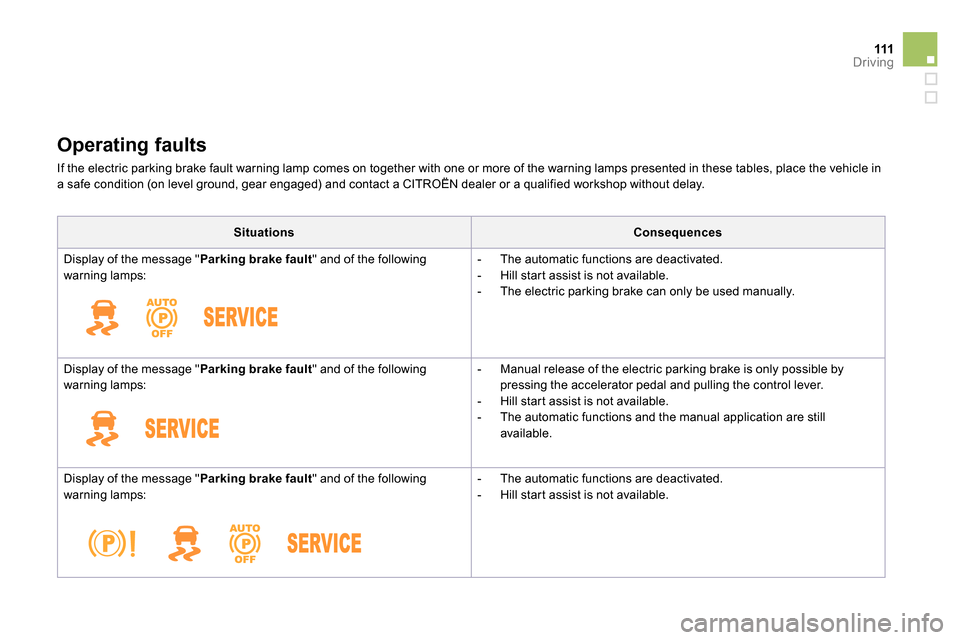
Display of the message " Parking brake fault
" and of the following
warning lamps:
- The automatic functions are deactivated.
- Hill start assist is not available.
- The electric parking brake can only be used manually.
Display of the message " Parking brake fault
" and of the following
warning lamps:
- Manual release of the electric parking brake is only possible by
pressing the accelerator pedal and pulling the control lever.
- Hill start assist is not available.
- The automatic functions and the manual application are still
available.
Display of the message " Parking brake fault
" and of the following
warning lamps:
- The automatic functions are deactivated.
- Hill start assist is not available.
Page 114 of 372

Situations
Consequences
To apply the electric parking brake:
immobilise the vehicle and switch off the ignition.
pull the control for at least 5 seconds or until application is complete.
switch on the ignition and check that the electric parking brake
warning lamps come on.
The application is slower than during normal operation.
To release the electric parking brake:
switch on the ignition.
pull the control lever and hold it for approximately 3 seconds then
release it.
If the braking warning lamp is flashing or if the warning lamps do not
come on with the ignition on, these procedures will not work. Place the
vehicle on level ground and have it checked by a CITROËN dealer or a
qualified workshop.
and possibly
flashing
Display of the message " Parking brake fault
" and of the following
warning lamps:
- Only the automatic application on switching off the engine and
automatic release on acceleration functions are available.
- The manual application/release of the electric parking brake and the
emergency braking are not available.
and possibly
flashing
Display of the message "Battery charge fault".
- You must stop as soon as it is safe to do so. Switch off and
immobilise your vehicle (if necessary, place the a chock under a
wheel).
- Apply the electric parking brake before switching off the engine.
Page 115 of 372

11 3Driving
Special situations
In the event of a malfunction of the parking
brake in the on position
or a battery failure,
manual release remains possible.
To ensure correct operation, and so
your safety, the number of successive
applications and releases of the parking
brake is limited to eight cycles.
If used excessively, you are alerted by
the message "parking brake faulty" and
a flashing warning lamp.
In some circumstances (engine start...),
the parking brake may adjust the level of
application itself. This is normal operation.
To move your vehicle a few centimetres
without starting the engine, with the ignition
on, press the brake pedal and release the
parking brake by pulling
then releasing
the control lever A
. Complete release of the
parking brake is indicated by the warning
lamps in the control lever A
and in the
instrument panel going off and by the display
of the message "Parking brake off ".
Page 129 of 372
127Driving
Stop & Start
Operation
Going into engine STOP mode
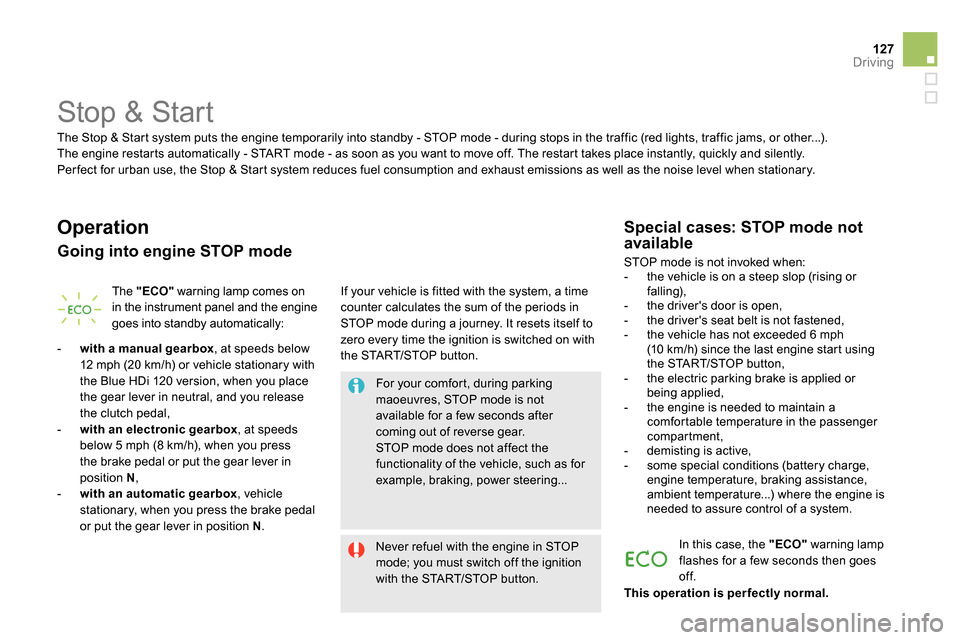
The "ECO"
warning lamp comes on
in the instrument panel and the engine
goes into standby automatically:
- with a manual gearbox
, at speeds below
12 mph (20 km/h) or vehicle stationary with
the Blue HDi 120 version, when you place
the gear lever in neutral, and you release
the clutch pedal,
- with an electronic gearbox
, at speeds
below 5 mph (8 km/h), when you press
the brake pedal or put the gear lever in
position N
,
- with an automatic gearbox
, vehicle
stationary, when you press the brake pedal
or put the gear lever in position N
. If your vehicle is fitted with the system, a time
counter calculates the sum of the periods in
STOP mode during a journey. It resets itself to
zero every time the ignition is switched on with
the START/STOP button.
Never refuel with the engine in STOP
mode; you must switch off the ignition
with the START/STOP button.
For your comfort, during parking
maoeuvres, STOP mode is not
available for a few seconds after
coming out of reverse gear.
STOP mode does not affect the
functionality of the vehicle, such as for
example, braking, power steering...
Special cases: STOP mode not
available
STOP mode is not invoked when:
- the vehicle is on a steep slop (rising or
falling),
- the driver's door is open,
- the driver's seat belt is not fastened,
- the vehicle has not exceeded 6 mph
(10 km/h) since the last engine start using
the START/STOP button,
- the electric parking brake is applied or
being applied,
- the engine is needed to maintain a
comfortable temperature in the passenger
compartment,
- demisting is active,
- some special conditions (battery charge,
engine temperature, braking assistance,
ambient temperature...) where the engine is
needed to assure control of a system.
In this case, the "ECO"
warning lamp
flashes for a few seconds then goes
off. The Stop & Start system puts the engine temporarily into standby - STOP mode - during stops in the traffic (red lights, traffic jams, or other...).
The engine restarts automatically - START mode - as soon as you want to move off. The restart takes place instantly, quickly and silently.
Per fect for urban use, the Stop & Start system reduces fuel consumption and exhaust emissions as well as the noise level when stationary.
This operation is per fectly normal.
Page 150 of 372
The sidelamps and dipped beam headlamps are
switched on automatically, without any action on
the part of the driver, when a low level of external
light is detected or in certain cases of activation of
the windscreen wipers.
As soon as the brightness returns to a sufficient
level or after the windscreen wipers are switched
off, the lamps are switched off automatically.
Automatic illumination of headlamps
Activation
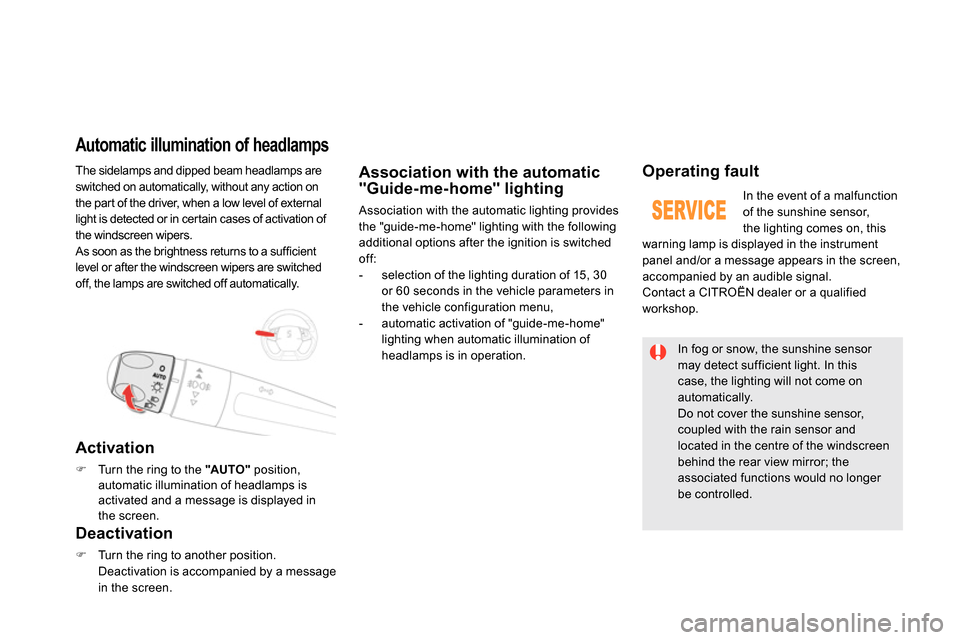
Turn the ring to the "AUTO "
position,
automatic illumination of headlamps is
activated and a message is displayed in
the screen.
Deactivation
Turn the ring to another position.
Deactivation is accompanied by a message
in the screen.
Association with the automatic
"Guide-me-home" lighting
Association with the automatic lighting provides
the "guide-me-home" lighting with the following
additional options after the ignition is switched
off:
- selection of the lighting duration of 15, 30
or 60 seconds in the vehicle parameters in
the vehicle configuration menu,
- automatic activation of "guide-me-home"
lighting when automatic illumination of
headlamps is in operation.
Operating fault
In the event of a malfunction
of the sunshine sensor,
the lighting comes on, this
warning lamp is displayed in the instrument
panel and/or a message appears in the screen,
accompanied by an audible signal.
Contact a CITROËN dealer or a qualified
workshop.
In fog or snow, the sunshine sensor
may detect sufficient light. In this
case, the lighting will not come on
automatically.
Do not cover the sunshine sensor,
coupled with the rain sensor and
located in the centre of the windscreen
behind the rear view mirror; the
associated functions would no longer
be controlled.
Page 151 of 372
149Visibility
Automatic headlamp dipping
Switching on
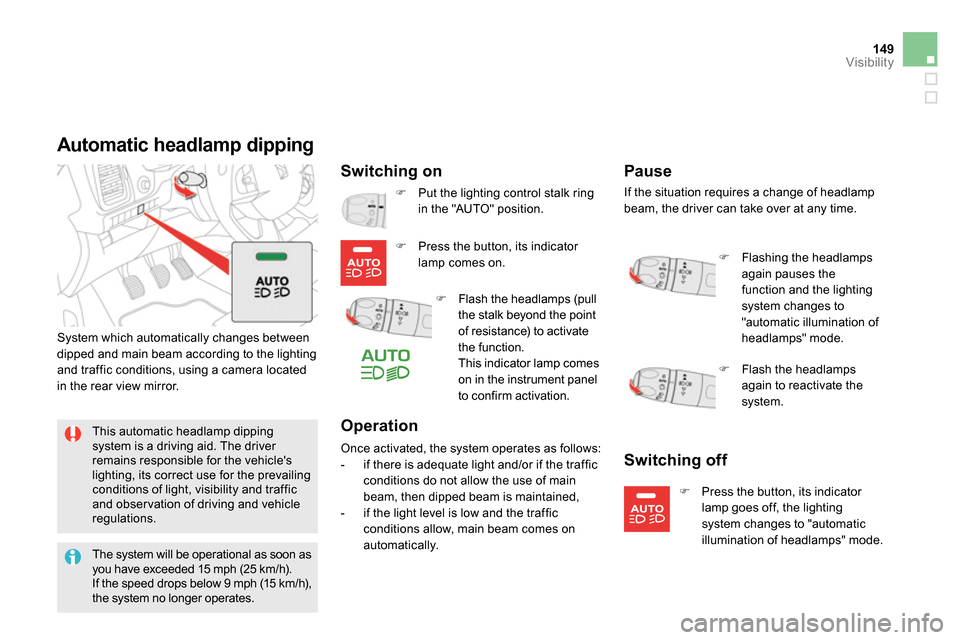
System which automatically changes between
dipped and main beam according to the lighting
and traffic conditions, using a camera located
in the rear view mirror.
Put the lighting control stalk ring
in the "AUTO" position.
This automatic headlamp dipping
system is a driving aid. The driver
remains responsible for the vehicle's
lighting, its correct use for the prevailing
conditions of light, visibility and traffic
and obser vation of driving and vehicle
regulations.
Flash the headlamps (pull
the stalk beyond the point
of resistance) to activate
the function.
This indicator lamp comes
on in the instrument panel
to confirm activation.
Press the button, its indicator
lamp comes on.
Switching off
Press the button, its indicator
lamp goes off, the lighting
system changes to "automatic
illumination of headlamps" mode.
Pause
Flashing the headlamps
again pauses the
function and the lighting
system changes to
"automatic illumination of
headlamps" mode.
Flash the headlamps
again to reactivate the
system.
The system will be operational as soon as
you have exceeded 15 mph (25 km/h).
If the speed drops below 9 mph (15 km/h),
the system no longer operates.
Operation
If the situation requires a change of headlamp
beam, the driver can take over at any time.
Once activated, the system operates as follows:
- if there is adequate light and/or if the traffic
conditions do not allow the use of main
beam, then dipped beam is maintained,
- if the light level is low and the traffic
conditions allow, main beam comes on
automatically.
Page 153 of 372

151Visibility
Exterior welcome
lighting
The remote switching on of the lighting makes
your approach to the vehicle easier in poor
light. It is activated according to the level of
light detected by the sunshine sensor.
Switching on
Switching off
The exterior welcome lighting switches off
automatically after a set time, when the ignition
is switched on or on locking the vehicle.
Programming
The lighting duration is selected via
the vehicle configuration menu.
The duration of the welcome lighting is
associated with and identical to that of
the automatic guide-me-home lighting.
Press the open padlock on the
remote control or the door handle
with Keyless Entry and Starting.
Door mirror spotlamps
Switching on
The spotlamps come on:
- when you unlock the vehicle,
- when you switch off the ignition,
- when you open a door,
- when you use the remote control to locate
the vehicle.
Switching off
They are timed to go off automatically.
To make your approach to the vehicle easier,
these illuminate:
- the zones facing the driver’s and
passenger’s doors,
- the zones for ward of the door mirrors and
rear ward of the front doors.
The dipped beam headlamps and the
sidelamps come on; your vehicle is also
unlocked.
Page 162 of 372

Interior mood lighting
The dimmed passenger compartment lighting improves visibility in the vehicle when the light is
poor.
At night, the interior mood lighting comes on
automatically when the sidelamps are switched
on (for example, a source of light in the roof
console illuminates the middle of the centre
console).
The interior mood lighting switches off
automatically when the sidelamps are
switched off. Lamps on: there are 7 levels of brightness.
The level of brightness increases progressively
with each press of the button, returning to zero
after the maximum level is reached.
A long press gives maximum brightness.
This adjustment is used to set the mood
lighting level for the interior lamp, as well as
for the door opening controls and the storage
locations (depending on version).
Foot well lighting
Activation
Its operation is identical to that of the courtesy
lamps. The lamps come on when one of the
doors is opened. The soft lighting provided by the footwell lamps
improves visibility in the vehicle when the light
is poor.
Switching on
Adjusting the brightness
of the courtesy lamp
Page 178 of 372

The incorrect installation of a child seat in a
vehicle compromises the child's protection in
the event of an accident.
Ensure that there is no seat belt or seat belt
buckle under the child seat, as this could
destabilise it.
Remember to fasten the seat belts or the
child seat harnesses keeping the slack
relative to the child's body to a minimum,
even for short journeys.
When installing a child seat using the seat
belt, ensure that the seat belt is tightened
correctly on the child seat and that it secures
the child seat firmly on the seat of your
vehicle. If your passenger seat is adjustable,
move it for wards if necessary.
At rear seating positions, always leave
sufficient space between the front seat and:
- a "rear ward facing" child seat,
- the child's feet for a child seat fitted
"forward facing".
To do this, move the front seat for wards
and, if necessary, move its backrest into the
upright position.
Advice on child seats
For optimum installation of the "for ward-
facing" child seat, ensure that the back of
the child seat is as close as possible to the
backrest of the vehicle's seat, in contact if
possible.
You mst remove the head restraint before
installing a child seat with backrest to a
passenger seat.
Ensure that the head restraint is stored or
attached securely to prevent it from being
thrown around the vehicle in the event of
sharp braking. Refit the head restraint when
the child seat is removed.
Children at the front
Installing a booster seat
The chest part of the seat belt must be
positioned on the child's shoulder without
touching the neck.
Ensure that the lap part of the seat belt
passes correctly over the child's thighs.
CITROËN recommends the use of a booster
seat which has a back, fitted with a seat belt
guide at shoulder level.
As a safety precaution, do not leave:
- a child or children alone and
unsuper vised in a vehicle,
- a child or an animal in a vehicle which
is exposed to the sun, with the windows
closed,
- the keys within reach of children inside
the vehicle.
To prevent accidental opening of the doors
and rear windows, use the "Child lock".
Take care not to open the rear windows by
more than one third.
To protect young children from the rays of
the sun, fit side blinds on the rear windows.
The legislation on carrying children on the front
passenger seat is specific to each country.
Refer to the legislation in force in your country.
Deactivate the passenger airbag when a
"rear ward-facing" child seat is installed on the
front seat.
Other wise, the child would risk being seriously
injured or killed if the airbag were to inflate.
Page 185 of 372
183Safety
Intelligent traction control
system ("Snow motion")
Your vehicle has a system to help driving on
snow: intelligent traction control.
This system detects situations of difficult
sur face adhesion that could make it difficult to
move off or make progress on deep fresh snow
or compacted snow.
In these situations, the intelligent traction
control
limits the amount of wheel slip to
provide the best traction and trajectory control
for your vehicle.
In extremely severe conditions (deep snow,
mud, ...), when it proves impossible to move off,
it may be useful to temporarily deactivate the
ESP/ASR systems to allow the wheels to spin
freely and so allow movement of the vehicle.
Operation
Anti-lock braking system (ABS)
and electronic brake force
distribution (EBFD)
In emergency braking, press
ver y firmly without releasing the
pressure.
When changing wheels (tyres and rims),
make sure that these are approved for
your vehicle.
Normal operation of the ABS may make
itself felt by slight vibrations of the brake
pedal. When this warning lamp comes on,
accompanied by an audible signal
and a message, it indicates that
there is a fault with the ABS, which
could cause loss of control of the vehicle when
braking.
When this warning lamp comes on,
coupled with the STOP
warning
lamp, accompanied by an audible
signal and a message, it indicates
that there is a fault with the electronic brake
force distribution (EBFD), which could cause
loss of control of the vehicle when braking.
You must stop as soon as it is safe to do so.
In both cases, contact a CITROËN dealer or a
qualified workshop.
The use of snow tyres is strongly
recommended on sur faces offering low levels
of adhesion.