brake CITROEN E-MEHARI 2017 Handbook (in English)
[x] Cancel search | Manufacturer: CITROEN, Model Year: 2017, Model line: E-MEHARI, Model: CITROEN E-MEHARI 2017Pages: 81, PDF Size: 2.46 MB
Page 4 of 81
e-mehari_en_Chap00a_sommaire_ed02-2016
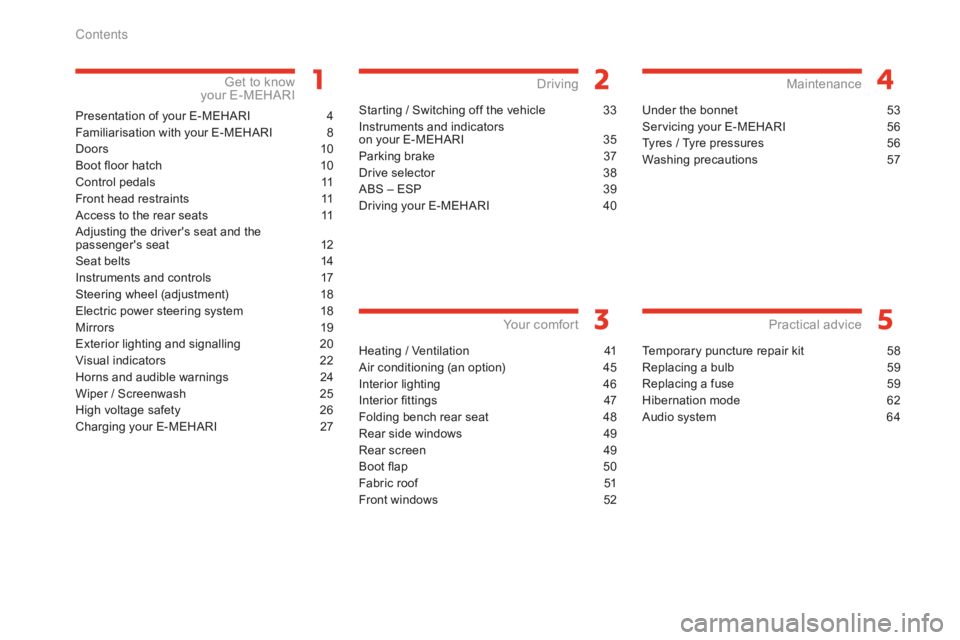
Presentation of your E-MEHARI 4
Fa miliarisation with your E-MEHARI
8
Do
ors
10
B
oot
fl
oor
h
atch 10
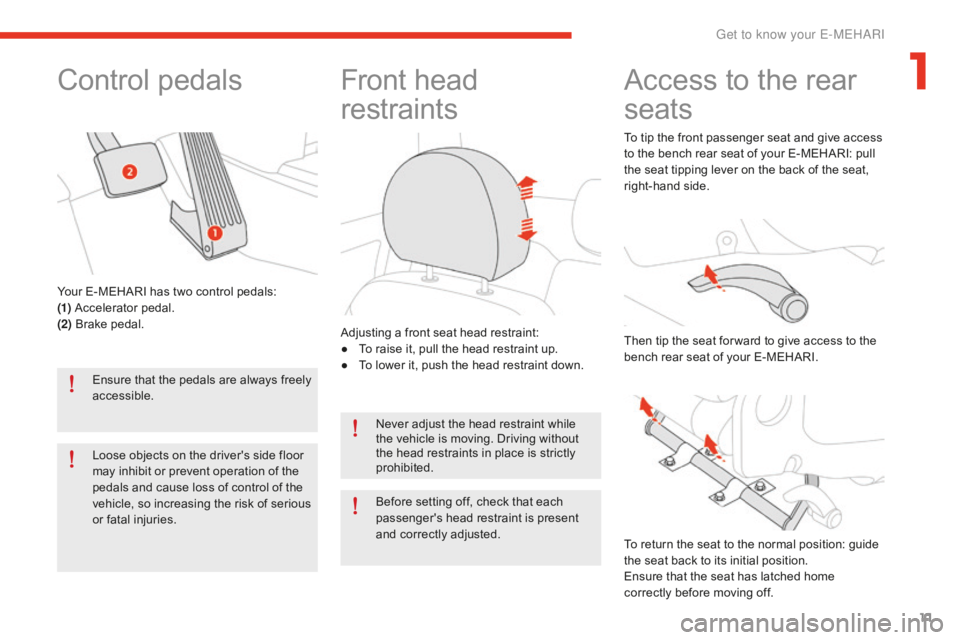
Control pedals
11
F
ront head restraints
11
A
ccess to the rear seats
11
A
djusting the driver's seat and the
passenger's seat
12
Se
at belts
14
I
nstruments and controls
17
S
teering wheel (adjustment)
18
E
lectric power steering system
18
M
irrors
19
Ex
terior lighting and signalling
20
V
isual indicators
22
H
orns and audible warnings
24
W
iper / Screenwash
25
Hig
h voltage safety
26
C
harging your E-MEHARI
27
Get to know
your E-MEHARI
Starting / Switching off the vehicle 33
I nstruments and indicators
on your E-MEHARI
35
P
arking brake
37
D
rive selector
38
A
BS – ESP
39
D
riving your E-MEHARI
40
Driving
Heating / Ventilation 41
A ir conditioning (an option)
45
I
nterior lighting
46
I
nterior
fi
ttings 47
Folding bench rear seat
48
R
ear side windows
49
R
ear screen
49
B
oot
fl
ap 50
Fabric roof
51
F
ront windows
52
Your comfort
Under the bonnet 53
S ervicing your E-MEHARI
56
T
yres / Tyre pressures
56
W
ashing precautions
57
Maintenance
Temporary puncture repair kit 58
R eplacing a bulb
59
R
eplacing a fuse
59
Hi
bernation mode
62
A
udio system
64
Practical advice
Contents
Page 5 of 81
.
e-mehari_en_Chap00a_sommaire_ed02-2016
Identification markings / Vehicle
VI N number 65
E
lectric motor: Technical characteristics -
LMP battery / Drive train
66
O
n-board charger
67
D
imensions / Weights
68
T
y r e s
6 8
P
erformance
6
9
Brakes and suspension
70
B
raking system
70
Technical data
Alphabetical index
Always use the driving regulations in force when using your
E-MEHARI.
● Never drive while under the influence of drugs or alcohol. Never take medicines that mi ght affect your ability to drive and control the vehicle before setting off.
● Always
o
bserve
t
he
s
peed
l
imit
a
nd
a
djust
y
our
s
peed
t
o
t
he
t
raffic
c
onditions.
● Always
g
ive
y
our
f
ull
a
ttention
t
o
d
riving
y
our
E
-MEHARI.
● In
a
ll
c
ircumstances,
u
se
t
he
s
afety
s
ystems
a
nd
a
ccessories
f
itted
t
o
y
our
E
-MEHARI.
Al
ways use the seat belts or restraint systems for children. All children under the age of
11
ye
ars must be installed at the rear using an appropriate restraint system that is type-
approved to the current standard in force in the European Union.
● Read
t
he
s
afety
i
nformation
g
iven
i
n
t
his
h
andbook.
Contents
Page 8 of 81
6
e-mehari_en_Chap01_faite-connaissance_ed02-2016
Your E- MEHARI uses a high voltage
batter y which can be up to 450 volts.
The temperature of the system can be
high during and after starting and when
the vehicle is switched off. Be aware of
the high voltage (see page 26).
Never dismantle, remove or replace the
high voltage components, cables and
connectors as they can cause serious
burns and an electric shock which could
cause serious or fatal injuries.
Precautions related to high
voltage
The high voltage cables are orange in colour.
There is no part of the high voltage system of
your E-MEHARI that can be replaced by the
user;
t
his
m
ust
o
nly
b
e
d
one
b
y
a q
ualified
pr
ofessional.
Take your E-MEHARI to a CITROËN
authorised
r
epairer
o
r
a q
ualified
p
rofessional
for
all maintenance and repair of the vehicle's
high voltage system. In the event of a collision
●
If you can drive the vehicle: move the vehicle to the side of the road, put the drive
selector at position "N" (neutral), apply the manual parking brake and switch off your
E-MEHARI.
● Make a visual check of the condition of your E- MEHARI to verify that no high voltage
cable or component is visible. To avoid injury: never touch the cables, the connectors,
the charger, the LMP
® battery or any other part of the high voltage system on your
E-MEHARI. You could suffer an electric shock if exposed cable conductors are visible,
whether inside or outside the vehicle. Never touch visible electric cables.
● If the vehicle has sustained a heavy impact to the floor: stop the vehicle in a safe
area and check the condition of your E-MEHARI's floor.
● If a fire has star ted in your E- MEHARI: get out of the vehicle immediately. Use a fire
extinguisher suitable for type ABC, BC or C fires of electric origin to put out the fire.
Using water or the wrong type of fire extinguisher can cause serious or fatal injuries
through electric shock.
● If your vehicle has to be recovered,
c
all
a C
ITROËN
a
uthorised
r
epairer
o
r
q
ualified
pr
ofessional. Have the front wheels lifted as, if the vehicle is towed with the front wheels
on the ground, the traction motor can produce electricity. This can damage the systems
on your E-MEHARI and cause a fire.
● If you cannot safely check the condition of your vehicle
b
ecause of the level of
damage sustained, do not touch your vehicle. Contact the emergency services and
specify that you have an electric vehicle. Inform the first to arrive at the scene of the
accident that it concerns an electric vehicle.
● In the event of an accident: you must contact a CITROËN authorised repairer or
a qualified professional who will send a person able to work on a damaged electric
vehicle.
● Obser ve the driving regulations on the safety of vehicles and third par ties.
Precautions related to road traffic accidents
Get to know your E-MEHARI
Page 9 of 81
7
e-mehari_en_Chap01_faite-connaissance_ed02-2016
Precautions in the event of
an electrical failure
In the event of a general electric failure,
your E-MEHARI will no longer be driven by
the
e
lectric
m
otor.
A
s
q
uickly
a
s
p
ossible,
yo
u should place the vehicle in a safe area
observing the driving regulations on road safety
(hard shoulder, side of the road…).
Immobilise your E-MEHARI, switch on the
hazard warning lamps, get out of the vehicle
and stand in a safe place, put on your high-
visibility vest and call CITRÖEN ASSISTANCE,
who will contact the emergency and roadside
assistance services.
Special aspects of electric
vehicles
Be particularly aware of pedestrians, cyclists,
children and motorcyclists. Your E-MEHARI
is a silent vehicle and they may not hear you
coming, which could give rise to collisions. Notes
● Your
E
-MEHARI
h
as
a
n
e
nergy
r
ecovery
sy
stem on deceleration. The main
purpose of energy recovery is to return
to the LMP
® battery some of the energy
generated when your vehicle is slowing
down, to improve the range of the LMP
®
battery and so the distance that can
be driven. In your E-MEHARI, it is the
braking effect of the electric motor that
plays this role.
● Special
c
ase:
f
ollowing
a f
ull
c
harge
o
f
th
e LMP
® battery and during the initial
subsequent u se o f t he v ehicle, t he br
aking effect of the electric motor may
be temporarily reduced. You should adapt
your
d
riving
i
n
c
onsequence.
● We
t
herefore
r
ecommend
t
hat
y
ou
an
ticipate the need to slow down as much
as possible, so as to obtain the maximum
driving range.
● The
b
rake
p
edal
s
hould
b
e
u
sed
t
o
s
low
or s
top the vehicle according to the road
and traffic conditions. Your E-MEHARI's
brakes do not allow energy recovery.
To avoid collisions with pedestrians, your
E-MEHARI is fitted with a special horn. This
special pedestrian horn allows you to announce
your approach in a friendly and less aggressive
way than would be the case with a conventional
horn (see page 24).
Before moving off, leave your foot on the brake
pedal until you are ready to drive. Before
leaving your E-MEHARI, don't forget to return
the drive selector to position "N", apply the
parking brake and switch off your vehicle.
1
Get to know your E-MEHARI
Page 13 of 81
11
e-mehari_en_Chap01_faite-connaissance_ed02-2016
Control pedals
Ensure that the pedals are always freely
accessible.
Loose objects on the driver's side floor
may inhibit or prevent operation of the
pedals and cause loss of control of the
vehicle, so increasing the risk of serious
or fatal injuries.Never adjust the head restraint while
the vehicle is moving. Driving without
the head restraints in place is strictly
prohibited.
Before setting off, check that each
passenger's head restraint is present
and correctly adjusted.
Your E-MEHARI has two control pedals:
(1)
Accelerator pedal.
(2) Brake pedal.
Front head
restraints
Adjusting a front seat head restraint:
● To r
aise i t, p ull t he h ead r estraint u p.
● To
l
ower
i
t,
p
ush
t
he
h
ead
r
estraint
d
own.
Access to the rear
seats
Then tip the seat for ward to give access to the
bench rear seat of your E-MEHARI. To tip the front passenger seat and give access
to the bench rear seat of your E-MEHARI: pull
the seat tipping lever on the back of the seat,
right-hand side.
To return the seat to the normal position: guide
the seat back to its initial position.
Ensure that the seat has latched home
correctly before moving off.
1
Get to know your E-MEHARI
Page 36 of 81

34
e-mehari_en_Chap02_conduite_ed02-2016
Your E-MEHARI is a silent electric
vehicle.
Your E-MEHARI produces no noise
from its electric motor.
For any manoeuvre: take particular
care in checking your surroundings,
particularly for pedestrians, cyclists and
other road users.
Moving off
To move off in your E-MEHARI, you should:
1. Unlock your E-MEHARI using your personal
RFID key ring.
2.
In
sert the key in the starting switch then turn
it to the MAR position. The welcome screen
appears.
3.
Wh
en you are invited to do it, turn the key to
the AV V position, holding it until your hear
an audible signal (beep). Release the key,
the switch automatically returns to the MAR
position. The following image appears in the
instrument panel screen: 4. Pr
ess the brake pedal.
5. Pl ace the drive selector at position "D"
(for ward drive) or "R" (reverse).
6.
Re
lease the manual parking brake.Switching off the vehicle
To park your E-MEHARI, you should:
1. Place the vehicle in a secure area suitable
for parking.
2.
Immo
bilise the vehicle.
3.
Pl
ace the drive selector at position
"
N".
4.
Ap
ply the manual parking brake.
5.
Sw
itch off and remove the key from the
starting switch.
Driving
Page 39 of 81
37
e-mehari_en_Chap02_conduite_ed02-2016
Parking brake
Always check that your manual parking
brake is applied before leaving the
vehicle.Note
In very cold conditions, the manual parking
brake could freeze and be impossible to
release.
When parking on a slope, turn the front
wheels into the kerb, apply the parking
brake and switch off at the starting
switch.
Check that the parking brake is
released before moving off.
Not releasing the parking brake could
result in its failure and cause an
accident.
Never release the parking brake from
outside the vehicle. Never leave children unsupervised
inside the vehicle.
They might release the parking brake
and cause an accident.
Only release the brake pedal once the
parking brake has been fully applied.
Failure to apply the parking brake could
allow the vehicle to move on its own
and cause an accident.Applying the parking brake
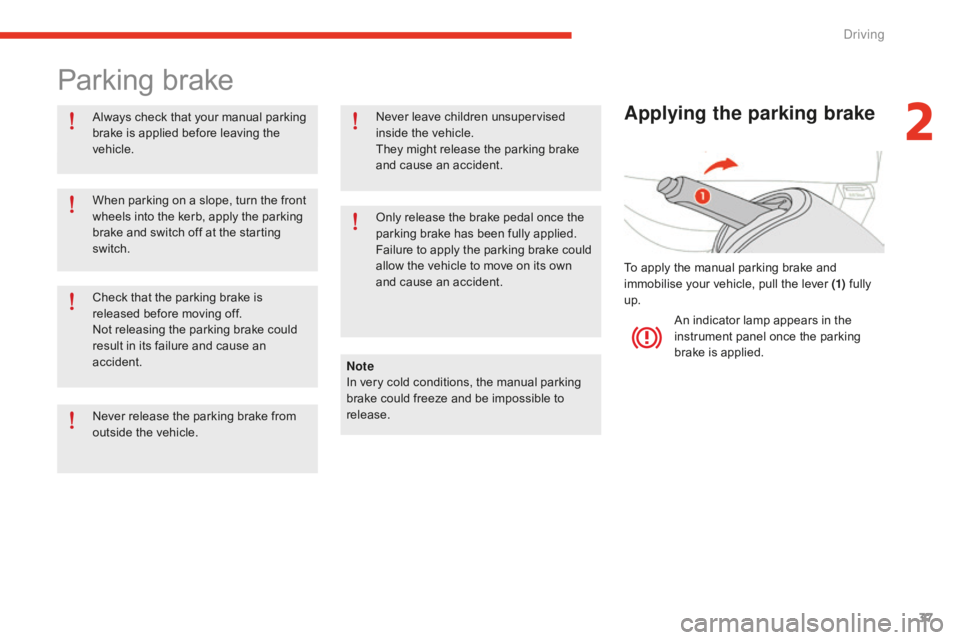
To apply the manual parking brake and
immobilise your vehicle, pull the lever (1)
fully
up.
An indicator lamp appears in the
instrument panel once the parking
brake is applied.
2
Driving
Page 40 of 81
38
e-mehari_en_Chap02_conduite_ed02-2016
Releasing the parking brake
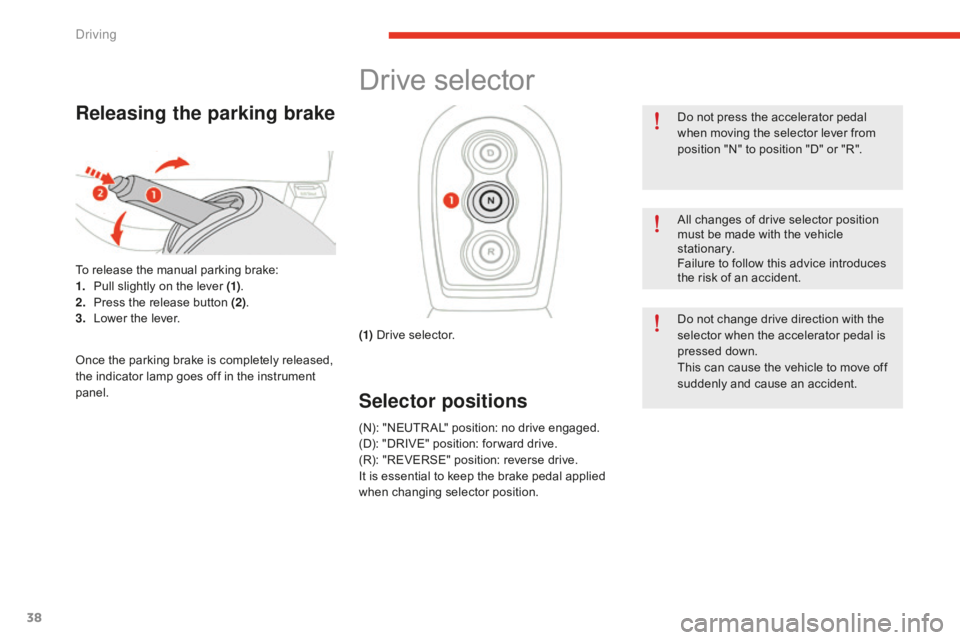
To release the manual parking brake:
1. Pull slightly on the lever (1) .
2.
Pr
ess the release button (2) .
3.
Lo
wer the lever.
Once the parking brake is completely released,
the indicator lamp goes off in the instrument
panel.
Drive selector
Do not press the accelerator pedal
when moving the selector lever from
position "N" to position "D" or "R".
All changes of drive selector position
must be made with the vehicle
stationary.
Failure to follow this advice introduces
the risk of an accident.
Do not change drive direction with the
selector when the accelerator pedal is
pressed down.
This can cause the vehicle to move off
suddenly and cause an accident.
(1)
Drive selector.
Selector positions
(N): "NEUTR AL" position: no drive engaged.
(D): "DRIVE" position: for ward drive.
(R): "REVERSE" position: reverse drive.
It is essential to keep the brake pedal applied
when changing selector position.
Driving
Page 41 of 81

39
e-mehari_en_Chap02_conduite_ed02-2016
ABS – ESP
These systems are additional aids when
driving in critical situations, allowing the
behaviour of the vehicle to be adapted
to the driver's wishes.
However these systems intervene
taking the place of the driver.
They cannot extend the vehicle's limits
and should not encourage you to drive
f a s t e r.
They cannot, in any circumstances,
replace the need for vigilance, or
the responsibility of the driver when
manoeuvring the vehicle (the driver
must always be alive to sudden events
that could occur while driving).Precautions
In an emergency, it is recommended that you
apply the brakes firmly and continuously.
It is not necessary to successively apply and
release the brakes (pumping the pedal).
The ABS will modulate the brake effort
applied.
ABS (anti-lock braking
system)
The ABS avoids locking the wheels under
heavy braking, so optimising the stopping
distance and allowing control of the vehicle to
be retained.
In these conditions, avoiding manoeuvres while
braking are possible.
In addition, this system optimises the stopping
distance on sur faces offering poor grip (wet
roads…).
ABS (warning lamp)
It comes on when the vehicle is switched on
and then goes off shortly after wards.
If it comes on when driving, it signals a fault in
the anti-lock braking system.
The braking system then operates as on
a vehicle not fitted with ABS. Contact a
CITROËN
a
uthorised
r
epairer
o
r
a q
ualified
pr
ofessional without delay.
ESP
This system helps retain control of the vehicle
in "critical" driving situations (avoiding an
obstacle, loss of grip in a corner…).
Principle of operation
A steering wheel sensor provides information
on the trajectory wanted by the driver.
Other sensors around the vehicle measure the
actual trajectory.
The system compares the driver's wishes with
the actual trajectory of the vehicle, correcting
the latter if necessary by acting on certain
brakes and/or the engine power.
ESP (warning lamp)
It comes on when the vehicle is switched on
and then goes off shortly after wards.
The ESP warning lamp flashes in regulation
mode, when its is called on to maintain grip.
If it comes on when driving, it signals a fault
in the ESP: contact a CITROËN authorised
repairer
o
r
a q
ualified
p
rofessional
w
ithout
d e
l ay.
Operation of the system can be felt by vibration
in the brake pedal.
The ABS does not improve the "physical"
per formance possible, which depends on the
grip between the tyres and the road.
It follows that the normal safe driving practices
must be observed (distance between
vehicles…).
2
Driving
Page 42 of 81

40
e-mehari_en_Chap02_conduite_ed02-2016
Never leave a child or a disabled adult
who usually needs help from others
alone in the vehicle.
Pets should not be left alone in the
vehicle.
Secure any loads in your vehicle so that
they cannot slide about.
Do not load the vehicle higher that the
seat backrests.
A poorly secured load could cause
serious injuries with sudden braking or
in a collision.
If the vehicle is not handled prudently
and in a safe way, you risk losing
control of it and causing an accident.
Driving your E-MEHARI
The following actions can increase
the risk of losing control of the
vehicle in the event of a loss of
pressure in a tyre:
● sudden
h
arsh
a
pplication
o
f
t
he
br
akes,
● releasing
t
he
a
ccelerator
p
edal
sudd
enly,
● turning
t
he
s
teering
w
heel
t
oo
qui
ckly.
Note: The vehicle generally moves
toward, or pulls, in the direction of the
under-inflated tyre.
Never drive under the influence of
alcohol or drugs.
The presence of alcohol or drugs in
your bloodstream reduces coordination,
slows reaction and impairs judgment.
Driving after taking alcohol or drugs
increases the risk of being involved in
an accident causing injuries, suffered
by yourself or inflicted on others.
Note also that, in the event of an
accident, the alcohol or drugs risk
increasing the severity of the injuries
suffered. Never take medicines that might affect
your ability to drive and control the
vehicle before setting off.
Never leave the starting switch in the
"MAR" position for a long period when
the vehicle is not being used.
This can reduce the range of the
vehicle.
When you stop your vehicle on a
rising slope, do not hold the vehicle by
pressing the accelerator.
Always use the brake pedal for this.
Driving