tow CITROEN E-MEHARI 2022 Owners Manual
[x] Cancel search | Manufacturer: CITROEN, Model Year: 2022, Model line: E-MEHARI, Model: CITROEN E-MEHARI 2022Pages: 84, PDF Size: 3.48 MB
Page 7 of 84
5
Precautions related to high
voltage
Your E- MEHARI uses a high voltage
b attery that can reach 450 volts.
The temperature of the system can be
high during and after starting and when
the vehicle is switched off. Be aware of the
high voltage.
For more information on High voltage
safety , refer to the corresponding section.
Never dismantle, remove, replace or
handle the high voltage components,
cables and connectors as they can cause
serious burns and an electric shock which
could cause serious or fatal injuries.
The high voltage cables are orange in colour.
There is no part of the high voltage system of
your E-MEHARI that can be replaced by the
user; this must only be done by a
qualified
professional.
Take your E-MEHARI to a
CITROËN
authorised repairer or a
qualified professional
for all maintenance and repair of the vehicle's
high voltage system.
Precautions related to road
accidents
In the event of collision
- I f you can drive the vehicle: move the
vehicle to the side of the road, put the
drive selector at position "N" (neutral),
apply the manual parking brake and
switch off your E-MEHARI.
-
C
arr y out a visual check of the
condition of your E-MEHARI to verify
that no high voltage cable or component
is visible. To avoid injury: never touch the
cables, the connectors, the charger, the
LMP
® battery or any other part of the high
voltage system on your E-MEHARI. You
could suffer an electric shock if exposed
cables are visible, whether you are inside
or outside the vehicle. Never touch visible
electric cables.
-
I
f the vehicle has sustained a heavy
impact to the floor: stop the vehicle in
a
safe area and check the condition of
your E-MEHARI's floor.
-
I
f a
fire has star ted in your E- MEHARI:
get out of the vehicle immediately. To
extinguish the fire, use an extinguisher
specially designed for electrical fires of
the ABC, BC or C type. Use of water or
the wrong type of extinguisher may cause serious or even fatal injuries due to electric
shock.
-
I
f your vehicle has to be recovered,
call a CITROËN authorised repairer or
a qualified professional and have the front
wheels lifted. If the vehicle is towed with
the front wheels on the ground, the traction
motor may produce electricity. This can
damage the systems on your E-MEHARI and
cause a fire.
-
I
f you cannot safely check the condition
of your vehicle because of the level of
damage sustained, do not touch your
vehicle. Contact the emergency services
and specify that you have an electric vehicle.
Inform the first to arrive at the scene of the
accident that it concerns an electric vehicle.
-
I
n the event of an accident: you must
contact a
CITROËN authorised repairer
or a
qualified professional who will send
a
person able to work on a damaged electric
vehicle.
-
O
bserve the driving regulations on the
safety of vehicles and third par ties.
.
Over view
Page 13 of 84
11
Manual central locking
- Press this button to operate the central locking of the vehicle (doors and boot) from
inside the vehicle.
The button indicator lamp comes on.
-
P
ressing the button again unlocks the
vehicle completely.
The button indicator lamp goes off.
Automatic central locking of the
doors (anti-intrusion security)
The doors and boot lock automatically when
driving, as soon as the speed exceeds 6 mph
(10
km/h).
To turn this function on or off (on by default):
-
W
ith the ignition on, press the central
locking button until a
padlock appears in the
instrument panel.
If one of the doors or the boot is open,
automatic central locking does not occur:
the sound of the locks rebounding can be
heard.
Driving with the doors locked could make
access to the passenger compartment by
the emergency services more difficult in
an emergency.
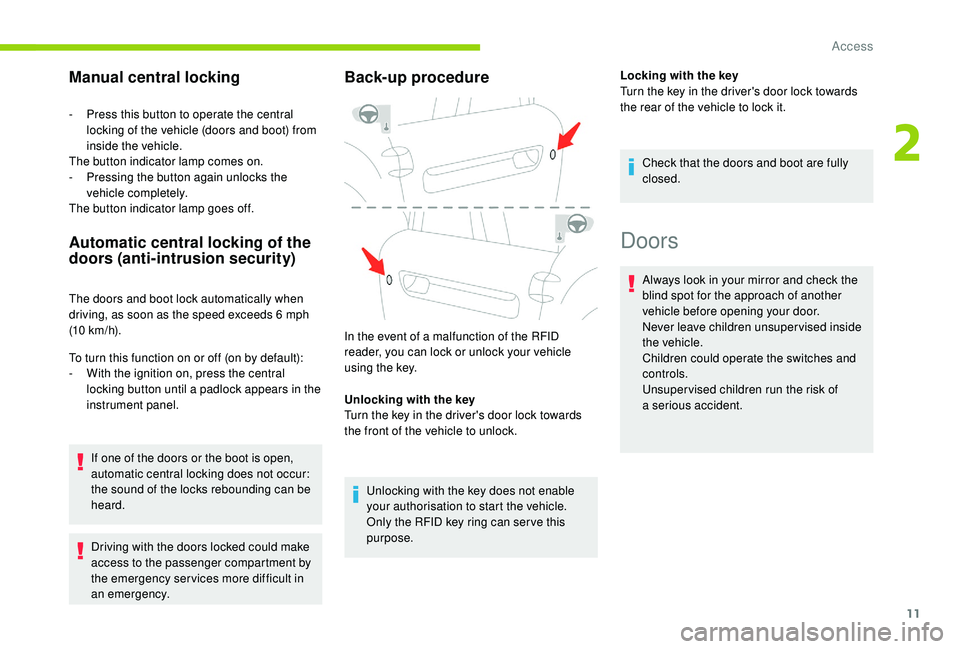
Back-up procedure
In the event of a malfunction of the RFID
r eader, you can lock or unlock your vehicle
using the key.
Unlocking with the key
Turn the key in the driver's door lock towards
the front of the vehicle to unlock.
Unlocking with the key does not enable
your authorisation to start the vehicle.
Only the RFID key ring can ser ve this
purpose. Locking with the key
Turn the key in the driver's door lock towards
the rear of the vehicle to lock it.
Check that the doors and boot are fully
closed.
Doors
Always look in your mirror and check the
blind spot for the approach of another
vehicle before opening your door.
Never leave children unsuper vised inside
the vehicle.
Children could operate the switches and
controls.
Unsuper vised children run the risk of
a
serious accident.
2
Access
Page 15 of 84
13
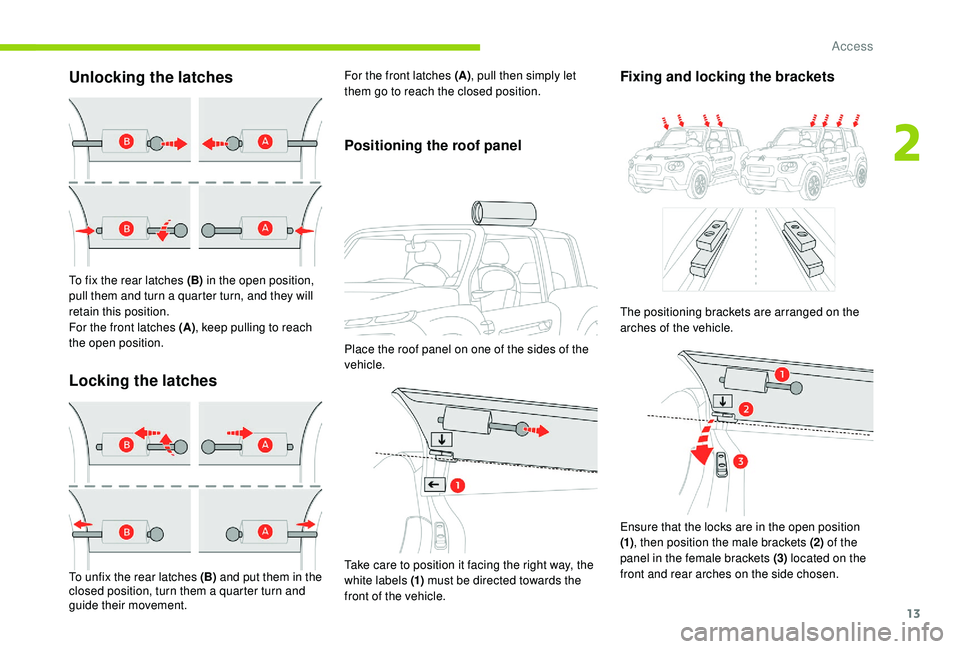
Unlocking the latches
To fix the rear latches (B) in the open position,
pull them and turn a quarter turn, and they will
retain this position.
For the front latches (A) , keep pulling to reach
the open position.
Locking the latches
For the front latches (A) , pull then simply let
them go to reach the closed position.
Positioning the roof panel
To unfix the rear latches (B) and put them in the
closed position, turn them a quarter turn and
guide their movement. Place the roof panel on one of the sides of the
vehicle.
Take care to position it facing the right way, the
white labels (1)
must be directed towards the
front of the vehicle.
Fixing and locking the brackets
The positioning brackets are arranged on the
arches of the vehicle.
Ensure that the locks are in the open position
(1) , then position the male brackets (2) of the
panel in the female brackets (3) located on the
front and rear arches on the side chosen.
2
Access
Page 16 of 84
14
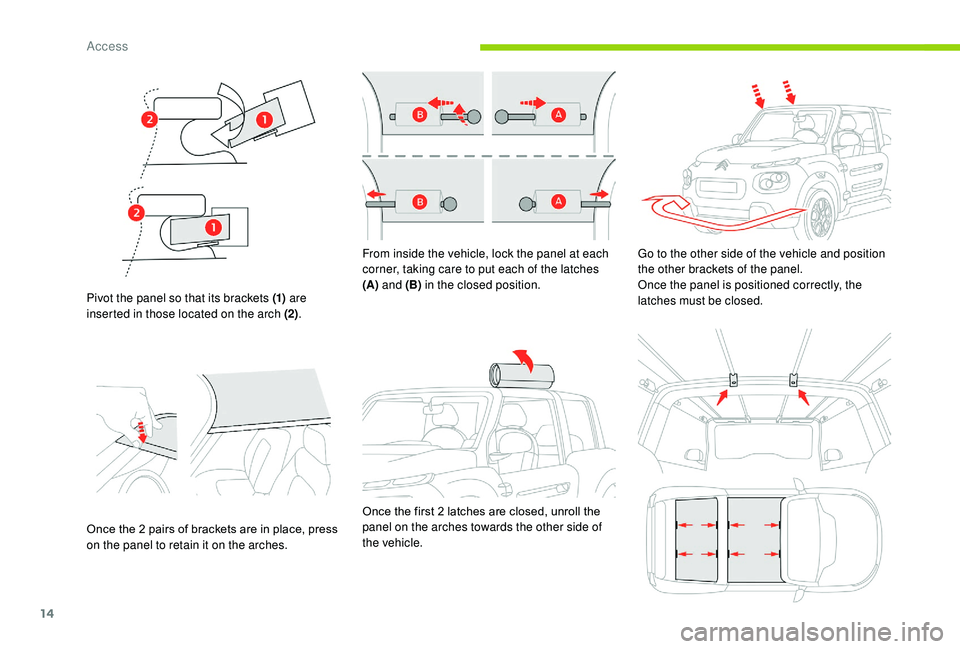
Pivot the panel so that its brackets (1) are
inserted in those located on the arch (2) .
Once the 2
pairs of brackets are in place, press
on the panel to retain it on the arches. From inside the vehicle, lock the panel at each
corner, taking care to put each of the latches
(A)
and (B) in the closed position.
Once the first 2 latches are closed, unroll the
panel on the arches towards the other side of
the vehicle. Go to the other side of the vehicle and position
the other brackets of the panel.
Once the panel is positioned correctly, the
latches must be closed.
Access
Page 17 of 84
15
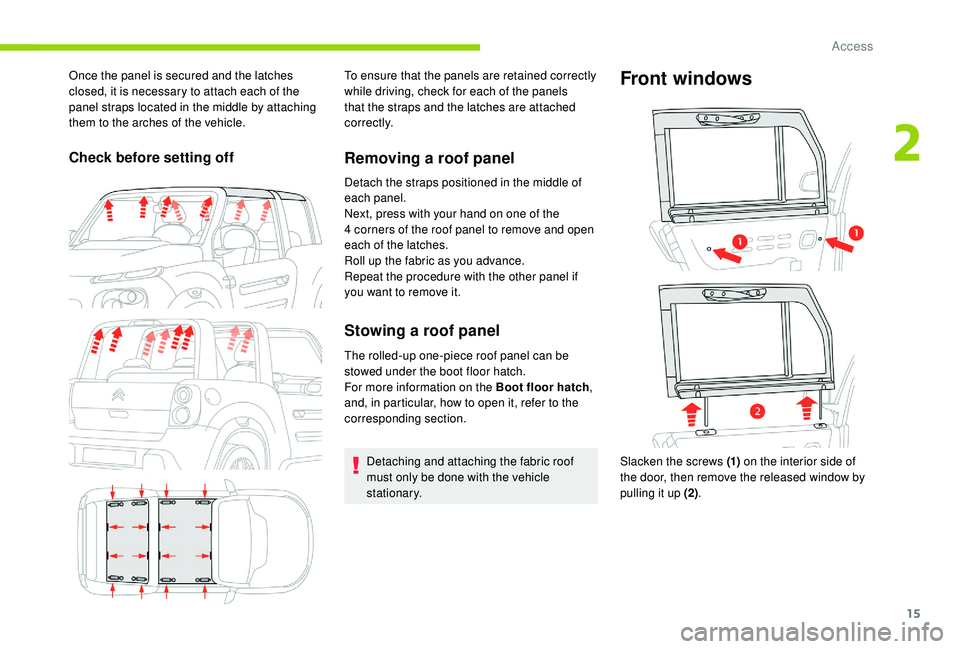
Once the panel is secured and the latches
closed, it is necessary to attach each of the
panel straps located in the middle by attaching
them to the arches of the vehicle.
Check before setting off
To ensure that the panels are retained correctly
while driving, check for each of the panels
that the straps and the latches are attached
c o r r e c t l y.
Removing a roof panel
Detach the straps positioned in the middle of
each panel.
Next, press with your hand on one of the
4 corners of the roof panel to remove and open
each of the latches.
Roll up the fabric as you advance.
Repeat the procedure with the other panel if
you want to remove it.
Stowing a roof panel
The rolled-up one-piece roof panel can be
stowed under the boot floor hatch.
For more information on the Boot floor hatch ,
and, in particular, how to open it, refer to the
corresponding section.
Detaching and attaching the fabric roof
must only be done with the vehicle
stationary.
Front windows
Slacken the screws (1) on the interior side of
the door, then remove the released window by
pulling it up (2) .
2
Access
Page 27 of 84

25
Push the lever (1) up to release the locking
mechanism and then adjust the position of the
steering wheel.
Lower the lever (1) to lock the adjustment
mechanism in the desired position.
Before driving, check that the adjustment
mechanism is locked.
Mirrors
Your E-MEHARI has 3 mirrors:
- T wo exterior door mirrors.
-
A c
entral interior rear view mirror.
Door mirrors
The door mirrors (1) are adjustable manually.
Direct each mirror using the levers (2) .
Objects seen in the passenger's side door
mirror are closer than they appear.
Take care when changing direction toward
the nearside.
Using only the passenger's side door
mirror could cause accidents.
Make use of the interior rear view mirror
and the driver's side door mirror or look
behind to estimate distances correctly.
Rear view mirror
(3) Interior rear view mirror.
(4) Day/night mode control lever.
To adjust the interior rear view mirror: adjust
the angle of the mirror to the desired position
by hand.
Objects seen in the interior rear view
mirror are closer than they appear.
Only use the night position when
necessary.
It reduces the clarity of the mirror.
3
Ease of use and comfort
Page 34 of 84
32
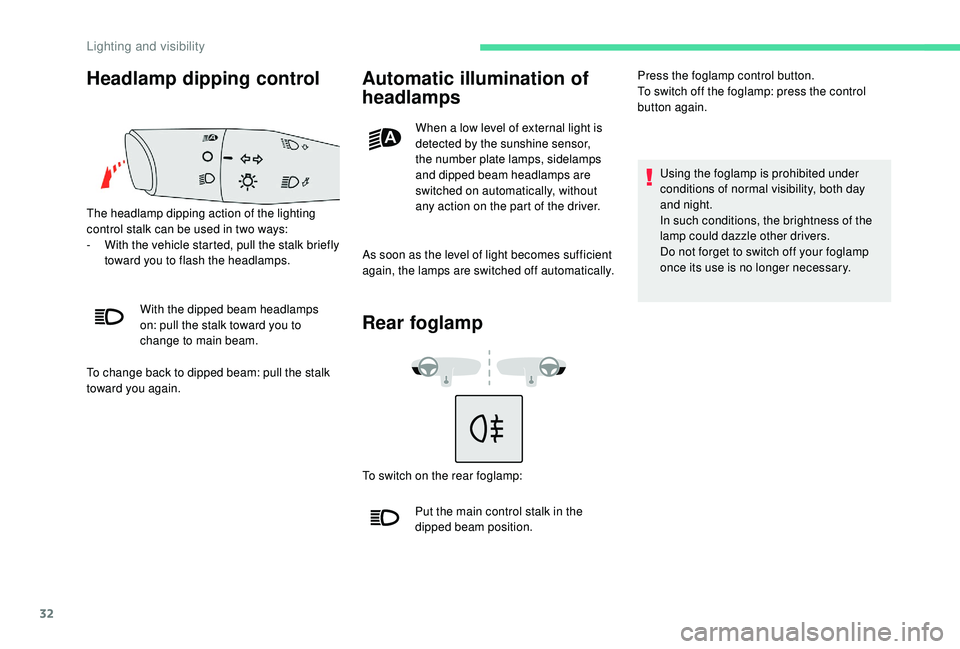
Headlamp dipping control
The headlamp dipping action of the lighting
control stalk can be used in two ways:
-
W
ith the vehicle started, pull the stalk briefly
toward you to flash the headlamps.
With the dipped beam headlamps
on: pull the stalk toward you to
change to main beam.
To change back to dipped beam: pull the stalk
toward you again.
Automatic illumination of
headlamps
When a low level of external light is
d etected by the sunshine sensor,
the number plate lamps, sidelamps
and dipped beam headlamps are
switched on automatically, without
any action on the part of the driver.
As soon as the level of light becomes sufficient
again, the lamps are switched off automatically.
Rear foglamp
To switch on the rear foglamp: Put the main control stalk in the
dipped beam position. Press the foglamp control button.
To switch off the foglamp: press the control
button again.
Using the foglamp is prohibited under
conditions of normal visibility, both day
and night.
In such conditions, the brightness of the
lamp could dazzle other drivers.
Do not forget to switch off your foglamp
once its use is no longer necessary.
Lighting and visibility
Page 35 of 84
33
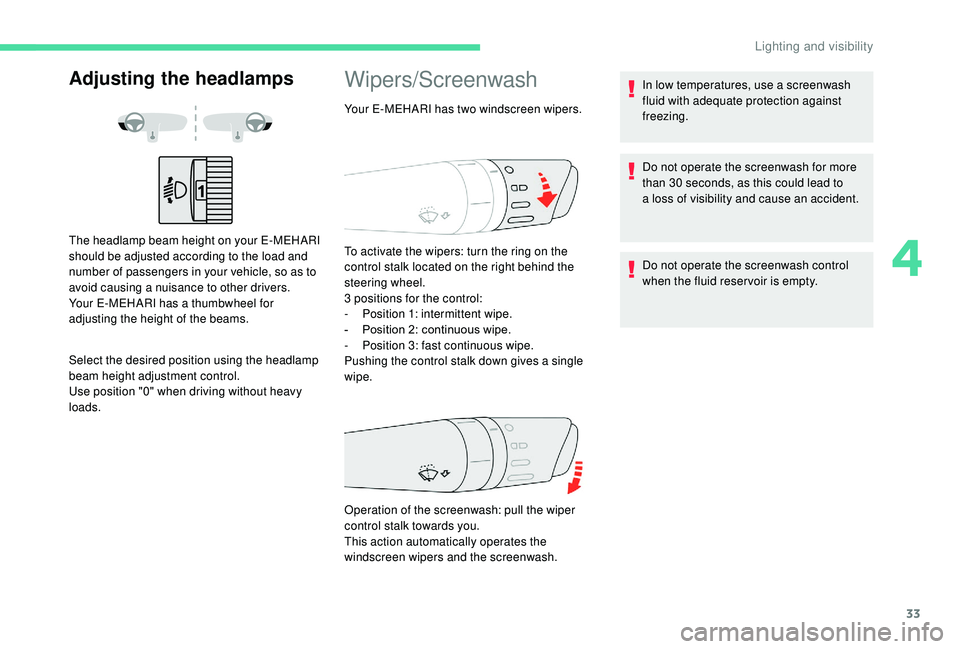
Adjusting the headlamps
The headlamp beam height on your E-MEHARI
should be adjusted according to the load and
number of passengers in your vehicle, so as to
avoid causing a nuisance to other drivers.
Your E-MEHARI has a
thumbwheel for
adjusting the height of the beams.
Select the desired position using the headlamp
beam height adjustment control.
Use position "0" when driving without heavy
loads.
Wipers/Screenwash
Your E-MEHARI has two windscreen wipers.
To activate the wipers: turn the ring on the
control stalk located on the right behind the
steering wheel.
3
positions for the control:
-
P
osition 1: intermittent wipe.
-
P
osition 2: continuous wipe.
-
P
osition 3: fast continuous wipe.
Pushing the control stalk down gives a
single
wipe.
Operation of the screenwash: pull the wiper
control stalk towards you.
This action automatically operates the
windscreen wipers and the screenwash. In low temperatures, use a
screenwash
fluid with adequate protection against
freezing.
Do not operate the screenwash for more
than 30
seconds, as this could lead to
a
loss of visibility and cause an accident.
Do not operate the screenwash control
when the fluid reservoir is empty.
4
Lighting and visibility
Page 41 of 84
39
Rear seat belts not fastened
alerts
Seat belts unfastened alert
When the ignition is switched on, with the
motor running or the vehicle driving above
6 mph (10 km/h), warning lamp A and the
corresponding dots in warning lamp B come on
for around thirty seconds, if one or more rear
passengers have not fastened their seat belts.
After the ignition is switched on, warning
lamp A and the corresponding dots in warning
lamp B come on if the driver and/or one or
more passengers unfasten their seat belts.
These warning lamps flash for 30
seconds,
accompanied by an audible signal. Beyond
this period of time, the warning lamps stay on
continuously until the seat belts are fastened.
Airbags
General information
This system contributes towards improving the
safety of passengers (with the exception of the
rear centre passenger) in the event of violent
collisions. The airbags supplement the action
of the seat belts fitted with force limiters (with
the exception of the rear centre passenger).
If a
collision occurs, the electronic detectors
record and analyse the front and side impacts
sustained in the impact detection zones:
-
i
n the event of a serious impact, the airbags
are deployed instantly and contribute
towards better protection of the passengers
(with the exception of the rear centre
passenger); immediately after the impact,
the airbags deflate rapidly so that they
do not hinder visibility or the exit of the
passengers,
-
i
n the case of a minor or rear impact or in
certain roll-over conditions, the airbags
may not be deployed; the seat belt
alone contributes towards ensuring your
protection in these situations.
The airbags do not operate when the
ignition is switched off.
This equipment will only deploy once. If
a
second impact occurs (during the same
or a
subsequent accident), the airbag will
not be deployed again.
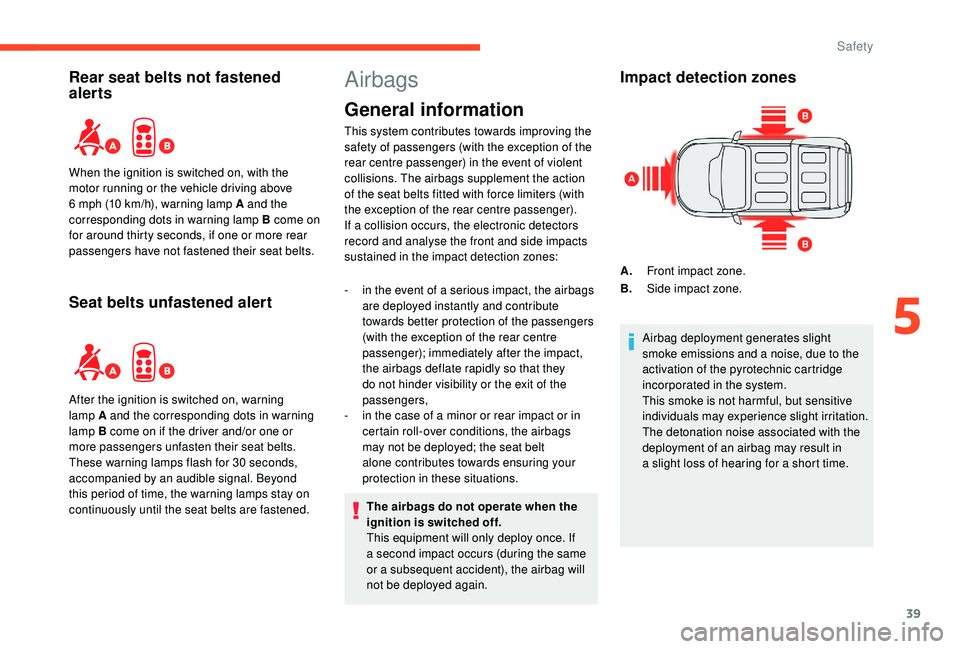
Impact detection zones
A. Front impact zone.
B. Side impact zone.
Airbag deployment generates slight
smoke emissions and a
noise, due to the
activation of the pyrotechnic cartridge
incorporated in the system.
This smoke is not harmful, but sensitive
individuals may experience slight irritation.
The detonation noise associated with the
deployment of an airbag may result in
a
slight loss of hearing for a short time.
5
Safety
Page 42 of 84
40
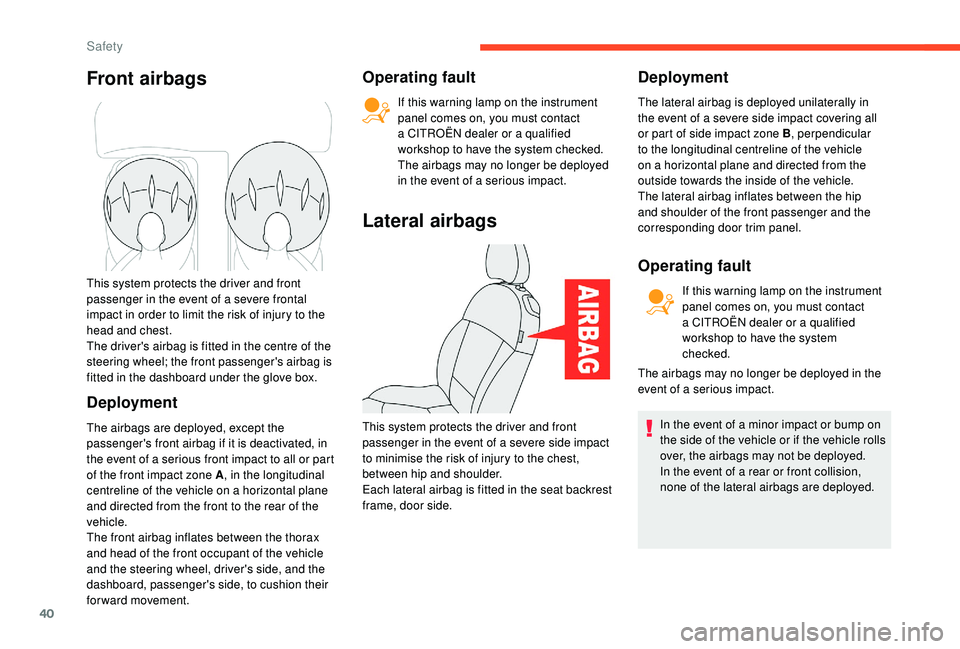
Front airbags
This system protects the driver and front
passenger in the event of a severe frontal
impact in order to limit the risk of injury to the
head and chest.
The driver's airbag is fitted in the centre of the
steering wheel; the front passenger's airbag is
fitted in the dashboard under the glove box.
Deployment
The airbags are deployed, except the
passenger's front airbag if it is deactivated, in
the event of a
serious front impact to all or part
of the front impact zone A , in the longitudinal
centreline of the vehicle on a
horizontal plane
and directed from the front to the rear of the
vehicle.
The front airbag inflates between the thorax
and head of the front occupant of the vehicle
and the steering wheel, driver's side, and the
dashboard, passenger's side, to cushion their
for ward movement.
Operating fault
If this warning lamp on the instrument
panel comes on, you must contact
a
CITROËN dealer or a qualified
workshop to have the system checked.
The airbags may no longer be deployed
in the event of a
serious impact.
Lateral airbags
This system protects the driver and front
passenger in the event of a severe side impact
to minimise the risk of injury to the chest,
between hip and shoulder.
Each lateral airbag is fitted in the seat backrest
frame, door side.
Deployment
The lateral airbag is deployed unilaterally in
the event of a severe side impact covering all
or part of side impact zone B , perpendicular
to the longitudinal centreline of the vehicle
on a
horizontal plane and directed from the
outside towards the inside of the vehicle.
The lateral airbag inflates between the hip
and shoulder of the front passenger and the
corresponding door trim panel.
Operating fault
If this warning lamp on the instrument
panel comes on, you must contact
a
CITROËN dealer or a qualified
workshop to have the system
checked.
The airbags may no longer be deployed in the
event of a
serious impact.
In the event of a
minor impact or bump on
the side of the vehicle or if the vehicle rolls
over, the airbags may not be deployed.
In the event of a
rear or front collision,
none of the lateral airbags are deployed.
Safety