parking brake Citroen GRAND C4 PICASSO RHD 2016 2.G User Guide
[x] Cancel search | Manufacturer: CITROEN, Model Year: 2016, Model line: GRAND C4 PICASSO RHD, Model: Citroen GRAND C4 PICASSO RHD 2016 2.GPages: 523, PDF Size: 13.63 MB
Page 133 of 523
131
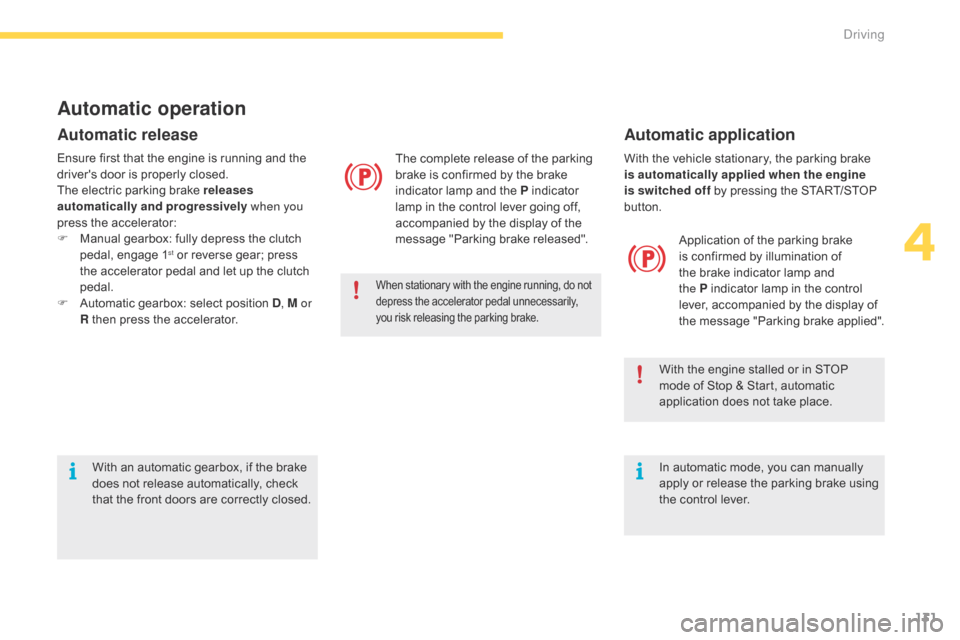
With the vehicle stationary, the parking brake is automatically applied when the engine
is switched off
by pressing the START/STOP
b
utton. Application
of the parking brake
i
s confirmed by illumination of
t
he brake indicator lamp and
t
he P indicator lamp in the control
l
ever, accompanied by the display of
t
he
m
essage
"
Parking
b
rake
a
pplied".
With
the engine stalled or in STOP
m
ode of Stop & Start, automatic
a
pplication does not take place.
In
automatic mode, you can manually
a
pply
o
r
r
elease
t
he
p
arking
b
rake
u
sing
t
he control lever.
Automatic operation
Automatic release
The complete release of the parking brake is confirmed by the brake
i
ndicator lamp and the P indicator
l
amp in the control lever going off,
a
ccompanied by the display of the
m
essage "Parking brake released".
When stationary with the engine running, do not depress the accelerator pedal unnecessarily, y
ou risk releasing the parking brake.
Ensure first that the engine is running and the driver's door is properly closed.
The
electric parking brake releases
automatically and progressively when you
press
the accelerator:
F
M
anual gearbox: fully depress the clutch
p
edal, engage 1
st or reverse gear; press t
he
accelerator
pedal and let up the clutch
ped
al.
F
A
utomatic
gearbox: select position D, M or
R
then
press
the
accelerator.
Automatic application
With an automatic gearbox, if the brake d oes not release automatically, check
t
hat the front doors are correctly closed.
4
Driving
Page 134 of 523

132
Special cases
Application of the parking brake is confirmed by illumination of
t
he brake indicator lamp and
t
he P indicator lamp in the control
l
ever, accompanied by the display of
t
he
m
essage
"
Parking
b
rake
a
pplied". The
complete release of the parking
b
rake is confirmed by the brake
i
ndicator lamp and the P indicator
l
amp in the control lever going off,
a
ccompanied by the display of the
m
essage "Parking brake released".
In
some
situations, you may need to operate
t
he
parking brake manually.
Immobilisation of the vehicle
with the engine running
To immobilise the vehicle with the engine r
unning, briefly pull the control lever.
Parking the vehicle with the
brake released
In very cold conditions, it is recommended that the parking brake
n
ot be applied (risk of freezing).
To
immobilise your vehicle, engage a
g
ear or fit a chock to one of the wheels.
Immobilisation of the vehicle with the
parking brake released
F
S
witch off the engine.
I
llumination of the warning lamps in the
i
nstrument panel and control lever confirm
a
pplication of the parking brake.
F
S
witch on the ignition again, without
s
tarting the engine.
F
R
elease the parking brake manually by
p
ushing the control lever while keeping
y
our foot on the brake. F
S
witch off the ignition.
Driving
Page 135 of 523
133
Emergency braking
In the event of a failure of the main service brake or in an exceptional situation (e.g. driver
t
aken ill, under instruction, etc.) a continuous
p
ull on the control lever will brake the vehicle.
B
raking takes place while the control lever is
b
eing pulled. It is interrupted if the control lever
i
s
r
eleased.
The
ABS and DSC systems provide stability of
t
he vehicle during emergency braking.
If
the emergency braking malfunctions, the
m
essage "Parking brake control faulty" will be
d
isplayed.
If
a failure of the ABS and DSC systems occurs,
s
ignalled by the illumination of one or both
w
arning lamps in the instrument panel, then
s
tability of the vehicle is no longer guaranteed.
In
this event, stability must be assured by the
d
river by repeating alternate "pull-release"
a
ctions on the control lever until the vehicle is
immobilised. The
emergency braking should only be
u
sed in an exceptional situation.
Repeat
this
procedure
to
reactivate
automatic
ope
ration.
Reactivation
of
automatic
operation
is
c
onfirmed
by
the
indicator
lamp
in
the
i
nstrument
panel
going
off.
Deactivating automatic operation
In some situations, such as very cold weather o r towing (caravan, recovery), it may be
n
ecessary to deactivate automatic operation of
t
he system.
F
S
tart the engine.
F
A
pply the parking brake with the control
l
ever, if it is released.
F
T
ake your foot off the brake pedal.
F
P
ush and hold the control lever in the
r
elease direction for at least 10 seconds
a
nd no more than 15 seconds.
F
R
elease the control lever.
F
P
ress and hold the brake pedal.
F
P
ull the control lever in the apply direction
f
or 2 seconds.
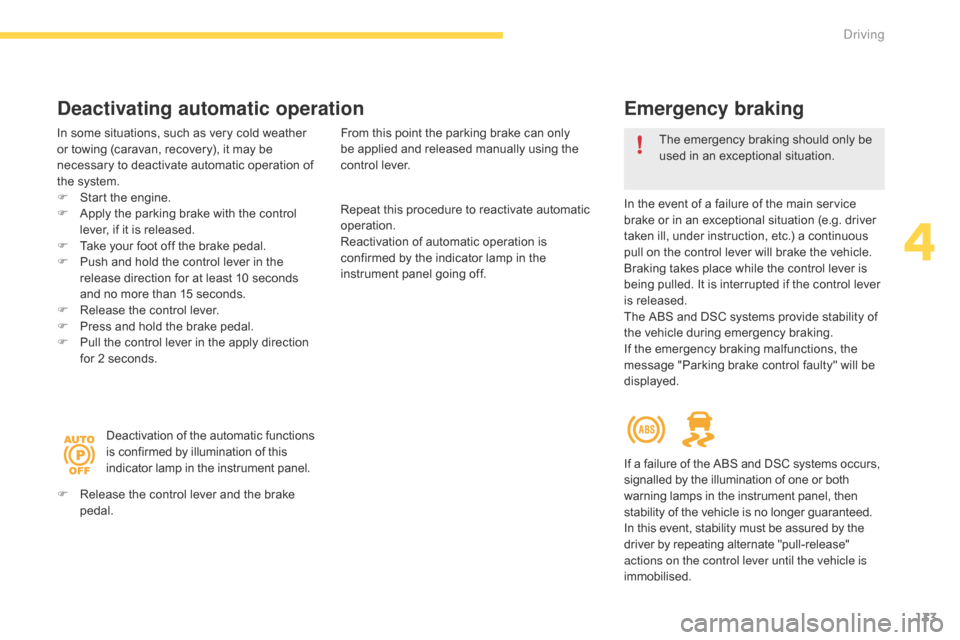
Deactivation
of the automatic functions
i
s confirmed by illumination of this
i
ndicator lamp in the instrument panel.
F
R
elease the control lever and the brake
ped
al. From
this point the parking brake can only b
e applied and released manually using the
c
ontrol lever.
4
Driving
Page 136 of 523
134
Operating faults
The various alert situations are described in the table below.
I n the event of a fault with the electric parking brake it is recommended that you contact a CITROËN dealer or a qualified workshop without delay.
Situations Consequences
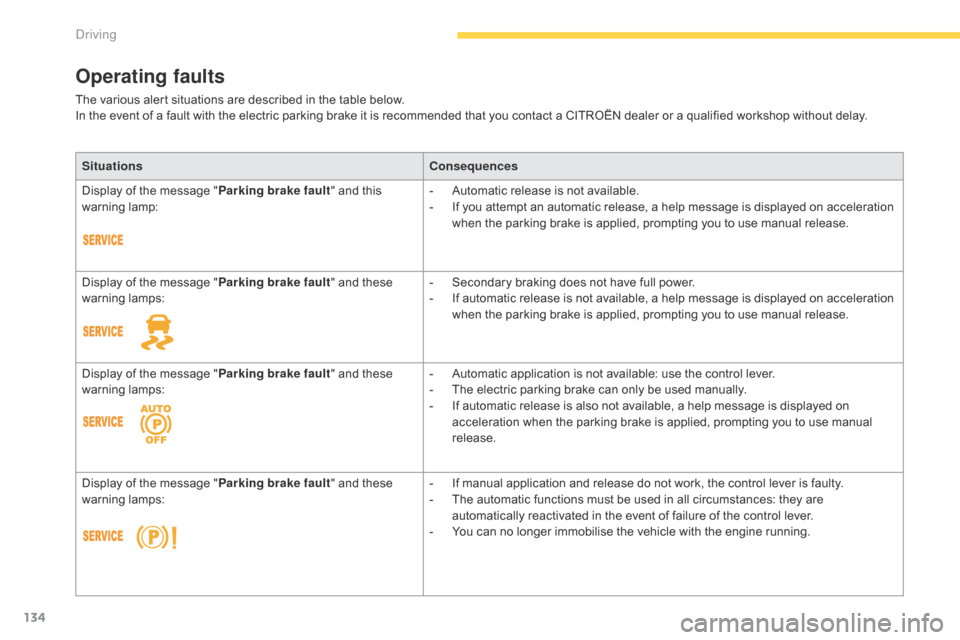
Display
of the message "Parking brake fault "
and this
w
arning
lam
p: -
A
utomatic release is not available.
-
I
f you attempt an automatic release, a help message is displayed on acceleration
w
hen the parking brake is applied, prompting you to use manual release.
Display
of the message "Parking brake fault "
and these
w
arning
lam
ps: -
S
econdary braking does not have full power.
-
I
f automatic release is not available, a help message is displayed on acceleration
w
hen the parking brake is applied, prompting you to use manual release.
Display
of the message "Parking brake fault "
and these
w
arning
lam
ps: -
A
utomatic application is not available: use the control lever.
-
T
he electric parking brake can only be used manually.
-
I
f automatic release is also not available, a help message is displayed on
a
cceleration when the parking brake is applied, prompting you to use manual
r
elease.
Display
of the message "Parking brake fault "
and these
w
arning
lam
ps: -
I
f manual application and release do not work, the control lever is faulty.
-
T
he automatic functions must be used in all circumstances: they are
a
utomatically reactivated in the event of failure of the control lever.
-
Y
ou can no longer immobilise the vehicle with the engine running.
Driving
Page 137 of 523

135
SituationsConsequences
Display of the message "Parking brake fault "
and these
w
arning
lam
ps: The
parking brake is faulty, the manual and automatic functions may not operate.
When stationary ,
to immobilise your vehicle:
-
P
ull and hold the control lever for about 7 to 15 seconds, until the warning lamp
c
omes on in the instrument panel.
If
this procedure does not work, you should make your vehicle safe:
-
P
ark on a level sur face.
-
E
ngage a gear with a manual gearbox, or place the gear selector at position P
with
an automatic gearbox.
-
I
f possible, fit a wheel chock.
Call
on a CITROËN dealer or a qualified workshop.
Display
of the message "Parking brake fault "
and these
w
arning
lam
ps: -
T
he parking brake does not have its full per formance to securely hold the vehicle
i
n all situations.
You
should make your vehicle safe:
-
P
ark on a level sur face.
-
E
ngage a gear with a manual gearbox, or place the gear selector at position P
with
an automatic gearbox.
-
I
f possible, fit a wheel chock.
Call
on a CITROËN dealer or a qualified workshop.
The
flashing of the P warning lamps on starting the vehicle indicates that the parking
b
rake is not correctly applied.
As
soon as possible, stop the vehicle and try to completely release the parking brake,
u
sing the control lever, with your foot on the brake pedal.
Display
of the message "Battery fault "
and this warning lamp:-
T
he state of charge of the battery is very low and requires immobilisation of the
v
ehicle in a safe place: engage a gear with a manual gearbox or fit a chock to
o
ne of the wheels.
-
O
nce the battery is completely discharged, the controls do not operate: to
r
elease the parking brake, call on a CITROËN dealer or a qualified workshop.
4
Driving
Page 138 of 523
136
Hill start assist
System which keeps your vehicle immobilised temporarily (approximately 2 seconds) when
m
oving off on a gradient, the time it takes to
m
ove your foot from the brake pedal to the
a
ccelerator
ped
al.
This
system only operates when:
-
t
he vehicle is completely stationary, with
y
our foot on the brake pedal,
-
c
ertain conditions of slope are met,
-
w
ith the driver’s door closed.
The
hill start assist system cannot be
d
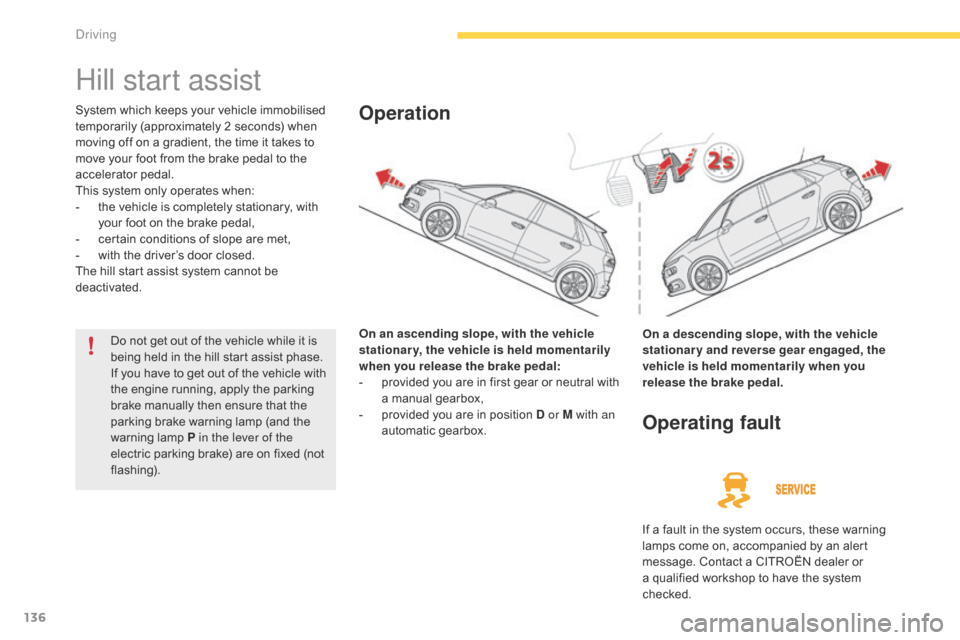
eactivated. On an ascending slope, with the vehicle
stationary, the vehicle is held momentarily
when you release the brake pedal:
-
p
rovided you are in first gear or neutral with
a
manual gearbox,
-
p
rovided you are in position D or M with an
automatic
gearbox.Operation
On a descending slope, with the vehicle
stationary and reverse gear engaged, the
vehicle is held momentarily when you
release the brake pedal.
Operating fault
If a fault in the system occurs, these warning lamps come on, accompanied by an alert
m
essage. Contact a CITROËN dealer or
a
qualified workshop to have the system
c
hecked.
Do
not
get
out
of
the
vehicle
while
it
is
b
eing
held
in
the
hill
start
assist
phase.
If
you
have
to
get
out
of
the
vehicle
with
t
he
engine
running,
apply
the
parking
b
rake
manually
then
ensure
that
the
p
arking
brake
warning
lamp
(and
the
w
arning
lam
p
P
in the lever of the
electric
parking
brake)
are
on
fixed
(not
f
lashing).
Driving
Page 140 of 523
138
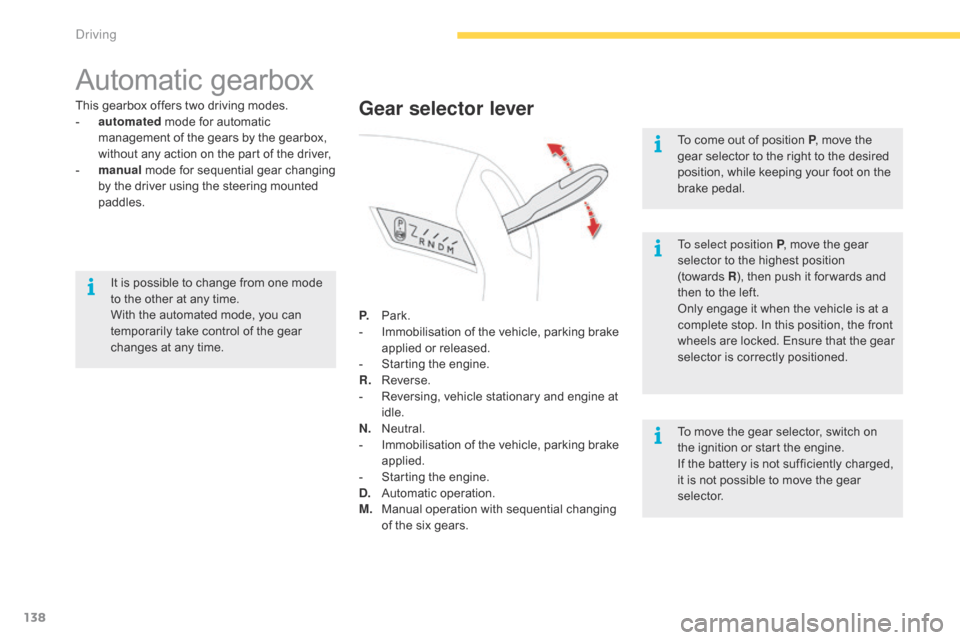
Automatic gearbox
This gearbox offers two driving modes.
- a utomated mode for automatic
m
anagement of the gears by the gearbox,
w
ithout any action on the part of the driver,
-
m
anual
mode for sequential gear changing
b
y the driver using the steering mounted
p
addles.
P.
Pa
rk.
-
I
mmobilisation of the vehicle, parking brake
a
pplied or released.
-
S
tarting the engine.
R.
R
everse.
-
R
eversing, vehicle stationary and engine at
i
dle.
N.
N
eutral.
-
I
mmobilisation of the vehicle, parking brake
a
pplied.
-
S
tarting the engine.
D.
A
utomatic
ope
ration.
M.
M
anual operation with sequential changing
o
f the six gears.Gear selector lever
To select position P, move the gear s
elector to the highest position
(
towards R),
then push it for wards and
t
hen to the left.
Only
engage it when the vehicle is at a
c
omplete stop. In this position, the front
w
heels are locked. Ensure that the gear
s
elector is correctly positioned.
To
move the gear selector, switch on
t
he ignition or start the engine.
If
the battery is not sufficiently charged,
i
t is not possible to move the gear
s
elector.
To
come out of position P
, move the
g
ear selector to the right to the desired
p
osition, while keeping your foot on the
b
rake
ped
al.
It
is
possible
to
change
from
one
mode
t
o
the
other
at
any
time.
With
the
automated
mode,
you
can
t
emporarily
take
control
of
the
gear
c
hanges
at
any
time.
Driving
Page 142 of 523
140
F Check that the symbol displayed in the i
nstrument panel agrees with the position
o
f the selector.
F
P
rogressively release the brake pedal.
F
I
f the parking brake is released, the vehicle
m
oves off.
I
f the parking brake is applied and
a
utomatic
ope
ration
i
s
a
ctivated,
a
ccelerate
a
way.
Never
press the accelerator and brake
p
edals at the same time. Braking and
a
cceleration should be done only with
t
he right foot. Pressing both pedals
t
ogether risks damaging the gearbox.
If
the brake does not release
a
utomatically, check that the front doors
a
re correctly closed. Never
leave children unsupervised in
t
he vehicle when the engine is running.
When
carrying out a maintenance
o
peration with the engine running,
a
pply
t
he parking brake and select position P. Never select position P or R unless the
vehicle
is at a complete stop with the
br
ake
a
pplied.
When
you want to engage reverse,
t
o avoid jolts, do not accelerate
i
mmediately after engaging R.
Changing
in
to
p
osition
R
is
accompanied
by an audible signal.
Never select position N
when driving.
I
f position N is engaged in error when
m
oving, allow the engine to idle, then
e
ngage position D to accelerate.
When
the engine is running at idle,
b
rakes released, if position R, D or M is
selected,
the vehicle will move even if
t
he accelerator is not pressed.
Driving
Page 144 of 523
142
Before switching off the engine, you can change to position P or N to be in neutral.
I
n either case, apply the parking brake to
i
mmobilise the vehicle, unless it is programmed
i
n automatic mode.
If the lever is not in position P ,
on opening the
d
river's door or approximately 45 seconds after
s
witching off the ignition there is an audible
s
ignal and a message appears:
F
m
ove the gear selector to position P; the
a
udible signal stops and the message
d
isappears.
Operating fault
Whenever parking, you must apply the parking brake to immobilise the vehicle, if automatic
o
peration has been deactivated.
Parking the vehicle
In all circumstances, ensure that the gear selector is in position P before
leaving
your vehicle. In the event of a fault with the
gearbox,
the service warning lamp
c
omes on in the instrument panel,
a
ccompanied by a message and an
a
udible
s
ignal.
In this case the gearbox goes into back-up
m
ode and stays in 3
rd gear. You may then feel a n
oticeable
jolt
when
going from P to R and from
N
to R .
This
jolt
does
not present any risk to the
g
earbox.
Do
not
exceed
60
mph (100 km/h) while also
o
bserving
legal
speed limits.
Have
it
checked
by
a
CITROËN dealer or a
q
ualified
w
orkshop.
In the event of a battery failure, use the
chock
to
immobilise
the
vehicle.
Driving
Page 146 of 523

144
Stop & Start
The Stop & Start system puts the engine temporarily into standby - STOP mode - during stops in the traffic (red lights, traffic jams, or other...). The engine restarts automatically - START mode - as soon as you want to move off. The restart takes place instantly, quickly and silently.
Operation
Going into engine STOP
mode
This indicator lamp comes on in the instrument panel and the engine goes into standby
au
tomatically:
-
w
ith a manual gearbox ,
at speeds below
1
2 mph (20 km/h), or vehicle stationary
(
with PureTech 130, THP 165 and
B
lueHDi 100, 115 and 120 versions), when
y
ou place the gear lever in neutral, and you
r
elease the clutch pedal,
-
w
ith an automatic gearbox , with the
vehicle stationary, when you press the
brake
pedal or place the gear selector lever
a
t position N . Never
refuel with the engine in STOP
m
ode; you must switch off the ignition
w
ith the START/STOP button.
For
your comfort, during parking
m
anoeuvres, STOP mode is not
a
vailable for a few seconds after
c
oming out of reverse gear.
The
Stop & Start system does not affect
t
he functionality of the vehicle, such as
for
example, braking, power steering...
Special cases: STOP mode not
available
STOP mode is not invoked when:
- t he driver's door is open,
-
t
he driver's seat belt is not fastened,
-
t
he vehicle has not exceeded 6 mph
(10
km/h) since the last engine start using
t
he START/STOP button,
-
t
he electric parking brake is applied or
be
ing
a
pplied,
-
t
he engine is needed to maintain a
c
omfortable temperature in the passenger
c
ompartment,
-
d
emisting is selected,
-
s
ome special conditions (battery charge,
e
ngine temperature, braking assistance,
a
mbient temperature...) where the engine is
n
eeded to assure control of a system.
In this case, this indicator lamp flashes for a few seconds then goes off.
This operation is perfectly normal.
Per fect
for
urban
use,
the
Stop
&
Start
system
reduces
fuel
consumption
and
exhaust
emissions
as
well
as the noise level when stationary.
If
your
vehicle
is
fitted
with
the
system,
a
time
c
ounter
calculates
the
sum
of
the
periods
in
S
TOP
mode
during
a
journey.
It
resets
itself
to
z
ero
every
time
the
ignition
is
switched
on
with
t
he
START/STOP
button.
Driving