parking brake Citroen GRAND C4 PICASSO RHD 2016 2.G Owner's Guide
[x] Cancel search | Manufacturer: CITROEN, Model Year: 2016, Model line: GRAND C4 PICASSO RHD, Model: Citroen GRAND C4 PICASSO RHD 2016 2.GPages: 523, PDF Size: 13.63 MB
Page 147 of 523

145
Going into engine START mode
This indicator lamp goes off and the engine s tarts a utomatically:
-
w
ith a manual gearbox , when you fully
depress
the clutch pedal,
-
w
ith an automatic gearbox :
●
g
ear selector in position D or M, when
you
release the brake pedal,
●
o
r
gear selector in position N and brake
p
edal released, when you place the gear
s
elector at position D or M ,
●
o
r
when you engage reverse. START
mode is invoked automatically when:
- y ou open the driver's door,
-
y
ou unfasten the driver's seat belt,
-
t
he speed of the vehicle exceeds 15 mph
(
25 km/h) with a manual gearbox (2 mph
(
3 km/h) with PureTech 130, THP 165 and
B
lueHDi 100, 115 and 120 versions) and
2 m
ph (3 km/h) with an automatic gearbox,
-
t
he electric parking brake is being applied,
-
s
ome special conditions (battery charge,
e
ngine temperature, braking assistance,
a
mbient temperature...) where the engine is
n
eeded for control of a system.
Special cases: START invoked
automaticallyIn some circumstances, such as the need to maintain a comfortable temperature in the
p
assenger compartment, it may be necessary
t
o deactivate the Stop & Start system.
The
system can be deactivated at any time,
o
nce the ignition is on.
If
the engine is in STOP mode, it then restarts.
The
Stop & Start system is automatically
r
eactivated every time the ignition is
s
witched on.
Manual deactivation/
reactivation
In this case this indicator lamp flashes for a few seconds, then goes off.
This operation is perfectly normal. Select
"Stop & Start" to deactivate the system.
This is confirmed by the illumination
o
f this indicator lamp.
Using the dynamic cruise control
d
eactivates the Stop & Start system.
Deactivation
of Stop & Start is done in the
D
riving
menu of the touch screen tablet.
Select "Stop & Start" again to reactivate the
s
ystem.
This is confirmed by the illumination o
f this indicator lamp.
4
Driving
Page 169 of 523

167
Switching on
The cruise control is switched on manually, i
t requires a vehicle speed of between 18 and
1
12 mph (30 and 180 km/h).
An
automatic gearbox must be in position D
or M . Other wise,
the last setting made will be used
w
hen switching on the system.
Switching off the ignition cancels any
p
rogrammed speed setting.
When the cruise control is operating, S
top & Start is automatically d
eactivated.
Pause
The dynamic cruise control can be paused
m anually b y:
-
a
ction by the driver:
●
o
n button 4,
●
o
n the brake pedal,
●
o
n the electric parking brake control,
●
w
hen changing from D to N with an
automatic
gearbox.
-
o
r automatically, if operation of the ESC
s
ystem is triggered for reasons of safety.
Following
braking of the vehicle
b
ringing it to a complete stop, the
s
ystem holds the vehicle stationary ;
t
he cruise control is paused. The driver
s
hould press the accelerator pedal to
m
ove off, then reactivate the system
b
y exceeding 18 mph (30 km/h) and
p
ressing button 2, 3 or 4 .
If
the driver takes no action following
t
his immobilisation, the electric parking
b
rake is applied automatically after a
f
ew
m
inutes.
F
W
ith
the
ignition
on,
turn
the
thumbwheel 1
to the " CRUISE "
position:
cruise
control
m
ode
is
selected,
but
not
started
(grey).
F
V
ehicle
moving,
press
one
of
the
buttons 2
or 3 :
the
current
speed
of
your
vehicle
b
ecomes
the
cruise
speed
setting.
The
cruise
control
is
activated
(green).
By
default,
the
inter-vehicle
distance
is
set
at
" No
rmal "
(2
dashes).
4
Driving
Page 192 of 523

190
Park Assist
This system provides active assistance with parking. It detects a parking space then
o
perates the steering to park in the space.
It
operates the steering while the driver
m
anages the accelerator, brakes, gears and
c
lutch (manual gearbox). During phases of
e
ntry into and exit from a parking space, the
s
ystem provides visual and audible information
t
o the driver in order to make the manoeuvres
s
afe. It may be necessary to move for wards
a
nd backwards more than once. During
a manoeuvre the steering
w
heel turns quickly: do not hold the
s
teering wheel, do not place your hands
b
etween the spokes of the steering
w
heel and take care with loose and
b
ulky clothing, scarves, handbags...
T
here is a risk of injury.
When
Park Assist is activated, it
p
revents a change to STOP mode of
S
top & Start. In STOP mode, activation
o
f Park Assist restarts the engine.
The
Park Assist system cannot in any
c
ircumstances replace the need for
v
igilance on the part of the driver.
The
driver must remain in control
o
f their vehicle ensuring that the
s
pace remains clear throughout the
m
anoeuvre.
In
some circumstances, the sensors
m
ay not detect small obstacles located
i
n their blind spots.
The
driver can take control at any time by
g
ripping the steering wheel. The
Park Assist system provides assistance for t
he following manoeuvres:
A.
E
ntry into a parallel parking space
B.
E
xit from a parallel parking space
C.
B
ay
par
kingThe
Park Assist system takes control
o
f the power steering for a maximum
o
f 4 manoeuvre cycles. The function
i
s deactivated after these 4 cycles.
I
f you think that your vehicle is not
p
ositioned correctly, you should then
t
ake control of the steering to carry out
t
he manoeuvre.
The
Park Assist system cannot work
w
ith the engine off.
Driving
Page 260 of 523
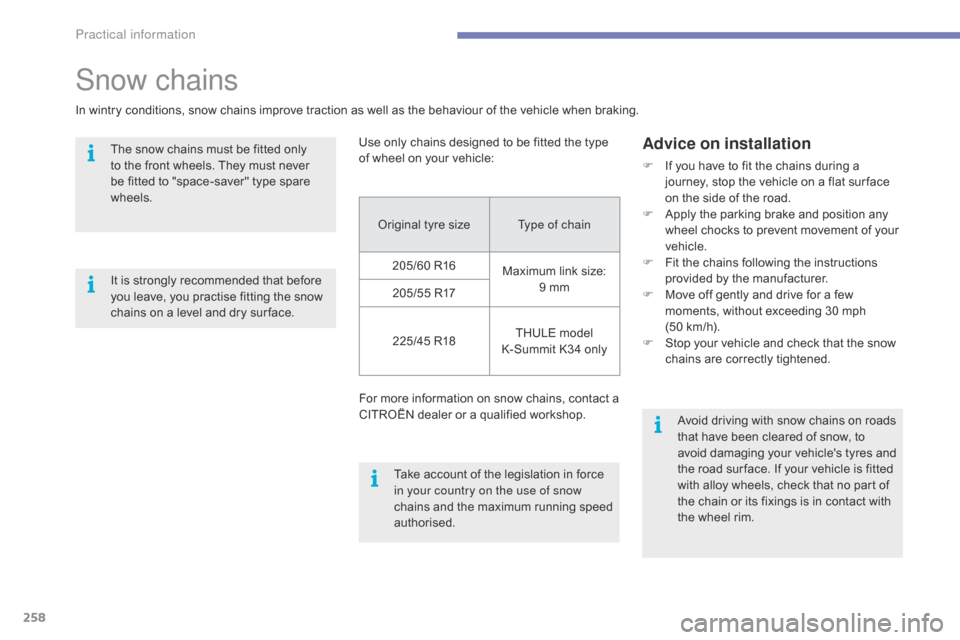
258
Original tyre sizeT ype of chain
205/60 R16 Maximum
link size:
9
mm
205/55
R17
225/45
R18 THULE
model
K
-Summit K34 only
For
more information on snow chains, contact a
C
ITROËN dealer or a qualified workshop.
Use
only chains designed to be fitted the type
o
f
wheel on your vehicle:
Snow chains
In wintry conditions, snow chains improve traction as well as the behaviour of the vehicle when braking.
T he snow chains must be fitted only
t
o the front wheels. They must never
b
e fitted to "space-saver" type spare
w
heels.
Advice on installation
F If you have to fit the chains during a j
ourney, stop the vehicle on a flat sur face
o
n the side of the road.
F
A
pply the parking brake and position any
w
heel chocks to prevent movement of your
v
ehicle.
F
F
it the chains following the instructions
p
rovided by the manufacturer.
F
M
ove off gently and drive for a few
m
oments, without exceeding 30 mph
(
50 km/h).
F
S
top your vehicle and check that the snow
c
hains are correctly tightened.
Take
account
of
the
legislation
in
force
i
n your country on the use of snow
chains
and
the
maximum
running
speed
a
uthorised. Avoid
driving with snow chains on roads
t
hat have been cleared of snow, to
a
void damaging your vehicle's tyres and
t
he road sur face. If your vehicle is fitted
w
ith alloy wheels, check that no part of
t
he chain or its fixings is in contact with
t
he wheel rim.
It
is
strongly
recommended
that
before
y
ou
leave,
you
practise
fitting
the
snow
c
hains
on
a
level
and
dry
sur face.
Practical information
Page 278 of 523
276
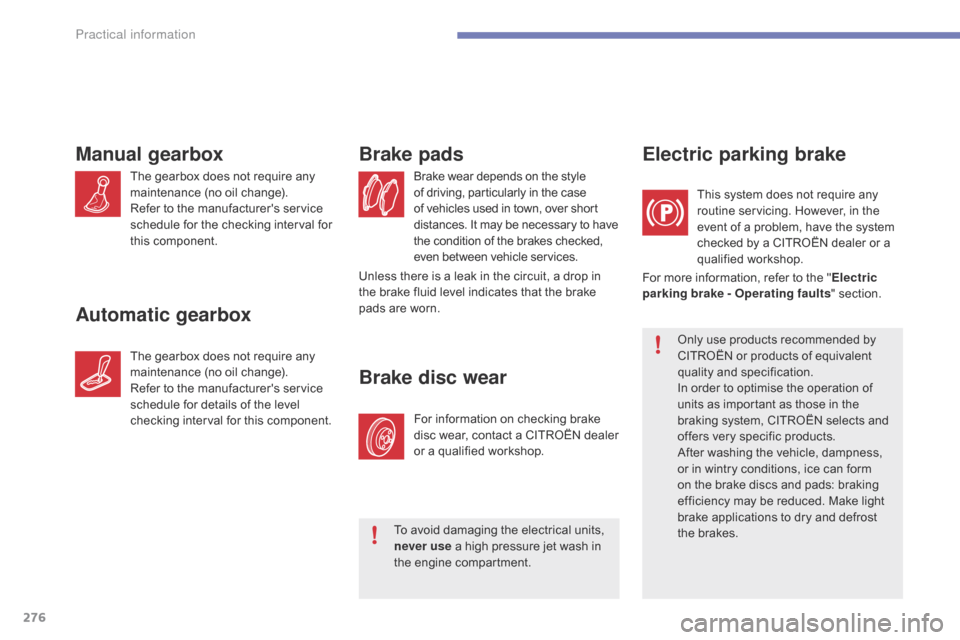
Brake wear depends on the style of driving, particularly in the case o
f vehicles used in town, over short
d
istances. It may be necessary to have
t
he condition of the brakes checked,
e
ven between vehicle services.
Brake pads
For information on checking brake disc wear, contact a CITROËN dealer
o
r a qualified workshop.
Brake disc wear
Only use products recommended by CITROËN or products of equivalent
q
uality
an
d
sp
ecification.
In
order to optimise the operation of
u
nits as important as those in the
b
raking system, CITROËN selects and
o
ffers very specific products.
After
washing the vehicle, dampness,
o
r in wintry conditions, ice can form
o
n the brake discs and pads: braking
e
fficiency may be reduced. Make light
b
rake applications to dry and defrost
t
he brakes.
Electric parking brake
For more information, refer to the "E lectric
parking brake - Operating faults "
section.
This
system does not require any
r
outine servicing. However, in the
e
vent of a problem, have the system
c
hecked by a CITROËN dealer or a
q
ualified
w
orkshop.
Manual gearbox
The gearbox does not require any m
aintenance (no oil change).
Refer
to the manufacturer's service
s
chedule for the checking interval for
t
his
c
omponent.
Automatic gearbox
The gearbox does not require any maintenance (no oil change).
Refer
to the manufacturer's service
s
chedule for details of the level
c
hecking interval for this component.
To
avoid damaging the electrical units,
n
ever use a high pressure jet wash in
t
he engine compartment.
Unless
there is a leak in the circuit, a drop in
t
he brake fluid level indicates that the brake
p
ads are worn.
Practical information
Page 297 of 523

295
Removing a wheel
Parking the vehicle
Immobilise the vehicle where it does not block traffic: the ground must be level,
s
table and not slippery.
Apply
the parking brake unless it has
b
een programmed to automatic mode,
s
witch off the ignition and engage first
g
ear* to block the wheels.
Check
that the braking warning lamp
a
nd the P warning lamp in the parking
b
rake control lever come on.
For
greater safety, place the chock 2
against
the wheel opposite to the one
b
eing
c
hanged.
The
occupants must get out of the
v
ehicle and wait where they are safe.
Never
go underneath a vehicle
s
upported by a jack; use an axle stand.
List of operations
F Remove the wheel bolt cover(s) using the t
ool 4 (depending on equipment).
F
F
it the security socket 5 on the
wheelbrace
1 to slacken the security bolt
(
if fitted).
F
S
lacken the other bolts (no more than a
1
/4 turn) using the wheelbrace 1
o
n l y.
* Position P
for
an
automatic
gearbox. Do
not use:
-
t
he jack for any purpose other than
l
ifting the vehicle,
-
a
ny other jack than the one
s
upplied by the manufacturer.F
P
lace the foot of the jack 3 on the ground
a
nd check that it is directly below the
f
ront A or rear B jacking point provided on
t
he underbody, whichever is closest to the w
heel to be changed.
Ensure that the jack is stable. If the
g
round is slippery or loose, the jack
m
ay slip or drop - Risk of injury!
Ensure
that the jack is positioned only
a
t one of the jacking points A or B
under
the vehicle, making sure that the
v
ehicle's contact sur face is centred on
t
he head of the jack. Other wise there is
a
risk of damage to the vehicle and/or of
t
he jack dropping - Risk of injury!
8
In the event of a breakdown
Page 319 of 523
317
To w i n g
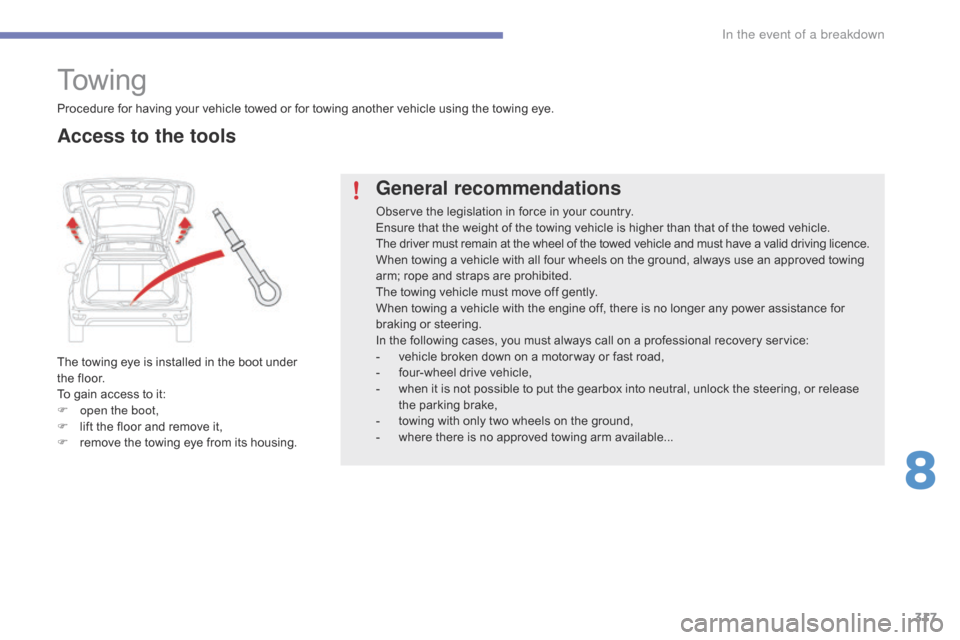
The towing eye is installed in the boot under the floor.
To
gain access to it:
F
o
pen the boot,
F
l
ift the floor and remove it,
F
r
emove the towing eye from its housing.
General recommendations
Observe the legislation in force in your country.
E nsure that the weight of the towing vehicle is higher than that of the towed vehicle.
The
driver must remain at the wheel of the towed vehicle and must have a valid driving licence.
When
towing a vehicle with all four wheels on the ground, always use an approved towing
a
rm; rope and straps are prohibited.
The
towing vehicle must move off gently.
When
towing a vehicle with the engine off, there is no longer any power assistance for
b
raking or steering.
In
the following cases, you must always call on a professional recovery service:
-
v
ehicle broken down on a motor way or fast road,
-
f
our-wheel drive vehicle,
-
w
hen it is not possible to put the gearbox into neutral, unlock the steering, or release
t
he parking brake,
-
t
owing with only two wheels on the ground,
-
w
here there is no approved towing arm available...
Procedure
for
having
your
vehicle
towed
or
for
towing
another vehicle using the towing eye.
Access to the tools
8
In the event of a breakdown
Page 337 of 523
335
Range .............................................................. 50
Range, AdBlue ............................... .................42
Reading
lamps, rear
...................................... 111
R
ear
s
creen,
d
emisting
................................. 10
2
Recharging
the battery
.................................3
15
Recirculation, air
...............................
. 94, 96, 98
Reduction
of electrical
load
............................................................. 26
3
Regeneration
of the particle
filter
........
..................................................... 275
Reinitialisation
of the under-inflation
detection
system
......................................... 19
9
Reinitialising
the remote
control
........................................................... 58
R
emote control
........................................... 51
- 5 9
Removing
a wheel
..............................
..........295
Removing
the mat
...............................
..........109
Replacing
bu
lbs
..............................
..............299
Replacing
f
uses
..............................
..............308
Replacing
the air filter
...................................2
75Replacing
the oil filter
...................................
2
75
Replacing
t
he
p
assenger
c
ompartment filter
......................................
2
75
Resetting the service
indicator
...............................
.........................
39
Resetting the trip recorder
..............................
45
R
eversing
c
amera
...............................
..........
187
Reversing
lam
p
.....................................
3
03-306
Roof bars
....................................................... 2
67
Running out of fuel (Diesel)
..........................
3
19
R
Parcel shelf, rear ....................................
111 , 114
Park Assist ............................... .....................192
Parking
brake, electric
.......................... 1
29, 276
Parking
sensors, front
...................................18
6
Parking
sensors, rear.................................... 185
Plates,
id
entification ...................................... 329
Port, USB
...................................................... 10
9
Pressures, tyres
................... 2
83, 288, 298, 329
Pre-tensioning
seat belts
..............................23
0
Priming
the fuel system
................................31
9
Protecting
children
................2
30, 232, 236 -254
Puncture
................
........................................ 282 Sockets,
audio ......................................
10 8, 10 9
Speed l imiter ............................... .. 147, 150, 152
Speed
limit
recognition
.................................................. 14
8
Spotlamps,
si
de
....................................2
12, 303
Stability control (ESC) ...................................223
Starting
the vehicle
....................... 1
23, 125, 126
Starting
using another
battery
................................................. 1
26, 314
Stay, bonnet
...............................
...................269
Steering
wheel,
adjustment
.................................................... 91
St
op
...............
..................................................27
Stopping
the vehicle
..................... 1
23, 125, 126
Stop & Start
........................2
5, 50, 93, 102, 144,
145,
255, 269, 275, 313, 316
Stop
(warning lamp)
........................................2
7
Storage
................
.......................... 106, 110, 112
Storing
driving
positions ........................................................ 78
Sun visor
....................................................... 10
6
Sun visor flap
...............................
.................10 6
Synchronising
the remote
control
........................................................... 58
S
afety, children
.....................2
30, 232, 236 -254
Scented
air freshener
...................................10
3
Screen,
cold climate
.....................................25
9
Screenwash, front
......................................... 2
18
Screenwash, rear
...............................
...........217
SCR (Selective Catalytic Reduction)
.................................................. 2
77
Seat belts
..............................................2
26, 242
Seats, electric
................................................. 77
Se
ats, front
...............................
........... 75, 77, 78
Seats,
h
eated
...............................
...................81
Seats, rear
.................................... 8
2, 84, 86, 87
Selector,
ge
ar
................................................13
8
Serial
number,
vehicle
...............................
..........................329
Service
i
ndicator
.............................................37
S
ervicing
...............................
............................ 9
Settings,
e
quipment
.................................. 1
1, 13
Sidelamps
............ 2
04, 208, 299, 301, 303, 305
Side
r
epeater
..............................
..................303
Snow chains
.................................................. 25
8
Socket,
12 V accessory
................ 1
05, 108, 112
S
Table of weights ........................... 322, 326, 327
Tables of engines ..........................3 20, 324, 325
Tables of fuses
.............................................. 3
08
Tailgate
................
......................................63, 65
Tank,
AdBlue
®
additive ............... ........................................ 277
Tank,
fuel
...............................
................255, 256
Technical
da
ta
....................................... 32
0-328
T
.
Alphabetical index