engine Citroen JUMPER 2008.5 2.G User Guide
[x] Cancel search | Manufacturer: CITROEN, Model Year: 2008.5, Model line: JUMPER, Model: Citroen JUMPER 2008.5 2.GPages: 163, PDF Size: 2.57 MB
Page 35 of 163
Starting and stopping
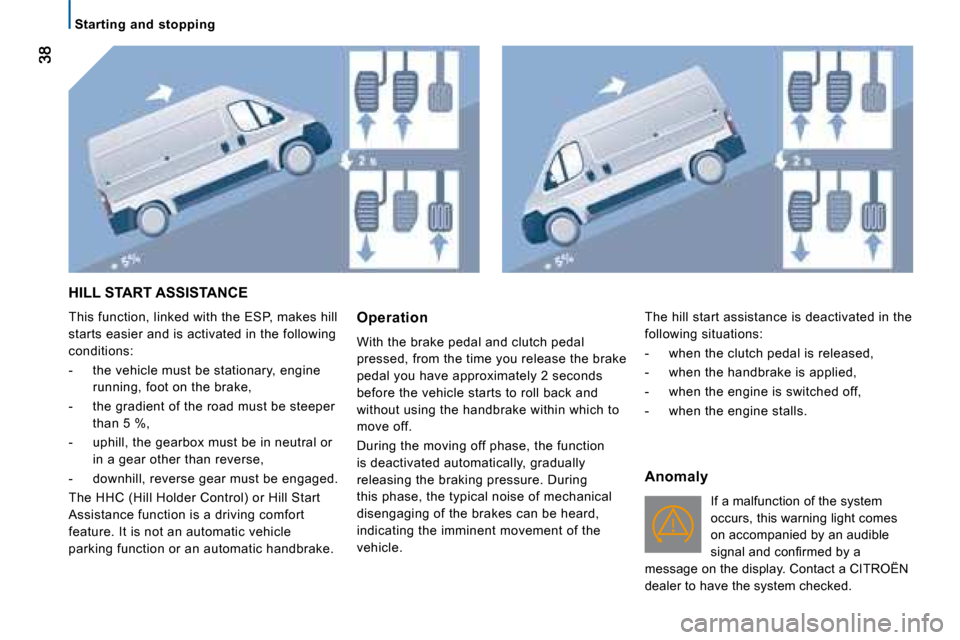
HILL START ASSISTANCE
This function, linked with the ESP, makes hill
starts easier and is activated in the following
conditions:
- the vehicle must be stationary, engine running, foot on the brake,
- the gradient of the road must be steeper than 5 %,
- uphill, the gearbox must be in neutral or in a gear other than reverse,
- downhill, reverse gear must be engaged.
The HHC (Hill Holder Control) or Hill Start
Assistance function is a driving comfort
feature. It is not an automatic vehicle
parking function or an automatic handbrake. Operation
With the brake pedal and clutch pedal
pressed, from the time you release the brake
pedal you have approximately 2 seconds
before the vehicle starts to roll back and
without using the handbrake within which to
move off.
During the moving off phase, the function
is deactivated automatically, gradually
releasing the braking pressure. During
this phase, the typical noise of mechanical
disengaging of the brakes can be heard,
indicating the imminent movement of the
vehicle.
Anomaly
If a malfunction of the system
occurs, this warning light comes
on accompanied by an audible
signal and confi rmed by a
message on the display. Contact a CITROËN
dealer to have the system checked.
The hill start assistance is deactivated in the
following situations:
- when the clutch pedal is released,
- when the handbrake is applied,
- when the engine is switched off,
- when the engine stalls.
Page 38 of 163
41
3
ERGONOMICS AND COMFORT
Steering wheel controls
AUTOMATIC LIGHTING
If your vehicle is fitted with this function,
the side lights and dipped headlamps are
switched on automatically if the light is
poor and when continuous operation of the
windscreen wipers is detected.
In fog or snow, the brightness sensor may
detect sufficient light. Therefore, the lights
will not be switched on automatically. If
necessary, you must switch on the dipped
headlamps manually.
They are switched off when the light returns
to a sufficient level or after the windscreen
wipers are switched off.
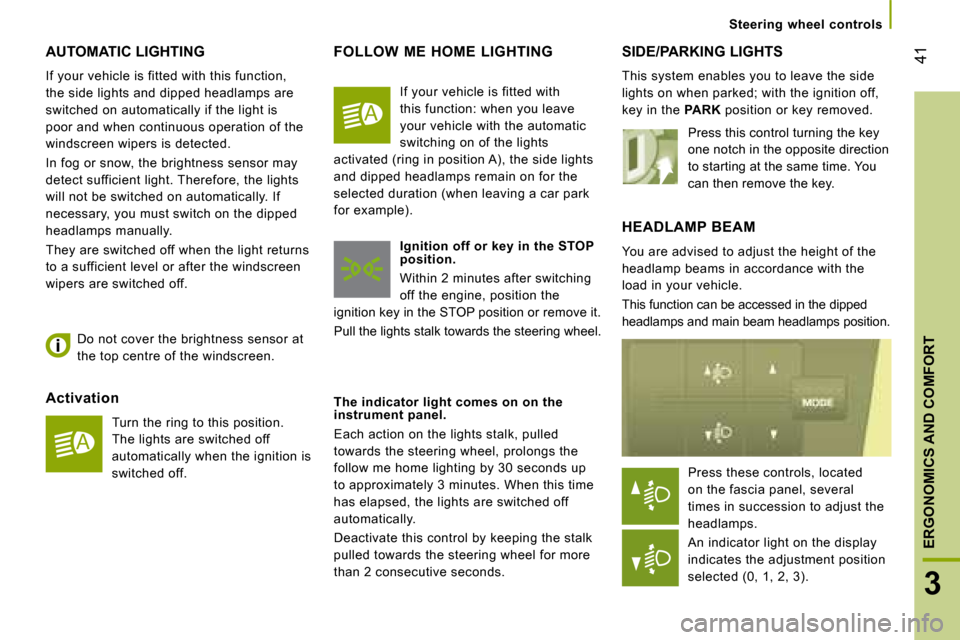
HEADLAMP BEAM
You are advised to adjust the height of the
headlamp beams in accordance with the
load in your vehicle.
This function can be accessed in the dipped
headlamps and main beam headlamps position.
SIDE/PARKING LIGHTS
This system enables you to leave the side
lights on when parked; with the ignition off,
key in the PARK position or key removed.
Activation
Turn the ring to this position.
The lights are switched off
automatically when the ignition is
switched off.
Do not cover the brightness sensor at
the top centre of the windscreen.
FOLLOW ME HOME LIGHTING
Ignition off or key in the STOP
position.
Within 2 minutes after switching
off the engine, position the
ignition key in the STOP position or remove it.
Pull the lights stalk towards the steering wheel.
The indicator light comes on on the
instrument panel.
Each action on the lights stalk, pulled
towards the steering wheel, prolongs the
follow me home lighting by 30 seconds up
to approximately 3 minutes. When this time
has elapsed, the lights are switched off
automatically.
Deactivate this control by keeping the stalk
pulled towards the steering wheel for more
than 2 consecutive seconds. Press this control turning the key
one notch in the opposite direction
to starting at the same time. You
can then remove the key.
If your vehicle is fitted with
this function: when you leave
your vehicle with the automatic
switching on of the lights
activated (ring in position A), the side lights
and dipped headlamps remain on for the
selected duration (when leaving a car park
for example).
Press these controls, located
on the fascia panel, several
times in succession to adjust the
headlamps.
An indicator light on the display
indicates the adjustment position
selected (0, 1, 2, 3).
Page 43 of 163
46
Ventilation
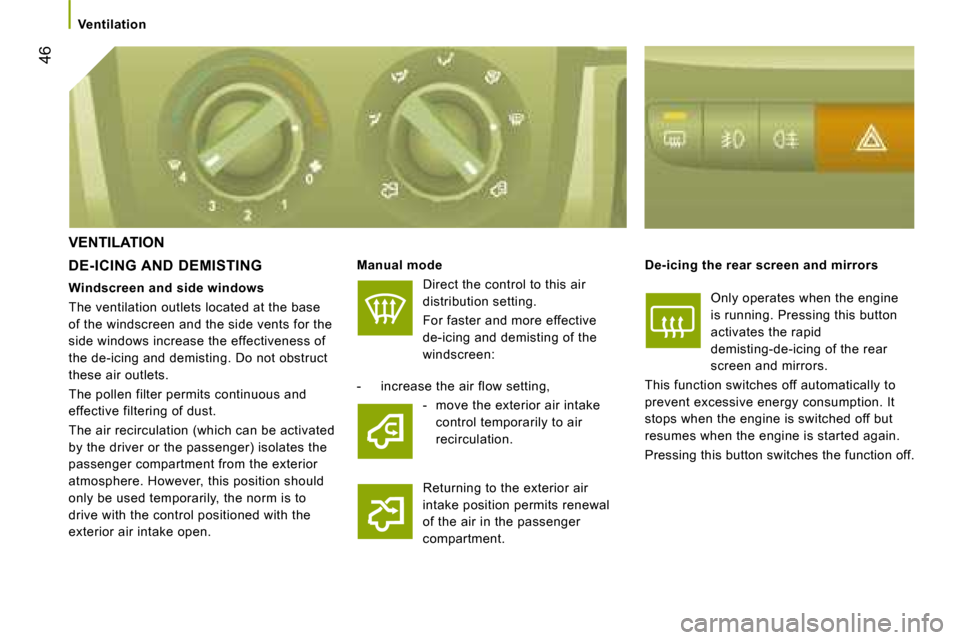
VENTILATION
DE-ICING AND DEMISTING
Manual mode
Direct the control to this air
distribution setting.
For faster and more effective
de-icing and demisting of the
windscreen: De-icing the rear screen and mirrors
Only operates when the engine
is running. Pressing this button
activates the rapid
demisting-de-icing of the rear
screen and mirrors.
This function switches off automatically to
prevent excessive energy consumption. It
stops when the engine is switched off but
resumes when the engine is started again.
Pressing this button switches the function off.
- increase the air flow setting,
- move the exterior air intake control temporarily to air
recirculation.
Returning to the exterior air
intake position permits renewal
of the air in the passenger
compartment.
Windscreen and side windows
The ventilation outlets located at the base
of the windscreen and the side vents for the
side windows increase the effectiveness of
the de-icing and demisting. Do not obstruct
these air outlets.
The pollen filter permits continuous and
effective filtering of dust.
The air recirculation (which can be activated
by the driver or the passenger) isolates the
passenger compartment from the exterior
atmosphere. However, this position should
only be used temporarily, the norm is to
drive with the control positioned with the
exterior air intake open.
Page 45 of 163
48
Ventilation
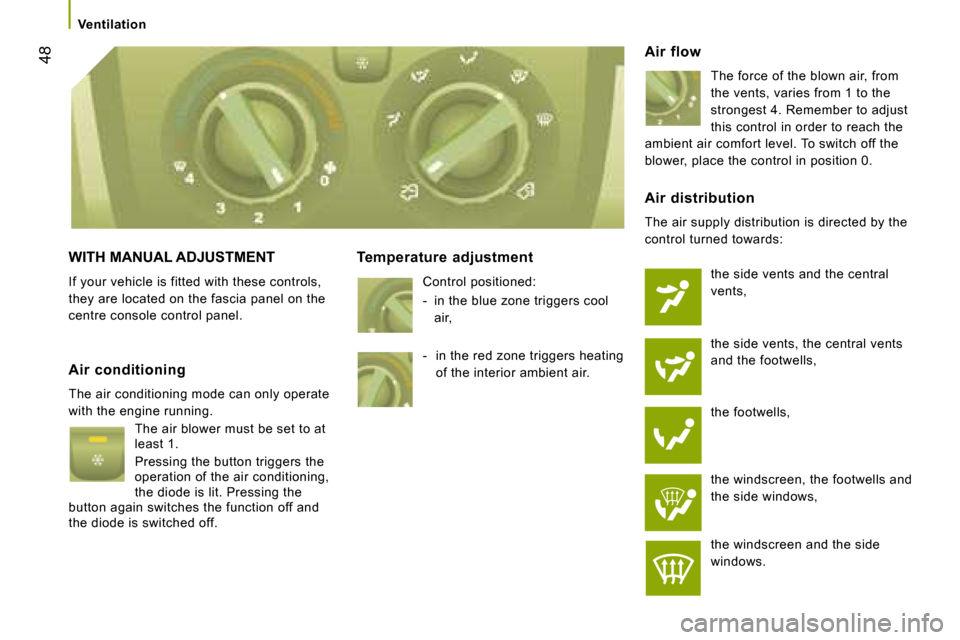
WITH MANUAL ADJUSTMENT
If your vehicle is fitted with these controls,
they are located on the fascia panel on the
centre console control panel.
Temperature adjustment
Control positioned:
- in the blue zone triggers cool air,
Air flow
The force of the blown air, from
the vents, varies from 1 to the
strongest 4. Remember to adjust
this control in order to reach the
ambient air comfort level. To switch off the
blower, place the control in position 0.
Air conditioning
The air conditioning mode can only operate
with the engine running.
The air blower must be set to at
least 1.
Pressing the button triggers the
operation of the air conditioning,
the diode is lit. Pressing the
button again switches the function off and
the diode is switched off.
Air distribution
The air supply distribution is directed by the
control turned towards:
the side vents and the central
vents,
the side vents, the central vents
and the footwells,
the footwells,
the windscreen, the footwells and
the side windows,
the windscreen and the side
windows.
- in the red zone triggers heating
of the interior ambient air.
Page 47 of 163
50
Ventilation
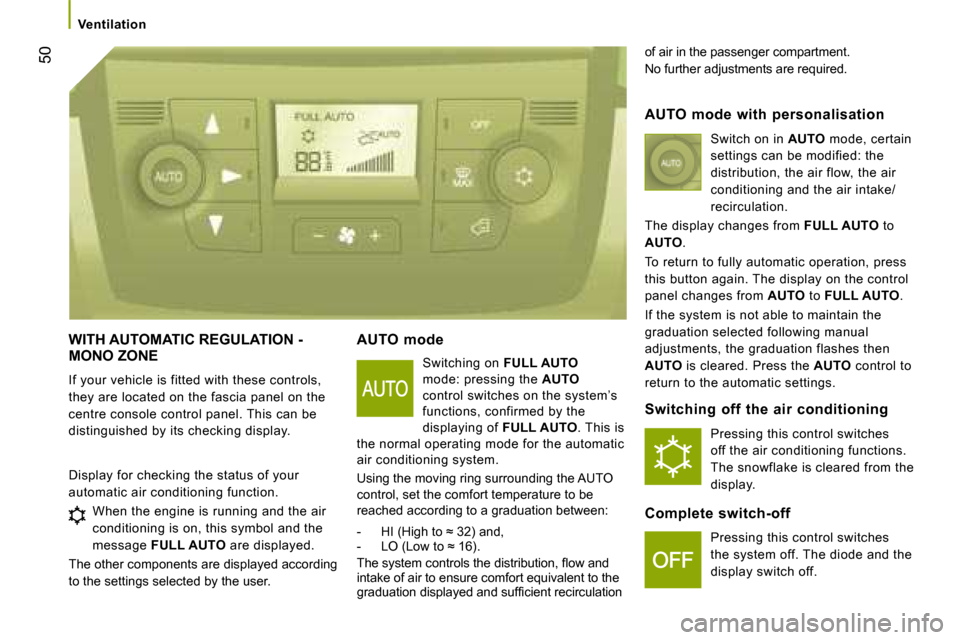
WITH AUTOMATIC REGULATION - MONO ZONE
If your vehicle is fitted with these controls,
they are located on the fascia panel on the
centre console control panel. This can be
distinguished by its checking display.
AUTO mode
Switching on FULL AUTO
mode: pressing the AUTO
control switches on the system’s
functions, confirmed by the
displaying of FULL AUTO . This is
the normal operating mode for the automatic
air conditioning system.
Using the moving ring surrounding the AUTO
control, set the comfort temperature to be
reached according to a graduation between:
- HI (High to ≈ 32) and,
- LO (Low to ≈ 16).
The system controls the distribution, fl ow and
intake of air to ensure comfort equivalent to the
graduation displayed and suffi cient recirculation of air in the passenger compartment.
No further adjustments are required.
Display for checking the status of your
automatic air conditioning function. When the engine is running and the air
conditioning is on, this symbol and the
message FULL AUTO are displayed.
The other components are displayed according
to the settings selected by the user.
AUTO mode with personalisation
Switch on in AUTO mode, certain
settings can be modified: the
distribution, the air flow, the air
conditioning and the air intake/
recirculation.
The display changes from FULL AUTO to
AUTO .
To return to fully automatic operation, press
this button again. The display on the control
panel changes from AUTO to FULL AUTO .
If the system is not able to maintain the
graduation selected following manual
adjustments, the graduation flashes then
AUTO is cleared. Press the AUTO control to
return to the automatic settings.
Switching off the air conditioning
Pressing this control switches
off the air conditioning functions.
The snowflake is cleared from the
display.
Complete switch-off
Pressing this control switches
the system off. The diode and the
display switch off.
Page 49 of 163
52
Ventilation
ADDITIONAL HEATING SYSTEMS
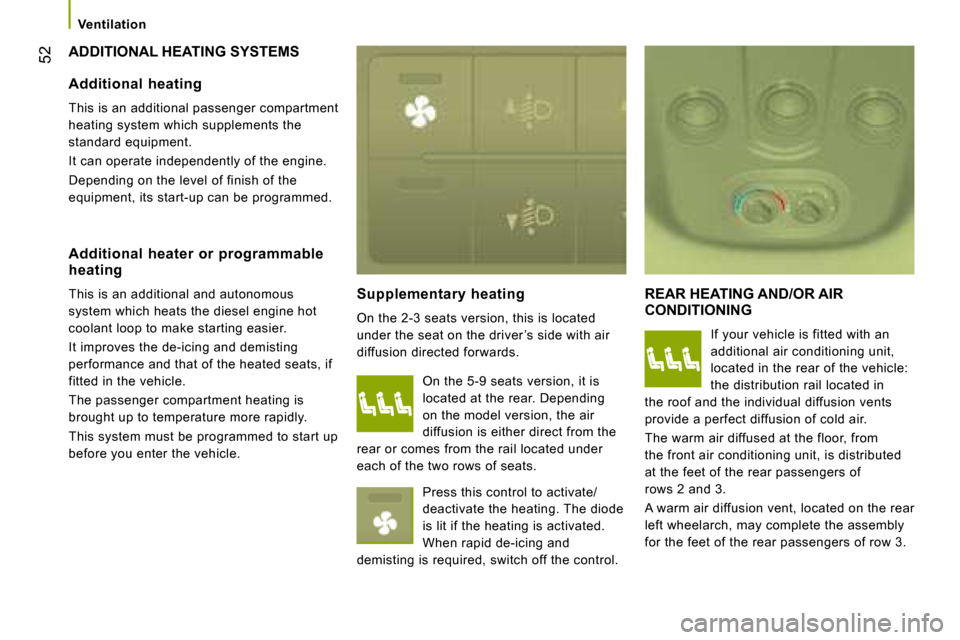
Supplementary heating
On the 2-3 seats version, this is located
under the seat on the driver ’s side with air
diffusion directed forwards.
REAR HEATING AND/OR AIR CONDITIONING
If your vehicle is fitted with an
additional air conditioning unit,
located in the rear of the vehicle:
the distribution rail located in
the roof and the individual diffusion vents
provide a perfect diffusion of cold air.
The warm air diffused at the floor, from
the front air conditioning unit, is distributed
at the feet of the rear passengers of
rows 2 and 3.
A warm air diffusion vent, located on the rear
left wheelarch, may complete the assembly
for the feet of the rear passengers of row 3.
Additional heating
This is an additional passenger compartment
heating system which supplements the
standard equipment.
It can operate independently of the engine.
Depending on the level of finish of the
equipment, its start-up can be programmed.
Additional heater or programmable heating
This is an additional and autonomous
system which heats the diesel engine hot
coolant loop to make starting easier.
It improves the de-icing and demisting
performance and that of the heated seats, if
fitted in the vehicle.
The passenger compartment heating is
brought up to temperature more rapidly.
This system must be programmed to start up
before you enter the vehicle. On the 5-9 seats version, it is
located at the rear. Depending
on the model version, the air
diffusion is either direct from the
rear or comes from the rail located under
each of the two rows of seats.
Press this control to activate/
deactivate the heating. The diode
is lit if the heating is activated.
When rapid de-icing and
demisting is required, switch off the control.
Page 51 of 163
54
Ventilation
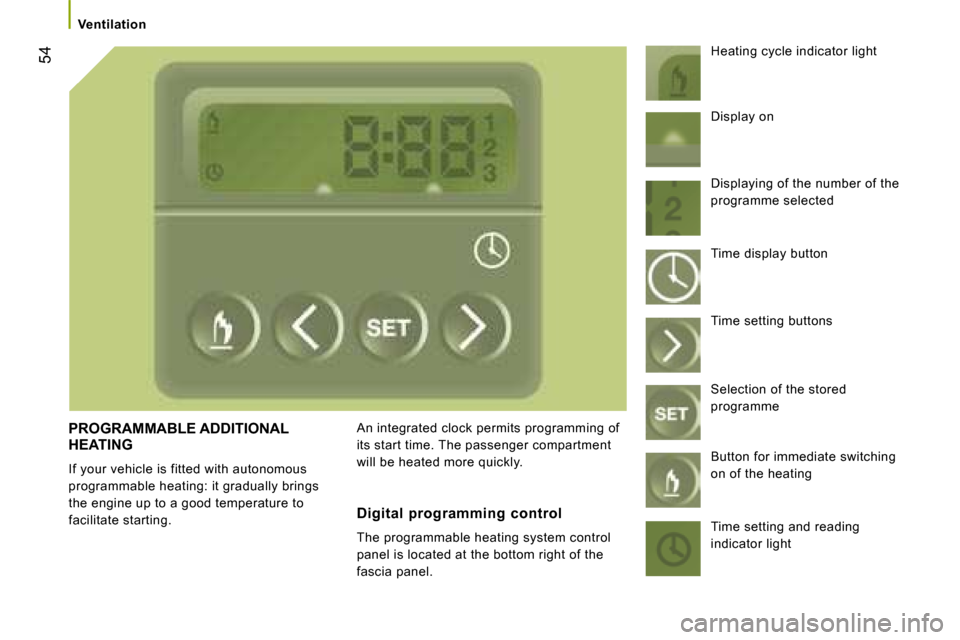
PROGRAMMABLE ADDITIONAL HEATING
If your vehicle is fitted with autonomous
programmable heating: it gradually brings
the engine up to a good temperature to
facilitate starting. An integrated clock permits programming of
its start time. The passenger compartment
will be heated more quickly. Heating cycle indicator light
Digital programming control
The programmable heating system control
panel is located at the bottom right of the
fascia panel. Display on
Displaying of the number of the
programme selected
Time display button
Time setting buttons
Selection of the stored
programme
Button for immediate switching
on of the heating
Time setting and reading
indicator light
Page 53 of 163
Ventilation
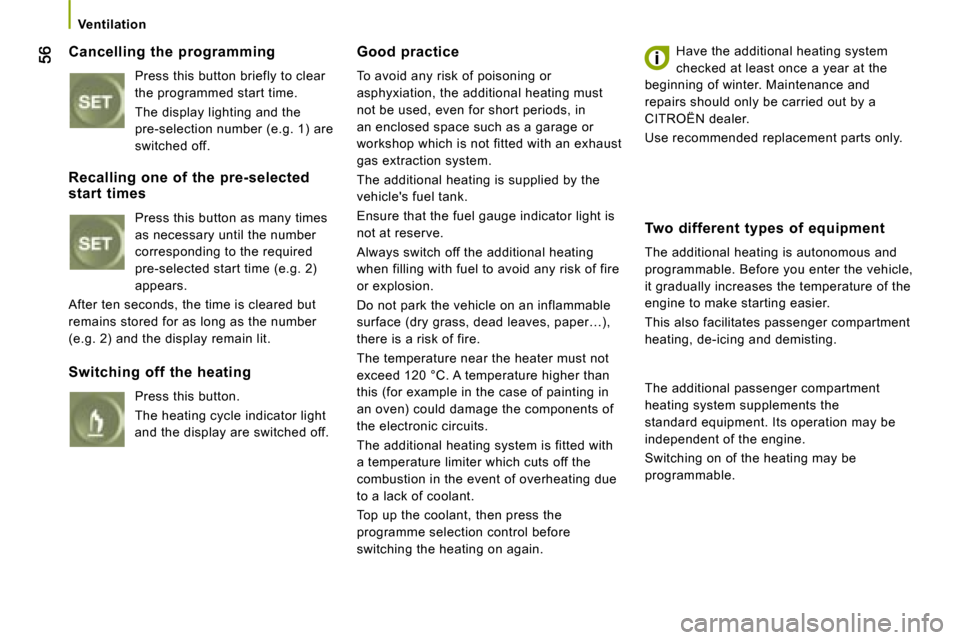
Cancelling the programming
Press this button briefly to clear
the programmed start time. The display lighting and the
pre-selection number (e.g. 1) are
switched off.
Good practice
To avoid any risk of poisoning or
asphyxiation, the additional heating must
not be used, even for short periods, in
an enclosed space such as a garage or
workshop which is not fitted with an exhaust
gas extraction system.
The additional heating is supplied by the
vehicle's fuel tank.
Ensure that the fuel gauge indicator light is
not at reserve.
Always switch off the additional heating
when filling with fuel to avoid any risk of fire
or explosion.
Do not park the vehicle on an inflammable
surface (dry grass, dead leaves, paper…),
there is a risk of fire.
The temperature near the heater must not
exceed 120 °C. A temperature higher than
this (for example in the case of painting in
an oven) could damage the components of
the electronic circuits.
The additional heating system is fitted with
a temperature limiter which cuts off the
combustion in the event of overheating due
to a lack of coolant.
Top up the coolant, then press the
programme selection control before
switching the heating on again. Have the additional heating system
checked at least once a year at the
beginning of winter. Maintenance and
repairs should only be carried out by a
CITROËN dealer.
Use recommended replacement parts only.
Recalling one of the pre-selected start times
Press this button as many times
as necessary until the number
corresponding to the required
pre-selected start time (e.g. 2)
appears.
After ten seconds, the time is cleared but
remains stored for as long as the number
(e.g. 2) and the display remain lit.
Switching off the heating
Press this button.
The heating cycle indicator light
and the display are switched off.
Two different types of equipment
The additional heating is autonomous and
programmable. Before you enter the vehicle,
it gradually increases the temperature of the
engine to make starting easier.
This also facilitates passenger compartment
heating, de-icing and demisting.
The additional passenger compartment
heating system supplements the
standard equipment. Its operation may be
independent of the engine.
Switching on of the heating may be
programmable.
Page 100 of 163
102
Driving safety
TRACTION CONTROL (ASR) AND DYNAMIC STABILITY CONTROL (ESP)
These systems are linked and complement
the ABS.
The ASR system is very useful for
maintaining optimum drive and avoiding
losses of control of the vehicle on
acceleration.
The system optimises drive to prevent the
wheels skidding, by acting on the brakes of
the drive wheels and on the engine. It also
allows the directional stability of the vehicle
to be improved on acceleration.
Use the ESP to hold your course without
attempting to countersteer. If there is a variation between the trajectory
followed by the vehicle and that required
by the driver, the ESP system automatically
acts on the engine and the brake of one
or more wheels, in order to put the vehicle
back on course.
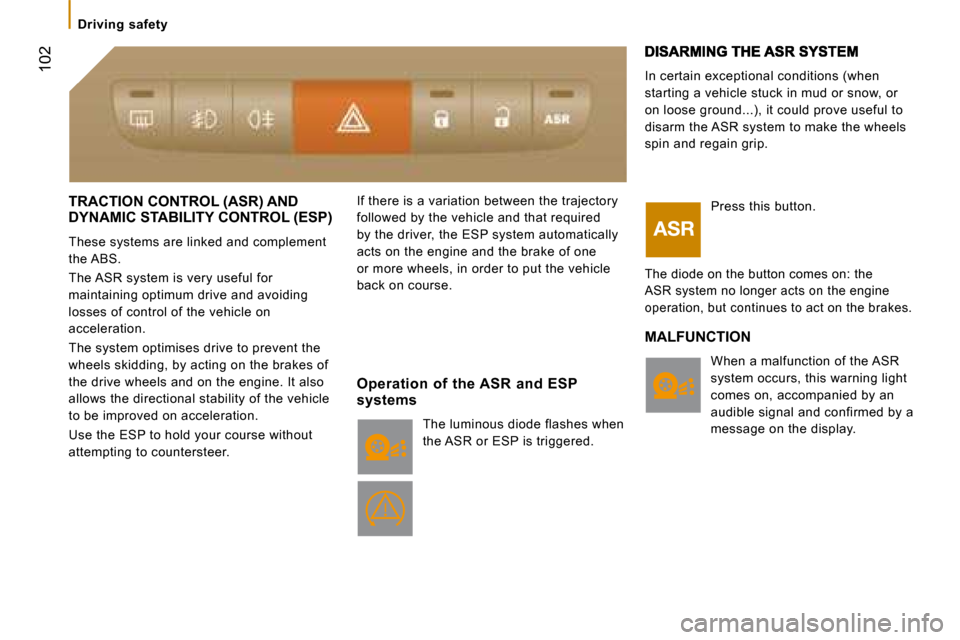
In certain exceptional conditions (when
starting a vehicle stuck in mud or snow, or
on loose ground...), it could prove useful to
disarm the ASR system to make the wheels
spin and regain grip.
Operation of the ASR and ESP systems
The luminous diode flashes when
the ASR or ESP is triggered.
Press this button.
The diode on the button comes on: the
ASR system no longer acts on the engine
operation, but continues to act on the brakes.
MALFUNCTION
When a malfunction of the ASR
system occurs, this warning light
comes on, accompanied by an
audible signal and confirmed by a
message on the display.
Page 105 of 163
106
Improved safety and security
IMPROVED SAFETY AND SECURITY
IMPACT RESISTANCE
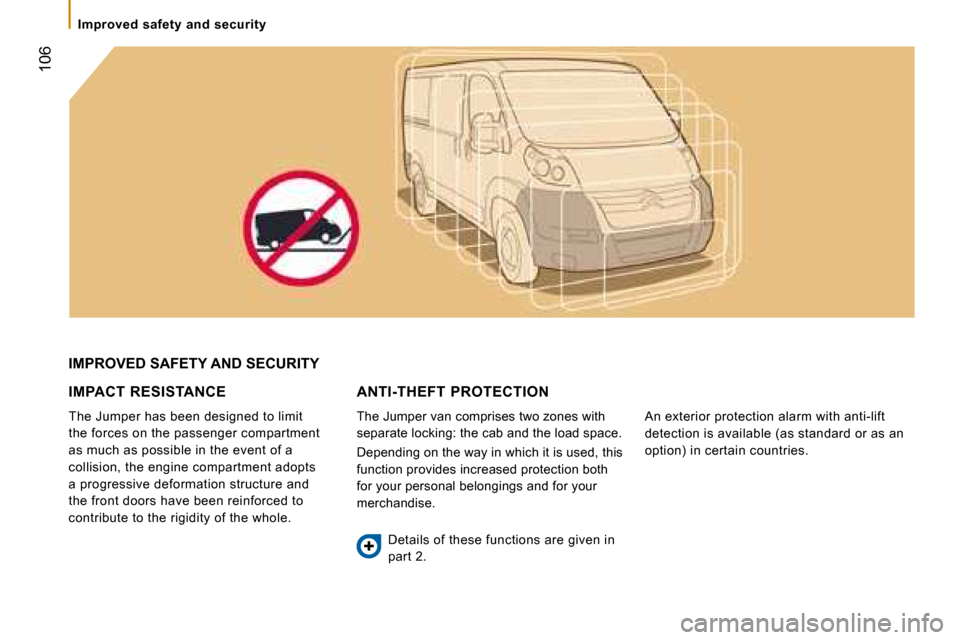
The Jumper has been designed to limit
the forces on the passenger compartment
as much as possible in the event of a
collision, the engine compartment adopts
a progressive deformation structure and
the front doors have been reinforced to
contribute to the rigidity of the whole.
ANTI-THEFT PROTECTION
The Jumper van comprises two zones with
separate locking: the cab and the load space.
Depending on the way in which it is used, this
function provides increased protection both
for your personal belongings and for your
merchandise.Details of these functions are given in
part 2. An exterior protection alarm with anti-lift
detection is available (as standard or as an
option) in certain countries.