Mode Citroen JUMPER 2016 2.G User Guide
[x] Cancel search | Manufacturer: CITROEN, Model Year: 2016, Model line: JUMPER, Model: Citroen JUMPER 2016 2.GPages: 276, PDF Size: 8.93 MB
Page 64 of 276
62
jumper_en_Chap03_Ergo-et-confort_ed01-2015
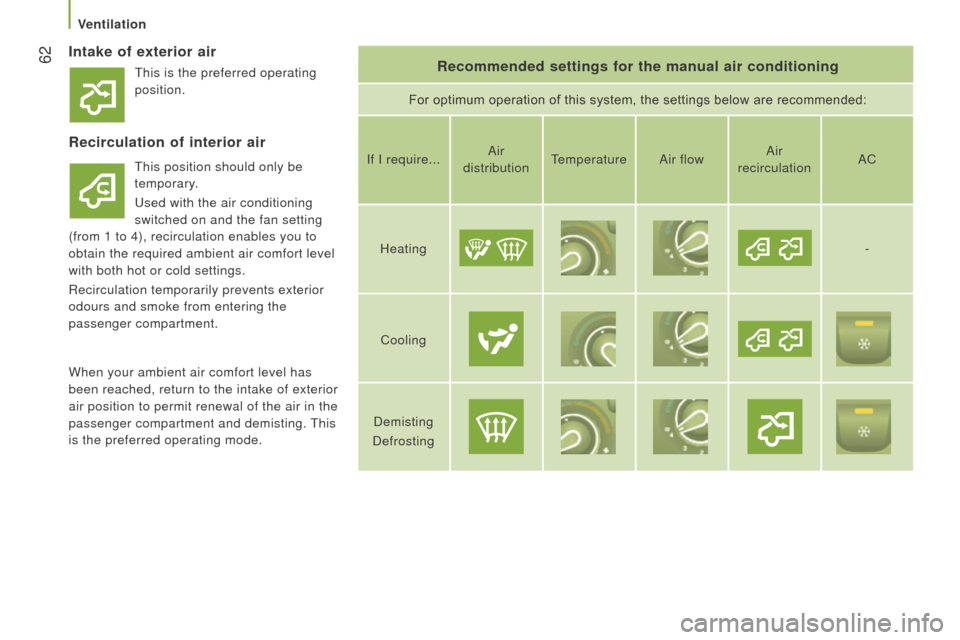
Intake of exterior airrecommended settings for the manual air conditioning
For optimum operation of this system, the settings below are recommended:
recirculation of interior air
This position should only be
temporary.
Used with the air conditioning
switched on and the fan setting
(from 1 to 4), recirculation enables you to
obtain the required ambient air comfort level
with both hot or cold settings.
r
ecirculation temporarily prevents exterior
odours and smoke from entering the
passenger compartment.i f i require...Air
distribution Temperature
Air flowAir
recirculation AC
Heating -
Cooling
Demisting
Defrosting
When your ambient air comfort level has
been reached, return to the intake of exterior
air position to permit renewal of the air in the
passenger compartment and demisting. This
is the preferred operating mode. This is the preferred operating
position.
Ventilation
Page 65 of 276
63
jumper_en_Chap03_Ergo-et-confort_ed01-2015
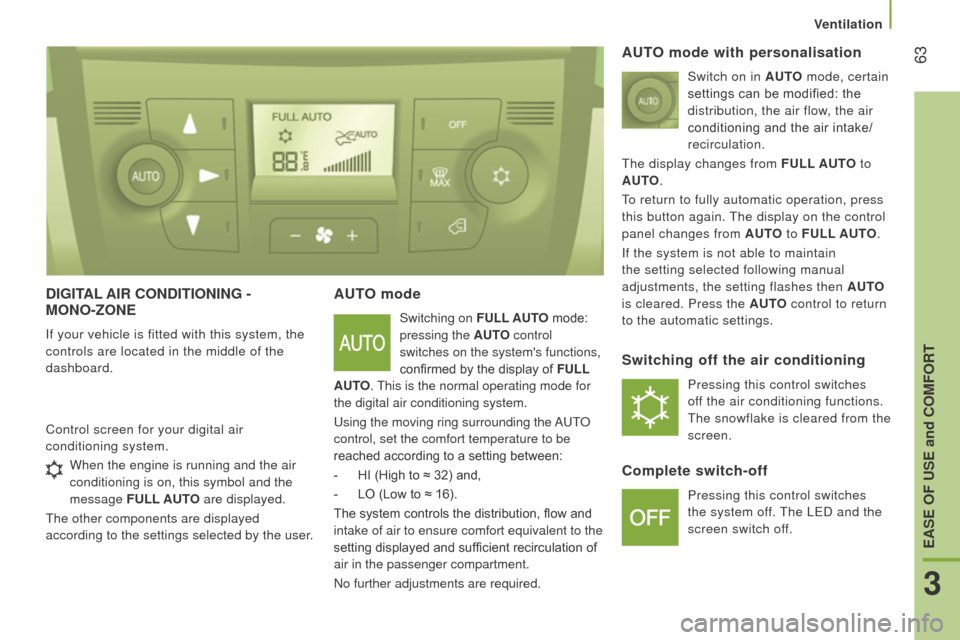
dIGItAL AIr c O nd I t IO n I n G -
M O n O -z O n E
if your vehicle is fitted with this system, the
controls are located in the middle of the
dashboard.
AutO mode
Switching on F u LL A utO mode:
pressing the A
ut
O
control
switches on the system's functions,
confirmed by the display of F
u LL
A
ut
O
. This is the normal operating mode for
the digital air conditioning system.
Using the moving ring surrounding the AUT
o
control, set the comfort temperature to be
reached according to a setting between:
-
HI (High to ≈
32) and,
-
LO (Low to ≈
16).
The system controls the distribution, flow and
intake of air to ensure comfort equivalent to the
setting displayed and sufficient recirculation of
air in the passenger compartment.
n
o further adjustments are required.
Control screen for your digital air
conditioning system.
AutO mode with personalisation
Switch on in AutO
mode, certain
settings can be modified: the
distribution, the air flow, the air
conditioning and the air intake/
recirculation.
The display changes from F
u LL A ut
O
to
A
ut
O
.
To return to fully automatic operation, press
this button again. The display on the control
panel changes from A
ut
O
to F u LL A ut
O
.
i
f the system is not able to maintain
the setting selected following manual
adjustments, the setting flashes then A
ut
O
is cleared. Press the
A ut
O
control to return
to the automatic settings.
Switching off the air conditioning
Pressing this control switches
off the air conditioning functions.
The snowflake is cleared from the
screen.
complete switch-off
Pressing this control switches
the system off. The LED and the
screen switch off.
When the engine is running and the air
conditioning is on, this symbol and the
message
F
u
LL A
utO
are displayed.
The other components are displayed
according to the settings selected by the user.
Ventilation
3
EASE OF uSE and cOMFOrt
Page 67 of 276
65
jumper_en_Chap03_Ergo-et-confort_ed01-2015
AddItIOnAL HEAt I n G SYS t EMS
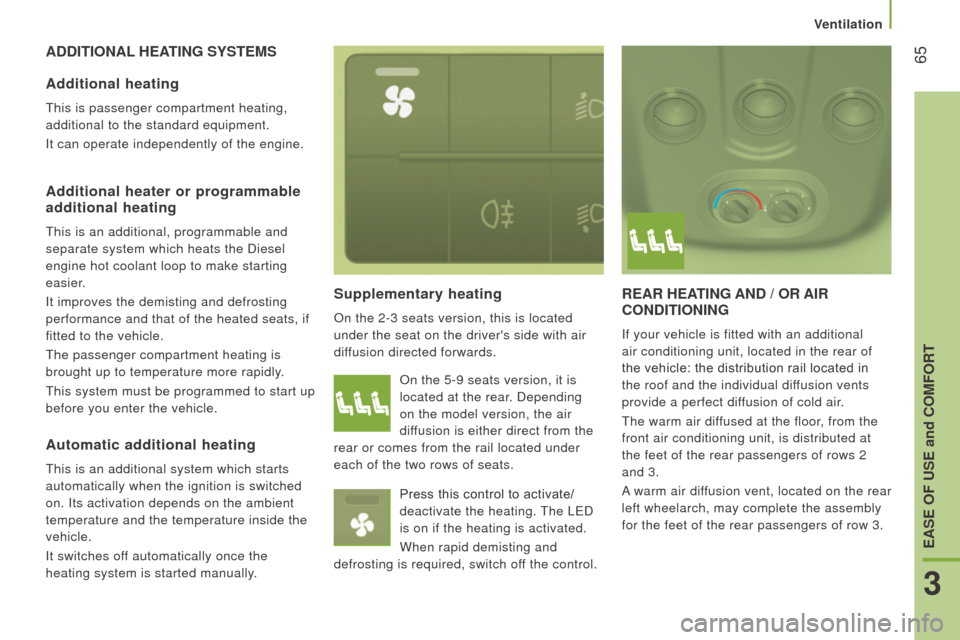
Supplementary heating
on the 2-3 seats version, this is located
under the seat on the driver's side with air
diffusion directed forwards.
rEAr HEAt I n G A nd / O r AI r
c O nd I t IO n I n G
if your vehicle is fitted with an additional
air conditioning unit, located in the rear of
the vehicle: the distribution rail located in
the roof and the individual diffusion vents
provide a perfect diffusion of cold air.
The warm air diffused at the floor, from the
front air conditioning unit, is distributed at
the feet of the rear passengers of rows
2
and 3.
A warm air diffusion vent, located on the rear
left wheelarch, may complete the assembly
for the feet of the rear passengers of row 3.
Additional heating
This is passenger compartment heating,
additional to the standard equipment.
i
t can operate independently of the engine.
Additional heater or programmable
additional heating
This is an additional, programmable and
separate system which heats the Diesel
engine hot coolant loop to make starting
easier.
i
t improves the demisting and defrosting
performance and that of the heated seats, if
fitted to the vehicle.
The passenger compartment heating is
brought up to temperature more rapidly.
This system must be programmed to start up
before you enter the vehicle.
o
n the 5-9 seats version, it is
located at the rear. Depending
on the model version, the air
diffusion is either direct from the
rear or comes from the rail located under
each of the two rows of seats.
Press this control to activate/
deactivate the heating. The LED
is on if the heating is activated.
When rapid demisting and
defrosting is required, switch off the control.
Automatic additional heating
This is an additional system which starts
automatically when the ignition is switched
on.
i ts activation depends on the ambient
temperature and the temperature inside the
vehicle.
i
t switches off automatically once the
heating system is started manually.
Ventilation
3
EASE OF uSE and cOMFOrt
Page 90 of 276
88
jumper_en_Chap04_Technologie-a-bord_ed01-2015
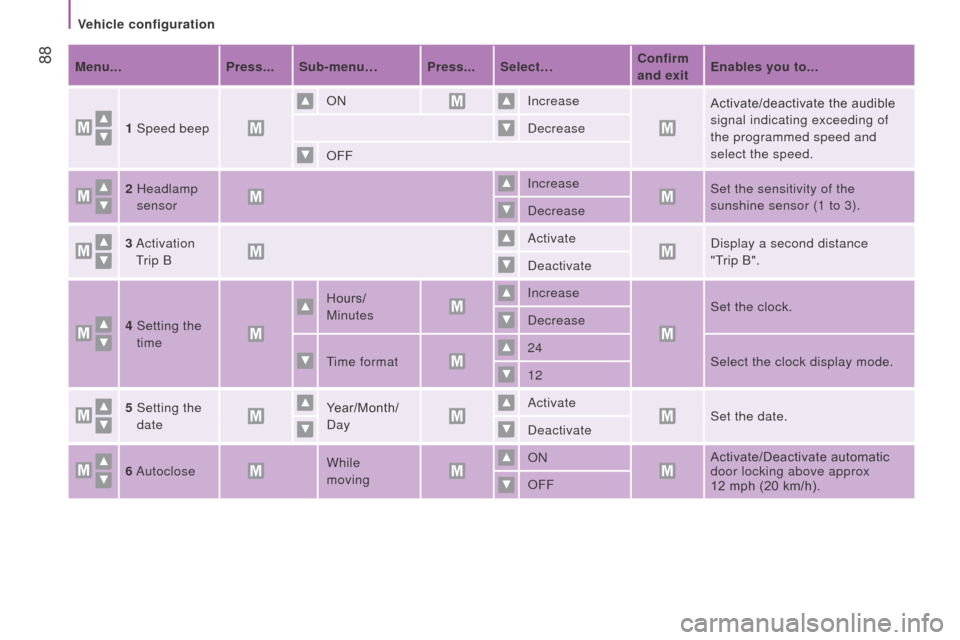
Menu...Press... Sub-menu… Press... Select…c onfirm
and exit Enables you to...
1 Speed beep
on i
ncreaseActivate/deactivate the audible
signal indicating exceeding of
the programmed speed and
select the speed.
Decrease
o
FF
2
Headlamp
sensor
i
ncreaseSet the sensitivity of the
sunshine sensor (1 to 3).
Decrease
3
Activation
Trip B Activate
Display a second distance
"Trip
B".
Deactivate
4
Setting the
time Hours/
Minutes
i
ncreaseSet the clock.
Decrease
Time format 24
Select the clock display mode.
12
5
Setting the
date Year/Month/
Day Activate
Set the date.
Deactivate
6 Autoclose While
moving
onActivate/Deactivate automatic
door locking above approx
12
mph (20 km/h).
o
FF
Vehicle configuration
Page 94 of 276
92
jumper_en_Chap04_Technologie-a-bord_ed01-2015
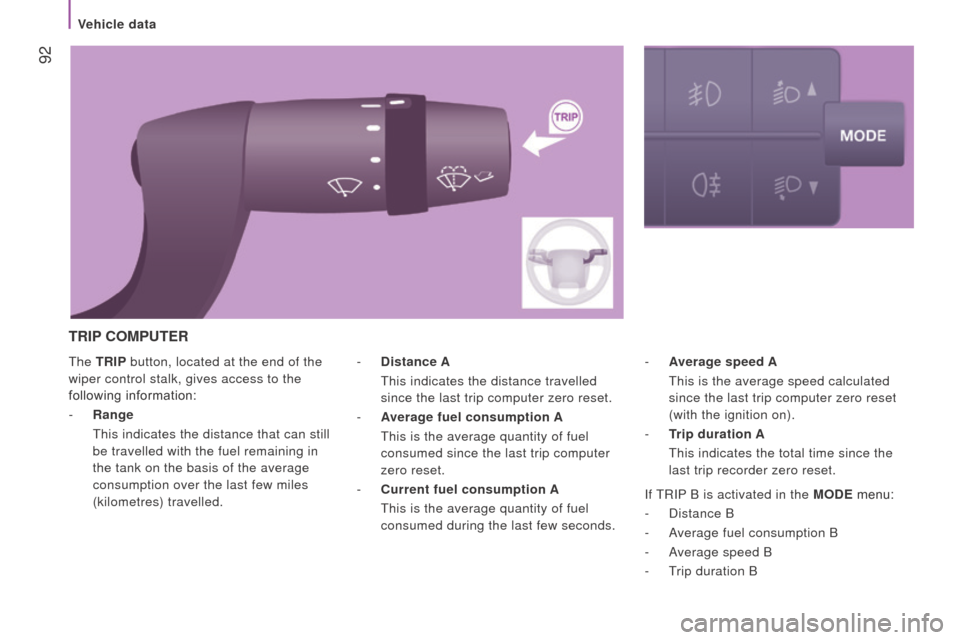
The trIP button, located at the end of the
wiper control stalk, gives access to the
following information:
-
r
ange
This indicates the distance that can still
be travelled with the fuel remaining in
the tank on the basis of the average
consumption over the last few miles
(kilometres) travelled. -
A verage speed A
This is the average speed calculated
since the last trip computer zero reset
(with the ignition on).
-
t
rip
duration A
This indicates the total time since the
last trip recorder zero reset.
-
d istance A
This indicates the distance travelled
since the last trip computer zero reset.
-
A
verage fuel consumption A
This is the average quantity of fuel
consumed since the last trip computer
zero reset.
-
c
urrent fuel consumption A
This is the average quantity of fuel
consumed during the last few seconds.
trIP c OMP ut E r
if TriP B is activated in the MOdE menu:
-
Distance B
-
A
verage fuel consumption B
-
A
verage speed B
-
T
rip duration B
Vehicle data
Page 108 of 276
106
jumper_en_Chap05_Securite_ed01-2015
cAB SEAt BELt S
if you install a front bench seat as
an accessory , it it must be fitted with
approved seat belts.
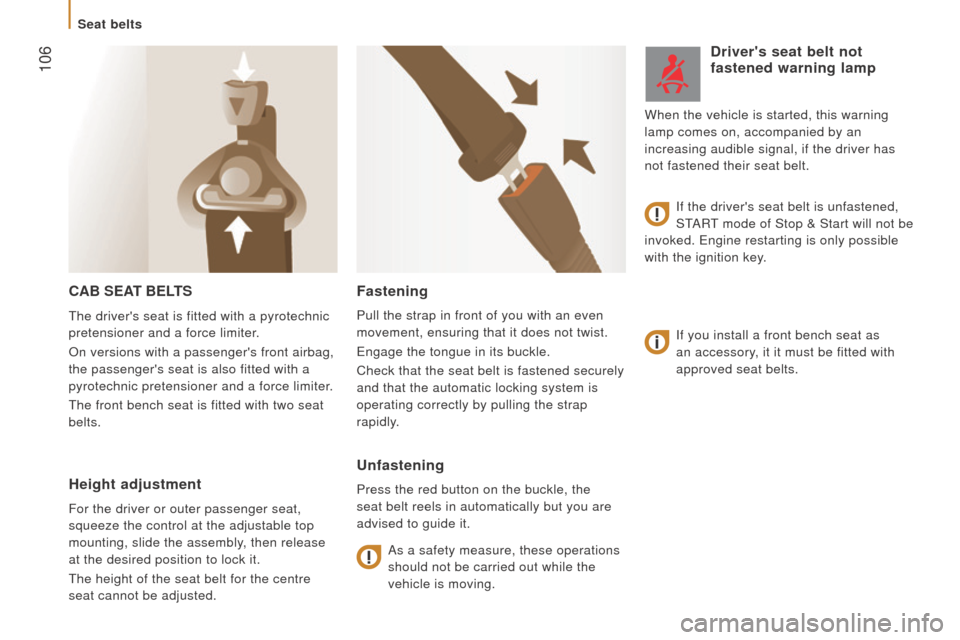
Fastening
Pull the strap in front of you with an even
movement, ensuring that it does not twist.
Engage the tongue in its buckle.
Check that the seat belt is fastened securely
and that the automatic locking system is
operating correctly by pulling the strap
rapidly.
unfastening
Press the red button on the buckle, the
seat belt reels in automatically but you are
advised to guide it.
As a safety measure, these operations
should not be carried out while the
vehicle is moving.
driver's seat belt not
fastened warning lamp
if the driver's seat belt is unfastened,
ST A r
T
mode of Stop & Start will not be
invoked. Engine restarting is only possible
with the ignition key. When the vehicle is started, this warning
lamp comes on, accompanied by an
increasing audible signal, if the driver has
not fastened their seat belt.
The driver's seat is fitted with a pyrotechnic
pretensioner and a force limiter.
o
n versions with a passenger's front airbag,
the passenger's seat is also fitted with a
pyrotechnic pretensioner and a force limiter.
The front bench seat is fitted with two seat
belts.
Height adjustment
For the driver or outer passenger seat,
squeeze the control at the adjustable top
mounting, slide the assembly, then release
at the desired position to lock it.
The height of the seat belt for the centre
seat cannot be adjusted.
Seat belts
Page 124 of 276
122
jumper_en_Chap06_Accessoires_ed01-2015
driving advice
distribution of loads: distribute the load in
the trailer so that the heaviest objects are as
close as possible to the axle and the nose
weight is close to the maximum authorised
without, however, exceeding it.
c
ooling: towing a trailer on a slope
increases the coolant temperature.
As the fan is electrically controlled, its
cooling capacity is not dependent on the
engine speed.
o
n the contrary, use a high gear to lower the
engine speed and reduce your speed.
i
n all cases, pay attention to the coolant
temperature.
tyres:
check the tyre pressures of the
towing vehicle and of the trailer, observing
the recommended pressures.
Fitting a towbar
We recommend the use of genuine
C i T roën towbars and their harnesses,
which have been tested and approved from
the design stage of your vehicle and that
the fitting of this equipment is entrusted to a
C
i T roën dealer.
These genuine towbars are compatible with
the operation of the rear parking sensors
and the reversing camera, if fitted to your
vehicle.
i
f this equipment is not fitted by a C i T roën
dealer
, it must be fitted in line with the
manufacturer's instructions.
Good practice
if the coolant temperature
warning lamp comes on, stop the
vehicle and switch off the engine
as soon as possible.
r
efer to the "Checks - Levels and
checks" section.
Brakes: towing increases the braking
distance. Drive at a moderate speed,
change down early and brake gradually. Side wind: sensitivity to side wind is
increased. Drive smoothly and at a
moderate speed. ABS: the system only controls the vehicle,
not the trailer.
r
ear parking sensors: the system is
deactivated while the vehicle is towing with a
genuine C
i T roën towbar fitted.
r
efer to the "Technical data -
i
dentification markings" section.
Transport solutions
Page 129 of 276
127
jumper_en_Chap07_Verifications_ed01-2015
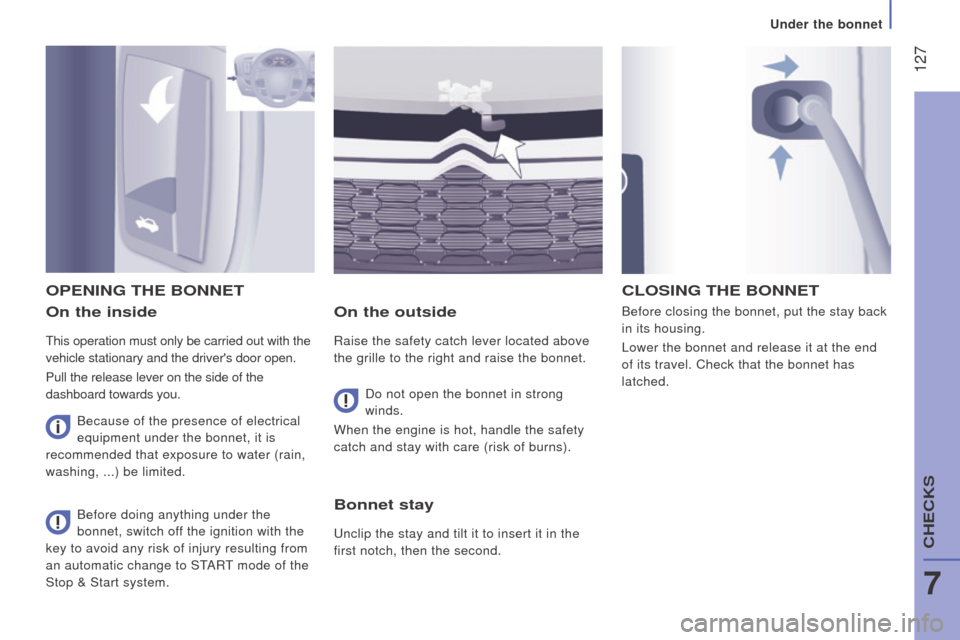
On the inside
This operation must only be carried out with the
vehicle stationary and the driver's door open.
Pull the release lever on the side of the
dashboard towards you.
On the outside
raise the safety catch lever located above
the grille to the right and raise the bonnet. Before closing the bonnet, put the stay back
in its housing.
Lower the bonnet and release it at the end
of its travel. Check that the bonnet has
latched.
OPEnInG tHE BOnnEt
Do not open the bonnet in strong
winds.
When the engine is hot, handle the safety
catch and stay with care (risk of burns).
Before doing anything under the
bonnet, switch off the ignition with the
key to avoid any risk of injury resulting from
an automatic change to STA
r
T
mode of the
Stop & Start system.
cLOSInG tHE BOnnEt
Bonnet stay
Unclip the stay and tilt it to insert it in the
first notch, then the second.
Because of the presence of electrical
equipment under the bonnet, it is
recommended that exposure to water (rain,
washing, ...) be limited.
7
Under the bonnet
CHECKS
Page 136 of 276
134
jumper_en_Chap07_Verifications_ed01-2015
Low fuel level
rEF
u
ELLI
n
G
In low temperatures
In mountainous and/or cold areas, it is
advisable to use a "winter" type fuel suited
to low or minus temperatures. With Stop & Start, never refuel with
the system in ST
o
P mode; you must
switch off the ignition with the key. When the fuel tank level E
(Empty) is reached, this warning
lamp comes on.
You then have around 10 to
12 litres in the reserve, depending on the
capacity of the tank, the engine type, the
driving conditions and the profile of the road.
r
efuel without delay to avoid running out of
fuel.
The capacity of the fuel tank is
approximately 90 litres.
Fuel tanks of different capacities, 60 and
120 litres, may be fitted. The fuel tank must be filled with the engine
off.
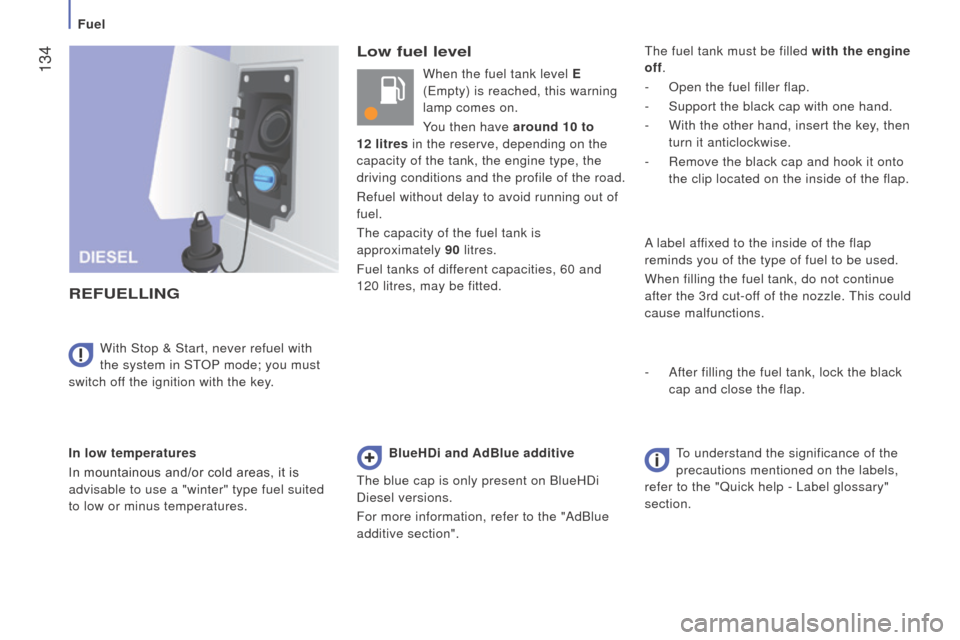
- o pen the fuel filler flap.
-
Support the black cap with one hand.
-
With the other hand, insert the key
, then
turn it anticlockwise.
- r emove the black cap and hook it onto
the clip located on the inside of the flap.
A label affixed to the inside of the flap
reminds you of the type of fuel to be used.
When filling the fuel tank, do not continue
after the 3rd cut-off of the nozzle. This could
cause malfunctions.
-
After filling the fuel tank, lock the black
cap and close the flap.
BlueH d i and AdBlue additive
The blue cap is only present on BlueHDi
Diesel versions.
For more information, refer to the "AdBlue
additive section". To understand the significance of the
precautions mentioned on the labels,
refer to the "Quick help - Label glossary"
section.
Fuel
Page 143 of 276
141
jumper_en_Chap07_Verifications_ed01-2015
refit the filler cap
- r efit the blue cap to the tank and turn it
a 6
th of a turn clockwise, to its stop.
-
Close the filler flap.
n
ever dispose of AdBlue
® additive
bottles in the household waste. Place
them in a special container provided this
purpose or take them to your dealer.
Keep AdBlue
® out of the reach of
children, in its original container.
n
ever transfer AdBlue
® to another container:
it would loose its purity.
n
ever dilute the additive with water.
n
ever pour the additive into the Diesel fuel
tank.
recommendations on storage
never store containers or bottles of
AdBlue® in your vehicle. Freezing of the AdBlue
® additive
AdBlue® freezes at about -11°C
(12.2°
F) and deteriorates above 25°C
(77°F).
i
t is recommended that containers and
bottles be stored in a cool area and
protected from direct sunlight.
Under these conditions, the additive can be
kept for at least a year.
Additive that has been frozen can be used
once it has thawed out in ambient air. The SC
r system includes an AdBlue
®
tank heater that ensures operation of
the vehicle in normal conditions.
i
n exceptional situations, such as when the
vehicle is kept at temperatures below -15°C
(5°F) for a long period, there may be an
emission fault alert related to freezing of the
AdBlue
® additive.
Park the vehicle in an area at a more
moderate temperature for a few hours until
the additive becomes a liquid again.
The emissions warning lamp does not go off
immediately, but does so after a few miles
of driving.
Additif AdBlue®
7
CHECKS