Mode Citroen JUMPER 2016 2.G Owner's Manual
[x] Cancel search | Manufacturer: CITROEN, Model Year: 2016, Model line: JUMPER, Model: Citroen JUMPER 2016 2.GPages: 276, PDF Size: 8.93 MB
Page 3 of 276
jumper_en_Chap00a_Sommaire_ed01-2015
WELCoME
IntrOductIOn
Within each section, symbols draw your attention to
specific information:
For any work on your vehicle, use a qualified
workshop that has the technical information, skills and
equipment required, all of which a Ci T roën dealer is
able to provide. directs you to the section and part which contains
detailed information concerning a function,
indicates important information relating to use of
the equipment,
alerts you to the safety of individuals and
on-board equipment.
The equipment presented may be standard, an option
or not available, depending on the model and can vary
from one country to another or not be available in all
countries of sale.CiTroën has a presence on every continent,
a complete product range,
bringing together technology and a permanent spirit of innovation,
for a modern and creative approach to mobility
.
We thank you and congratulate you on your choice.
At the wheel of your new vehicle,
getting to know each system,
each control, each setting,
makes your trips, your journeys
more comfortable and more enjoyable.
Happy motoring!
Page 4 of 276
2
jumper_en_Chap00a_Sommaire_ed01-2015
Lighting control stalk 45
wipers 48
Cruise control
49
Speed limiter
55
Demisting and
defrosting
59
Manual heating / Air
conditioning
61
Digital air conditioning
63
Additional heating
systems
65
Rear Heating / Air
Conditioning
65
Programmable additional heating
67
Front seats
71
Front bench seat
73r
ear seats
74
Front fittings
76
Rear fittings
81
Exterior fittings
84
Mirrors
85
Electric windows
86
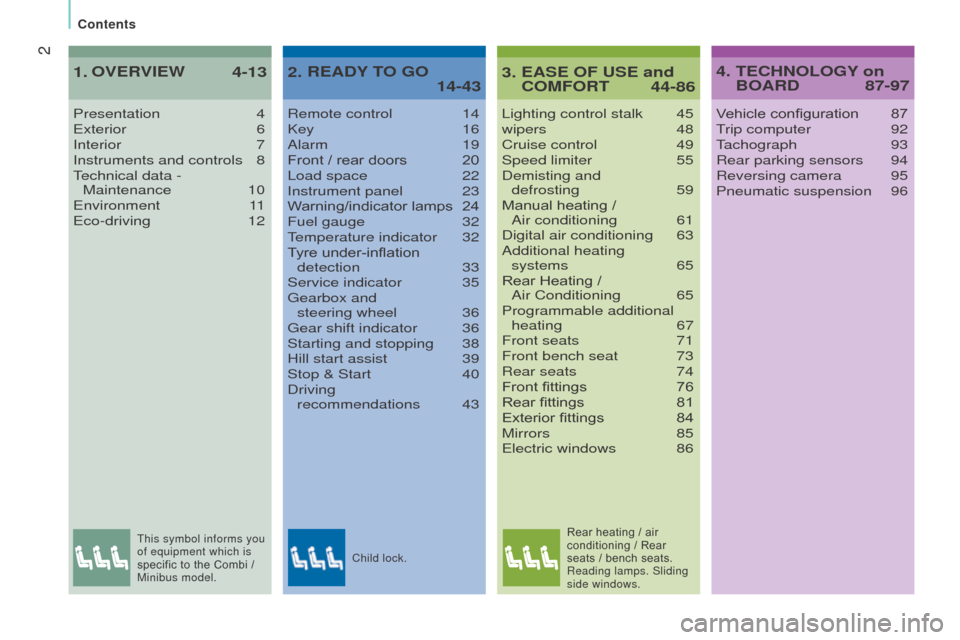
Presentation
4
Exterior
6i
nterior
7i
nstruments and controls
8
T
echnical data - Maintenance
10
Environment
11
Eco-driving
12
OVErVIEW
1. 4-13
Vehicle configuration 87
T rip computer 92
T
achograph
93r
ear parking sensors
94r
eversing camera
95
Pneumatic suspension
96
rEAdY tO GO
2.
14-43
remote control 14
Key 16
Alarm
19
Front / rear doors
20
Load space
22i
nstrument panel
23
W
arning/indicator lamps
24
Fuel gauge
32
T
emperature indicator
32
T
yre under-inflation detection
33
Service indicator
35
Gearbox and
steering wheel
36
Gear shift indicator
36
Starting and stopping
38
Hill start assist
39
Stop & Start
40
Driving
recommendations
43
This symbol informs you
of equipment which is
specific to the Combi /
Minibus model. Child lock.Rear heating / air
conditioning / Rear
seats / bench seats.
r
eading lamps. Sliding
side windows.
EASE OF uSE and c OMFO rt3.
44-86t E c H n OLOGY on
BOA rd4. 87-97
Contents
Page 21 of 276
19
jumper_en_Chap02_Pret-a-Partir_ed01-2015
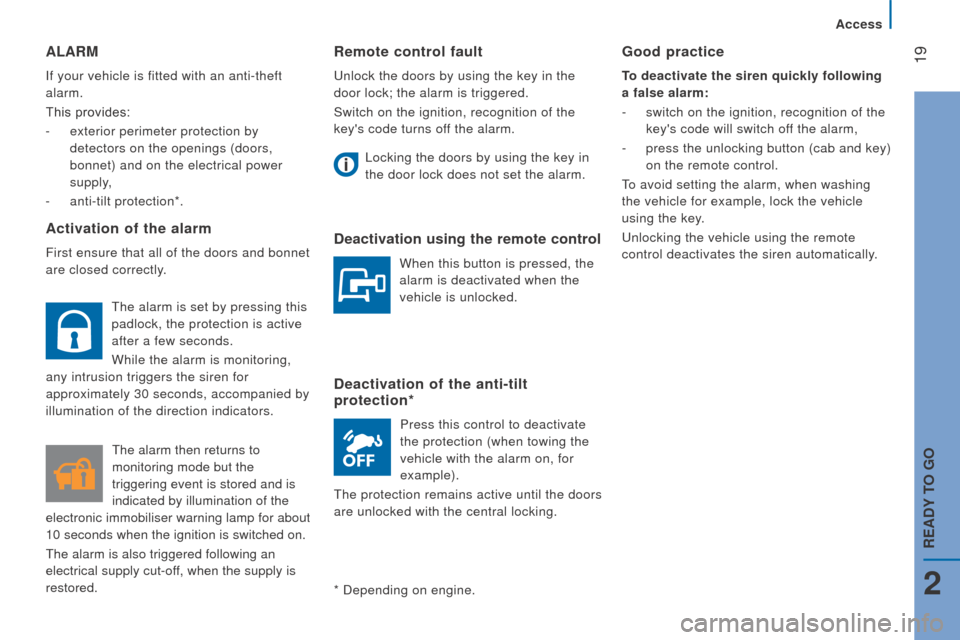
remote control fault
Unlock the doors by using the key in the
door lock; the alarm is triggered.
Switch on the ignition, recognition of the
key's code turns off the alarm.Locking the doors by using the key in
the door lock does not set the alarm.
deactivation using the remote control
When this button is pressed, the
alarm is deactivated when the
vehicle is unlocked.
deactivation of the anti-tilt
protection*
Press this control to deactivate
the protection (when towing the
vehicle with the alarm on, for
example).
The protection remains active until the doors
are unlocked with the central locking.
ALArM
if your vehicle is fitted with an anti-theft
alarm.
This provides:
-
exterior perimeter protection by
detectors on the openings (doors,
bonnet) and on the electrical power
supply,
-
anti-tilt protection*.
Activation of the alarm
First ensure that all of the doors and bonnet
are closed correctly.
*
Depending on engine.
Good practice
to deactivate the siren quickly following
a false alarm:
-
switch on the ignition, recognition of the
key's code will switch off the alarm,
-
press the unlocking button (cab and key)
on the remote control.
To avoid setting the alarm, when washing
the vehicle for example, lock the vehicle
using the key.
Unlocking the vehicle using the remote
control deactivates the siren automatically.
The alarm is set by pressing this
padlock, the protection is active
after a few seconds.
While the alarm is monitoring,
any intrusion triggers the siren for
approximately 30 seconds, accompanied by
illumination of the direction indicators.
The alarm then returns to
monitoring mode but the
triggering event is stored and is
indicated by illumination of the
electronic immobiliser warning lamp for about
10
seconds when the ignition is switched on.
The alarm is also triggered following an
electrical supply cut-off, when the supply is
restored.
2
Access
rEAdY tO GO
Page 32 of 276
30
jumper_en_Chap02_Pret-a-Partir_ed01-2015
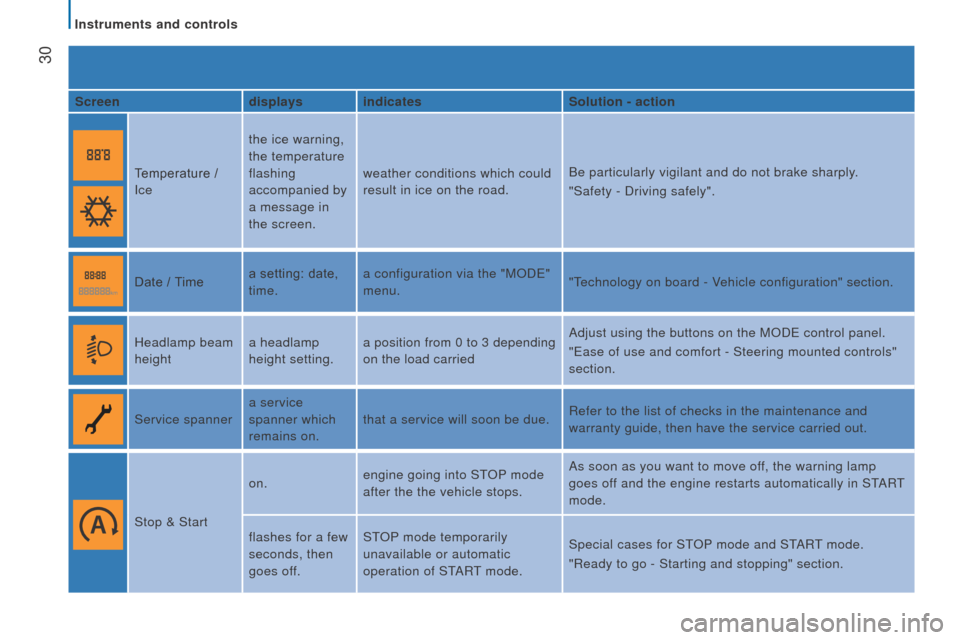
Screendisplays indicates Solution - action
Temperature /
i
ce the ice warning,
the temperature
flashing
accompanied by
a message in
the screen. weather conditions which could
result in ice on the road.
Be particularly vigilant and do not brake sharply.
"Safety - Driving safely".
Date / Time a setting: date,
time.a configuration via the "M
o DE"
menu. "Technology on board
- Vehicle configuration" section.
Headlamp beam
height a headlamp
height setting.a position from 0 to 3
depending
on the load carried Adjust using the buttons on the M
o DE control panel.
"Ease of use and comfort - Steering mounted controls"
section.
Service spanner a service
spanner which
remains on.that a service will soon be due.
r
efer to the list of checks in the maintenance and
warranty guide, then have the service carried out.
Stop & Start on.
engine going into ST
o
P mode
after the the vehicle stops. As soon as you want to move off, the warning lamp
goes off and the engine restarts automatically in STA
r
T
mode.
flashes for a few
seconds, then
goes off. ST
o
P mode temporarily
unavailable or automatic
operation of STA
r
T
mode.Special cases for ST
o
P mode and STA r
T
mode.
"
r eady to go - Starting and stopping" section.
Instruments and controls
Page 35 of 276
33
jumper_en_Chap02_Pret-a-Partir_ed01-2015
EMISSIOnS cOntrOLS
EoBD (European on Board Diagnosis)
is a diagnostics system which complies
with, among others, the standards on the
authorised emissions of:
-
C
o (carbon monoxide),
-
HC (unburnt hydrocarbons),
-
no x (nitrous oxides) or particles,
detected by oxygen sensors placed
upstream and downstream of the
catalytic converters.
tYrE undEr-InFLAt IO n d E t E ct IO n
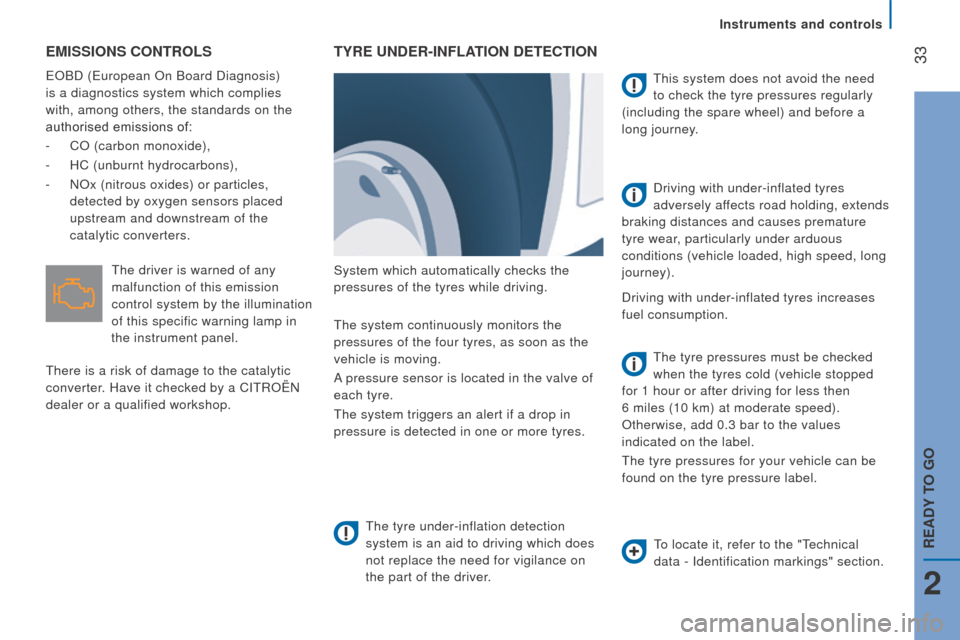
System which automatically checks the
pressures of the tyres while driving.
The tyre under-inflation detection
system is an aid to driving which does
not replace the need for vigilance on
the part of the driver. This system does not avoid the need
to check the tyre pressures regularly
(including the spare wheel) and before a
long journey.
Driving with under-inflated tyres increases
fuel consumption.
The system continuously monitors the
pressures of the four tyres, as soon as the
vehicle is moving.
A pressure sensor is located in the valve of
each tyre.
The system triggers an alert if a drop in
pressure is detected in one or more tyres. The tyre pressures must be checked
when the tyres cold (vehicle stopped
for 1 hour or after driving for less then
6 miles (10 km) at moderate speed).
o
therwise, add 0.3 bar to the values
indicated on the label.
The tyre pressures for your vehicle can be
found on the tyre pressure label.
The driver is warned of any
malfunction of this emission
control system by the illumination
of this specific warning lamp in
the instrument panel.
There is a risk of damage to the catalytic
converter. Have it checked by a C
i
T
roën
dealer or a qualified workshop.
T
o locate it, refer to the "Technical
data
- i dentification markings" section.
Driving with under-inflated tyres
adversely affects road holding, extends
braking distances and causes premature
tyre wear, particularly under arduous
conditions (vehicle loaded, high speed, long
journey).
Instruments and controls
2
rEAdY tO GO
Page 42 of 276
40
jumper_en_Chap02_Pret-a-Partir_ed01-2015
The Stop & Start system puts the engine
temporarily into standby - ST
o
P mode -
during stops in the traffic (red lights, traffic
jams, or other...). The engine restarts
automatically - STA
r
T
mode - as soon as
you want to move off. The restart takes
place instantly, quickly and silently.
Perfect for urban use, the Stop & Start
system reduces fuel consumption and
exhaust emissions and offers the comfort of
complete silence when stationary.
StOP & StA rt
Operation
Going into engine StOP mode
With the vehicle stationary, put the gear
lever into neutral, then release the clutch
pedal.
-
This indicator lamp comes on
in the instrument panel and
the engine goes into standby. Automatic stopping of the engine is
only possible after the vehicle has
exceed a speed of about 6 mph (10 km/h),
to avoid repeated stopping of the engine
when driving slowly.
n
ever leave your vehicle with out first
turning off the ignition with the key.n ever refuel with the engine in STo P
mode; you must switch off the ignition
with the key. Special cases: S
t
OP
mode unavailable
The STOP mode is not invoked when:
-
the system is initialising,
-
the driver's door is open,
-
the driver's seat belt is not fastened,
-
the air conditioning is running,
-
the heated rear screen is on,
-
the windscreen wiper is on fast wipe,
-
reverse gear is engaged, for a parking
manoeuvre,
-
some special conditions (battery
charge, engine temperature, particle
filter regeneration, braking assistance,
ambient temperature...) where the
engine is needed to assure control of a
system.
This indicator lamp in the
instrument panel flashes for a
few seconds, then goes off.
t
his operation is perfectly normal.
Starting and switching off
Page 43 of 276
41
jumper_en_Chap02_Pret-a-Partir_ed01-2015
Going into engine StArt mode
-
This indicator lamp goes of
f
and the engine restarts.
i
f following an automatic restart in STA r
T
mode, the driver takes no action on the
the vehicle during the next
3 minutes, the
system stops the engine definitively. The
engine can then only be restarted using
the
key. Special cases: S
tA rt invoked
automatically
The STA
r
T
mode is invoked automatically
when:
-
the vehicle's is free wheeling on a slope,
-
the windscreen wiper is on fast wipe,
-
the air conditioning is running,
-
the engine has been stopped for around
3 minutes with Stop & Start,
-
some special conditions (battery charge,
engine temperature, braking assistance,
ambient temperature...) where the
engine is needed to assure control of a
system.
i
n this case, a message appears
in the instrument panel screen,
accompanied by this indicator
lamp, which flashes for a
few
seconds, then goes off.Good practice
With a manual gearbox in SToP mode, if a
gear is engaged without fully depressing the
clutch pedal, restarting may not take place.
An indicator lamp and/or message is
displayed in the instrument panel asking
you to fully depress the clutch pedal to allow
restarting.
t
his operation is perfectly normal.
With the vehicle in gear, automatic engine
restarting is only allowed by fully depressing
the clutch pedal.
With the engine stopped in ST
o
P
mode, if the driver unfasten's
their seat belt and opens a front
door, the engine can only be
restarted using the ignition key. There is
an audible signal, accompanied by flashing
of this indicator lamp and the display of a
message.
Starting and switching off
2
rEAdY tO GO
Page 44 of 276
42
jumper_en_Chap02_Pret-a-Partir_ed01-2015
deactivation
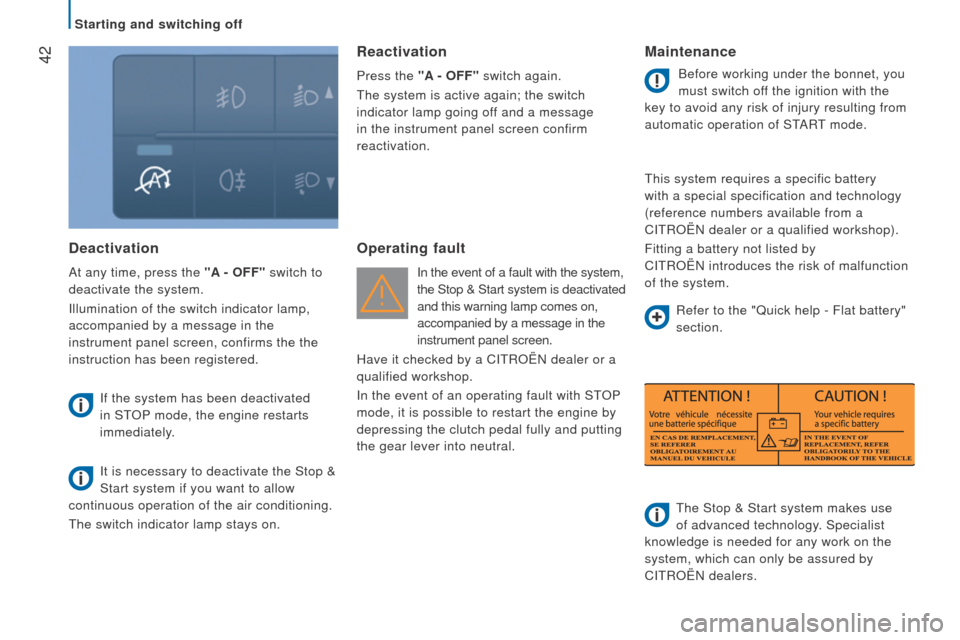
At any time, press the "A - OFF" switch to
deactivate the system.
i
llumination of the switch indicator lamp,
accompanied by a message in the
instrument panel screen, confirms the the
instruction has been registered.
i
f the system has been deactivated
in ST
o
P mode, the engine restarts
immediately.
i
t is necessary to deactivate the Stop &
Start system if you want to allow
continuous operation of the air conditioning.
The switch indicator lamp stays on.
reactivation
Press the "A - OFF" switch again.
The system is active again; the switch
indicator lamp going off and a message
in the instrument panel screen confirm
reactivation.
Operating fault
in the event of a fault with the system,
the Stop & Start system is deactivated
and this warning lamp comes on,
accompanied by a message in the
instrument panel screen.
Have it checked by a C
i T roën dealer or a
qualified workshop.
i
n the event of an operating fault with ST
o
P
mode, it is possible to restart the engine by
depressing the clutch pedal fully and putting
the gear lever into neutral.
Maintenance
Before working under the bonnet, you
must switch off the ignition with the
key to avoid any risk of injury resulting from
automatic operation of STA
r
T
mode.
This system requires a specific battery
with a special specification and technology
(reference numbers available from a
C
i
T
roën dealer or a qualified workshop).
Fitting a battery not listed by
C
i
T
roën introduces the risk of malfunction
of the system.
The Stop & Start system makes use
of advanced technology. Specialist
knowledge is needed for any work on the
system, which can only be assured by
C
i
T
roën dealers.
r
efer to the "Quick help - Flat battery"
section.
Starting and switching off
Page 50 of 276
48
jumper_en_Chap03_Ergo-et-confort_ed01-2015
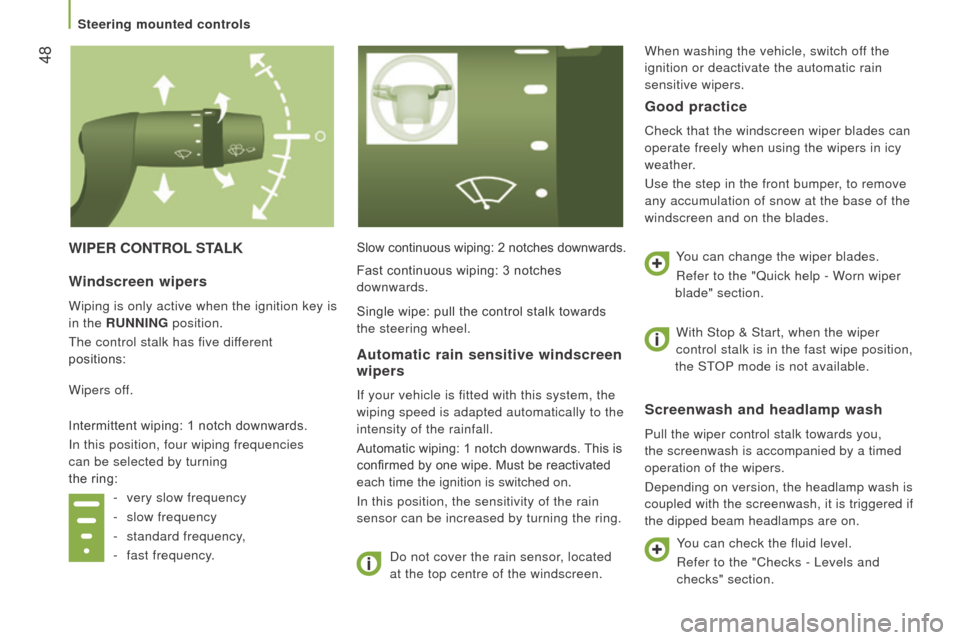
WIPEr cOntrOL S tALKSlow continuous wiping: 2 notches downwards.
Do not cover the rain sensor, located
at the top centre of the windscreen.
Screenwash and headlamp wash
Pull the wiper control stalk towards you,
the screenwash is accompanied by a timed
operation of the wipers.
Depending on version, the headlamp wash is
coupled with the screenwash, it is triggered if
the dipped beam headlamps are on.
Windscreen wipers
Wiping is only active when the ignition key is
in the runn I n G position.
The control stalk has five different
positions:
Wipers off.
Intermittent wiping: 1 notch downwards.
i
n this position, four wiping frequencies
can be selected by turning
the ring:
-
very slow frequency
-
slow frequency
-
standard frequency
,
-
fast frequency
.
Automatic rain sensitive windscreen
wipers
if your vehicle is fitted with this system, the
wiping speed is adapted automatically to the
intensity of the rainfall.
Automatic wiping: 1 notch downwards. This is
confirmed by one wipe. Must be reactivated
each time the ignition is switched on.
i
n this position, the sensitivity of the rain
sensor can be increased by turning the ring.
Good practice
Check that the windscreen wiper blades can
operate freely when using the wipers in icy
weather.
Use the step in the front bumper, to remove
any accumulation of snow at the base of the
windscreen and on the blades.
You can change the wiper blades.
r
efer to the "Quick help - Worn wiper
blade" section.
You can check the fluid level.
r
efer to the "Checks - Levels and
checks" section.
Fast continuous wiping: 3 notches
downwards.
Single wipe: pull the control stalk towards
the steering wheel.
With Stop & Start, when the wiper
control stalk is in the fast wipe position,
the ST
o
P mode is not available.
When washing the vehicle, switch off the
ignition or deactivate the automatic rain
sensitive wipers.
Steering mounted controls
Page 61 of 276
59
jumper_en_Chap03_Ergo-et-confort_ed01-2015
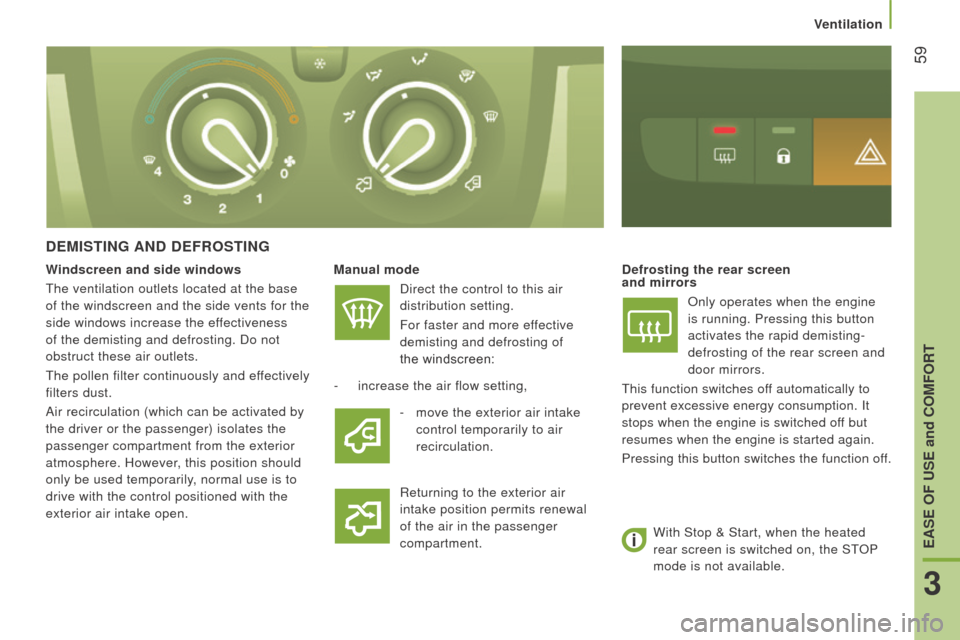
dEMIStInG And dEF r OS t I n G
Manual mode
Direct the control to this air
distribution setting.
For faster and more effective
demisting and defrosting of
the windscreen:d efrosting the rear screen
and mirrors
o nly operates when the engine
is running. Pressing this button
activates the rapid demisting-
defrosting of the rear screen and
door mirrors.
This function switches off automatically to
prevent excessive energy consumption.
i t
stops when the engine is switched off but
resumes when the engine is started again.
Pressing this button switches the function off.
-
increase the air flow setting,
r
eturning to the exterior air
intake position permits renewal
of the air in the passenger
compartment.
Windscreen and side windows
The ventilation outlets located at the base
of the windscreen and the side vents for the
side windows increase the effectiveness
of the demisting and defrosting. Do not
obstruct these air outlets.
The pollen filter continuously and effectively
filters dust.
Air recirculation (which can be activated by
the driver or the passenger) isolates the
passenger compartment from the exterior
atmosphere. However, this position should
only be used temporarily, normal use is to
drive with the control positioned with the
exterior air intake open.
-
move the exterior air intake
control temporarily to air
recirculation.
With Stop & Start, when the heated
rear screen is switched on, the ST
o
P
mode is not available.
Ventilation
3
EASE OF uSE and cOMFOrt