Citroen jumpy Citroen JUMPY 2016 2.G Manual Online
[x] Cancel search | Manufacturer: CITROEN, Model Year: 2016, Model line: JUMPY, Model: Citroen JUMPY 2016 2.GPages: 595, PDF Size: 12.47 MB
Page 285 of 595
283
Jumpy _en_Chap07_info-pratiques_ed01-2016
AdBlue® and SCR system
for BlueHDi Diesel engines
To assure respect for the environment and
conformity with the new Euro 6 emissions
standard, without adversely affecting the
per formance or fuel consumption of Diesel
engines, CITROËN has taken the decision to
equip its vehicles with an effective system that
associates SCR (Selective Catalytic Reduction)
with a particle filter (FAP) for the treatment of
exhaust gases.
Presentation of the SCR system
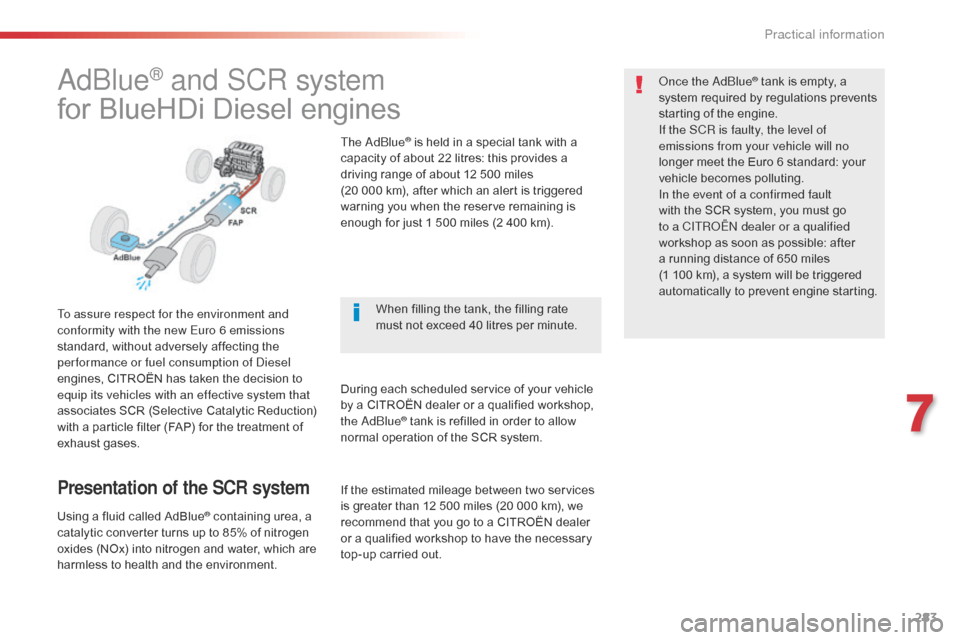
Using a fluid called AdBlue® containing urea, a
catalytic converter turns up to 85% of nitrogen
oxides (NOx) into nitrogen and water, which are
harmless to health and the environment. The AdBlue
® is held in a special tank with a
capacity of about 22 litres: this provides a
driving range of about 12 500 miles
(20 000 km), after which an alert is triggered
warning you when the reserve remaining is
enough for just 1 500 miles (2 400 km).
During each scheduled service of your vehicle
by a CITROËN dealer or a qualified workshop,
the AdBlue
® tank is refilled in order to allow
normal operation of the SCR system. Once the AdBlue
® tank is empty, a
s
ystem required by regulations prevents
starting of the engine.
If the SCR
is faulty, the level of
emissions from your vehicle will no
longer meet the Euro 6 standard: your
vehicle becomes polluting.
In the event of a confirmed fault
with the SCR system, you must go
to a CITROËN dealer or a qualified
workshop as soon as possible: after
a running distance of 650 miles
(1
100 km), a system will be triggered
automatically to prevent engine starting.
When filling the tank, the filling rate
must not exceed 40 litres per minute.
If the estimated mileage between two services
is greater than 12 500 miles (20 000 km), we
recommend that you go to a CITROËN dealer
or a qualified workshop to have the necessary
top-up carried out.
7
Practical information
Page 286 of 595

284
Jumpy _en_Chap07_info-pratiques_ed01-2016
Topping-up the AdBlue®
Filling the AdBlue® tank is an operation
included in every routine service on your
vehicle by a CITROËN dealer or a qualified
workshop.
Nevertheless, given the capacity of the tank, it
may be necessary to top-up the fluid between
services, more particularly if an alert (warning
lamps and a message) signals the requirement.
You can go to a CITROËN dealer or a qualified
workshop.
If you envisage topping-up yourself, please
read the following warnings carefully.
Precautions in use
Keep AdBlue® out of the reach of
children, in its original bottle.
Never transfer AdBlue
® to another
container: it would lose its purity. Use only AdBlue
® fluid that meets the
ISO
22241 standard.
Never dilute AdBlue
® with water.
Never pour AdBlue® into the Diesel fuel
tank.
The supply in a non-drip bottle simplifies
topping-up. You can obtain 1.89 litre (half a
US gallon) bottles from a CITROËN
dealer or a
qualified workshop.
Never top-up from an AdBlue
®
dispenser reserved for heavy goods
vehicles.
AdBlue
® is a urea-based solution. This liquid is
non-flammable, colourless and odourless (kept
in a cool area).
In the event of contact with the skin, wash
the affected area with soap and water. In the
event of contact with the eyes, wash (irrigate)
the eyes with large amounts of water or with
an eye wash solution for at least 15 minutes.
If a burning sensation or irritation persists, get
medical attention.
If swallowed, immediately wash out the mouth
with clean water and then drink plenty of water.
In certain conditions (high ambient
temperature, for example), the risk of release of
ammonia cannot be excluded: do not inhale the
fluid. Ammonia vapour has an irritant effect on
mucous membranes (eyes, nose and throat).
Important
If your vehicle's AdBlue
® tank is
c
ompletely empty (which is confirmed
by the alert messages and the
impossibility of starting the engine)
you must add at least 3.8 litres
(so two 1.89 litre bottles).
Practical information
Page 289 of 595

287
Jumpy _en_Chap08_En-cas-de-panne_ed01-2016
Warning triangle (stowing)
Before leaving your vehicle to set up
and install the triangle, switch on the
hazard warning lamps and put on your
high visibility vest.
This safety equipment should be used in
addition to the hazard warning lamps.
Its presence in the vehicle is mandatory.
Placing the triangle in the
road
Refer to the manufacturer's instructions on
unfolding and assembly supplied with the
triangle. F
P
lace the triangle behind the vehicle, as
required by the legislation in force in your
c o unt r y.
The triangle is available as an
accessory; contact a CITROËN dealer
or a qualified workshop.
Tool box
Access
The tool box is located under the left-hand front
seat.
As a safety measure, the bars 1 and
2
prevent the box escaping from its
housing, if it is not correctly secured.
8
In the event of a breakdown
Page 295 of 595

293
Jumpy _en_Chap08_En-cas-de-panne_ed01-2016
If after around 5 to 7 minutes the
pressure is not attained, this indicates
that the tyre is not repairable; contact
a CITROËN dealer or a qualified
workshop for assistance.
F
S
witch on the compressor by moving
the switch B to position "I" until the tyre
pressure reaches 2.0 bars.
T
he sealant is injected into the tyre under
pressure; do not disconnect the pipe from
the valve during this operation (risk of
splashing). F
R
emove the kit and screw the cap back on
the white pipe.
T
ake care to avoid staining your vehicle
with traces of fluid. Keep the kit to hand.
2. Inflation
F Turn the selector A to the "Air" position.
F
U
ncoil the black pipe H fully.
F
C
onnect the black pipe to the valve of the
wheel.
F
D
rive immediately for approximately
three miles (five kilometres), at
reduced
speed (between 15 and 35 mph
(20 and
60
km/h)), to plug the puncture.
F
S
top to check the repair and the tyre
pressure using the kit.
8
In the event of a breakdown
Page 296 of 595

294
Jumpy _en_Chap08_En-cas-de-panne_ed01-2016
F Connect the compressor's electric plug to the vehicle's 12 V socket.
F
S
tart the vehicle again and leave the
engine running. F
A djust the pressure using the compressor
(to inflate: switch B in position "I" ; to
deflate: switch B
in position "O" and press
button C ), in accordance with the vehicle's
tyre pressure label (located on the left
hand door aperture).
A l
oss of pressure indicates that the
puncture has not been fully plugged;
contact a CITROËN dealer or qualified
workshop for assistance.
F
R
emove and stow the kit.
F
D
rive at reduced speed (50 mph [80 km/h]
max) limiting the distance travelled to
approximately 120 miles (200 km).
As soon as possible, go to a CITROËN
dealer or a qualified workshop.
You must inform the technician that you
have used this kit. After inspection, the
technician will advise you on whether
the tyre can be repaired or if it must be
replaced.
Removing the cartridge
F Stow the black pipe.
F
D etach the angled base from the white pipe.
F
S
upport the compressor vertically.
Beware of discharges of fluid.
The expiry date of the fluid is indicated
on the cartridge.
The sealant cartridge is designed for
single use; even if only partly used, it
must be replaced.
After use, do not discard the cartridge
into the environment, take it to an
authorised waste disposal site or a
CITROËN dealer.
Do not forget to obtain a new sealant
cartridge, available from CITROËN
dealers or from a qualified workshop.
F
U
nscrew the cartridge from the bottom.
In the event of a breakdown
Page 304 of 595
302
Jumpy _en_Chap08_En-cas-de-panne_ed01-2016
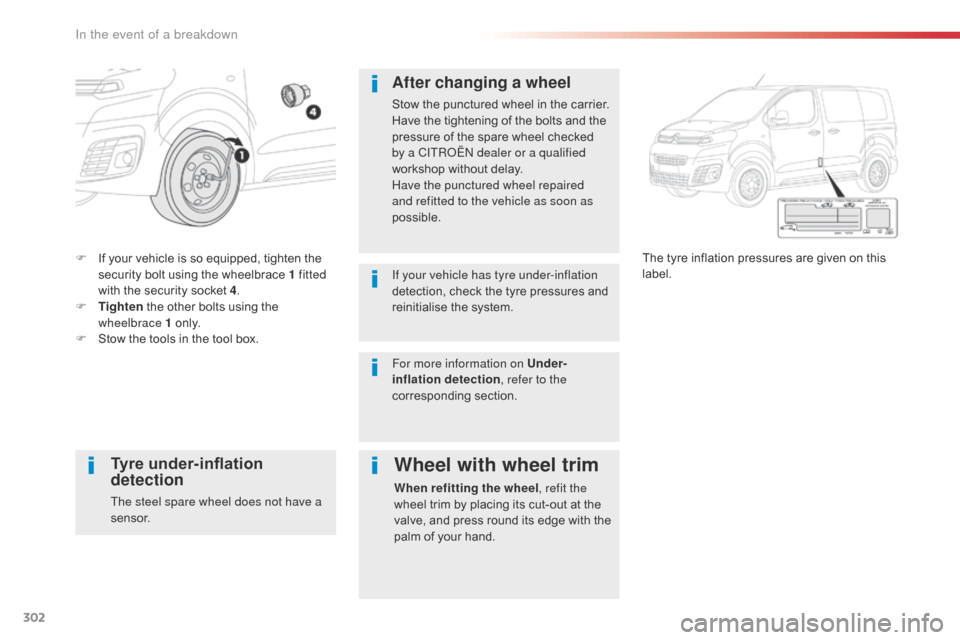
F If your vehicle is so equipped, tighten the security bolt using the wheelbrace 1 fitted
with the security socket 4 .
F
T
ighten the other bolts using the
wheelbrace 1 o n l y.
F
S
tow the tools in the tool box. The tyre inflation pressures are given on this
label.
After changing a wheel
Stow the punctured wheel in the carrier.
Have the tightening of the bolts and the
pressure of the spare wheel checked
by a CITROËN dealer or a qualified
workshop without delay.
Have the punctured wheel repaired
and refitted to the vehicle as soon as
possible.
If your vehicle has tyre under-inflation
detection, check the tyre pressures and
reinitialise the system.
Tyre under-inflation
detection
The steel spare wheel does not have a
sensor.
Wheel with wheel trim
When refitting the wheel
, refit the
wheel trim by placing its cut-out at the
valve, and press round its edge with the
palm of your hand.
For more information on Under-
inflation detection
, refer to the
corresponding section.
In the event of a breakdown
Page 305 of 595
303
Jumpy _en_Chap08_En-cas-de-panne_ed01-2016
Changing a bulb
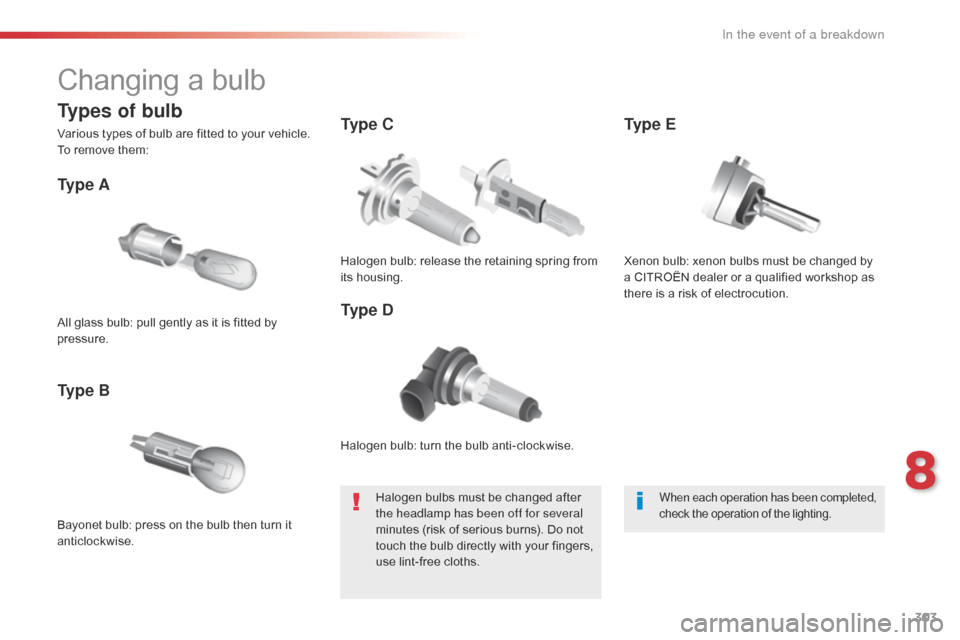
Halogen bulb: turn the bulb anti-clockwise.
Ty p e A
Bayonet bulb: press on the bulb then turn it
anticlockwise.
Ty p e BTy p e C
Ty p e D
All glass bulb: pull gently as it is fitted by
pressure.
Halogen bulb: release the retaining spring from
its housing.
Halogen bulbs must be changed after
the headlamp has been off for several
minutes (risk of serious burns). Do not
touch the bulb directly with your fingers,
use lint-free cloths.
When each operation has been completed,
check the operation of the lighting.
Types of bulb
Various types of bulb are fitted to your vehicle.
To remove them: Xenon bulb: xenon bulbs must be changed by
a CITROËN dealer or a qualified workshop as
there is a risk of electrocution.Ty p e E
8
In the event of a breakdown
Page 307 of 595

305
Jumpy _en_Chap08_En-cas-de-panne_ed01-2016
Direction indicator side
repeater
Ty p e A, W Y5W-5W (amber)
Daytime running lamps / sidelamps
If fitted to your vehicle, contact a CITROËN
dealer or a qualified workshop for the
replacement of this type of LED lamp and light
guide.
A replacement kit for the LEDs is available from
CITROËN dealers. The headlamps have polycarbonate
lenses with a protective coating:
F
d
o not clean them using a dr y
or abrasive cloth, nor with a
detergent or solvent product,
F
u
se a sponge and soapy water or a
pH neutral product,
F
w
hen using a high pressure washer
on persistent marks, do not keep
the lance directed towards the
lamps or their edges for too long,
so as not to damage their protective
coating and seals.
Changing a bulb should only be done
after the headlamp has been switched
off for several minutes (risk of serious
burns).
F
D
o not touch the bulb directly with
your fingers, use a lint-free cloth.
It is imperative to use only anti-
ultraviolet (UV) type bulbs to avoid
damaging the headlamp.
Always replace a failed bulb with a
new bulb with the same type and
specification.
-
P
ush the repeater towards the rear and
disengage it.
-
W
hen refitting, engage the repeater
towards the front and then bring it towards
the rear.
Amber coloured bulbs (direction indicators and
side repeaters) must be replaced with bulbs of
identical specification and colour.
8
In the event of a breakdown
Page 310 of 595
308
Jumpy _en_Chap08_En-cas-de-panne_ed01-2016
Dipped beam headlamps
(xenon headlamps)
Ty p e E, D8S 25W
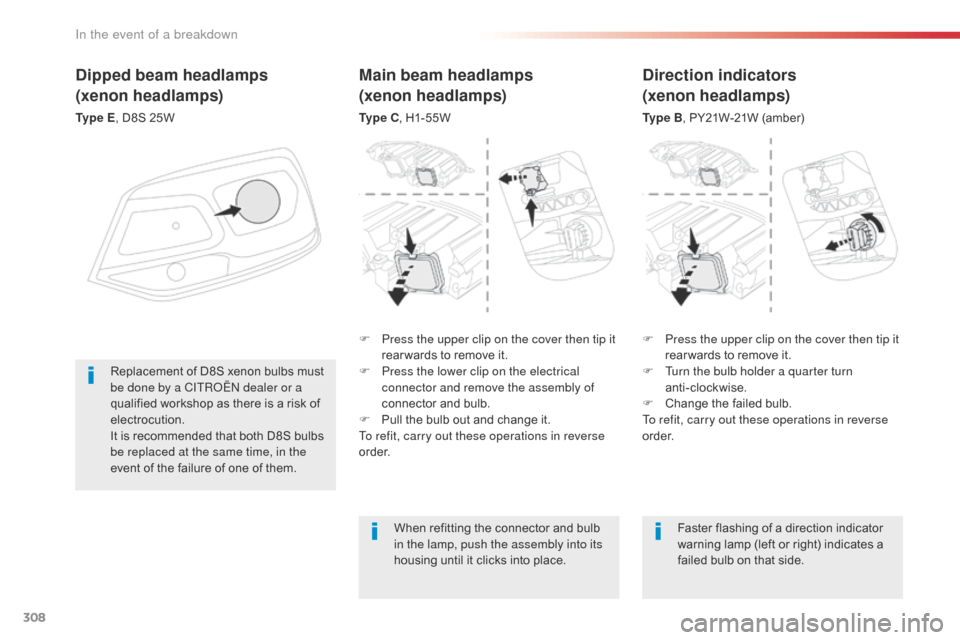
F
P
ress the upper clip on the cover then tip it
rear wards to remove it.
F
T
urn the bulb holder a quarter turn
anti-clockwise.
F
C
hange the failed bulb.
To refit, carry out these operations in reverse
o r d e r.
Replacement of D8S xenon bulbs must
be done by a CITROËN dealer or a
qualified workshop as there is a risk of
electrocution.
It is recommended that both D8S bulbs
be replaced at the same time, in the
event of the failure of one of them.
Main beam headlamps
(xenon headlamps)
Ty p e C
, H1-55W
When refitting the connector and bulb
in the lamp, push the assembly into its
housing until it clicks into place. Faster flashing of a direction indicator
warning lamp (left or right) indicates a
failed bulb on that side.
Direction indicators
(xenon headlamps)
Ty p e B
, PY21W-21W (amber)
F
P
ress the upper clip on the cover then tip it
rear wards to remove it.
F
P
ress the lower clip on the electrical
connector and remove the assembly of
connector and bulb.
F
P
ull the bulb out and change it.
To refit, carry out these operations in reverse
o r d e r.
In the event of a breakdown
Page 311 of 595
309
Jumpy _en_Chap08_En-cas-de-panne_ed01-2016
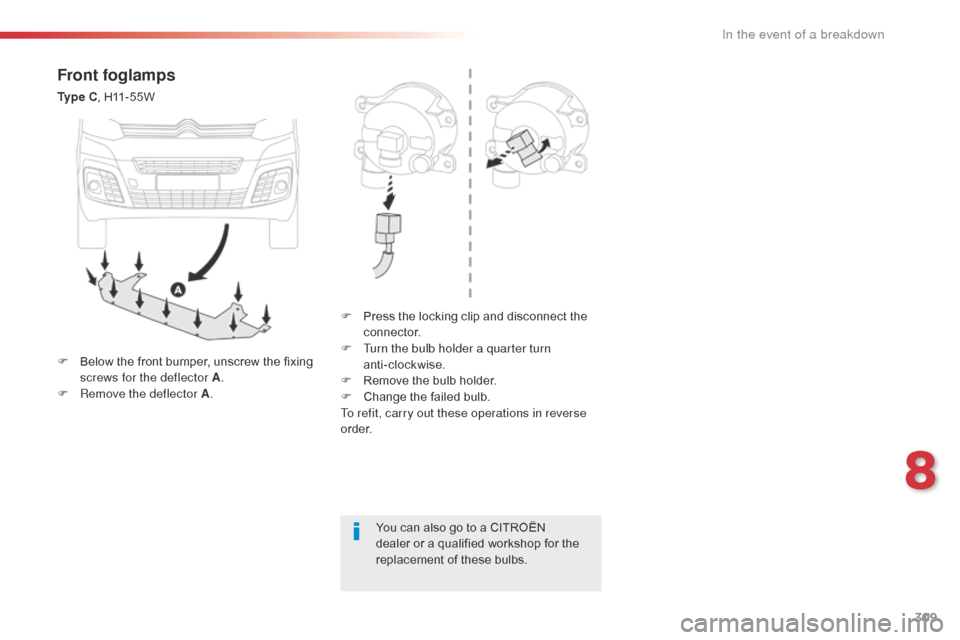
Front foglamps
Ty p e C, H11-55W
F
P
ress the locking clip and disconnect the
connector.
F
T
urn the bulb holder a quarter turn
anti-clockwise.
F
R
emove the bulb holder.
F
C
hange the failed bulb.
To refit, carry out these operations in reverse
o r d e r.
You can also go to a CITROËN
dealer or a qualified workshop for the
replacement of these bulbs.
F
B
elow the front bumper, unscrew the fixing
screws for the deflector A .
F
R
emove the deflector A .
8
In the event of a breakdown