heating CITROEN RELAY 2019 Handbook (in English)
[x] Cancel search | Manufacturer: CITROEN, Model Year: 2019, Model line: RELAY, Model: CITROEN RELAY 2019Pages: 232, PDF Size: 8.21 MB
Page 4 of 232
2
.
.
Instrument panels 7
W arning and indicator lamps 8
I
ndic ators
18
Vehicle configuration
2
2
Setting the date and time
2
8
Trip computer
2
8
Tachograph
2
9
Instruments and controls
4
C
entre console
4
K
ey
30
Remote control
3
0
Anti-intrusion security
3
3
Front doors
3
3
Sliding side door
3
3
Rear doors
3
4
Alarm
35
Electric windows
3
6
Driver's seat 3 7
2-seat front bench seat 3 9
Rear seats
4
0
Rear bench seats
4
0
Steering wheel adjustment
4
1
Mirrors
42
H
eating/Manual air conditioning
4
3
Automatic air conditioning
4
4
Additional heating systems
4
6
Rear heating and/or air conditioning
4
6
Programmable additional heating
4
7
Recommendations for ventilation and air
conditioning
5
0
Front demist – defrost
5
1
Defrosting the rear screen and
door mirrors
5
1
Cab layout
5
2
Rear fittings
5
7
Exterior fittings
6
0Lighting controls
6
1
LED daytime running lamps
6
2
Automatic illumination of headlamps
6
2
Guide-me-home lighting
6
2
Automatic headlamps
6
3
Parking lamps
6
4
Headlamp beam height adjustment
6
5
Wiper control stalk
6
5
General safety recommendations
6
7
Hazard warning lamps
6
8
Horn 68
Electronic stability control (ESC) 6 8
Seat belts
7
2
Airbags
75
Child seats
7
7
Deactivating the passenger's front airbag
7
8
ISOFIX mountings and child seats
8
3
Child lock
8
6
Over view
Dashboard instruments Access
Ease of use and comfort Safety
Lighting and visibility
Eco-driving
Contents
Page 6 of 232
4
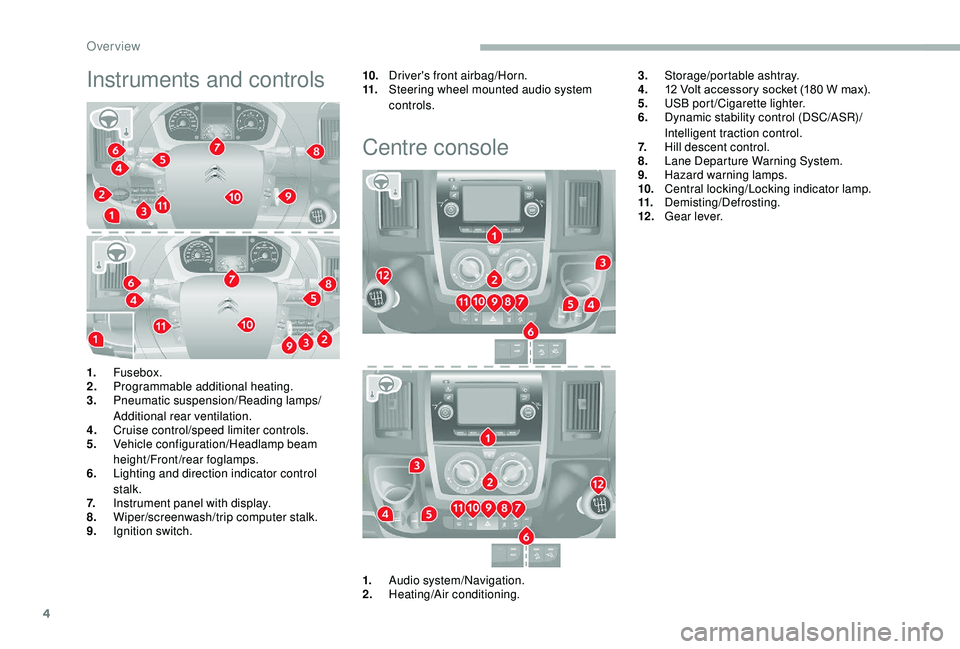
Instruments and controls10.Driver's front airbag/Horn.
11. Steering wheel mounted audio system
controls.
Centre console
3.Storage/portable ashtray.
4. 12
Volt accessory socket (180 W max).
5. USB port/Cigarette lighter.
6. Dynamic stability control (DSC/ASR)/
Intelligent traction control.
7. Hill descent control.
8. Lane Departure Warning System.
9. Hazard warning lamps.
10. Central locking/Locking indicator lamp.
11. Demisting/Defrosting.
12 . Gear lever.
1. Fusebox.
2. Programmable additional heating.
3. Pneumatic suspension/Reading lamps/
Additional rear ventilation.
4. Cruise control/speed limiter controls.
5. Vehicle configuration/Headlamp beam
height/Front/rear foglamps.
6. Lighting and direction indicator control
stalk.
7. Instrument panel with display.
8. Wiper/screenwash/trip computer stalk.
9. Ignition switch.
1.Audio system/Navigation.
2. Heating/Air conditioning.
Over view
Page 17 of 232
15
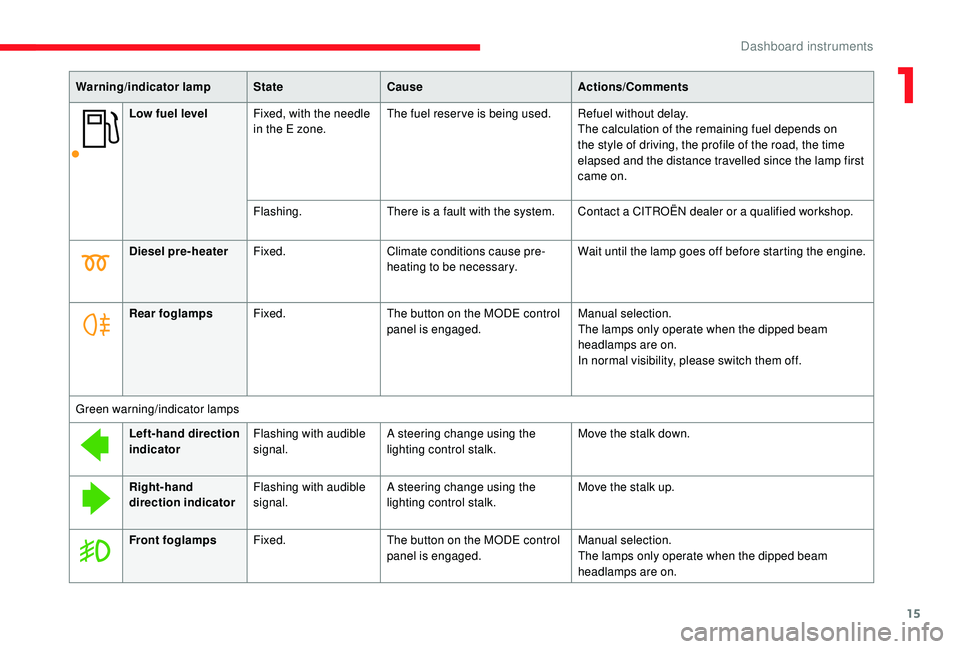
Low fuel levelFixed, with the needle
in the E zone. The fuel reserve is being used.
Refuel without delay.
The calculation of the remaining fuel depends on
the style of driving, the profile of the road, the time
elapsed and the distance travelled since the lamp first
came on.
Flashing. There is a
fault with the system. Contact a CITROËN dealer or a qualified workshop.
Warning/indicator lamp
StateCause Actions/Comments
Diesel pre-heater Fixed. Climate conditions cause pre-
heating to be necessary. Wait until the lamp goes off before starting the engine.
Rear foglamps Fixed. The button on the MODE control
panel is engaged. Manual selection.
The lamps only operate when the dipped beam
headlamps are on.
In normal visibility, please switch them off.
Green warning/indicator lamps Left-hand direction
indicator Flashing with audible
signal. A steering change using the
lighting control stalk. Move the stalk down.
Right-hand
direction indicator Flashing with audible
signal. A steering change using the
lighting control stalk. Move the stalk up.
Front foglamps Fixed. The button on the MODE control
panel is engaged. Manual selection.
The lamps only operate when the dipped beam
headlamps are on.
1
Dashboard instruments
Page 40 of 232

38
Adjustable armrestHeated seat
When the seat and passenger
compartment have reached an adequate
temperature, you can switch off the
function; reducing the consumption
of electrical current reduces fuel
consumption.
F
T
o remove the head restraint, press the tabs
and raise the head restraint.
F
Ra
ise or lower the armrest.
F
T
urn the wheel located under the end of the
armrest to lock it in the desired position. Use this control to switch the heating of the
seat on or off.
Do not use the function when the seat is
e m pt y.
Prolonged use is not recommended for
those with sensitive skin.
There is a
risk of burns for people whose
perception of heat is impaired (illness,
taking medication, etc.).
There is a risk of overheating the system if
material with insulating properties is used,
such as cushions or seat covers.
Do not use the system:
-
i
f wearing damp clothing,
-
i
f child seats are fitted.
To avoid breaking the heating element in
the seat:
- d o not place heavy objects on the seat,
-
d
o not kneel or stand on the seat,
-
d
o not place sharp objects on the seat,
-
d
o not spill liquids onto the seat.
To avoid the risk of short-circuit:
-
d
o not use liquid products for cleaning
the seat,
-
n
ever use the heating function when
the seat is damp.
Ease of use and comfort
Page 45 of 232
43
Heating/Manual air
conditioning
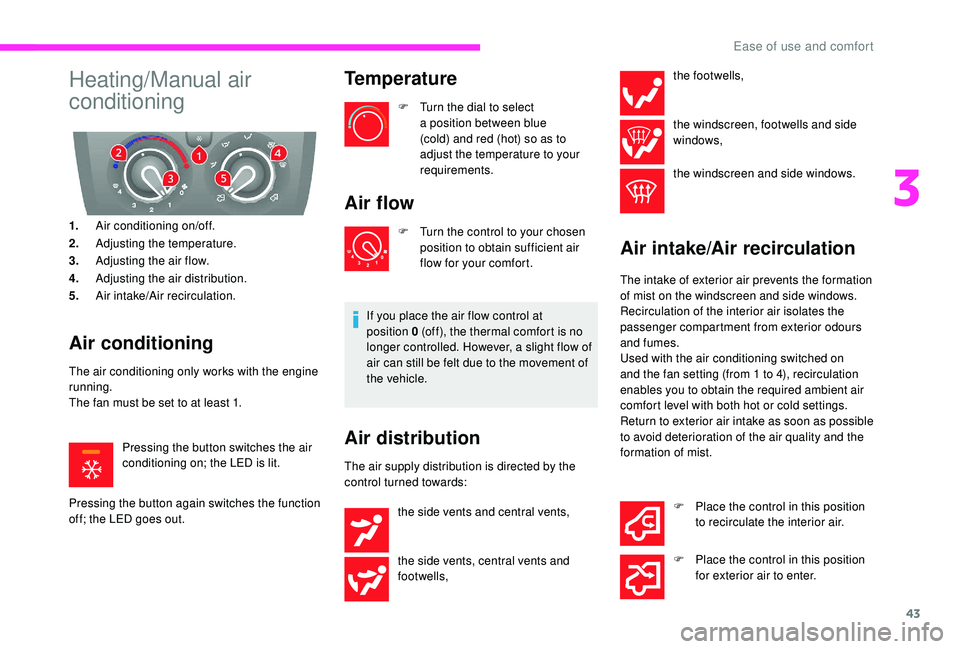
1.Air conditioning on/off.
2. Adjusting the temperature.
3. Adjusting the air flow.
4. Adjusting the air distribution.
5. Air intake/Air recirculation.
Air conditioning
The air conditioning only works with the engine
running.
The fan must be set to at least 1.
Pressing the button switches the air
conditioning on; the LED is lit.
Pressing the button again switches the function
off; the LED goes out.
Temperature
F Turn the dial to select a position between blue
(cold) and red (hot) so as to
adjust the temperature to your
requirements.
Air flow
F Turn the control to your chosen position to obtain sufficient air
flow for your comfort.
If you place the air flow control at
position 0 (off), the thermal comfort is no
longer controlled. However, a slight flow of
air can still be felt due to the movement of
the vehicle.
Air distribution
The air supply distribution is directed by the
control turned towards: the footwells,
the windscreen, footwells and side
windows,
the windscreen and side windows.
Air intake/Air recirculation
The intake of exterior air prevents the formation
of mist on the windscreen and side windows.
Recirculation of the interior air isolates the
passenger compartment from exterior odours
and fumes.
Used with the air conditioning switched on
and the fan setting (from 1
to 4), recirculation
enables you to obtain the required ambient air
comfort level with both hot or cold settings.
Return to exterior air intake as soon as possible
to avoid deterioration of the air quality and the
formation of mist.
the side vents and central vents,
the side vents, central vents and
footwells, F
P
lace the control in this position
to recirculate the interior air.
F
P
lace the control in this position
for exterior air to enter.
3
Ease of use and comfort
Page 48 of 232
46
Air outlet
Press this control to activate
extraction of air to the outside; the
LED comes on. Press again to
switch off.
Air intake
Pressing this control activates the
exterior air intake into the passenger
compartment; the LED comes on.
Press again to switch off.
Additional heating
systems
Additional heating
This is passenger compartment heating,
additional to the standard equipment.
It can operate independently of the engine.
Additional heater or
programmable additional
heating
This is an additional, programmable and
separate system which heats the Diesel engine
hot coolant loop to make starting easier.
It improves the demisting and defrosting
per formance and that of the heated seats, if
fitted to the vehicle.
Automatic additional
heating
This is an additional system which starts
automatically when the ignition is switched
on. Its activation depends on the exterior
temperature and the temperature inside the
vehicle.
It switches off automatically once the heating
system is started manually. The passenger compartment heating is brought
up to temperature more rapidly.
This system must be programmed to start up
before you enter the vehicle.
Supplementary heating
On the 2-3 seats model, this is located under
t he seat on the driver's side with air diffusion
directed forwards.
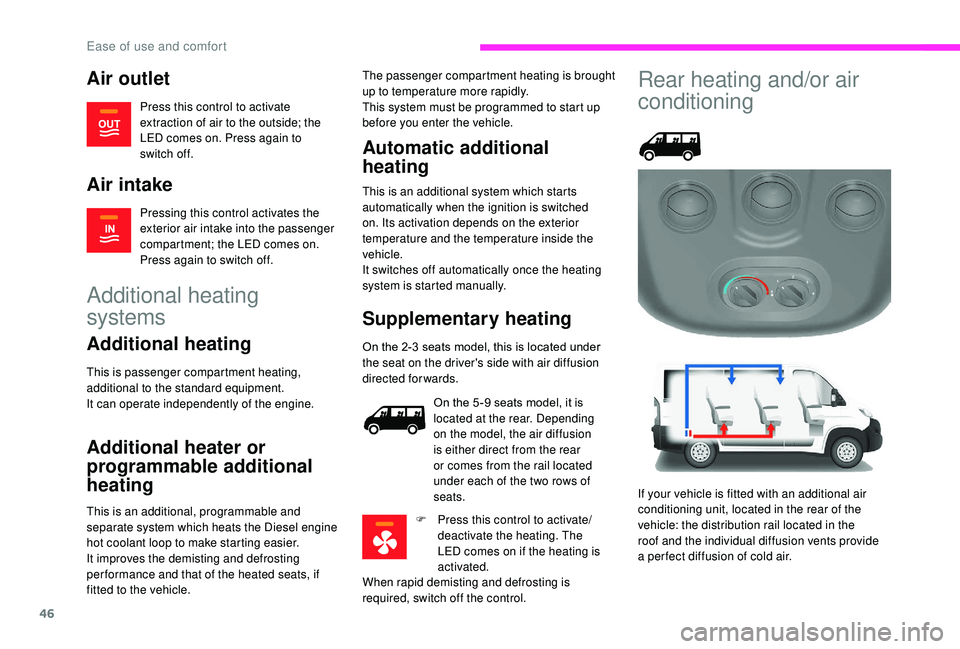
On the 5 -9
seats model, it is
located at the rear. Depending
on the model, the air diffusion
is either direct from the rear
or comes from the rail located
under each of the two rows of
seats.
F
P
ress this control to activate/
deactivate the heating. The
LED comes on if the heating is
activated.
When rapid demisting and defrosting is
required, switch off the control.
Rear heating and/or air
conditioning
If your vehicle is fitted with an additional air
conditioning unit, located in the rear of the
vehicle: the distribution rail located in the
roof and the individual diffusion vents provide
a
per fect diffusion of cold air.
Ease of use and comfort
Page 49 of 232
47
The warm air diffused at floor level from the
front air conditioning unit is distributed at the
feet of the rear passengers of rows 2 and 3.
A warm air diffusion vent, located on the rear
left wheel arch, can supplement the unit for the
feet of the rear passengers in row 3.
Activation/Deactivation
F From the driver's seat, press this button on the MODE control
panel to activate the operation
of the rear controls. The
indicator lamp comes on.
Air flow
F Turn the control to your chosen position to obtain sufficient air
flow for your comfort.
Comfort temperature
adjustment
F Turn the control to select a position between blue
(cold) and red (hot) so as to
adjust the temperature to your
requirements.
The OFF control on the "Single zone"
central control panel switches off the
function.
However, a safety device will ventilate the
rear circuit automatically, even if the control
is in position 0, to prevent condensation
forming.
Pressing this button again deactivates the rear
controls. The indicator lamp goes out.
Programmable additional
heating
This also facilitates passenger
compartment heating, demisting and
defrosting.
Digital programming
control
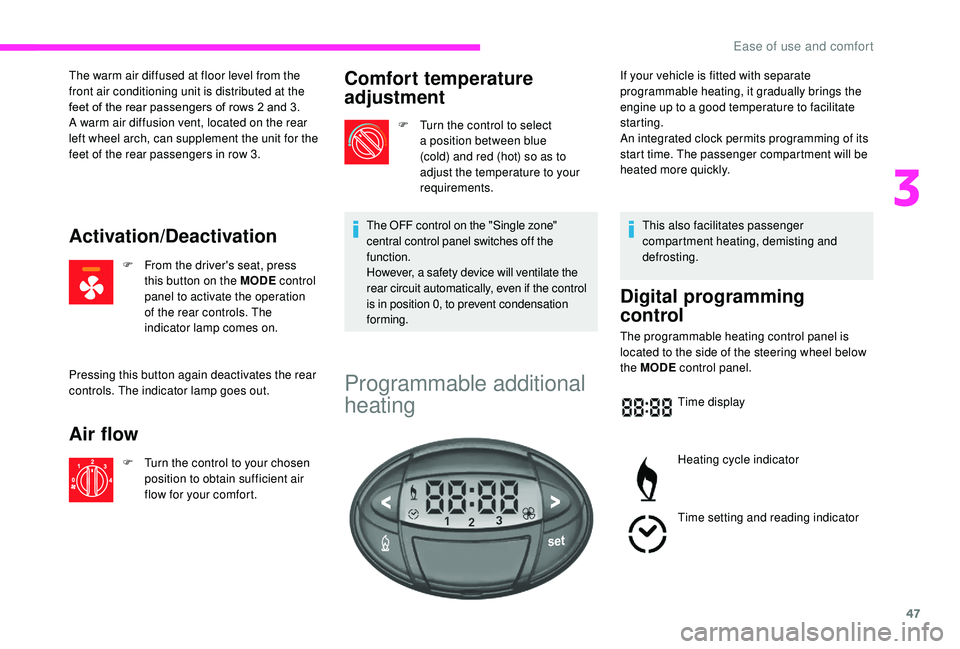
The programmable heating control panel is
located to the side of the steering wheel below
the MODE control panel.
Time display
Heating cycle indicator
Time setting and reading indicator
If your vehicle is fitted with separate
programmable heating, it gradually brings the
engine up to a
good temperature to facilitate
starting.
An integrated clock permits programming of its
start time. The passenger compartment will be
heated more quickly.
3
Ease of use and comfort
Page 50 of 232
48
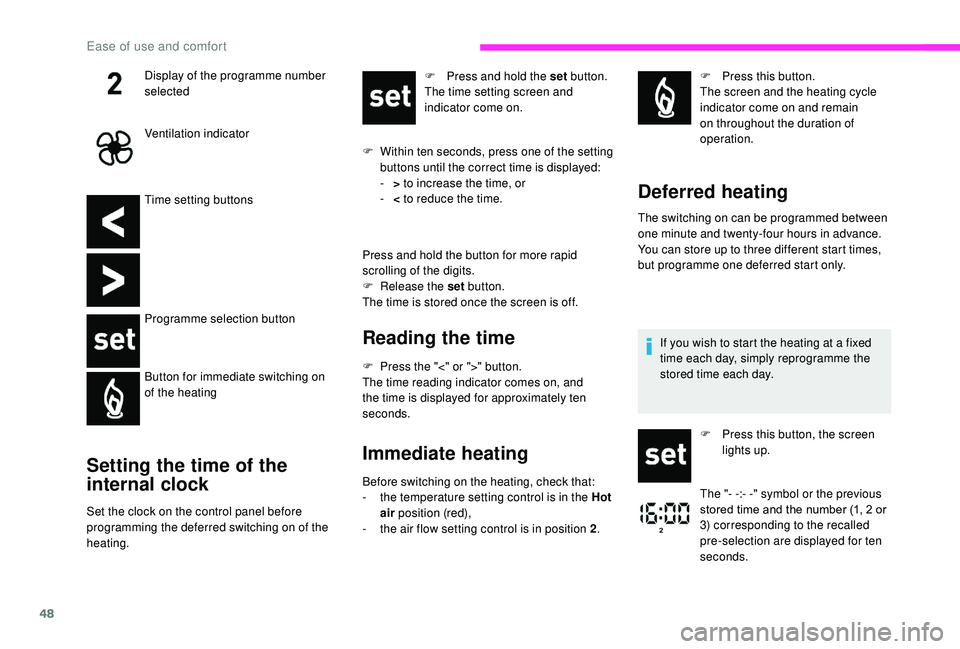
Time setting buttons
Programme selection button
Button for immediate switching on
of the heating
Setting the time of the
internal clock
Set the clock on the control panel before
programming the deferred switching on of the
heating.F
P
ress and hold the set button.
The time setting screen and
indicator come on.
F
W
ithin ten seconds, press one of the setting
buttons until the correct time is displayed:
-
>
to increase the time, or
-
<
to reduce the time.
Press and hold the button for more rapid
scrolling of the digits.
F
R
elease the set
button.
The time is stored once the screen is off.
Reading the time
F Press the "<" or ">" button.
The time reading indicator comes on, and
the time is displayed for approximately ten
seconds.
Immediate heating
Before switching on the heating, check that:
- t he temperature setting control is in the Hot
air position (red),
-
t
he air flow setting control is in position 2 .F
P
ress this button.
The screen and the heating cycle
indicator come on and remain
on throughout the duration of
operation.
Deferred heating
The switching on can be programmed between
one minute and twenty-four hours in advance.
You can store up to three different start times,
but programme one deferred start only.
Display of the programme number
selected
Ventilation indicator
If you wish to start the heating at a fixed
time each day, simply reprogramme the
stored time each day.
F
P
ress this button, the screen
lights up.
The "- -:- -" symbol or the previous
stored time and the number (1, 2
or
3) corresponding to the recalled
pre-selection are displayed for ten
seconds.
Ease of use and comfort
Page 51 of 232
49
By default, pre-selected times are already
stored in the system (1 = 06:00; 2 = 16:00;
3 = 22:00). Any modification cancels and
replaces the previous pre-selected time.
If the battery is disconnected, the default
pre-selected times are restored.
Cancelling the
programming
F Press this button briefly to clear the programmed start
time.
The screen illumination and the pre-selection
number (1, 2
or 3) go off.
Recalling one of the pre-
selected start times
F Press this button as many times as necessary until the
number corresponding to the
required pre-selected start
time (1, 2
or 3) appears.
After ten seconds, the time disappears but
remains stored while the corresponding
number (1, 2
or 3) and the screen remain on.
Setting the period of
operation
The period of operation can be set to between
10 and 60 minutes.
F
P
ress and hold this button. The programmed period of operation is
displayed and the heating or ventilation cycle
indicator flashes.
F
A
djust the period by pressing the "<" or ">"
button.
The setting is confirmed by the period
disappearing from the screen or by pressing
the set button again
In the case of deferred operation, the heating
stops at the end of the programmed period. F
I
n the case of immediate
operation, press this button
again to switch off manually.
The heating cycle indicator and the screen go
of f.
Have the additional heating checked
at least once a
year at the beginning of
winter. Maintenance and repairs should
only be carried out by a
CITROËN dealer
or a
qualified workshop.
Use only genuine replacement parts.
Stopping the heating
If you want to recall another preset time,
press the set button several times within
ten seconds. Within ten seconds, press
the "<" or ">" setting button to select the
required start time.
Setting of the stored time is confirmed by
clearing of the start time, display of the pre-
selection number (1, 2
or 3) and illumination of
the screen.
F
A
t the same time, press the "<" or ">"
button.
The time and the time setting indicator come
on.
F
P
ress and hold the set button again.
F
A
t the same time, press the "<" or ">" button
again.
3
Ease of use and comfort
Page 52 of 232
50
To avoid the risks of poisoning or
asphyxia, the additional heating must
not be used, even for short periods, in
a closed environment such as a garage or
workshop which are not equipped with an
exhaust gas extraction system.
The additional heating switches off when
the battery voltage is low, so as to allow
engine starting.
The additional heating is fed by the
vehicle's fuel tank. Ensure that the low fuel
warning lamp is not on.
Always switch off the additional heating
when refuelling to avoid any risk of fire or
explosion!
The temperature near the heating
system must not exceed 120°C. A higher
temperature (e.g. when baking the
paint) could damage the components of
electronic circuits.
The additional heating is fitted with
a
temperature limiter which cuts off
the combustion in the event of engine
overheating due to a
lack of coolant.
Check the level and top up if necessary.
For more information on Checking levels ,
refer to the corresponding section.
Then press the programme selection
button before switching the heating on
again.Recommendations for ventilation and air conditioning
In order for these systems to be fully effective,
follow the operation and maintenance
guidelines below:
F
T
o ensure that the air is distributed evenly,
keep the external air intake grilles at the
base of the windscreen, the nozzles, the
vents, the air outlets and the air extractor
in the boot free from obstructions.
F
D
o not cover the sunshine sensor,
located on the dashboard; this is used for
regulation of the automatic air conditioning
system.
F
O
perate the air conditioning system for
at least 5
to 10 minutes once or twice
a
month to keep it in per fect working order.
F
E
nsure that the passenger compartment
filter is in good condition and replace
the filter elements periodically. We
recommend the use of a
combined
passenger compartment filter. Thanks to
its special active additive, it helps both to
purify the air breathed by the occupants
and to keep the passenger compartment
clean (reduction of allergic symptoms, bad
odours and greasy deposits). F
T o ensure correct operation of the
air conditioning system, you are also
advised to have it checked regularly as
recommended in the Maintenance and
Warranty Guide.
F
I
f the system does not produce cold air,
switch it off and contact a
CITROËN
dealer or a
qualified workshop.
When towing the maximum load on a
steep
gradient in high temperatures, switching off
the air conditioning increases the available
engine power and so improves the towing
ability.
To avoid the windows misting up and
deterioration in the quality of the air:
-
d
o not drive for too long with the
ventilation switched off.
-
d
o not keep air recirculation set for an
extended period.
Ease of use and comfort