seats CITROEN RELAY 2020 Handbook (in English)
[x] Cancel search | Manufacturer: CITROEN, Model Year: 2020, Model line: RELAY, Model: CITROEN RELAY 2020Pages: 196, PDF Size: 34.07 MB
Page 59 of 196

57
Safety
5Airbags
The airbags have been designed to optimise the
safety of the occupants in the event of a serious
collision; they work in conjunction with the force
limiting seat belts.
In the event of a serious collision, electronic
detectors record and analyse any abrupt
deceleration of the vehicle:
– if there is a violent impact, the airbags deploy
instantly and help better protect occupants of the
vehicle; immediately after the impact, the airbags
deflate rapidly in order not to hinder the visibility
or the possible exit of the occupants.
– in the case of a minor or rear impact or in
certain rollover conditions, the airbags are not
deployed; the seat belt alone contributes towards
ensuring your protection in these situations.
The airbags do not operate when the
engine is not running.
This equipment will only deploy once. If a
second impact occurs (during the same or a
subsequent accident), the airbag will not be
deployed again.
Deployment of the airbags is
accompanied by a slight discharge of
smoke and a noise, resulting from activation
of the pyrotechnic charge incorporated in the
system.
Although this smoke is not harmful, sensitive
individuals may experience slight irritation.
The noise of the detonation may result in a
slight loss of hearing for a short time.
Front airbags
System that protects the driver and front
passenger(s) in the event of a serious front
impact, in order to limit the risk of head and
chest injury.
The driver's airbag is fitted in the centre of the
steering wheel; the front passenger(s) airbag is
fitted in the dashboard above the glove box.
Lateral airbags and curtain
airbags
If fitted to your vehicle, the lateral airbags are
built into the backrests of the front seats, on the
side by the door.
The curtain airbags are built into the pillars and
the upper passenger compartment area, in the
roof above the front seats.
They inflate between the occupant and the
window.
They deploy on one side only (the side where
the collision occurs).
Malfunction
If this warning lamp comes on, contact a
CITROËN dealer to have the system
checked.
Advice
For the airbags to be fully effective,
observe the safety recommendations
below.
Adopt a normal upright sitting position.
Fasten the seat belt ensuring it is correctly
positioned and adjusted.
Do not leave anything between the occupants
and the airbags (a child, pet, object, etc.), nor
fix or attach anything close to or in the way of
the airbag release trajectory; this could cause
injuries during their deployment.
Never modify the original definition of your
vehicle, particularly in the area directly around
the airbags.
After an accident or if the vehicle has been
stolen, have the airbag systems checked.
All work on the airbag systems must only
be performed by a CITROËN dealer or a
qualified workshop.
Even if all of the precautions mentioned
are observed, a risk of injury or of minor
burns to the head, chest or arms cannot be
ruled out when an airbag is deployed. The
airbag inflates almost instantly (within a few
milliseconds) then deflates within the same
Page 60 of 196

58
Safety
Installing a booster seat
The chest part of the seat belt must be
positioned on the child's shoulder without
touching the neck.
Ensure that the lap part of the seat belt
passes correctly over the child's thighs.
Use a booster seat with backrest, equipped
with a belt guide at shoulder level.
Additional protections
To prevent accidental opening of the
doors and rear windows, use the "Child lock".
Take care not to open the rear windows by
more than one third.
To protect young children from the rays of the
sun, fit side blinds on the rear windows.
As a safety precaution, do not leave:
– a child alone and unattended in a vehicle,
– a child or an animal in a vehicle which is
exposed to the sun, with the windows closed,
– the keys within reach of children inside the
vehicle.
Child seat at the rear
time discharging the hot gas via openings
provided for this purpose.
Front airbags
Do not drive holding the steering wheel
by its spokes or resting your hands on the
centre part of the wheel.
Passengers must not place their feet on the
dashboard.
Do not smoke as deployment of the airbags
can cause burns or the risk of injury from a
cigarette or pipe.
Never remove or pierce the steering wheel or
hit it violently.
Do not fix or attach anything to the steering
wheel or dashboard, as this could cause
injuries when the airbags are deployed.
Lateral airbags
Use only approved covers on the seats,
compatible with the deployment of the lateral
airbags. For information on the range of seat
covers suitable for your vehicle, contact a
CITROËN dealer.
Do not fix or attach anything to the seat
backrests (clothes, etc.), as this could cause
injuries to the thorax or arm when the lateral
airbag is deployed.
Do not sit with the upper part of the body any
nearer to the door than necessary.
Curtain airbags
Do not fix or attach anything to the roof,
as this could cause head injuries when the
curtain airbag is deployed.
Do not remove the grab handles installed on
the roof, as they play a part in securing the
curtain airbags.
Child seats
The regulations on carrying children are specific to each country. Refer to the
legislation in force in your country.
For maximum safety, please observe the
following recommendations:
– In accordance with European regulations, all
children under the age of 12 or less than 4
ft 11” (150 cm) tall must travel in approved
child seats suited to their weight , on seats
fitted with a seat belt or ISOFIX mountings.
– Statistically, the safest seats in your
vehicle for carrying children are the rear
seats.
– Children weighing less than 9 kg must
travel in the "rear facing" position, whether in
the front or rear of the vehicle.
It is recommended that children travel
on the rear seats of the vehicle:
– ‘rear facing’ up to the age of 3,
– ‘forward facing’ over the age of 3.
Make sure that the seat belt is correctly
positioned and tightened.
For child seats with a support leg, ensure that
the support leg is in firm and steady contact
with the floor.
Advice
An incorrectly installed child seat compromises the child's safety in the
event of an accident.
Ensure that there is no seat belt or seat belt
buckle under the child seat, as this could
destabilise it.
Remember to fasten the seat belts or the
harness of child seats, keeping the slack
relative to the child's body to a minimum,
even for short journeys.
When installing a child seat using the seat
belt, ensure that the seat belt is tightened
correctly on the child seat and that it secures
the child seat firmly on the seat of the vehicle.
If the passenger seat is adjustable, move it
forwards if necessary.
Remove the head restraint before
installing a child seat with a backrest on a
passenger seat.
Ensure that the head restraint is stored or
attached securely to prevent it from being
thrown around the vehicle in the event of
sharp braking. Refit the head restraint once
the child seat has been removed.
Page 62 of 196

60
Safety
"ISOFIX" mountings
If fitted on the vehicle, the regulation ISOFIX
mountings are identified by labels.
The mountings comprise three rings for each
seat:
Deactivating the front
passenger airbag
Passenger airbag OFF
To guarantee the safety of your child, the
front passenger airbag must be
deactivated when a "rear facing" child seat is
installed on the front passenger seat.
Otherwise, the child risks being seriously
injured or killed if the airbag is deployed.
Vehicles not equipped with a
deactivation control
Installing a “rear facing” child seat on the front
passenger seat or bench seat is expressly
prohibited! Doing so would expose the child to
the risk of death or serious injury in the event
of airbag deployment.
Deactivating / Reactivating the front
passenger airbag
► Press this button and then, in the
"Passenger airbag" menu, select "OFF" to
deactivate the airbag.
► Select “ON” to reactivate it.When the ignition is switched on, this
warning lamp comes on accompanied by
a message in the display screen to indicate the
deactivation.
For more information on Vehicle
configuration (MODE) , refer to the
corresponding section.
Depending on version, it can also be deactivated
or reactivated via the touch screen audio and
telematics system.
Locations for child seats secured using the seat belt
In accordance with European regulations, this table indicates the options for installing child seats secured using a seat belt and universally approved
according to the weight of the child and the seating position in the vehicle.
Page 63 of 196

61
Safety
5SeatWeight of the child and indicative age
Under 13 kg
(groups 0 (a) and
0+)
Up to about 1 year
old From 9 to 18 kg
(group 1)
From about 1 to 3
years old From 15 to 25 kg
(group 2)
From about 3 to 6
years old From 22 to 36 kg
(group 3)
From about 6 to 10
years old
Front passenger seat (b) U
Front passenger bench seat with central and side seats (b)
Central and side seats in row 2 and 3
(a) Group 0: from birth to 10 kg.
(b) Refer to the current legislation before installing your child on this se\
at.
U Seat suitable for the installation of a child seat secured using a seat belt and universally approved, "rearward facing" and/or "forward facing".
"ISOFIX" mountings
If fitted on the vehicle, the regulation ISOFIX
mountings are identified by labels.
The mountings comprise three rings for each
seat:
– two front rings, located between the vehicle
seat backrest and cushion.
– one rear ring, to fix the upper strap referred to
as the TOP TETHER.
This ISOFIX mounting system provides fast,
reliable and safe fitting of the child seat in the
vehicle.
Page 64 of 196

62
Safety
Child lock
It prevents the opening of the sliding side door
from inside.
The ISOFIX child seats are fitted with two
latches which are secured on the two front rings.
Some also have an upper strap which is
attached to the rear ring.
To fasten this strap, remove and stow the head
restraint before installing the child seat on this seat (refit it once the child seat has been
removed). Then, attach the hook to the rear ring
and tighten the upper strap.An incorrectly installed child seat compromises the child's safety in the
event of an accident.
To find out how to install ISOFIX child seats in
the vehicle, refer to the summary table for the
location of ISOFIX child seats.
Summary table of locations for ISOFIX child seats
In accordance with European regulations, this table shows the options for installing ISOFIX child seats on vehicle seats fitted with ISOFIX mountings.
In the case of the universal and semi-universal ISOFIX child seats, the child seat's ISOFIX size category , designated by a letter from A to G, is indicated
on the child seat next to the ISOFIX logo.
Under 10 kg
(group 0)
Up to about 6 months
old Under 10 kg
(group 0)
Under 13 kg (group 0+)
Up to about 1 year old From 9 to 18 kg
(group 1)
From about 1 to 3 years old
Type of ISOFIX
child seat Carrycot
"rearward facing" "forward facing"
ISOFIX size
category F
G CD EC DA B1
Row 2 rear
side seats with
individual seats in
Row 1
IUF IUF IUF
Page 65 of 196

63
Safety
5Under 10 kg
(group 0)
Up to about 6 months
old Under 10 kg
(group 0)
Under 13 kg (group 0+)
Up to about 1 year old From 9 to 18 kg
(group 1)
From about 1 to 3 years old
Type of ISOFIX
child seat Carrycot
"rearward facing" "forward facing"
ISOFIX size
category F
G CD EC DA B1
Row 2 rear side
seats with 2-seat
bench seat in
Row 1
IUF XIUF X IUF
IUF Seat suitable for the installation of a universal ISOFIX child seat. “Forward facing” ISOFIX child seats equipped with an upper strap attached to the
upper ring of the vehicle’s ISOFIX seats.
X Seat which is not suitable for the installation of an ISOFIX child seat of the size category indicated.
Child lock
It prevents the opening of the sliding side door
from inside.
► Press the control located on the edge of the
side door.
Page 120 of 196
11 8
In the event of a breakdown
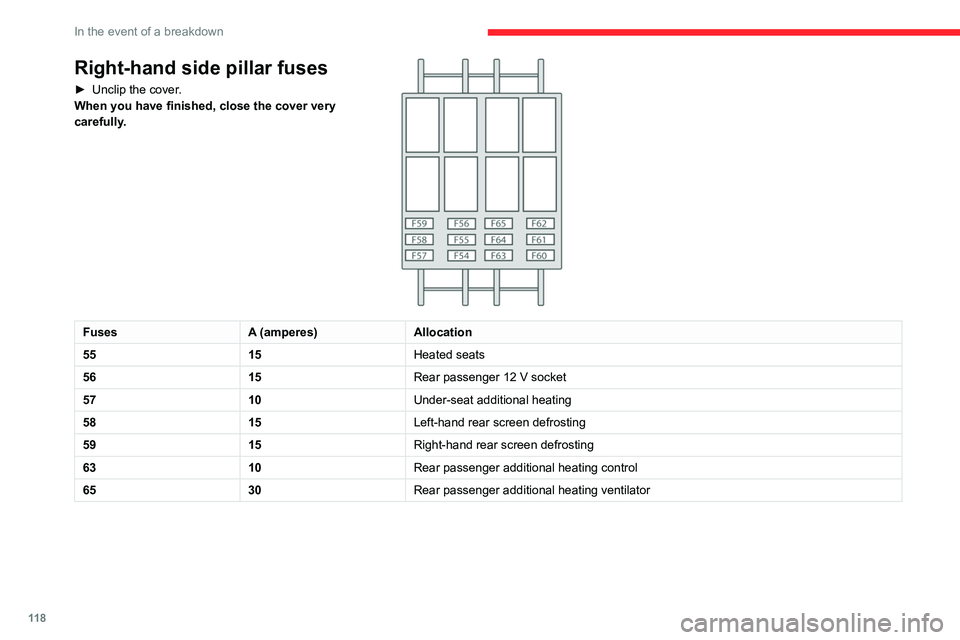
Right-hand side pillar fuses
► Unclip the cover.
When you have finished, close the cover very
carefully.
Fuses A (amperes)Allocation
55 15Heated seats
56 15Rear passenger 12 V socket
57 10Under-seat additional heating
58 15Left-hand rear screen defrosting
59 15Right-hand rear screen defrosting
63 10Rear passenger additional heating control
65 30Rear passenger additional heating ventilator
Engine compartment fuses
► Remove the nuts and tilt the casing to access
the fuses.
When you have finished, close the cover very
carefully.
Page 138 of 196

136
Special features
Crew cab
The crew cab, available on van
versions, consists of a bench
seat, seat belts, a storage
compartment and side windows.
It is separated from the loading area by a high-
resistance partition providing comfort and safety.
Rear bench seat
This ergonomic bench seat has four seats.
Storage space
A storage space is available under the bench
seat.
From the cab, tilt the seat cushion forwards to
access it.
Do not tilt the bench seat cushion during
transport.
Do not attach anything to the cab fixing
structure.
Do not exceed the number of passengers
indicated on the registration certificate.
In the rear, the loading area is intended
for carrying goods only.
You are advised to place the goods or heavy
objects as far forwards as possible in the
loading area (towards the cab) and to secure
them by means of straps using the stowing
rings on the floor.
Child seats
Do not install child seats, booster
cushions or carry-cots on the rear seats
of the cab.
Chassis cab / Flatbed cab
The chassis cab and flatbed
cab versions are equipped with
a cab, fixed flatbed and specific
rear lamps.
These versions are also available with other
equipment:
– a double cab,
– a tipper truck.
For more information on all of its
equipment, refer to the corresponding
section.
Changing a bulb
For more information on Types of bulbs,
refer to the corresponding section.
Rear lamps
1. Direction indicators
Type B, PY21W - 21W
2. Brake lamps
Type B, P21W - 21W
3. Sidelamps
Type A, W5W - 5W
4. Reversing lamps
Type A, W16W - 16W
5. Foglamps
Type A, W16W - 16W
► Locate the faulty bulb.
Page 144 of 196
142
Special features
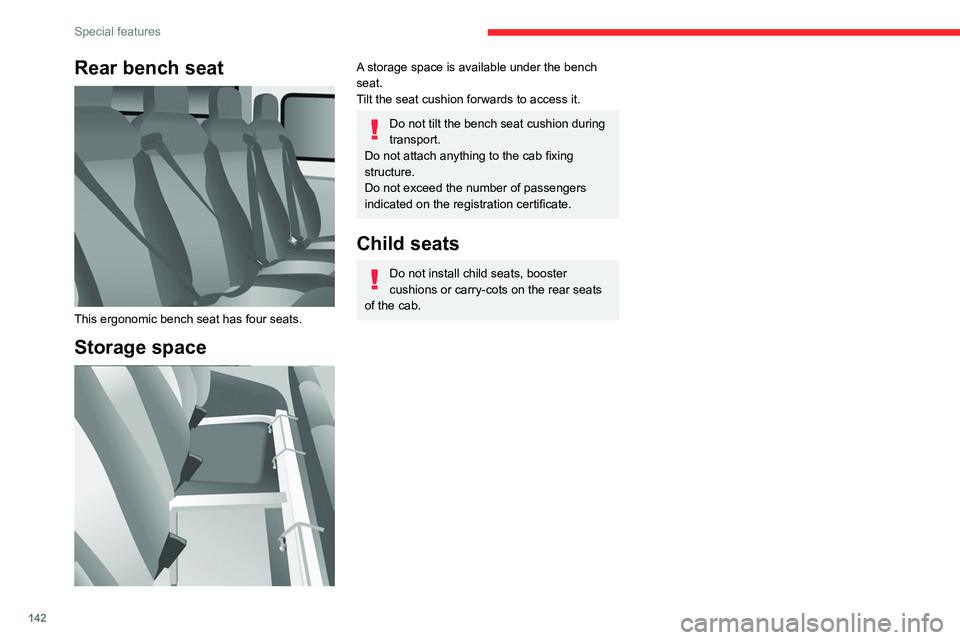
Rear bench seat
This ergonomic bench seat has four seats.
Storage space
A storage space is available under the bench
seat.
Tilt the seat cushion forwards to access it.
Do not tilt the bench seat cushion during
transport.
Do not attach anything to the cab fixing
structure.
Do not exceed the number of passengers
indicated on the registration certificate.
Child seats
Do not install child seats, booster
cushions or carry-cots on the rear seats
of the cab.
Double chassis cab/double platform cab dimensions
Dimension values are given in millimetres.
Page 178 of 196
176
Alphabetical index
A
ABS 52
Accessories 51
Active Safety Brake 84, 86
AdBlue® 101
AdBlue® tank 102
Adjusting the date 18
Adjusting the seat angle 27
Adjusting the seat belt height 55
Adjusting the time 18
Advice on driving 5, 64–65
Airbags 57–59
Airbags, curtain 58
Airbags, front 57–58
Airbags, lateral 58
Air conditioning 31, 35–36
Air conditioning, additional 35–36
Air conditioning, automatic 33
Air conditioning, manual 32–33
Air vents 31
Alarm 24–25
Anti-lock braking system (ABS) 52
Armrest, front 28
ASR 52
Assistance, emergency braking 52, 86
Audible warning 51
Audio streaming (Bluetooth) 162–163
Audio system 151
B
Battery 67, 120
Battery, 12 V 98, 120
Blind spot sensors 83
BlueHDi 12, 98
Bluetooth (hands-free) 154, 166–167
Bluetooth (telephone) 154, 166–167
Bonnet 94
Brake discs 99–100
Brakes 99–100
Braking, automatic emergency 84, 86
Brightness 6
Bulbs (changing) 111
Bulbs (changing, type) 111
C
Cable, audio 153, 162
Cable, Jack 153, 162
Capacity, fuel tank 90
CD 162
CD, MP3 162
Centre console 4
Changing a bulb 111
Checking the levels 96–98
Checks 98–100
Checks, routine 98–100
Children 56
Child seats 56, 58–59
Cigar lighter 43
Collision Risk Alert 84–85
Configuration, vehicle 13, 18
Container, AdBlue® 101–102
Control, heated seats 28
Control stalk, lighting 46
Control stalk, wipers 49
Courtesy lamp, front 38–40, 42
Courtesy lamp, rear 43
Courtesy lamps 43
Cruise control 78–80
D
DAB (Digital Audio Broadcasting) -
Digital radio 161
Dashboard 4
Daytime running lamps 46
Daytime running lamps, LED 46
Deactivating the passenger airbag 57, 59
Dimensions 129
Dipstick 96
Direction indicators 46
Display screen, instrument panel 6, 69
Driving 64–65
Driving abroad 46
Driving aids camera (warnings) 74
Driving aids (recommendations) 73
Driving economically 5
DSC 52
Dynamic stability control (DSC) 52–53