ECU DACIA DUSTER 2010 1.G Owner's Manual
[x] Cancel search | Manufacturer: DACIA, Model Year: 2010, Model line: DUSTER, Model: DACIA DUSTER 2010 1.GPages: 200, PDF Size: 7.12 MB
Page 75 of 200

ENG_NU_898-5_H79_Dacia_2
Driving
– Drive carefully for the first few miles
u")
JauneNoirNoir texte
2.7
ENG_UD22435_3
Conseils : antipollution, économies de carburant, conduite (H79 - Da\
cia)
ENG_NU_898-5_H79_Dacia_2
Driving
– Drive carefully for the first few miles
until the engine reaches its normal
operating temperature, rather than
let it warm up while the vehicle is sta-
tionary.
– Speed is expensive.
– Sporty driving uses a lot of fuel: drive
with a light right foot.
– Brake as little as possible. If you an-
ticipate an obstacle or bend in ad -
vance, you may then simply release
the accelerator pedal.
– Avoid sudden acceleration.
ADVICE: antipollution, fuel economy and driving (2/3)
– Double declutching and accelerating
before switching off are unnecessary
in modern vehicles.
– Do not try to maintain the same
speed up a hill, accelerate no more
than you would on the level. Keep
your foot in the same position on the
accelerator pedal.
– Do not overrev the engine in the in-
termediate gears. Always use the
highest gear possible without labour-
ing the engine.
On versions with an automatic gear-
box, it is preferable to keep the gear
lever in position D.
Your vehicle has a greater
ground clearance than an
ordinary passenger vehicle.
This gives it a higher centre
of gravity, making it more suscepti-
ble to rolling during sudden or ag -
gressive manoeuvres, or when cor-
nering at high speeds.
Take extra care when the vehicle is
loaded (in particular when the load
is on the roof).
Ensure that all passengers are
wearing their seat belts.
A label affixed to the sun visor re -
minds you of this.
Vehicles with 4x4 (4WD) trans -
mission
On flat, level ground, with the vehi-
cle unladen, you are recommended
to start in second gear.
Driving problems
On the driver ’s side, only
use mats specially adapted
for the vehicle and attached
to prefitted devices. Check regularly
to make sure they are secure. Do
not overlay several mats.
Risk of pedals jamming .
Page 109 of 200
rear bench seat..................................... (up to the end of the DU)
rear seats functions ......................................... (up to the end of the DU)
3.19
ENG_UD24693_4
Banquette arrière (H79 - Dacia)
ENG_NU_898-5_H79_Dacia_3
Rear bench seat
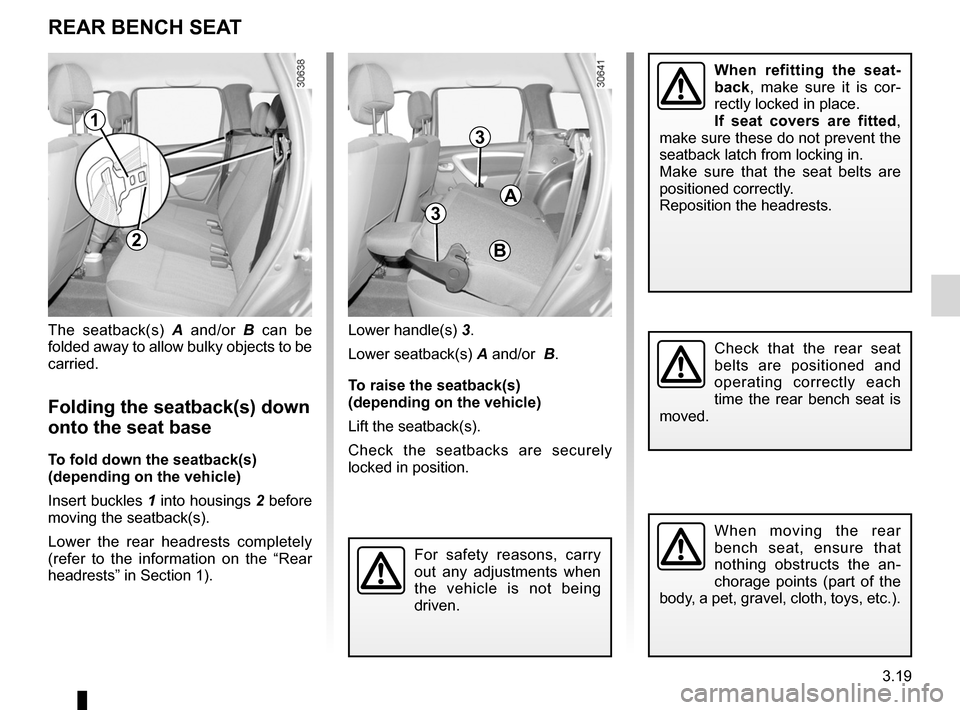
The seatback(s) A and/or B can be
folded away to allow bulky objects to be
carried.
Folding the seatback(s) down
onto the seat base
To fold down the seatback(s)
(depending on the vehicle)
Insert buckles 1 into housings 2 before
moving the seatback(s).
Lower the rear headrests completely
(refer to the information on the “Rear
headrests” in Section 1).
For safety reasons, carry
out any adjustments when
the vehicle is not being
driven.
REAR BENCH SEAT
Lower handle(s) 3.
Lower seatback(s) A and/or B.
To raise the seatback(s)
(depending on the vehicle)
Lift the seatback(s).
Check the seatbacks are securely
locked in position.
When moving the rear
bench seat, ensure that
nothing obstructs the an -
chorage points (part of the
body, a pet, gravel, cloth, toys, etc.).
When refitting the seat -
back , make sure it is cor -
rectly locked in place.
If seat covers are fitted ,
make sure these do not prevent the
seatback latch from locking in.
Make sure that the seat belts are
positioned correctly.
Reposition the headrests.
A
B
3
3
Check that the rear seat
belts are positioned and
operating correctly each
time the rear bench seat is
moved.
1
2
Page 120 of 200
4.6
ENG_UD22463_5
Niveau huile moteur : appoint / remplissage (H79 - Dacia)
ENG_NU_898-5_H79_Dacia_4
ENGINE OIL LEVEL: topping up/filling (2/2)
Oil change
S e r v i c e i n t e r v a l : r e f e r t o t h e
Maintenance Service Booklet for your
vehicle.
Average capacities for oil change oil
filter included.
(for information)
1.6 16V engine: 4.80 litres
Engine2.0 16V : 5.40 litres
1.5 dCi engine: 4.50 litres
Engine oil grade
Refer to the Maintenance Service
Booklet for your vehicle.
Filling: take care when
topping up the oil that
no oil drips onto engine
components - risk of fire.
Remember to refit the cap securely
as there is a risk of fire if oil splashes
onto hot engine components.
Engine oil change: if you
are changing the oil when
the engine is hot, be careful
not to scald yourself if the
oil overflows.
Never run the engine in an
enclosed space as exhaust
gases are poisonous.
The engine may be hot
during operations in close
proximity. In addition, the
engine cooling fan may
come on at any moment.
Risk of injury.
If there is an abnormal or repeated
drop in the fluid level, please consult
an authorised dealer.
Resetting the alert after an oil
change
(depending on the vehicle)
If you change the oil yourself, you will
need to reset the oil change warning.
To do this, after switching on the igni -
tion, for ten seconds you must:
– Depress the accelerator pedal fully,
– with your foot on the accelerator, de-
press the brake pedal three times in
succession.
Reinitialisation is complete when the
# indicator light goes out. If this is
not the case, repeat the operation.
Special case : if you change the oil
before the oil change interval exceeded
warning is displayed, it will also be nec-
essary to reset the display. In this case,
the
# warning light comes on for
approximately 5 seconds to confirm the
reset.
Page 131 of 200

ENG_NU_898-5_H79_Dacia_4
Removing/refitting factory
fitted remov")
JauneNoirNoir texte
4.17
ENG_UD22288_6
Entretien des garnitures intérieures (B90 - U90 - L90 Ph2 - F90 Ph2 \
- R90 Ph2 - H79 - Dacia)
ENG_NU_898-5_H79_Dacia_4
Removing/refitting factory
fitted removable equipment
in the vehicle
If you need to remove equipment to
clean the passenger compartment (e.g.
mats), always make you refit it properly
and on the correct side (driver’s side
mats must be fitted on the driver’s side,
etc.), using retaining components sup-
plied with the equipment (e.g. the driv-
er’s side mat must always be secured
using prefitted retaining devices).
In all cases, with the vehicle stationary,
ensure that nothing can hinder driving
(obstacle underneath the pedals, heel
trapped by the mat, etc.).
What you should not do
You are strongly advised not to place
items such as air fresheners, perfume
etc. near the air vents as these could
damage the dashboard fittings.
INTERIOR TRIM MAINTENANCE (2/2)
You are strongly recom -
mended not to use high -
pressure or spray cleaning
equipment inside the pas -
senger compartment: this equip -
ment could impair the correct func-
tioning of the electrical or electronic
components in the vehicle, or have
other detrimental effects.
Page 134 of 200
practical advice ..................................... (up to the end of the DU)
jack ....................................................... (up to the end of the DU)
lifting the vehicle changing a wheel ............................ (up to the end of the DU)
wheelbrace ............................................................ (current page)
hubcap tool ............................................................ (current page)
5.2
ENG_UD20543_3
Outils (H79 - Dacia)
ENG_NU_898-5_H79_Dacia_5
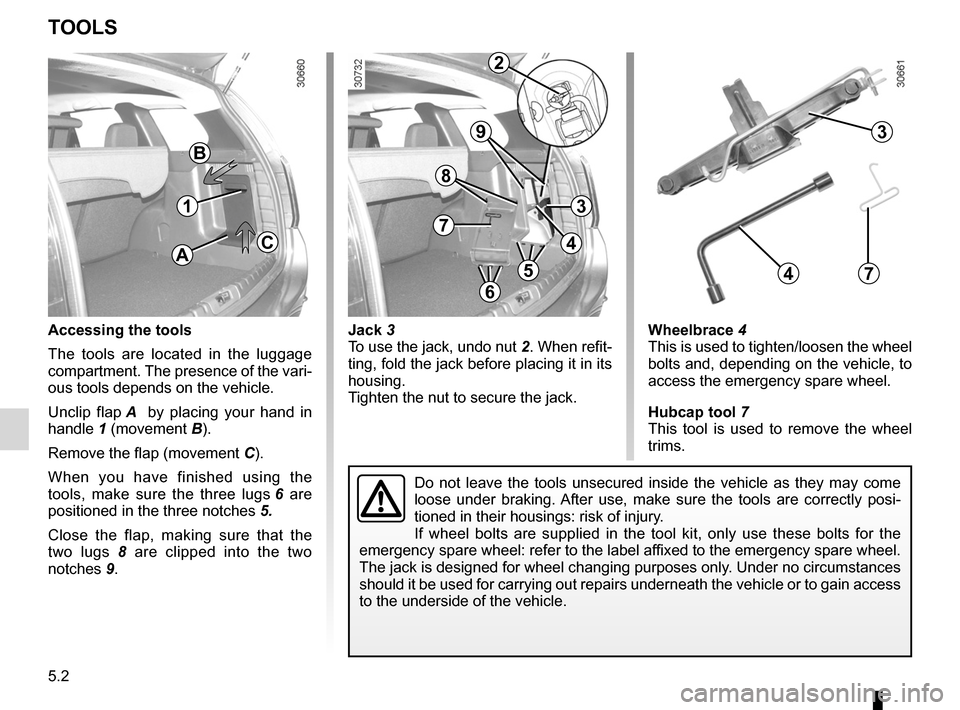
Jack 3
To use the jack, undo nut 2. When refit-
ting, fold the jack before placing it in its
housing.
Tighten the nut to secure the jack.
Tools
TOOLS
Accessing the tools
The tools are located in the luggage
compartment. The presence of the vari-
ous tools depends on the vehicle.
Unclip flap A by placing your hand in
handle 1 (movement B).
Remove the flap (movement C).
When you have finished using the
tools, make sure the three lugs 6 are
positioned in the three notches 5.
Close the flap, making sure that the
two lugs 8 are clipped into the two
notches 9. Wheelbrace 4
This is used to tighten/loosen the wheel
bolts and, depending on the vehicle, to
access the emergency spare wheel.
Hubcap tool
7
This tool is used to remove the wheel
trims.
3
74
Do not leave the tools unsecured inside the vehicle as they may come
loose under braking. After use, make sure the tools are correctly posi -
tioned in their housings: risk of injury.
If wheel bolts are supplied in the tool kit, only use these bolts for the
emergency spare wheel: refer to the label affixed to the emergency spare wheel.
The jack is designed for wheel changing purposes only. Under no circumstances
should it be used for carrying out repairs underneath the vehicle or to gain access
to the underside of the vehicle.
B
AC
1
9
8
7
6
5
4
3
2
Page 139 of 200
JauneNoirNoir texte
5.7
ENG_UD22629_3
Kit de gonflage des pneumatiques (H79 - Dacia)
ENG_NU_898-5_H79_Dacia_5
TYRE INFLATION KIT (3/3)
Once the tyre is inflated correctly:
– stop using the kit;
– close the integrated cap on the bottle
again;
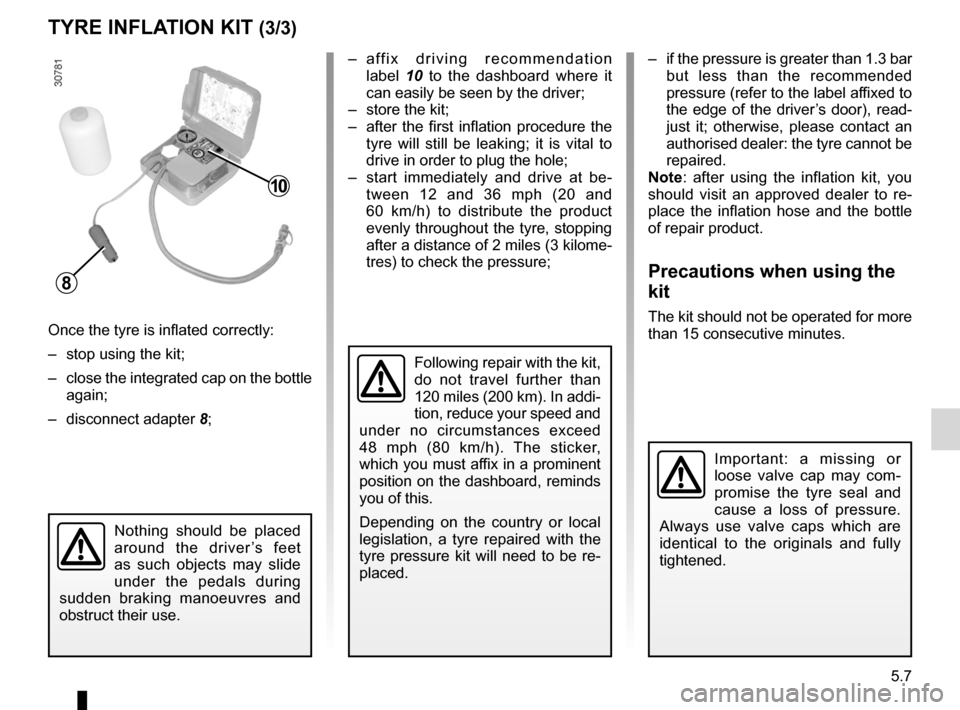
– disconnect adapter 8; –
a ff i x d r i v i n g r e c o m m e n d a t i o n
label 10 to the dashboard where it
can easily be seen by the driver;
– store the kit;
– after the first inflation procedure the
tyre will still be leaking; it is vital to
drive in order to plug the hole;
– start immediately and drive at be -
tween 12 and 36 mph (20 and
60 km/h) to distribute the product
evenly throughout the tyre, stopping
after a distance of 2 miles (3 kilome-
tres) to check the pressure; –
if the pressure is greater than 1.3 bar
but less than the recommended
pressure (refer to the label affixed to
the edge of the driver’s door), read-
just it; otherwise, please contact an
authorised dealer: the tyre cannot be
repaired.
Note : after using the inflation kit, you
should visit an approved dealer to re -
place the inflation hose and the bottle
of repair product.
Precautions when using the
kit
The kit should not be operated for more
than 15 consecutive minutes.
Important: a missing or
loose valve cap may com -
promise the tyre seal and
cause a loss of pressure.
Always use valve caps which are
identical to the originals and fully
tightened.
Following repair with the kit,
do not travel further than
120 miles (200 km). In addi -
tion, reduce your speed and
under no circumstances exceed
48 mph (80 km/h). The sticker,
which you must affix in a prominent
position on the dashboard, reminds
you of this.
Depending on the country or local
legislation, a tyre repaired with the
tyre pressure kit will need to be re-
placed.
Nothing should be placed
around the driver ’s feet
as such objects may slide
under the pedals during
sudden braking manoeuvres and
obstruct their use.
10
8
Page 166 of 200
5.34
ENG_UD22437_4
Remorquage : dépannage (H79 - Dacia)
ENG_NU_898-5_H79_Dacia_5
TOWING: breakdown (3/3)
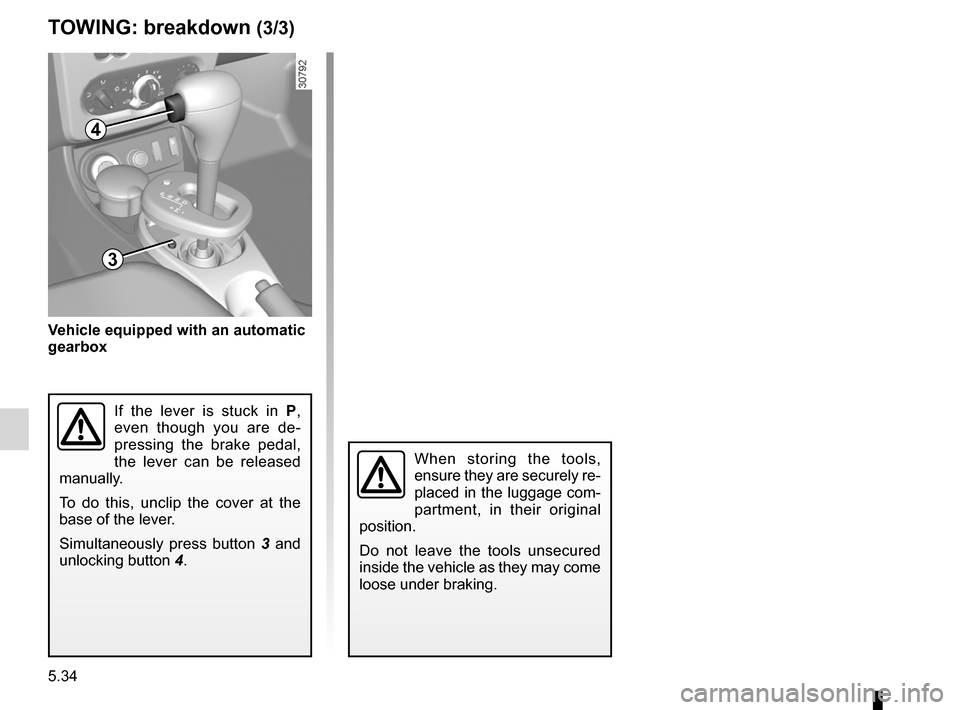
If the lever is stuck in P,
even though you are de -
pressing the brake pedal,
the lever can be released
manually.
To do this, unclip the cover at the
base of the lever.
Simultaneously press button 3 and
unlocking button 4.
When storing the tools,
ensure they are securely re-
placed in the luggage com-
partment, in their original
position.
Do not leave the tools unsecured
inside the vehicle as they may come
loose under braking.
3
4
Vehicle equipped with an automatic
gearbox
Page 171 of 200
operating faults ..................................... (up to the end of the DU)
practical advice ..................................... (up to the end of the DU)
faults operating faults ............................... (up to the end of the DU)
5.39
ENG_UD20968_2
Anomalies de fonctionnement (H79 - Dacia)
ENG_NU_898-5_H79_Dacia_5
Operating faults
OPERATING FAULTS (1/5)
The following advice will enable you to carry out quick, temporary repairs. For safety reasons you should always contact
an approved dealer as soon as possible.
The starter is activated POSSIBLE CAUSESWHAT TO DO
Warning lights dim or fail to come on;
the starter does not run. Battery terminals disconnected,
oxidised or incorrectly secured.Retighten them, reconnect them or clean
them if they are oxidised.
Battery discharged or worn. Connect another battery to the faulty bat -
tery. Refer to the information on “Battery:
troubleshooting” in Section 5 or replace the
battery if necessary.
Do not push the vehicle if the steering
column is locked.
The engine will not start. Starting conditions are not fulfilled.Refer to the information on “Starting/stop -
ping the engine in Section 2.
The steering column remains locked. Steering wheel locked.To unlock, gently move the key and the
steering wheel (refer to the information on
the “Ignition switch” in Section 2).