Speed DACIA DUSTER 2010 1.G Owner's Manual
[x] Cancel search | Manufacturer: DACIA, Model Year: 2010, Model line: DUSTER, Model: DACIA DUSTER 2010 1.GPages: 200, PDF Size: 7.12 MB
Page 139 of 200
JauneNoirNoir texte
5.7
ENG_UD22629_3
Kit de gonflage des pneumatiques (H79 - Dacia)
ENG_NU_898-5_H79_Dacia_5
TYRE INFLATION KIT (3/3)
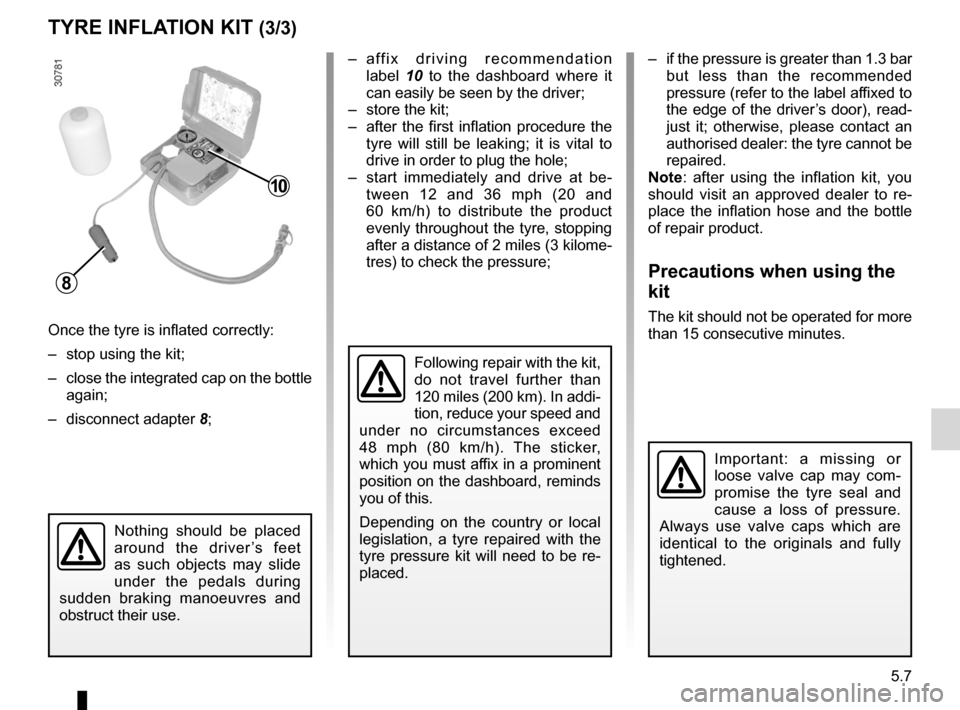
Once the tyre is inflated correctly:
– stop using the kit;
– close the integrated cap on the bottle
again;
– disconnect adapter 8; –
a ff i x d r i v i n g r e c o m m e n d a t i o n
label 10 to the dashboard where it
can easily be seen by the driver;
– store the kit;
– after the first inflation procedure the
tyre will still be leaking; it is vital to
drive in order to plug the hole;
– start immediately and drive at be -
tween 12 and 36 mph (20 and
60 km/h) to distribute the product
evenly throughout the tyre, stopping
after a distance of 2 miles (3 kilome-
tres) to check the pressure; –
if the pressure is greater than 1.3 bar
but less than the recommended
pressure (refer to the label affixed to
the edge of the driver’s door), read-
just it; otherwise, please contact an
authorised dealer: the tyre cannot be
repaired.
Note : after using the inflation kit, you
should visit an approved dealer to re -
place the inflation hose and the bottle
of repair product.
Precautions when using the
kit
The kit should not be operated for more
than 15 consecutive minutes.
Important: a missing or
loose valve cap may com -
promise the tyre seal and
cause a loss of pressure.
Always use valve caps which are
identical to the originals and fully
tightened.
Following repair with the kit,
do not travel further than
120 miles (200 km). In addi -
tion, reduce your speed and
under no circumstances exceed
48 mph (80 km/h). The sticker,
which you must affix in a prominent
position on the dashboard, reminds
you of this.
Depending on the country or local
legislation, a tyre repaired with the
tyre pressure kit will need to be re-
placed.
Nothing should be placed
around the driver ’s feet
as such objects may slide
under the pedals during
sudden braking manoeuvres and
obstruct their use.
10
8
Page 144 of 200
tyre pressure.......................................................... (current page)
5.12
ENG_UD20582_3
Pneumatiques (H79 - Dacia)ENG_NU_898-5_H79_Dacia_5
Jaune NoirNoir texte
Emergency spare wheel
Refer to the information on the
“ E m e r g e n c y s p a r e w h e e l ” a n d
“Changing a wheel” in Section 5.
TYRES (2/3)
Tyre pressures
Adhere to the tyre pressures (including
the emergency spare wheel). The tyre
pressures should be checked at least
once a month and additionally before
any long journey (refer to the label af -
fixed to the edge of the driver’s door).
Incorrect tyre pressures
lead to abnormal tyre wear
and unusually hot running.
These are factors which
may seriously affect safety and lead
to:
– poor road holding;
– risk of blowouts or throwing a
tread.
The tyre pressure depends on the
load and speed of use; adjust the
pressures according to the condi -
tions of use (refer to the information
on “Tyre pressures” in Section 4).
For safety reasons, this op-
eration must be carried out
by a specialist.
Fitting different tyres may
change your vehicle as follows:
– it may mean that your vehicle no
longer conforms to current regu-
lations;
– It may change the way it handles
when cornering;
– It may cause the steering to be
heavy;
– it may affect the use of snow
chains.
Please be aware that a poorly tightened or missing valve cap can make
the tyres less airtight and may lead to pressure loss. Always use valve
caps of the same type as the originals and tighten them fully.
Fitting new tyresPressures should be checked when the
tyres are cold; ignore higher pressures
which may be reached in hot weather
or following a fast journey.
If tyre pressures cannot be checked
when the tyres are cold, assume an in-
crease of 0.2 to 0.3 bar.
Never deflate a hot tyre.
Special note
Depending on the vehicle, there may
be an adapter which needs to be posi-
tioned on the valve before air is added.
Your vehicle is equipped with large
wheels. These are more sensitive
to imbalance. If you experience vi -
bration while driving, contact an ap-
proved dealer.
Page 145 of 200
JauneNoirNoir texte
5.13
ENG_UD20582_3
Pneumatiques (H79 - Dacia)ENG_NU_898-5_H79_Dacia_5
Use in winter
Chains
2-wheel drive version (2WD)
Snow chains must be fitted to the
front wheels.
4-wheel drive version (4WD)
Snow chains may be fitted to only the
front wheels, or to all four wheels.
TYRES (3/3)
It is forbidden to fit snow
chains to only the rear
wheels.
Snow chains may only be
fitted to tyres of the same size as
those originally fitted to your vehicle.
Only certain chains can be fitted to
tyres.
Consult an approved dealer.
Snow or Winter tyres
We would recommend that these be
fitted to all four wheels to ensure that
your vehicle retains maximum adhe -
sion.
Warning: These tyres sometimes
have a specific direction of rotation
and a maximum speed index which
may be lower than the maximum
speed of your vehicle.
Studded tyres
This type of equipment may only be
used for a limited period and as laid
down by local legislation.
It is necessary to observe the speed
specified by current legislation.
These tyres must, at a minimum, be
fitted to the two front wheels.
In all cases, we would recommend
that you contact your approved
dealer who will be able to advise you
on the choice of equipment which is
most suitable for your vehicle.
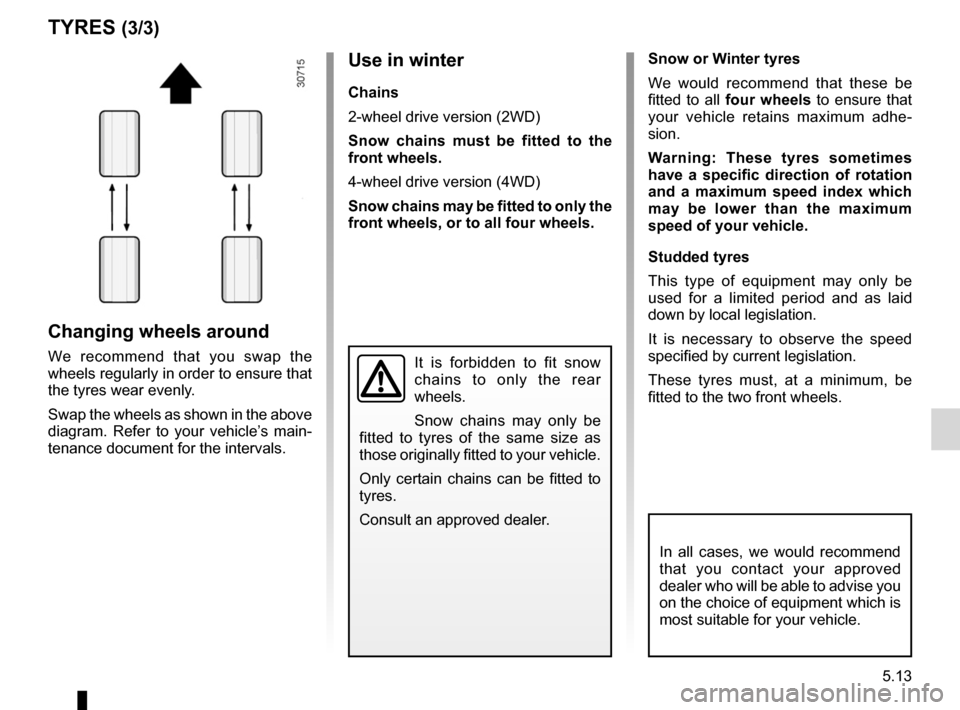
Changing wheels around
We recommend that you swap the
wheels regularly in order to ensure that
the tyres wear evenly.
Swap the wheels as shown in the above
diagram. Refer to your vehicle’s main -
tenance document for the intervals.
Page 161 of 200
JauneNoirNoir texte
5.29
ENG_UD24505_3
Batterie : dépannage (H79 - Dacia)
ENG_NU_898-5_H79_Dacia_5
BATTERY: troubleshooting (2/2)
Starting the vehicle using the
battery from another vehicle
If you have to use the battery from an-
other vehicle to start, obtain suitable
jump leads (with a large cross section)
from an approved dealer or, if you al -
ready have jump leads, ensure that
they are in perfect condition.
The two batteries must have an iden-
tical nominal voltage of 12 volts. The
battery supplying the current should
have a capacity (amp-hours, Ah) which
is at least the same as that of the dis-
charged battery.
Ensure that there is no risk of contact
between the two vehicles (risk of short
circuiting when the positive terminals
are connected) and that the discharged
battery is properly connected. Switch
off your vehicle ignition.
Start the engine of the vehicle supply -
ing the current and run it at an interme-
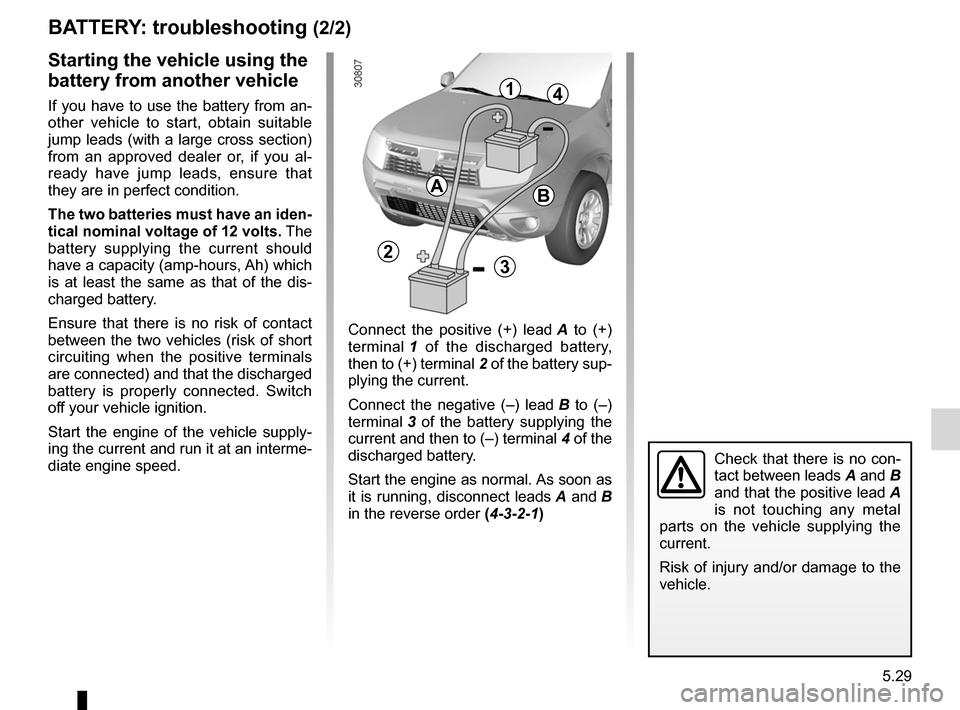
diate engine speed. Connect the positive (+) lead
A to (+)
terminal 1 of the discharged battery,
then to (+) terminal 2 of the battery sup-
plying the current.
Connect the negative (–) lead B to (–)
terminal 3 of the battery supplying the
current and then to (–) terminal 4 of the
discharged battery.
Start the engine as normal. As soon as
it is running, disconnect leads A and B
in the reverse order (4-3-2-1)
Check that there is no con-
tact between leads A and B
and that the positive lead A
is not touching any metal
parts on the vehicle supplying the
current.
Risk of injury and/or damage to the
vehicle.
AB
14
23
Page 172 of 200
5.40
ENG_UD20968_2
Anomalies de fonctionnement (H79 - Dacia)
ENG_NU_898-5_H79_Dacia_5
Jaune NoirNoir texte
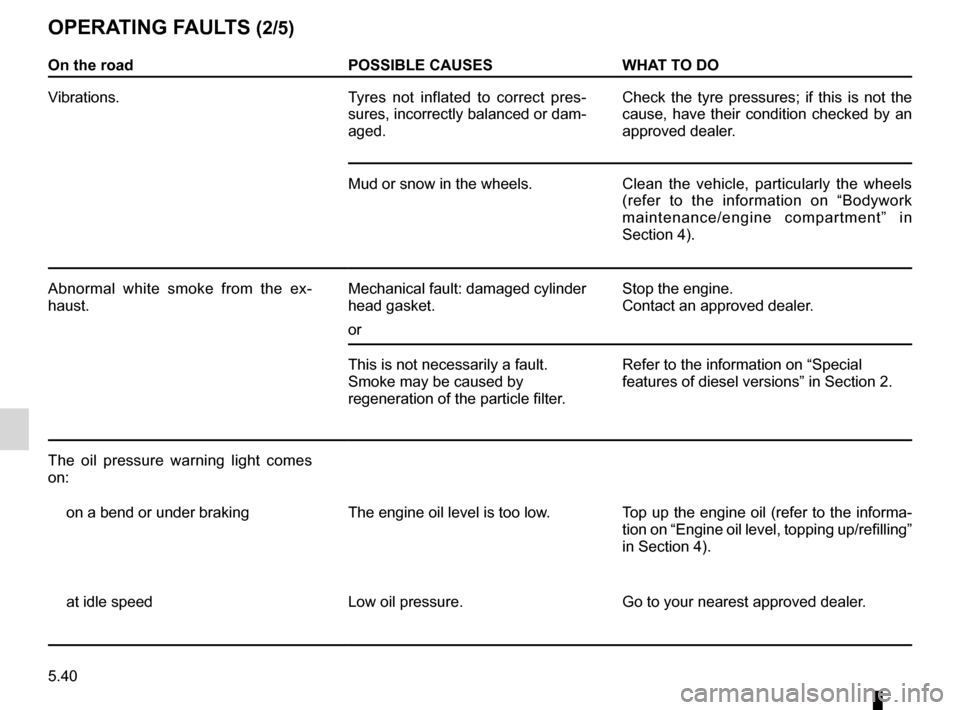
OPERATING FAULTS (2/5)
On the road POSSIBLE CAUSESWHAT TO DO
Vibrations. Tyres not inflated to correct pres-
sures, incorrectly balanced or dam-
aged. Check the tyre pressures; if this is not the
cause, have their condition checked by an
approved dealer.
Mud or snow in the wheels. Clean the vehicle, particularly the wheels
(refer to the information on “Bodywork
maintenance/engine compartment” in
Section 4).
Abnormal white smoke from the ex -
haust. Mechanical fault: damaged cylinder
head gasket.
orStop the engine.
Contact an approved dealer.
This is not necessarily a fault.
Smoke may be caused by
regeneration of the particle filter. Refer to the information on “Special
features of diesel versions” in Section 2.
The oil pressure warning light comes
on: on a bend or under braking The engine oil level is too low.Top up the engine oil (refer to the informa-
tion on “Engine oil level, topping up/refilling”
in Section 4).
at idle speed Low oil pressure.Go to your nearest approved dealer.
Page 173 of 200
JauneNoirNoir texte
5.41
ENG_UD20968_2
Anomalies de fonctionnement (H79 - Dacia)
ENG_NU_898-5_H79_Dacia_5
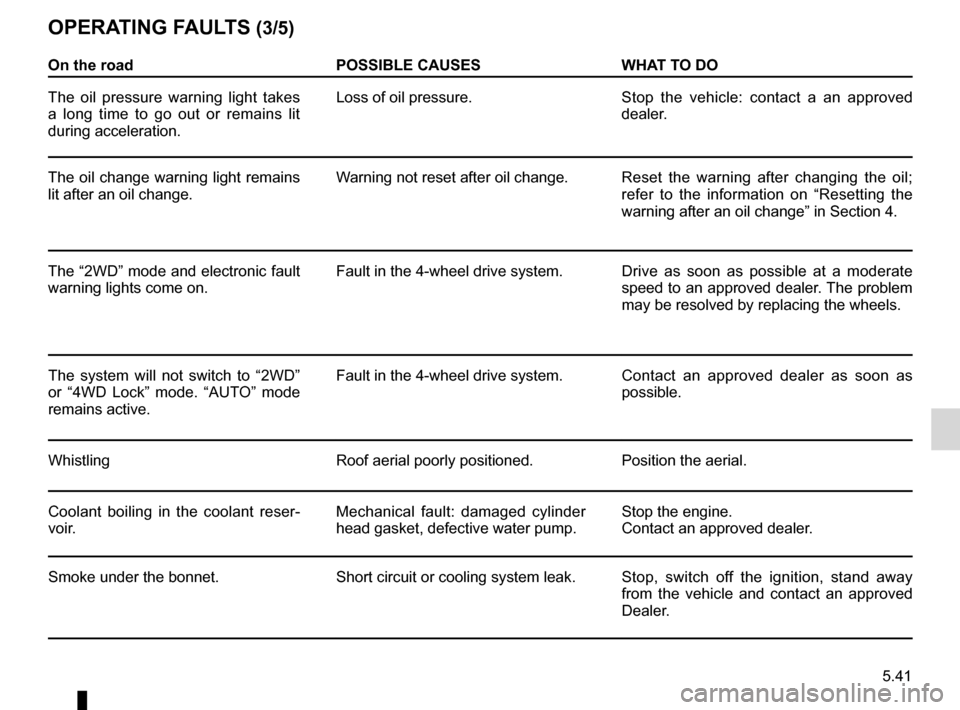
OPERATING FAULTS (3/5)
On the road POSSIBLE CAUSESWHAT TO DO
The oil pressure warning light takes
a long time to go out or remains lit
during acceleration. Loss of oil pressure.
Stop the vehicle: contact a an approved
dealer.
The oil change warning light remains
lit after an oil change. Warning not reset after oil change.
Reset the warning after changing the oil;
refer to the information on “Resetting the
warning after an oil change” in Section 4.
The “2WD” mode and electronic fault
warning lights come on. Fault in the 4-wheel drive system.
Drive as soon as possible at a moderate
speed to an approved dealer. The problem
may be resolved by replacing the wheels.
The system will not switch to “2WD”
or “4WD Lock” mode. “AUTO” mode
remains active. Fault in the 4-wheel drive system.
Contact an approved dealer as soon as
possible.
Whistling Roof aerial poorly positioned.Position the aerial.
Coolant boiling in the coolant reser -
voir. Mechanical fault: damaged cylinder
head gasket, defective water pump.Stop the engine.
Contact an approved dealer.
Smoke under the bonnet. Short circuit or cooling system leak.Stop, switch off the ignition, stand away
from the vehicle and contact an approved
Dealer.
Page 182 of 200
technical specifications ......................... (up to the end of the DU)
weight ................................................... (up to the end of the DU)
towing ................................................... (up to the end of the DU)
towing a caravan ................................................... (current page)
towing weights ....................................................... (current page)
weights .................................................................. (current page)
6.6
ENG_UD22464_3
Masses/Charges remorquables (H79 - Dacia)
ENG_NU_898-5_H79_Dacia_6
Weights/Towing weights
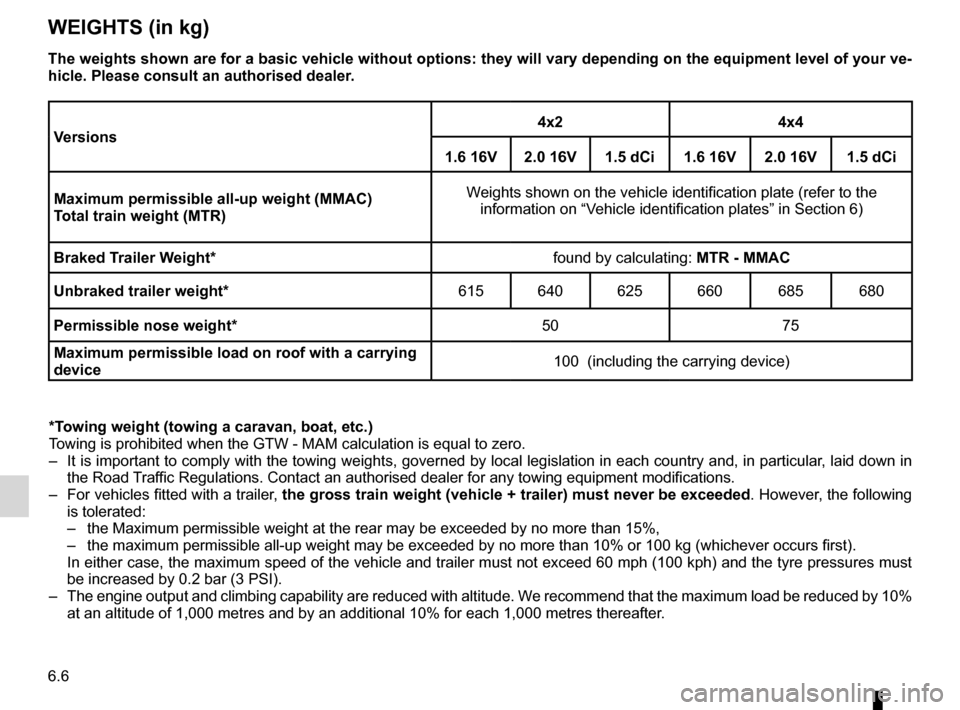
WEIGHTS (in kg)
Versions 4x2
4x4
1.6 16V 2.0 16V 1.5 dCi1.6 16V 2.0 16V 1.5 dCi
Maximum permissible all-up weight (MMAC)
Total train weight (MTR) Weights shown on the vehicle identification plate (refer to the
information on “Vehicle identification plates” in Section 6)
Braked Trailer Weight* found by calculating: MTR - MMAC
Unbraked trailer weight* 615640625 660 685680
Permissible nose weight* 5075
Maximum permissible load on roof with a carrying
device 100 (including the carrying device)
*Towing weight (towing a caravan, boat, etc.)
Towing is prohibited when the GTW - MAM calculation is equal to zero.
– It is important to comply with the towing weights, governed by local legislation in each country and, in particular, laid down in
the Road Traffic Regulations. Contact an authorised dealer for any towing equipment m\
odifications.
– For vehicles fitted with a trailer, the gross train weight (vehicle + trailer) must never be exceeded . However, the following
is tolerated:
– the Maximum permissible weight at the rear may be exceeded by no more than 15%,
– the maximum permissible all-up weight may be exceeded by no more than 10% or 100 kg (whichever occu\
rs first).
In either case, the maximum speed of the vehicle and trailer must not exceed 60 mph (100 kph) and the tyre pressures must
be increased by 0.2 bar (3 PSI).
– The engine output and climbing capability are reduced with altitude. We recommend that the maximum load be reduced by 10%
at an altitude of 1,000 metres and by an additional 10% for each 1,000 m\
etres thereafter.
The weights shown are for a basic vehicle without options: they will vary depending on the equipment level of your ve-
hicle. Please consult an authorised dealer.
Page 197 of 200
JauneNoirNoir texte
7.3
FRA_UD25066_7
Index (H79 - Dacia)
ENG_NU_898-5_H79_Dacia_7
AlphAbeticAl index (3/4)
adjustment ................................................................... 1.56
lights: adjusting ...................................................................... 1.56
brake lights ....................................................... 5.18 – 5.19
dipped beam headlights ..........................1.54, 5.14 → 5.16
direction indicators ....................... 1.52 – 1.53, 5.14 → 5.16
fog lights ............................................................. 1.55, 5.17
hazard warning ................................................. 1.52 – 1.53
main beam headlights ............................. 1.54, 5.14 → 5.16
reversing lights .................................................. 5.18 – 5.19
side lights ................................................ 1.54, 5.14 → 5.16
locking the doors ................................................................. 1.4
luggage compartment cover ................................... 3.22 – 3.23
M
maintenance: bodywork ......................................................... 4.13 → 4.15
interior trim ........................................................ 4.16 – 4.17
mechanical ..................................4.4, 4.7, 4.12, 6.8 → 6.13
mileage before service ....................................... 6.8 → 6.13
methods of restraint in addition to the front seat belts ..............
1.16 → 1.18, 1.20
mirrors ........................................................................\
....... 3.13
O
oil change ........................................................................\
.... 4.5
opening the doors ................................................................ 1.7
operating faults ...................................................... 5.39 → 5.43
overspeed buzzer .............................................................. 1.44
p
paintwork maintenance ................................................................ 4.13
reference ............................................................... 6.2 – 6.3
power-assisted steering .............................................. 1.50, 4.9
power-assisted steering pump .............................................4.9practical advice
........................................ 5.2 – 5.4, 5.8 → 5.43
puncture .................................................... 5.3 – 5.4, 5.9 – 5.10
R
radio fitting a radio ..................................................... 5.36 – 5.37
rear bench seat .................................................................. 3.19
rear screen demisting ..................................................................... 1.42
rear screen de-icing/demisting ..................................3.4 → 3.7
rear seats functions ...................................................................... 3.19
rear view mirrors ................................................................ 1.35
remote control door locking unit ................................... 1.2, 1.4
replacement parts ................................................................ 6.7
reverse gear selecting ....................................................................... 2.10
roof bars ........................................................................\
.... 3.24
roof rack roof bars ....................................................................... 3.24
running in ........................................................................\
..... 2.2
S
seat belts ............................................................... 1.12 → 1.20
service sheets .......................................................... 6.8 → 6.13
signals and lights .................................................... 1.54 – 1.55
speakers location ............................................................. 5.36 – 5.37
special features of diesel versions .......................................2.5
special features of petrol vehicles ....................................... 2.4
starting ........................................................................\
......... 2.3
starting the engine ...................................................... 2.2 – 2.3
steering wheel adjustment ................................................................... 1.50
storage compartment ............................................. 3.15 → 3.18
storage compartments ........................................... 3.15 → 3.18