engine DACIA DUSTER 2010 1.G Workshop Manual
[x] Cancel search | Manufacturer: DACIA, Model Year: 2010, Model line: DUSTER, Model: DACIA DUSTER 2010 1.GPages: 200, PDF Size: 7.12 MB
Page 128 of 200
4.14
ENG_UD20966_2
Entretien de la carrosserie / compartiment moteur (H79 - Dacia)
ENG_NU_898-5_H79_Dacia_4
Jaune NoirNoir texte
BODyWORK MAINTENANCE, ENGINE COMPARTMENT (2/3)
y ou should
–
Respect local regulations about
washing vehicles (e.g. do not wash
your vehicle on a public highway).
– Always follow the recommenda -
tions supplied with the high-pressure
cleaning equipment (jet distance and
pressure).
– Before going through a roller type
car wash, return the windscreen
wiper stalk to park position (refer
to the information on “Windscreen
wash/wipe” in Section 1), check the
mounting of external accessories,
additional lights and door mirrors
and be sure to hold the wiper blades
and radio aerial in place with adhe -
sive tape. Remove the radio aerial
mast if your vehicle is fitted with this
equipment.
Remember to remove the tape and
refit the antenna after washing. –
After driving off-road (eg. on muddy,
dusty or sandy terrain) quickly clean
the radiator from the outside of the
vehicle through the openings in the
bumper, to prevent it from becoming
blocked or clogged (risk of engine
overheating).
– Wash your vehicle frequently with
the engine off , using shampoo ap -
proved by our Technical Department
(never use abrasive products) and
rinse thoroughly using a warm or
cold water jet (never hot):
– spots of tree resin and industrial
grime;
– the layer of dust or mud and any
insects;
– bird droppings , which contain
chemicals that rapidly discolour
paintwork and may even cause
the paint to peel off ;
Wash the vehicle immediately to
remove these marks since it is im-
possible to remove them by pol -
ishing; –
salt deposited in the wheel arches
and underneath the body after
driving in areas where the roads
are chemically treated;
– mud in the wheel arches and un-
derneath the body which form
damp patches.
– Clean mud and sand from the
wheels, in particular the inside of the
wheels and the brakes, as this can:
– reduce the braking efficiency and
damage the components of the
braking system;
– cause vibrations in the bodywork
and steering column.
We have selected special products
to care for your vehicle and you can
obtain these from the manufactur -
er’s accessory outlets.
Page 129 of 200
JauneNoirNoir texte
4.15
ENG_UD20966_2
Entretien de la carrosserie / compartiment moteur (H79 - Dacia)
ENG_NU_898-5_H79_Dacia_4
BODyWORK MAINTENANCE, ENGINE COMPARTMENT (3/3)
– After cleaning your vehicle, check
the brakes while driving at low speed
to ensure that the braking efficiency
has not been reduced by the water.
If it has, depress the brake pedal
gently while driving to dry the brakes.
– Check the drain holes at the bottom
of the doors to make sure they are
not blocked.
– Inspect the wheels regularly to check
for any traces of impacts or corro -
sion. These can damage the tyre or
cause it to lose pressure.
– Keep well away from the vehicle in
front when driving on gravelled sur -
faces to prevent paint damage.
– Repair, or have repaired quickly,
patches where the paint has been
damaged to prevent corrosion
spreading. –
Remember to visit the body shop pe-
riodically in order to maintain your
anticorrosion warranty. Refer to the
Maintenance Service Booklet.
– Spray mechanical components,
hinges, etc. with products approved
by the Technical Department to
protect them after they have been
cleaned.
Page 138 of 200
5.6
ENG_UD22629_3
Kit de gonflage des pneumatiques (H79 - Dacia)
ENG_NU_898-5_H79_Dacia_5
Jaune NoirNoir texte
TYRE INFLATION KIT (2/3)
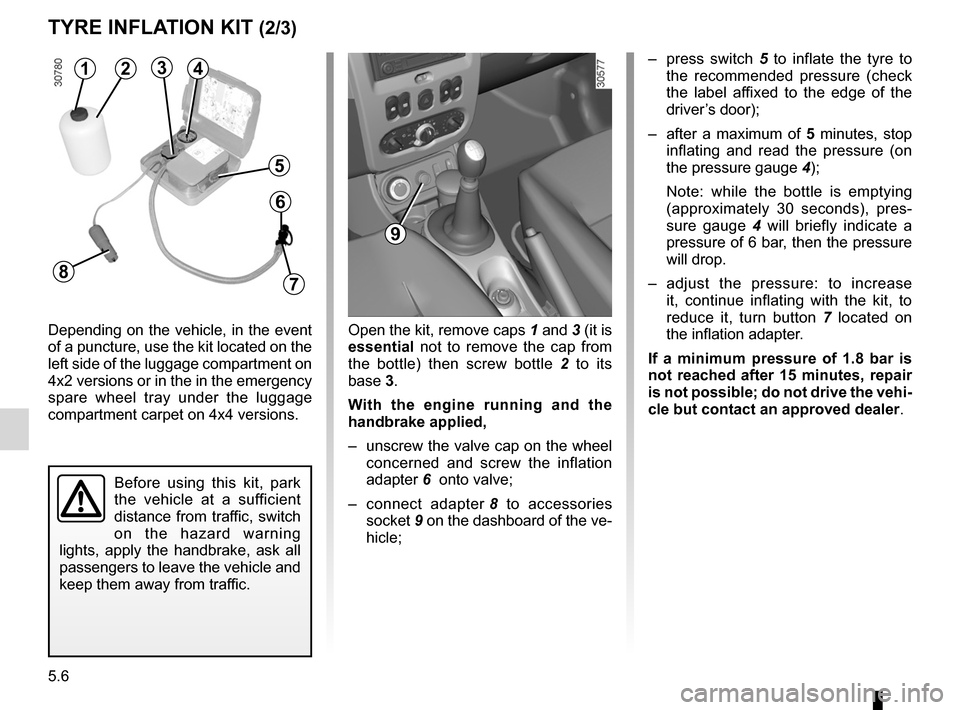
Depending on the vehicle, in the event
of a puncture, use the kit located on the
left side of the luggage compartment on
4x2 versions or in the in the emergency
spare wheel tray under the luggage
compartment carpet on 4x4 versions. –
press switch 5 to inflate the tyre to
the recommended pressure (check
the label affixed to the edge of the
driver’s door);
– after a maximum of 5 minutes, stop
inflating and read the pressure (on
the pressure gauge 4);
Note: while the bottle is emptying
(approximately 30 seconds), pres -
sure gauge 4 will briefly indicate a
pressure of 6 bar, then the pressure
will drop.
– adjust the pressure: to increase
it, continue inflating with the kit, to
reduce it, turn button 7 located on
the inflation adapter.
If a minimum pressure of 1.8 bar is
not reached after 15 minutes, repair
is not possible; do not drive the vehi-
cle but contact an approved dealer .
Before using this kit, park
the vehicle at a sufficient
distance from traffic, switch
on the hazard warning
lights, apply the handbrake, ask all
passengers to leave the vehicle and
keep them away from traffic.
Open the kit, remove caps 1 and 3 (it is
essential not to remove the cap from
the bottle) then screw bottle 2 to its
base 3.
With the engine running and the
handbrake applied,
– unscrew the valve cap on the wheel
concerned and screw the inflation
adapter 6 onto valve;
– connect adapter 8 to accessories
socket 9 on the dashboard of the ve-
hicle;
9
1234
5
6
78
Page 147 of 200
JauneNoirNoir texte
5.15
ENG_UD20700_2
Feux avant : remplacement des lampes (H79 - Dacia)
ENG_NU_898-5_H79_Dacia_5
FRONT LIGHTS: changing bulbs (2/3)
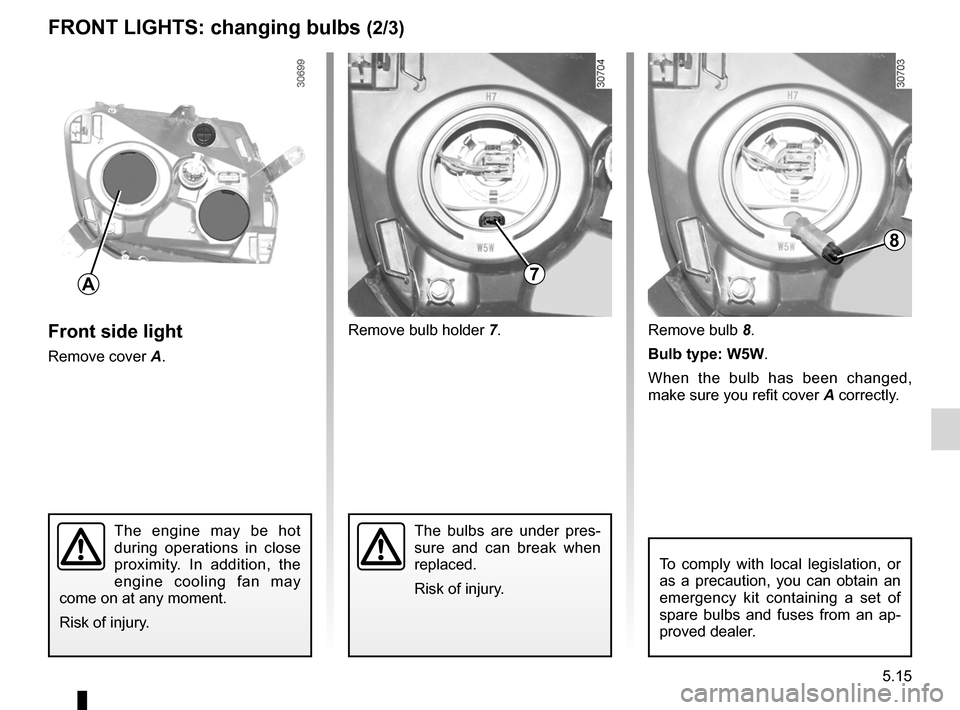
Front side light
Remove cover A.
To comply with local legislation, or
as a precaution, you can obtain an
emergency kit containing a set of
spare bulbs and fuses from an ap -
proved dealer.
The bulbs are under pres -
sure and can break when
replaced.
Risk of injury.
Remove bulb holder 7. Remove bulb 8.
Bulb type: W5W.
When the bulb has been changed,
make sure you refit cover A correctly.
The engine may be hot
during operations in close
proximity. In addition, the
engine cooling fan may
come on at any moment.
Risk of injury.
A7
8
Page 149 of 200
bulbschanging ......................................... (up to the end of the DU)
changing a bulb .................................... (up to the end of the DU)
practical advice ..................................... (up to the end of the DU)
lighting: exterior ............................................ (up to the end of the DU)
lights: fog lights ......................................... (up to the end of the DU)
bulbs changing ......................................... (up to the end of the DU)
lights additional ........................................ (up to the end of the DU)
5.17
ENG_UD20701_2
Projecteurs antibrouillard : remplacement des lampes (H79 - Dacia)
ENG_NU_898-5_H79_Dacia_5
Additional lights
If you wish to fit fog lights or long range
headlights to your vehicle, consult an
approved dealer.
Fog lights
FOG LIGHTS: changing bulbs
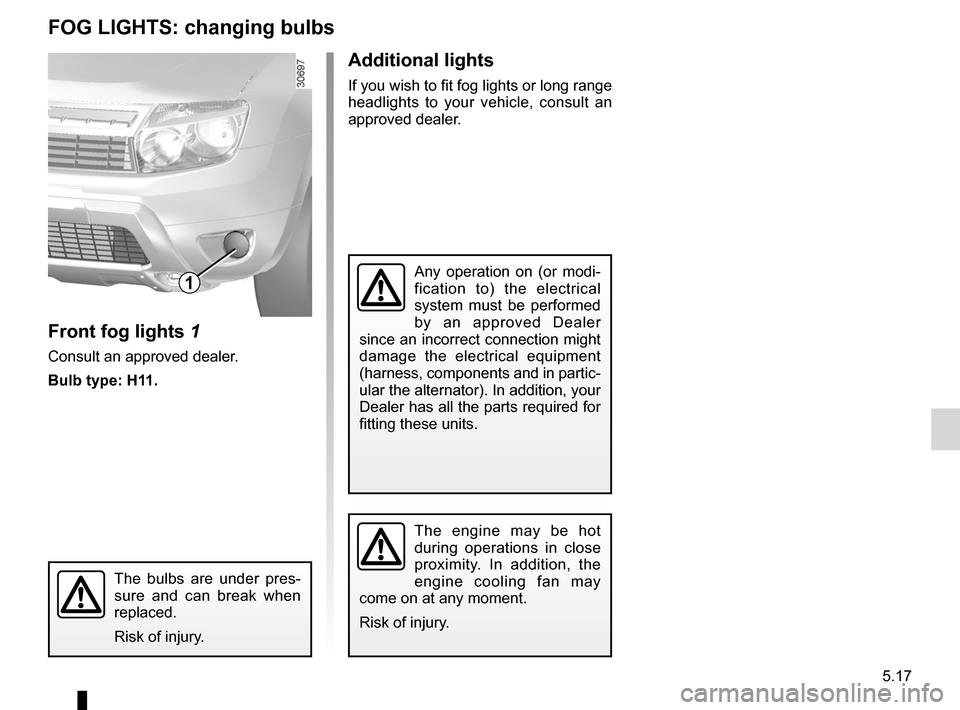
Front fog lights 1
Consult an approved dealer.
Bulb type: H11.
Any operation on (or modi -
fication to) the electrical
system must be performed
by an approved Dealer
since an incorrect connection might
damage the electrical equipment
(harness, components and in partic-
ular the alternator). In addition, your
Dealer has all the parts required for
fitting these units.
The engine may be hot
during operations in close
proximity. In addition, the
engine cooling fan may
come on at any moment.
Risk of injury.
The bulbs are under pres -
sure and can break when
replaced.
Risk of injury.
1
Page 157 of 200
fuses ..................................................... (up to the end of the DU)
advice on antipollution .......................... (up to the end of the DU)
practical advice ..................................... (up to the end of the DU)
5.25
ENG_UD22381_3
Fusibles (H79 - Dacia)
ENG_NU_898-5_H79_Dacia_5
Fuses
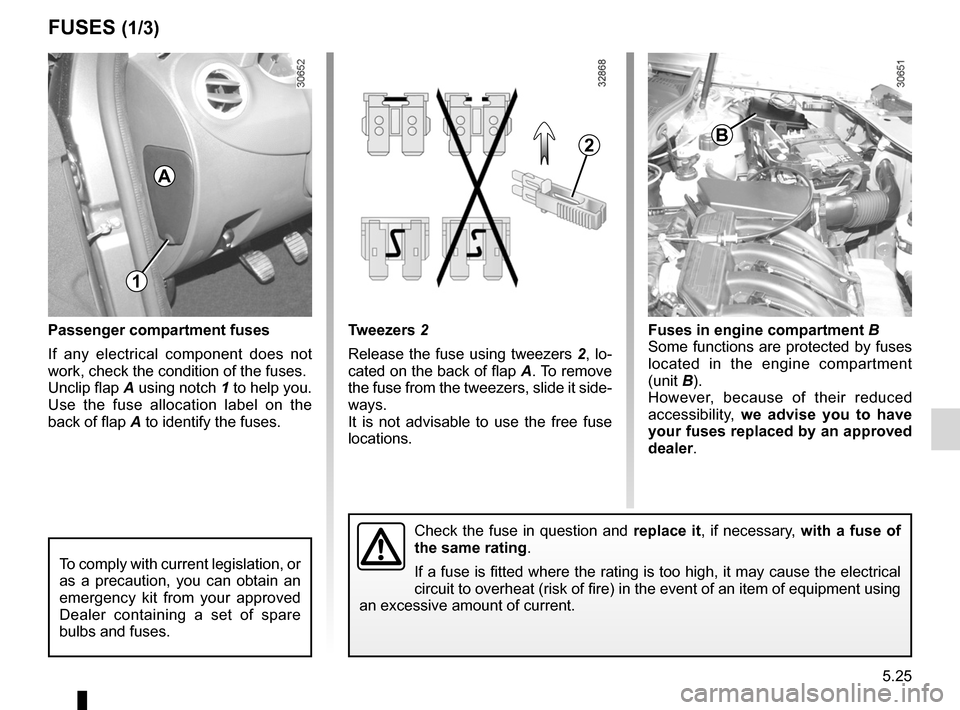
Passenger compartment fuses
If any electrical component does not
work, check the condition of the fuses.
Unclip flap A using notch 1 to help you.
Use the fuse allocation label on the
back of flap A to identify the fuses.
Check the fuse in question and replace it, if necessary, with a fuse of
the same rating.
If a fuse is fitted where the rating is too high, it may cause the electrical
circuit to overheat (risk of fire) in the event of an item of equipment using
an excessive amount of current.
To comply with current legislation, or
as a precaution, you can obtain an
emergency kit from your approved
Dealer containing a set of spare
bulbs and fuses.
FUSES (1/3)
Tweezers 2
Release the fuse using tweezers 2, lo-
cated on the back of flap A. To remove
the fuse from the tweezers, slide it side-
ways.
It is not advisable to use the free fuse
locations. Fuses in engine compartment
B
Some functions are protected by fuses
located in the engine compartment
(unit B).
However, because of their reduced
accessibility, we advise you to have
your fuses replaced by an approved
dealer.
1
A
B2
Page 159 of 200
JauneNoirNoir texte
5.27
ENG_UD22381_3
Fusibles (H79 - Dacia)
ENG_NU_898-5_H79_Dacia_5
FUSES (3/3)
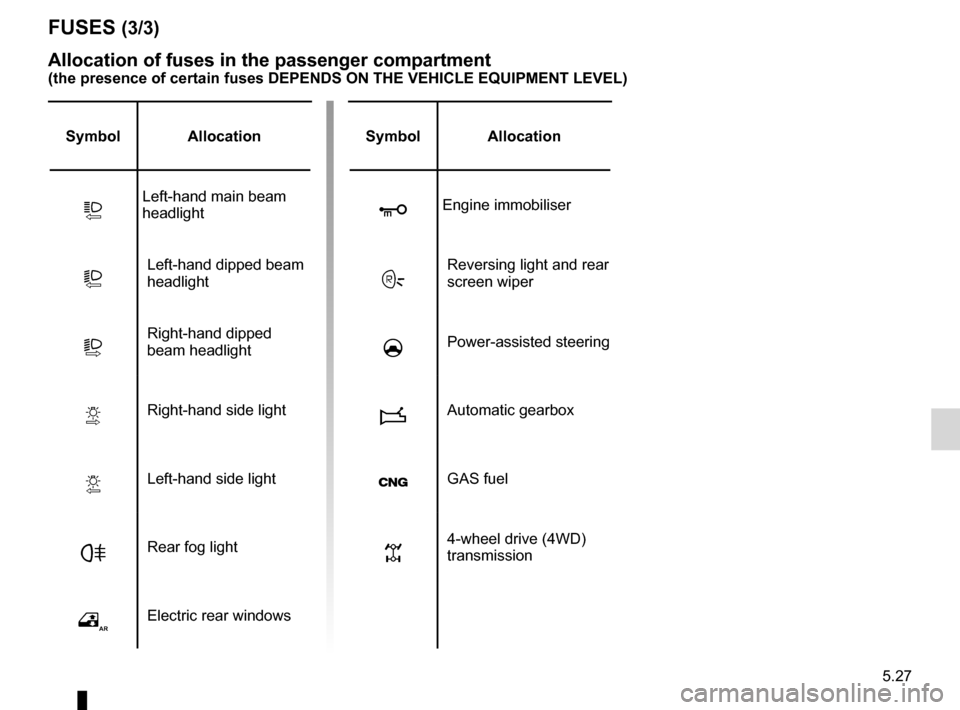
Allocation of fuses in the passenger compartment
(the presence of certain fuses DEPENDS ON THE VEHICLE EQUIPMENT LEVEL)\
Symbol Allocation
QLeft-hand main beam
headlight
LLeft-hand dipped beam
headlight
TRight-hand dipped
beam headlight
VRight-hand side light
YLeft-hand side light
FRear fog light
ḼElectric rear windows
SymbolAllocation
qEngine immobiliser
ËReversing light and rear
screen wiper
uPower-assisted steering
iAutomatic gearbox
GAS fuel
ḻ4-wheel drive (4WD)
transmission
Page 160 of 200
batterytroubleshooting ............................... (up to the end of the DU)
practical advice ..................................... (up to the end of the DU)
5.28
ENG_UD24505_3
Batterie : dépannage (H79 - Dacia)
ENG_NU_898-5_H79_Dacia_5
Jaune NoirNoir texte
Battery: troubleshooting
BATTERY: troubleshooting (1/2)
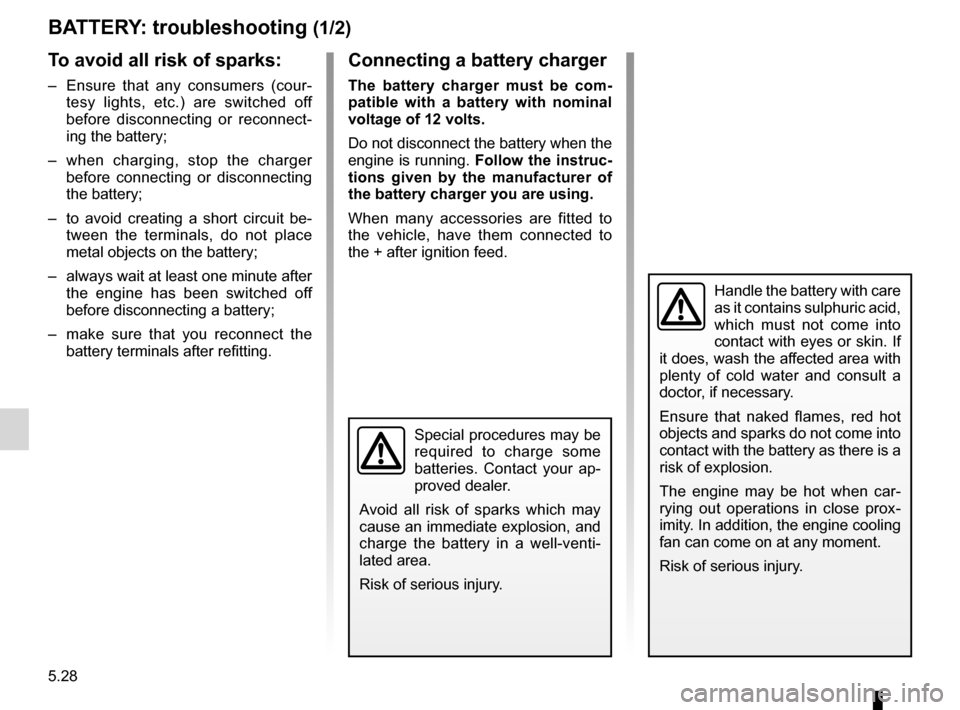
To avoid all risk of sparks:
– Ensure that any consumers (cour -
tesy lights, etc.) are switched off
before disconnecting or reconnect -
ing the battery;
– when charging, stop the charger
before connecting or disconnecting
the battery;
– to avoid creating a short circuit be -
tween the terminals, do not place
metal objects on the battery;
– always wait at least one minute after
the engine has been switched off
before disconnecting a battery;
– make sure that you reconnect the
battery terminals after refitting.
Handle the battery with care
as it contains sulphuric acid,
which must not come into
contact with eyes or skin. If
it does, wash the affected area with
plenty of cold water and consult a
doctor, if necessary.
Ensure that naked flames, red hot
objects and sparks do not come into
contact with the battery as there is a
risk of explosion.
The engine may be hot when car -
rying out operations in close prox -
imity. In addition, the engine cooling
fan can come on at any moment.
Risk of serious injury.
Special procedures may be
required to charge some
batteries. Contact your ap -
proved dealer.
Avoid all risk of sparks which may
cause an immediate explosion, and
charge the battery in a well-venti -
lated area.
Risk of serious injury.
Connecting a battery charger
The battery charger must be com -
patible with a battery with nominal
voltage of 12 volts.
Do not disconnect the battery when the
engine is running. Follow the instruc-
tions given by the manufacturer of
the battery charger you are using.
When many accessories are fitted to
the vehicle, have them connected to
the + after ignition feed.
Page 161 of 200
JauneNoirNoir texte
5.29
ENG_UD24505_3
Batterie : dépannage (H79 - Dacia)
ENG_NU_898-5_H79_Dacia_5
BATTERY: troubleshooting (2/2)
Starting the vehicle using the
battery from another vehicle
If you have to use the battery from an-
other vehicle to start, obtain suitable
jump leads (with a large cross section)
from an approved dealer or, if you al -
ready have jump leads, ensure that
they are in perfect condition.
The two batteries must have an iden-
tical nominal voltage of 12 volts. The
battery supplying the current should
have a capacity (amp-hours, Ah) which
is at least the same as that of the dis-
charged battery.
Ensure that there is no risk of contact
between the two vehicles (risk of short
circuiting when the positive terminals
are connected) and that the discharged
battery is properly connected. Switch
off your vehicle ignition.
Start the engine of the vehicle supply -
ing the current and run it at an interme-
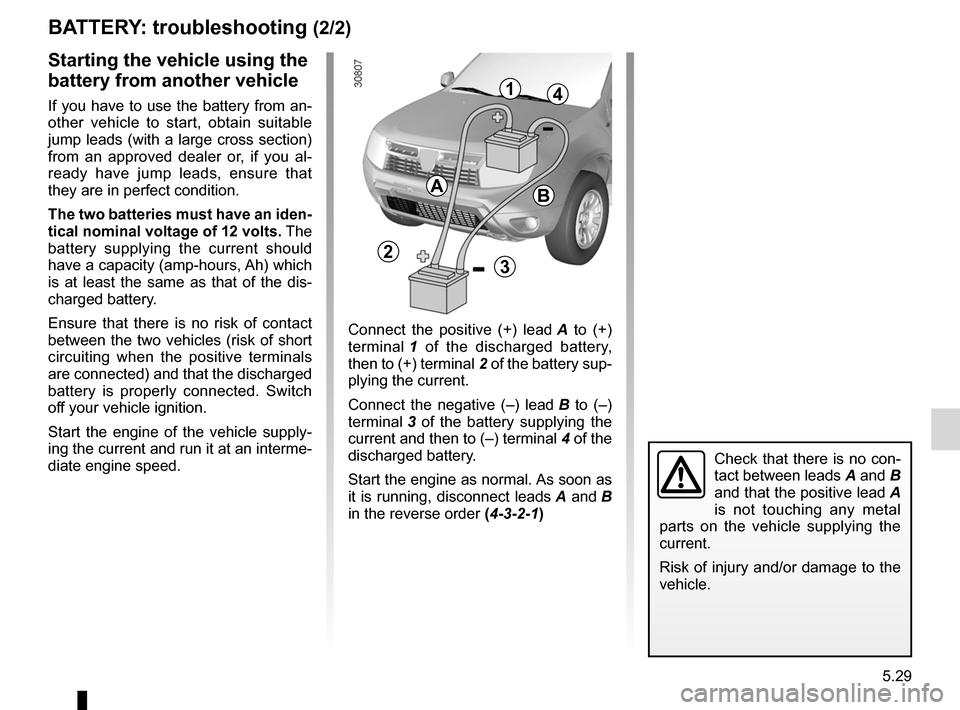
diate engine speed. Connect the positive (+) lead
A to (+)
terminal 1 of the discharged battery,
then to (+) terminal 2 of the battery sup-
plying the current.
Connect the negative (–) lead B to (–)
terminal 3 of the battery supplying the
current and then to (–) terminal 4 of the
discharged battery.
Start the engine as normal. As soon as
it is running, disconnect leads A and B
in the reverse order (4-3-2-1)
Check that there is no con-
tact between leads A and B
and that the positive lead A
is not touching any metal
parts on the vehicle supplying the
current.
Risk of injury and/or damage to the
vehicle.
AB
14
23
Page 171 of 200
operating faults ..................................... (up to the end of the DU)
practical advice ..................................... (up to the end of the DU)
faults operating faults ............................... (up to the end of the DU)
5.39
ENG_UD20968_2
Anomalies de fonctionnement (H79 - Dacia)
ENG_NU_898-5_H79_Dacia_5
Operating faults
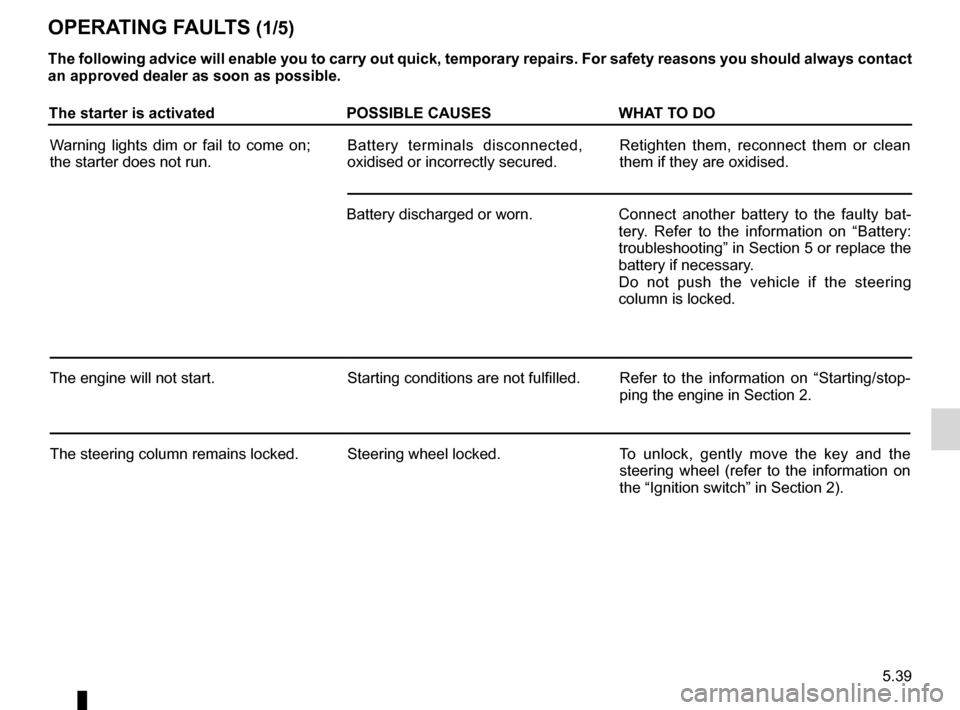
OPERATING FAULTS (1/5)
The following advice will enable you to carry out quick, temporary repairs. For safety reasons you should always contact
an approved dealer as soon as possible.
The starter is activated POSSIBLE CAUSESWHAT TO DO
Warning lights dim or fail to come on;
the starter does not run. Battery terminals disconnected,
oxidised or incorrectly secured.Retighten them, reconnect them or clean
them if they are oxidised.
Battery discharged or worn. Connect another battery to the faulty bat -
tery. Refer to the information on “Battery:
troubleshooting” in Section 5 or replace the
battery if necessary.
Do not push the vehicle if the steering
column is locked.
The engine will not start. Starting conditions are not fulfilled.Refer to the information on “Starting/stop -
ping the engine in Section 2.
The steering column remains locked. Steering wheel locked.To unlock, gently move the key and the
steering wheel (refer to the information on
the “Ignition switch” in Section 2).