belt DACIA DUSTER 2012 1.G Owner's Manual
[x] Cancel search | Manufacturer: DACIA, Model Year: 2012, Model line: DUSTER, Model: DACIA DUSTER 2012 1.GPages: 200, PDF Size: 2.4 MB
Page 37 of 200
\
ENG_NU_898-5_H79_Dacia_1
CHILD SAFETY: fitting a child seat (6/6)
X = Seat not suitable for")
JauneNoirNoir texte
1.31
ENG_UD24887_4
Sécurité enfants : installation du siège enfant (H79 - Dacia)\
ENG_NU_898-5_H79_Dacia_1
CHILD SAFETY: fitting a child seat (6/6)
X = Seat not suitable for fitting child seats.
U = Seat which allows a child seat with “Universal” approval to b e installed using a seat belt; check that it can be fitted.
IUF =
Seat
which, on equipped vehicles, allows forward-facing child seats with “Universal” approval to be attached by the ISOFIX
system: check that it can be fitted.
IL =
On
equipped vehicles, seat which allows an approved “semi-universal” or “vehicle specific” child seat to be attached using the
ISOFIX system; check that it can be fitted.
Refer to the brochure “Child safety equipment” available from the Network to choose the seat suited to your child and
recommended for your vehicle.
(1)
Only
a rear-facing child seat can be fitted in this seat: raise the seat to the maximum and position it as far back as possible,
tilting the seatback slightly (approximately 25°).
(2)
A
carrycot can be installed across the vehicle and will take up two seats. Position the child with his or her feet nearest the door.
(3)
Move
the front seat as far forward as possible to install a rear-facing child seat, then move back the seat in front as far as it will
go, although without allowing it to come into contact with the child sea\
t.
(4)
Forward-facing
child seat; position the seatback of the child seat in contact with the seatback of the vehicle seat. Adjust the
headrest, or remove it if necessary. Do not push the seat in front of the child more than halfway back on its runners and do not
recline the seatback more than 25°.
(7)
A
child seat may only be fitted in this seat if it is equipped with an inertia-reel seat belt. For any additional information, please
contact an authorised dealer.
Page 43 of 200
JauneNoirNoir texte
1.37
ENG_UD24352_3
Poste de conduite direction à gauche (H79 - Dacia)
ENG_NU_898-5_H79_Dacia_1
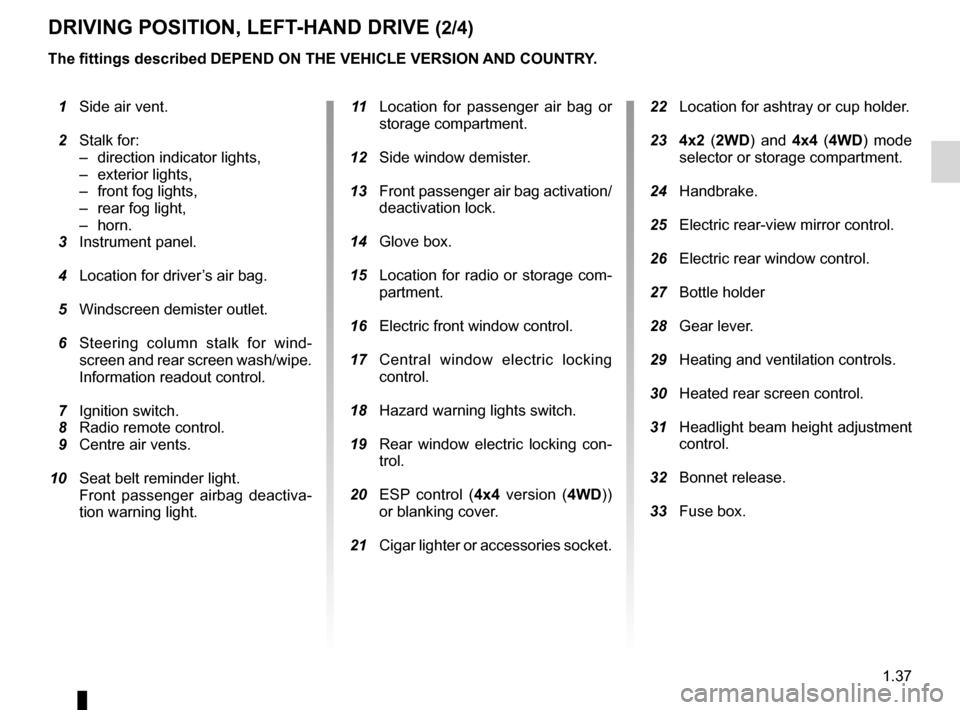
DRIVING POSITION, LEFT-HAND DRIVE (2/4)
1 Side air ven t.
2
Stalk for:
–
direction indicator lights,
–
exterior lights,
–
front fog lights,
–
rear fog light,
–
horn. 3
Instrument panel.
4
Location for
driver’s air bag.
5
Windscreen
demister outlet.
6
S
teering column stalk for wind-
screen and rear screen wash/wipe.
Information readout control.
7
Ignition swit
ch.
8
Radio remo
te control.
9
Centre air vents.
10
Seat belt reminder light.
F
ront passenger airbag deactiva-
tion warning light. 1 1 L ocation for passenger air bag or
storage compartment.
12
Side window
demister.
13
Front
passenger air bag activation/
deactivation lock.
14
Glove box.
15
Location
for radio or storage com-
partment.
16
Electric front window contro
l.
17
C
entral window electric locking
control.
18
Hazard war
ning lights switch.
19
R
ear window electric locking con-
trol.
20
E
SP control (4x4 version ( 4WD))
or blanking cover.
21
Cigar
lighter or accessories socket. 22 Location for ashtray or cup holder.
23
4
x2 (2WD ) and 4x4 (4WD ) mode
selector or storage compartment.
24
Handbrake.
25
Electric rear-view mirror con
trol.
26
Electric rear window control
.
27
Bottle holde
r
28
Gear lever
.
29
Heating and
ventilation controls.
30
Heated rear
screen control.
31
Headlight
beam height adjustment
control.
32
Bonnet rele
ase.
33
Fuse box.
The fittings described DEPEND ON THE VEHICLE VERSION AND COUNTRY.
Page 45 of 200
JauneNoirNoir texte
1.39
ENG_UD24352_3
Poste de conduite direction à gauche (H79 - Dacia)
ENG_NU_898-5_H79_Dacia_1
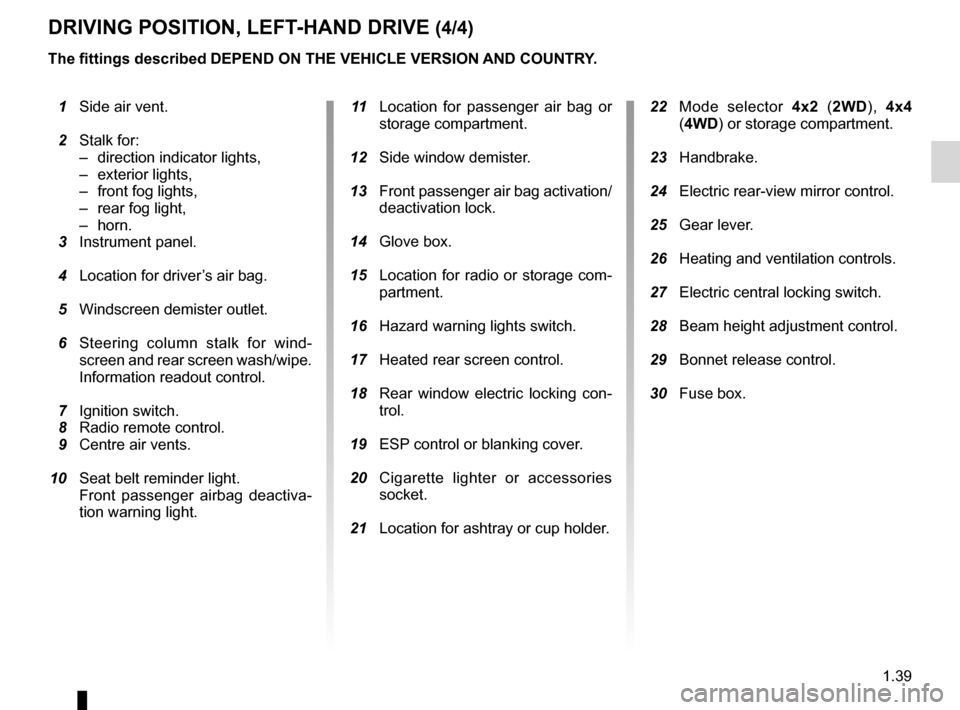
DRIVING POSITION, LEFT-HAND DRIVE (4/4)
The fittings described DEPEND ON THE VEHICLE VERSION AND COUNTRY.
1
Side air ven
t.
2
Stalk for:
–
direction indicator lights,
–
exterior lights,
–
front fog lights,
–
rear fog light,
–
horn. 3
Instrument panel.
4
Location for
driver’s air bag.
5
Windscreen
demister outlet.
6
S
teering column stalk for wind-
screen and rear screen wash/wipe.
Information readout control.
7
Ignition swit
ch.
8
Radio remo
te control.
9
Centre air vents.
10
Seat belt reminder light.
F
ront passenger airbag deactiva-
tion warning light.
1
1
L
ocation for passenger air bag or
storage compartment.
12
Side window
demister.
13
Front
passenger air bag activation/
deactivation lock.
14
Glove box.
15
Location
for radio or storage com-
partment.
16
Hazard war
ning lights switch.
17
Heated rear
screen control.
18
R
ear window electric locking con-
trol.
19
ESP
control or blanking cover.
20
C
igarette lighter or accessories
socket.
21
Location for
ashtray or cup holder.
22
M
ode selector 4x2 (2WD ), 4x4
(4WD) or storage compartment.
23
Handbrake.
24
Electric rear-view mirror con
trol.
25
Gear lever
.
26
Heating and
ventilation controls.
27
Electric central locking switc
h.
28
Beam heigh
t adjustment control.
29
Bonnet rele
ase control.
30
Fuse box.
Page 49 of 200

ENG_NU_898-5_H79_Dacia_1
WARNING LIGHTS (4/4)
The presence and operation of the warning lights DEPEND ON THE EQUIPMENT\
AND COUN")
JauneNoirNoir texte
1.43
ENG_UD24501_4
Témoins lumineux (H79 - Dacia)
ENG_NU_898-5_H79_Dacia_1
WARNING LIGHTS (4/4)
The presence and operation of the warning lights DEPEND ON THE EQUIPMENT\
AND COUNTRY.
Warning lights on console B
]Front passenger air bag de-
activation warning light.
Refer to the information on “Child
Safety” in Section 1.
ßFront seat belt reminder
warning light
This warning light comes on continu-
ously on the centre console when the
engine is started. If one of the seat belts
affected is not fastened, the light stays
on then, when the vehicle reaches
a speed of approximately 6
m
ph
(10
km/h),
it flashes and a beep sounds
for approximately 90 seconds.
BB
Page 75 of 200

ENG_NU_898-5_H79_Dacia_2
Driving
–
Drive
carefully for the first few miles")
JauneNoirNoir texte
2.7
ENG_UD22435_3
Conseils : antipollution, économies de carburant, conduite (H79 - Da\
cia)
ENG_NU_898-5_H79_Dacia_2
Driving
–
Drive
carefully for the first few miles
until the engine reaches its normal
operating temperature, rather than
let it warm up while the vehicle is sta-
tionary.
–
Speed
is expensive.
–
Sporty
driving uses a lot of fuel: drive
with a light right foot.
–
Brake
as little as possible. If you an-
ticipate an obstacle or bend in ad-
vance, you may then simply release
the accelerator pedal.
–
A
void sudden acceleration.
ADVICE: antipollution, fuel economy and driving (2/3)
– Double declutching and accelerating before switching off are unnecessary
in modern vehicles.
–
D
o not try to maintain the same
speed up a hill, accelerate no more
than you would on the level. Keep
your foot in the same position on the
accelerator pedal.
–
Do
not overrev the engine in the in-
termediate gears. Always use the
highest gear possible without labour-
ing the engine.
On versions with an automatic gear-
box, it is preferable to keep the gear
lever in position D.
Your vehicle has a greater
ground clearance than an
ordinary passenger vehicle.
This gives it a higher centre
of gravity, making it more suscepti-
ble to rolling during sudden or ag-
gressive manoeuvres, or when cor-
nering at high speeds.
Take extra care when the vehicle is
loaded (in particular when the load
is on the roof).
Ensure that all passengers are
wearing their seat belts.
A label affixed to the sun visor re-
minds you of this.
Vehicles with 4x4 (4WD) trans-
mission
On flat, level ground, with the vehi-
cle unladen, you are recommended
to start in second gear.
Driving problems
On the driver ’s side, only
use mats specially adapted
for the vehicle and attached
to prefitted devices. Check regularly
to make sure they are secure. Do
not overlay several mats.
Risk of pedals jamming .
Page 109 of 200
rear bench seat..................................... (up to the end of the DU)
rear seatsfunctions ......................................... (up to the end of the DU)
3.19
ENG_UD24693_4
Banquette arrière (H79 - Dacia)
ENG_NU_898-5_H79_Dacia_3
Rear bench seat
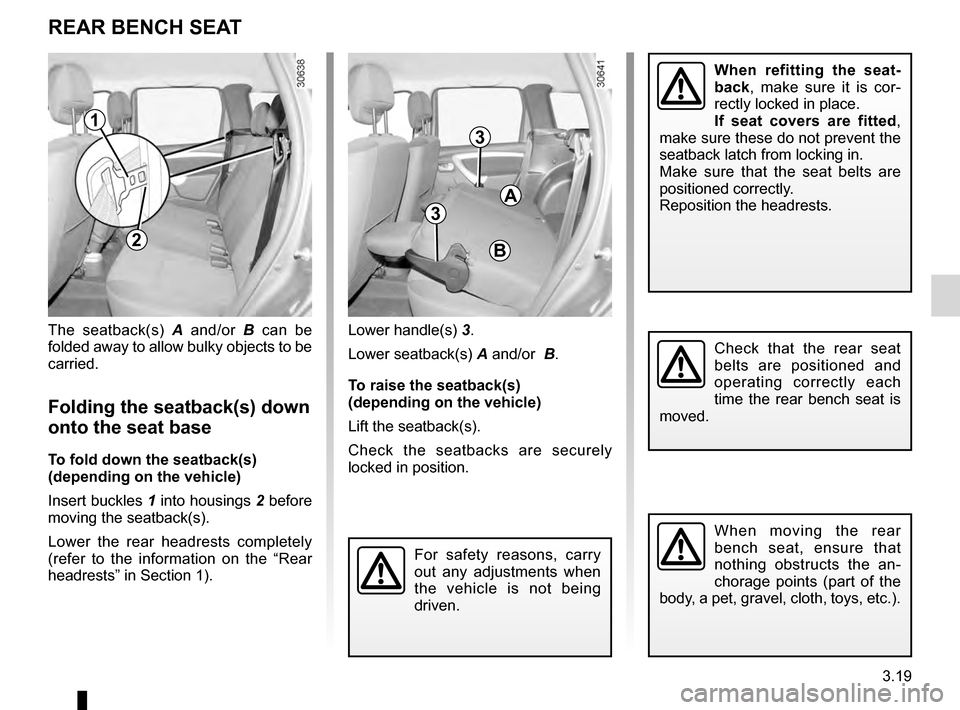
The seatback(s) A and/or B can be
folded away to allow bulky objects to be
carried.
Folding the seatback(s) down
onto the seat base
To fold down the seatback(s)
(depending on the vehicle)
Insert buckles
1
into housings
2 before
moving the seatback(s).
L
ower the rear headrests completely
(refer to the information on the “Rear
headrests” in Section 1).
For safety reasons, carry
out any adjustments when
the vehicle is not being
driven.
REAR BENCH SEAT
Lower handle(s) 3 .
Lower seatback(s)
A
and/or B.
To raise the seatback(s)
(depending on the vehicle)
Lift the seatback(s).
Check the seatbacks are securely
locked in position.
When moving the rear
bench seat, ensure that
nothing obstructs the an-
chorage points (part of the
body, a pet, gravel, cloth, toys, etc.).
When refitting the seat-
back , make sure it is cor-
rectly locked in place.
If seat covers are fitted ,
make sure these do not prevent the
seatback latch from locking in.
Make sure that the seat belts are
positioned correctly.
Reposition the headrests.
A
B
3
3
Check that the rear seat
belts are positioned and
operating correctly each
time the rear bench seat is
moved.
1
2
Page 111 of 200
transporting objectsin the luggage compartment ........... (up to the end of the DU)
towing rings .......................................... (up to the end of the DU)
towing towing equipment ............................ (up to the end of the DU)
towing equipment fitting ............................................... (up to the end of the DU)
towing a caravan .................................. (up to the end of the DU)
3.21
ENG_UD24628_3
Transport d’objets dans le coffre (H79 - Dacia)
ENG_NU_898-5_H79_Dacia_3
Transporting objects in the boot
TRANSPORTING OBjECTS IN THE LuGGAGE COMPARTMENT
Always position the heavi-
est items directly on the
floor. Use the lashing points
on the luggage compart-
ment floor, if these are fitted to the
vehicle. The luggage should be
loaded in such a way that no items
will be thrown forward and strike the
occupants if the driver has to brake
suddenly.
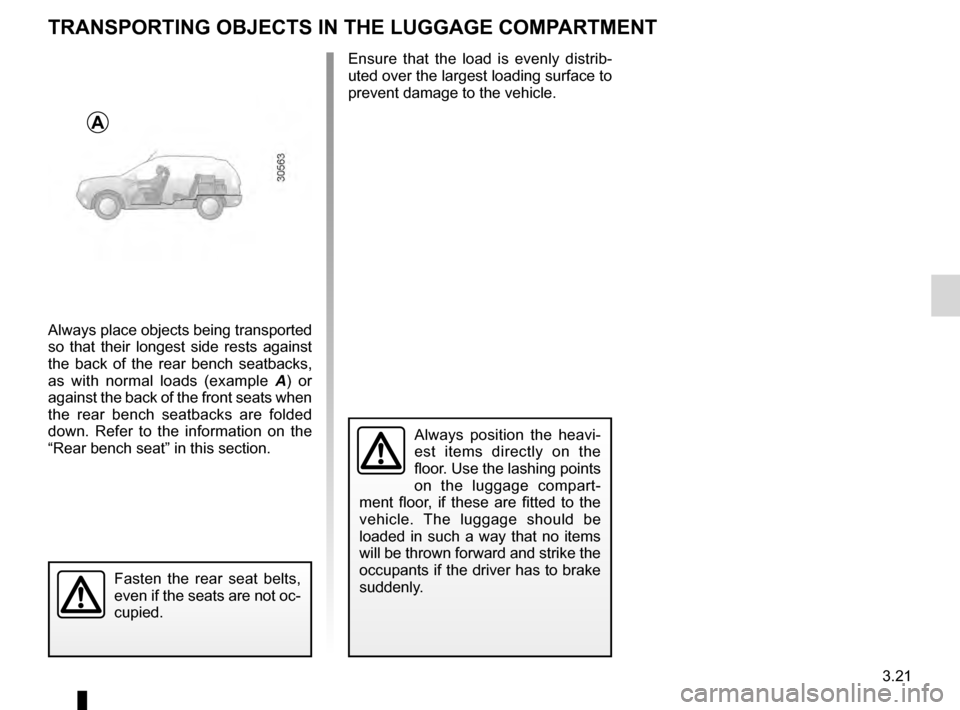
Always place objects being transported
so that their longest side rests against
the back of the rear bench seatbacks,
as with normal loads (example
A )
or
against the back of the front seats when
the rear bench seatbacks are folded
down. Refer to the information on the
“Rear bench seat” in this section.
A
Fasten the rear seat belts,
even if the seats are not oc-
cupied.
Ensure that the load is evenly distrib-
uted over the largest loading surface to
prevent damage to the vehicle.
Page 130 of 200
maintenance:interior trim ...................................... (up to the end of the DU)
interior trim maintenance ................................... (up to the end of the DU)
4.16
ENG_UD22288_6
Entretien des garnitures intérieures (B90 - U90 - L90 Ph2 - F90 Ph2 \
- R90 Ph2 - H79 - Dacia)
ENG_NU_898-5_H79_Dacia_4
Jaune NoirNoir texte
Glass instrument panel(e.g.: instrument panel, clock, exterior
temperature display, radio display).
Use a soft or cotton cloth. If this does
not clean them properly, use a soft cloth
(or cotton wool) slightly moistened with
soapy water and then wipe clean with
another damp soft or cotton cloth.
Finally, dry off carefully with a soft dry
cloth.
Cleaning products containing alco-
hol must not be used under any cir-
cumstances.
Seat belts
These must be kept clean. Use products
selected by our Technical Department
or warm, soapy water and a sponge
and wipe with a dry cloth.
Detergents or dyes must not be used
under any circumstances.
Interior trim maintenance
INTERIOR TRIM MAINTENANCE (1/2)
A well-maintained vehicle will have a
longer service life. It is therefore ad-
visable to maintain the vehicle interior
regularly.
Stains should always be dealt with
quickly. Whatever type of stain is on
the trim, use soapy water (if possible,
warm water) containing:
Do not use detergents (washing up
liquid, powdered products, alcohol-
based products, etc.).
Use a soft cloth.
Rinse and soak up the excess.Fabrics (seats, door trim,
etc.)
Dust fabrics regularly.
Liquid stains
Use soapy water.
Dab lightly (never rub) with a soft cloth,
rinse and remove the excess.
Solid or thick stains
Remove any excess solid or thick ma-
terial immediately and carefully using
a spatula (from the edge inwards to
avoid spreading the stain).
Clean using the procedure for a liquid
stain.
Special instructions for sweets or
chewing gum
Put an ice cube on the stain to solidify
it, then proceed as for a solid stain.
For advice on interior maintenance
and/or on unsatisfactory results,
contact an approved dealer.
Page 165 of 200
JauneNoirNoir texte
5.33
ENG_UD22437_4
Remorquage : dépannage (H79 - Dacia)
ENG_NU_898-5_H79_Dacia_5
TOWING: breakdown (2/3)
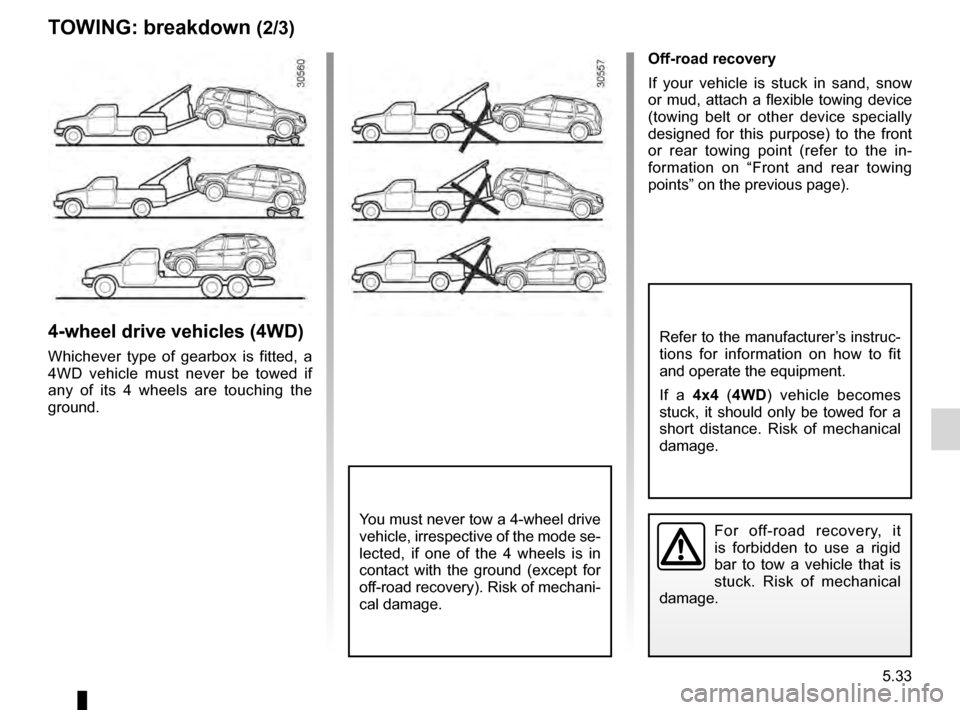
4-wheel drive vehicles (4WD)
Whichever type of gearbox is fitted, a
4WD vehicle must never be towed if
any of its 4 wheels are touching the
ground.
Off-road recovery
If your vehicle is stuck in sand, snow
or mud, attach a flexible towing device
(towing belt or other device specially
designed for this purpose) to the front
or rear towing point (refer to the in-
formation on “Front and rear towing
points” on the previous page).
For off-road recovery, it
is forbidden to use a rigid
bar to tow a vehicle that is
stuck. Risk of mechanical
damage.You must never tow a 4-wheel drive
vehicle, irrespective of the mode se-
lected, if one of the 4 wheels is in
contact with the ground (except for
off-road recovery). Risk of mechani-
cal damage.
Refer to the manufacturer’s instruc-
tions for information on how to fit
and operate the equipment.
If a 4x4 (4WD ) vehicle becomes
stuck, it should only be towed for a
short distance. Risk of mechanical
damage.
Page 174 of 200
5.42
ENG_UD20968_2
Anomalies de fonctionnement (H79 - Dacia)
ENG_NU_898-5_H79_Dacia_5
Jaune NoirNoir texte
On the road POSSIBLE CAUSESWHAT TO DO
The power-assisted steering be-
comes heavy. Belt broken.
Lack of power-assisted steer-
ing oil in the pump.Have the belt replaced.
For maintenance operations on the power-assisted
steering, contact an approved dealer.
The engine overheats. The coolant
temperature indicator light comes
on. Engine cooling fan not work-
ing.
Stop the vehicle, switch off the engine and contact
an approved dealer.
Coolant leaks. Stop the vehicle, switch off the engine and check
the coolant reservoir: it should contain fluid. If there
is no coolant, consult an approved dealer as soon
as possible.
Radiator blocked or clogged. Stop the vehicle, switch off the engine and clean the radiator (refer to the information on “Bodywork
maintenance/engine compartment” in Section 2). If
it is clean, consult an approved dealer as soon as
possible.
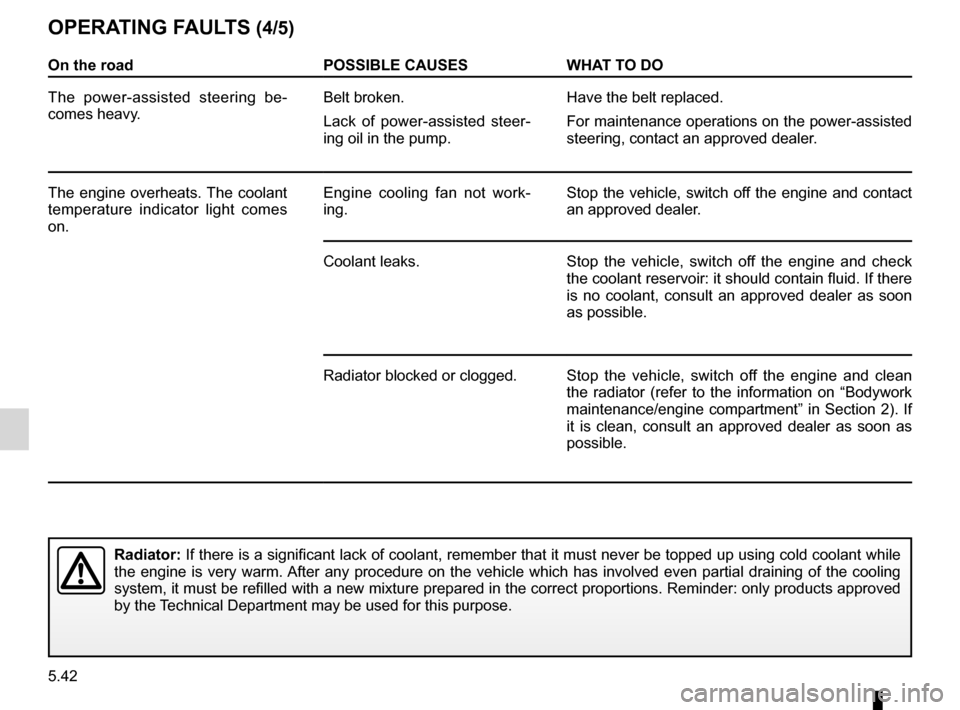
OPERATING FAULTS (4/5)
Radiator: If there is a significant lack of coolant, remember that it must never be topped up using cold coolant while
the engine is very warm. After any procedure on the vehicle which has involved even partial draining of the cooling
system, it must be refilled with a new mixture prepared in the correct proportions. Reminder: only products approved
by the Technical Department may be used for this purpose.