speed DAEWOO LACETTI 2004 Service Repair Manual
[x] Cancel search | Manufacturer: DAEWOO, Model Year: 2004, Model line: LACETTI, Model: DAEWOO LACETTI 2004Pages: 2643, PDF Size: 80.54 MB
Page 972 of 2643

2E – 10ITIRES AND WHEELS
DAEWOO V–121 BL4
turers of tire chains have a specific chain size for each tire
size to ensure a proper fit when the chain is installed. Be
sure to purchase the correct chains for the tires on which
they are to be used. Use rubber adjusters to take up any
slack or clearance in loose chains.
Use of chains may adversely affect vehicle handling.
When tire chains are installed, follow these precautions:
S Adjust speed to road conditions.
S Avoid sharp turns.
S Avoid locked–wheel braking.
To prevent chain damage to the vehicle, install the chains
on the front tires as tightly as possible. Tighten them again
after driving 0.4 to 0.8 kilometer (0.3 to 0.5 mile). The use
of chains on the rear tires is not recommended because
they may contact the vehicle and possibly damage it. If
chains must be used on the rear tires, be sure there is suffi-
cient clearance between the chains and the body. Do not
exceed 70 km/h (45 mph) or the chain manufacturer’s
speed limit, if lower. Avoid large bumps, potholes, severe
turns and any other maneuvers which could cause the
tires to bounce. Follow any other instructions of the chain
manufacturer which do not disagree with the above in-
structions.
REPLACEMENT TIRES
A tire performance criteria (TPC) specification number is
molded in the sidewall near the tire size of all original
equipment tires. This specification number assures that
the tire meets performance standards for traction, endur-
ance, dimensions, noise, handling and rolling resis–tance.
Usually a specific TPC number is assigned to each tire
size.
CAUTION : Do not mix different types of tires on the
same vehicle such as radial, bias and bias–belted
tires except in emergencies, because vehicle han-
dling may be seriously affected and may result in loss
of control.
Use only replacement tires with the same size, load range,
and construction as the original. The use of any other tire
size or construction type may seriously affect ride, han-
dling, speedometer/odometer calibration, vehicle ground
clearance, and tire clearance to the body and the chassis.
This does not apply to the spare tire furnished with the ve-
hicle.
It is recommended that new tires be installed in pairs on
the same axle.
If it is necessary to replace only one tire, pair it with the tire
having the most tread to equalize the braking action.
Although they may appear different in tread design, tires
built by different manufacturers with identical TPC specifi-
cations may be used on the same vehicle.
ALL SEASON TIRES
Most vehicles are now equipped with steel–belted all sea-
son radial tires as standard equipment. These tires qualify
as snow tires, with a 37 percent higher average rating for
snow traction than the non–all season radial tires pre-
viously used. Other performance areas, such as wet trac-
tion, rolling resistance, tread life, and air retention, have
also been improved. This was done by improvements in
both tread design and tread compounds. These tires are
identified by an ”M + S” molded in the tire sidewall following
the size number. The suffix ”MS” is also molded in the side-
wall after the TPC specification number.
The optional handling tires used on some vehicles are not
all season tires. These will not have the ”MS” marking after
the tire size or the TPC specification number.
PASSENGER METRIC SIZED TIRES
All Daewoo vehicles now use Passenger (P) metric sized
tires. P–metric tires are available in two load ranges: stan-
dard load (35 psi maximum) and extra load (41 psi maxi-
mum). Most passenger vehicle tires are standard load.
Most P–metric tire sizes do not have exact corresponding
alphanumeric tire sizes. For example, a P175/70R13 is
not exactly equal in size and load–carrying capacity to an
FR70–13. For this reason, replacement tires should be of
the same TPC specification number as the originals. If P–
metric tires must be replaced with other sizes, consult a
tire dealer. Tire companies can best recommend the clos-
est match of alphanumeric to P–metric sizes within their
own tire lines.
The metric term for measuring tire inflation pressure is the
kilopascal (kPa). Tire pressure may be printed in both kPa
and psi. One psi equals 6.895 kPa.
See the tire label or refer to ”Tire Size and Pressure Speci-
fications” in this section for tire inflation pressures.
TIRE LABEL
The tire label is permanently located on the rear face of the
driver’s door and should be referred to for tire information.
It lists the maximum vehicle load, the tire size (including
the spare tire), and the cold inflation pressure (including
the spare tire).
SPARE TIRE
The notchback and the wagon come equipped with a full–
sized tire on a steel wheel. The hatchback comes
equipped with a reduced–sized temporary tire on a steel
wheel.
WHEELS
Wheels must be replaced if they are bent, dented, have
excessive lateral or radial runout, leak air through welds,
have elongated bolt holes, or if the wheel bolts won’t stay
tight or are heavily rusted. Wheels with excessive runout
may cause vehicle vibration. Replacement wheels must
be equivalent to the original equipment wheels in load ca-
Page 973 of 2643

TIRES AND WHEELS 2E – 11
DAEWOO V–121 BL4
pacity, diameter, rim width, offset, and mounting configu-
ration. A wheel of improper size or type may affect wheel
and bearing life, brake cooling, speedometer/odometer
calibration, vehicle ground clearance, and tire clearance
to the body and the chassis. The wheel offset is 49 ± 1 mm
(1.93 ± 0.04 inches). Steel wheels may be identified by a
two– or three–letter code stamped into the rim near the
valve stem. Alloy wheels should have the code, the part
number, and the manufacturer ID cast into the back side.
INFLATION O TIRES
The pressure recommended for any vehicle line is careful-
ly calculated to give a satisfactory ride, handling, tread life,
and load–carrying capacity.
Tire pressure should be checked monthly or before any
extended trip. Check the tires when they are cold, after the
vehicle has sat for 3 hours or more, or has been driven less
than 1 mile. Set the tire pressure to the specifications on
the tire label located on the rear face of the driver’s door.
Tire inflation pressure is also given under ”Tire Size and
Pressure Specifications” in this section.
Valve caps or extensions should be on the valves to keep
dust and water out.
For sustained driving at speeds up to 140 km/h (85 mph),
inflate the tires to the pressure recommended on the tire.
Sustained driving at speeds faster than 140 km/h (85mph), even if permitted by law, is not advised unless the
vehicle has special high–speed tires available from many
tire dealers. Tire pressures may increase as much as 41
kPa (6 psi) when the tires are hot.
Higher than recommended tire pressure can cause
S Hard ride.
S Tire bruising or damage.
S Rapid tread wear at the center of the tire.
Lower than recommended pressure can cause
S Tire squeal on turns.
S Hard steering.
S Rapid and uneven wear on the edges of the tread.
S Tire rim bruises and rupture.
S Tire cord breakage.
S High tire temperatures.
Unequal tire pressures on same axle can cause
S Uneven braking.
S Steering lead.
S Reduced handling.
S Swerve on acceleration.
S Torque steer.
Page 1006 of 2643
MANUAL TRANSAXLE DRIVE AXLE 3B – 7
DAEWOO V–121 BL4
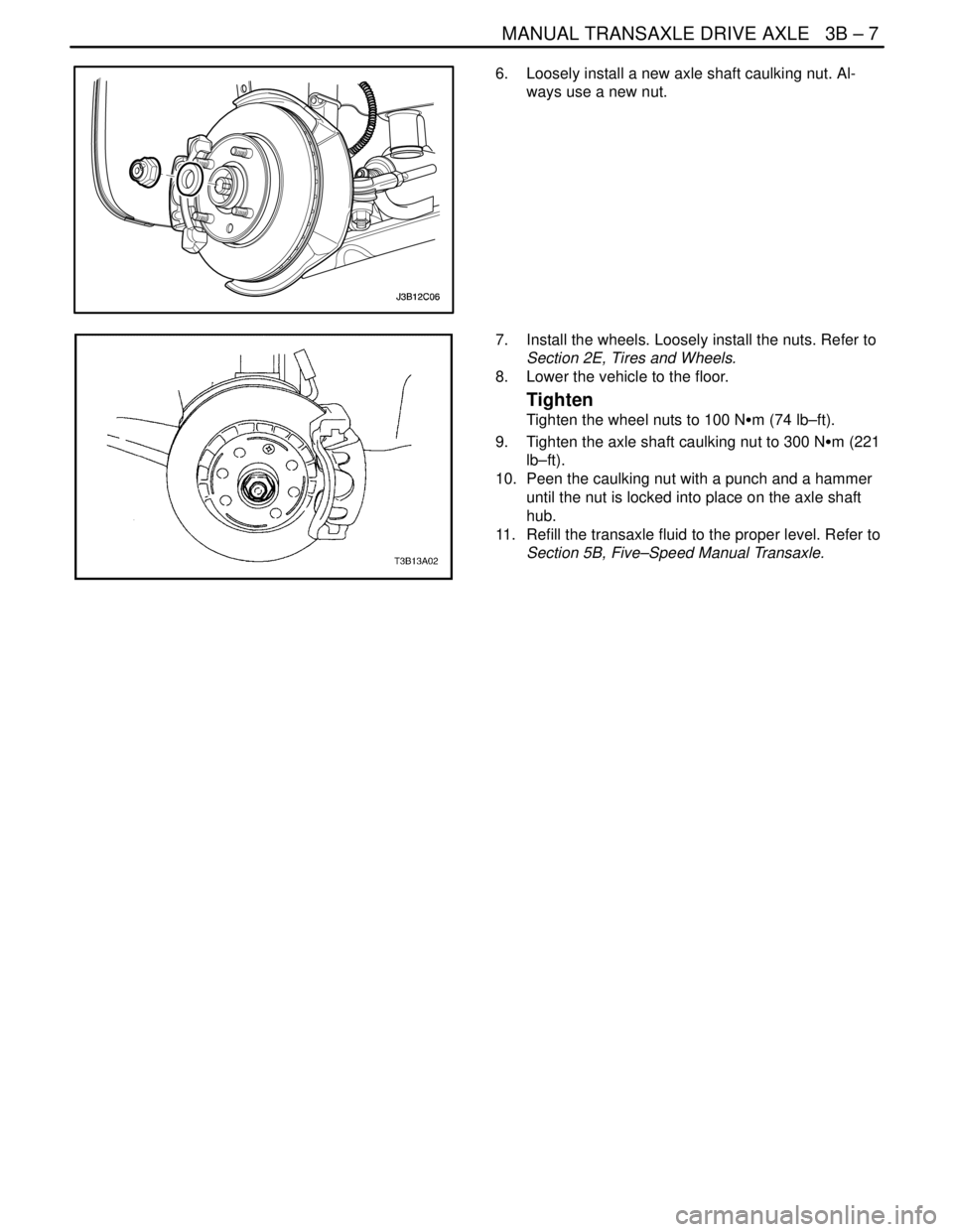
6. Loosely install a new axle shaft caulking nut. Al-
ways use a new nut.
7. Install the wheels. Loosely install the nuts. Refer to
Section 2E, Tires and Wheels.
8. Lower the vehicle to the floor.
Tighten
Tighten the wheel nuts to 100 NSm (74 lb–ft).
9. Tighten the axle shaft caulking nut to 300 NSm (221
lb–ft).
10. Peen the caulking nut with a punch and a hammer
until the nut is locked into place on the axle shaft
hub.
11. Refill the transaxle fluid to the proper level. Refer to
Section 5B, Five–Speed Manual Transaxle.
Page 1021 of 2643

HYDRAULIC BRAKES 4A – 5
DAEWOO V–121 BL4
DIAGNOSIS
BRAKE SYSTEM TESTING
Brakes should be tested on a dry, clean, reasonably
smooth and level roadway. A true test of brake perfor-
mance cannot be made if the roadway is wet, greasy, or
covered with loose dirt whereby all tires do not grip the
road equally. Testing will also be adversely affected if the
roadway is crowned so as to throw the weight so roughly
that the wheels tend to bounce.
Test the brakes at different vehicle speeds with both light
and heavy pedal pressure; however, avoid locking the
brakes and sliding the tires. Locked brakes and sliding
tires do not indicate brake efficiency since heavily braked,
but turning, wheels will stop the vehicle in less distance
than locked brakes. More tire–to–road friction is present
with a heavily–braked, turning tire than with a sliding tire.
Because of the high deceleration capability, a firmer pedal
may be felt at higher deceleration levels.
There are three major external conditions that affect brake
performance:
S Tires having unequal contact and grip of the road
will cause unequal braking. Tires must be equally
inflated, and the tread pattern of the right and the
left tires must be approximately equal.
S Unequal loading of the vehicle can affect the brake
performance since the most heavily loaded wheels
require more braking power, and thus more braking
effort, than the others.
S Misalignment of the wheels, particularly conditions
of excessive camber and caster, will cause the
brakes to pull to one side.
To check for brake fluid leaks, hold constant foot pressure
on the pedal with the engine running at idle and the shift
lever in NEUTRAL. If the pedal gradually falls away with
the constant pressure, the hydraulic system may be leak-
ing. Perform a visual check to confirm any suspected
leaks.
Check the master cylinder fluid level. While a slight drop
in the reservoir level results from normal lining wear, an ab-
normally low level indicates a leak in the system. The hy-
draulic system may be leaking either internally or external-
ly. Refer to the procedure below to check the master
cylinder. Also, the system may appear to pass this test
while still having a slight leak. If the fluid level is normal,
check the vacuum booster pushrod length. If an incorrect
pushrod length is found, adjust or replace the rod.
Check the master cylinder using the following procedure:
S Check for a cracked master cylinder casting or
brake fluid leaking around the master cylinder.
Leaks are indicated only if there is at least one drop
of fluid. A damp condition is not abnormal.S Check for a binding pedal linkage and for an incor-
rect pushrod length. If both of these parts are in
satisfactory condition, disassemble the master cyl-
inder and check for an elongated or swollen primary
cylinder or piston seals. If swollen seals are found,
substandard or contaminated brake fluid should be
suspected. If contaminated brake fluid is found, all
the components should be disassembled and
cleaned, and all the rubber components should be
replaced. All of the pipes must also be flushed.
Improper brake fluid, or mineral oil or water in the fluid,
may cause the brake fluid to boil or cause deterioration of
the rubber components. If the primary piston cups in the
master cylinder are swollen, then the rubber parts have
deteriorated. This deterioration may also be evidenced by
swollen wheel cylinder piston seals on the drum brake
wheels.
If deterioration of rubber is evident, disassemble all the hy-
draulic parts and wash the parts with alcohol. Dry these
parts with compressed air before reassembly to keep alco-
hol out of the system. Replace all the rubber parts in the
system, including the hoses. Also, when working on the
brake mechanisms, check for fluid on the linings. If exces-
sive fluid is found, replace the linings.
If the master cylinder piston seals are in satisfactory condi-
tion, check for leaks or excessive heat conditions. If these
conditions are not found, drain the fluid, flush the master
cylinder with brake fluid, refill the master cylinder, and
bleed the system. Refer to ”Manual Bleeding the Brakes”
or”Pressure Bleeding the Brakes” in this section.
BRAKE HOSE INSPECTION
The hydraulic brake hoses should be inspected at least
twice a year. The brake hose assembly should be checked
for road hazard damage, cracks, chafing of the outer cov-
er, and for leaks or blisters. Inspect the hoses for proper
routing and mounting. A brake hose that rubs on a suspen-
sion component will wear and eventually fail. A light and
a mirror may be needed for an adequate inspection. If any
of the above conditions are observed on the brake hose,
adjust or replace the hose as necessary.
WARNING LAMP OPERATION
This brake system uses a BRAKE warning lamp located
in the instrument panel cluster. When the ignition switch
is in the START position, the BRAKE warning lamp should
glow and go OFF when the ignition switch returns to the
RUN position.
The following conditions will activate the BRAKE lamp:
S Parking brake applied. The light should be ON
whenever the parking brake is applied and the igni-
tion switch is ON.
S Low fluid level. A low fluid level in the master cylin-
der will turn the BRAKE lamp ON.
S EBD system is disabled. The light should be ON
when the EBD system is malfunctioning.
Page 1077 of 2643
4E2 – 8IREAR DRUM BRAKES
DAEWOO V–121 BL4
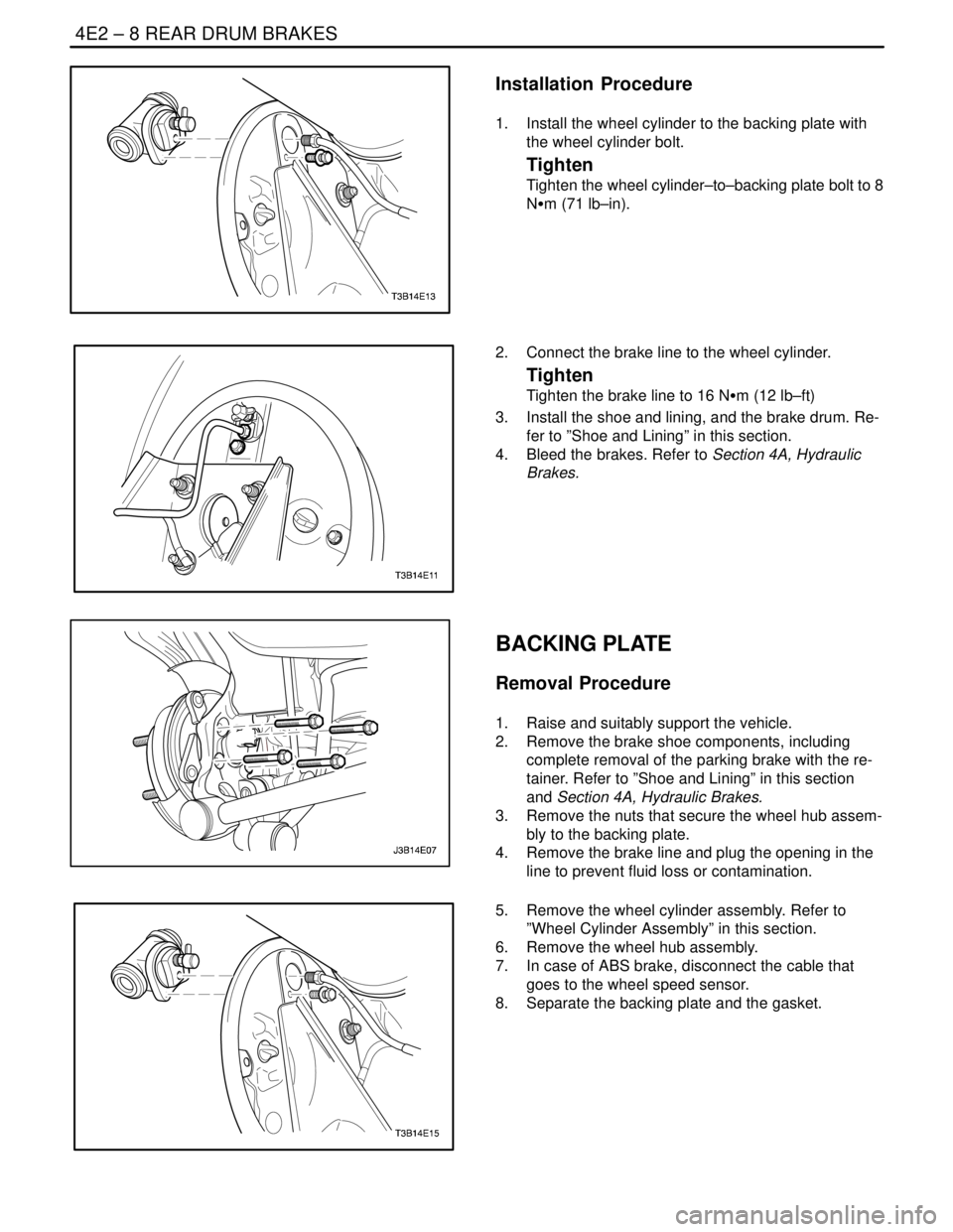
Installation Procedure
1. Install the wheel cylinder to the backing plate with
the wheel cylinder bolt.
Tighten
Tighten the wheel cylinder–to–backing plate bolt to 8
NSm (71 lb–in).
2. Connect the brake line to the wheel cylinder.
Tighten
Tighten the brake line to 16 NSm (12 lb–ft)
3. Install the shoe and lining, and the brake drum. Re-
fer to ”Shoe and Lining” in this section.
4. Bleed the brakes. Refer to Section 4A, Hydraulic
Brakes.
BACKING PLATE
Removal Procedure
1. Raise and suitably support the vehicle.
2. Remove the brake shoe components, including
complete removal of the parking brake with the re-
tainer. Refer to ”Shoe and Lining” in this section
and Section 4A, Hydraulic Brakes.
3. Remove the nuts that secure the wheel hub assem-
bly to the backing plate.
4. Remove the brake line and plug the opening in the
line to prevent fluid loss or contamination.
5. Remove the wheel cylinder assembly. Refer to
”Wheel Cylinder Assembly” in this section.
6. Remove the wheel hub assembly.
7. In case of ABS brake, disconnect the cable that
goes to the wheel speed sensor.
8. Separate the backing plate and the gasket.
Page 1082 of 2643

SECTION : 4F
ANTILOCK BRAKE SYSTEM
CAUTION : Disconnect the negative battery cable before removing or installing any electrical unit or when a tool
or equipment could easily come in contact with exposed electrical terminals. Disconnecting this cable will help
prevent personal injury and damage to the vehicle. The ignition must also be in LOCK unless otherwise noted.
TABLE OF CONTENTS
SPECIFICATIONS4F–2 . . . . . . . . . . . . . . . . . . . . . . . . . .
Fastener Tightening Specifications 4F–2. . . . . . . . . .
SPECIAL TOOLS4F–2 . . . . . . . . . . . . . . . . . . . . . . . . . . .
Special Tools Table 4F–2. . . . . . . . . . . . . . . . . . . . . . . .
SCHEMATIC AND ROUTING DIAGRAMS4F–3 . . . . .
Abs System Circuit (I) 4F–3. . . . . . . . . . . . . . . . . . . . . .
Abs System Circuit (II) 4F–4. . . . . . . . . . . . . . . . . . . . .
Ebcm Connector Face View 4F–5. . . . . . . . . . . . . . . . .
COMPONENT LOCATOR4F–6 . . . . . . . . . . . . . . . . . . . .
ABS/EBD System Drive 4F–6. . . . . . . . . . . . . . . . . . . .
DIAGNOSIS4F–7 . . . . . . . . . . . . . . . . . . . . . . . . . . . . . . . .
Diagnostic Circuit Check 4F–7. . . . . . . . . . . . . . . . . . .
ABS Indicator Lamp Inoperative 4F–9. . . . . . . . . . . . .
Power Supply to Control Module,
No DTCs Stored 4F–12. . . . . . . . . . . . . . . . . . . . . . . .
ABS Indicator Lamp Illuminated Continuously,
No DTCs Stored 4F–16. . . . . . . . . . . . . . . . . . . . . . . .
Electronic Brake–Force Distribution (EBD)
System Indicator Lamp Inoperative 4F–18. . . . . . . .
SELF–DIAGNOSTICS 4F–22. . . . . . . . . . . . . . . . . . . .
DISPLAYING DTCs 4F–22. . . . . . . . . . . . . . . . . . . . . . .
CLEARING DTCs 4F–22. . . . . . . . . . . . . . . . . . . . . . . .
INTERMITTENTS AND POOR
CONNECTIONS 4F–22. . . . . . . . . . . . . . . . . . . . . . . .
DTC C0035 Left Front Wheel Speed Sensor
Circuit Malfunction 4F–23. . . . . . . . . . . . . . . . . . . . . .
DTC C0040 Right Front Wheel Speed Sensor
Circuit Malfunction 4F–26. . . . . . . . . . . . . . . . . . . . . .
DTC C0045 Left Rear Wheel Speed Sensor
Circuit Malfunction 4F–29. . . . . . . . . . . . . . . . . . . . . .
DTC C0050 Right Rear Wheel Speed Sensor
Circuit Malfunction 4F–32. . . . . . . . . . . . . . . . . . . . . .
DTC C0060/C0065 Left Front Inlet and
Outlet Valve Solenoid Fault 4F–35. . . . . . . . . . . . . . .
DTC C0070/C0075 Right Front Inlet and
Outlet Valve Solenoid Fault 4F–37. . . . . . . . . . . . . . . DTC C0080/C0085 Left Rear Inlet and
Outlet Valve Solenoid Fault 4F–39. . . . . . . . . . . . . . .
DTC C0090/C0095 Right Rear Inlet and
Outlet Valve Solenoid Fault 4F–41. . . . . . . . . . . . . . .
DTC C0110 Pump Motor Circuit Malfunction 4F–43. .
DTC C0121 Valve Relay Circuit Malfunction 4F–45. .
DTC C0161 ABS Brake Switch Circuit
Malfunction 4F–47. . . . . . . . . . . . . . . . . . . . . . . . . . . .
DTC C0245 Wheel Speed Sensor Frequency
Error 4F–50. . . . . . . . . . . . . . . . . . . . . . . . . . . . . . . . . .
DTC C0550 ABS Control Module Internal
Fault 4F–54. . . . . . . . . . . . . . . . . . . . . . . . . . . . . . . . . .
DTC C0800 Low Voltage Fault 4F–56. . . . . . . . . . . . .
DTC C0931 Overheated 4F–59. . . . . . . . . . . . . . . . . . .
MAINTENANCE AND REPAIR4F–60 . . . . . . . . . . . . . .
ON–VEHICLE SERVICE 4F–60. . . . . . . . . . . . . . . . . . . .
Service Precautions 4F–60. . . . . . . . . . . . . . . . . . . . . . .
Bleeding System 4F–61. . . . . . . . . . . . . . . . . . . . . . . . .
ABS 5.3 Assembly 4F–61. . . . . . . . . . . . . . . . . . . . . . . .
Front Wheel Speed Sensor 4F–62. . . . . . . . . . . . . . . .
Front Wheel Speed Sensor Jumper Harness 4F–63.
Rear Wheel Speed Sensor 4F–64. . . . . . . . . . . . . . . . .
GENERAL DESCRIPTION AND SYSTEM
OPERATION4F–65 . . . . . . . . . . . . . . . . . . . . . . . . . . . . .
Basic Knowledge Required 4F–65. . . . . . . . . . . . . . . . .
ABS System Components 4F–65. . . . . . . . . . . . . . . . .
Base Braking Mode 4F–65. . . . . . . . . . . . . . . . . . . . . . .
Antilock Braking Mode 4F–66. . . . . . . . . . . . . . . . . . . . .
EBD System 4F–69. . . . . . . . . . . . . . . . . . . . . . . . . . . . .
Electronic Brake–Force Distribution (EBD) Failure
Matrix 4F–70. . . . . . . . . . . . . . . . . . . . . . . . . . . . . . . . .
Tires and ABS/EBD 4F–71. . . . . . . . . . . . . . . . . . . . . . .
Electronic Brake Control Module (EBCM) 4F–71. . . .
Front Wheel Speed Sensors 4F–71. . . . . . . . . . . . . . .
Front Wheel Speed Sensor Rings 4F–71. . . . . . . . . . .
Rear Wheel Speed Sensors and Rings 4F–71. . . . . .
Valve Relay and Pump Motor Relay 4F–71. . . . . . . . .
Page 1083 of 2643
4F – 2IANTILOCK BRAKE SYSTEM
DAEWOO V–121 BL4
Wiring Harness 4F–71. . . . . . . . . . . . . . . . . . . . . . . . . . . Indicators 4F–71. . . . . . . . . . . . . . . . . . . . . . . . . . . . . . . .
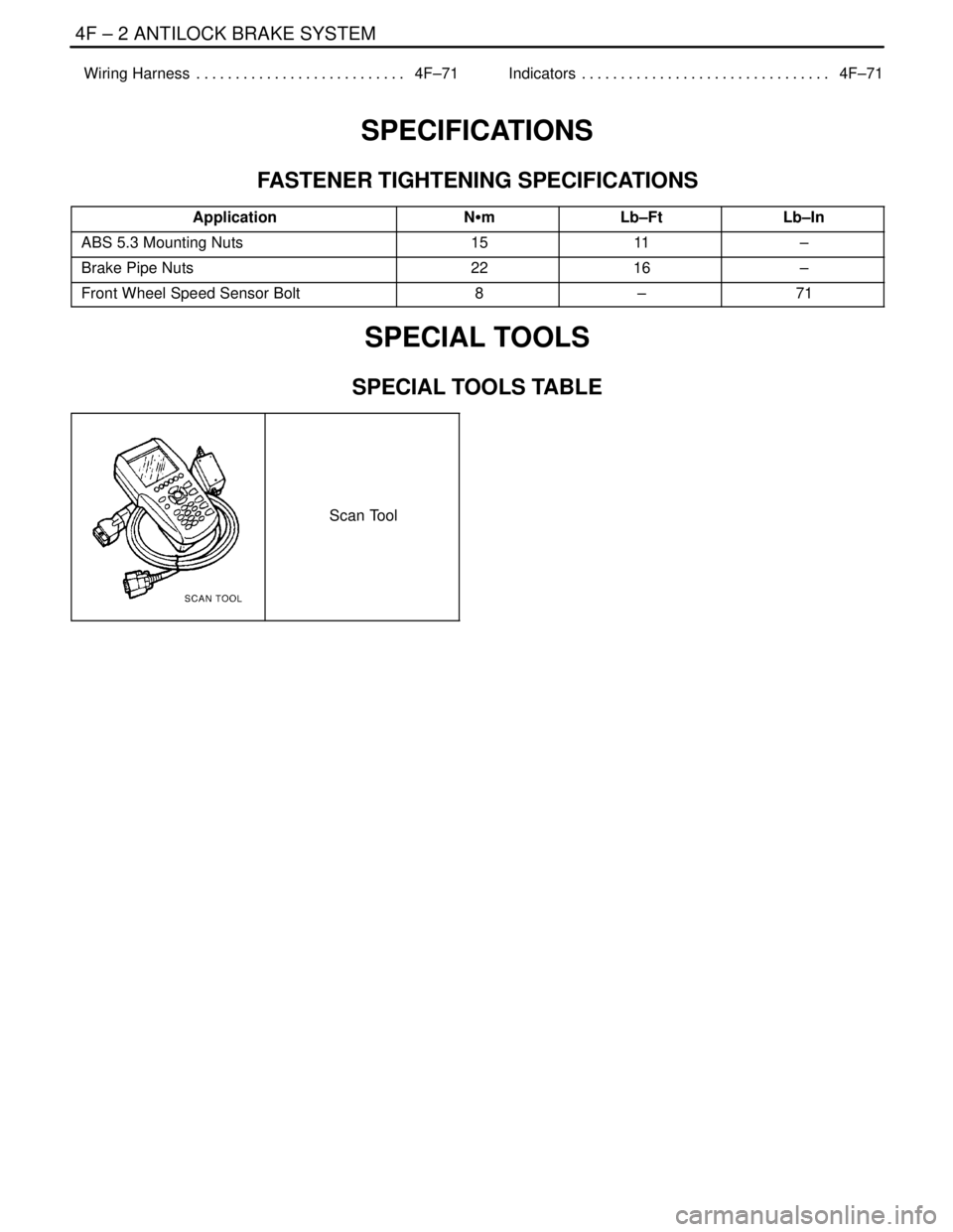
SPECIFICATIONS
FASTENER TIGHTENING SPECIFICATIONS
ApplicationNSmLb–FtLb–In
ABS 5.3 Mounting Nuts1511–
Brake Pipe Nuts2216–
Front Wheel Speed Sensor Bolt8–71
SPECIAL TOOLS
SPECIAL TOOLS TABLE
Scan Tool
Page 1084 of 2643

ANTILOCK BRAKE SYSTEM 4F – 3
DAEWOO V–121 BL4
SCHEMATIC AND ROUTING DIAGRAMS
ABS SYSTEM CIRCUIT (I)
1
12
2
C111 1 2 2
E B C M
19
16 1418
B+
B+1576 54
G106
10A
62C202 BRN
BRN
BRN
BRN
BRNF11
Hot in Run and Start
6C110 C107 C107
40 C202
60A
1
6C105
C102
RED ORN/
BLK
RED RED
RED
Ground IGN+
Ground LT B L U Brake
Switch2
4Ef215AEf13
Hot at All Times
4330
C201 C201
J3B14F01
11
11
S301
2 WHT GRYGRY
WHT GRY
WHT PPL
YEL
WHTWHT
RED
BRN BRN
BLK BLK
DK
BLUBRN LT
BLU
1
21 4 5
10 89 3
31
C110
43
12
C30214C202
LT B L U LT B L U LT B L U
LT B L U
RR/LH
Wheel Speed SensorRR/RH BLK/WHT
G106
BLK
61
C201
76
C201
17
Oil feeding
Connector
”2”Ter
Oil feeding
Connector
”4”Ter
FRT/LHWheel Speed Sensor
FRT/RH
1C110
Page 1087 of 2643
4F – 6IANTILOCK BRAKE SYSTEM
DAEWOO V–121 BL4
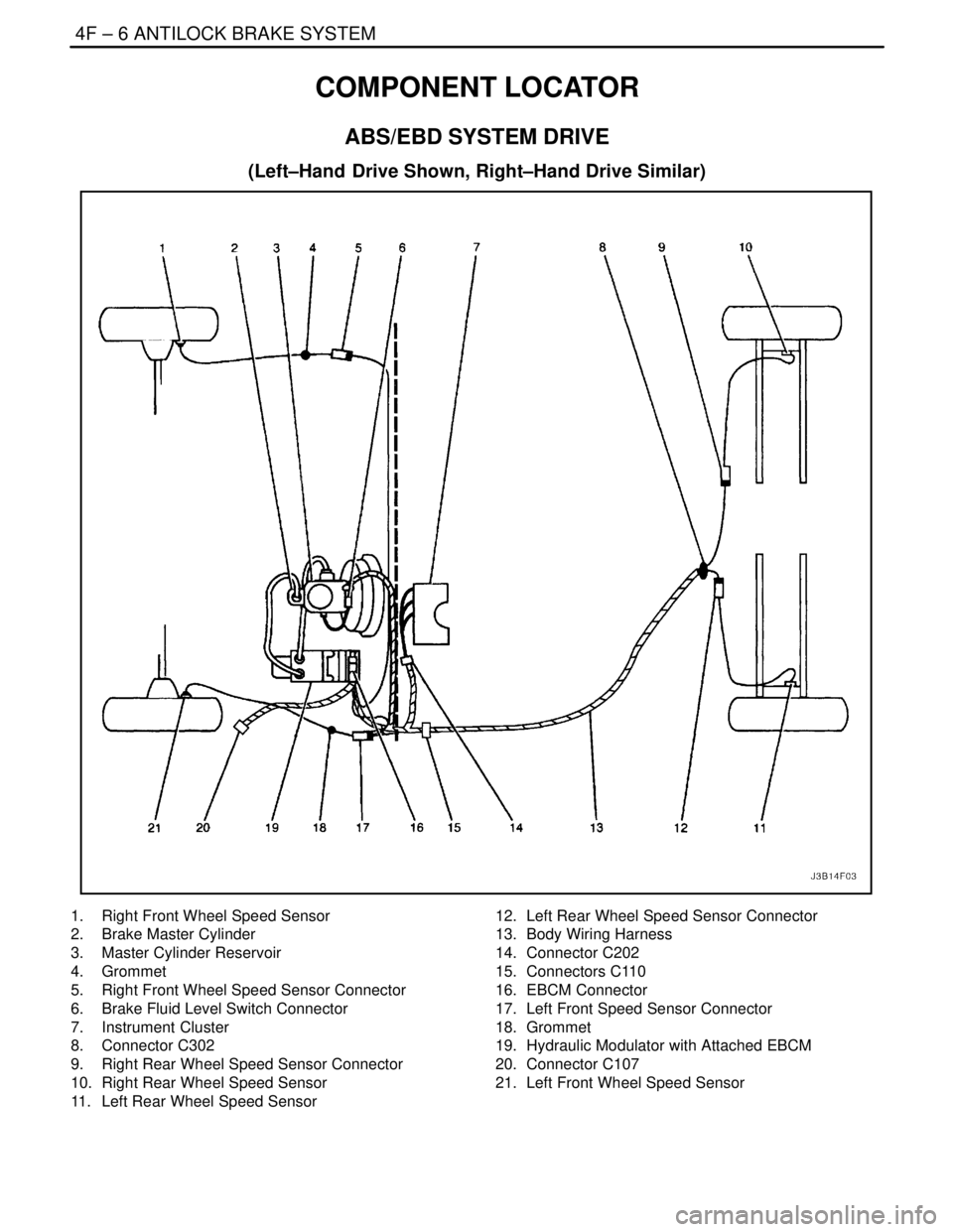
COMPONENT LOCATOR
ABS/EBD SYSTEM DRIVE
(Left–Hand Drive Shown, Right–Hand Drive Similar)
1. Right Front Wheel Speed Sensor
2. Brake Master Cylinder
3. Master Cylinder Reservoir
4. Grommet
5. Right Front Wheel Speed Sensor Connector
6. Brake Fluid Level Switch Connector
7. Instrument Cluster
8. Connector C302
9. Right Rear Wheel Speed Sensor Connector
10. Right Rear Wheel Speed Sensor
11. Left Rear Wheel Speed Sensor12. Left Rear Wheel Speed Sensor Connector
13. Body Wiring Harness
14. Connector C202
15. Connectors C110
16. EBCM Connector
17. Left Front Speed Sensor Connector
18. Grommet
19. Hydraulic Modulator with Attached EBCM
20. Connector C107
21. Left Front Wheel Speed Sensor
Page 1103 of 2643

4F – 22IANTILOCK BRAKE SYSTEM
DAEWOO V–121 BL4
SELF–DIAGNOSTICS
Important : The electronic brake control module (EBCM)
turns the valve relay off when a diagnostic trouble code
(DTC) is set. The scan tool will indicate that the valve relay
is off when it is used to monitor the data list. This is normal
and should not be considered a malfunction.
Important : For safety reasons it is recommended that the
vehicle not be driven with test equipment connected. Ex-
ception : for testing of wheel speeds provided the test reg-
ulations are met.
The EBCM performs system self–diagnostics and can de-
tect and often isolate system malfunctions. When it de-
tects a malfunction, the EBCM sets a DTC that represents
the malfunction, turns ON the ABS and/or the EBD indica-
tors in most instances, and may disable the ABS and/or
the EBD functions as necessary for the duration of the igni-
tion cycle.
Once each ignition cycle, the EBCM performs an automat-
ic test when the vehicle speed > 6 km/h and the brake ped-
al is not actuated or when the vehicle speed > 15 km/h and
the brake pedal is actuated. In the course of this test, the
system cycles each valve solenoid and the pump motor,
along with the necessary relays, to check component op-
eration. If the EBCM detects any malfunctions, it will set
a DTC as described above.
DISPLAYING DTCS
Tools Required
Scan Tool
DTCs can be read through the use of the scan tool.
CLEARING DTCS
Tools Required
Scan Tool
The diagnostic trouble codes (DTCs) in the electronic
brake control module (EBCM) memory are erased:S Use the scan tool ”Clear DTCs” selection.
The method is detailed below. Be sure to verify proper sys-
tem operation and absence of DTCs when the clearing
procedure is completed.
The EBCM will not permit DTC clearing until all DTCs have
been displayed. Also, DTCs cannot be cleared by discon-
necting the EBCM, disconnecting the battery cables, or
turning the ignition switch to LOCK.
Scan Tool Method
The scan tool can clear ABS system DTCs using the mass
storage cartridge.
1. Install the scan tool and the mass storage cartridge.
2. Select ”Fault Memory.”
3. Select ”Clear Fault Memory.”
Clearing the fault memory cannot reset a valve relay which
was shut down when the fault was recognized. Changes
are possible only after the fault has been eliminated and
the next ignition cycle has begun.
INTERMITTENTS AND POOR
CONNECTIONS
As with most electronic systems, intermittent malfunctions
may be difficult to diagnose accurately. The following is a
method to try to isolate an intermittent malfunction, espe-
cially in wheel speed circuitry.
If an ABS malfunction occurs, the ABS indicator will illumi-
nate during the ignition cycle in which the malfunction was
detected. If it is an intermittent problem which seems to
have corrected itself (ABS indicator off), a history DTC will
be stored. Also stored will be the history data of the DTC
at the time the malfunction occurred. Use the scan tool
modular diagnostic system to read ABS history data.
Most intermittents are caused by faulty electrical connec-
tions or wiring, although a sticking relay or solenoid can oc-
casionally be at fault.