Reverse DAEWOO LACETTI 2004 Service User Guide
[x] Cancel search | Manufacturer: DAEWOO, Model Year: 2004, Model line: LACETTI, Model: DAEWOO LACETTI 2004Pages: 2643, PDF Size: 80.54 MB
Page 1369 of 2643

5A1 – 20IZF 4 HP 16 AUTOMATIC TRANSAXLE
DAEWOO V–121 BL4
Reverse
In Reverse, transaxle drive is via the input shaft and clutch
B. The elements of this transaxle function are as follows:
S Clutch B is engaged and drives the reverse sun
gear in a clock––wise direction.
S The D band is engaged and holds the planetary
gear carrier (front & rear) stationary causing the
differential pinion to rotate clockwise.
S The differential rotates in a counterclockwise direc-
tion.
S The output shaft is driven in a counterclockwise or
reverse direction.
Control
Clutch B Engaged
The line pressure, which is supplied by the oil pump, is di-
rected to clutch B via the manual valve. The position of the
check ball will change allowing direct pressure to clutch B.
Brake D Engaged
The line pressure, which engaged clutch B, is also sup-
plied to clutch valve D.In Reverse, solenoid 1 is switched ON and EDS 4 is
switched OFF. This will cause the fluid supplied to the re-
duction valve to flow to clutch valve D via the EDS 4.
The spool of clutch valve D will be depressed allowing fluid
to pass to holding valve D.
Lock–up Clutch (TCC)
Solenoid 2 is turned ON and the line pressure control valve
spool will be depressed. Fluid will now flow through the
torque converter pressure valve.
As a result, the oil pressure behind the converter lock–up
clutch piston and in the turbine zone is equal. The direction
of flow is through the turbine shaft and through the space
behind the piston, to the turbine chamber.
Lubrication/Cooling
The lubricating valve ensures that the converter is sup-
plied with cooling oil first if the pump rate is low. The lubri-
cating pressure valve in addition guarantees that the nec-
essary amount of cooling and lubricating oil is available via
the bypass duct.
The fluid, which is supplied from the torque converter,
flows to the cooler via the lubrication valve.
Page 1392 of 2643

ZF 4 HP 16 AUTOMATIC TRANSAXLE 5A1 – 43
DAEWOO V–121 BL4
DIAGNOSTIC INFORMATION AND
PROCEDURES DIAGNOSIS
BASIC KNOWLEDGE REQUIRED
You must be familiar with some basic electronics to use
this section of the Service Manual. They will help you to
follow diagnostic procedures.
Notice : Lack of the basic knowledge of this transaxle
when performing diagnostic procedures could result in in-
correct diagnostic performance or damage to transaxle
components.
Do not, under any circumstances, attempt to diagnose a
transaxle problem without this basic knowledge.
Notice : If a wire is probed with a sharp instrument and not
properly sealed afterward, the wire will corrode and an
open circuit will result.
Diagnostic test probes are now available that allow you to
probe individual wires without leaving the wire open to the
environment. These probe devices are inexpensive and
easy to install, and they permanently seal the wire from
corrosion.
Special Tools
You should be able to use a Digital Volt Meter (DVM), a cir-
cuit tester, jumper wires or leads and a line pressure gauge
set.
The functional check procedure is designed to verify the
correct operation of electronic components in the trans-
axle.
This will eliminate the unnecessary removal of transaxle
components.
FUNCTIONAL CHECK PROCEDURE
Begin with the Functional Check Procedure which pro-
vides a general outline of how to diagnose automatic
transaxle. The following functional check procedure will in-
dicate the proper path of diagnosing the transaxle by de-
scribing the basic checks and then referencing the loca-
tions of the specific checks.
S Check the fluid level according to the Fluid Level
Service Procedure.
S Check the transaxle for fluid leaks.
S Check if the transaxle fluid is not burnt by color and
smell.
S Ensure that the transaxle is not in Limp Home
Mode(LHM).
S Check the battery terminals and the ground con-
nections for corrosion or looseness.
S Check that the cooler flow is not restricted.S Check all electrical connections for tightness.
S Use on–board diagnostic tool or a scan tool to see
if any transaxle trouble codes have been set. Refer
to the appropriate ”Diagnostic Trouble Code (DTC)”
information and repair the vehicle as directed. After
repairing the vehicle, perform the road test and
verify that the code has not set again.
S Perform the Electrical/Garage Shift Tests.
S Perform the Road Test Procedure in this section.
S Inspect the oil and check for metal or other contam-
inants in the oil pan.
LINE PRESSURE CHECK
PROCEDURE
The 4HP 16 A/T uses a trochoid type oil pump to produce
hydraulic pressure, and a pressure control solenoid (sole-
noid 1) to control that pressure at the pressure regulator
valve, after it leaves the pump. The transaxle pressure
control solenoid is controlled by an electrical signal that
ranges from 0 to 12 volts corresponds to minimum line
pressure (approx. 89.9 to 124.7 psi (6.2 to 8.6 bar)) and
0 volt corresponds to a maximum line pressure (approx.
221.9 to 252.4 psi (15.3 to 17.4 bar)) in all range.
Line pressures are calculated for two sets of gear ranges
– Drive–Park–Neutral and Reverse. This allow the trans-
axle line pressure to be appropriate for different pressure
needs in different gear ranges:
Gear
Range
Solenoid
1RPMPressure
Drive,
ReverseOff2,500221.9~252.4psi
(15.3~17.4 bar)
On2,50017.4~269.8psi
(1.2~18.6 bar)
Neutral,
ParkOff2,500221.9~252.4psi
(15.3~17.4 bar)
On2,50089.9~269.8 psi
(6.2~18.6 bar)
Before performing a line pressure check, verify that the
pressure control solenoid is receiving the correct electrical
signal from the TCM:
1. Install a scan tool.
2. Start the engine and set parking brake.
3. Check for a stored pressure control solenoid diag-
nostic trouble code, and other diagnostic trouble
codes.
Page 1393 of 2643
5A1 – 44IZF 4 HP 16 AUTOMATIC TRANSAXLE
DAEWOO V–121 BL4
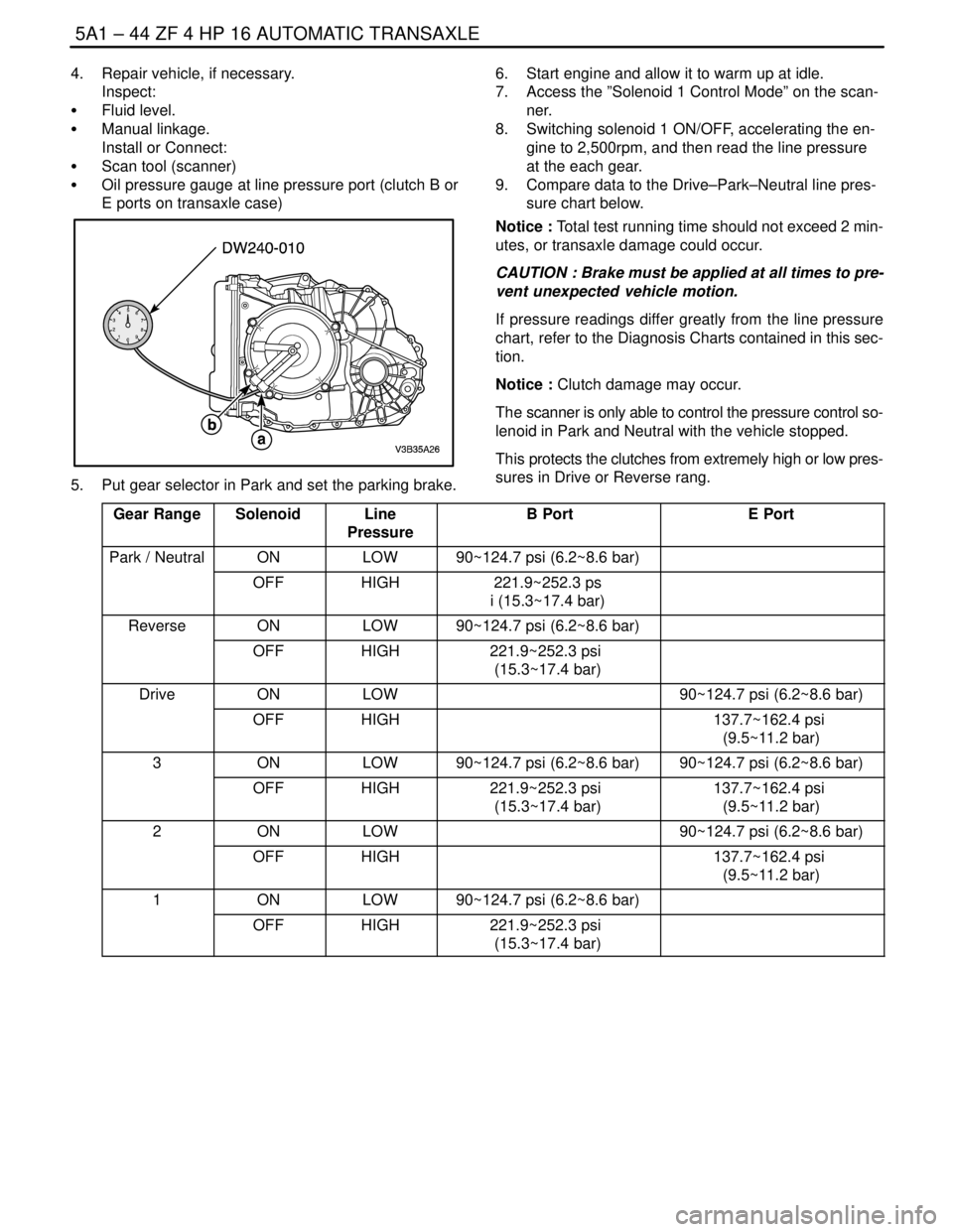
4. Repair vehicle, if necessary.
Inspect:
S Fluid level.
S Manual linkage.
Install or Connect:
S Scan tool (scanner)
S Oil pressure gauge at line pressure port (clutch B or
E ports on transaxle case)
5. Put gear selector in Park and set the parking brake.6. Start engine and allow it to warm up at idle.
7. Access the ”Solenoid 1 Control Mode” on the scan-
ner.
8. Switching solenoid 1 ON/OFF, accelerating the en-
gine to 2,500rpm, and then read the line pressure
at the each gear.
9. Compare data to the Drive–Park–Neutral line pres-
sure chart below.
Notice : Total test running time should not exceed 2 min-
utes, or transaxle damage could occur.
CAUTION : Brake must be applied at all times to pre-
vent unexpected vehicle motion.
If pressure readings differ greatly from the line pressure
chart, refer to the Diagnosis Charts contained in this sec-
tion.
Notice : Clutch damage may occur.
The scanner is only able to control the pressure control so-
lenoid in Park and Neutral with the vehicle stopped.
This protects the clutches from extremely high or low pres-
sures in Drive or Reverse rang.
Gear Range
SolenoidLine
Pressure B PortE Port
Park / NeutralONLOW90~124.7 psi (6.2~8.6 bar)
OFFHIGH221.9~252.3 ps
i (15.3~17.4 bar)
ReverseONLOW90~124.7 psi (6.2~8.6 bar)
OFFHIGH221.9~252.3 psi
(15.3~17.4 bar)
DriveONLOW90~124.7 psi (6.2~8.6 bar)
OFFHIGH137.7~162.4 psi
(9.5~11.2 bar)
3ONLOW90~124.7 psi (6.2~8.6 bar)90~124.7 psi (6.2~8.6 bar)
OFFHIGH221.9~252.3 psi
(15.3~17.4 bar)137.7~162.4 psi
(9.5~11.2 bar)
2ONLOW90~124.7 psi (6.2~8.6 bar)
OFFHIGH137.7~162.4 psi
(9.5~11.2 bar)
1ONLOW90~124.7 psi (6.2~8.6 bar)
OFFHIGH221.9~252.3 psi
(15.3~17.4 bar)
Page 1394 of 2643

ZF 4 HP 16 AUTOMATIC TRANSAXLE 5A1 – 45
DAEWOO V–121 BL4
CLUTCH PLATE DIAGNOSIS
Composition Plates
Dry the plate and inspect the plates for the following condi-
tions :
S Pitting
S Flaking
S Wear
S Glazing
S Cracking
S Charring
Chips or metal particles embedded in the lining
Replace a composition plate which shows any of these
conditions.
Steel Plates
Wipe the plates dry and check the plates for heat discolor-
ation. If the surfaces are smooth, even if colorsmear is in-
dicated, you can reuse the plate. If the plate is discolored
with hot spots or if the surface is scuffed, replace the plate.
Important : If the clutch shows evidence or extreme heat
or burning, replace the springs.
Causes of Burned Clutch Plates
The following conditions can result in a burned clutch
plate:
S Incorrect usage of clutch plates.
S Engine coolant in the transaxle fluid.
S A cracked clutch piston.
S Damaged or missing seals.
S Low line pressure.
S Valve problems.
– The valve body face is not flat
– Porosity between channels
– The valve bushing clips are improperly installed.
– The check balls are misplaced.
S The seal rings are worn or damaged
Engine Coolant in Transaxle
Notice : Antifreeze will deteriorate the O–ring seals and
the glue used to bond the clutch material to the pressure
plate. Both conditions may cause transaxle damage.
Perform the following steps if the transaxle oil cooler has
developed a leak, allowing engine coolant to enter the
transaxle:
1. Because the coolant will attach to the seal material
causing leakage, disassemble the transaxle and
replace all rubber type seals.
2. Because the facing material may become sepa-
rated from the steel center portion, replace the
composition faced clutch plate assemblies.
3. Replace all nylon parts including washers.
4. Replace the torque converter.
5. Thoroughly clean and rebuild the transaxle, using
new gaskets and oil filter.6. Flush the cooler lines after you have properly re-
paired or replaced the transaxle.
COOLER FLUSHING AND FLOW
TEST
Notice : You must flush the cooler whenever you receive
a transaxle for service. Cooler flushing is essential for
SRTA installation, major overhaul, whenever you replace
a pump or torque converter, or whenever you suspect that
the fluid has been contaminated.
After filling the transaxle with fluid, start the engine and run
for 30 seconds. This will remove any residual moisture
from the oil cooler. Disconnect the return line at the trans-
axle and observe the flow with the engine running. If the
fluid flow is insufficient, check the fluid flow by disconnect-
ing the feed line at the cooler. Observe the flow with the
engine running.
S If the flow from the cooler return line at the trans-
axle is insufficient, check the flow rate from the feed
line to the cooler. BLockage exists in the transaxle
or the cooler.
S If the flow from the transaxle feed line to the cooler
is insufficient, the transaxle is the cause of the fluid
flow problem.
S If the flow the transaxle feed line to the cooler is
insufficient, but flow from the cooler return line to
the transaxle is insufficient, inspect the cooler pipes
and fittings. Then repeat the cooler flushing proce-
dure. If the flow is still insufficient, replace the cool-
er.
TRANSAXLE FLUID LEVEL SERVICE
PROCEDURE
This procedure is to be used when checking a concern
with the fluid level in a vehicle. A low fluid level will result
in slipping and loss of drive/ reverse or delay on engage-
ment of drive/ reverse when the vehicle is cold.
The vehicle is first checked for transaxle diagnostic mes-
sages on the scan tool. If the oil level is low, it is possible
to register a vehicle speed signal fault.
The vehicle is to be test driven to determine if there is an
abnormal delay when selecting drive or reverse, or loss of
drive. One symptom of low fluid level is a momentary loss
of drive when driving the vehicle around a corner. Also
when the transaxle fluid level is low, a loss of drive may oc-
cur when the transaxle fluid temperature is low.
When adding or changing transaxle fluid use only ESSO
LT 71141 automatic transaxle fluid or other approved
fluids. The use of incorrect fluid will cause the performance
and durability of the transaxle to be severely degraded.
Fluid Level Diagnosis Procedure
1. If the vehicle is at operating temperature allow the
vehicle to cool down for two hours, but no greater
than four hours. Or if the vehicle is at cool status,
start the engine and allow the engine to idle for
approximately 5 minutes (825~875 rpm), if pos-
Page 1397 of 2643

5A1 – 48IZF 4 HP 16 AUTOMATIC TRANSAXLE
DAEWOO V–121 BL4
The Lock up clutch should not apply unless the transaxle
has reached a minimum operating temperature of 8°C
(46°F) TRANS TEMP AND engine coolant temp of 50°C
(122°F).
5. Repeat steps 1–4 using several different throttle
angles.
Part Throttle Detent Downshift
At vehicle steeds of 55 to 65km/h (34 to 40mph) in Fourth
gear, quickly increase throttle angle to greater than 50%.
Verify that :
S TCC apply.
S Transaxle downshift to 3rd gear.
S Solenoid 1 turns ON to OFF.
S Solenoid 2 turns OFF.
Full Throttle Detent Downshift
At vehicle speeds of 55 to 65km/h (34 to 40mph)in Fourth
gear, quickly increase throttle angle to its maximum posi-
tion (100%)
Verify that :
S TCC release.
S Transaxle downshift to Second gear immediately.
S Solenoid 1 turns ON to OFF
S Solenoid 2 turns OFF.
Manual Downshifts
1. At vehicle speeds of 60km/h (40mph)in Fourth
gear, release accelerator pedal while moving gear
selector to Manual Third (3). Observe that :
S Transaxle downshift to Third gear immediately.
S Engine slows vehicle down.
2. Move gear selector back to overdrive(D) and accel-
erate to 31mph (50km/h). Release the accelerator
pedal and move the gear selector to Manual
First(1) and observe that :
S Transaxle downshift to second gear immediate-
ly.
S Engine slows vehicle down
Notice : A Manual First––Third Gear Ratio will occur at
high speeds as an upshift safety feature. Do not attempt
to perform this shift.
Coasting Downshifts
1. With the gear selector in Overdrive(D), accelerate
to Fourth gear with TCC applied.
2. Release the accelerator pedal and lightly apply the
brakes, and observe that :
S TCC release.
S Down shifts occur at speeds shown ON the shift
speed chart.
Manual Gear Range Selection
Upshifts in the manual gear ranges are controlled by the
shift solenoids. Perform the following tests by accelerating
at 25 percent TP sensor increments.
Manual Third (3)
S With vehicle stopped, move the gear selector to
Manual third(3) and accelerate to observe :
– 1–2 shift.
– 2–3 shift.
Manual Second (2)
S With vehicle stopped, move the gear selector to
Manual second(2) and accelerate to observe :
– 1–2 shift.
S Accelerate to 40km/h(25mph) and observe :
– 2–3 shift does not occur
– TCC does not apply
Manual First (1)
S With vehicle stopped, move gear selector to Manu-
al First(1). Accelerate to 30km/h(19mph) and ob-
serve :
– No upshifts occur
Reverse (R)
S With vehicle stopped, move gear selector to R(Re-
verse) and observe :
– Solenoid 1 is OFF
– Solenoid 2 is OFF
Use a scan tool to see if any transaxle trouble codes have
been set. Refer to ”Diagnostic Trouble Codes”in this sec-
tion and repair the vehicle as directed. After repairing the
vehicle, perform the hoist test and verify that the code has
not set again.
If the transaxle is not performing well and no trouble codes
have been set, there may be an intermittent condition.
Check all electrical connections for damage or a loose fit.
You also have to perform a snapshot test which can help
catch an intermittent condition that dose not occur long
enough to set a code.
You may want to read ”Electronic Component Diagnosis”
in this section to become familiar with transaxle conditions
caused by transaxle electrical malfunction.
If no trouble codes have been set and the condition is sus-
pected to be hydraulic, take the vehicle on a road test.
TORQUE CONVERTER LOCK–UP
CLUTCH(TCC) DIAGNOSIS
To properly diagnosis the lock–up clutch(TCC) system,
perform all electrical testing first and then the hydraulic
testing.
The TCC is applied by fluid pressure which is controlled by
a solenoid Located inside the valve body. The solenoid is
energized by completing an electrical circuit through a
combination of switches and sensors.
Page 1407 of 2643

5A1 – 58IZF 4 HP 16 AUTOMATIC TRANSAXLE
DAEWOO V–121 BL4
Symptom ActionPossible Cause
NoiseThe Engine’s Torsional Vibrations are
Being Transmitted to the Drive ShaftsS At low speeds in fourth gear, vibration can
arise (driving at too low an engine speed)
S Noise is functionally unavoidable; due to toler-
ances. Convince the customer.
NoiseTorque Reaction Strut LooseS Check mounting and repair if necessary.
Shift quality
Notice :
– The assessment of shaft quality is, to a large ex-
tent, an individual, subjective matter. Take careful
note of how the customer describes the complaint
and of the manner in which he or she handles the
vehicle and the controls.
– A sudden deterioration of shift quality may also
be caused by the transaxle selecting an emergency
or substitute program
Test Steps :– Carry out the general checks described in the
automatic transaxle diagnostic information.
– Perform a test drive to answer the following ques-
tions.
In which driving situations does the shift quality
complaint arise?
To which shifts does the complaint apply?
Is the complaint reproducible within a short period,
or has it only occurred sporadically or on a single
occasion?
– Check the oil level and oil quality
– Interrogate the fault memory and read out mea-
surement block data.
Symptom
Possible CauseAction
Shift QualityRapid Pressure Build–up in the ClutchS Operating error (position selected several times
in quick succession).
Jerk When Parking Lock Is ReleasedS Refer to ”Noise” in this section.
Incorrect Electronic Transaxle Control
moduleS Check the data status for transaxle control
module ; refer to ”TCM” in this section.
Emergency/Substitute Program Has
Been ActivatedS For checking and remedial action, refer to
”Emergency/Substitute program” in this sec-
tion.
Accelerator Pedal in Indefinite Position
Between Full Throttle and Kick DownS Persuade customer to choose clearly between
kick down and full throttle
S Check setting according go engine repair in-
struction ; adjust if necessary.
Control Overlap Between to Clutches
During ShiftS Production status
S Convince the customer
Temperature Sensor
(Not Fault Memory)S Check function according to ”Emergency/Sub-
stitute program” in this section.
Kick Down Setting IncorrectS Check
A) Floor mat is obstructing accelerator pedal
B) The kick down setting as described in the
Engine Section.
Malfunction
Notice :
The faults dealt with here concern transaxle functions
such as ”traction” (forwards and reverse) and all type of
shifts. Entries will not always be made in the fault memory.Test Steps :
Perform the general checks according to the automatic
transaxle diagnostic procedure.
– Test drive
– Check oil level and quality
– Interrogate fault memory
Page 1435 of 2643

5A1 – 86IZF 4 HP 16 AUTOMATIC TRANSAXLE
DAEWOO V–121 BL4
DIAGNOSTIC TROUBLE CODE(DTC) P0705
TRANSMISSION RANGE SENSOR CIRCUIT
MALFUNCTION (PRNDL INPUT)
Circuit Description
The Transmission range switch is located on the selector
shaft and informs the TCM of the current selector lever
position P–R–N–D–3–2–1.
The selector lever position is transmitted to the TCM in en-
coded form along 4 lines. The encoding is such that mal-
functions in the connecting lead are identified.
The TR switch is located on the selector shaft, which is
connected to the selector lever via a pull cable. In addition,
the TR switch controls the starter interlock, the reverse
lights and the selector lever position indicator on the in-
strument panel.
Conditions for Setting The DTC
S TR switch stuck to closed.
S TR switch wiring harness shortage to ground.
S TR switch wiring harness shortage to power.
S Immediately after the above condition occurs.Action Taken When The DTC Sets
S The Malfunction Indicator Lamp(MIL) will illuminate.
S The TCM will record operating conditions at the
time the diagnostic fails. This information will be
stored in the Failure Records buffer.
S Adopt Emergency/ Substitute mode and constant
4th gear.
Conditions for Clearing the MIL/DTC
S The MIL will turn OFF when the malfunction has
not occurred after three–ignition cycles.
S A history DTC will clear after 40 consecutive warm
up cycles without a fault.
S Using a scan tool can clear history DTCs.
Diagnostic Aids
S When DTC P0705 sets, the possible cause of TR
switch.
Page 1561 of 2643
5A1 – 212IZF 4 HP 16 AUTOMATIC TRANSAXLE
DAEWOO V–121 BL4
UNIT REPAIR
TORQUE CONVERTER
Disassembly and Assembly Procedure
1. Remove the transaxle assembly. Refer to ”Trans-
axle Assembly” in this section.
2. Remove the torque converter assembly.
3. Installation should follow the removal procedure in
the reverse order.
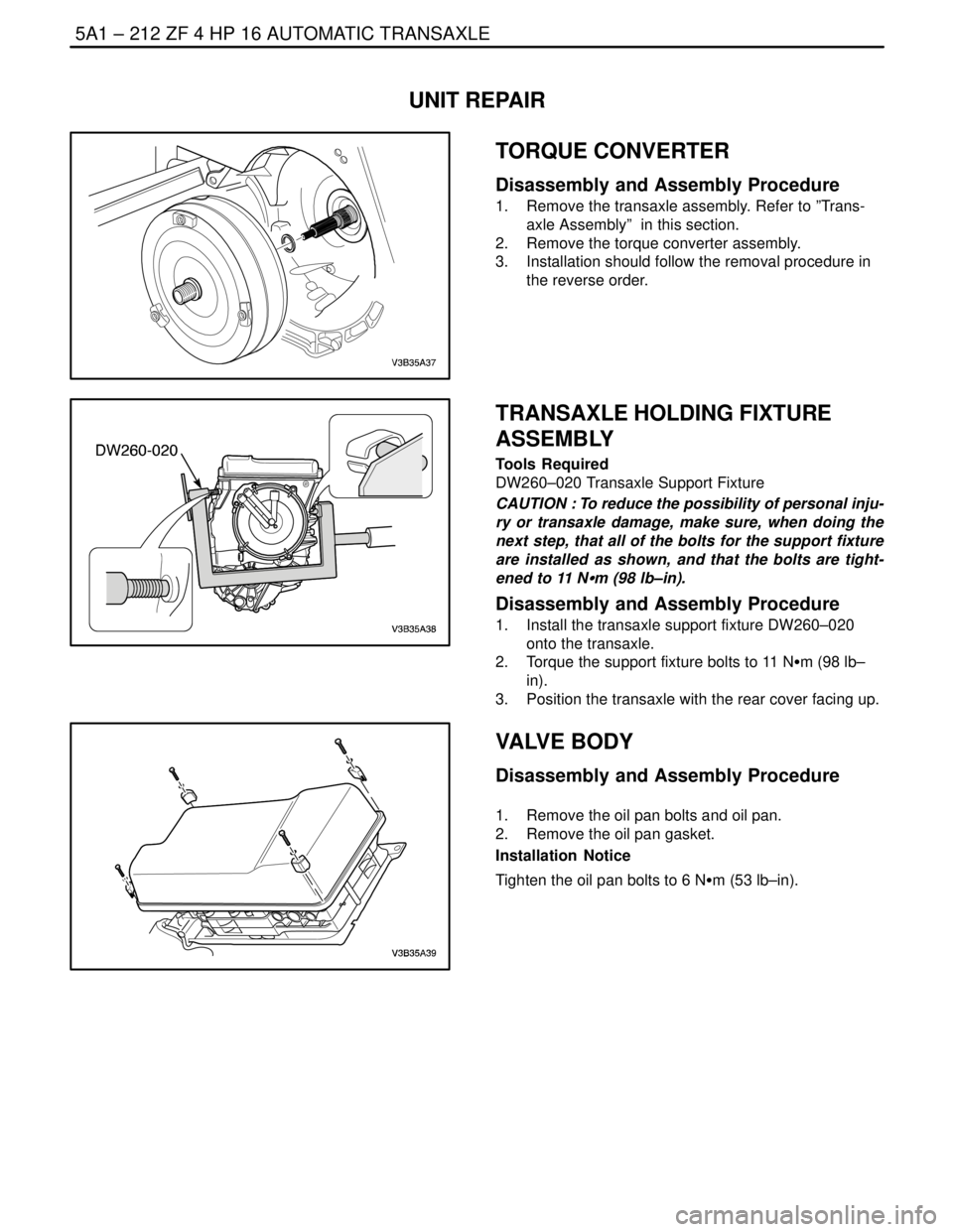
TRANSAXLE HOLDING FIXTURE
ASSEMBLY
Tools Required
DW260–020 Transaxle Support Fixture
CAUTION : To reduce the possibility of personal inju-
ry or transaxle damage, make sure, when doing the
next step, that all of the bolts for the support fixture
are installed as shown, and that the bolts are tight-
ened to 11 NSm (98 lb–in).
Disassembly and Assembly Procedure
1. Install the transaxle support fixture DW260–020
onto the transaxle.
2. Torque the support fixture bolts to 11 NSm (98 lb–
in).
3. Position the transaxle with the rear cover facing up.
VALVE BODY
Disassembly and Assembly Procedure
1. Remove the oil pan bolts and oil pan.
2. Remove the oil pan gasket.
Installation Notice
Tighten the oil pan bolts to 6 NSm (53 lb–in).
Page 1562 of 2643
ZF 4 HP 16 AUTOMATIC TRANSAXLE 5A1 – 213
DAEWOO V–121 BL4
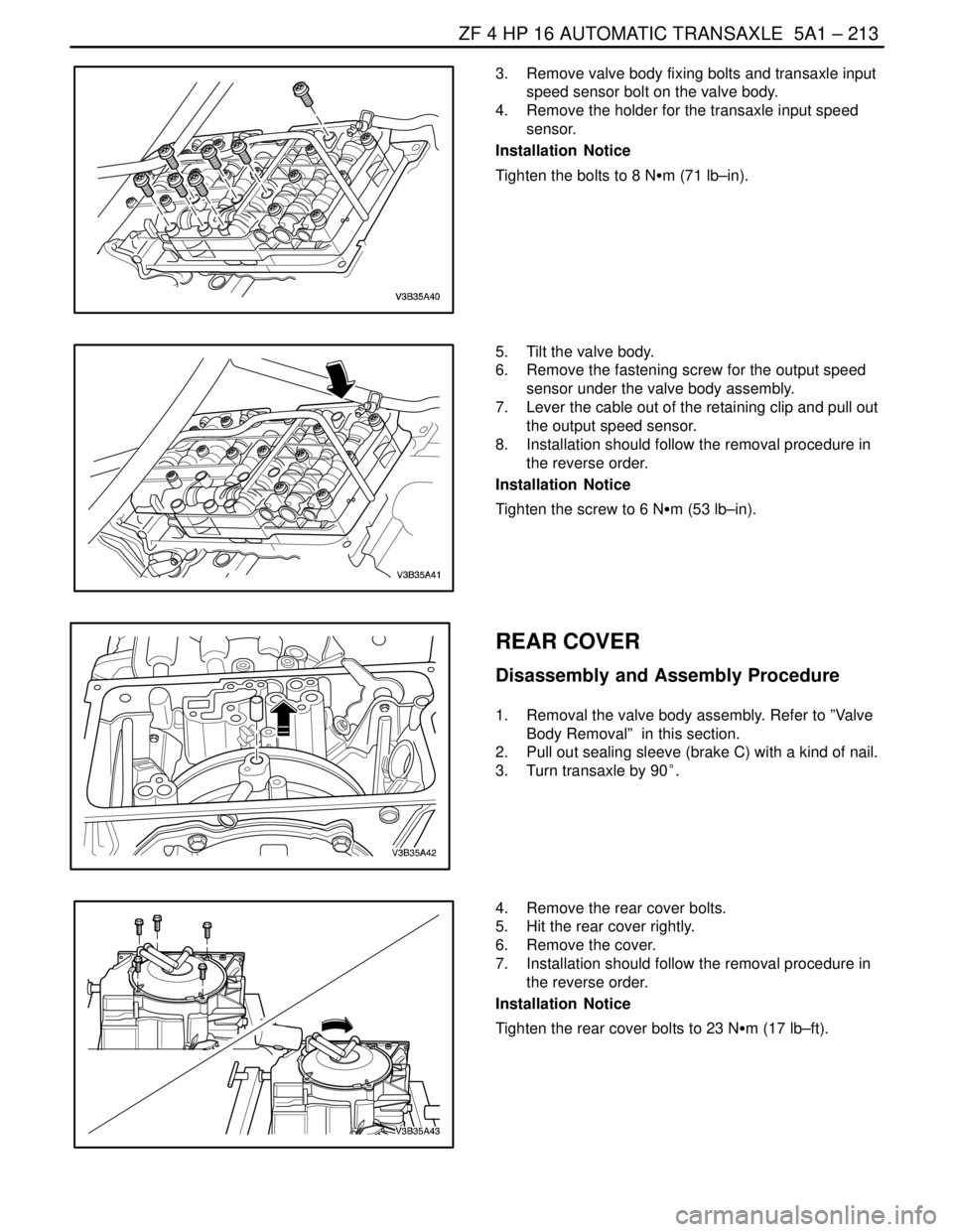
3. Remove valve body fixing bolts and transaxle input
speed sensor bolt on the valve body.
4. Remove the holder for the transaxle input speed
sensor.
Installation Notice
Tighten the bolts to 8 NSm (71 lb–in).
5. Tilt the valve body.
6. Remove the fastening screw for the output speed
sensor under the valve body assembly.
7. Lever the cable out of the retaining clip and pull out
the output speed sensor.
8. Installation should follow the removal procedure in
the reverse order.
Installation Notice
Tighten the screw to 6 NSm (53 lb–in).
REAR COVER
Disassembly and Assembly Procedure
1. Removal the valve body assembly. Refer to ”Valve
Body Removal” in this section.
2. Pull out sealing sleeve (brake C) with a kind of nail.
3. Turn transaxle by 90°.
4. Remove the rear cover bolts.
5. Hit the rear cover rightly.
6. Remove the cover.
7. Installation should follow the removal procedure in
the reverse order.
Installation Notice
Tighten the rear cover bolts to 23 NSm (17 lb–ft).
Page 1566 of 2643
ZF 4 HP 16 AUTOMATIC TRANSAXLE 5A1 – 217
DAEWOO V–121 BL4
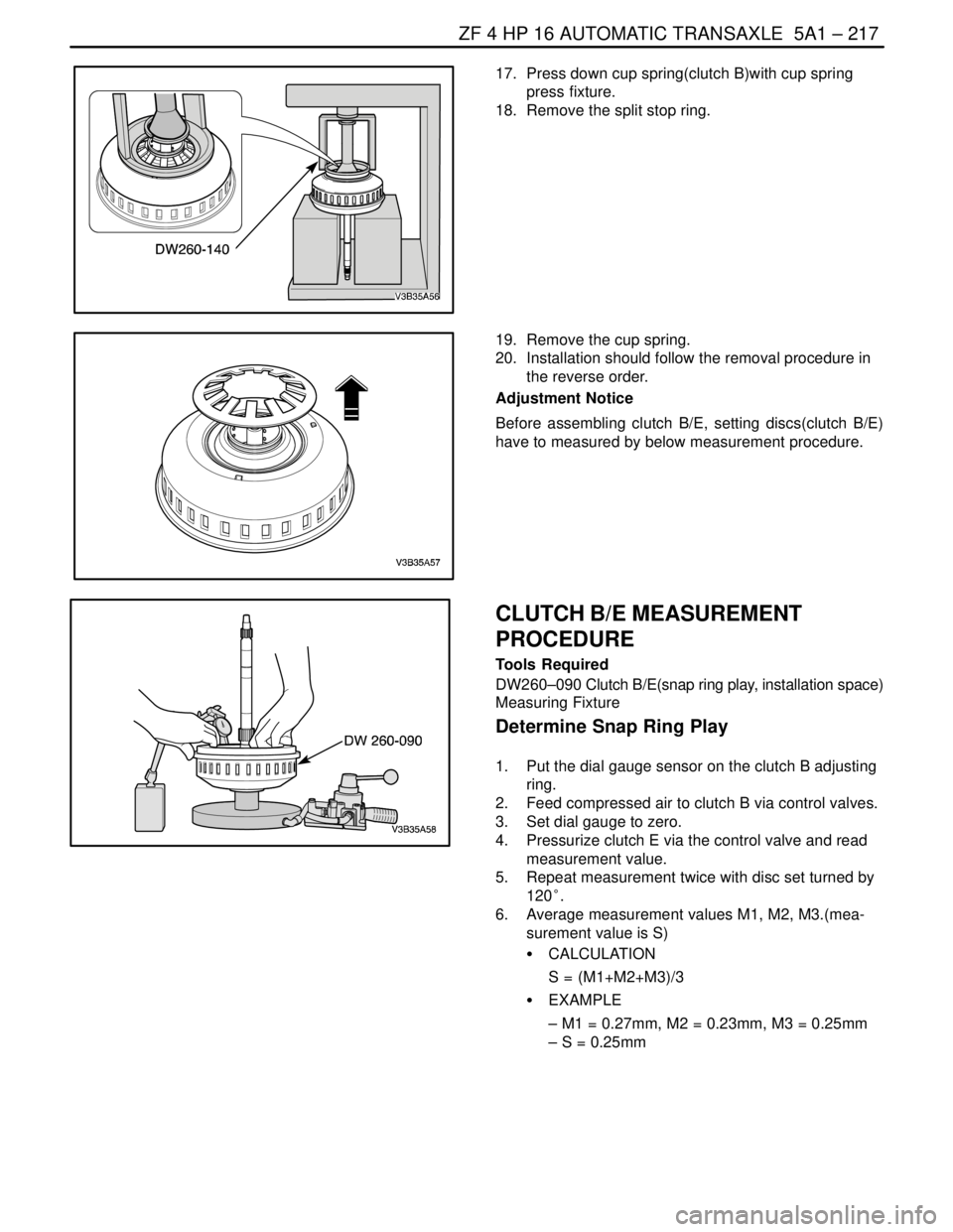
17. Press down cup spring(clutch B)with cup spring
press fixture.
18. Remove the split stop ring.
19. Remove the cup spring.
20. Installation should follow the removal procedure in
the reverse order.
Adjustment Notice
Before assembling clutch B/E, setting discs(clutch B/E)
have to measured by below measurement procedure.
CLUTCH B/E MEASUREMENT
PROCEDURE
Tools Required
DW260–090 Clutch B/E(snap ring play, installation space)
Measuring Fixture
Determine Snap Ring Play
1. Put the dial gauge sensor on the clutch B adjusting
ring.
2. Feed compressed air to clutch B via control valves.
3. Set dial gauge to zero.
4. Pressurize clutch E via the control valve and read
measurement value.
5. Repeat measurement twice with disc set turned by
120°.
6. Average measurement values M1, M2, M3.(mea-
surement value is S)
S CALCULATION
S = (M1+M2+M3)/3
S EXAMPLE
– M1 = 0.27mm, M2 = 0.23mm, M3 = 0.25mm
– S = 0.25mm