SPI DAEWOO LACETTI 2004 Service User Guide
[x] Cancel search | Manufacturer: DAEWOO, Model Year: 2004, Model line: LACETTI, Model: DAEWOO LACETTI 2004Pages: 2643, PDF Size: 80.54 MB
Page 818 of 2643

1F – 572IENGINE CONTROLS
DAEWOO V–121 BL4
DIAGNOSTIC TROUBLE CODE (DTC) P1650
SPI COMMUNICATION BETWEEN ERROR WITH SIDM
CHIP
Circuit Description
The Engine Control Module (ECM) is the control center of
the fuel injection system. It constantly looks at the informa-
tion from various sensors, and controls the systems that
affect vehicle performance. The ECM also performs the
diagnostic function of the system. It can recognize opera-
tional problems, alert the driver through the Malfunction In-
dicator Lamp (MIL) (Check Engine), and store a Diagnos-
tic Trouble Code (DTC) or DTCs which identify the
problem areas to aid the technician in making repairs. An
Electrically Erasable Programmable Read Only Memory
(EEPROM) is used to house the program information and
the calibrations required for engine, transmission, and
powertrain diagnostics operation. The Diagnostic Trouble
Code (DTC) will stored, when the ECM detects SPI com-
munication between main CPU and output driver I/C is
corrupted.
Conditions for Setting the DTCS Ignition switch is turned to ON.
S Battery voltage is greater than 11 volts.
Action Taken When the DTC Sets
S The Malfunction Indicator Lamp (MIL) will not illumi-
nate.
S The ECM will record operating conditions at the
time the diagnostic fails. This information will be
stored in the Freeze Frame and Failure Records
buffers.
S A history DTC is stored.
Conditions for Clearing the MIL/DTC
S A history DTC will clear after 40 consecutive warm–
up cycles without a fault.
S DTC(s) can be cleared by using the scan tool.
S Disconnecting the ECM battery feed for more than
10 seconds.
DTC P1650 – SPI Communication Between Error with SIDM Chip
StepActionValue(s)YesNo
1Perform an On–Board Diagnostic (EOBD) System
Check.
Was the check performed?–Go to Step 2Go to
”On–Board
Diagnostic Sys-
tem Check”
21. Turn the ignition OFF.
2. Replace the Engine Control Module (ECM).
Is the repair complete?–Go to Step 3–
31. Using the scan tool, clear the Diagnostic
Trouble Codes (DTCs).
2. Start the engine and idle at normal operating
temperature.
3. Operate the vehicle within the Conditions for
setting this DTC as specified in the supporting
text.
Does the scan tool indicate that this diagnostic has
run and passed?–Go to Step 4Go to Step 2
4Check if any additional DTCs are set.
Are any DTCs displayed that have not been diag-
nosed?–Go to
Applicable DTC
tableSystem OK
Page 819 of 2643

ENGINE CONTROLS 1F – 573
DAEWOO V–121 BL4
DIAGNOSTIC TROUBLE CODE (DTC) P1655
SPI COMMUNICATION BETWEEN ERROR WITH PSVI
CHIP
Circuit Description
The Engine Control Module (ECM) is the control center of
the fuel injection system. It constantly looks at the informa-
tion from various sensors, and controls the systems that
affect vehicle performance. The ECM also performs the
diagnostic function of the system. It can recognize opera-
tional problems, alert the driver through the Malfunction In-
dicator Lamp (MIL) (Check Engine), and store a Diagnos-
tic Trouble Code (DTC) or DTCs which identify the
problem areas to aid the technician in making repairs. An
Electrically Erasable Programmable Read Only Memory
(EEPROM) is used to house the program information and
the calibrations required for engine, transmission, and
powertrain diagnostics operation. The Diagnostic Trouble
Code (DTC) will stored, when the ECM detects corrupted
serial peripheral interface (SPI) comunication between
main CPU and output driver I/C.
Conditions for Setting the DTCS Ignition switch is turned to ON.
S Battery voltage is greater than 11 volts.
Action Taken When the DTC Sets
S The Malfunction Indicator Lamp (MIL) will illuminate
after three consecutive trip with a fail.
S The ECM will record operating conditions at the
time the diagnostic fails. This information will be
stored in the Freeze Frame and Failure Records
buffers.
S A history DTC is stored.
Conditions for Clearing the MIL/DTC
S A history DTC will clear after 40 consecutive warm–
up cycles without a fault.
S DTC(s) can be cleared by using the scan tool.
S Disconnecting the ECM battery feed for more than
10 seconds.
DTC P1655 – SPI Communication Between Error with PSVI Chip
StepActionValue(s)YesNo
1Perform an On–Board Diagnostic (EOBD) System
Check.
Was the check performed?–Go to Step 2Go to
”On–Board
Diagnostic Sys-
tem Check”
21. Turn the ignition OFF.
2. Replace the Engine Control Module (ECM).
Is the repair complete?–Go to Step 3–
31. Using the scan tool, clear the Diagnostic
Trouble Codes (DTCs).
2. Start the engine and idle at normal operating
temperature.
3. Operate the vehicle within the Conditions for
setting this DTC as specified in the supporting
text.
Does the scan tool indicate that this diagnostic has
run and passed?–Go to Step 4Go to Step 2
4Check if any additional DTCs are set.
Are any DTCs displayed that have not been diag-
nosed?–Go to
Applicable DTC
tableSystem OK
Page 830 of 2643

1F – 584IENGINE CONTROLS
DAEWOO V–121 BL4
StepNo Yes Value(s) Action
11Replace any restricted or leaking fuel injectors.
Is the repair complete?–System OK–
12Check the fuel system pressure after a cold start or
during moderate or full throttle acceleration.
Is the fuel pressure within specifications?41–47 psi
(284–325 kPa)Go toStep 14Go toStep 13
13Repair the restriction in the fuel system or replace
the faulty fuel pump.
Is the repair complete?–System OK–
141. Check for faulty ignition wires.
2. Inspect for fouled spark plugs.
3. Check the ignition system output on each cylin-
der with a spark tester.
Is the problem found?–Go toStep 15Go toStep 16
15Repair or replace any ignition components as need-
ed.
Is the repair complete?–System OK–
161. Check the generator output voltage.
2. Repair or replace the generator if the generator
output is less than the value specified.
3. Check the Exhaust Gas Recirculation (EGR)
valve operation.
Are all checks and needed repairs complete?12–16 vSystem OK–
CUTS OUT, MISSES
Definition : This Involves a steady pulsation or jerking that follows engine speed, usually more pronounced as engine load
increases. The exhaust has a steady spitting sound at idle or low speed.
Step
ActionValue(s)YesNo
1Were the Important Preliminary Checks performed?–Go toStep 2Go to
”Important Pre-
liminary
Checks”
2Check the ignition system output voltage for all of the
cylinders using a spark tester.
Is spark present on all of the cylinders?–Go toStep 3Go to
”Ignition Sys-
tem Check”
31. Inspect the spark plugs for excessive wear,
insulation cracks, improper gap, or heavy de-
posits.
2. Check the resistance of the ignition wires. Re-
place any ignition wires that have a resistance
greater than the value specified.
Is the problem found?3,000 ΩGo toStep 4Go toStep 5
4Repair or replace any components as needed.
Is the repair complete?–System OK–
5With the engine running, spray the ignition wires with
a fine water mist to check for arcing and shorting to
ground.
Is the problem found?–Go toStep 6Go toStep 7
6Replace the ignition wires.
Is the repair complete?–System OK–
Page 840 of 2643
1F – 594IENGINE CONTROLS
DAEWOO V–121 BL4
MAINTENANCE AND REPAIR
ON–VEHICLE SERVICE
FUEL SYSTEM PRESSURE RELIEF
Procedure
CAUTION : The fuel system is under pressure. To
avoid fuel spillage and the risk of personal injury or
fire, it is necessary to relieve the fuel system pressure
before disconnecting the fuel lines.
1. Remove the fuel cap.
2. Remove the fuel pump fuse Ef18 from the engine
fuse block.
3. Start the engine and allow the engine to stall.
4. Crank the engine for an additional 10 seconds.
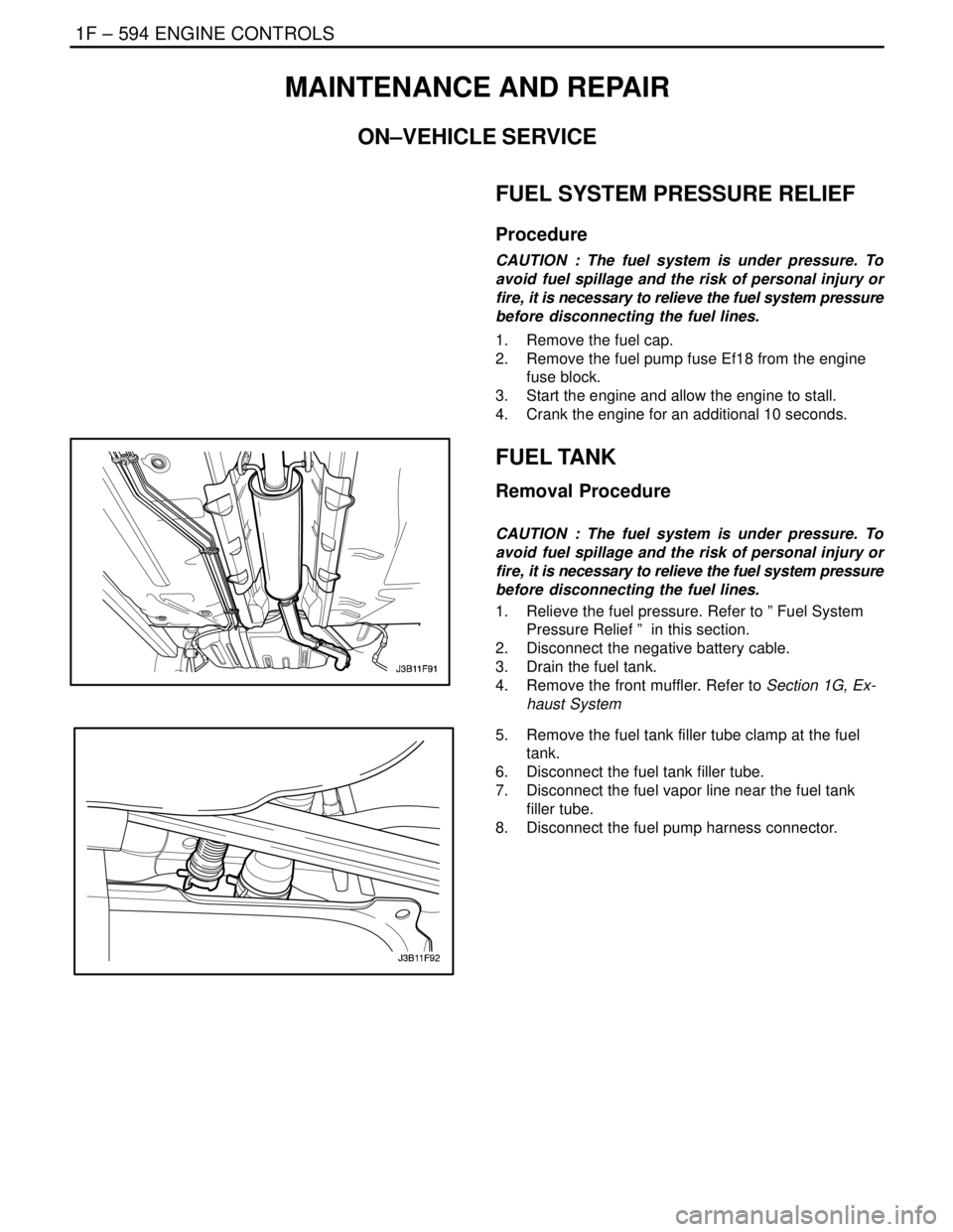
FUEL TANK
Removal Procedure
CAUTION : The fuel system is under pressure. To
avoid fuel spillage and the risk of personal injury or
fire, it is necessary to relieve the fuel system pressure
before disconnecting the fuel lines.
1. Relieve the fuel pressure. Refer to ” Fuel System
Pressure Relief ” in this section.
2. Disconnect the negative battery cable.
3. Drain the fuel tank.
4. Remove the front muffler. Refer to Section 1G, Ex-
haust System
5. Remove the fuel tank filler tube clamp at the fuel
tank.
6. Disconnect the fuel tank filler tube.
7. Disconnect the fuel vapor line near the fuel tank
filler tube.
8. Disconnect the fuel pump harness connector.
Page 842 of 2643
1F – 596IENGINE CONTROLS
DAEWOO V–121 BL4
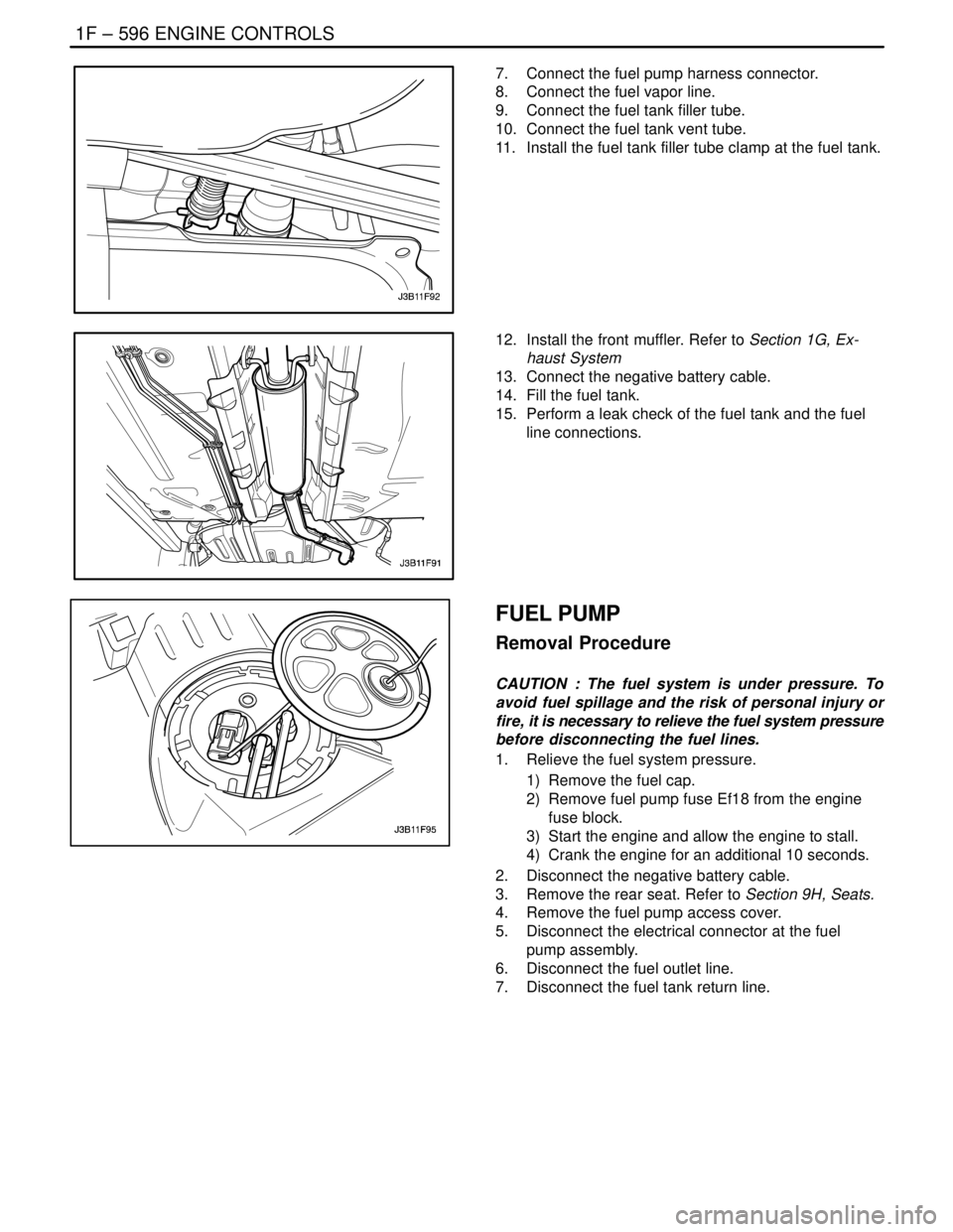
7. Connect the fuel pump harness connector.
8. Connect the fuel vapor line.
9. Connect the fuel tank filler tube.
10. Connect the fuel tank vent tube.
11. Install the fuel tank filler tube clamp at the fuel tank.
12. Install the front muffler. Refer to Section 1G, Ex-
haust System
13. Connect the negative battery cable.
14. Fill the fuel tank.
15. Perform a leak check of the fuel tank and the fuel
line connections.
FUEL PUMP
Removal Procedure
CAUTION : The fuel system is under pressure. To
avoid fuel spillage and the risk of personal injury or
fire, it is necessary to relieve the fuel system pressure
before disconnecting the fuel lines.
1. Relieve the fuel system pressure.
1) Remove the fuel cap.
2) Remove fuel pump fuse Ef18 from the engine
fuse block.
3) Start the engine and allow the engine to stall.
4) Crank the engine for an additional 10 seconds.
2. Disconnect the negative battery cable.
3. Remove the rear seat. Refer to Section 9H, Seats.
4. Remove the fuel pump access cover.
5. Disconnect the electrical connector at the fuel
pump assembly.
6. Disconnect the fuel outlet line.
7. Disconnect the fuel tank return line.
Page 843 of 2643
ENGINE CONTROLS 1F – 597
DAEWOO V–121 BL4
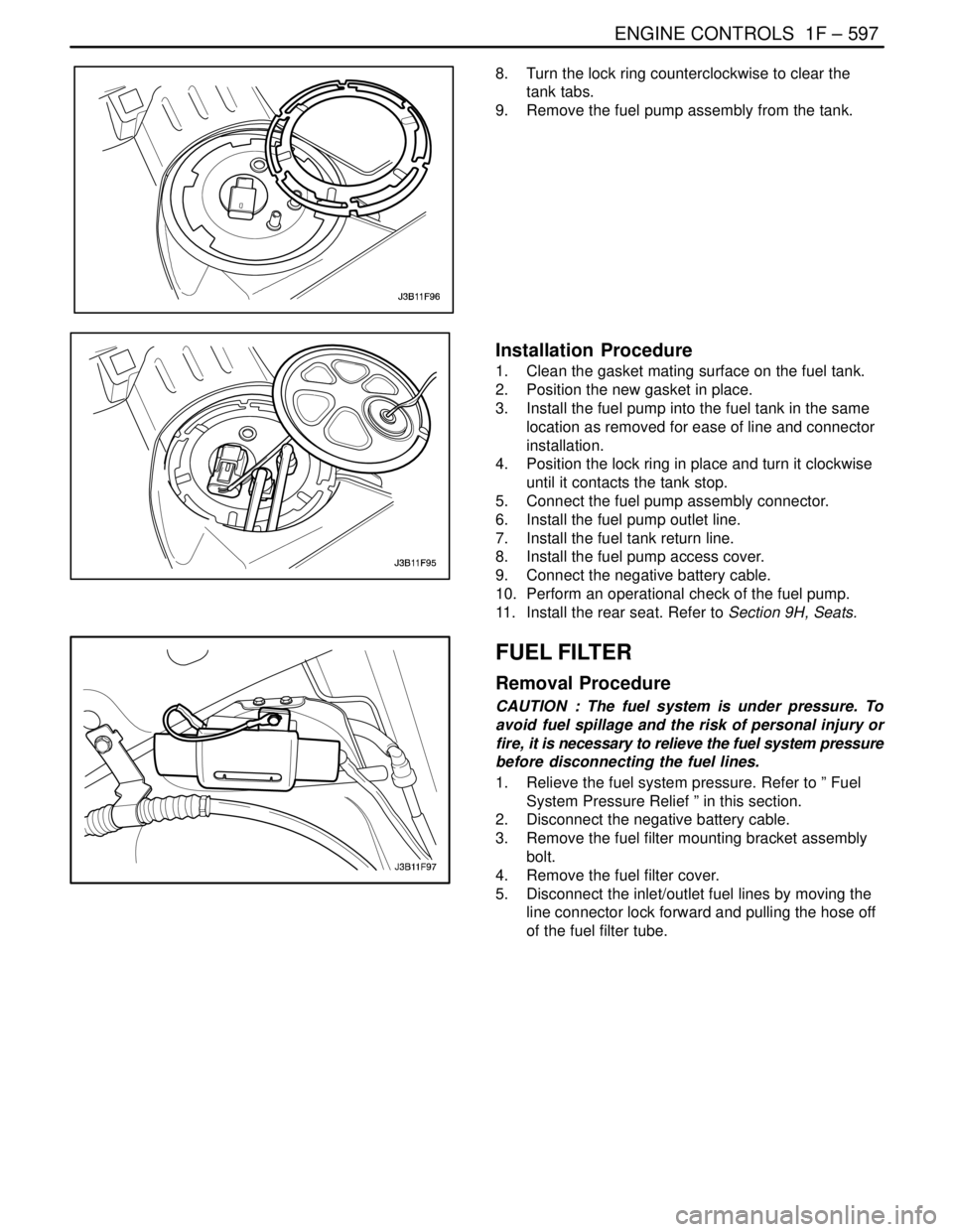
8. Turn the lock ring counterclockwise to clear the
tank tabs.
9. Remove the fuel pump assembly from the tank.
Installation Procedure
1. Clean the gasket mating surface on the fuel tank.
2. Position the new gasket in place.
3. Install the fuel pump into the fuel tank in the same
location as removed for ease of line and connector
installation.
4. Position the lock ring in place and turn it clockwise
until it contacts the tank stop.
5. Connect the fuel pump assembly connector.
6. Install the fuel pump outlet line.
7. Install the fuel tank return line.
8. Install the fuel pump access cover.
9. Connect the negative battery cable.
10. Perform an operational check of the fuel pump.
11. Install the rear seat. Refer to Section 9H, Seats.
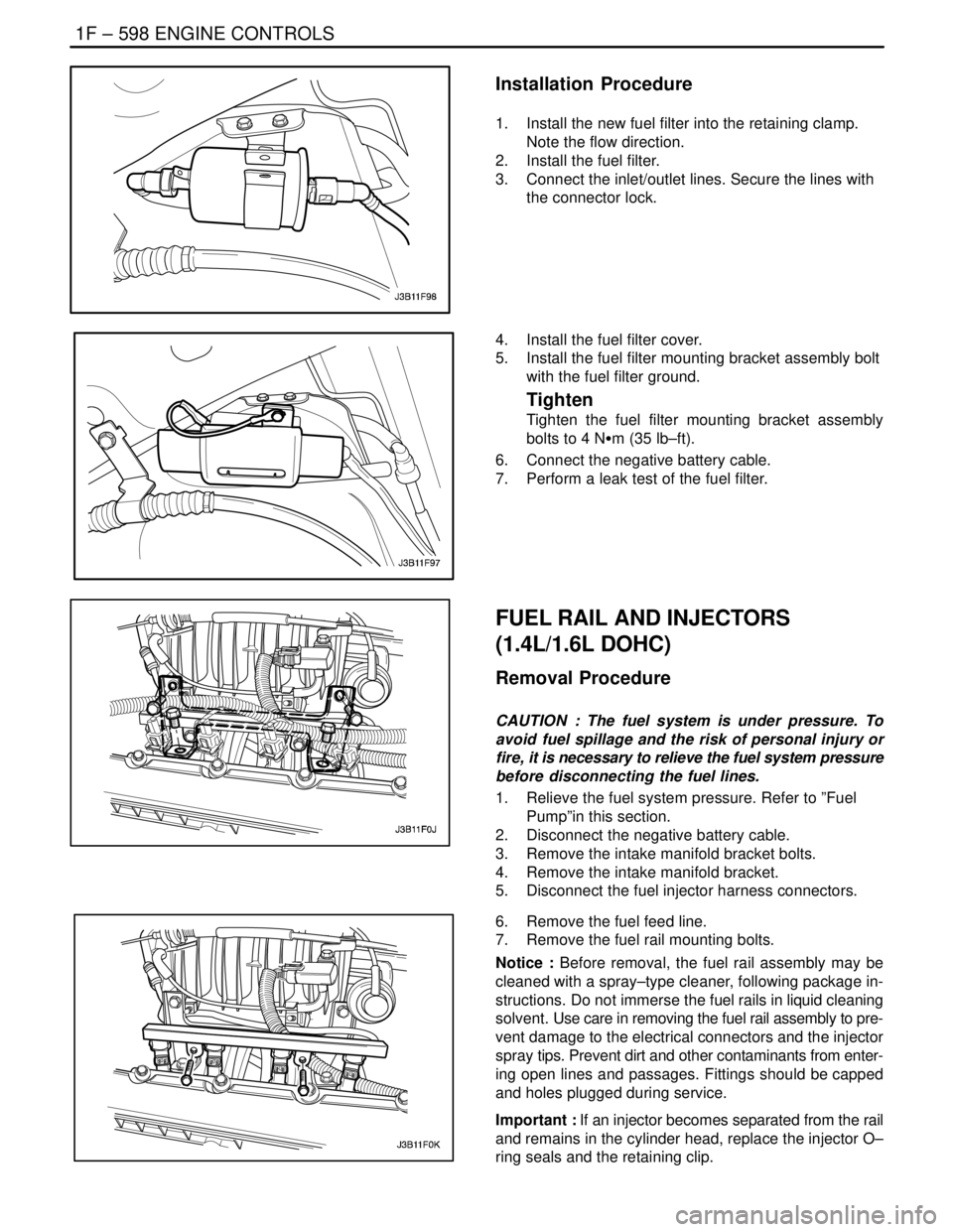
FUEL FILTER
Removal Procedure
CAUTION : The fuel system is under pressure. To
avoid fuel spillage and the risk of personal injury or
fire, it is necessary to relieve the fuel system pressure
before disconnecting the fuel lines.
1. Relieve the fuel system pressure. Refer to ” Fuel
System Pressure Relief ” in this section.
2. Disconnect the negative battery cable.
3. Remove the fuel filter mounting bracket assembly
bolt.
4. Remove the fuel filter cover.
5. Disconnect the inlet/outlet fuel lines by moving the
line connector lock forward and pulling the hose off
of the fuel filter tube.
Page 844 of 2643
1F – 598IENGINE CONTROLS
DAEWOO V–121 BL4
Installation Procedure
1. Install the new fuel filter into the retaining clamp.
Note the flow direction.
2. Install the fuel filter.
3. Connect the inlet/outlet lines. Secure the lines with
the connector lock.
4. Install the fuel filter cover.
5. Install the fuel filter mounting bracket assembly bolt
with the fuel filter ground.
Tighten
Tighten the fuel filter mounting bracket assembly
bolts to 4 NSm (35 lb–ft).
6. Connect the negative battery cable.
7. Perform a leak test of the fuel filter.
FUEL RAIL AND INJECTORS
(1.4L/1.6L DOHC)
Removal Procedure
CAUTION : The fuel system is under pressure. To
avoid fuel spillage and the risk of personal injury or
fire, it is necessary to relieve the fuel system pressure
before disconnecting the fuel lines.
1. Relieve the fuel system pressure. Refer to ”Fuel
Pump”in this section.
2. Disconnect the negative battery cable.
3. Remove the intake manifold bracket bolts.
4. Remove the intake manifold bracket.
5. Disconnect the fuel injector harness connectors.
6. Remove the fuel feed line.
7. Remove the fuel rail mounting bolts.
Notice : Before removal, the fuel rail assembly may be
cleaned with a spray–type cleaner, following package in-
structions. Do not immerse the fuel rails in liquid cleaning
solvent. Use care in removing the fuel rail assembly to pre-
vent damage to the electrical connectors and the injector
spray tips. Prevent dirt and other contaminants from enter-
ing open lines and passages. Fittings should be capped
and holes plugged during service.
Important : If an injector becomes separated from the rail
and remains in the cylinder head, replace the injector O–
ring seals and the retaining clip.
Page 846 of 2643
1F – 600IENGINE CONTROLS
DAEWOO V–121 BL4
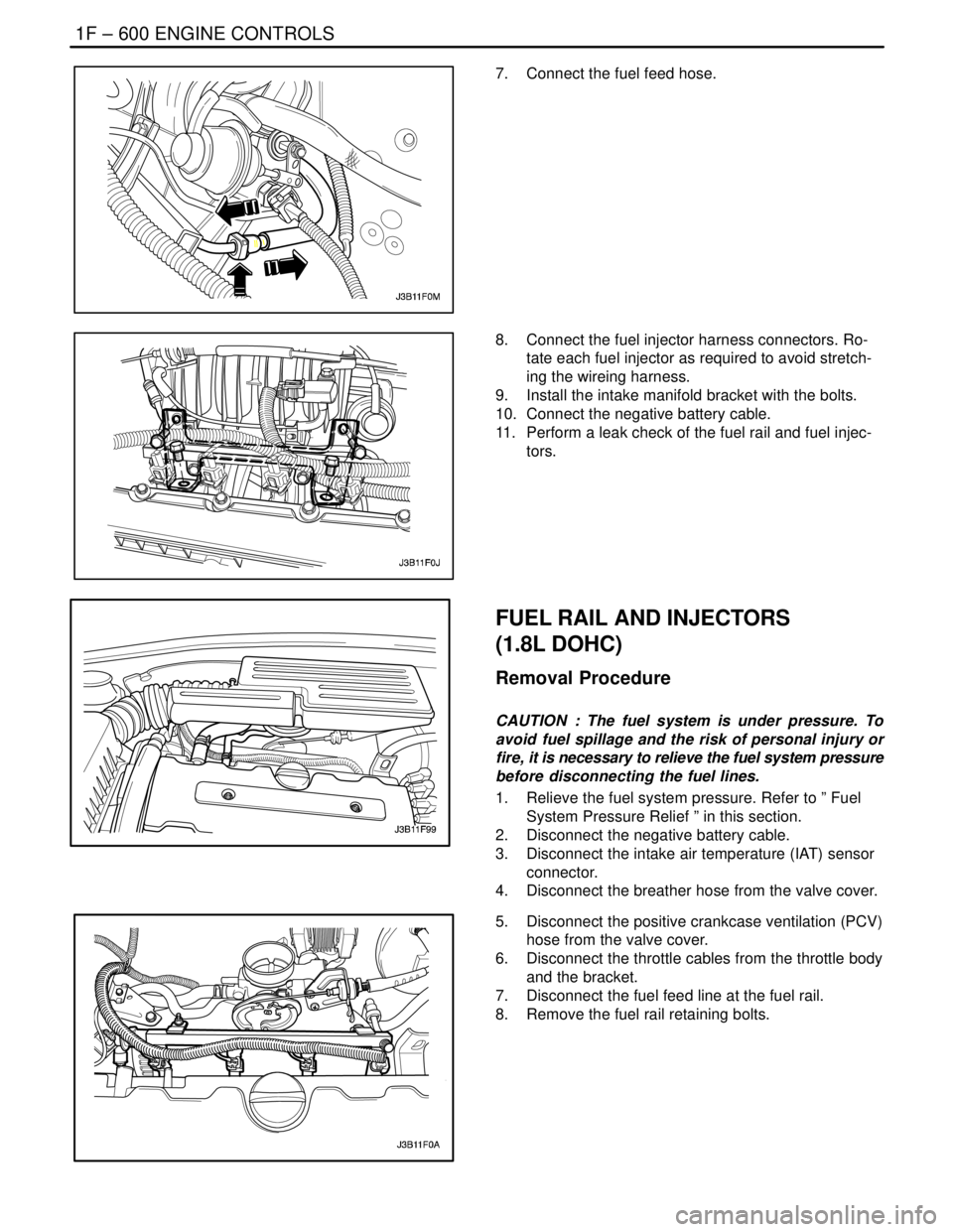
7. Connect the fuel feed hose.
8. Connect the fuel injector harness connectors. Ro-
tate each fuel injector as required to avoid stretch-
ing the wireing harness.
9. Install the intake manifold bracket with the bolts.
10. Connect the negative battery cable.
11. Perform a leak check of the fuel rail and fuel injec-
tors.
FUEL RAIL AND INJECTORS
(1.8L DOHC)
Removal Procedure
CAUTION : The fuel system is under pressure. To
avoid fuel spillage and the risk of personal injury or
fire, it is necessary to relieve the fuel system pressure
before disconnecting the fuel lines.
1. Relieve the fuel system pressure. Refer to ” Fuel
System Pressure Relief ” in this section.
2. Disconnect the negative battery cable.
3. Disconnect the intake air temperature (IAT) sensor
connector.
4. Disconnect the breather hose from the valve cover.
5. Disconnect the positive crankcase ventilation (PCV)
hose from the valve cover.
6. Disconnect the throttle cables from the throttle body
and the bracket.
7. Disconnect the fuel feed line at the fuel rail.
8. Remove the fuel rail retaining bolts.
Page 947 of 2643

REAR SUSPENSION 2D – 5
DAEWOO V–121 BL4
1. Strut Mount Lock Nut
2. Strut Assembly–to–Body Nut
3. Strut Mount
4. Upper Spring Seat
5. Rear Spring
6. Strut Dampener Dust Cover
7. Hollow Bumper
8. Lower Spring Insulation Ring
9. Rear Strut Dampener
10. Strut Assembly–to–Knuckle Bolt
11. Strut Assembly–to–Knuckle Nut
12. Spindle Assembly
13. Brake Disc
14. Stabilizer Shaft Clamp Bolt
15. Stabilizer Shaft Clamp16. Stabilizer Shaft Insulator
17. Stabilizer Shaft
18. Stabilizer Shaft–to–Stabilizer Link Nut
19. Stabilizer Link
20. Rear Parallel Link–to–Knuckle Bolt
21. Rear Parallel Link
22. Trailing Link
23. Front Parallel Link
24. Trailing Link Bracket
25. Rear Crossmember–to–body Bolts
26. Rear Crossmember
27. Rear Crossmember Cover
28. Toe–in Adjustment Bolt
29. ABS Wiring Cover
30. Rear Drum
Page 966 of 2643
2E – 4ITIRES AND WHEELS
DAEWOO V–121 BL4
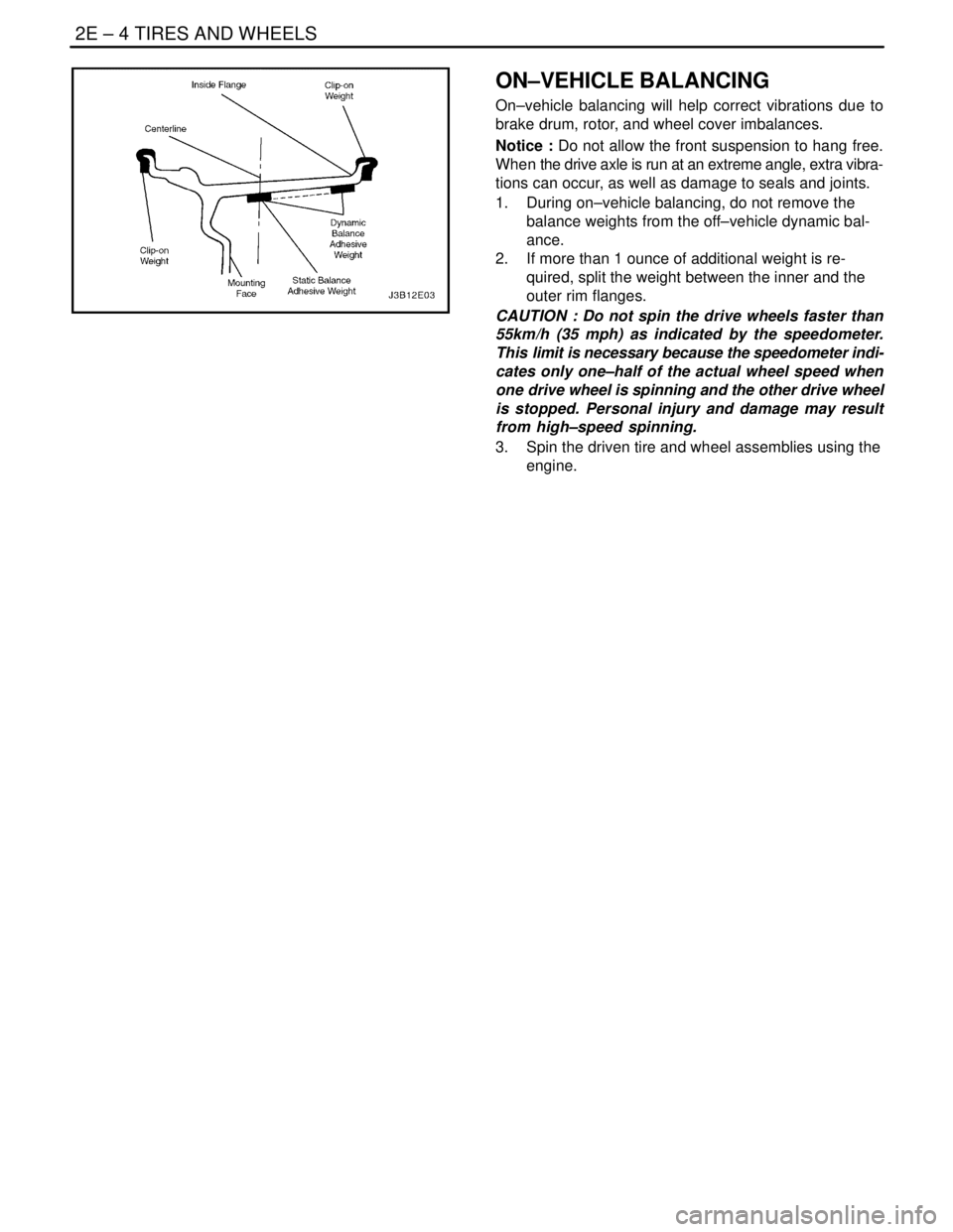
ON–VEHICLE BALANCING
On–vehicle balancing will help correct vibrations due to
brake drum, rotor, and wheel cover imbalances.
Notice : Do not allow the front suspension to hang free.
When the drive axle is run at an extreme angle, extra vibra-
tions can occur, as well as damage to seals and joints.
1. During on–vehicle balancing, do not remove the
balance weights from the off–vehicle dynamic bal-
ance.
2. If more than 1 ounce of additional weight is re-
quired, split the weight between the inner and the
outer rim flanges.
CAUTION : Do not spin the drive wheels faster than
55km/h (35 mph) as indicated by the speedometer.
This limit is necessary because the speedometer indi-
cates only one–half of the actual wheel speed when
one drive wheel is spinning and the other drive wheel
is stopped. Personal injury and damage may result
from high–speed spinning.
3. Spin the driven tire and wheel assemblies using the
engine.