SPI DAEWOO LACETTI 2004 Service Owner's Manual
[x] Cancel search | Manufacturer: DAEWOO, Model Year: 2004, Model line: LACETTI, Model: DAEWOO LACETTI 2004Pages: 2643, PDF Size: 80.54 MB
Page 968 of 2643

2E – 6ITIRES AND WHEELS
DAEWOO V–121 BL4
S Amchem Alodine No. 1001. Stock No. DX50T or
equivalent coating chemical for alloys.
S Ditzler Delclear Acrylic Urethane Clear, Stock No.
DAU–75 or equivalent.
S Ditzler Delthane Ultra–Urethane Additive, Stock No.
DXR–80 or equivalent.
Before repairing the alloy damage or the clear coat dam-
age, prepare the wheels and the tires.
1. Remove the wheel from the vehicle.
2. Mark the location of the outboard weights and re-
move them.
3. Wash the wheel inside and out with a water–based,
all–purpose cleaner. Remove the grease and oil
with a solvent cleaner.
4. Mask the tire prior to painting.
5. Using a 400–grit wet or dry sandpaper, sand over
the painted areas that will not require recoloring.
Sanding will promote the adhesion of the clear coat.
Alloy Damage on Wheel Surface
1. Mount the wheel on a brake lathe and spin the as-
sembly slowly.
2. Sand the wheel with a backing block or pad. Hold
the backing block or pad flat to the surface of the
wheel and sand slowly back and forth from the cen-
ter to the outer edge of the tire to remove the dam-
age. Use the following sandpaper grits in the order
listed:
1) 80 grit.
2) 150 grit.
3) 240 grit.
Clear Coat Damage on Unpainted Wheels
1. Apply the chemical stripper Amchem Alumi Prep
No. 33. Use a small 1/4–inch detail brush to apply
the stripper around the perimeter and spoke–like
areas.
2. Remove the stripper according to the manufactur-
er’s recommendations.
CAUTION : To avoid serious personal injury, do not
use engine power to rotate the wheel while sanding.
3. Sand the wheel with 240–grit sandpaper by rotating
the wheel on a slow–spinning brake lathe or by
mounting the wheel on the car and spinning it by
hand. Sanding restores the machined appearance
and promotes adhesion.
After repairing the alloy or clear coat damage, the wheels
must be recoated.
Page 969 of 2643

TIRES AND WHEELS 2E – 7
DAEWOO V–121 BL4
Recoating Procedure
CAUTION : To avoid serious personal injury when ap-
plying any two–part component paint system, follow
the specific precautions provided by the paint
manufacturer. Failure to follow these precautions
may cause lung irritation and an allergic respiratory
reaction.
1. Clean the surface.
2. Soak the wheel with Amchem Alumi Prep No. 33 or
equivalent for 1 to 3 minutes. Rinse the wheel with
water and blow it dry.
3. Soak the wheel with Amchem Alodine No. 1001 or
equivalent for 1 to 3 minutes. Rinse the wheel with
water and blow it dry.
4. Finish with Ditzler Delclear Urethane and Ditzler
Ultra–Urethane Additive or equivalent, using three
coats.
1st coat – spray on a light mist coat; let dry.
2nd coat – spray or paint on a light coat; let dry.
3rd coat – spray or paint on a heavy double wet
coat; let dry.
5. Let the urethane dry for 24 hours or flash for 30
minutes and force dry at 60°C (140°F) for 30 min-
utes. Allow the urethane to cool for 5 minutes be-
fore mounting the wheel on the vehicle.
OFF–VEHICLE BALANCING
Perform wheel balancing with an electronic off–vehicle ba-
lancer. The balancer is easy to use and gives both a static
and a dynamic balance. Unlike on–vehicle balancing, the
off–vehicle balancer does not correct for drum or rotor im-
balance. This drawback is overcome by its accuracy (usu-
ally to within 1/8 ounce). Secure the wheel on the balancer
with a cone through the back side of the centerhole, not
through the wheel bolt holes.
CORRECTING NON–UNIFORM TIRES
There are two ways to correct properly balanced tires
which still vibrate. One method uses an automatic ma-
chine which loads the tire and buffs small amounts of rub-
ber from high spots on the outer two tread rows. Correction
by this method is usually permanent and, if it is done prop-
erly, does not significantly affect the appearance or the
tread life of the tire. Tire truing with a blade–type machine
is not recommended because it substantially reduces the
tread life and often does not correct the problem perma-
nently.
Another method is to dismount the tire and rotate it 180 de-
grees on the rim. Do this only on the tire and wheel assem-
blies which are known to be causing a vibration because
this method is just as likely to cause good assemblies to
vibrate.
Page 971 of 2643
TIRES AND WHEELS 2E – 9
DAEWOO V–121 BL4
GENERAL DESCRIPTION
AND SYSTEM OPERATION
TIRE AND WHEEL BALANCING
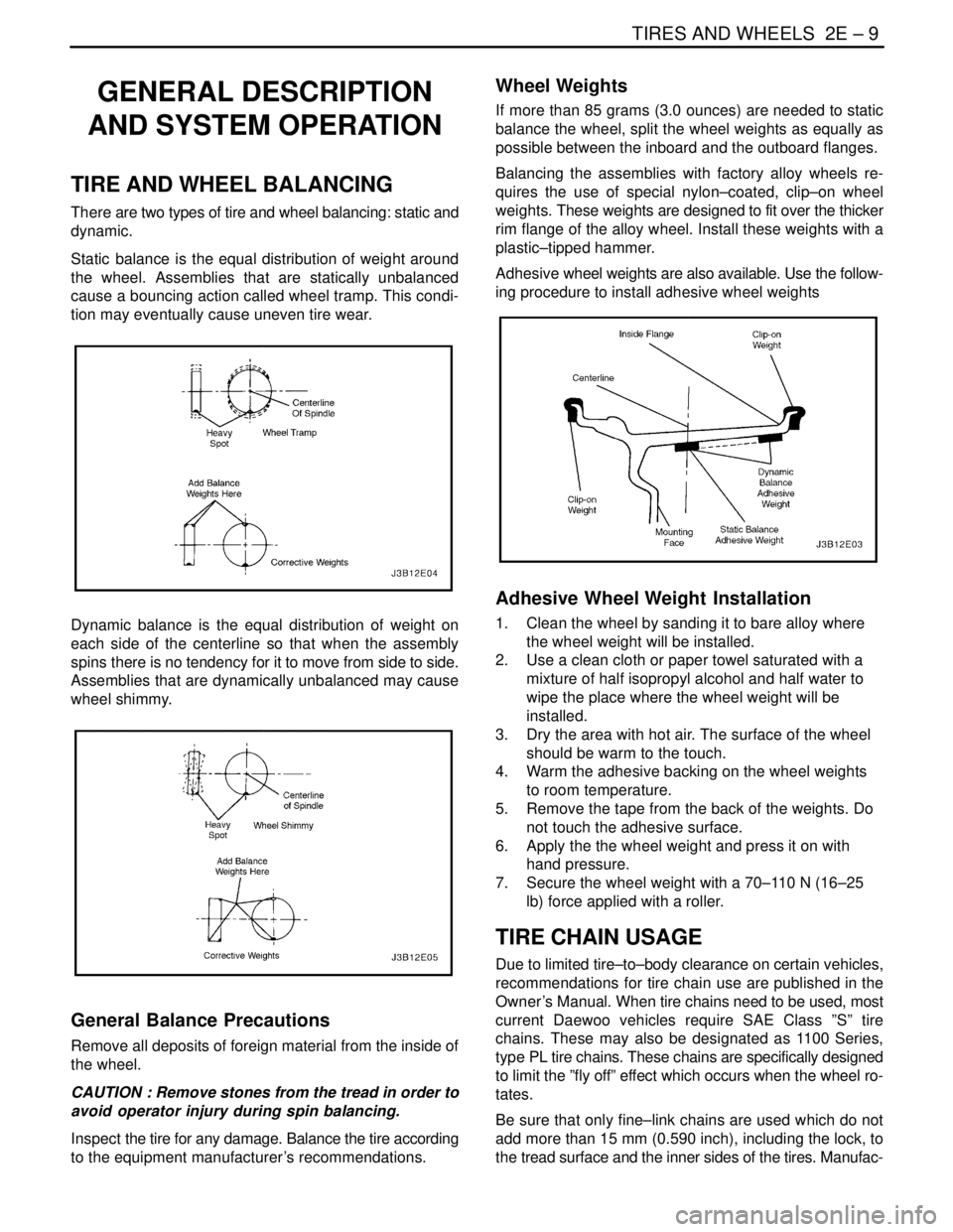
There are two types of tire and wheel balancing: static and
dynamic.
Static balance is the equal distribution of weight around
the wheel. Assemblies that are statically unbalanced
cause a bouncing action called wheel tramp. This condi-
tion may eventually cause uneven tire wear.
Dynamic balance is the equal distribution of weight on
each side of the centerline so that when the assembly
spins there is no tendency for it to move from side to side.
Assemblies that are dynamically unbalanced may cause
wheel shimmy.
General Balance Precautions
Remove all deposits of foreign material from the inside of
the wheel.
CAUTION : Remove stones from the tread in order to
avoid operator injury during spin balancing.
Inspect the tire for any damage. Balance the tire according
to the equipment manufacturer’s recommendations.
Wheel Weights
If more than 85 grams (3.0 ounces) are needed to static
balance the wheel, split the wheel weights as equally as
possible between the inboard and the outboard flanges.
Balancing the assemblies with factory alloy wheels re-
quires the use of special nylon–coated, clip–on wheel
weights. These weights are designed to fit over the thicker
rim flange of the alloy wheel. Install these weights with a
plastic–tipped hammer.
Adhesive wheel weights are also available. Use the follow-
ing procedure to install adhesive wheel weights
Adhesive Wheel Weight Installation
1. Clean the wheel by sanding it to bare alloy where
the wheel weight will be installed.
2. Use a clean cloth or paper towel saturated with a
mixture of half isopropyl alcohol and half water to
wipe the place where the wheel weight will be
installed.
3. Dry the area with hot air. The surface of the wheel
should be warm to the touch.
4. Warm the adhesive backing on the wheel weights
to room temperature.
5. Remove the tape from the back of the weights. Do
not touch the adhesive surface.
6. Apply the the wheel weight and press it on with
hand pressure.
7. Secure the wheel weight with a 70–110 N (16–25
lb) force applied with a roller.
TIRE CHAIN USAGE
Due to limited tire–to–body clearance on certain vehicles,
recommendations for tire chain use are published in the
Owner ’s Manual. When tire chains need to be used, most
current Daewoo vehicles require SAE Class ”S” tire
chains. These may also be designated as 1100 Series,
type PL tire chains. These chains are specifically designed
to limit the ”fly off” effect which occurs when the wheel ro-
tates.
Be sure that only fine–link chains are used which do not
add more than 15 mm (0.590 inch), including the lock, to
the tread surface and the inner sides of the tires. Manufac-
Page 1141 of 2643

4F – 60IANTILOCK BRAKE SYSTEM
DAEWOO V–121 BL4
MAINTENANCE AND REPAIR
ON–VEHICLE SERVICE
SERVICE PRECAUTIONS
CAUTION : Brake fluid may irritate eyes and skin. In
case of contact, take the following actions:
S Eye contact – rinse thoroughly with water.
S Skin contact – wash with soap and water.
S Ingestion – consult a physician immediately.
CAUTION : To help avoid personal injury due to poor
braking, DO NOT tap into the vehicle’s brake system
to operate a trailer brake system.
Notice : When fasteners are removed, always reinstall
them at the same location from which they were removed.
If a fastener needs to be replaced, use the correct part
number fastener for that application. If the correct part
number fastener is not available, a fastener of equal size
and strength (or stronger) may be used. Fasteners that
are not reused, and those requiring thread–locking com-
pound will be called out. The correct torque values must
be used when installing fasteners that require them. If the
above procedures are not followed, parts or system dam-
age could result.
Notice : Use only DOT 3 equivalent hydraulic brake fluid.
The use of DOT 5 (silicone) brake fluid is not recom-
mended. Reduced brake performance or durability may
result.
Notice : Avoid spilling brake fluid on any of the vehicle’s
painted surfaces, wiring, cables, or electrical connectors.
Brake fluid will damage paint and electrical connections.
If any fluid is spilled on the vehicle, flush the area with wa-
ter to lessen the damage.
Computer System Service Precautions
Take care to avoid electronic brake control module
(EBCM) circuit overloading. In testing for opens or shorts,
do not ground or apply voltage to any circuit unless
instructed to do so by the diagnostic procedure. Test cir-
cuits only with a high–impedance multimeter. Never re-
move or apply power to any control module with the igni-
tion switch in the ON position. Always turn the ignition to
the OFF position before removing or connecting battery
cables, fuses, or connectors.
General Service Precautions
S Disconnect the EBCM connector before performing
any vehicle welding work using an electric arc weld-
er.
S Do not attempt to disassemble any component des-
ignated as nonserviceable. The hydraulic modulator
and the EBCM can be separated from each other
and replaced separately but cannot be serviced.
They have no replaceable parts, and there is no
access to the components they contain.
Page 1934 of 2643
POWER STEERING GEAR 6C – 17
DAEWOO V–121 BL4
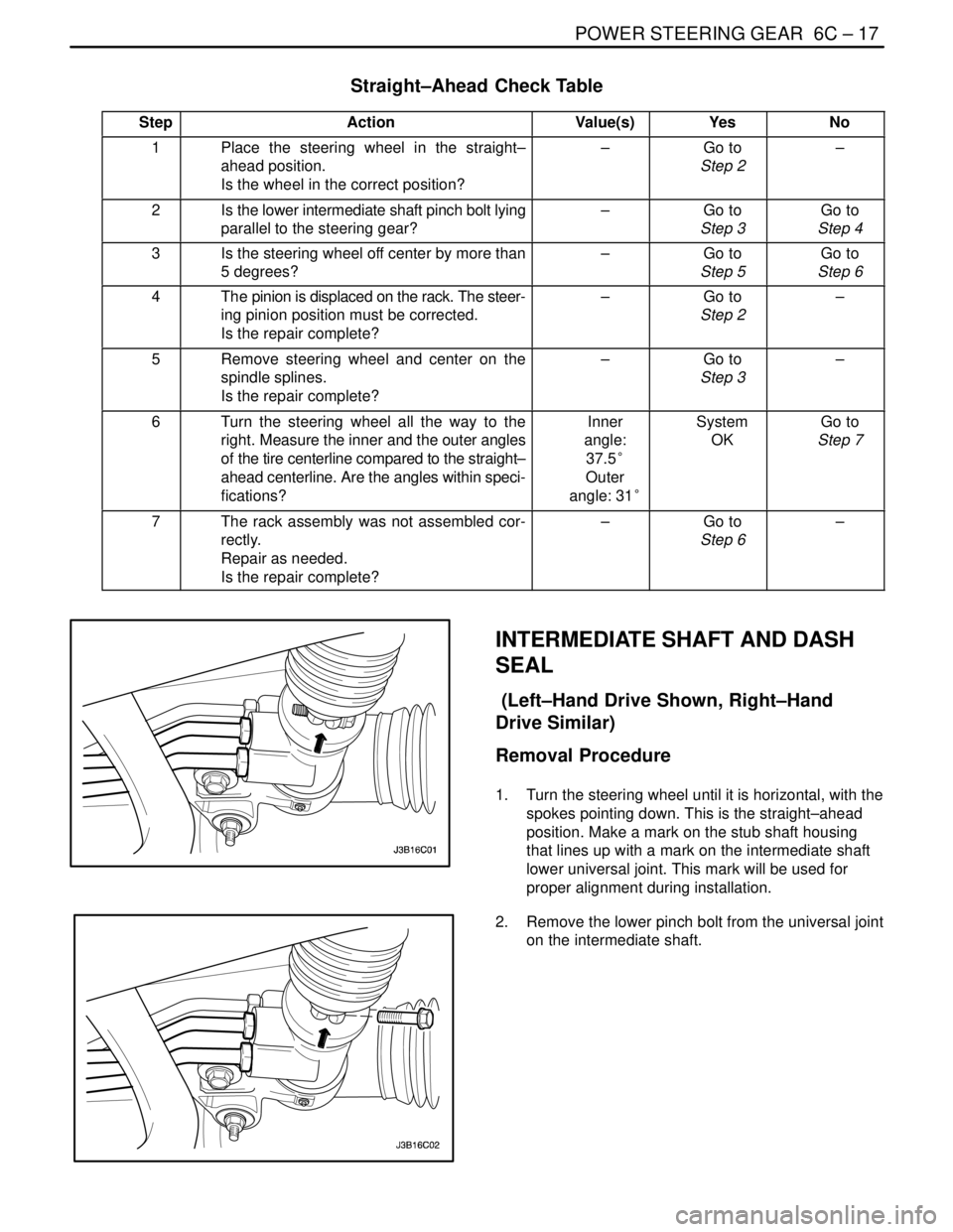
Straight–Ahead Check Table
StepActionValue(s)YesNo
1Place the steering wheel in the straight–
ahead position.
Is the wheel in the correct position?–Go to
Step 2–
2Is the lower intermediate shaft pinch bolt lying
parallel to the steering gear?–Go to
Step 3Go to
Step 4
3Is the steering wheel off center by more than
5 degrees?–Go to
Step 5Go to
Step 6
4The pinion is displaced on the rack. The steer-
ing pinion position must be corrected.
Is the repair complete?–Go to
Step 2–
5Remove steering wheel and center on the
spindle splines.
Is the repair complete?–Go to
Step 3–
6Turn the steering wheel all the way to the
right. Measure the inner and the outer angles
of the tire centerline compared to the straight–
ahead centerline. Are the angles within speci-
fications?Inner
angle:
37.5°
Outer
angle: 31°System
OKGo to
Step 7
7The rack assembly was not assembled cor-
rectly.
Repair as needed.
Is the repair complete?–Go to
Step 6–
INTERMEDIATE SHAFT AND DASH
SEAL
(Left–Hand Drive Shown, Right–Hand
Drive Similar)
Removal Procedure
1. Turn the steering wheel until it is horizontal, with the
spokes pointing down. This is the straight–ahead
position. Make a mark on the stub shaft housing
that lines up with a mark on the intermediate shaft
lower universal joint. This mark will be used for
proper alignment during installation.
2. Remove the lower pinch bolt from the universal joint
on the intermediate shaft.
Page 2041 of 2643
MANUAL CONTROL HEATING, VENTILATION AND AIR CONDITIONING SYSTEM 7B – 39
DAEWOO V–121 BL4
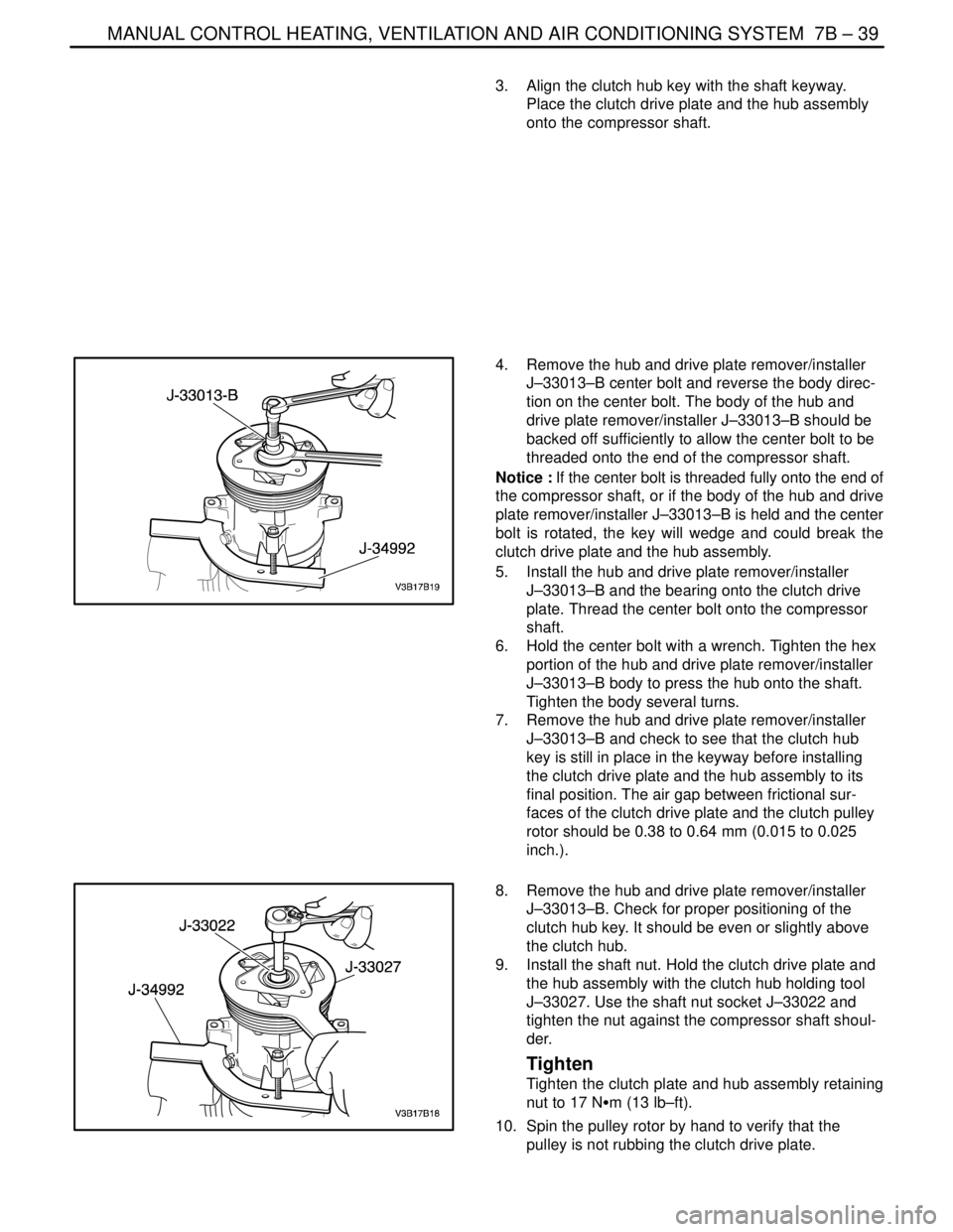
3. Align the clutch hub key with the shaft keyway.
Place the clutch drive plate and the hub assembly
onto the compressor shaft.
4. Remove the hub and drive plate remover/installer
J–33013–B center bolt and reverse the body direc-
tion on the center bolt. The body of the hub and
drive plate remover/installer J–33013–B should be
backed off sufficiently to allow the center bolt to be
threaded onto the end of the compressor shaft.
Notice : If the center bolt is threaded fully onto the end of
the compressor shaft, or if the body of the hub and drive
plate remover/installer J–33013–B is held and the center
bolt is rotated, the key will wedge and could break the
clutch drive plate and the hub assembly.
5. Install the hub and drive plate remover/installer
J–33013–B and the bearing onto the clutch drive
plate. Thread the center bolt onto the compressor
shaft.
6. Hold the center bolt with a wrench. Tighten the hex
portion of the hub and drive plate remover/installer
J–33013–B body to press the hub onto the shaft.
Tighten the body several turns.
7. Remove the hub and drive plate remover/installer
J–33013–B and check to see that the clutch hub
key is still in place in the keyway before installing
the clutch drive plate and the hub assembly to its
final position. The air gap between frictional sur-
faces of the clutch drive plate and the clutch pulley
rotor should be 0.38 to 0.64 mm (0.015 to 0.025
inch.).
8. Remove the hub and drive plate remover/installer
J–33013–B. Check for proper positioning of the
clutch hub key. It should be even or slightly above
the clutch hub.
9. Install the shaft nut. Hold the clutch drive plate and
the hub assembly with the clutch hub holding tool
J–33027. Use the shaft nut socket J–33022 and
tighten the nut against the compressor shaft shoul-
der.
Tighten
Tighten the clutch plate and hub assembly retaining
nut to 17 NSm (13 lb–ft).
10. Spin the pulley rotor by hand to verify that the
pulley is not rubbing the clutch drive plate.
Page 2510 of 2643

1–2 GENERAL INFORMATIONNUBIRA/LACETTI
1. GENERAL INSTRUCTION
This publication is designed to help you the body repair
technician with your specialized work. Vehicle bodywork
has changed a great deal over the years. As vehicles
have developed technically, vehicle bodywork has also
had to meet new requirements with design, changes to
reconcile apparently conflicting demands to name just a
few examples:
S strength and safety ; low weight
S spaciousness ; good aerodynamices
S high quality ; low price
.
The durability and ease of repair of the bodywork also
plays an important part.
.
Nowadays, the use of highly automated production
equipment makes it possible to maintain the tightest
tolerances and thus ensure a high level of quality.
.
When bodywork is damaged, the customer rightly ex-
pects it to be expertly repaired to the same quality stan-
dards.
.
At the same time, for his safety, the customer expects
you to have comprehensive knowledge of materials,
measuring and straightening methods, possible distor-
tion, optimum corrosion prevention and much more be-
sides.
.
This publication is designed to help you update your
knowledge and give you an idea of what you require to
rectify moderate or severe accident damage, for your
own safety and for the satisfaction of your customers.
2. IMPORTANT SAFETY NOTICE
2–1. BEFORE BEGINNING WORK
S Disconnect the battery to reduce the possibility of fire
caused by electrical shorts.
S Check for fuel leaks and repair as necessary.
S Remove the fuel tank and/or fuel lines if welding equip-
ment is to be used near the fuel system.
S Before welding, sanding or cutting, protect carpets and
seats with fire–proof covers.
S Follow standard safety practices when using toxic or
flammable liquids.
S Use standard safety equipment when spraying paint,
welding, cutting, sanding or grinding. Standard safety
equipment includes.
S Respirator and filter masks: Designed to filter out toxic
fumes, mist, dust or other airborn particles. Use a respi-
rator or filter mask designed to protect you from the haz-
ards of the particular job; some respirators, for example,
are designed to filter out only dust and airborn particles,
not toxic fumes.
S Safety goggles or glasses: Designed to protect your
eyes from projectiles, dust particles or splashing liquid.
S Gloves: Rubber gloves protect against corrosive chemi-
cals. Welding gloves protect against burns and abra-
sions caused by welding, sanding or grinding.
S Safety shoes: Non–slip soles protect against slipping.
Metal toe inserts protect against falling objects.
S Ear plugs: Protect eardrums from harmful noise levels.
.
2–2. DURING WORK
S Do not smoke while working near the fuel system.
S Deposit gas or solvent–soaked shop towels in an ap-
proved container.
S Brake lining contains asbestos, which can cause cancer.
Do not use an air hose to blow off brake assemblies: use
only an approved vacuum cleaner, and wear an ap-
proved filter mask or respirator.
S Always attach a safety cable when using a hydraulic ram
or a frame straightening table: do not stand in direct line
with the chains used on such equipment.
Page 2511 of 2643
NUBIRA/LACETTIGENERAL INFORMATION 1–3
3. BODY SAFETY
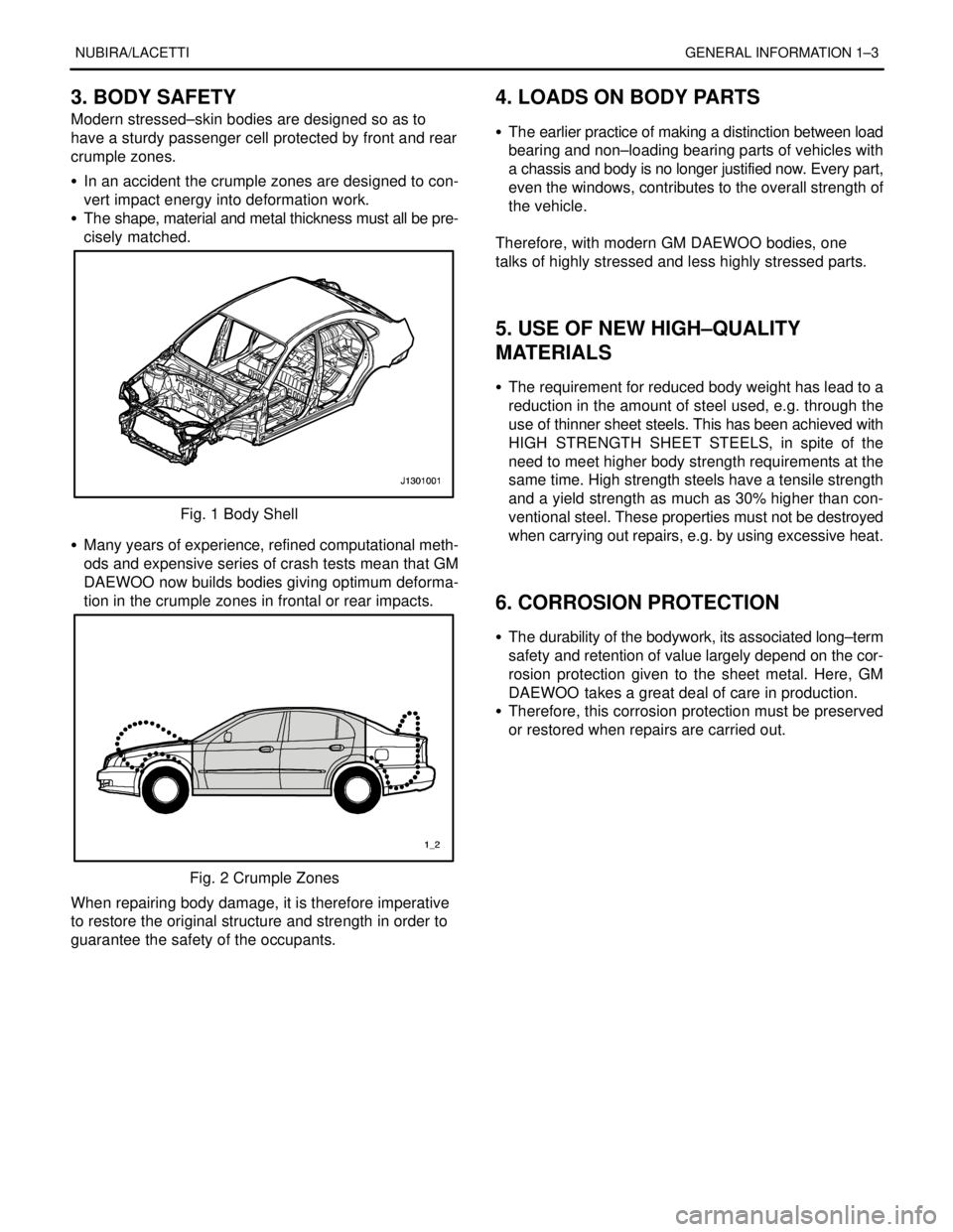
Modern stressed–skin bodies are designed so as to
have a sturdy passenger cell protected by front and rear
crumple zones.
S In an accident the crumple zones are designed to con-
vert impact energy into deformation work.
S The shape, material and metal thickness must all be pre-
cisely matched.
Fig. 1 Body Shell
S Many years of experience, refined computational meth-
ods and expensive series of crash tests mean that GM
DAEWOO now builds bodies giving optimum deforma-
tion in the crumple zones in frontal or rear impacts.
Fig. 2 Crumple Zones
When repairing body damage, it is therefore imperative
to restore the original structure and strength in order to
guarantee the safety of the occupants.
4. LOADS ON BODY PARTS
S The earlier practice of making a distinction between load
bearing and non–loading bearing parts of vehicles with
a chassis and body is no longer justified now. Every part,
even the windows, contributes to the overall strength of
the vehicle.
.
Therefore, with modern GM DAEWOO bodies, one
talks of highly stressed and less highly stressed parts.
.
.
5. USE OF NEW HIGH–QUALITY
MATERIALS
S The requirement for reduced body weight has lead to a
reduction in the amount of steel used, e.g. through the
use of thinner sheet steels. This has been achieved with
HIGH STRENGTH SHEET STEELS, in spite of the
need to meet higher body strength requirements at the
same time. High strength steels have a tensile strength
and a yield strength as much as 30% higher than con-
ventional steel. These properties must not be destroyed
when carrying out repairs, e.g. by using excessive heat.
.
.
6. CORROSION PROTECTION
S The durability of the bodywork, its associated long–term
safety and retention of value largely depend on the cor-
rosion protection given to the sheet metal. Here, GM
DAEWOO takes a great deal of care in production.
S Therefore, this corrosion protection must be preserved
or restored when repairs are carried out.
Page 2538 of 2643
4–4 FRONTNUBIRA/LACETTI
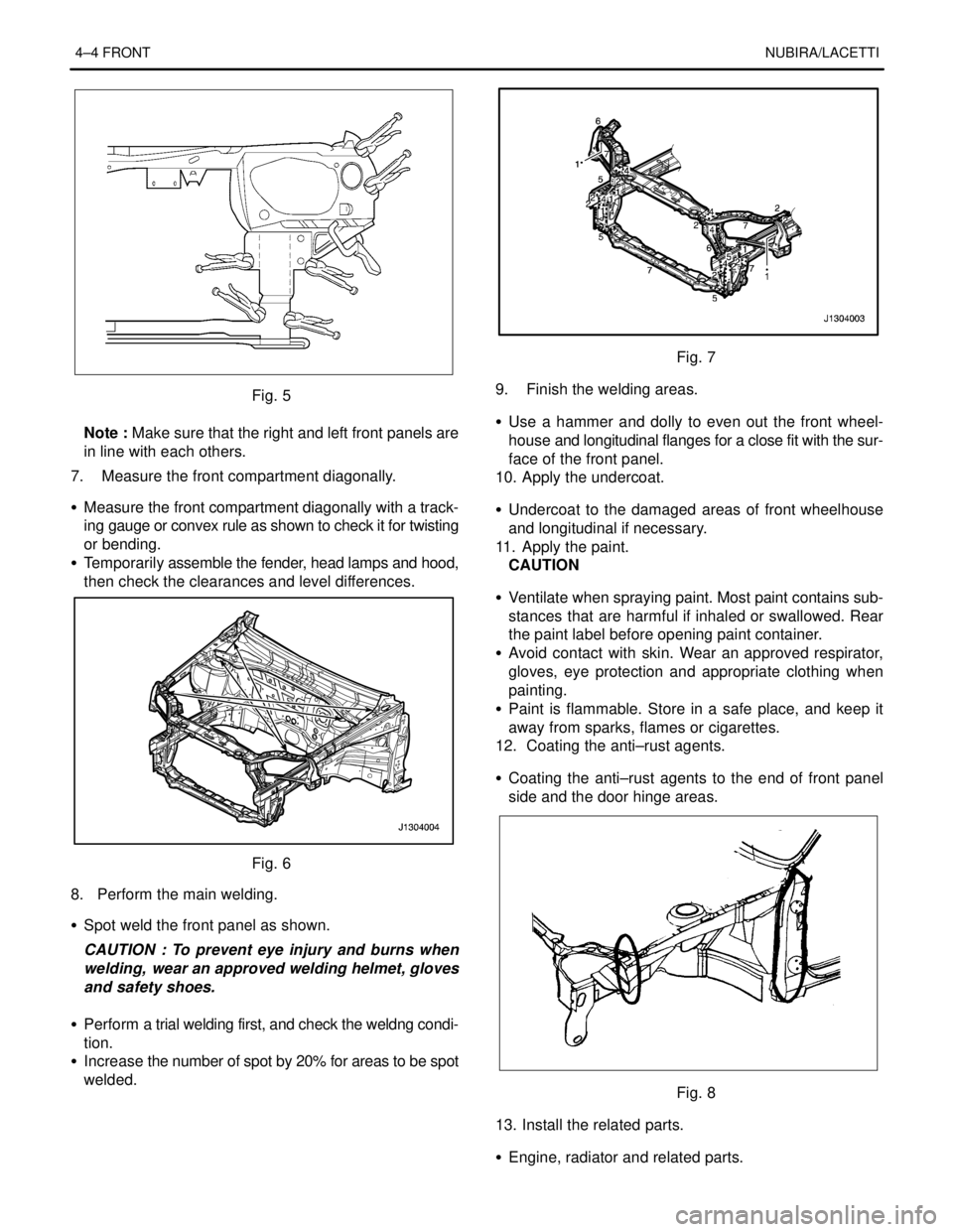
Fig. 5
Note : Make sure that the right and left front panels are
in line with each others.
7. Measure the front compartment diagonally.
S Measure the front compartment diagonally with a track-
ing gauge or convex rule as shown to check it for twisting
or bending.
S Temporarily assemble the fender, head lamps and hood,
then check the clearances and level differences.
Fig. 6
8. Perform the main welding.
S Spot weld the front panel as shown.
CAUTION : To prevent eye injury and burns when
welding, wear an approved welding helmet, gloves
and safety shoes.
S Perform a trial welding first, and check the weldng condi-
tion.
S Increase the number of spot by 20% for areas to be spot
welded.
Fig. 7
9. Finish the welding areas.
S Use a hammer and dolly to even out the front wheel-
house and longitudinal flanges for a close fit with the sur-
face of the front panel.
10. Apply the undercoat.
S Undercoat to the damaged areas of front wheelhouse
and longitudinal if necessary.
11. Apply the paint.
CAUTION
S Ventilate when spraying paint. Most paint contains sub-
stances that are harmful if inhaled or swallowed. Rear
the paint label before opening paint container.
S Avoid contact with skin. Wear an approved respirator,
gloves, eye protection and appropriate clothing when
painting.
S Paint is flammable. Store in a safe place, and keep it
away from sparks, flames or cigarettes.
12. Coating the anti–rust agents.
S Coating the anti–rust agents to the end of front panel
side and the door hinge areas.
Fig. 8
13. Install the related parts.
S Engine, radiator and related parts.
Page 2543 of 2643
NUBIRA/LACETTIFRONT 4–9
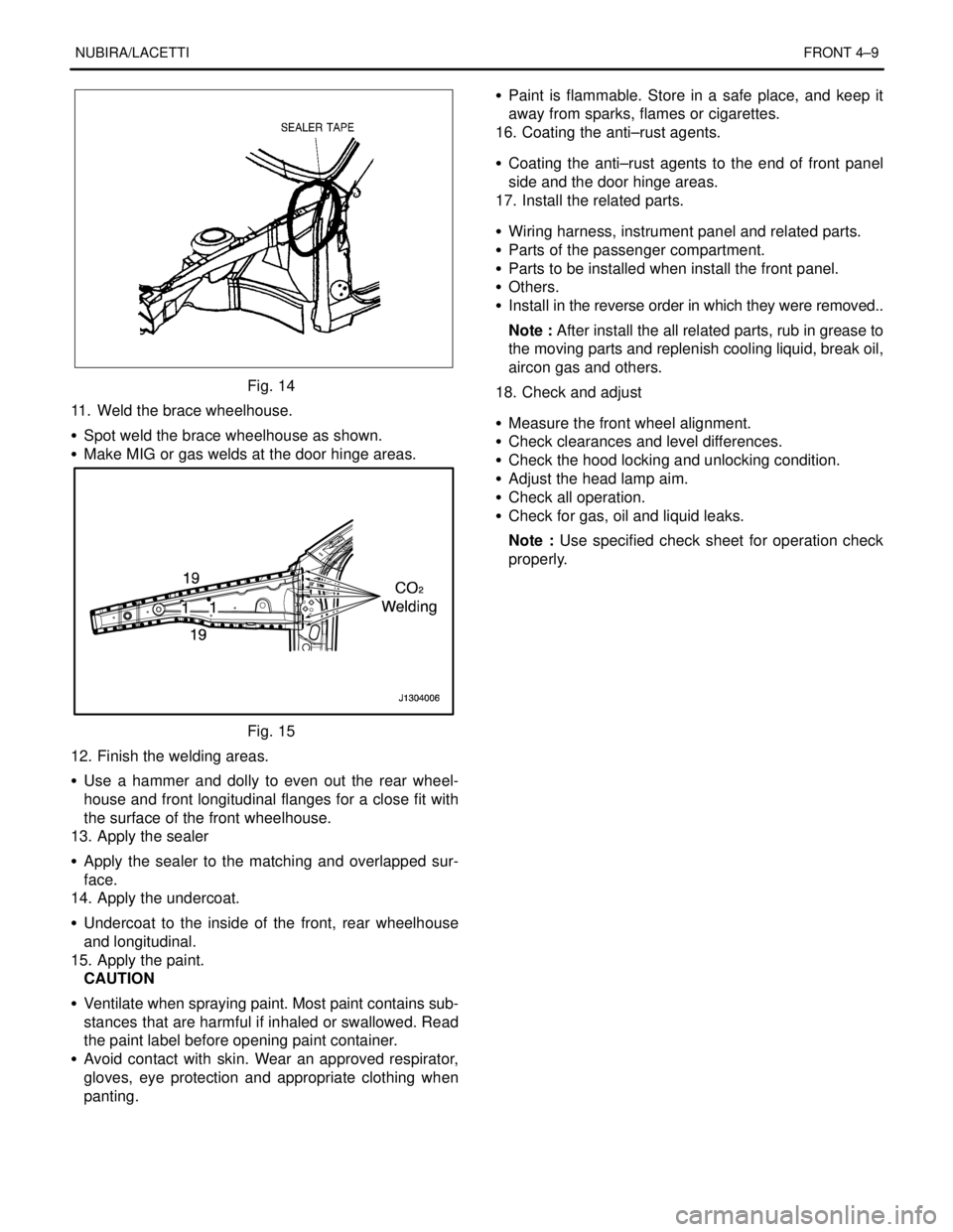
Fig. 14
11. Weld the brace wheelhouse.
S Spot weld the brace wheelhouse as shown.
S Make MIG or gas welds at the door hinge areas.
Fig. 15
12. Finish the welding areas.
S Use a hammer and dolly to even out the rear wheel-
house and front longitudinal flanges for a close fit with
the surface of the front wheelhouse.
13. Apply the sealer
S Apply the sealer to the matching and overlapped sur-
face.
14. Apply the undercoat.
S Undercoat to the inside of the front, rear wheelhouse
and longitudinal.
15. Apply the paint.
CAUTION
S Ventilate when spraying paint. Most paint contains sub-
stances that are harmful if inhaled or swallowed. Read
the paint label before opening paint container.
S Avoid contact with skin. Wear an approved respirator,
gloves, eye protection and appropriate clothing when
panting.S Paint is flammable. Store in a safe place, and keep it
away from sparks, flames or cigarettes.
16. Coating the anti–rust agents.
S Coating the anti–rust agents to the end of front panel
side and the door hinge areas.
17. Install the related parts.
S Wiring harness, instrument panel and related parts.
S Parts of the passenger compartment.
S Parts to be installed when install the front panel.
S Others.
S Install in the reverse order in which they were removed..
Note : After install the all related parts, rub in grease to
the moving parts and replenish cooling liquid, break oil,
aircon gas and others.
18. Check and adjust
S Measure the front wheel alignment.
S Check clearances and level differences.
S Check the hood locking and unlocking condition.
S Adjust the head lamp aim.
S Check all operation.
S Check for gas, oil and liquid leaks.
Note : Use specified check sheet for operation check
properly.